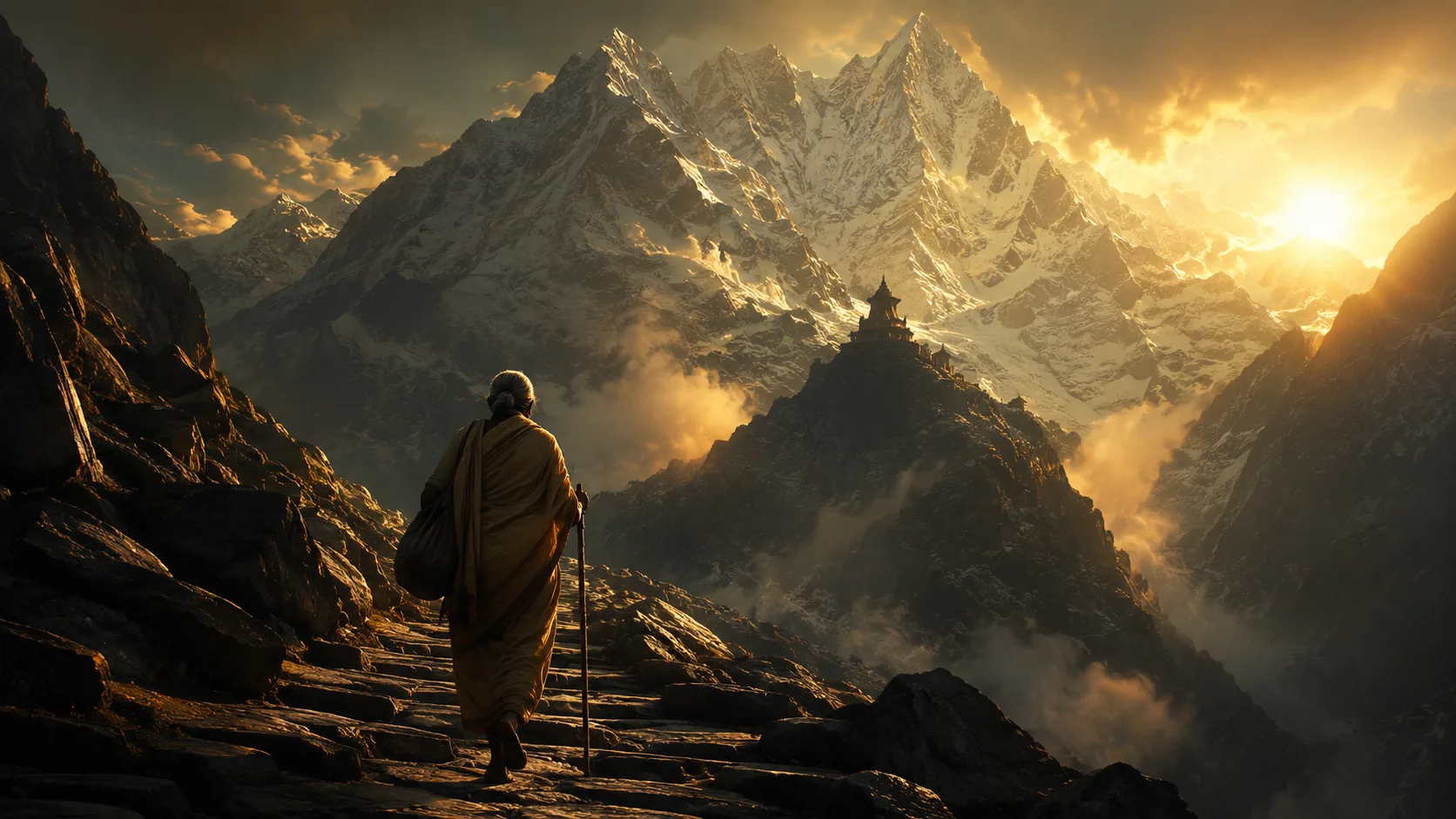
A Grandmother Climbs to Kedāra
A hundred years ago, an old woman from the South — perhaps your great-grandmother, perhaps mine — tied her few belongings into a cloth bundle, took the name of her iṣṭadevatā on her lips, and set out for Kedāranātha.
Understand what that meant in those days, because the modern mind has forgotten how to be astonished by it. There were no roads worth the name. No helicopters lifting pilgrims over the Garhwal ridgelines. No guesthouses with hot water, no rescue teams, no telephone to call home. The last stretch to Kedāra was a brutal climb through thinning air, past glaciers and landslides, along paths cut into the flank of the mountain where a single misstep ended a life with no witness and no grave. The journey from a village in the Tamil country or the Telugu country to the high Himālaya could take the better part of a year on foot and on bullock-cart, through forests thick with fever, across rivers without bridges, among people whose language was a wall of pure sound. Many who set out did not return. Everyone who set out knew that. They wrote their wills, in effect, before they left. They said goodbye like people saying goodbye for the last time, because often it was.
And still they went. Generation after generation, from every corner of the subcontinent, they went. Not because any king commanded it. Not because any law required it. Not for a holiday, not for a photograph, not for a story to tell. They went because a Sanātanī's life was felt to be incomplete without it — because the Cārdhāma, the Kāśī-yātrā, the darśana of the great tīrthas was not tourism but dharma, a duty woven so deep into the bones that the frail body would undertake what cold reason called madness, and undertake it gladly, and count the danger a price worth paying for the merit.
Stop and sit with what that woman actually did. She had never left her district in her life. She spoke a language that became unintelligible four hundred miles in any direction and utterly foreign eight hundred miles to the north. She had no map. She had no protection. She could not read the signboards, if there were any, and there were none. And she walked, an old woman, into the highest mountains on the face of the earth — and she knew, with total certainty, exactly where she was going, exactly what she would do when she arrived, and exactly why it was the most important thing she would ever do. The Himālayan priest who finally received her at the shrine spoke a different tongue, ate different food, wore different cloth, worshipped under customs that differed in a hundred small ways from her own. And yet when she climbed the last steps and stood before the liṅga at Kedāra, she was not a foreigner in a strange land. She was home. The same Śiva she had bathed and dressed and fed every dawn of her life in a small shrine-room two thousand miles to the south was waiting for her here, in the ice, at the roof of the world. She had come all this way to meet someone she had known her whole life.
This is the thing that ought to stop us cold, and somehow, through familiarity, no longer does. How is it that a land this vast, this divided, this multiplied into a hundred kingdoms and a thousand tongues, is so completely, so stubbornly, so unmistakably one? How does a continent of strangers turn out, the moment you look beneath the surface, to be a single family that has simply forgotten it was ever apart?
That question is the whole question. Answer it honestly and you understand Bhārata. Refuse to ask it, and you will spend a lifetime miscounting kingdoms and missing the country entirely.
A New Language Every Two Hundred Miles
The cliché is true, and the cliché conceals everything that matters.
Travel across Bhārata and the spoken language shifts roughly every two hundred miles — sometimes the script shifts with it, sometimes the entire grammatical family. Tamil and Kashmiri sit as far apart on the tree of languages as Portuguese sits from Russian. A Bengali and a Kannadiga, set down in a room with no third language between them, cannot exchange a single sentence. The food changes, the dress changes, the music changes, the architecture changes, the festivals acquire new names and new local flavours, and even the shape of the human face changes as you move from the deep South to the far Northwest. By every instrument that European political science was built to recognize — one common language, one common ethnicity, one contiguous administration under one sovereign — Bhārata should not be a nation at all. It should be a dozen nations, or fifty, the way Europe is.
And here is the trap, the great optical illusion that has fooled every conqueror who ever set covetous eyes on this land. The men who came to rule India — the Sultanate amīrs, the Mughal emperors, the Portuguese, the Dutch, the French, the British — all looked at this dazzling surface and drew, every one of them, the same comforting conclusion: there is no India here to conquer. There is only a geographical expression, a quarrelsome patchwork of rival princes, a subcontinent that imagines itself one out of mere vanity. And a thing that does not really exist cannot really resist you. A thing that is merely a name on a map can be partitioned, played against itself, and ruled forever, because it has no centre to defend and no soul to rouse.
They were looking, all of them, at the wrong layer of the thing. They mistook the skin for the body.
Because beneath the babel of languages ran a structure of unity so deep and so precise that the conquerors had no instrument capable of measuring it — indeed, no concept by which even to imagine it. The Brahmin in a Kerala village chanting the Ṛgveda and the Brahmin in a Kashmir village chanting the Ṛgveda were reciting the very same hymns, in the very same metres, on the very same svaras, preserved across thousands of miles and thousands of years with a fidelity so exact that when modern European philologists finally collated the recensions they could scarcely believe what their own science was telling them — that an oral text had travelled the length of a subcontinent and ridden down a hundred generations without corrupting. A bride in Bengal and a bride in Gujarat both circled the same fire, both bound by the same Saptapadī, the seven steps, both invoking the same Agni as the witness who would hold their marriage true. A dying man in Maharashtra and a dying man in Assam both longed, with their last strength, for the same few drops of Gaṅgā water on the tongue. The language of the prayer differed from region to region; the prayer itself was one prayer.
That is not what a country is. A country is a smaller and a shallower thing — an arrangement of borders and bureaucracies that can be drawn and redrawn by treaties. What Bhārata possessed was something far older and far harder to kill: a civilization. And a civilization is held together not by administration but by a shared and inherited idea of what it means to live rightly, to die well, to owe a debt to one's ancestors, and to belong to something immeasurably older and larger than oneself. No army can sack that. No treaty can partition it. It does not sit on a throne where a conqueror can reach it. It sits in the practice of a hundred crore lives, and to destroy it you would have to destroy them, one by one, and even then their children carry it out of the ashes.
The Cārdhāma: A Compass Laid Over a Continent
Look at what one man did in a single short life, and the whole architecture of this unity stands revealed in a stroke.
Ādi Śaṅkara was born in Kālaḍi, in the deep South of Kerala, in an age when the Buddhist and the materialist had between them nearly buried the living Vedānta. He lived, by the tradition's reckoning, barely thirty-two years. And in that span he did something that no emperor with an army at his back has ever matched. He walked — walked — the entire length and breadth of Bhārata, from the southern tip to the Himālayan north, from the western sea to the eastern, debating the finest minds of every school in their own idiom, restoring the Vedānta to its commanding height, and binding the whole of the land into a single field of dharma by the sheer pressure of his presence and his argument.
And he did not stop at teaching. With the cold precision of a surveyor planting boundary-stones to fix the edges of an estate, he established four maṭhas at the four corners of the subcontinent. Śṛṅgeri in the South. Dvārakā in the West. Purī in the East. Jyotirmaṭha, at Badarī, in the high North. Four directions, four seats, one Vedānta, one unbroken transmission of teacher to disciple that has carried on, seat by seat, for more than a thousand years and carries on still today. He took a continent and he organized its spiritual sovereignty into a single coherent body, with four pillars set deliberately at the four ends of the land so that no direction would lack its anchor and no region would fall outside the whole.
The Cārdhāma proper — Badarīnātha in the North, Dvārakā in the West, Purī in the East, Rāmeśvaram in the far South — is a compass laid bodily across the entire subcontinent, and the needle of that compass is dharma. To complete the Cārdhāma is to inscribe the unity of Bhārata onto your own two feet. It is to touch the snow of the Himālaya in the North and wade into the southern sea at Rāmeśvaram in the South; to stand before Jagannātha where the sun rises over the eastern ocean and before Kṛṣṇa's Dvārakā where it sets into the western; and to understand, not as an idea in the head but as an ache in the legs and a memory in the muscle, that all four are one land, one sacred geography, one indivisible civilization. The pilgrim who completes it has, with his own body, sewn the four corners of Bhārata together.
Now grasp how staggering this is as an act of nation-binding — except that it predates the very concept of the "nation" by thousands of years and accomplishes the work more thoroughly than any nation in history has ever managed. There was no central state ordering the pilgrims north and south. There was no ministry of integration, no compulsory schooling drilling into children that they were one people, no flag, no anthem, no propaganda. There was only dharma. And dharma alone — with no enforcement but the conscience of the believer — sent the Tamil grandmother to Kedāra and the Bengali widow to Rāmeśvaram and the Gujarati merchant to Purī and the Maithili scholar to Dvārakā, century upon century upon century, until the map carried in the pilgrim's heart and the map of the actual land became, in every Sanātanī breast, one and the same map. The state never had to impose the unity. The pilgrims wove it, with their feet, from below.
The Sacred Body of the Land
And the Cārdhāma is only one axis of a sacred geometry that covers the whole subcontinent like a net of light.
Consider the Dvādaśa Jyotirliṅgas — the twelve shrines where Śiva is held to have manifested as a pillar of pure light. String them on a map and watch what they do. Kedāranātha in the icebound North. Somanātha on the western coast of Saurāṣṭra, sacked and rebuilt more times than any other shrine on earth and standing yet. Mahākāleśvara at Ujjain in the centre. Viśvanātha at Kāśī on the Gaṅgā. Vaidyanātha in the East. Rāmeśvaram and Mallikārjuna in the South. Bhīmaśaṅkara and Tryambakeśvara and Grīṣṇeśvara in the West. Twelve points, scattered with what looks like the deliberation of a single mind across every region of the land, so that Śiva himself is strung from the Himālayan snows to the southern sea, and no son of this soil lives more than a few hundred miles from a place where the Lord stood up in light. To worship the Jyotirliṅgas is, again, to traverse and to bind the whole of Bhārata.
Consider the Sapta Purī, the seven cities of liberation — Ayodhyā, Mathurā, Māyā (which is Haridvāra), Kāśī, Kāñcī, Avantikā (which is Ujjain), and Dvārakā. Seven holy cities, flung deliberately across the North, the South, the West, the centre, each one a place where the dust of the streets is said to loosen the knots of karma, each one drawing pilgrims from regions whose languages the local priests could not understand. A man might be born in Kāñcī in the Tamil South and aspire all his life to Ayodhyā in the Hindi North, and feel, rightly, that both cities were equally his inheritance, equally his home.
And consider, most astonishing of all, the Śakti Pīṭhas — the one-and-fifty seats where, in the tradition, the severed limbs and ornaments of the Devī fell to earth as Śiva carried her body across the sky in his grief. Map them. They scatter the body of the Goddess across the entire breadth of Bhārata and spill beyond its present borders — Hiṅgalāja in the far west, in what is now called Baluchistan; Kāmākhyā in the far east in Assam, where the Yoni of the Goddess is worshipped; Jvālāmukhī in the Himālayan foothills where a natural flame burns from the rock; pīṭhas in Bengal and Bihar and Odisha and the South and Nepal and Sri Lanka and Tibet. The meaning is breathtaking and it is unmistakable: the land itself is the body of the Devī. Every region of Bhārata is a limb of one living Goddess. The geography is not a backdrop on which the religion happens; the geography is the religion, the soil itself sacralized into a single divine form, so that to walk the land is to move across the body of the Mother.
This is the structure the conquerors could not see, because they had no eyes built to see it. They saw a map of kingdoms. They were standing, the whole time, on the body of a Goddess, and never knew it.
And over all of it run the rivers. The Gaṅgā above all — the river that fell from heaven, the river that purifies the living and carries the dead, the river toward which a hundred crore people across forty languages turn the same longing. But not the Gaṅgā alone: the Yamunā, the Sarasvatī of memory, the Narmadā whose very sight is said to liberate, the Kāverī that the South calls its own Gaṅgā, the Godāvarī, the Sindhu that gave the land one of its names. In the daily saṅkalpa, before any rite, the Sanātanī invokes the sacred rivers and the sacred mountains and locates himself precisely within Jambūdvīpa, within Bhārata-varṣa, within this exact cosmography — so that a man performing a simple pūjā in a village hut in Kerala situates himself, by name, within the same sacred map as a man performing the same pūjā in a village hut in Kashmir. They are not two men in two countries. They are two points on one body, reciting the same coordinates.
Kāśī: The City Every Sanātanī Carries
And at the heart of that body, on the curve of the Gaṅgā, there is Kāśī.
Ask a Sanātanī from anywhere — a Tamil from Madurai, a Maithili from Darbhanga, a Marathi from Pune, a Malayali from Thrissur, an Assamese from the Brahmaputra valley — to name the most sacred city, the single place a Sanātanī must see before he dies, the city where to die is itself said to be liberation. The answer returns identical from every direction, across every wall of language: Kāśī.
Not the temple of their own region. Not the city nearest to their home. Kāśī — Vārāṇasī, Avimukta, the eternal city on the Gaṅgā, the city of Viśvanātha, the city older than legend and older than most of the kingdoms that ever rose and fell around it, the city where, the tradition holds, Śiva himself bends to whisper the tāraka-mantra into the ear of the dying so that they cross the final water in peace. A Sanātanī might live the whole of his life two thousand miles away from it. He might never once speak a word of the language they speak on the ghāts. And still Kāśī is his city, the destination of a lifetime's saving and aspiration, the place he prays his ashes will reach even if his living feet never do.
Reflect on what it means that a hundred crore people, separated by every barrier that can separate human beings — language, dynasty, distance, custom, caste, the sheer scale of a subcontinent — all turn their faces toward the same city on the same river. It means that underneath the ever-shifting political map of princely states and sultanates and provinces and colonial presidencies, there ran always a single sacred geography that every one of them carried, intact, inside the chest. The kingdoms warred. The languages diverged past the point of mutual sound. But Kāśī was Kāśī to all of them, and the Gaṅgā was the mother of all of them, and that shared interior map was more real, more durable, and more binding than any throne that ever sat in Delhi or Vijayanagara or anywhere else.
And here is the iron lesson the conquerors learned and never understood. You cannot conquer a city that lives inside a hundred crore hearts. You can burn its temple — and they burned the Viśvanātha temple at Kāśī, again, and again, and again, razed it and built over it and razed what was rebuilt — and the city does not die. It does not even flinch. Because the city was never only made of stone. The stone was the least of it. Kāśī lived in the longing of the Tamil grandmother and the Bengali widow and the Marathi pilgrim, and that longing no army on earth could reach, because it had no walls to breach and no garrison to starve. They held the rubble; they never touched the city.
The Same Pūjā in the North, the South, the East, the West
Walk into a Sanātana home at dawn, anywhere across this civilization, and watch what unfolds — and then walk into another, two thousand miles away, and watch the same thing unfold.
A lamp is lit. A bell is rung. Water is offered, and unbroken rice, and flowers, and a flame is circled before the mūrti in the slow gesture of ārati. Incense climbs. The Gāyatrī is murmured — the same Gāyatrī, the same twenty-four syllables, the same metre, the same Sun invoked to illumine the intellect — whether the lips that shape it are in Tamil Nadu or Uttar Pradesh, in Gujarat or Assam, and have been for three thousand years and more. The names of the lunar months follow the same reckoning across the land. The great festivals fall on the same tithis: when the South kindles its lamps for Dīpāvalī, the North kindles them in the same dark fortnight of the same month; when Bengal raises the Devī in the autumn Durgā Pūjā, Mysore raises her too in its own imperial Daśarā; the whole subcontinent counts the same twenty-seven nakṣatras, keeps the fast of the same Ekādaśīs, marks the sun's turning at the same Makara Saṅkrānti under a dozen regional names — Poṅgal, Lohri, Bihu, Saṅkrānti — that are, underneath, one single festival of the returning light.
The śrāddha that a son performs for his departed father in a Kerala courtyard and the śrāddha that a son performs in a Bihar courtyard invoke the same ancestors by the same formulae, offer the same piṇḍa, and rest on the same unshaken conviction — that the lineage runs unbroken into the deep past, that the dead are not gone but owed, and that the living son is the bridge across which the debt is paid. The Brahmin's twice-daily sandhyāvandana, the bride's seven steps around the fire, the sacred thread laid across the boy's shoulder at his upanayana, the first tonsure of the infant, the sixteen saṃskāras that mark a Sanātanī life from the womb to the cremation-ground — these are not regional customs that merely happen to resemble one another by coincidence. They are one ritual grammar, spoken in many regional accents, descended from one Vedic source, binding the entire civilization into a single liturgical body that performs, in ten thousand mutually unintelligible villages, the very same acts in the very same order for the very same reasons.
How can this possibly hold, across a land with no central church, no Vatican, no enforcing pope, no single sovereign with the power to standardize a rite from the capital? It holds because the Veda was never the property of any state, and so no state's collapse could carry it down. It was carried instead in the breath and the memory of Brahmins who committed it to heart syllable by syllable, with the elaborate redundancies of pāṭha — the word recited forward, backward, woven, braided — a mnemonic engineering so ferociously precise that it was designed to make corruption mathematically detectable and therefore impossible to pass on unnoticed. The text was built to survive the death of every library and every kingdom, because it was stored in the one place a conqueror cannot sack: living human memory, refreshed every dawn in a thousand thousand mouths. Empires rose and fell above it like weather. The Veda did not fall, because the Veda had no walls to be thrown down.
The Faith That Lives Even in the Unbeliever
Here is the strangest and most telling proof of how deep this current runs.
Even the Sanātanī who calls himself an unbeliever believes. The man who argues cleverly against ritual at the dinner table still feels something rise unbidden in his chest at the first sight of the Gaṅgā. He still cannot quite bring himself to set his foot upon a sacred book, or to speak with contempt of his mother's gods. He still wants, when the hour comes, his father's last rites performed correctly, in the old way, every syllable in its place — and he is troubled, in a way he cannot fully explain to himself, by the thought of getting them wrong. He still feels the pull of Kāśī even as his mouth, in company, denies that any of it means anything. The doubt sits on the surface, articulate and proud. Underneath, in the blood, the older knowing waits, patient, unbothered, certain it will have the last word.
This is not credulity and it is not weakness of mind. It is the signature of a civilization that has shaped its people so thoroughly, over so many thousands of years, that its deepest convictions have sunk below the level of opinion and become something nearer to instinct — carried not in the arguing mind but in the marrow. The Vedānta did not need to be consciously affirmed to be inherited. The Rāmāyaṇa and the Mahābhārata were never learned from a schoolroom text; they were absorbed in childhood from grandmothers at the lamp-lit hour, from the painted walls of temples, from the all-night performances in the village square, from the songs sung at every wedding and every death, until every Sanātanī simply knew the story of Rāma and the story of the Pāṇḍavas the way one knows the floor-plan of the house one was born in — without ever remembering having learned it. Bhārata's epics are not its literature, to be picked up or set down. They are its memory, and a people cannot put down its own memory.
And this is precisely why a civilization is so much harder to kill than a kingdom. An army you can defeat in a single afternoon. A king you can depose, a treasury you can seize, a capital you can rename and a fort you can garrison. But you cannot march into the bloodstream of a hundred crore people and pull out the Gāyatrī. You cannot order a grandmother to forget Rāma. You cannot legislate the longing for the Gaṅgā out of a dying man's heart. The conquerors held the forts and the revenue rolls and the thrones — they held, that is, everything that sat on the surface — and the civilization went on performing its dharma underneath them, in the courtyards and the kitchens and the cremation-grounds, year after year, century after century, as untouched in its essence as bedrock beneath a passing storm. The rulers above were weather. The dharma below was the rock the weather broke upon.
What the Conquerors Could Not See
When the first Arab armies crossed into Sindh in the early eighth century, and when Maḥmūd came down seventeen times from Ghazni to plunder and to smash the temples of the North, and when the Ghūrids fixed the Sultanate upon Delhi, and when the Mughals after them spread their dominion across the Indo-Gangetic plain — each of them saw, on the surface, exactly what he hoped and expected to see. A land of many kings and no single sovereign. No unified command to break, because there was no unity to begin with. Easy, surely, to set one rāja against another, to buy this one and crush that one, to rule the whole by dividing it — and easy, above all, to believe that there was no India there to be conquered in the first place, only a loose scatter of Indians who happened to share a subcontinent.
And when the Portuguese seized Goa, and the Dutch and the French built their fortified factories, and the British at last spread their company's rule across the whole, they too read the same comforting surface, and they said their conclusion aloud, openly and often, and built an empire's whole moral justification upon it: India is not a nation. India is merely a geographical expression. There has never in history been one India — and we, the British, are the very first power ever to unify it. We have given this land the gift of a oneness it could never give itself.
It was a lie, and like the most dangerous lies it was a lie that flattered the man who told it. Bhārata had been one for three thousand years and more before a single Englishman set foot upon its shores. One — not always in the manner of a single centralized empire, though it was that too, gloriously, under a Candragupta Maurya whose writ ran from the Hindu Kush to the eastern sea, under Aśoka, under the Guptas in their golden age, under the Cōḷas who carried Bhārata's dharma across the ocean to the islands of the southeast. But one above all in the far deeper and far more durable way that the conqueror's eye could never register: one in its dharma, one in its tīrthas, one in its Veda, one in its epics, one in the bone-deep conviction — held identically from Kanyākumārī in the South to Kashmir in the North — that this entire land between the Himālaya and the encircling seas was a single sacred body, Bhārata-varṣa, the karma-bhūmi, the one land on earth set apart for the performance of dharma.
The conquerors mistook the absence of a single throne for the absence of a single nation. It was the error of men who knew only one kind of unity — the unity imposed downward by a crown — and could not conceive of the other kind, the unity woven upward by a civilization through the feet of its pilgrims and the syllables of its prayers. And it was an error with a price, and the price came due. Because a nation that is seated on a throne can be ended by toppling the throne — but a nation that is seated in the practice of a civilization cannot be reached by any sword, and that is the precise and simple reason why a thousand years of rule by powers hostile to that civilization could batter it, bleed it, burn its temples and break its kings and convert its frightened millions — and still could not dissolve it. They could rule the land. They could never become the land. And after everything — after the Sultanate and the Mughals and the Raj, after the centuries of temple-breaking and forced conversion and famine and the final vivisection of partition — Bhārata emerges from the far end of that thousand years still overwhelmingly, defiantly Sanātana; still walking the Cārdhāma; still carrying Kāśī in its chest; still lighting the same lamp at the same dawn to the same Sun. What sort of "land that was never one" does that? What kind of mirage survives a thousand years of men with swords trying to wake the dreamer?
They Bled for an Idea: The Long Resistance
And it did not survive by accident, and it did not survive by passivity. It survived because, in age after age, men and women chose to die rather than let it die — and they did not die for a flag or a border, because there was no flag and the borders shifted with every reign. They died for Bhārata, the idea, the dharma, the civilization that was larger than any of them and older than all of them.
When Maḥmūd's armies came for Somanātha, the defenders did not yield the shrine to save their lives; they died in their thousands on its steps, and when the temple was thrown down it was raised again, and thrown down again, and raised again, across the centuries, in a refusal so obstinate that the very repetition became a statement: you may break the stone as often as you like; we will set it up as often as you break it, and one of us will tire first, and it will not be us. When the Ghūrid host met the Chāhamāna shield at Tarain, kṣatriyas died for the dharmic order of the North against a power that recognized no ṛta and no restraint in war. At Talikota the armies of Vijayanagara — the City of Victory, raised up precisely as a southern bulwark of dharma when the North had fallen — went down in blood, and the city that had dazzled foreign travellers with its wealth and its temples was given over to months of methodical destruction; and even that did not end the thing the city had stood for, which fled south and west and regathered and fought on.
The Rajputs chose the terrible fire of jauhar over surrender and dishonour, the women walking into the flames as the men rode out to certain death, because there were things they held more sacred than survival. The Marathas rose from the western hills under Śivājī and rolled the tide back across half the subcontinent, founding their power explicitly on the protection of dharma and the cow and the Brahmin and the temple. The Sikhs raised a wall of steel in the Northwest, their Gurus martyred — one of them giving his life expressly in defence of the Kashmiri Pandits' right to their sacred thread — and their Khalsa turning the long retreat at last into an advance. And beneath the named kings and the famous battles, there were the numberless unnamed: the ordinary villagers who refused the sword's offer of conversion and paid for the refusal with their lives, the saints and the singers who held the dharma together in the people's hearts during the long centuries when the kings could not hold it on the field, the women who kept the lamp lit and the story alive when the temples were rubble.
Hundreds of thousands of them, across a thousand years. They were not defending a state, for the states came and went. They were defending a civilization — the one that sent the grandmother to Kedāra, the one that whispered in Kāśī, the one that lived in the Veda and the epic and the dawn-lit lamp. And the proof that they did not die in vain is the simple, overwhelming, statistical fact of the present: that after a full thousand years of rule by powers set against it, this land at the end of it all remains, by the great majority, exactly what it was at the beginning — Sanātana. The civilization they bled to defend is still here, still walking its tīrthas, still chanting its hymns. They held the line across a thousand years, and the line held.
Śaṅkara Saw It. Vivekānanda Saw It.
The greatest minds this civilization has produced saw its unity plainly and immediately — saw it precisely because they looked past the surface that forever deceives the conqueror.
Ādi Śaṅkara, in the eighth century, did not merely write the commentaries that re-founded Vedānta. He walked the unity into visible being. From Kerala to Kashmir, from Kedāra in the north to Kāñcī in the south, he travelled and debated and established his four seats at the four corners, and the whole campaign of his short life rested on a premise he never needed to argue because he knew it in his bones: that this was one spiritual territory, one field of dharma, governed by one Vedānta, and that his task was simply to make that latent and sleeping unity awake to itself and manifest in the world. He did not invent the oneness of Bhārata. He revealed it, and he organized it, and he handed it down through institutions that have carried his revelation for more than twelve hundred years.
A full millennium later, Svāmī Vivekānanda stood before the modern world and said the same truth in words that no one could mistake or misfile. He declared that beneath the bewildering, dazzling, infinite diversity of India there ran a single spiritual current, one unifying stream; that this was a nation unlike any other that had ever existed, because its very ground and foundation was not race, not language, not commerce, not conquest, not any of the things on which the nations of the earth are ordinarily built — but renunciation, and the eternal, and the shared and ancient pursuit of the divine. He saw that India's nationhood was sui generis, a thing of its own kind, because it was a nation founded upon a civilizational soul rather than upon a state. He went out and told the West, which had been confidently informing India that it was no nation at all, that it was on the contrary the oldest continuous nation on earth, and that its unity was deeper than any the West possessed precisely because it did not depend on the fragile scaffolding of politics.
Two men, a thousand years apart, the one walking the land's unity into institutional form and the other naming it for the modern age — and between and around them, across all the intervening centuries, the hundreds of thousands who gave their lives so that the thing both men saw would still be there to be seen. They were all looking at the same reality. They simply had the eyes to see what the conqueror, counting his kingdoms, never could.
India Is Not a Land. It Is an Idea That Happens to Have a Land.
So here, at last, is the truth that the surface forever hides and the depths forever hold.
India is not, in its essence, a country. India is a civilization, and the country is the body that the civilization wears in the world. This must be said with care, because the land is not incidental and the land is not a mere stage. The land is sacred — there is no denying the soil, for it is precisely here, on this karma-bhūmi between the Himālaya and the seas, that the Sanātanī performs his dharma, and nowhere else; the tīrthas are real places that can be touched with the hand, the rivers are real waters that can be poured over the head, and a Sanātanī's bond to this exact soil is not sentimental but structural, woven into the very rites that define his life and his death. The land is crucial. The land is the body. But the idea is larger than the land, the way a soul is larger than the body it animates — and it is by being larger than the land that the civilization becomes, in the final reckoning, impossible to destroy.
Watch how this works in the cruelest of tests. Drive a Kashmiri Pandit from his ancestral valley by terror and slaughter and the threat of the knife — and he carries his dharma out with him, his Śiva, his Gaṅgā, his Veda, his saṃskāras, intact in the heart, undamaged by exile. Scatter the Brahmins of a region, frighten them into flight across a thousand miles — and wherever they finally come to rest, they kindle the same fire, recite the same recitation, perform the same rites of passage, and Bhārata exists again, whole and entire, in a borrowed room far from the lost home. The land can be occupied; the civilization travels light, and it travels intact. Wherever a Sanātanī goes, he carries Bhārata with him, folded into the dharma he keeps — because Bhārata was never only the soil. It was the soil and the dharma carried in the soil's children, and while the first can be seized, the second walks out the door alive in everyone who keeps it.
And this brings us, without flinching, to the hardest matter, and it must be said plainly and without the false comfort of slogans. Every Muslim of this subcontinent is descended from someone who was, at some point in the line, a Sanātanī. This is not a polemic; it is a simple genealogical fact, and it cannot be otherwise. There were no Muslims in this land before the invaders came across the Northwest passes and the western sea. The vast population that professes Islam in the subcontinent today did not sail in from Arabia and settle an empty country; it was converted, generation by generation, from the people already here — sometimes by genuine persuasion, far more often by the sword, by the crushing weight of the discriminatory tax and the closed door, by despair, by the simple arithmetic of power pressing down across centuries upon people who had run out of room to refuse. The conversions were real and they were a deep and lasting wound in the body of the civilization. But a wound does not erase the body's origin. The man whose great-great-grandfather was pressed out of his dharma still has, somewhere up the same unbroken line, a grandmother who lit the lamp at the same dawn and longed, as all of them longed, for Kāśī. The soil of his ancestry is this soil and no other. The rupture in his line is historical, datable, often violent — and the root beneath the rupture is older than the rupture and was, every single time, Sanātana.
This is not said in hatred and it requires no answering slogan of false and easy brotherhood to soften it. It is said as a plain statement of how things stood and where things came from, and the truth of it is written in the very genealogy of the subcontinent for anyone honest enough to read it. When the first invader rode down through the passes, this entire land, from the western sea to the eastern, from the snows to the southern tip, was Sanātana — wholly, without exception, one. Everything that came afterward was built upon that foundation: a few stones laid by persuasion, far more laid by force, but every one of them laid upon a ground that was already, and entirely, dharmic. To know this is not to hate any living person, who chose none of it and inherited all of it. It is only, and finally, to refuse the great flattering lie that Bhārata was never one — when the very bloodline of every community now living upon it testifies, beyond the possibility of honest denial, that it was wholly and completely one before anyone ever arrived to try to break it.
The Vacation of the Dharmic
Notice, in closing, what the Sanātanī's deepest lifelong longing has always been — and, just as tellingly, what it has never been.
The Sanātanī did not, by the deep grain of his civilization, dream of luxury. The crowning aspiration of an entire life was not a palace, not a hoard of gold, not some distant pleasure to be purchased and consumed. It was the yātrā. The journey to Kāśī, undertaken at last after a lifetime of saving and waiting. The arduous climb to Badarī and Kedāra in the high Himālaya. The darśana at Kāñcī, at Purī, at Rāmeśvaram, at Tirupati where the god is said to dwell on the seven hills. The "vacation," if that thin modern word can even be made to fit, was the pilgrimage — and the pilgrimage was not rest but its opposite, a deliberate undertaking of hardship and hunger and danger and devotion, which returned the pilgrim not a souvenir and a tan but a sanctification, a merit, a nearness to the sacred that no comfort could ever have bought. A man laboured and saved across the whole of his working life not to purchase ease but to touch a tīrtha once before he died. That is the value-system of a civilization oriented, to its very foundations, not toward the gratification of the self but toward the worship of the sacred and the discharge of a duty older than the self.
And here is the quiet miracle with which to end: it has not stopped. It is happening, at this very hour, in numbers the grandmother could never have imagined. Today the roads are paved and the helicopters beat their way up the Himālayan valleys and the YouTubers narrate their ascent to Kedāra to the camera and the travel-bloggers monetize their Cārdhāma reels for an audience of strangers — and underneath all of that modern noise and clutter, the very same yātrā is being performed that the old woman performed a hundred years ago on her own two failing feet. The packaging has changed past recognition; the pilgrimage has not changed at all. Millions still climb to Kedāra every season the mountain is open. Millions still pour into Kāśī to pray and to die and to consign their dead to the Gaṅgā. And every twelve years the Kumbha Melā still gathers, at the confluence of the sacred rivers, the single largest assembly of human beings anywhere on the face of the earth — drawn by no compulsion, no command, no incentive but dharma alone, tens of crores of people converging on one sacred spot for one sacred bath, as they have converged for longer than any record reaches. The civilization is doing, in the twenty-first century, precisely and recognizably what it did in the eighth, and in the fourth, and before the reach of memory — walking its tīrthas, binding its sacred geography anew with its own feet, carrying Kāśī in its chest.
So when someone tells you, with the confidence of the half-educated, that India was never really one country, you may let yourself smile — because they have mistaken the surface for the substance, exactly as every conqueror before them did, and exactly as every conqueror before them was proven wrong by the simple refusal of the thing to die. They are counting thrones and missing the dharma. They are reading the thin political map and have never once seen the sacred map printed underneath it — the map the grandmother carried in her heart all the way to Kedāra, the map Śaṅkara walked into institutional form, the map Vivekānanda named for the modern world, the map that hundreds of thousands bled and burned to keep. It is the map written not on any parchment but in the very bloodstream of a civilization that was one before the conquerors ever came, that stayed one beneath a thousand years of their rule, and that remains, to this hour, defiantly and unmistakably one.
The languages change every two hundred miles. The dharma does not change at all. That is Bhārata. That is the country that was always one — because it was never, in the first place and in the final truth, merely a country.