Prologue: Ganga, Burning
On the second of February 1971, at Lahore, two young men set fire to an Indian aircraft while a crowd watched.
The aircraft was a Fokker Friendship, registration VT-DMA, among the oldest airframes in the Indian Airlines fleet. It had a name, as Indian aircraft then did. It was called Ganga.
Three days earlier it had lifted off from Srinagar on the short hop to Jammu with thirty-two people aboard, on a sector so routine that it barely counted as a flight. Somewhere over the Pir Panjal a young man named Hashim Qureshi and his cousin Ashraf came forward with a pistol and a grenade and told the crew to turn for Lahore. The aircraft crossed the frontier and came down at Allama Iqbal International and never left it.
The passengers were released. The crew were released. India asked to send a replacement crew to fly the aircraft home, and Pakistan refused. Zulfikar Ali Bhutto, then in opposition and shortly to be in power, came to the airport and met the men who had taken it and was photographed with them. For three days the aircraft sat on Pakistani tarmac as a piece of theatre. Then, on the second of February, it burned.
What was destroyed -- The Ganga was not chosen for its value. It was among the oldest and least useful machines Indian Airlines operated. The choice was made for the name and for the flag, and the burning was staged for cameras. An aircraft was being used to say something that could not be said with words.
The consequence arrived within days and changed the map. India closed its airspace to Pakistani aircraft. From that moment until the war that came nine months later, every Pakistani soldier, every crate of ammunition and every officer moving between the western and eastern wings of that country had to travel around the whole of Bharata, by sea or by the long air route over Sri Lanka. Two thousand kilometres became five thousand. In December 1971 the eastern wing fell in thirteen days, and among the many reasons it fell was that for nine months it had been supplied the long way round.
Contested Pakistan later convened a one-man judicial committee which declared the hijacking an Indian intelligence operation, and jailed Qureshi for years on that finding. Qureshi has maintained ever since that the seizure was the work of the National Liberation Front and of nobody else. He served his sentence, left, and lives in the Netherlands. His cousin remained.
Whatever the truth of the conspiracy, the fact stands unaltered: an aircraft carrying the name of the Ganga was burned on foreign ground, and the country it belonged to could do nothing but watch, and the burning was understood by everyone who saw it to be a statement about who owned what.
That is the whole subject.
An aircraft is not a machine. It is a piece of sovereign territory that moves, carrying a hundred and eighty citizens and a flag on the tail, and it is the single most exposed thing a modern state possesses. It cannot be defended. It can only be recovered, or lost. What follows is seventy years of Bharata losing and recovering, and the slow, uneven, still-incomplete education of a state in what it means to hold something that flies.
Chapter I: Geography as Destiny
The measurement
Raja Sansi to Allama Iqbal is about fifty kilometres.
At the speeds an airliner uses on approach it is eight minutes of flying. A car covers it in an hour, if the road were open, which it is not. On a clear night the glow of one city is visible from the outskirts of the other. Amritsar and Lahore are, in every sense except the one that matters, a single conurbation with a wound down the middle of it.
Almost the entire history of Indian aircraft hijacking happened inside that gap.
The reason is not ideology. Kashmiri separatists, Khalistani groups, a Haryana truck driver protesting communal violence, four arts students who wanted their examinations postponed, and a Pakistani jihadist cell working for the release of a jailed commander -- these people had nothing in common. They read nothing the same, wanted nothing the same, and would not have shared a room. What they shared was a fuel gauge.
What a hijacker actually controls
A man who stands up in an aisle with a pistol, a kirpan, a bottle of kerosene or a grenade improvised from a guava wrapped in newspaper has taken possession of a great many lives and almost no options.
He cannot fly the aircraft. He cannot refuel it. He cannot repair it, feed the people in it, or keep them alive beyond a day or two without cooperation from the ground. Every hour that passes weakens him: the passengers adapt, the state organises, the fuel and the water and the sanitation and his own sleep run down together.
He holds exactly one asset, and it is temporary. For a short window, measured in the fuel already in the tanks, he can move a piece of Indian territory across an international frontier and put it somewhere Indian commandos cannot legally board it.
Everything else is negotiation. That single move is the operation.
And so the question that decides every Indian hijacking is not what the hijacker believed. It is how far he could go before the tanks ran dry, and which runway lay inside that radius, and whether the government that owned the runway would open it.
The manifesto is written in the cabin. The outcome is written on the fuel gauge.
Ambition, meeting the gauge
The pattern shows itself most clearly in the failures of ambition.
On the tenth of September 1976, six Kashmiris took a Boeing 737 out of Delhi bound for Mumbai (Bombay) and ordered it to Libya. The commander, B. N. Reddy, explained the arithmetic: there was not fuel to reach Libya, nor anything like it. The demand collapsed within minutes into a request for Lahore, and from Lahore the aircraft went on to Karachi, and at Karachi the hijackers were given breakfast, and in the water served with the breakfast were tranquillisers, and they were seized while sedated. Eleven Indian security staff were suspended. An inquiry was promised. The six men were later released by Pakistan for want of evidence.
On the twentieth of December 1978, Bholanath Pandey and Devendra Pandey took IC 410 out of Kolkata (Calcutta) with a toy gun and demanded that Indira Gandhi be released from custody, that the cases against Sanjay Gandhi be dropped, and that the Janata government resign. They asked to be flown to Nepal. There was not fuel. They asked for Bangladesh. There was not fuel. The aircraft landed at Varanasi, a state chief minister was produced to negotiate, and the two men surrendered before a bank of cameras with a plastic pistol. Both were later elected to the Uttar Pradesh legislature on Congress tickets, and the absurdity of that is not incidental to the record but part of it.
Ambition is expensive. Geography is free. In every Indian case, geography won.
Amritsar, the failure mode
Because Lahore is where a hijacker goes, Amritsar is where he ends up when Lahore says no. This is the single most important structural fact in the whole seventy years, and it is almost never stated.
Raja Sansi is not the alternative to Allama Iqbal. It is the consequence of Allama Iqbal refusing. By the time a Pakistani controller declines clearance, the aircraft is already committed westward with minutes in hand, and there is exactly one runway within reach, and it is in Punjab, in Bharata.
On the twentieth of August 1982, Manjit Singh, an electrician from Amritsar, took a 737 on the Mumbai-Delhi routing and demanded Lahore. Lahore refused. The aircraft circled the Pakistani field more than forty times while the fuel went down, and then turned back and landed at Raja Sansi, and he was shot dead there in an operation that the record describes, without softening it, as ham-handed. Among the passengers was Peter Lamont, the production designer then working on a film being shot in Rajasthan, who thus acquired a hijacking on his way to work.
On the twenty-seventh of March 1993, Hari Singh, a truck driver from Haryana, took IC 439 on the Delhi-Chennai (Madras) sector in protest at the communal violence then convulsing the country, and asked for asylum in Pakistan. Lahore refused. He landed at Amritsar and surrendered. His explosive device turned out to be a hair dryer.
On the twenty-fourth of April 1993, Mohammad Yousuf took IC 427 on the Delhi-Srinagar sector with a hundred and forty-one people aboard and demanded Kabul. Pakistan refused overflight. The aircraft came down at Raja Sansi with the fuel gone, and this time the National Security Guard was there, and went aboard, and killed him in about three minutes. The operation was called Ashwamedh. Every other person aboard walked off unhurt.
On the twenty-fourth of December 1999, IC 814 asked for Lahore and was refused, and landed at Raja Sansi with roughly ten minutes of fuel remaining, and what happened next occupies the fourth chapter below.
Where Indian hijacked aircraft were taken, 1971 to 1999
| Year | Aircraft demanded to go | Where it actually ended |
|---|---|---|
| 1971 | Lahore | Lahore, then burned |
| 1976 | Libya | Lahore, then Karachi |
| 1978 | Nepal, then Bangladesh | Varanasi |
| 1981 | Lahore | Lahore |
| 1982 (August, first) | Lahore | Amritsar |
| 1982 (August, second) | Lahore | Amritsar |
| 1984 (July) | Lahore and beyond | Lahore |
| 1984 (August) | The United States | Lahore, Karachi, Dubai |
| 1993 (March) | Lahore | Amritsar |
| 1993 (April) | Kabul | Amritsar |
| 1999 | Lahore | Amritsar, Lahore, Dubai, Kandahar |
The low bar
There is a temptation, looking back at a list of seizures carried out by armed political organisations, to imagine that taking an Indian airliner in this period required capability. It did not.
On the tenth of April 1993, four students of a Lucknow arts college boarded a Boeing 737 for Delhi carrying a bottle of combustible liquid. Their demands were that certain course changes be made, that an award given to a professor be cancelled, and that their examinations be postponed. They were overpowered by the passengers. All fifty-nine people aboard were unhurt.
On the fourth of August 1982, Gurbaksh Singh took a Delhi-Srinagar flight with a device that was not a bomb, in protest at an instruction that Sikh passengers not carry the kirpan aboard aircraft. Denied Lahore, he landed at Amritsar and surrendered.
On the twenty-second of January 1993, Satish Chandra Pandey took IC 810 with a device that was not a bomb and demanded the release of those arrested after the demolition at Ayodhya and the construction of the temple. He surrendered after speaking on the radio to Atal Bihari Vajpayee, and was later sentenced to four years.
On the thirteenth of January 1994, a man took an Airbus with fifty-six passengers aboard and demanded that Marathwada University be renamed for Bhimrao Ambedkar. Contested Accounts differ on the sector flown. The renaming was announced the following day, at the end of a struggle that had run for sixteen years and cost lives on the ground, and the connection between the two events has never been established.
Four students with a bottle. A man with a hair dryer. A man with a toy pistol who became a legislator. This is not a record of formidable adversaries. It is a record of a system in which the aisle of an Indian aircraft was, for two decades, one of the easiest places in the country to seize.
The corridor
Palam to Raja Sansi to Allama Iqbal. Delhi, Amritsar, Lahore, arranged on a line four hundred and fifty kilometres long, of which the last fifty carry almost the whole weight.
Thirty years of Indian hijacking happened along that line. The aircraft that were taken were the ones whose sectors ran along it -- Delhi to Amritsar, Delhi to Srinagar, Srinagar to Jammu, and later Kathmandu to Delhi, which enters the same airspace from the east and ends in the same place. The destination was Lahore in every case where a destination was achieved. The fallback was Amritsar in every case where it was not.
A country the size of a subcontinent, and the whole phenomenon fitted inside a strip narrower than a mid-sized city, because that was the distance a hijacker could buy with the fuel he had already been given.
Understanding this does not diminish the politics of the men who did it. Kashmiri separatism was real, the Khalistan movement was real, the Harkat-ul-Mujahideen was real and was directed from across a border. But their politics were executed inside a box fifty kilometres wide, and what happened inside that box was decided less by what they wanted than by two things neither they nor Bharata controlled: how much fuel was in the tanks, and whether a Pakistani controller picked up the radio.
The second of those is the subject of the next chapter, and it is stranger than any account of it has been willing to say.
Chapter II: The Hospitable Enemy
Two facts that do not fit together
On the twenty-ninth of September 1981, five men of the Dal Khalsa took an Indian Airlines Boeing 737 out of Palam and flew it to Lahore. On the thirtieth, commandos of Pakistan's Special Service Group went aboard the aircraft and freed every passenger and crew member on it. Nobody died. The five were tried in a Pakistani court and imprisoned.
The leader of those five men lived out the remainder of his life in Pakistan, under protection, on India's list of the twenty most wanted, and died there of a heart attack at seventy-four, and his last rites were performed at Nankana Sahib.
Both statements are true. They describe the same state, the same decade, the same man.
There is no contradiction to resolve. The sponsorship is the policy and it ran unbroken for fifty years. The rescue is the single hour in which that policy was inconvenient, and Pakistan bought itself an alibi at the cost of five men it went on protecting the moment the cameras left.
1971: the patron
The Ganga has already been described. What matters here is the posture. Bhutto travelled to the airport. The two men who had taken the aircraft were received as guests and photographed as heroes. India's request to send a crew to recover its own property was refused, and the refusal was not incidental -- it was the precondition for the burning. Without it, the aircraft flies home and the episode is a nuisance. With it, the aircraft becomes a bonfire on the evening news.
This is not the conduct of a neutral state receiving an aircraft it did not ask for. A head of government in waiting went to the airport to be photographed with men who had taken Indian citizens hostage. The refusal of a ferry crew was a decision, made in an office, to ensure the aircraft burned. Pakistan gained the theatre and paid for it within a week, when Indian airspace closed and the eastern wing began to be supplied around the long way. It was the most expensive piece of theatre in that country's history.
1976: the acquitter
Five years later, six Kashmiris took a Boeing 737 to Lahore and Karachi and were sedated and arrested on Pakistani soil.
Then they were released, for want of evidence.
There was no shortage of evidence. There was a policy. The men had committed their offence against Indian citizens on an Indian aircraft and had been caught red-handed on Pakistani soil by Pakistani officials, and they walked out free, and they walked out free because releasing them was what the Pakistani state wanted done. A court that cannot see what is in front of it is not a failing court. It is a functioning instrument.
1981: the rescuer
And then, five years after that, the opposite.
IC 423 left Palam on the twenty-ninth of September 1981 for Raja Sansi with a hundred and eleven passengers and six crew. Registration VT-EDR. Over Punjab five men of the Dal Khalsa took the aircraft with daggers and what was reported as a grenade. Contested Some accounts describe the grenades as improvised from guavas wrapped in newspaper. Their names were Gajinder Singh, Tejinder Pal Singh, Satnam Singh, Dalbir Singh and Karan Singh. The stated trigger was the killing of sixteen Sikhs in police firing at Chowk Mehta earlier that year. Their demands were the release of Jarnail Singh Bhindranwale and others, and five hundred thousand dollars.
The aircraft went to Lahore, and there something happened that has no parallel in the whole seventy-year record. Gajinder Singh negotiated, on Pakistani soil, with Kunwar Natwar Singh, who was India's ambassador to Pakistan. India asked Pakistan for help. Pakistan agreed.
The Special Service Group is the finest thing the Pakistani military has ever built. On the thirtieth of September its men went aboard an Indian aircraft in a Pakistani airport and took it back without a single death. All hundred and seventeen people walked off. The five hijackers were tried by a special court in Lahore and given fourteen years, and they served them, and were released on the thirty-first of October 1994.
That is a rescue. There is no way to describe it as anything else, and no purpose in trying.
What the rescue purchased -- Zia-ul-Haq in 1981 was three years into a military government buying legitimacy in Western capitals, with Afghanistan making him useful to Washington and a hijacking record that embarrassed him in front of the people he was courting. A bloodless rescue on his own tarmac cost nothing and bought a great deal. It was an advertisement, and it was paid for out of a policy of sponsorship that resumed the moment it had served.
1984: the manager
Blue Star was in June. The hijackings came within weeks.
On the fifth of July 1984, IC 405 left Srinagar for Delhi with two hundred and fifty-four passengers and ten crew, and nine men took it with guns, daggers and a device that was not a bomb. Their demands were the release of every Sikh arrested during the operation at the Golden Temple, twenty-five million dollars in damages, and the return of articles they said had been removed from the complex. The aircraft went to Lahore. It sat there through a Punjab July with the doors closed and the air conditioning failing, and after seventeen hours the nine men surrendered to Pakistani authorities.
On the twenty-fourth of August 1984, seven men took IC 421 out of Delhi for Srinagar and demanded to be flown to the United States. Lahore, then Karachi, then across the Gulf to Dubai, where the aircraft finally stopped. The defence minister of the Emirates conducted the negotiation himself, the hostages were freed, and the man who had led the seizure was handed to India. It was the longest hijacking in Indian history until 1999, and it ended because a third country decided it would end.
Pakistan in 1984 was neither embarrassed nor uninvolved. It was running the campaign that produced these seizures, and its problem that summer was not the hijackings but their visibility. Hijacked Indian airliners parked in daylight on Pakistani tarmac advertised the sponsorship the training camps were meant to conceal, and so they were absorbed quietly, contained without drama, and moved on with the minimum of exposure.
What happened to the men of IC 423
Gajinder Singh completed his sentence in 1994 and did not go home.
In 1996 he attempted to enter Germany and was turned back after Indian objection, and returned to Pakistan. In 2002 he was placed on the Indian list of the twenty most wanted men in the world. In September 2020 five high priests headed by the officiating Jathedar of the Akal Takht resolved to honour him with the title of Sikh warrior-in-exile, though the ceremony was not held. He died of a heart attack at seventy-four and was cremated at Nankana Sahib, with a daughter present who had come from Britain.
Of the other four: Tejinder Pal Singh and Satnam Singh returned to India, in 1997 and 1999. Dalbir Singh and Karan Singh obtained asylum in Switzerland.
In August 2018 a Delhi court acquitted Tejinder Pal Singh and Satnam Singh, then sixty-six and sixty-seven, of the hijacking of IC 423. The judge held that the prosecution had failed, and used the word miserably.
Thirty-seven years. A hundred and seventeen hostages. Five hijackers. Two acquittals, two asylums, and one state funeral in a foreign country for a man on the most-wanted list.
The commandos who took that aircraft back and the state that sheltered its hijacker for the next thirty years answered to the same headquarters. The rescue was the exception it made for an audience. The shelter was the policy.
The principle
Set the postures side by side and the policy is visible, and it is not a policy of neutrality.
In 1971 a hijacking by Kashmiris served Pakistani ends, and the hijackers were received as guests and the aircraft was destroyed. In 1976 the men were caught and released. In 1981 a bloodless rescue was staged because it bought standing in Washington and London, and the man it convicted was sheltered for the next three decades. In 1984, with the Khalistan campaign running on Pakistani training, Pakistani money and Pakistani ground, hijacked aircraft parked in daylight on Pakistani tarmac had become an advertisement for the sponsorship rather than a cover for it, and they were moved on.
The Inter-Services Intelligence directorate built the Khalistan insurgency and then built the Kashmir insurgency out of the same apparatus of camps, couriers, money and safe houses, and the hijackings of Indian aircraft are one visible output of that apparatus. Settled The Harkat-ul-Mujahideen, which took IC 814, was raised and run from Pakistani soil. Jaish-e-Mohammed, founded by the man released at Kandahar, has operated openly from Bahawalpur ever since.
And when the question was asked for the last time, on the night of the twenty-fourth of December 1999, Pakistan answered it by switching off the runway lights at Lahore and shutting down the navigational aids, so that an Indian airliner running on empty tanks, carrying a hundred and seventy-nine civilians, would have no field to find. A state that will darken its own runway against a fuel-starved airliner full of the neighbouring country's citizens has told the truth about itself, and the record of the other fifty years agrees with it.
The hospitality was never hospitality. It was cover.
What Bharata learned from it
Nothing, is the short answer, and the long answer is worse.
Across twenty-eight years and eleven seizures, the Indian state faced the same problem in the same fifty-kilometre corridor with the same short-haul aircraft and the same predictable destination, and it never once established a standing arrangement for what to do when Lahore said no. There was no permanent anti-hijack posture at Raja Sansi. There was no bowser held on call. There was no pre-delegated authority allowing an officer at Amritsar to act without a telephone call to Delhi.
There was one exception, and it worked, and it was not retained. That is the subject of the fourth chapter.
Before it, there is a larger loss to account for, which happened not in the corridor but over the North Atlantic, and which remains the largest crime ever committed against Indian civil aviation.
Chapter III: Kanishka
The first bomb, thirty years earlier
On the eleventh of April 1955, an Air India Lockheed Constellation named Kashmir Princess broke up over the South China Sea and fell with nineteen people aboard. Three survived.
The aircraft had been chartered to carry a Chinese delegation from Hong Kong to the conference of Asian and African states at Bandung. The man the bomb was meant for was Zhou Enlai, and Zhou was not on it. Contested Accounts differ as to whether he was kept away by illness or by warning.
Hong Kong police concluded that the operation was the work of the Kuomintang, then established on Taiwan. Their investigation settled on an airport worker who fled the colony before a warrant could be served, aboard an aircraft belonging to a company owned by the American Central Intelligence Agency.
An Indian aircraft. An Indian crew. Sixteen dead, of whom the Indian dead were flight and cabin crew going about their work. The target belonged to another country, the killers belonged to a third, the escape was arranged by a fourth, and the aeroplane and the people in it were simply what happened to be in the way.
This is the first entry in the ledger, and it establishes the terms. An Indian aircraft is a place where other people's wars are fought.
The names -- Air India named its fleet after mountains, rivers, coasts and emperors: Malabar Princess, Kashmir Princess, Kanchenjunga, Emperor Ashoka, Emperor Kanishka. A civilisation naming its machines after the things it holds sacred. Every aircraft named here was destroyed.
Two suitcases, one morning
On the twenty-second of June 1985, at Vancouver, two suitcases were checked in.
One was booked through to Tokyo. One was booked through to Toronto and onward. Neither of the passengers whose names were on the tickets boarded any aircraft. The bags flew alone, and the interline system, which existed to move baggage between carriers without friction, moved them exactly as designed.
That is the whole of the technical failure. A suitcase went onto an international flight whose ticket holder was not aboard, and nothing in the system was built to stop it, because nobody had yet been made to imagine why it would matter.
Narita
The Tokyo bag detonated on the ground at Narita during the transfer, at 06:19 Greenwich Mean Time on the twenty-third of June. Two Japanese baggage handlers, Hideo Asano and Hideharu Koda, were killed. It had been intended for Air India Flight 301, then preparing to depart for Bangkok, and it went off fifty-five minutes early.
Those fifty-five minutes saved a second aircraft and everybody in it. They also produced the only physical evidence that ever convicted anybody, because a bomb that explodes on the ground leaves fragments, and fragments can be traced to a tuner bought in a shop on Vancouver Island by a man whose name was known.
The Atlantic
Fifty-five minutes later, Air India Flight 182 was at thirty-one thousand feet over the North Atlantic, a hundred and ninety kilometres west-southwest of Waterville on the Irish coast, inbound for London.
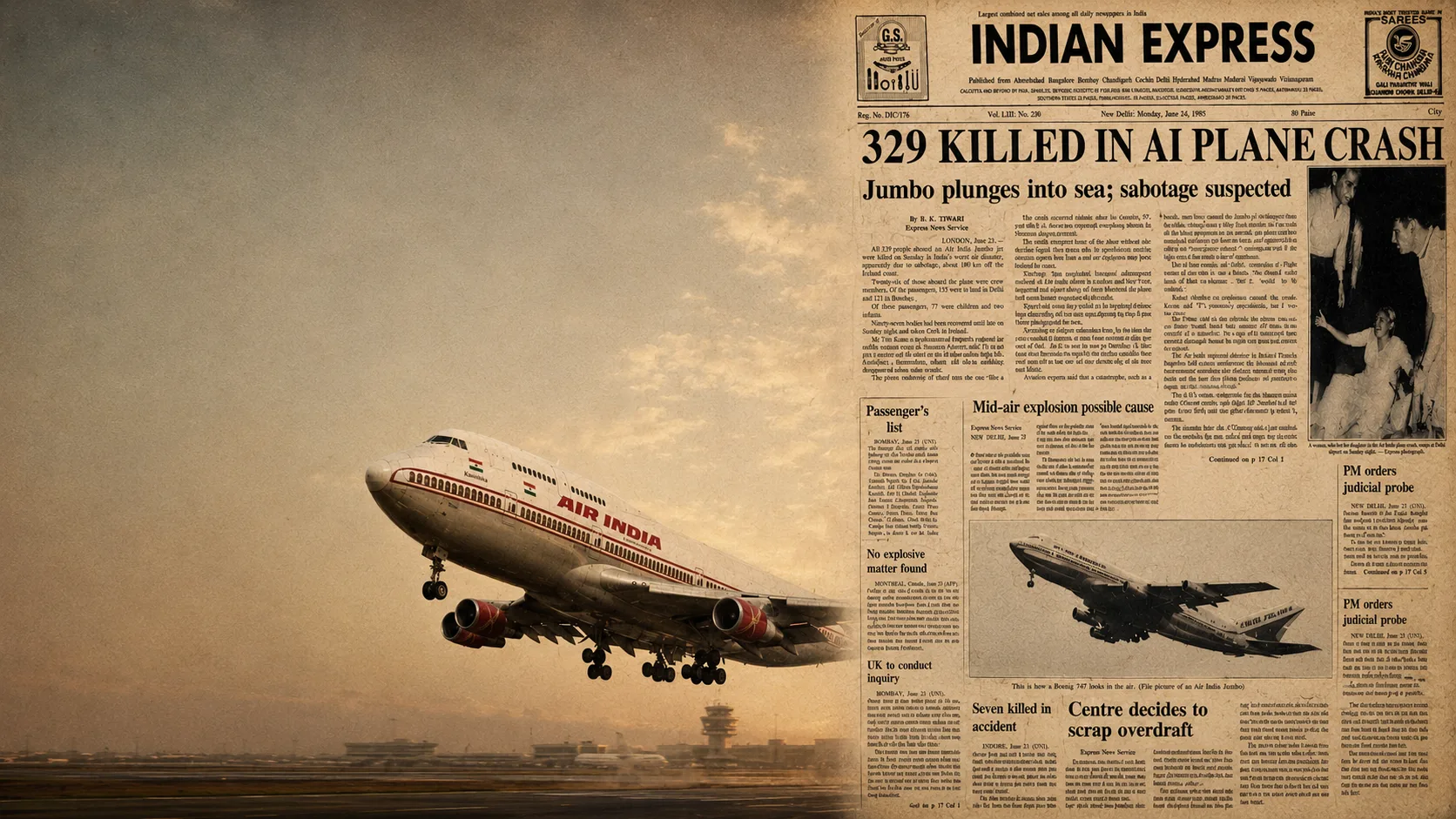
The aircraft was a Boeing 747-237B, registration VT-EFO. It carried the name Emperor Kanishka. It had left Toronto as Flight 181, become Flight 182 at Montreal, and was routed onward through London to Delhi and Mumbai. Three hundred and seven passengers and twenty-two crew.
At about 07:14 GMT the second bomb detonated in the forward cargo hold. The aircraft broke apart. There was no distress call. It came down into water two thousand metres deep.
Three hundred and twenty-nine people died. Two hundred and sixty-eight of them held Canadian citizenship, and almost all of those were of Indian origin. Twenty-four held Indian passports. Eighty-six were children.
One hundred and thirty-one bodies were recovered from the sea. The remaining hundred and ninety-eight were not.
Until the eleventh of September 2001, the murder of the Emperor Kanishka was the deadliest act of aviation terrorism committed anywhere on earth. It was carried out against Indians, in Canadian airspace of departure, from a Canadian city, by men living in Canada.
Cork
The bodies came ashore at Cork.
The Irish naval service, the merchant vessels that diverted, the fishing boats, the helicopter crews of the Royal Air Force flying from Cornwall: these people spent days on a stretch of the Atlantic recovering the dead of a country most of them had never visited. The bodies were brought to the regional hospital at Cork and laid out for identification, and the families came from Toronto and Montreal and Delhi and Mumbai to walk between them.
The town received them. It has gone on receiving them for four decades. There is a memorial garden at Ahakista on the Sheep's Head peninsula, a sundial facing the water, and on every twenty-third of June the families gather there and the names are read aloud, and the people of west Cork come and stand with them. They have done this every year since 1986.
That is where the mourning happened. It did not happen in Ottawa, and for a long time it did not happen in Delhi either.
What eighty-six children means
The number resists comprehension, which is why it must be broken.
The flight was full because it was late June, and late June is when the diaspora goes home. School had ended the week before. The passenger list was families -- children being taken to see grandparents in Punjab and Gujarat and Maharashtra, travelling on the cheap summer routing through London, in the school holidays, at the start of the trip they had been promised all year.
Whole families were erased in a line. Parents and all their children. In some cases the entire descent of a household in Canada ended at 07:14 on a June morning.
The Canadian state, for twenty years afterwards, treated this as an Indian matter that had occurred at some distance from Canadian life. It was the largest mass murder in Canadian history. It took until 2005 for a Prime Minister to say so plainly, and until 2010 for the state to apologise to the families for how it had treated them.
Twenty years, one conviction
The investigation began badly and did not improve.
Within five months of the bombing, Canadian police searched the premises of Talwinder Singh Parmar of the Babbar Khalsa and of Inderjit Singh Reyat, an electrician on Vancouver Island. The charges laid were minor explosives offences. Reyat was convicted in relation to the Narita device.
Intelligence tapes that had recorded the suspects were erased by the Canadian Security Intelligence Service, as a matter of routine policy, while the criminal investigation was under way. The service and the police did not share what they had. A key witness was murdered. Others withdrew.
Talwinder Singh Parmar left Canada and was killed in Punjab in 1992 in circumstances that Indian police described as an encounter and that others have disputed. He was never tried.
In 2000, fifteen years after the bombing, Ripudaman Singh Malik and Ajaib Singh Bagri were charged with mass murder. Their trial ran into 2005 and ended in acquittal on all counts. The judge found the evidence insufficient. The cost of the prosecution ran to something close to a hundred and thirty million Canadian dollars, the most expensive in the country's history.
In 2003 Inderjit Singh Reyat pleaded guilty to manslaughter in respect of the two hundred and ninety-two people killed by the bomb he had helped build, and was sentenced to fifteen years. He later served a further term for perjury, having lied in the witness box at the trial of the other two.
That is the entire criminal result. One man, one plea, one count of manslaughter, and a perjury conviction for lying about it.
The legal record of the Kanishka bombing
| Person | Outcome |
|---|---|
| Talwinder Singh Parmar | Never tried; killed in Punjab in 1992 |
| Inderjit Singh Reyat | Convicted for the Narita device; pleaded guilty to manslaughter in 2003; later convicted of perjury |
| Ripudaman Singh Malik | Charged in 2000; acquitted in 2005 |
| Ajaib Singh Bagri | Charged in 2000; acquitted in 2005 |
| Total convictions for 329 deaths | One count of manslaughter |
The commission
In 2006 Canada finally appointed a commission of inquiry under a retired judge of its Supreme Court, John Major. It reported in 2010.
The findings were unsparing. The commission described a cascade of errors, incompetence and inattention. It found that Canadian agencies had possessed information that should have prevented the bombing and had failed to act on it or to share it. It found that the families had been treated as foreigners in their own country, left without support, and in some cases handled with a coldness that the report set down in detail. It found that the aviation security regime had known of a threat to Air India and had not raised protection accordingly.
Bob Rae, who had conducted the earlier review that led to the inquiry, framed the central charge in a way that has not been improved upon: the events were treated as something that had happened to somebody else, rather than as the mass murder of Canadians.
The commission recommended compensation, structural reform of intelligence-sharing, and an acknowledgement of failure. Some of it was implemented.
The question Bharata has not asked itself
An account of the Kanishka that ends with Canadian failure is a comfortable account, and an incomplete one.
Three hundred and twenty-nine people were killed on an aircraft belonging to the national carrier of Bharata, bearing the name of an emperor of Bharata, flying under an Indian flag, en route to Indian soil. The Indian state was a party to the investigation from the first week and had its own intelligence on the organisations involved.
For twenty years, Indian pressure on Canada was episodic. Governments changed and the file cooled. There was no sustained diplomatic campaign of the kind mounted for other outrages, no annual reckoning in Parliament, no insistence that made the matter costly to leave alone. The memorial in Bharata came late. The date is not marked in the national calendar with anything approaching the weight it carries.
Polemical The reason is not difficult to name. The victims were, in the main, Canadian passport holders of Indian origin, and a state's attention follows its citizens. The dead of the Kanishka fell into the gap between two countries, and each was content to regard them as belonging mostly to the other.
Eighty-six children fell into that gap.
The arithmetic, stated once
Three hundred and twenty-nine dead. One manslaughter conviction.
Forty-one years, two acquittals, one erased set of tapes, one suspect killed before trial, one commission of inquiry, one apology, and a sundial on an Irish headland where the names are read out every June by people who owe the dead nothing except the decency of remembering them.
A distinction the record requires
On the twelfth of November 1996, over Charkhi Dadri in Haryana, a Saudi Arabian Airlines Boeing 747 climbing out of Delhi collided with a Kazakhstan Airlines Ilyushin descending toward it. Three hundred and forty-nine people died. It remains the deadliest mid-air collision anywhere and the greatest loss of life in any aviation disaster on Indian soil.
Twenty more than the Kanishka. Neither aircraft was Indian; the cause was not a crime but a failure of language, altimetry and air traffic control procedure in Indian airspace, and it reshaped collision-avoidance rules across the world.
The distinction matters and should be stated exactly. Charkhi Dadri is the largest accident. The Kanishka is the largest crime.
Chapter IV: Forty-Nine Minutes
The ordinary aircraft
The Airbus lifted off from Tribhuvan at about four in the afternoon, into the thin gold light that hangs over the Kathmandu valley on winter evenings, and for thirty-odd minutes it was the most ordinary aircraft in Asia. Christmas Eve. A Friday. One hundred and seventy-nine passengers and eleven crew on a sector so short that the cabin service is a race against the descent. Honeymooners going home. Traders with Nepali carpets in the hold. A Delhi family that had gone up for the week. The kind of flight nobody remembers taking.
In the left seat sat Devi Sharan, thirty-seven years old, born in a village near Karnal, trained on light aircraft at the Karnal club in 1984 and taken on by Indian Airlines the following year. Beside him, First Officer Rajinder Kumar. Behind them at the engineer's panel, Anil Kumar Jaggia, fifty-eight, the oldest man on the flight deck and the one with the longest memory of what airline flying in India had been. Sharan had a family holiday booked for the moment the wheels touched Palam.
At about 16:53 Indian Standard Time the aircraft crossed into Indian airspace. Within minutes a masked man came through the cockpit door with a grenade in one hand and a revolver in the other and told Sharan to turn west, for Lahore.
There were five of them. Ibrahim Athar, Shahid Akhtar Sayed, Sunny Ahmed Qazi, Zahoor Mistry and Shakir, all Pakistani nationals, all of the Harkat-ul-Mujahideen, an organisation raised, trained, funded and housed on Pakistani soil under the protection of the Pakistani state. They worked under names taken from nowhere -- Chief, Doctor, Burger, Bhola, Shankar -- so that the hostages would have nothing to give an interrogator afterwards. Settled They had boarded at Kathmandu, through a security screen that has never been satisfactorily accounted for, and they wanted one thing: Masood Azhar out of an Indian jail.
Tribhuvan
The question that has never been answered is how five armed men walked onto an Indian aircraft at Kathmandu.
Tribhuvan International was, through the 1990s, the softest international airport within reach of the Indian mainland. Nepal was open to Indian nationals without a visa, which made it the natural staging ground for anyone who wished to reach an Indian target without crossing an Indian frontier. Indian intelligence had said so, repeatedly, in assessments that circulated for years before December 1999. The Indian Airlines counter at Kathmandu was a known vulnerability and the sector was a known vulnerability and nothing about the vulnerability was secret.
Grenades and revolvers went through the screen. Settled Whether they went through it or around it, whether the weapons were carried aboard or placed aboard, whether the screening was defeated or simply not performed -- none of this was ever established to public satisfaction, and no Nepali or Indian inquiry produced a finding that closed the question.
What is certain is that a party of five boarded a two-hour flight with the means to take it, and that they had chosen the one route into India where that was easiest.
The pattern -- The 1971 seizure of the Fokker named Ganga was carried out on the Srinagar sector, the shortest hop in the fleet. The 1981 seizure of IC 423 was carried out on the Delhi-Amritsar sector. IC 814 was taken on the Kathmandu sector. In every case the aircraft chosen was the one that could be brought to a foreign runway on the fuel it was already carrying.
The Cabin
Behind the flight deck door, the eight days that began that evening were spent by a hundred and seventy-nine people in conditions that no account has ever fully rendered.
The window shades were kept down. Passengers were made to keep their heads bowed and their eyes covered, at times with strips of cloth, at times with their own clothing. Speech between rows was forbidden. Movement to the lavatories was rationed and supervised. Men were separated from women and children in the seating, and the men who were thought to look like security personnel or officials were watched with particular attention. Food and water ran out and were replenished only at the stops, and at Kandahar the aircraft sat through nights cold enough that the cabin temperature became a medical question rather than a comfort one.
The cabin crew worked the aisles through all of it. They were, for eight days, the only people aboard who were permitted to move freely and speak, and the reason they were permitted was that somebody had to keep a hundred and seventy-nine people alive. The senior cabin crew member and her colleagues carried water, rearranged seating for the sick, brought children to their mothers, and stood between armed men and passengers who had begun to break. None of them has a decoration.
The Pilot's Arithmetic
What happened over the next three hours was a negotiation conducted in fuel.
Sharan turned west as ordered. The aircraft made for Lahore, and Lahore refused it. Allama Iqbal International would not grant clearance to land and Pakistani control would not grant passage through its airspace, and so the Airbus was left circling in the dark over the frontier with a fuel state that was falling toward the point where no choice would remain to anybody.
This is the moment the whole night turns on, and it belongs to the man in the left seat.
Sharan told the hijackers the truth, and then used it. There was not enough fuel to hold, not enough to go anywhere else, and if Lahore would not take the aircraft then it would have to come down on the nearest runway or come down in a field. The nearest runway was Raja Sansi, at Amritsar. Fifty kilometres from the Pakistani field that had just closed its door. Eight minutes of flying.
The hijackers agreed. At about 18:15 the aircraft reached the reporting point known as Ansari and Sharan turned it toward Amritsar. Three minutes later he was on the radio to Indian control for the first time since the cockpit door had opened, and what he transmitted was a plain statement of the tactical position: in contact with Lahore, Lahore refusing, forty minutes of fuel remaining.
A pilot with a gun at his back had just handed the Republic a hijacked aircraft, on Indian soil, with empty tanks. Everything after this was India's to lose.
At about 19:01 the Airbus touched down at Raja Sansi with, by the accounts given afterwards, something in the region of ten minutes of usable fuel. It could not take off again in any meaningful sense. It could not go to Lahore, it could not go to Delhi, it could not go anywhere at all. It was a two-hundred-tonne object sitting on a runway in Punjab, and it needed something from India before it could move: fuel.
The corridor -- Raja Sansi and Allama Iqbal sit roughly fifty kilometres apart. For a hijacker with a short-haul aircraft, Lahore is the closest point outside Indian jurisdiction, which is why thirty years of Indian hijackings ran along this line. Amritsar is not the alternative to Lahore. Amritsar is what happens when Lahore says no.
Forty-Nine Minutes
The aircraft was on the ground at Amritsar for forty-nine minutes. Contested Some accounts give forty-five. The difference matters less than what filled them, which was almost nothing.
There was no fuel bowser at the airfield. No flight was due in or out of Raja Sansi that evening, and so the tanker was not standing by. It had to be sent for. By the account later given by the Punjab police chief, it took some thirty-five minutes to reach the runway.
Meanwhile, in Delhi, the Crisis Management Group was still assembling. The hijack had been known to Delhi air traffic control since shortly after five o'clock. The instruction that eventually reached Amritsar came at 19:35, and it said that a National Security Guard team had been dispatched and that the aircraft was to be prevented from taking off.
It did not say how.
That sentence is the centre of the night. An order was issued with no method attached to it, to men who had no authority to improvise one. Armed Punjab policemen were in position on the apron and ready to move. They did not receive clearance from Delhi. The plan that formed on the ground -- put policemen on the fuel tanker, let it approach as though to refuel, and shoot out the tyres so that the aircraft was pinned -- was a sound plan devised by people who understood the problem, and it required a decision from a room five hundred kilometres away that was still deciding.
Two commandos took position on the bowser. The bowser began to move toward the aircraft.
And then it stopped.
In the cockpit, the hijackers had spent forty minutes watching an airport do nothing. They had asked for fuel on landing and no fuel had come. They had seen a tanker appear and halt. To men who expected treachery, a tanker that stops is not an accident of driving; it is the trap closing. They began to kill.
Rupin Katyal was twenty-five years old. He was in seat sixteen with his wife Rachna beside him, coming home from their honeymoon. They had been married a few weeks. He was cut across the throat while the aircraft stood still on an Indian runway, and it took a long time for him to die, and his wife did not at first understand what had been done because the cabin lights were low and the man beside her had been made to keep his head down.
Sharan was told from the cabin that passengers were being killed. He told Amritsar control that he had to take off. On the ground there was disbelief -- the Punjab police chief said afterwards that they did not believe a killing had actually occurred -- and while the disbelief lasted the aircraft began to roll.
At 19:49 IC 814 lifted off Raja Sansi with no fuel to speak of, missing the stationary bowser by very little. The control tower had not expected it. Nobody had expected it. An observer in the tower said afterwards that the aircraft had hardly any fuel and that nobody anticipated so suicidal a step.
The National Security Guard landed at Amritsar at 20:15. Twenty-six minutes after the aircraft had gone. Three hours and twenty-three minutes after Delhi air traffic control first learned that IC 814 had been taken.
The Amritsar clock, 24 December 1999, Indian Standard Time
| Time | Event |
|---|---|
| 16:53 | IC 814 enters Indian airspace and is seized |
| 18:15 | The aircraft reaches point Ansari; Sharan turns for Amritsar |
| 18:18 | First contact with Amritsar control: Lahore refusing, forty minutes of fuel |
| 19:01 | Touchdown at Raja Sansi with about ten minutes of fuel remaining |
| 19:35 | Delhi instructs that the aircraft be prevented from taking off; no method specified |
| 19:45 | The bowser plan forms; Punjab police in position, awaiting clearance from Delhi |
| 19:49 | IC 814 takes off, narrowly missing the bowser |
| 20:15 | The NSG team lands at Amritsar |
The Highway
What followed has become, in the retelling, a story of Indian helplessness. It was not. For the next ninety minutes the most aggressive actor in the entire affair was the captain of the hijacked aircraft.
Sharan turned west again for Lahore, because there was nowhere else and because the tanks were now genuinely empty. Pakistani control refused a second time. Then Lahore did what no civil authority anywhere is permitted to do to an aircraft in distress: it put out the runway lights and shut down the navigational aids, so that there would be no field for IC 814 to find. A hundred and seventy-nine civilians were aboard, and the state that had raised and armed the men holding them was now willing to see the aeroplane go into the ground rather than accept it.
An airliner running on fumes, in darkness, over a country that has extinguished its own airport rather than accept it.
Sharan lined up on the lights of a highway.
He has said since that this was deliberate, that he never told his own crew, and that the intention was to make Lahore control watch an Airbus descend toward a public road at night and decide which outcome it preferred. The aircraft came down close enough that the highway resolved into a highway. Then the radio spoke and the runway was open, and the lights came back on, and Sharan pulled up and went round and landed at Allama Iqbal.
Contested The account of the feint is Sharan's own, given many years afterwards; what is not in dispute is that the lights were off, that the aircraft descended toward a road, and that Lahore reversed itself.
The Airbus was refuelled at Lahore. It flew to Dubai, where twenty-seven passengers were released and Rupin Katyal's body was taken off. Then it flew to Kandahar, into the hands of a government that recognised no other government, and stood there for six days while men in Delhi argued about what a hostage is worth.
The Room in Delhi
While the aircraft stood at Amritsar the machinery of the Indian state was still switching itself on.
The Crisis Management Group existed on paper. It had a composition, a chair in the Cabinet Secretary, and a mandate that covered exactly this contingency. What it did not have on the evening of 24 December was speed. Delhi air traffic control knew of the hijack shortly after five. The Group was still forming when the aircraft landed at seven. The instruction to prevent the take-off was transmitted at 19:35, thirty-four minutes after touchdown and fourteen minutes before departure, and it reached an airfield with no bowser, no commandos and no delegated authority.
The Home Minister was in North Block that evening, pacing, waiting for information that arrived through television before it arrived through the system. The National Security Guard, whose entire purpose is to be at an airfield before an aircraft can leave it, was airborne toward Amritsar while the aircraft it was meant to intercept was already rolling.
Underneath the individual delays sits a structural fact. Nobody at Raja Sansi had the authority to act without Delhi, and Delhi was not yet in a condition to give an order with a verb in it. The system had been built so that responsibility travelled upward to a room that had not finished convening, and the men on the tarmac who could see the aircraft, who had a workable plan, and who were armed and in position, were required to wait.
An order that says what must not happen, without saying who is to prevent it or how, is not an order. It is a record of anxiety.
Kandahar
The Airbus came to rest at Kandahar in the small hours of 25 December, on an airfield held by a government that four states in the world recognised and India was not among them.
The Taliban ringed the aircraft with fighters and armoured vehicles and announced that they would not permit an assault, which had the effect of protecting the hijackers from Indian action while presenting the arrangement as protection of the hostages. The Taliban government of the day was itself a creation of Pakistani policy, sustained by Pakistani money, arms and recruitment, and the ground on which the aircraft stood was therefore not neutral ground. It was the far end of the same apparatus that had put the five men aboard at Kathmandu. Indian negotiators flew in and worked out of a building at the edge of the field. Whatever their instructions were at the start, the geometry of the ground had already decided the outcome: an Indian rescue operation on Afghan soil was not available, and the Taliban knew it, and the hijackers knew it.
The opening demand was for thirty-six prisoners, a sum of money running into hundreds of millions of dollars, and the remains of a militant commander buried in India. Contested The figures given in different accounts vary. Over six days the demand came down to three names, and the money and the body fell away, and what remained was the only currency India had agreed to spend.
In Delhi the families of the hostages had gathered and were on the streets and on the television screens, and they wanted their people back, and they said so to any camera that was pointed at them. That pressure was real and it was legitimate and it was also, in the exact sense, the mechanism by which the hijack worked. A hijack of a civil aircraft is an operation conducted against a government through the emotions of its own citizens. It cannot function in any other way.
The Bill
On 31 December three men were released from Indian custody: Masood Azhar, Ahmed Omar Saeed Sheikh and Mushtaq Ahmed Zargar. The Minister for External Affairs flew with them to Kandahar. The hostages came home on New Year's Eve to a country that had decided not to look at what it had just done.
Azhar was received in Pakistan, addressed a public gathering at Karachi within days of his release, and founded Jaish-e-Mohammed within months, and it has operated from Bahawalpur ever since under the protection of the state that produced it. Settled Omar Saeed Sheikh surfaced in Karachi in 2002 in the abduction and murder of the journalist Daniel Pearl. Zargar returned to the Kashmir valley circuit. The men freed at Kandahar are woven through the next quarter-century of attacks on Bharata, and every one of those attacks is downstream of forty-nine minutes on a runway at Amritsar.
The most damaging assessment of that evening was not made by a critic of the government. It was made by Brajesh Mishra, who was the National Security Adviser at the time and sat in the room where the decisions were not made. Speaking years later, he said that the airport authorities at Amritsar had asked for a bowser, that the bowser could easily have been put in front of the aircraft, and that the only place where the whole affair could have been handled differently was Amritsar.
He also said there had been no inquiry afterwards.
The state could not stop an aircraft that had no fuel, on its own runway, in its own country, with its own police standing on the tarmac waiting for a word that never came.
K.P.S. Gill, writing on the sequence, declined to name the individuals who had failed, on the ground that naming them would be futile: the same failures would simply be repeated by different men the next time a crisis arrived, because the failure was structural and not personal. That is the harshest verdict available, and it is harsher than blame. Blame implies that somebody could have been replaced.
What Amritsar Was
Six years earlier, on 25 April 1993, an Indian Airlines Boeing had been taken on the Delhi-Srinagar sector by a man who demanded Kabul. Pakistan refused overflight, the aircraft came down at Raja Sansi with the fuel gone, and the National Security Guard went aboard and killed the hijacker in about three minutes. Not one of the hundred and forty other people on that aircraft was harmed. The operation was given a name, Ashwamedh, and it worked.
The same airfield. The same fuel logic. The same force.
Between 1993 and 1999 nothing was retained. There was no standing anti-hijack drill at Raja Sansi, no bowser on call, no delegated authority to a local commander, no doctrine that said an aircraft on an Indian runway with empty tanks is an asset the Republic already holds and must simply refuse to give back. The instruction sent from Delhi at 19:35 assumed that somebody at Amritsar knew how to stop an aircraft, and nobody had been told, because nobody had written it down after the last time it had gone right.
Sharan flew for another quarter-century. He retired in his sixties, bringing a Boeing in from Melbourne on his last rotation, and said afterwards that the hijack had taught him that life is unpredictable and one must always be ready to fight back, and that he hoped no crew member or passenger anywhere would live through such days again. Jaggia wrote his account. Sharan wrote his.
Rupin Katyal was twenty-five. There is no memorial to him at Raja Sansi, and no plaque marking the stand where the aircraft waited, and no marker on the taxiway where the fuel tanker came to a halt with two policemen crouched on it, waiting for Delhi.
Chapter V: The Sealed Envelope
Law arriving late
The Anti-Hijacking Act came into force in 1982, in the middle of the Khalistan wave, after eight Indian aircraft had already been taken.
It was replaced in 2016 by a new Act which made hijacking a capital offence where death results, and widened the definition to cover threats and attempts and to reach hijackers wherever in the world they might be found. Seventeen years after Kandahar. Thirty-two years after the two seizures that followed Blue Star. Forty-five years after the Ganga.
Indian aviation law has never once been written before the aircraft was lost. It has been written afterwards, every time, and the interval between the loss and the law is usually measured in decades.
The twelfth of June 2025
At about 1:38 in the afternoon, Air India Flight 171 lifted off from Ahmedabad for London Gatwick. A Boeing 787-8, registration VT-ANB, two hundred and thirty passengers and twelve crew.
Thirty-two seconds later it came down onto the hostel block of the B. J. Medical College, one point seven kilometres beyond the end of the runway, in the middle of the lunch hour.
Two hundred and forty-one of the two hundred and forty-two people aboard were killed. Nineteen people on the ground were killed, most of them medical students at their meal. One passenger walked out of the wreckage.
It is the worst accident in the history of Indian civil aviation and the first hull loss of a Boeing 787 anywhere.
Two switches, one second
The preliminary report of the Aircraft Accident Investigation Bureau appeared in July 2025.
It recorded that both engine fuel control switches moved from the RUN position to the CUTOFF position within about one second of each other, seconds after the aircraft left the ground. Both engines ran down. The ram air turbine deployed, which is what an aircraft does when it has lost the power to fly itself. The switches were then returned to RUN and the engines began to relight, and there was not enough height or time.
The report also recorded an exchange on the cockpit voice recording, in which one pilot asks the other why he has cut off, and the other answers that he did not.
That is the whole of what has been established in public. Everything beyond it -- which pilot spoke, which hand moved, whether a hand moved at all, whether a switch can move without one -- is not established, and stating it as though it were would be a lie told about two dead men who cannot answer.
What the report did not say -- The preliminary report made no finding of cause, issued no recommendation to operators of the 787, and identified no fault with the aircraft or its engines. It described a sequence. The interpretation of that sequence has been supplied by everybody except the investigators.
The envelope
Fourteen months later the matter has reached the Supreme Court, and the argument before it is not about what happened in the cockpit. It is about who is entitled to know.
The Bureau has declined to release the cockpit voice recording and the cockpit image recording, citing the Aircraft (Investigation of Accidents and Incidents) Rules of 2025 -- rules promulgated in the same year as the accident they are now being used to withhold evidence about. The draft final report is to be submitted to the Court in the first week of October 2026, in sealed cover.
Thirty families of the dead have petitioned. What they have asked for is modest and specific: regular disclosure of the progress of the investigation, independent simulator testing of the sequence recorded on the flight data, and a serving professional pilot on the investigation team. They have not asked for a verdict. They have asked to be told what is being done.
The reply has been the Rules.
A sealed envelope handed to a court is not an investigation made public. It is an investigation made private with judicial supervision, which is a different thing, and the difference is the whole of what the families are asking about.
Contested The obligations under Annex 13 of the Chicago Convention require a final report to be made publicly available, and where that is not possible within twelve months, an interim statement on each anniversary. Whether the arrangement now in place satisfies those obligations is a matter of live dispute.
Ashwamedh, and what was not kept
There is one moment in this entire seventy-year account when the Indian state did the thing correctly, at speed, without loss, and it has been mentioned twice already because everything turns on it.
On the twenty-fifth of April 1993, at Raja Sansi, the National Security Guard boarded IC 427 and killed the hijacker inside about three minutes. A hundred and forty people were not harmed. The intelligence was adequate, the force was in position, the decision was made, and the operation was executed.
Six years and eight months later, at the same airfield, with the same fuel logic producing the same landing, the same force arrived twenty-six minutes after the aircraft had left, on the authority of an instruction that did not say what anyone was to do.
Nothing had been retained. Not the standing posture, not the pre-positioned tanker, not the delegated authority, not the doctrine that an aircraft on an Indian runway with empty tanks is already in Indian hands and needs only to be kept there.
An institution that succeeds and does not write down why has not succeeded. It has been lucky, in a way that will not repeat.
The through-line
Set the three moments beside one another and a single question runs through all of them.
In 1971 the state could not prevent an aircraft carrying the name of the Ganga from being burned on foreign ground, because the aircraft was outside its jurisdiction and it had no means of reaching in.
In 1999 the state could not prevent an aircraft from leaving its own runway with no fuel in the tanks, because the authority to act sat five hundred kilometres from the men who could see the aeroplane.
In 2026 the question is no longer whether the state can hold an aircraft. It is whether the state can tell its own citizens what happened inside one.
The corridor was always about jurisdiction: whose ground, whose law, whose reach. It still is. Only the frontier has moved. It used to run between Amritsar and Lahore. It now runs between the Aircraft Accident Investigation Bureau and the families of the dead.
Coda: The Names
Air India named its aircraft the way a civilisation names its children.
Malabar Princess, a Constellation, into the shoulder of Mont Blanc in November 1950, forty-eight dead.
Kashmir Princess, a Constellation, into the South China Sea by a bomb meant for another country's premier, April 1955, sixteen dead.
Kanchenjunga, a Boeing 707, into the same mountain that took the Malabar Princess, January 1966, a hundred and seventeen dead, and among them Homi Jehangir Bhabha, going to Vienna, carrying in his head a decade of what Bharata would need in order to be left alone.
Emperor Ashoka, a Boeing 747, into the sea off Mumbai on the first day of 1978, two hundred and thirteen dead, brought down by an instrument that failed and a crew that could no longer tell which way was up.
Emperor Kanishka, a Boeing 747, over the Atlantic in June 1985, three hundred and twenty-nine dead, eighty-six of them children.
Ganga, a Fokker Friendship, burned on a runway at Lahore in February 1971 with nobody aboard at all.
A coast. A valley. Two mountains. Two emperors. A river.
Every one of them was named for something that was supposed to outlast the people who named it. Every one was destroyed, and each destruction took a piece of the name away with it, so that Kanishka now means an aeroplane before it means an emperor, and Ganga in this one narrow context means a burning Fokker rather than the river that made the plain.
The list does not argue. It is simply the register of what Bharata put into the air and did not get back.
0 responses