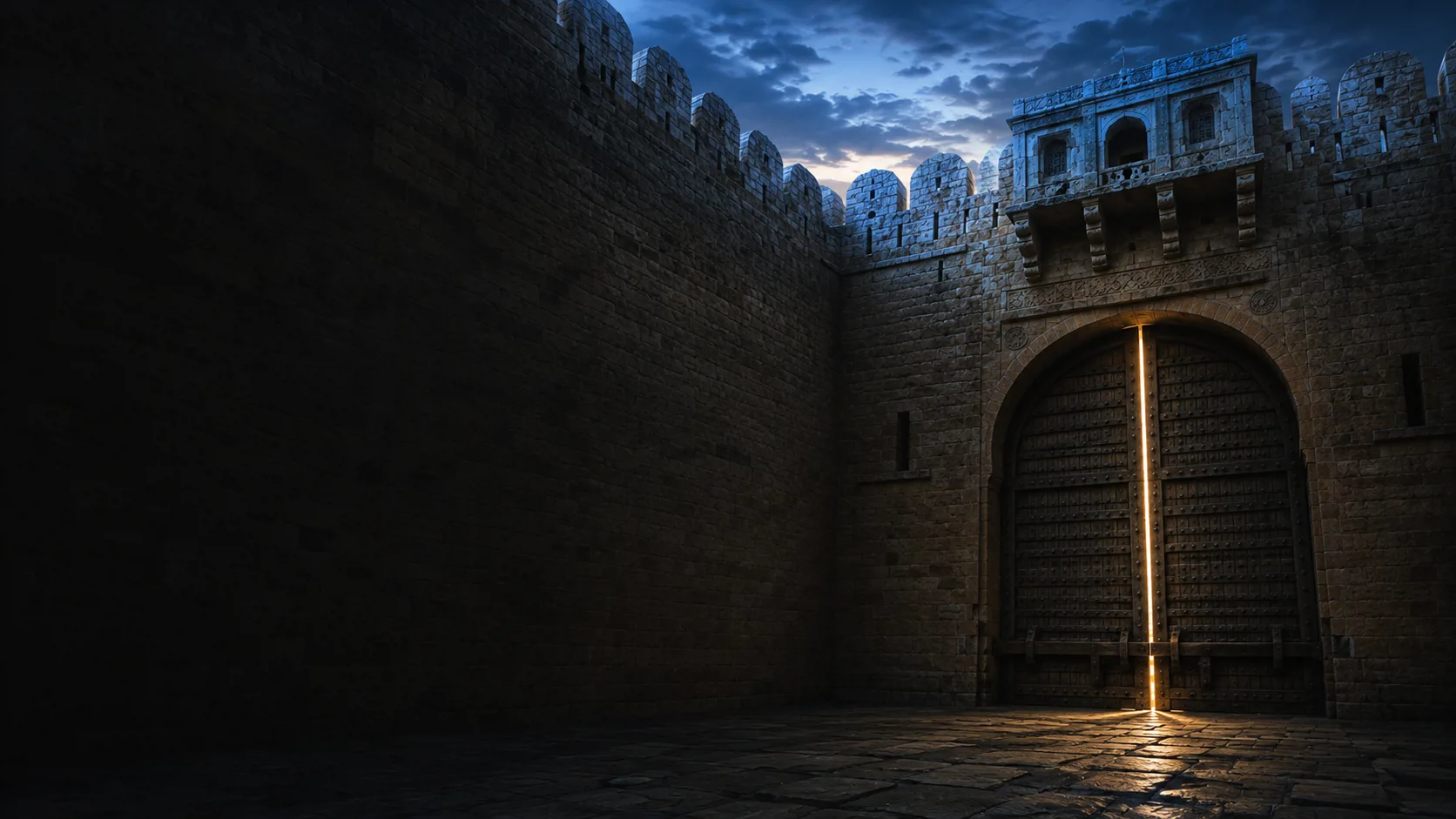
The Night Before Chittor
On the night of 22 February 1568, the fires on the ramparts of Chittor were not signal fires. They had been burning for four months of siege, and by that night everyone inside the fort understood what the smoke meant.
Akbar's sabat, the covered approach trench, had crept to the base of the wall like a slow animal. Two hundred labourers had died building it, crushed by stone dropped from above, and the emperor had replaced them each morning. The mines under the Gambhiri bastion had been fired. The breach was open. Jaimal Rathore of Badnor, who had commanded the defence since Rana Udai Singh moved the house of Mewar out to the Girva hills to keep the line alive, had taken a matchlock ball through the leg the previous evening while supervising repairs to the wall by torchlight. The gun was called Sangram. Akbar had fired it himself.
By first light the Rajputs would put on saffron. That was the whole of the plan, and it was not a plan for victory.
What happened inside the palace enclosure in the hours before dawn is recorded, in outline, by the victors. Wood was stacked in the underground chambers below the Gaumukh reservoir and in the vaults beneath the Mahasati terrace. Ghee was poured. The women of the fort, the wives and daughters and mothers of the garrison, together with those of the townspeople who had come inside the walls when the siege closed, went down into those chambers. The wife of Patta Sisodia, sixteen years old, went with them. Patta's mother had already put on armour and gone to the wall.
The fires were lit before sunrise. When they had burned down, the gates were opened, and eight thousand men in saffron rode out into an army of sixty thousand to be killed.
This is jauhar. It has a shape, a vocabulary, a sequence, and a cause, and every one of those four things is now the subject of an argument being conducted almost entirely by people who have not read the sources.
The Word and the Rite
Jauhar is a rite of the fortress. It is collective, it is preemptive, and it belongs entirely to siege warfare. The women of a fort enter fire while their husbands are still alive, still armed, and still on the walls. The men then die a few hours later.
Every element of that sequence is fixed and every element is a response to a military condition. It is performed only under siege. It is performed only when the fall of the fort has become certain and imminent, usually within hours. It is performed by the whole community of women inside the walls at once, not by an individual. And it is performed before the deaths of the men, not after.
Jauhar is also inseparable from its other half, and that half needs naming before it can be used, because the word is Rajasthani, it is technical, and it has no equivalent in ordinary English.
The word is saka.
A saka is the deliberate final sortie of a garrison that has decided not to surrender. When the wall is breached and the fort can no longer be held, the surviving defenders do not wait inside to be taken, and they do not fight on in the hope of relief. They open their own gates and ride out into the besieging army to be killed. The object is not victory and is not escape. Nobody who rides out in a saka expects either.
The preparation is fixed and is recorded consistently across the Rajput sources. The men bathe. They put on kesariya, robes dyed the saffron of renunciation, which is why the phrase for undertaking a saka in Rajasthani is to put on saffron. A tulsi leaf is taken. In several accounts the men have their own funerary rites performed over themselves before they go, so that they pass through the gate already ritually dead, with nothing left owing on either side of the account. Then the gates are opened, and the fort's last hour is spent outside the wall rather than behind it.
So the full rite has two movements in fixed order. Jauhar is the first: the fire of the women, before dawn, inside. Saka is the second: the ride of the men, at dawn, out. A saka undertaken without a preceding jauhar has its own name, ardh-saka, the half-saka, and the forts that count one are careful to say so. A jauhar with no saka following it is not recorded anywhere in the literature. The men always went out.
That last sentence is a structural fact rather than a sentiment, and it is fatal to a great deal of what is written on the subject today. It will be returned to.
The derivation of saka is unsettled. The likeliest connection is with Sanskrit saka in the sense of an epoch, the same sense that names the Saka era, an event so decisive that time afterward is reckoned from it. That reading matches the usage exactly. A fort's history is not counted in reigns or in sieges but in sakas: Chittor counts three, Jaisalmer two and a half, and to say that a fort has taken its saka is to say that its account was closed on a particular morning and that everything after is a different reckoning.
Derivation of saka
The etymology is unsettled. Three derivations compete. The first takes jauhar from Sanskrit jatugrha, the lac house, recalling the Varanavata episode of the Mahabharata in which a house of lac is built to burn the Pandavas alive. The second takes it from Arabic and Persian jauhar, jewel or essence, the same root that gives jauhari, jeweller, and reads the word as the offering of what is most precious. The third, favoured by some Rajasthani philologists, reads jiva-hara or jaya-vira through Prakrit intermediates. Colonel James Tod, writing in 1829, spells it johur throughout and offers no derivation at all.
Etymology unsettled
The vocabulary matters because the modern argument frequently turns on it. If jauhar is Persian in origin, the claim runs, then the rite is late, foreign, and therefore not what Rajput tradition says it is. The inference does not follow. Persian became the chancery language of northern Bharata after the thirteenth century and supplied administrative and military vocabulary to every Indian language it touched, including the vocabulary used to describe resistance to the power that brought it. The word for the thing arrived with the enemy. The thing itself did not.
Jauhar: the fixed elements of the rite
| Element | What the record shows |
|---|---|
| Setting | Fortress under siege, without exception |
| Trigger | Certainty of imminent capture, usually within hours |
| Scale | The entire community of women within the walls |
| Timing | Before the deaths of the defending men |
| Preparation | Designated chambers, stored fuel, an understood order |
| Sequel | Saka, the sortie of the garrison in saffron |
| Position in the sastra | Unmentioned in any text of the corpus |
That last row is the whole argument.
What the Sastra Does Not Say
There is no vidhi for jauhar. There is no injunction anywhere in the dharmasastra corpus that commands, permits, regulates, or even describes it.
Manusmrti does not mention it. Yajnavalkya does not mention it. Parasara, Narada, Brhaspati, Katyayana do not mention it. The great nibandhas that codify domestic and royal practice across the medieval centuries, the Mitaksara, the Dayabhaga, the Krtyakalpataru of Laksmidhara, the Caturvargacintamani of Hemadri, the Nirnayasindhu, the Dharmasindhu, contain no chapter, no section, no stray sutra on the practice. Kautilya's Arthasastra, which discusses siege warfare in exhaustive operational detail, including the conduct of a garrison facing capitulation, contains nothing resembling it.
What the corpus does contain, and contains emphatically, is a prohibition of self-slaughter.
This verse is the standard proof-text cited against atmahatya across the commentarial tradition. Sankara reads atmahanah in its widest sense, but the plain reading was never abandoned by the smrti writers, who prescribe expiation for the survivors of a suicide, deny the ordinary funerary rites to the body, and classify the act among the mahapatakas in several enumerations.
The narrow exceptions the tradition does recognise are precisely enumerated and none of them fits. Mahaprasthana, the great departure, is the walking out of an aged king or ascetic who has discharged every obligation. Prayopavesana is death by fasting, undertaken over weeks at specified tirthas, the sacred crossing-places where such a departure is permitted. Both are conditions of the completed life. Neither describes a sixteen-year-old girl walking into a vault under a besieged fort at three in the morning.
So the question sharpens. If the sastra forbids the act, and the tradition supplies no ritual for it, and no acarya of any sampradaya ever wrote a defence of it, then what exactly is being indicted when the practice is laid at the door of Sanatana Dharma?
No dharmasastra text prescribes jauhar
A civilisation is indicted for a practice its own law books forbid, on the strength of an emergency created by an army that came from outside it.
The honest classification is apad-dharma, the dharma of extremity: the recognition, present throughout the tradition from the Santi Parva onward, that catastrophic conditions suspend the ordinary rule and leave the actor with a choice among evils. Apad-dharma is not a licence and it is not a prescription. It is an acknowledgement that the ordinary rule assumes an ordinary world.
Jauhar is what apad-dharma looks like when the world has stopped being ordinary. It was innovated, in fortresses, under siege, by people who had run out of alternatives, and it was innovated because a specific and documented thing was going to happen to them otherwise.
That thing has a literature of its own, and its authors were not Hindus.
The Other Law
The conquest of Bharata by the Turco-Afghan and later Mughal powers was not conducted as a series of dynastic accidents. It was conducted within a legal framework, and that framework had explicit provisions for the disposal of a defeated population.
The relevant categories are ghanimah, the spoils of war, and sabaya, the captives. Under the classical fiqh, the jurisprudence of the schools that governed the invading armies, the population of a territory classified as dar al-harb, resisting and unconverted, was subject to enslavement upon conquest. The khums, the fifth, went to the treasury. The remainder was distributed to the army. Women and children constituted the largest and most valuable single category of that distribution.
This is not an inference drawn by hostile modern historians. It is the boast of the chroniclers themselves, recorded with pride, in numbers, on the authority of eyewitnesses attached to the campaigns.
Al-Utbi, secretary to Mahmud of Ghazni, writing the Tarikh-i-Yamini within his master's lifetime, describes the aftermath of the Waihind campaign in terms of the slave market: so many captives were brought to Ghazni that merchants came from distant cities to buy, and the price of a slave collapsed. He describes it as a mercy of God upon the faithful. Firishta, working from earlier material, records five hundred thousand taken in a single season of Mahmud's campaigns. The figures are unverifiable and probably inflated. The institution they describe is not.
Amir Khusrau, court poet to the Sultans of Delhi, attached himself to the armies of Jalaluddin and Alauddin Khalji on campaign and wrote down what he saw. His Khazain-ul-Futuh describes captives taken in such quantity at Devagiri, Warangal, and Ma'bar that the counting was abandoned. He was not a soldier and he was not required to be there. He went because he chose to, and he wrote about the taking of women without any apparent sense that a reader might find it troubling.
Ziauddin Barani, in the Tarikh-i-Firoz Shahi, preserves the conversation between Alauddin Khalji and Qazi Mughis of Bayana in which the Sultan asks what the law says the Hindu is owed, and the Qazi answers with a list of humiliations. Barani sets the exchange down approvingly.
Shams-i-Siraj Afif records that Firoz Shah Tughlaq accumulated one hundred and eighty thousand slaves, that a standing bureau existed to administer them, and that the collection of them was a normal function of provincial governors, who forwarded the best of each year's take to Delhi.
Ibn Battuta, who served as qazi under Muhammad bin Tughlaq for years and had no polemical interest whatsoever, describes in the Rihla the routine gifting of captured Hindu women, records that he himself received them, and mentions the prices. His tone throughout is that of a man describing the ordinary furniture of the world he lived in.
Sharaf al-Din Yazdi's Zafarnama and the Malfuzat-i-Timuri record that Timur, encamped before Delhi in December 1398 with one hundred thousand Hindu captives taken on the march, had them all put to death before the battle because they could not be guarded while he fought. Then he took the city and began again.
Captive-taking recorded by the invaders' own chroniclers
| Campaign | Authority | What the chronicler records | Source |
|---|---|---|---|
| Waihind and Punjab, 1001-1008 | Mahmud of Ghazni | Slave prices in Ghazni collapse under supply | Al-Utbi, Tarikh-i-Yamini |
| Somanatha and Gujarat, 1026 | Mahmud of Ghazni | Captives beyond counting driven to Khurasan | Firishta, compiling earlier sources |
| Deccan campaigns, 1296-1311 | Alauddin Khalji | Captives from Devagiri, Warangal, Ma'bar | Amir Khusrau, Khazain-ul-Futuh |
| Reign, 1351-1388 | Firoz Shah Tughlaq | 180,000 slaves held; a bureau to manage them | Shams-i-Siraj Afif, Tarikh-i-Firoz Shahi |
| Delhi, December 1398 | Timur | 100,000 captives executed before the battle | Yazdi, Zafarnama; Malfuzat-i-Timuri |
| Bajaur and Hindustan, 1519-1528 | Babur | Captives and towers of heads, recorded first-hand | Baburnama |
Mass enslavement is documented by the perpetrators
Set these two bodies of evidence beside each other and the question that dominates contemporary discussion collapses.
On one side: a civilisation whose legal literature forbids self-killing, prescribes expiation for it, and never once in two thousand years of jurisprudence enjoins the burning of women. On the other: a body of law that classified the same women as distributable property, and a chain of chroniclers who counted them by the hundred thousand and thought the counting a credit to their patrons.
The women in the vault at Chittor were not obeying a Hindu text. They were declining a Persian ledger.
Rawar, 712
The first fire is at the beginning, at the western edge, in the year the frontier broke.
Muhammad bin Qasim came up the Indus in 711 with six thousand Syrian cavalry, a siege train including the great catapult called al-Arus, the Bride, and a commission from al-Hajjaj ibn Yusuf, governor of Iraq, whose correspondence with his young general the Chachnama preserves at length. Debal fell first. Its temple was destroyed, its priests killed, and by the letter of al-Hajjaj which the chronicle reproduces, the population that resisted was put to the sword for three days and the survivors enslaved.
Raja Dahir of Sindh met the invasion at Rawar on the eastern bank of the Indus in June 712. He fought from an elephant, the howdah lit with naphtha arrows, and died on the field. His army broke.
What followed in the fort of Rawar is the earliest account in the subcontinental record of the thing that would later be called jauhar. The Chachnama, an early thirteenth-century Persian version of a lost Arabic original, records that when the news of Dahir's death reached the fort, the women gathered, and that rather than fall into the hands of the Arabs they set fire to themselves and burned. The chronicle gives a figure in the thousands. The figure is not reliable. The act is described without embarrassment by a source written to celebrate the conquest, which is precisely why it is difficult to dismiss.
Numbers at Rawar are unreliable; the act is recorded by the conquest chronicle itself
The Chachnama also records what happened to those who did not burn. Dahir's wife Ladi was taken. His daughters, called Suryadevi and Parimaldevi in the tradition, were sent to Damascus as part of the khums due to the Caliph al-Walid. The chronicle then tells a story of their revenge, in which they claim to have been dishonoured by bin Qasim before being forwarded, and the Caliph has him sewn into a hide and killed, whereupon the deception is discovered and the sisters executed. The historicity of the revenge episode is doubtful and the manner of bin Qasim's death is disputed in the Arabic sources.
The revenge of Dahir's daughters
But the fate of the women who were taken is not doubtful, because the taking was the point of the expedition and the chronicle says so. Al-Hajjaj's letters are concerned with the remittance. The Chachnama, written to glorify, records that at Brahmanabad thirty thousand were enslaved. The women of Rawar, watching the fort's last hours from inside, did not need a chronicler to tell them what a caravan to Basra meant.
The rite begins where the frontier failed, and it will be found, thereafter, wherever the frontier fails again.
The Long Silence
Then, for five centuries, almost nothing.
Between Rawar in 712 and Ranthambhore in 1301 the record of jauhar is close to empty. This gap is not an accident of preservation and it is not evidence that the practice was invented later. It is a military fact.
The Arab conquest stopped at the edge of Sindh. It did not pass Rajasthan. The reason it did not was the Gurjara-Pratihara empire, which held the line at Bhinmal and Kannauj through the eighth and ninth centuries, and whose kings the Arab geographers themselves describe as the greatest enemy of Islam in the east. Sulaiman the merchant, writing around 851, says the ruler of al-Juzr keeps a large cavalry and that no prince in India is more hostile to the Arabs.
To the north-west, the Hindu Sahis of Kabul and Udabhandapura held the Khyber approaches for two hundred years against Saffarid and Ghaznavid pressure. Jayapala, Anandapala, Trilochanapala fought and finally lost, and when they lost, in the first decades of the eleventh century, the road opened. Al-Biruni, who came with Mahmud, wrote of the Sahis with an admiration he extended to almost nothing else in Bharata, calling their record noble and their memory deserving of preservation.
The Chahamanas of Sakambhari, the Chaulukyas of Gujarat, the Paramaras of Malwa absorbed the Ghaznavid and then the Ghurid pressure for another century and a half. Prithviraja III broke Muhammad of Ghor at Tarain in 1191. He lost at Tarain in 1192, and the loss was decisive in a way the earlier defeats were not, because Ghor did not go home. He left Qutbuddin Aibak in Delhi with an army of occupation, and the occupation became a Sultanate.
The chronology of jauhar is therefore the exact negative image of the chronology of Hindu military capacity. Where the field armies hold, there is no jauhar, because there is no encirclement and no certainty of capture. Where the field armies are destroyed and the war becomes a war of fortresses, jauhar appears, and appears everywhere, within a single generation.
The chronology of jauhar tracks the collapse of the field armies
The rite is not a cultural pathology. It is a siege phenomenon, and it appears when sieges become the only remaining form of the war.
Ranthambhore, 1301
The archetype is Hammira.
Hammira Deva Chauhan, of the Ranthambhore branch of the Chahamanas, descendant of Prithviraja, was, by every account including the hostile ones, a man who did not bend. The phrase Hammira hatha, the resolve of Hammira, entered Rajasthani proverb and has stayed there for seven centuries. He had given asylum to Muhammad Shah, a Mongol officer who had rebelled against Alauddin Khalji, and he refused to surrender him. Alauddin sent Ulugh Khan and Nusrat Khan. Nusrat Khan was killed under the walls by a stone from a manjaniq, the counterweight engine that threw rock at a fortification until the fortification failed. Alauddin came himself.
The siege ran through 1300 and into the summer of 1301. Ranthambhore sits on an isolated hill above the forest, and the fort had held against everything the Sultanate had sent for decades. Alauddin invested it completely, built a pashib, an earth ramp, against the wall, and waited out the granaries.
Amir Khusrau was in the camp. He describes the siege in the Khazain-ul-Futuh, and he describes its end.
When the food was gone and the wall was breached, Hammira's queen Rangadevi led the women of the fort into fire. Khusrau records the burning. Then Hammira put on saffron, took the surviving garrison out of the gate, and was killed. Two of his officers had gone over to the besiegers during the siege; the Rajput account records that Alauddin paid them for it with execution once the fort was his, which is the customary wage.
Ranthambhore has an unusually rich source position for a fourteenth-century Rajput event. The Persian side is Khusrau, present in the camp. The Sanskrit side is Nayachandra Suri's Hammira Mahakavya, a Jaina court epic of the fifteenth century, and there are the Rajasthani Hammira Rasau and Hammira Rasa. The two traditions agree on the siege, the defection inside the fort, the jauhar, and the saka. They disagree, as one would expect, on whose valour was greater. Where a Persian court poet and a Jaina Sanskritist independently record the same fire, the fire is not a later invention.
The Ranthambhore jauhar of 1301
The Ranthambhore sequence sets the template that every later instance follows. Total investment. Exhausted supplies. A breach. The recognition, by everyone inside, that the fort will fall within hours. Then the fire, then the gate, then the sortie. It is not a spontaneous panic. It is a procedure, executed in order, by people who had thought about what they would do when this day came.
Chittor, 1303
Two years later Alauddin came to Chittor, and the siege that followed became the most argued-over event in the history of Bharata.
Chittorgarh stands on a mesa five hundred feet above the Mewar plain, three miles long, walled around its entire circumference. Ratnasimha, the Guhila ruler, had come to the throne in 1302. Alauddin invested the fort in January 1303 and took it on 26 August 1303.
Amir Khusrau was there again. His account, in the Khazain-ul-Futuh and in his poem Devalrani Khizr Khan, is the contemporary record. He describes the siege, the fall, and its aftermath: the Sultan ordering the massacre of thirty thousand Hindus in a day, and the renaming of Chittor to Khizrabad after Alauddin's son Khizr Khan, who was installed there.
Khusrau also records that the Rajputs, at the end, made a fire.
He does not name Padmini. He does not name any Hindu queen, at any siege, anywhere in his work.
The Padmini narrative as it is popularly known descends from the Padmavat of Malik Muhammad Jayasi, an Awadhi Sufi poem completed in 1540, two hundred and thirty-seven years after the siege. Jayasi's work is a spiritual allegory in the premakhyan tradition, the genre of Sufi love-romance in which the pursuit of an unattainable woman figures the soul's pursuit of God: Ratnasena is the seeking soul, Padmavati is divine beauty, the parrot Hiraman is the guide, Alauddin is worldly power. Jayasi says so himself in the poem's frame. The narrative then passed into Rajput bardic tradition, was collected by Colonel James Tod in the Annals and Antiquities of Rajasthan in 1829, and from Tod entered English, then Bengali through Rangalal Bandyopadhyay and Abanindranath Tagore, then the popular imagination of all of Bharata.
From the fact that the most widely read telling of the story is a poem of 1540, a conclusion is now routinely drawn that the queen of that story never existed and was manufactured by the poet. The conclusion does not follow from the premise, and it does not survive examination of what the premise actually establishes.
It establishes that Jayasi wrote a poem. It establishes nothing about whether the material he wrote it from was invented by him, and three features of the poem indicate that it was not.
The first is that Jayasi does not claim invention. The premakhyan poets worked by taking a narrative already in circulation and reading a spiritual sense into it, and Jayasi's frame presents him as doing exactly that. An allegorist needs a story his audience already knows, because the allegory is carried by the audience's prior familiarity with the surface tale. A composition addressed to listeners who had never heard of Chittor, Ratnasena or Padmavati would not function as the genre requires.
The second is that Jayasi has the king right. Ratnasimha's occupation of the Chittor throne at the time of Alauddin's siege is independently established and was not available in any popular source a poet in Jais would have been drawing on casually two and a half centuries later. An author inventing a romance has no need of the correct Guhila ruler for the correct two years, and no obvious way to acquire him. What that accuracy indicates is transmitted material, and material transmitted with the king's name intact is unlikely to have shed the queen's.
The third is the Rajasthani and Jain corpus of the sixteenth and seventeenth centuries, which carries the story with figures and episodes that are not in Jayasi at all. Gora and Badal, the two commanders of the rescue at the Sultan's camp, occupy a large place in the Rajasthani tradition and a small one in the Awadhi poem. Traditions do not usually expand a borrowed source in directions the source does not go; they do preserve different parts of a shared inheritance, which is what the divergence looks like.
Against this stands a single negative argument: that Amir Khusrau does not name her. He does not name Rangadevi either, the queen who led the jauhar at Ranthambhore two years before, whose existence nobody has thought to question and who is known by name from the Rajput side alone on precisely the evidentiary footing that is held to be insufficient here. Khusrau names no Hindu queen anywhere. Persian court chronicle did not report the interior of Hindu households and had no vocabulary for doing so. Silence of that kind is a fact about a genre. It is not a fact about a woman.
Rani Padmini of Chittor was a queen of Mewar who died in the jauhar of 1303. The standard of proof under which she is deleted is applied to no other figure of the period, and would empty the Rajput, Chalukya and Kakatiya record of most of its women within an afternoon.
The Chittor jauhar of 1303 is recorded by Khusrau, present at the siege
A demand was made for a woman, it was refused, and the refusal cost Chittor its garrison and its people. Both halves of that sentence rest on the same evidence, and only the half concerning the woman is ever asked to prove itself.
The demand at the centre of the story is also the least remarkable thing in it. The purchase of a peace with a woman is attested across the whole period in the chronicles, in the tribute arrangements, in the marriages imposed as terms of submission, and in the transfers that accompanied every settlement between a Sultanate and a Hindu house that had lost a war. Alauddin asking Chittor for its queen is not an exotic invention requiring explanation. It is the ordinary conduct of the period, recorded elsewhere without embarrassment by the men who conducted it, and the only thing that distinguishes Chittor is the answer it received.
The 1303 fire is the first of Chittor's three sakas. There would be two more.
Jalore and the Sakas of Jaisalmer
Alauddin's western campaigns produced two more in the same decade.
Jalore fell in 1311. Kanhadadeva Songara Chauhan had already fought the Khalji armies in 1299, when Ulugh Khan's expedition to Gujarat passed through Marwar and the returning column, mutinous over the division of loot, was cut up in the passes. Kanhadadeva had also intercepted the caravan carrying the Somanatha lingam fragments toward Delhi. The reckoning came twelve years later.
Padmanabha's Kanhadade Prabandha, composed in Old Gujarati-Rajasthani in 1455, is the principal source. It records the siege, the betrayal of the water supply to the besiegers, the fall, the jauhar led by the women of the fort, and the saka in which Kanhadadeva and his son Viramdeva died. The Persian sources confirm the fall and Kanhadadeva's death without the interior detail.
Interior detail at Jalore rests on a fifteenth-century source
Jaisalmer, alone among the forts of Rajasthan, counts three sakas.
The first belongs to the Khalji period. The Bhatis of Jaisalmer held and taxed the caravan roads running west to Sindh, and in the course of the war with Delhi they intercepted a treasure convoy belonging to Alauddin and took it. Interdicting an enemy's revenue is an act of war and was understood as one on both sides. The Sultan sent an army. The siege that followed is remembered in Bhati tradition as lasting years, and ended with the jauhar of the women under Rawal Mulraj and the saka of the men. The traditional figure of twenty-four thousand women is a bardic number and should be read as such.
Bardic figures for Jaisalmer
The second saka falls in the reign of Muhammad bin Tughlaq, when Rawal Dudu and Tribhuvanarai defended the fort and died with it, the women having gone into fire first.
The third is not a full saka and Jaisalmer's own tradition insists on the distinction. In 1550 Amir Ali of Kandahar sought entry to the fort under the pretence of a visit, with armed men concealed in palanquins as women. Rawal Lunkaran extended the protection owed to guests, which was the only answer his code permitted and the exact thing the deception was designed to exploit. By the time the palanquins opened there was no time to prepare the jauhar chambers. The men fought and died. The women could not complete the rite. Jaisalmer calls it ardh-saka, the half-saka, and counts it as incomplete.
The insistence on that terminological distinction is itself evidence about the nature of the practice. A community engaged in an ad hoc panic does not develop a technical vocabulary for the incomplete performance of it. Ardh-saka is the language of a codified procedure with recognised conditions of validity. The forts had drills. Chittor, Ranthambhore, and Jaisalmer all had designated chambers, prepared fuel stores, and an understood order of precedence.
Kampili, 1327, and What Rose From It
The single most detailed description of a jauhar by a contemporary observer was written by a Moroccan qazi in the service of the Sultan of Delhi.
Kampili was a small kingdom on the Tungabhadra, ruled by Kampiladeva. Its offence was the same as Ranthambhore's: it had sheltered a rebel, Baha-ud-din Gurshasp, a cousin of Muhammad bin Tughlaq. The Sultan sent an army. Kampiladeva sent the rebel on to the Hoysala court and stood siege.
Ibn Battuta, arriving in India some years later and writing his Rihla from the accounts current at the Delhi court, describes what happened when the food ran out. The raja ordered a great fire lit. His wife and the women of the household bathed, dressed, put on their ornaments, and walked into it. The other women of the fort followed. Then the raja and his men ate, took off their armour, and rode out to die.
Ibn Battuta is describing a Hindu rite he found remarkable, in a book written for a Muslim readership, with no polemical stake in Rajput or Karnataka honour. His account, arriving from an entirely independent direction, matches the Rajasthani pattern in every structural particular: the fire first, the women's own initiative, then the men going out to be killed.
Ibn Battuta's account of the Kampili jauhar
What happened next is the reason Kampili matters beyond the fire.
Two brothers of the Kampili administration, Harihara and Bukka, were taken to Delhi as captives. They were converted to Islam and sent back south as Tughlaq agents to hold the Tungabhadra frontier. On the Tungabhadra, at the hermitage of Vidyaranya of the Sringeri lineage, they returned to Sanatana Dharma, repudiated Delhi, and in 1336 founded a city on the south bank of the river.
The city was Vijayanagara. Within a century it was the greatest Hindu power in the subcontinent and the wall behind which the entire south of Bharata sheltered for two hundred and thirty years.
From the ashes of Kampili's fire rose the state that held the Deccan for two centuries. The rite of last extremity and the civilisation's capacity for renewal are the same story, told at two different scales.
The formal rite of readmission that Vidyaranya performed for the brothers is itself worth noticing, because it is the tradition acting exactly opposite to the caricature: a sampradaya of the highest standing receiving back men who had been forcibly converted, without penalty, because the conversion had been under duress and the return was the thing that mattered.
The details of Vidyaranya's role are variously reported
Chanderi, 1528: The Invader's Own Hand
Some events are contested because the sources are late, partisan, or bardic. Chanderi is not one of them, because the source is Babur.
Medini Rai, a Rajput noble who had served Mahmud Khalji of Malwa and then broken with him, held Chanderi in Bundelkhand. He had fought at Khanwa in March 1527 with Rana Sanga. Babur came for Chanderi in January 1528.
The Baburnama records the assault, the storming of the outer fortifications, and then, in the emperor's own dictated account, what the defenders did when the fort was lost. The Hindus, he writes, having no way out, killed their wives and children and then came out to fight naked, meaning without armour, to be killed. He records that two or three hundred came out in that condition. He records that he built a tower of the heads of the slain.
There is no bardic exaggeration to argue about here, no Jaisi allegory, no Tod. The man who ordered the assault wrote down what the defenders did and what he did afterward, and he wrote it as an achievement.
Babur records the Chanderi jauhar and saka in his own memoir
Chanderi is analytically valuable for a second reason. The Baburnama phrasing, that the men killed the women, sits alongside the Rajput accounts elsewhere in which the women act on their own initiative and frequently lead. Both are true of different instances, and the honest historian records the range rather than flattening it. Where the fire was prepared in advance and the queen led the descent into the chambers, as at Ranthambhore and Chittor, the agency is the women's and the sources are explicit. Where a fort fell suddenly, without warning, the record sometimes shows something else, and something worse.
That distinction is not a concession to the modern critique. It is the material with which the modern critique must actually be argued, rather than argued around.
Raisen, 1532 and 1543: Two Fires and a Broken Oath
Raisen in Malwa burned twice in eleven years, and the second fire is the one that should be taught in every school in Bharata.
In 1532 Bahadur Shah of Gujarat besieged Raisen, held by Silhadi Purbiya. The siege ended with the surrender of Silhadi on terms and, when the terms proved worthless, the jauhar of the women of the fort under Silhadi's wife, and the death of the garrison. Silhadi himself died in the fighting.
Eleven years later Sher Shah Suri came to the same fort, then held by Puran Mal.
The siege of 1543 went badly for Sher Shah. Raisen's walls were good and the garrison was disciplined. So he offered terms: safe conduct out of the fort for Puran Mal, his family, and his men, with their possessions. He swore to it on the Qur'an.
Puran Mal accepted, opened the gates, and camped with his people in the open ground below the fort.
Abbas Khan Sarwani, in the Tarikh-i-Sher Shahi, and Badauni, in the Muntakhab-ut-Tawarikh, both record what followed. The ulama of the camp were consulted, and issued the opinion that an oath sworn to infidels was not binding where its breach served the faith and the state. Sher Shah surrounded the camp at dawn.
Puran Mal, understanding what was happening, killed his own wife. The women of the camp who could, burned. Sarwani records the number of women and children who died there in the hundreds. The men were killed to the last. Puran Mal's daughter and a few others were taken alive and sent to the slave dealers; Badauni records this with a note of disquiet that is rare in the Persian chronicles and is worth pausing over, because Badauni was an orthodox scholar with no sympathy for Hindus and even he found the episode difficult.
The Raisen massacre of 1543 and the fatwa that authorised it
Raisen 1543 is the answer to the most common modern objection: that the women could simply have surrendered. At Raisen they did surrender. The terms were sworn on scripture. The scripture was then consulted to explain why the terms need not hold.
The alternative to the fire was not survival. It was the same end, arrived at later, with the surrender thrown in for nothing.
The doctrine invoked at Raisen was not invented for the occasion. The principle that undertakings to non-Muslims within dar al-harb could be set aside where the interest of the faith required it had a jurisprudential history and was applied elsewhere: at Chittor in 1568 after the surrender negotiations, in the Deccan campaigns of the seventeenth century, and most notoriously in the treatment of the Sikh garrisons of Anandpur in 1704, where the oath sworn on the Qur'an by Aurangzeb's commanders and on the cow by the hill rajas was broken within hours of the evacuation, at the crossing of the Sirsa.
Chittor, 1535: Karnavati
Chittor's second saka came a generation after Rana Sanga's death at Khanwa had broken Mewar's field army.
Bahadur Shah of Gujarat, fresh from Raisen and Malwa, invested Chittor in 1534 with an artillery train under an Ottoman gunner called Rumi Khan, brought in for the specific purpose of bringing down walls that had never been brought down. Mewar was governed by Rani Karnavati, widow of Sanga, as regent for the boy Vikramaditya. Rumi Khan's mines went under the Bhairon Pol and the wall came down.
On 8 March 1535 the second jauhar was performed. Karnavati led it. The traditional figure is thirteen thousand women.
The figure of thirteen thousand at Chittor in 1535
The men rode out under Rawat Bagh Singh of Deolia and were destroyed.
The story that Karnavati sent a rakhi to Humayun and that he abandoned a campaign against Bengal to march to her aid, arriving too late, is not attested in any contemporary source. It does not appear in Gulbadan Begum's Humayun-nama, nor in Jauhar Aftabchi, nor in Abul Fazl. It surfaces in the Rajput bardic material and reaches print through Tod. Humayun did move against Bahadur Shah, and did so in 1535, and the timing has allowed the story to survive. It should be described as tradition, not history.
The rakhi sent to Humayun
The 1535 fire is the least documented of Chittor's three and the most freighted with later legend. What is not in doubt is the fall of the fort, the collapse of the wall under Rumi Khan's mines, and the destruction of the garrison. Bahadur Shah held Chittor briefly. Mewar recovered it. Thirty-three years later it would be taken for the last time.
Chittor, 1568: Akbar and the Farman of Victory
The third saka is the greatest, the best documented, and the one that makes it impossible to write the Mughal century in the vocabulary of accommodation and synthesis.
Akbar invested Chittor on 20 October 1567. Rana Udai Singh II took the ruling house out into the Aravallis, on the settled Mewar doctrine that the dynasty is the state and a dynasty inside a besieged fort is a dynasty offered to the enemy in one place. The fort could be lost. The line could not. leaving the fort under Jaimal Rathore of Badnor and Patta Sisodia of Kelwa, with a garrison of eight thousand Rajputs and a civilian population that had come inside the walls, including the peasant militias of the surrounding villages who had harassed the imperial supply lines throughout the siege.
The siege lasted four months. Akbar built the sabat, a covered approach broad enough for ten horsemen abreast and high enough to shield a mounted man, which advanced under continuous fire toward the wall. Abul Fazl records that the labourers on it died in scores every day. Mines were sprung under the Lakhota bastion, one of them prematurely, killing several hundred of Akbar's own officers.
On the night of 22 February 1568, Jaimal was wounded by a matchlock ball fired by Akbar personally from the gun Sangram. Abul Fazl records the shot with pride and Akbar remembered it for the rest of his life.
That night the jauhar was performed. The chambers under the Mahasati and near the Gaumukh were filled. Patta Sisodia's mother, refusing the fire, put on armour and went to the wall with a lance, and sent her son's young wife down into the chambers with the others. Both women's names come to the record through the bardic tradition and both are described in Rajput sources; the Persian sources record the fire without the interior detail.
At dawn the gates opened. Jaimal, unable to walk, was carried into the fight on the shoulders of Kalla Rathore, a kinsman, fighting with a sword in each of the four arms the composite figure appeared to have; the image entered Rajasthani iconography and remains there. Patta was seventeen. Both died. The eight thousand died.
Then Akbar did the thing that the standard account of his reign has never adequately absorbed.
He ordered a general massacre of the civilian population of Chittor. The figure recorded is thirty thousand. The victims were not the garrison, which was already dead, but the townspeople and the peasant militias who had come inside the walls, and their families.
The source for this is not a hostile Rajput bard. It is Akbar's own farman-i-fath, the victory dispatch he circulated to his provinces announcing the conquest, which states the massacre as an accomplishment and justifies it on the grounds that the population had actively assisted the defence. Abul Fazl, his hagiographer, records it in the Akbarnama. Badauni, present in the camp, records it. The sacred thread taken from the bodies of the dead was weighed, and the weight was reported.
The Chittor massacre of 1568, recorded in Akbar's own victory dispatch
The reign held up for four centuries as the age of Mughal tolerance opens with the killing of thirty thousand non-combatants, announced in the emperor's own name, in a formal dispatch, as an achievement of state.
Akbar afterward had stone statues of Jaimal and Patta mounted on elephants set up at the gate of Agra Fort. The gesture has been read for four centuries as chivalry. It is a trophy. The men were killed, their people were massacred, their fort was emptied, and their likenesses were carried off to stand at the entrance of the conqueror's own capital, where every visitor arriving at the Mughal court would pass between them. That is what a captured standard is for.
Chittor was never reoccupied as a capital. Udai Singh had already founded Udaipur on the lake to the south-west, and Mewar governed from there. His son Pratap took an oath, recorded in Mewar tradition and reflected in the ascetic conditions of his court, not to resume the ordinary comforts of kingship until Chittor was recovered. He never recovered it. He also never submitted, which was the more consequential of the two facts.
The principal recorded jauhars, with their evidentiary basis
| Place | Year | Adversary | Principal defender | Chief source |
|---|---|---|---|---|
| Rawar, Sindh | 712 | Muhammad bin Qasim | Raja Dahir | Chachnama |
| Ranthambhore | 1301 | Alauddin Khalji | Hammira Deva Chauhan | Amir Khusrau; Hammira Mahakavya |
| Chittor, first saka | 1303 | Alauddin Khalji | Ratnasimha | Amir Khusrau |
| Jalore | 1311 | Alauddin Khalji | Kanhadadeva Songara | Kanhadade Prabandha |
| Jaisalmer, first saka | c. 1299 | Alauddin Khalji | Rawal Mulraj | Bhati bardic tradition |
| Kampili | 1327 | Muhammad bin Tughlaq | Kampiladeva | Ibn Battuta, Rihla |
| Jaisalmer, second saka | c. 1326 | Tughlaq forces | Rawal Dudu, Tribhuvanarai | Bhati bardic tradition |
| Chanderi | 1528 | Babur | Medini Rai | Baburnama |
| Raisen, first | 1532 | Bahadur Shah of Gujarat | Silhadi Purbiya | Persian chronicles of Gujarat |
| Chittor, second saka | 1535 | Bahadur Shah of Gujarat | Rani Karnavati, regent | Rajput tradition; Persian notice of the fall |
| Raisen, second | 1543 | Sher Shah Suri | Puran Mal | Tarikh-i-Sher Shahi; Badauni |
| Jaisalmer, ardh-saka | 1550 | Amir Ali of Kandahar | Rawal Lunkaran | Bhati bardic tradition |
| Garh-Katanga | 1564 | Asaf Khan, for Akbar | Rani Durgavati | Akbarnama; Gond tradition |
| Chittor, third saka | 1568 | Akbar | Jaimal Rathore, Patta Sisodia | Akbar's farman-i-fath; Akbarnama; Badauni |
The Manufacture of Tolerance
Chittor is the fact that the standard account of Akbar has never been able to place, and the reason it cannot be placed is that the account was built to exclude it.
That account runs on a familiar sequence: the pilgrimage tax remitted in 1563, the jizya remitted in 1564, jizya being the levy imposed on non-Muslim subjects in exchange for permission to continue existing as non-Muslims, the Ibadat Khana opened at Fatehpur Sikri in 1575 to debate, Jain and Zoroastrian and Jesuit and Hindu voices admitted, and at the end of it the Tauhid-i-Ilahi, a universal creed offered to a plural empire. From this a figure has been assembled who is presented as the exception among the invaders, the one who understood Bharata.
The dates refuse to cooperate. The pilgrimage tax goes in 1563 and the jizya in 1564. Chittor is stormed in February 1568 and thirty thousand non-combatants are killed on the emperor's order. The farman announcing it is drafted in the vocabulary of holy war and justifies the killing on the ground that the victims were infidels who had assisted infidels. Four years after the remission of the tax, in the same reign, by the same hand. Whatever the remissions were, they were not the expression of a conviction, because a conviction does not switch off for a fortnight in Mewar and switch on again in Agra.
The Chittor farman postdates the remission of the jizya
What the record does support is a reading in which every one of these measures is an instrument of consolidation, and the instrument is aimed at a specific obstacle.
The obstacle was the ulama. An emperor in Hindustan governed a population overwhelmingly not Muslim, through an administration and an army that had to be paid from that population's revenue, while remaining formally subordinate in religious authority to a class of jurists who had their own view of what could be permitted and who had the power to declare a ruler deficient in faith. Every earlier Sultan had operated under that constraint and several had been broken by it. The Ottoman claim to the khilafat, the caliphate, the succession to temporal and spiritual headship of the entire Muslim world, placed the ultimate religious authority outside Hindustan altogether, in a court that was not his.
Akbar dismantled the constraint in stages, and the stages are documented.
In September 1579 a mahzar, a formal attestation subscribed by jurists and carrying the force of a collective legal finding, was drafted by Shaikh Mubarak and signed by the leading ulama of the empire, the class of religious scholars whose authority the throne had always had to accommodate. It declared the emperor Imam-i-Adil and Mujtahid, a jurist competent to rule on disputed questions in his own right, and held that where the jurists differed his choice among their opinions would bind. Badauni, who was present at court and whose Muntakhab-ut-Tawarikh was written in concealment and did not surface until after Akbar's death, records the circumstances of the signing and does not describe them as free. Abul Fazl's political theology completed the structure: the emperor as zill-i-ilahi, the shadow of God, bearing the farr-i-izadi, the divine effulgence, standing above the jurists rather than beneath them and styled khalifa of the age.
The Tauhid-i-Ilahi followed around 1582. It was not a religion offered to an empire. It was a discipleship order with a few dozen members, drawn almost entirely from the court, whose initiates surrendered jan, mal, namus and din, life, property, honour and faith, to the person of the emperor, performed sijda before him, the full prostration that Islamic practice reserves for God, and carried a medallion bearing a formula that could be read either as praise of God or as praise of Akbar. Badauni, watching it, called it what he thought it was.
Whether the khilafat ambition is the organising motive
A universal creed with forty members, all of them courtiers, all of them bound to the person of the ruler by an oath transferring their religion to him, is not a settlement between faiths. It is a mechanism for locating religious authority in the throne.
The remissions belong to the same architecture. The Rajput marriages belong to it more plainly still. From Amber in 1562 onward, submission to the empire was sealed by the transfer of a daughter into the imperial household, and the transfer ran one way only. No Mughal princess went to a Rajput house. The arrangement that has been described for four centuries as an alliance was, in its actual terms, the same instrument that runs through every siege in this account, applied without a siege: the settlement of a political question by the delivery of a woman.
The one-directional character of the Mughal-Rajput marriage arrangements
The difference between Akbar and Aurangzeb is therefore not a difference of purpose. It is a difference of technique. One imposed the jizya and demolished the temples under his own name and let the ledger stand in the open. The other remitted the tax, staged the debate, took the daughters, and killed thirty thousand people at Chittor, and has been thanked for it ever since by historians who read the remission and not the farman.
Garh-Katanga, 1564: The Rani Who Did Not Wait
Rani Durgavati of the Gond kingdom of Garha-Mandla was a Chandela princess of Mahoba who had ruled in her own name for sixteen years after the death of her husband Dalpat Shah, governing a prosperous forest kingdom of considerable wealth.
The wealth was the offence. Asaf Khan, Akbar's governor at Kara, invaded in 1564.
Durgavati fought the campaign herself, mounted, in command. She won the first engagement in the Narrai defile. The second, fought when she had been forced back and her son Vir Narayan had been wounded and carried from the field, went against her. She took an arrow in the temple and pulled it out, took a second beside her ear, and when her mahout urged retreat she refused it. Abul Fazl, writing for the man whose general killed her, records her generalship and her end without disparagement.
She took her own dagger and killed herself on the field rather than be taken alive.
Her son died at Chauragarh a few weeks later. The women of the fort, under Durgavati's sister Kamalavati, performed jauhar as the fort fell.
Durgavati's death and the Chauragarh jauhar
Garh-Katanga is important because it removes the practice from Rajasthan and from the Rajput bardic tradition entirely. This is a Gond kingdom in central Bharata, a different lineage, a different court culture, a different language, recorded principally by the Mughal chronicler. The pattern is identical. It appears wherever the same conditions appear, which is what one would expect of a response to conditions and not of a regional cultural quirk.
Why the Fires Stopped
The rite has an end, and the reason for the end is the most important single fact about it.
Jauhar does not disappear because it was reformed away, or legislated against, or preached against, or because Hindu society came to think better of it. There is no reform movement against jauhar, because there was never a doctrine to reform. It disappears because the strategic condition that produced it disappears.
That condition was the certainty of capture. Remove the certainty and the rite has no occasion.
Three developments removed it.
The first was Mewar itself. Pratap's refusal to submit, and the guerrilla war conducted from the Aravallis after Haldighati in 1576, demonstrated that a Rajput state could decline the imperial embrace indefinitely without being annihilated, provided it declined to be besieged. The lesson of Chittor was learned as an operational lesson: do not stand in a fort against Mughal artillery.
The second was the Maratha resurgence. What Shivaji built from 1645 onward was a system designed from first principles to make the siege irrelevant. The hill forts were provisioned and mutually supporting, the field armies were mobile, the war was carried into the enemy's territory rather than awaited at home, and the Hindavi Svarajya, the self-rule of the people of this land, expanded by liberating country rather than by holding walls. Under Shivaji's own standing orders, the treatment of captured women was regulated in the opposite direction: his instructions on the conduct of his troops toward women prisoners are explicit and were enforced. The episode of the Muslim governor's daughter-in-law at Kalyan, whom Shivaji returned unharmed with an escort, is recorded and consistent with the standing order.
By the eighteenth century the Marathas were the paramount power from the Narmada to Delhi. The condition that produced jauhar no longer obtained anywhere in that territory.
The third was the Khalsa, the order instituted by Guru Gobind Singh in 1699 into which the Sikh Panth was constituted as a standing body under arms. The Sikh response to the same problem was structurally different and equally effective: not the fire but the endurance, and then the counter-attack. The women of the Mata Sundari's community held in the Lahore prisons under Mir Mannu in the 1740s, whose testimony survives in the Sikh tradition, chose an entirely different path from the Rajput one, and by 1799 the Punjab had a Sikh state and Lahore had a Sikh court.
Jauhar ends with the recovery of Hindu military initiative, not with reform
No sant preached against jauhar and no smrti was amended to forbid it, because there was nothing to preach against and nothing to amend. Shivaji ended it, in the only way it could have been ended.
Thoa Khalsa, March 1947
The argument that jauhar belongs to a distant, half-legendary medieval world, recoverable only through bards and therefore endlessly deniable, has one insuperable difficulty. It happened again in the twentieth century, in front of witnesses who were still alive to be interviewed in the 1990s.
In the first week of March 1947, in the Rawalpindi district of the Punjab, the villages of the Potohar plateau were attacked. Thoa Khalsa was a Sikh and Hindu village. It held out for several days. On 15 March, with the village surrounded, the ammunition gone, and the terms offered understood by everyone present, Sardar Gulab Singh's household well became the site of what the survivors, without prompting and without any acquaintance with medieval Rajput historiography, described it in the vocabulary of the sieges.
Ninety women went into the well.
The number comes from the testimony of survivors, collected decades later. The most extensive record is the interview with Bir Bahadur Singh, who was present as a boy, and whose account of his own family was recorded and published by Urvashi Butalia in The Other Side of Silence. Butalia's scholarly and political commitments are as far from this journal's as it is possible to be, which is precisely what makes her documentation valuable. She records that the well filled, that the last women to arrive could not drown because the water was already full of bodies, and that some of those were pulled out alive.
She also records the thing that the medieval sources will not yield, because no one thought to record it: what the survivors thought about it afterward. Some of the men described it as the community's honour preserved. Some of the women who survived described something considerably more complicated. Bir Bahadur Singh's account of his own sister and of his father's part in her death is not a heroic narrative and does not pretend to be.
Thoa Khalsa, March 1947, recorded from living witnesses
Thoa Khalsa establishes four things at once.
It establishes that the phenomenon is real and not a bardic construction, because there is nothing bardic about a tape recorder in a Delhi flat in 1993.
It establishes that the trigger is the specific threat of mass abduction and forced conversion, because that is what the witnesses say it was, and because the abduction was real: the recovery operations conducted by the Indian and Pakistani states between 1947 and 1956 under the Abducted Persons Act located and repatriated approximately thirty thousand women, and everyone involved understood that number to be a fraction of the total.
It establishes that this was never a matter of doctrine at all, because Thoa Khalsa was substantially a Sikh village, with no Rajput lineage, no bardic memory of Chittor, and no ritual inheritance of any kind that would account for it. The response appeared anyway, because the conditions appeared.
And it establishes that the moral question is genuinely hard, because the witnesses themselves say it is, and they were there.
The recovery operations that followed Partition produced a second tragedy that belongs to the same story. Women recovered from abduction, sometimes years later, sometimes with children, were frequently refused by their own families on return. The state repatriated them; the households did not. That refusal, not the fire, is the place where an honest critique of patriarchal honour codes has its strongest ground, and it is a very long way from a queen leading her household into a vault at Chittor with her husband about to die at the gate.
The Second Siege
Chittor has been taken four times. Three of those were military.
The fourth is being conducted now, in academic monographs, in film controversies, in textbook committees and in the vast informal seminar of social media, and its object is not the fort but the meaning of what happened in it.
The assault has three lines.
The first is the argument from transmission. Because the Padmini narrative can be traced through Jayasi in 1540 and through Tod's Annals in 1829, and because each retelling can be shown to bear the marks of its own moment, the whole Rajput memory of Chittor is presented as a construction assembled backward out of literature and colonial romance. Scholarship tracing that transmission is careful work and mostly does not itself make the larger claim; the larger claim is made by others who cite it and who treat a documented chain of retellings as though it were a documented absence at the origin.
It is not one. Every event of the medieval centuries reaches the present through a chain of retellings, each bearing the marks of its moment, and the existence of the chain is the ordinary condition of historical knowledge rather than a disqualification peculiar to Chittor. The method being applied here is applied nowhere else, and it produces the conclusion it was built to produce.
The reduction of jauhar to a colonial-romantic construction
The second is the argument from patriarchy. On this reading jauhar is not sacrifice but coercion: an honour code that valued women's chastity above their lives, enforced by men, dressed up afterward as heroism. In its strong form the claim is that jauhar is a mass honour killing.
This argument deserves a serious answer rather than a dismissal, and it has one.
The paired structure of jauhar and saka is decisive against the strong form. A system existing to protect male honour by controlling female sexuality does not require the men to die a few hours later. It requires the men to survive, having discharged the obligation. In every recorded instance the men went out and were killed. The rite is not the preservation of a household's honour by the sacrifice of its women; it is the simultaneous destruction of the entire household by its own decision, women and men together, within a single dawn. That is a different thing, and no theory of patriarchal control accounts for it.
The second answer is the alternative. The critique routinely proceeds as though the choice were between the fire and life. It was not. The choice-set is documented in the previous sections, in the chronicles of the men who created it: distribution as ghanimah, the slave caravans to Ghazni and Samarqand and Basra, the bureaus of Firoz Shah, the market prices recorded by al-Utbi and Ibn Battuta. The women in the vault were not choosing between death and living. They were choosing between two deaths, one of them immediate and their own, the other slow and belonging to somebody else.
The third answer is that the coercion question is real but local. The sources vary. At Ranthambhore, Chittor, and Kampili, the queens lead and the accounts are unambiguous about initiative. At Chanderi, Babur's phrasing is different and darker. At Thoa Khalsa the survivors' testimony contains both. The honest position is that jauhar covers a range from collective resolve to something much closer to what the critique describes, and that the range must be reported rather than averaged.
The degree of individual volition varies by instance and by source
What cannot be conceded is the aetiology. The choice-set was manufactured, and it was not manufactured by Hindu society.
The third line of assault is the least visible because it operates below the level of argument, by image rather than by claim. Jauhar is dissolved into a general impression of Hindu women and fire, detached from siege, from date, from fortress, from the army outside the wall, and offered as an emblem of the civilisation as such.
Nothing in that impression is an argument, and nothing in it can be answered by argument, which is its advantage. What can be done is to insist on the particulars, which is what the preceding sections have done: a named fort, a named year, a named commander outside it, a named chronicler recording what he saw. Jauhar is a garrison's last operation under a specific and recoverable set of military conditions. It has to be argued on that evidence or not at all.
The dissolution of jauhar into a general emblem
The tradition is arraigned for a practice its own law forbids, in an emergency its own law never contemplated, produced by an army its own law had no jurisdiction over.
The Verdict From a Distance
The three lines of assault set out above are arguments, and arguments are answerable. What has grown up alongside them is not.
Every few years the subject returns to public argument, usually because a film or a textbook has disturbed it, and each time the same performance is staged by the same commentariat: a verdict delivered in the vocabulary of scholarship by people who have read nothing, on a subject they encountered for the first time that week, about a civilisation they inhabit the way a tenant inhabits a building whose foundations do not interest him.
The tell is always the same, and it is not ideological. It is the sources.
The entire case set out above can be built without a single Hindu witness. It runs on Khusrau, who stood outside the wall at Ranthambhore and Chittor. On Ibn Battuta, who was a qazi in the Sultan's service. On Babur, who ordered the assault at Chanderi and dictated what the defenders did. On Sarwani and Badauni, who recorded the oath sworn at Raisen and the ruling that dissolved it. On a victory dispatch issued in Akbar's own name announcing thirty thousand dead. Not one of these men was a Rajput, a Hindu, or a friend. Every one of them is available in translation and has been for a century.
None of it is ever engaged. The verdict arrives without a citation, because the verdict did not come from reading. It came from a syllabus, and the syllabus arrived already concluded.
A position formed without opening a single source cannot be dislodged by opening one, which is why the argument is never conducted at the level of evidence and never will be.
The second tell is the asymmetry. The same commentary that finds jauhar an intolerable expression of patriarchal control has, on the institution that produced it, nothing at all to say. The slave bureaus of Firoz Shah with their standing establishment of one hundred and eighty thousand, the collapse of prices at Ghazni, the hundred thousand killed outside Delhi in a single December because they were inconvenient to guard, the routine conversion of the women of a defeated household into distributable property: these are not contested facts requiring courage to state, and they are stated by their own perpetrators with pride. They pass without comment. The outrage is available for the response and unavailable for the cause, and a moral instrument that works in only one direction is not a moral instrument.
The third tell is the condescension, and it is the one that ought to be resented most.
The strong version of the modern verdict holds that the women of these forts did not choose. It holds that they were disposed of, that the accounts of queens leading the descent are romance, and that what actually occurred was the killing of women by men who had decided their honour required it. Whatever else this is, it is the removal from these women of the only thing they had left. In a fortress where every other faculty had been taken from them by the army outside, the one act still available was the decision about how it would end. The verdict from a distance takes even that and reassigns it to their husbands.
The women of Chittor are thereby made incapable of the one thing the record says they did, and they are made incapable of it by commentators who have never in their lives been required to decide anything at a cost. It is difficult to think of a more complete erasure, and it is performed in the name of restoring their voices.
The serious form of the patriarchy argument was answered earlier, on its evidence, because it deserves an answer on its evidence: the paired structure of jauhar and saka defeats it, the alternative was documented and was not survival, and the degree of individual volition genuinely varies across the instances and is reported here as varying. The object of this section is not that argument. It is the thing that borrows that argument's vocabulary without doing any of its work, and then borrows its authority as well.
The unread verdict
What is finally being asserted, underneath the vocabulary, is a claim about who these women were: that they were victims of their own civilisation rather than of the army at their gate, and that the fire is therefore a thing to be apologised for by their descendants rather than a thing done to them by somebody else. That claim requires the invader to be edited out of his own siege, and he cannot be, because he wrote the account.
The women in those chambers were not confused, and they were not disposed of. They understood the arithmetic better than anyone judging them from seven centuries away has ever been required to understand anything, and they closed the account themselves.
What the Fire Says
Two questions remain, and they are the only two that matter.
The first is what the rite was for. The answer given by the Rajput tradition, and the answer that the structure of the practice supports, is that it was for the removal of the enemy's prize. A fortress that falls yields three things: the treasury, the walls, and the people. Jauhar and saka together are a mechanism for handing over the first two and destroying the third before it can be delivered. The invader arrives to find the vaults open and the population gone, into fire and into the sortie, and the victory is a victory over stone.
There is a coldness in this that the romantic literature misses entirely. Jauhar is not primarily an expression of feeling. It is an instrument, developed by a besieged military culture, for denying an asset to an enemy who valued that asset above all others. That it was executed by women who understood exactly what they were denying, and executed in good order, with the household jewels on and the ritual bath performed, does not make it less an instrument. It makes it a more terrible one.
The second question is what it says about the civilisation that produced it, and here the answer is the opposite of the one currently in circulation.
A tradition that prescribed self-immolation would have produced a literature for it: injunctions, procedures, merit-claims, a heaven for the immolated, commentaries adjudicating the fine cases. Sanatana Dharma produced no such literature, because it never prescribed the thing. What it produced instead was the Isavasya's condemnation of the slayer of the self, expiations for the survivors of suicide, and two thousand years of jurisprudence that finds no occasion to mention jauhar at all.
That verse is the nearest thing in the whole corpus to a warrant, and it is addressed to a man, on a battlefield, being told to fight rather than to die. The Gita's entire argument at that point is that Arjuna must live and act, not that he must burn.
Rise and fight. That is the injunction the tradition actually issues, and the saka is its literal execution. The jauhar is not the tradition's instruction. It is what remained when the instruction had been carried out to the end and the gate was still going to open.
The women of Rawar, Ranthambhore, Chittor, Jalore, Jaisalmer, Kampili, Chanderi, Raisen, Chauragarh and Thoa Khalsa were not obeying anything. There was no text to obey. They decided, in vaults and in courtyards and beside a well in the Potohar, with a few hours in hand and no good options in front of them, that they would not be inventory.
The fires are not a stain on Sanatana Dharma. They are the measure of what was done to it, recorded in the only ledger the perpetrators did not get to keep.
Chittor is empty now. The Vijaya Stambha stands, and the Gaumukh still runs, and the chambers under the Mahasati are dark and open to anyone who walks down into them. Nothing is written on the walls. Three times the ground there was made unfit for the purpose an army had come for, and each time the army got the stone.
Mewar was never conquered. Vijayanagara rose out of Kampili's ashes and held the south for two centuries. Puran Mal's Raisen is remembered for the oath that was broken and not for the fort that was taken. The Marathas came out of the Sahyadris and took Delhi. The Khalsa took Lahore.
The fires went out because they were no longer needed. That is the ending, and it is not a melancholy one.
The Corpus
The account above rests, wherever it was possible to make it do so, on the testimony of the men who conducted the sieges rather than on the memory of those who endured them. That is a deliberate evidentiary choice. A Rajput bard recording a jauhar has an interest in it; a Persian court poet attached to the besieging army, writing for the Sultan who ordered the assault, has none, and where such a witness records the same fire the bards record, the fire is established on the strongest footing the medieval record can offer.
Where no hostile witness exists and the account rests on the Sanskrit, Jain or Rajasthani side alone, the text above says so at the point of use.
Contemporary and near-contemporary Persian and Arabic sources
| Work | Author and date | What it supplies |
|---|---|---|
| Akhbar al-Sin wa'l-Hind | Sulaiman the merchant, c. 851 | Arab notice of Gurjara-Pratihara hostility on the western frontier |
| Tarikh-i-Yamini | Al-Utbi, early 11th century, Arabic | Ghaznavid captive-taking; the collapse of slave prices at Ghazni |
| Kitab fi Tahqiq ma li'l-Hind | Al-Biruni, c. 1030 | Assessment of the Hindu Sahis and the state of Bharata at the Ghaznavid irruption |
| Khazain-ul-Futuh | Amir Khusrau, c. 1311 | Ranthambhore 1301 and Chittor 1303 from within Alauddin's camp; Deccan captives |
| Deval Rani Khizr Khan | Amir Khusrau, c. 1316 | The renaming of Chittor and its assignment to Khizr Khan |
| Tarikh-i-Firoz Shahi | Ziauddin Barani, c. 1357 | Alauddin's policy toward Hindus; the exchange with Qazi Mughis of Bayana |
| Tarikh-i-Firoz Shahi | Shams-i-Siraj Afif, late 14th century | The 180,000 slaves of Firoz Shah Tughlaq and the bureau administering them |
| Zafarnama | Sharaf al-Din Ali Yazdi, 1424 | Timur before Delhi in 1398 and the execution of the captives |
| Malfuzat-i-Timuri | Ascribed to Timur, later recension | The same events in the first person |
| Chachnama | Ali Kufi, c. 1216, from a lost Arabic original | Sindh 712; Rawar; the correspondence of al-Hajjaj; the enslavements at Brahmanabad |
| Baburnama | Babur, 1520s, Chaghatai Turkic | Chanderi 1528 in the words of the commander who ordered the assault |
| Tarikh-i-Sher Shahi | Abbas Khan Sarwani, c. 1580 | Raisen 1543; the oath, the fatwa, and the massacre |
| Akbarnama and Ain-i-Akbari | Abul Fazl, 1590s | Chittor 1568; Garh-Katanga 1564; the imperial theology of kingship |
| Muntakhab-ut-Tawarikh | Abdul Qadir Badauni, completed 1595 | Chittor and Raisen; the mahzar of 1579; the Tauhid-i-Ilahi, from a hostile witness at court |
| Farman-i-fath of Chittor | Issued in Akbar's name, March 1568 | The massacre of thirty thousand, announced by the state that ordered it |
| Tarikh-i-Firishta | Muhammad Qasim Firishta, c. 1610 | Compilation preserving earlier Ghaznavid material |
The Malfuzat-i-Timuri as Timur's own composition
Foreign observers writing from outside both traditions
| Work | Author and date | What it supplies |
|---|---|---|
| Rihla | Ibn Battuta, dictated 1355 | The Kampili jauhar of 1327 described in detail; the routine gifting of captured women at the Tughlaq court |
Ibn Battuta occupies a particular position in the argument. He served the Sultan of Delhi as qazi, wrote for a readership in the Maghrib, had no acquaintance with Rajput tradition and no stake in Hindu honour, and produced an account of the rite that matches the Rajasthani pattern in every structural particular. Corroboration arriving from that direction is not easily explained away.
Sanskrit, Jain, Rajasthani and Gujarati sources
| Work | Author and date | What it supplies |
|---|---|---|
| Hammira Mahakavya | Nayachandra Suri, 15th century, Sanskrit | Ranthambhore 1301 from the Jaina side; the defection within the fort |
| Hammira Rasau and Hammira Rasa | Rajasthani, undated recensions | The Hammira cycle in the vernacular tradition |
| Kanhadade Prabandha | Padmanabha, 1455, Old Gujarati-Rajasthani | Jalore 1311; the Somanatha fragments; the betrayal of the water supply |
| Padmavat | Malik Muhammad Jayasi, 1540, Awadhi | The most widely transmitted telling of Chittor 1303 |
| Gora Badal Padmini Chaupai | Hemratan, 1589, Rajasthani | The Rajasthani line of the same narrative, carrying material absent from Jayasi |
| Bhati tradition of Jaisalmer | Oral and bardic, undated | The three sakas; the terminology of ardh-saka |
| Mewar and Marwar khyat literature | 17th century onward | Chittor 1535 and 1568 from the Rajput side |
Sastraic corpus consulted on the question of prescription
| Work | Author and date | Bearing on the question |
|---|---|---|
| Isavasya Upanisad | Vedic | The condemnation of the slayer of the self, verse 3 |
| Bhagavad Gita | Itihasa | Kshatra obligation stated as the duty to rise and fight, not to die by one's own hand |
| Manusmrti and Yajnavalkyasmrti | Smrti | No mention of the practice |
| Arthasastra | Kautilya | Siege warfare and the conduct of a garrison facing capitulation, with no mention of the practice |
| Mitaksara | Vijnanesvara, 12th century | No mention of the practice |
| Krtyakalpataru | Laksmidhara, 12th century | No mention of the practice |
| Caturvargacintamani | Hemadri, 13th century | No mention of the practice |
| Nirnayasindhu and Dharmasindhu | 1612 and 1790 | No mention of the practice |
The repetition in that last table is the finding. A search of the corpus for a prescription of jauhar returns nothing, and it returns nothing in the texts most likely to have contained one had it existed.
The sastraic silence is complete
Nineteenth and twentieth century material
| Work | Author and date | What it supplies |
|---|---|---|
| Annals and Antiquities of Rajasthan | James Tod, 1829 to 1832 | The channel through which the bardic material entered English, with its romanticism to be discounted |
| The Other Side of Silence | Urvashi Butalia, 1998 | The Thoa Khalsa testimony of March 1947, recorded from survivors |
| Borders and Boundaries | Ritu Menon and Kamla Bhasin, 1998 | The recovery operations and the fate of returned women |
| Abducted Persons Recovery and Restoration Act | Government of India, 1949 | The legal instrument under which recoveries were conducted, and the official figures |
| The Many Lives of a Rajput Queen | Ramya Sreenivasan, 2007 | The transmission history of the Padmini narrative, consulted and contested above |
| Religious and Intellectual History of the Muslims in Akbar's Reign | S A A Rizvi, 1975 | The Chittor farman, the mahzar, and the documentary basis of the Akbar section |
| Muslim Slave System in Medieval India | K S Lal, 1994 | The compiled captive figures from the Persian chronicles |
Two of these are cited against their authors' own conclusions, which is legitimate and should be stated openly rather than concealed. Butalia's framework and this account's differ in nearly every respect; her documentation of Thoa Khalsa stands regardless, and it stands more firmly for having been assembled by someone with no interest in establishing what it establishes. Sreenivasan's reconstruction of the Padmini transmission is careful work that has been put to a use she does not make of it, and the disagreement recorded above is with that use.