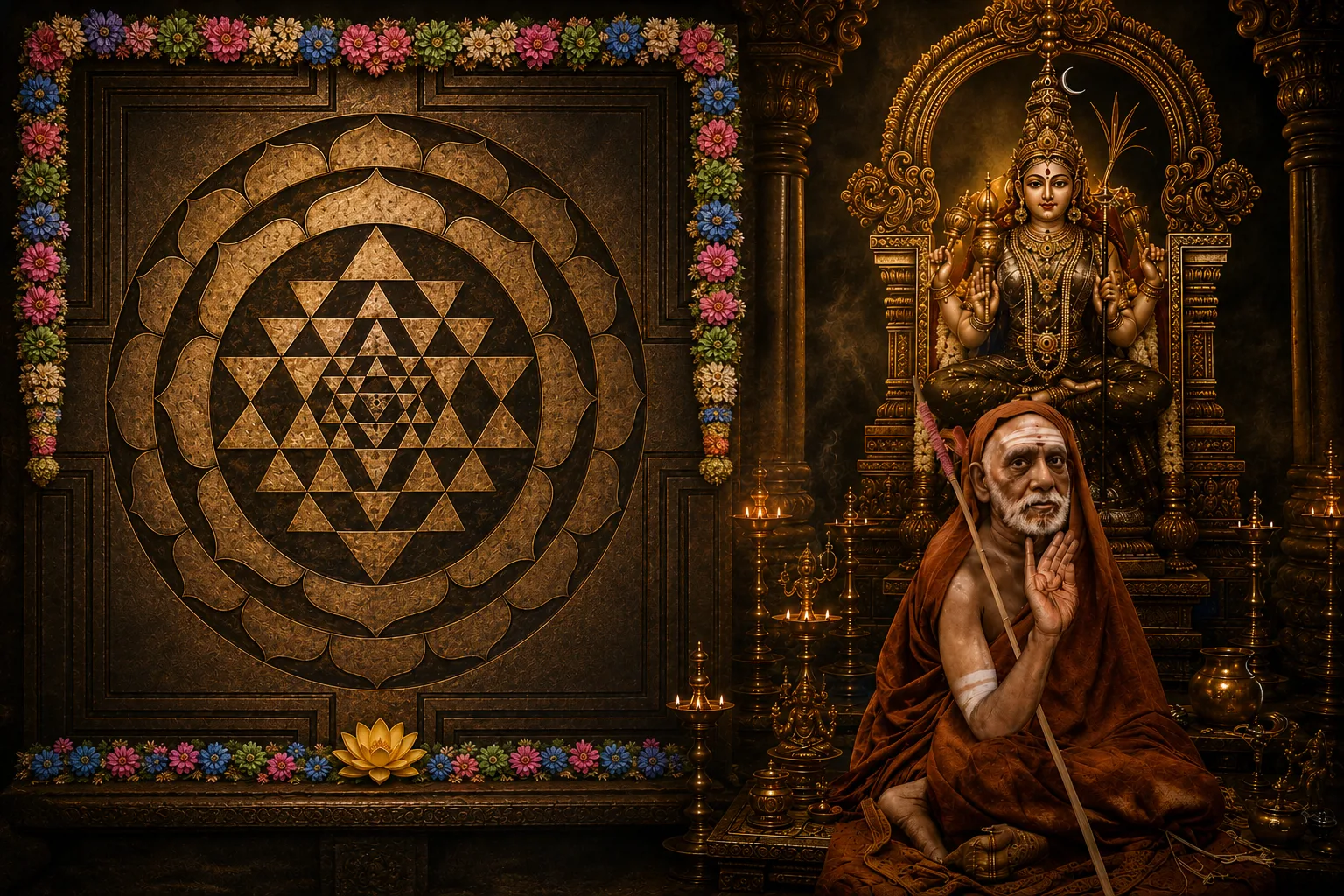
The Cart to Kalavai
On a February morning in 1907 a bullock cart left Kāñcīpuram on the road north-west towards Arcot, carrying a hereditary servant of the Śaṅkara Maṭham and a boy of thirteen who did not know where he was being taken.
The boy had bathed that morning at the Kumāra Koṣṭha tīrtha. He had come with his mother and his brothers and sisters from Tindivanam, where his father was in government educational service and where he was a prize-winning student at the Arcot American Mission High School. The family was travelling to Kalavai to console his mother's sister, a widow whose only son had just been made a sannyāsī and taken from her forever. That was the whole purpose of the journey. A death had emptied the seat of the Kāñcī Kāmakoṭi Pīṭham, the widow's son had been chosen to fill it, and the women of the family were going to weep with her.
At the Maṭham in Kāñcīpuram a cart had arrived from Kalavai to buy articles for the tenth-day rites of the departed Ācārya. One of the men in it, a maistri of the Maṭham, asked the boy to come with him. A separate cart was arranged for the rest of the family to follow. That sepāration was the first thing that was strange.
As the wheels turned the maistri began, carefully, to say things. That the boy might not be going home again. That the rest of his life might be spent inside the Maṭham. The boy reasoned it out as a child reasons: his elder cousin had become head of the institution and must want family near him, though what use a thirteen-year-old could be to a Jagadguru was hard to see.
Mile by mile the man let the rest of it out. The new Ācārya, the cousin, had been taken by a violent fever that had gone into delirium. He had held the seat for seven days. He was dead.
The boy understood then why he had been put in a separate cart.
He lay down in the moving cart in a kneeling posture and repeated the only prayer he knew, the name of Rāma, for the rest of the journey.
His mother arrived at Kalavai some hours later. She had come to console her sister on the loss of a son to sannyāsa. She found that she had been brought there to be consoled herself.
His name was Swaminathan. On the thirteenth of February 1907 he was given sannyāsa and the name Candraśekharendra Sarasvatī, and he became the sixty-eighth Ācārya of the Kāñcī Kāmakoṭi Pīṭham.
He held that seat for eighty-seven years. Settled
The Seat He Was Put On
What Kāñcī holds
To understand what happened to the boy in the cart, the seat itself has to be understood first, because the Kāñcī Kāmakoṭi Pīṭham is not an office of administration with a religious title attached. It is a specific and continuous ritual obligation, and the man who holds it is bound to it every day of his life.
Śrī Ādi Śaṅkara Bhagavatpāda, having completed his conquest of the schools and established his maṭhas, came south to Kāñcī and made it the place of his final years. With the assistance of Rājasena, the ruler of Kāñcī, he had the city remodelled and the three principal temples rebuilt, those of Śrī Ekāmranātha, Devi Kāmākṣī and Śrī Varadarāja. Before Kāmākṣī he consecrated the Śrī Cakra, binding the fierce grace of the Devi into a form that would bless all who came for her darśana. He ascended the Sarvajña-pīṭha, the Throne of Omniscience, at Kāñcī. And at Kāñcī, having consecrated Kāmākṣī, he attained the state beyond return.
The record. Śaṅkara's years at Kāñcī, the consecration of the Śrī Cakra before Kāmākṣī, the ascent of the Sarvajña-pīṭha and the attainment at Kāñcī are set down in Anantānandagiri's Śaṅkaravijaya, in the seventy-second khaṇḍa of the Mārkaṇḍeya Saṃhitā, and in the Śivarahasya, whose manuscripts are catalogued in the Oriental Research Institute collections at Mysore. The Pīṭham was established in 482 BCE and has carried an unbroken succession of Ācāryas from Śaṅkara himself to the present day, seventy-one in the line.
The Pīṭham is the Mūlāmnāya Sarvajña Pīṭham, the seat of the root transmission. Its presiding form is Kāmākṣī. Its daily worship is of the Candramaulīśvara, one of the five sphaṭika liṅgas that Parameśvara gave to Śaṅkara on Kailāsa with instructions on how they were to be worshipped for the welfare of the worlds. Śaṅkara kept the Yoga Linga for his own worship and for that of his successors at Kāñcī.
That pūjā is not delegable. It is performed by the Ācārya himself, every day, wherever he happens to be, in a temple town or under a tree on a road in Maharashtra. For eighty-seven years a man performed it without a break.
The Devi of the seat
Kāmākṣī at Kāñcī is not one shrine among many for the Kāñcī Ācārya. She is the deity of the Pīṭham. The Śrī Cakra before her is Śaṅkara's own installation, and the Ācārya of Kāñcī is by office an upāsaka of that Śrīvidyā lineage. The Pīṭham's Ācāryas have historically been Śrīvidyā upāsakas of the highest order, and the sixty-eighth was recognised by those competent to judge as standing at the summit of that tradition in his century.
This bears directly on what devotees came to say about him. Those who came to him in the last decades of his life did not experience themselves as visiting a distinguished monk. They experienced themselves as being looked at by Kāmākṣī. The identification of the Ācārya with the Devi of his seat, and with Śaṅkara whose seat it is, came first and came involuntarily, from the people standing in front of him, including a great many with no motive to say such a thing and considerable professional reason not to.
The Ācārya's exposition of the Saundaryalaharī, delivered in Tamil across many sittings and later printed, remains one of the closest readings of that hymn made in the modern period. He treated it exactly as the tradition treats it, as Śiva's own composition handed to Śaṅkara, and he read it as a manual rather than as poetry.
Viluppuram, 1894
The family
He was born on the twentieth of May 1894, in Viluppuram in South Arcot, under the nakṣatra Anurādhā, in a Kannada-speaking Smārta family of the Hoysala Karnataka community which had migrated into the Tamil country generations earlier.
His father was Subrahmanya Sastri, a schoolmaster who rose in the educational service and served as a District Education Officer. His mother was Mahalakshmi, of a Kannada Brāhmaṇa family from Eachangudi near Tiruvaiyaru. He was their second son. A younger brother, born in 1903, became known to a later generation of Madras as Sivan SAR, a figure of considerable learning in his own right.
The child was named Swaminathan after the family deity, Swaminatha of Swamimalai, the Lord who taught his own father the meaning of the Pranava. The name would turn out to be exact.
Hoysala Karnataka Smārtas. A community of Kannada-speaking Smārta Brāhmaṇas whose migration into the Tamil country dates to the medieval period, retaining Kannada in the home while functioning entirely within Tamil Vedic and temple life. The household the Ācārya was born into was therefore trilingual before he was old enough to notice, and the ease with which he later moved between Sanskrit, Tamil, Telugu, Kannada, Marathi, Hindi and English begins here.
The horoscope and the school
When Subrahmanya Sastri had the boy's horoscope read, the astrologer set down the palm leaf and prostrated to the child.
The rest of the childhood ran along lines that read, in retrospect, as ordinary and slightly comic. He was educated at the Arcot American Mission High School at Tindivanam, where his father was posted. He was a first-rate student across subjects. He won a school prize for proficiency in recitation of the Bible.
His upanayana was performed at Tindivanam in 1905, and from that point the Vedic training began in earnest alongside the mission-school English. He was quick past the point of comfort. A family story that survives from those years has him hearing a cousin recite a Vedic passage and repeating it back without error, having never learnt it.
In 1906 the sixty-sixth Ācārya of the Kāmakoṭi Pīṭha was camping at Perumukkal, a village near Tindivanam, for the Cāturmāsya observance. The boy would have had darśana there. Neither he nor anyone else had reason to think it meant anything.
Seven Days in 1907
The two deaths
The sixty-sixth Ācārya attained siddhi at Kalavai in the first week of February 1907.
Before he went he had made his arrangements. Word had been sent for a boy of the family at Tindivanam to be brought as his successor. In the confusion of the moment the choice fell first on Swaminathan's maternal cousin, Lakshmikantan, the only son of his mother's widowed sister. That boy was given sannyāsa and installed as the sixty-seventh Ācārya with the name Mahādevendra Sarasvatī.
He held the seat for seven days. A fever took him and went into delirium and he died on the thirteenth of February 1907.
The succession at Kalavai in February 1907
| Ācārya | Identity | Dates |
|---|---|---|
| 66th | Candraśekharendra Sarasvatī, pontiff from 1891 | Siddhi at Kalavai, early February 1907 |
| 67th | Mahādevendra Sarasvatī, born Lakshmikantan, first cousin of Swaminathan | Installed February 1907, siddhi after seven days |
| 68th | Candraśekharendra Sarasvatī, born Swaminathan, aged thirteen | Sannyāsa 13 February 1907, seat held until 8 January 1994 |
What was done to a boy of thirteen
The bare sequence conceals the violence of it. In the space of one journey a schoolboy lost his cousin, his family, his school, his name, his hair, his clothes, his mother and the entire expected shape of his life, and was placed under an obligation that would not release him for eighty-seven years.
He was given sannyāsa at Kalavai on the thirteenth of February 1907. The formal paṭṭābhiṣeka as sixty-eighth Pīṭhādhipati was performed at the Kumbakonam Maṭham on the ninth of May 1907, days before his thirteenth birthday had turned into his fourteenth year.
He never spoke about the loss with self-pity, and in the one long interview he gave about his own life he described the whole episode with the flatness of a man describing weather. But the measure of what he became was taken twenty-five years later, and it is worth putting here rather than in its chronological place.
14 June 1932. A messenger arrived at the Maṭham from the Ācārya's native village carrying a telegram. Before the man could hand it over the Ācārya asked him whether the message came from that village. Told that it did, he sent him away without opening it. Then he turned to those around him and said that there was nothing a sannyāsī could do or say when his mother had died.
That is the whole of it. The renunciation was not a costume worn over an ordinary man. By 1932 there was nobody inside it who could be widowed of a mother.
The Court of Wards Years
An institution in receivership, a boy in training
The Maṭham that came to him in 1907 was not in good condition. A minor held the seat. Between 1911 and 1915 the temporal affairs of the institution were administered by the Court of Wards, the colonial machinery for managing the estates of proprietors who were legally incapable, until the Ācārya attained his majority in May 1915.
The spiritual formation, meanwhile, was in the hands of scholars, and it was relentless.
From 1909, at fifteen, he studied for two years under the pandits of the Maṭham at Kumbakonam. From 1911 to 1914 he was at Mahendramangalam, a small village on the northern bank of the Akhaṇḍa Kaveri, in conditions of near-total seclusion, and this was the period in which the foundation was laid. He returned to Kumbakonam in 1914. His personal training at Kalavai in the earliest period was overseen by Adayapalam Pasupati Iyer, who took a stunned thirteen-year-old and began turning him into a Jagadguru.
What the training consisted of
The curriculum of a Śaṅkarācārya is not general religious education. It is technical, and it is enormous.
He was taken through the Veda in recitation and in meaning, through Vedānta with the bhāṣyas of Śaṅkara, through Purva Mīmāṃsā, through Vyākaraṇa in the line of Pāṇini, Kātyāyana and Patañjali, through Nyāya, through the Dharmaśāstras with their commentarial apparatus, through Jyotiṣa and the calendrical sciences, through the Āgamas that govern temple construction and worship, and through the sixty-four kalās that the tradition considers the proper furniture of a cultivated mind.
Alongside this he took an interest in things nobody expected. He learnt photography. He worked at mathematics. He followed astronomy closely enough to reason about calendrical questions with professionals, and he retained that interest for the rest of his life, later questioning physicists and astronomers who came for darśana with a specificity that unnerved them.
The training produced a man who could sit with a Vedic pandit, a Sanskrit grammarian, a temple sthapati, a nuclear physicist and an illiterate village woman in the same afternoon, and give each of them the conversation they needed.
By his majority in 1915 the boy in the cart had been replaced. What emerged was an Ācārya of the classical type, who had absorbed the entire technical inheritance of the tradition and had also, quietly and without any of it being visible from outside, become something the technical inheritance describes but rarely produces.
The Century He Was Given
What was happening to the ground under him
The scale of what he did is only visible against the century he did it in.
He was born in 1894 in the Madras Presidency, in the reign of Victoria, in a country administered from London. He died in 1994 in a Republic that had fought four wars, survived a Partition, written itself a Constitution, and just begun dismantling its own economic controls. Between those two dates the social order that had carried the Vedic transmission for three thousand years was subjected to more pressure than in the whole preceding millennium.
The agrahāram economy that had supported hereditary recitation was dissolving. Land settlements, litigation and the fragmentation of holdings removed the base that had fed pandits without their needing employment. Colonial education created a single ladder to advancement, and the ladder was in English, and it did not have Sanskrit on it. The professions filled with men whose grandfathers had known a Veda śākhā and whose sons would not know the alphabet it was written in. Temples lost endowments to legislation, mismanagement and neglect. The cities pulled the young out of the villages, and what a boy learnt in a village between the ages of eight and eighteen was precisely what he no longer had time to learn.
The arithmetic of a śākhā. A Veda śākhā is transmitted by a boy learning it aloud from a teacher over roughly twelve years, beginning around age eight. It cannot be learnt part-time, in adulthood, in a city, or from a printed book, because what is transmitted is not the text but the exact sound, the svaras, and the recitational permutations that armour it. Each śākhā therefore requires an unbroken supply of eight-year-olds every generation. Break the supply for forty years and the śākhā is not damaged. It is gone.
Why he walked instead of writing
That is the situation into which a man with the largest religious authority in southern India was placed, and it explains his method entirely.
He did not write books, found a movement, take a political position, seek legislation or build a following abroad. He walked, for twenty years continuously and for decades intermittently after that, into the villages where the eight-year-olds were, and asked in each one whether the pāṭhaśālā still functioned, whether the pandit was being fed, whether the temple was open, and whether anybody was still reciting.
Then he built the trusts that put money into exactly those points.
He was not defending a religion against rivals. He was keeping a chain of sound from breaking during the one century in which it could actually have broken.
The Vijaya Yatra
Setting out, 1919
In 1919 the Ācārya left Kumbakonam on foot.
The journey that began that year did not end until 1939. Twenty years. It has no real parallel in the modern religious history of the subcontinent, and it is the single fact from which everything else about his public life follows.
The scale of the procession in the early years was that of a medieval court. The Ācārya travelled in a palanquin. Behind him moved two hundred people, twenty bullock carts, elephants, camels and horses, the Vedic pandits of the Maṭham, the ritual vessels, the Candramaulīśvara for the daily pūjā. Towns emptied to receive him. He himself treated the entire apparatus of pomp as belonging to Īśvara and not in any sense to the body being carried in the palanquin.
The route took him through the whole Tamil country, then Andhra, then Karnataka, then Maharashtra, then north and west and back, camping in villages for a night and in towns for a season, halting for the four months of Cāturmāsya wherever the calendar caught him.
What a camp was. A camp was not a stop. Wherever the Ācārya halted, the day's Candramaulīśvara pūjā was performed, Vedic recitation was arranged, local pandits were examined and honoured, the state of the local temples was enquired into, disputes were heard, and anyone who came was given darśana. In hundreds of places the arrival of the camp was the first time in generations that the Veda had been recited publicly in that village and the first time anyone had asked whether the local temple still had a functioning pūjāri.
Tiruchirappalli, 1923
The reception at Tiruchirappalli in May 1923 gives the measure of what he had become by his late twenties.
The chairman of the reception committee was F. G. Natesa Iyer, the elected Mayor, a leading Congress activist of the town and one of the principal organisers of the Non-Cooperation Movement there. He had been raised a Christian from the age of ten by Englishmen who took him in, and had returned to the Sanātana fold twenty years later after taking his doubts to this Ācārya and receiving answers that satisfied him. He now put the entire machinery of the nationalist movement in Tiruchirappalli into welcoming a Śaṅkarācārya.
The procession ran for miles and took nearly five hours to reach the Maṭham at Thiruvanaikkaval. Seven groups of nadaswaram players led it, with band parties, four elephants, horses and camels, bhajana groups, Thevaram singers, and a mass of Brāhmaṇas chanting the Veda around the ivory palanquin. Natesa Iyer himself held the front pole. People of every community lined the route.
The editorial in The Hindu on the tenth of May 1923 recorded the plain political fact of it, that neither a Viceroy nor the Emperor could have drawn such a crowd, and read it as evidence of where the real hold on the Indian people still lay.
The colonial state understood processions and could organise them. It could not manufacture the thing that emptied Tiruchirappalli onto the streets that evening.
Khadi
Somewhere on that yātrā the Ācārya made a decision that was noticed far outside religious circles.
The Maṭham's practice was that the Ācārya wore silk. At Rāmeśvaram he stopped, and moved to khadi, hand-spun and handwoven, dyed in kāṣāya. He had already asked devotees at Trichy to give up foreign and unnatural cloth. He did not make a political speech about it and he never joined a political movement. He simply changed what he wore and let a hundred thousand people draw the inference.
When Gandhi met him four years later, the first thing the Mahatma noticed was the handspun ochre cloth on the man in front of him.
Kāśī, October 1934
The yātrā reached Kāśī in early October 1934, and the Ācārya stayed nearly six months.
A Śaṅkarācārya of the southern seat, arriving in the city of Viśvanātha at the head of a Vedic camp, in the middle of the colonial period, and remaining half a year: the effect on the north Indian pandit community was considerable. The Kāñcī Maṭham's presence in Kāśī dates its modern strength from that stay.
In the course of his life he covered the country from Rāmeśvaram to the Gaṅgā on foot twice. Later generations gave him the name that stuck harder than any title conferred by any institution.
Nadamadum Deivam. The walking God. In Telugu, Nadiche Devudu. The name was not given by the Maṭham and was never claimed by him. It arose in the villages, from people who had watched him come down a dirt road in the sun at the head of his camp, and it is the name by which crores of people who never learnt his sannyāsa name knew exactly who was meant.
The Telugu Country
Nadiche Devudu
The yātrās took him through the Telugu-speaking country again and again, and the Telugu lands gave him a name of their own. Nadiche Devudu, the God who walks, is the exact Telugu of the Tamil Nadamadum Deivam, and it arose independently in the same way, from villagers watching a camp come down a road.
He spoke to Telugu devotees in Telugu. The accounts of this are numerous and they follow a pattern that recurs in every language of the peninsula: a devotee arrives, having said nothing about where he is from, and is addressed in his own mother tongue by a man who was expected to speak only Tamil and Sanskrit. Nobody who received this treated it as a linguistic accomplishment. Everybody who received it understood it as being known.
What he built there
The Andhra country carries a permanent share of his institutional work. The Sri Kanchi Veda Vedanta Sastra Sabha at Tenali was established under his direction as a body for the examination, certification and honouring of śāstra scholars, and it has continued to function as one of the significant instruments of Vedic and śāstraic assessment in the Telugu lands. The Sri Sankara Veda Samskruta Pathasala in Andhra Pradesh belongs to the same network of pāṭhaśālās raised and sustained under the Veda Rakshana Nidhi.
His discourses in the Telugu districts covered the same ground he covered everywhere, dharma, the protection of the Veda, the duties of the householder, and the single obligation of transmission. Telugu devotion to him did not diminish after 1994. It grew. In the present century Telugu devotees have retraced his pādayātrā routes through Andhra Pradesh on foot with his pādukās, in an attempt to walk what he walked.
A line that returned. On the thirtieth of April 2025, on Akṣaya Tṛtīyā, at the Kāmākṣī Ambal Devasthanam in Kāñcīpuram on the banks of the Pañca-Gaṅgā pond, Śaṅkara Vijayendra Sarasvatī gave sannyāsa dīkṣā to a young man from Annavaram in Andhra Pradesh, born Duddu Satya Venkata Surya Subrahmanya Ganesha Sarma Dravid, who became Satya Candraśekharendra Sarasvatī, designated the seventy-first Ācārya. A hundred and eighteen years after a Kannada-speaking boy from a Tamil district was put in a cart to Kalavai, the seat passed toward a Telugu boy from the Godāvarī country. The Pīṭham has never been the property of a language.
The Cattle Shed at Nellisseri
15 October 1927
Mahatma Gandhi toured the south in the latter half of 1927. He had heard about the Sage of the Kāmakoṭi Pīṭha and wanted to meet him. The Ācārya was camping at Palghat in the course of the yātrā.
The meeting took place on the fifteenth of October 1927, at Nellisseri village near Palakkad, in the cattle shed at the back of the camp. Rajaji had come with the Mahatma.
They talked for over an hour, the Ācārya in Sanskrit and Gandhi in Hindi. The Ācārya put to him the position that faith in and devotion to Īśvara decide the outcome of all human activity, and Gandhi assented.
Shortly before Gandhi had reached Palghat the news had come of the assassination of Svāmī Sraddhananda of the Arya Samaj. Gandhi raised it in the cattle shed. He said he had a foreboding that killings of that kind would come more often in the years ahead, and he prayed that not even a small measure of hatred against the assassin should arise in him.
Forty-one years later, in November 1968, the University of Madras held a seminar on the relevance of Gandhi to the world of thought and asked the Ācārya for a message. Of everything the two men had discussed, that was the exchange he chose to place before the seminar.
The end of the meeting. It was half past five. Rajaji, who had waited outside during the conversation, came in to remind Gandhi that he did not eat after six. Gandhi answered that the conversation with the Svāmī was itself his evening meal. As he left, the Ācārya gave him a citrus fruit, and Gandhi took it with unusual reverence and said it was the fruit he liked best. At a public meeting in Coimbatore that evening people asked him what had passed between them. He said it was a private interview, that no reporters had been present for exactly that reason, and that there was no purpose in disclosing it.
Gandhi kept whatever he had asked for to himself for the rest of his life. Long after the assassination the Ācārya told a devotee what it had been. Gandhi had asked for a death with the name of Rāma on his lips, and had been told not to worry, that by the grace of Īśvara it would be so.
On the thirtieth of January 1948 it was so.
The Englishman Who Was Sent Away
In 1930 a British journalist named Raphael Hurst came to India looking for genuine spiritual attainment and finding mostly conjuring. He met Meher Baba, Vishuddhananda Paramahansa, assorted yogis and several frauds. He also met the Ācārya of Kāñcī.
By the time of that meeting he was ill, exhausted, out of money and out of patience, and intended to leave the country. The Ācārya insisted that before he left he must go to Tiruvannamalai and see the Maharṣi.
He went. What happened at the feet of Śrī Ramaṇa Maharṣi produced, in 1934, the book A Search in Secret India, published under the name Paul Brunton. It became a bestseller in England and it is the single work most responsible for the fact that the West knows who Ramaṇa Maharṣi was.
Brunton was in no doubt about who had sent him. Of all the holy men he had met in India, he named two who had marked him permanently, the Maharṣi of Arunachala and the Śaṅkarācārya of Kāñcī. Of every living holy man in India, he wrote, the Kāñcī Ācārya was by a long distance the most enlightened.
An entire century of Western interest in Advaita traces back through Brunton to a sick and disillusioned journalist being told, by a man who could have kept him, to go and see somebody else.
That is the detail worth holding. The Ācārya had in front of him a Western writer capable of making any teacher famous, and he sent him to Arunachala.
Veda Rakshanam
The one thing he was doing
For eighty-seven years, under all the variety of his activity, the Ācārya was doing a single thing, and he said so in almost every discourse he ever gave. He was protecting the Veda.
His reasoning was not sentimental. The Veda is apauruseya, not composed by any person, transmitted by exact oral succession with an elaborate armour of recitational patterns designed to make corruption impossible. That armour only works if human beings keep reciting. A generation that stops is not a generation that loses a book, because the book can be reprinted. A generation that stops breaks a chain of sound that has been unbroken since before history, and no amount of scholarship reconstitutes it afterwards.
He read the third of those injunctions as an instruction with a deadline attached, and he spent nine decades acting on it.
The machinery he built
He was not a man who issued appeals and moved on. He built durable institutions with money, trustees and rules, and he did it repeatedly across seventy years.
Principal institutions and trusts founded or inspired by the sixty-eighth Ācārya
| Body | Purpose | Note |
|---|---|---|
| Advaita Sabha | Propagation and defence of Advaita | Established 1895 by the 66th Ācārya, sustained and expanded under the 68th |
| Veda Dharma Sastra Paripalana Sabha | Protection of Vedic and śāstraic practice | Dissemination and public assembly work |
| Veda Rakshana Nidhi Trust | Funding and inspection of Veda pāṭhaśālās, examinations and certification | The central instrument of Veda protection |
| Shashtiabdapoorthi Trust | Support for higher learning of the Veda, beyond recitation into meaning | Established 1954, on the Ācārya's sixtieth year |
| Veda Pata Nidhi Trust | Lifelong monthly support for aged and indigent Veda pandits | Proposed by him in March 1983, on his eightieth birthday concern |
| Sri Sankara Vidyalayas and Sankara schools | Modern schooling rooted in Indian values | From 1970 onwards across the south |
| Sri Chandrasekharendra Sarasvati Viswa Mahavidyalaya | Deemed university at Kāñcīpuram | Established in his centenary period |
The Veda Pata Nidhi Trust deserves its own sentence because of how it began. He was being honoured on his eightieth birthday, in the middle of the celebration, and he observed that while so much was being spent on honouring him there was almost nobody looking after Vedic pandits far more learned than the men organising the felicitation. T. S. Santhanam of the TVS group founded the trust. Nani Palkhivala, the constitutional lawyer, became its first chairman. It pays a monthly honorarium for life to old men who have preserved the moolam of a Veda śākhā and have nothing else.
Why the money mattered. A Veda pati who has spent twelve years memorising a śākhā in ghana pāṭha has no marketable skill in a modern economy. He can officiate at rituals and recite for a fee, and when he becomes too old to walk to the ritual he starves. Every generation of such men who die in destitution is a live advertisement to their sons not to learn. The Ācārya understood the economics of transmission with total clarity, and the trusts he built were aimed exactly at the point where the chain actually breaks.
He also did the unglamorous half of the work. He examined pandits himself. He instituted the Śāstra Parīkṣā. He arranged Veda Sammelanams and Veda Pārāyaṇams and Saptāhas so that recitation happened in public and boys saw it. He insisted on correct pronunciation and corrected priests on their svaras without embarrassment. He revived Āgamic standards in temple worship. He caused kumbhābhiṣekams and renovations at temples across the country in numbers no one has fully counted.
The Voice
How he taught
He gave no lectures in the modern sense. He sat on the floor, or on a low platform, and talked, in Tamil, for as long as the subject took, on the verandah of a house, on a river bed, in the courtyard of a temple, in a small sabha hall. There was no amplification for most of his life and no theatre in the delivery. People sat on the ground in front of him.
The range of the discourses is the astonishing thing. Over decades he spoke on the Vedas and their śākhās, on the six darśanas, on Vedānta and the bhāṣyas, on Sanskrit grammar and prosody, on Tamil literature and the Thevaram and the Divya Prabandham, on the Tirukkural, on temple architecture and iconography, on music, on astronomy and the calendar, on medicine, on economics as a moral question, on the duties of the different āśramas, on how to bring up a child, on what to do about a quarrel with a neighbour.
He never separated the vast from the small. A discourse could move from the nature of Brahman to the correct way to keep a household lamp without changing gear, because in his understanding these were not two subjects.
Deivathin Kural. The discourses were taken down over many years by Ra. Ganapathy, a devotee, and published in Tamil by Vanathi Publishers as Deivathin Kural, the Voice of God, running to seven volumes. Selections appeared in English as Hindu Dharma, published by the Bharatiya Vidya Bhavan, and as the Voice of God volumes, and have been translated into many Indian languages. The corpus is the largest and most wide-ranging body of oral teaching left by any Ācārya of the Śaṅkara tradition in the modern period.
Tamil, Sanskrit and the children
He was a Sanskritist of the first rank who was also, and without any tension, a lover of Tamil.
He held long discussions with the leading Tamil scholars of his day, spoke about the Thevaram and the Divya Prabandham and the Tirukkural as freely as about the Upaniṣads, and rejected the premise, then being manufactured around him, that devotion to Sanskrit and devotion to Tamil were competing loyalties. The Tamil devotional corpus in his handling was not a vernacular substitute for the Veda. It was the same thing in another tongue, made by people who had the same realisation.
He was equally clear that a child must be taught its own language properly before anything else, and that a household which loses its mother tongue in one generation loses access to everything written in it in all the generations before.
His most characteristic intervention on this front was aimed at children. He instituted the Paavai Nonbu Padal Poti, competitions held in the month of Margazhi in which young children recite and sing the Thiruppavai of Andal and the Thiruvempavai of Manikkavachakar. It is a small thing and it was entirely deliberate. A child who has stood up in a competition at seven and sung thirty verses of Andal carries them at seventy.
On music. He treated Carnatic music as an instrument of dharma rather than as an art requiring his patronage, and the musicians of his period treated him accordingly. His interventions were characteristically technical: correct pronunciation of the Sanskrit in the compositions, correct understanding of what the composer had actually said, and preference for what carried bhakti over what displayed skill. The single largest effect of this was the recorded devotional repertoire that came out of it, which reached more households in a decade than the concert tradition had reached in a century.
The refrain
Almost every talk ended the same way. He would state the position, and then he would say that this is a dharma that has to be practised, not discussed. The Vedas are the breath of Īśvara. Preserving them is a debt owed not only to Īśvara but to every ṛṣi who kept the chain intact long enough to hand it on.
He asked for small, exact, daily things rather than grand resolutions: recite something every day, however little; write the name of Rāma; light the lamp; go to the temple; do the sandhyavandana at the right time; give a fixed share away; teach the children the language they were born into.
He held that a civilisation is not destroyed by argument. It is destroyed by a generation that stops doing small things daily, and is restored the same way.
The Teaching Itself
Advaita, taught without dilution
He was a Śaṅkarācārya, and what he taught was Śaṅkara's Advaita without softening and without novelty. Brahman alone is real. The jiva is not other than Brahman. The world of names and forms is not an independent second thing. Liberation is not the production of a new state but the removal of an ignorance about a state that already obtains.
He refused, absolutely and throughout his life, to modify the śāstra to suit the age. His stated position on his own office was precise and he repeated it whenever people pressed him to innovate. A Pīṭhādhipati is not empowered to alter the Dharmaśāstras. His mandate is to expound them, to follow them, and to be the demonstration that they can be followed. Reform of the śāstra was not in his commission. Living it visibly, so that the claim that it could not be lived became untenable, was.
The realised man who kept working
The question that devotees asked most often about him, and that he never answered directly, was why a man in that state continued to carry an institution.
The tradition's answer is in the Gītā, and he lived inside it so exactly that his life reads as a commentary on those verses. The jñānī who has nothing left to gain by action continues to act, because the standard of conduct in a society is set by what its best men actually do, and because withdrawal by the wise produces confusion in everyone watching.
Lokasangraha, the holding together of the world, is the technical term, and it is the correct description of what he was doing for eighty-seven years. He had realised the Ātman as a living fact. He then got up every morning and performed the Candramaulīśvara pūjā, examined pandits, settled temple disputes, wrote letters, corrected pronunciations, consoled widows, walked twenty miles and did it again, because that was the duty attached to the seat he had been placed on at thirteen, and because a jñānī who abandons the duty teaches everyone below him to abandon theirs.
Nama, japa and the reach of it
He was severe about śāstra and completely unsevere about access to it. The instruction he gave most often, to the largest number of people, was the simplest one available. Take the name. Repeat it. Write it. He set enormous numbers of ordinary people to writing Rāma nāma in notebooks, and he encouraged Viṣṇu Sahasranāma parayana widely, including among women, in a period when that was not the settled custom everywhere.
Duty as debt
His treatment of varṇa and jāti was the classical one and it was, in his mouth, uncomfortable for exactly the people who expected to be comfortable with it.
The hereditary orders of society, in his exposition, are an allocation of obligations, not a distribution of privileges. A Brāhmaṇa is not a man with rights. He is a man carrying an unpaid debt to the Veda, required to study it, to teach it without fee, to live on very little, and to be available to everybody. The moment he stops doing that he has not merely failed personally, he has forfeited the entire ground on which anyone owed him anything, and the Ācārya said so to Brāhmaṇa audiences with a bluntness he never used on anyone else. The hardest words he ever spoke in public were spoken to his own community, and he spoke them for seventy years.
The same logic ran the other way. He held that every hereditary craft community of Bhārata is the custodian of a technique that exists nowhere else and cannot be reconstructed once the last practitioner dies. The sthapati who knows the proportions of a vimāna, the weaver, the vaidya, the temple musician, the maker of instruments, the sculptor in stone and the caster in bronze: each of them is holding a piece of the civilisation in their hands. He honoured such men publicly, examined their knowledge with real interest, and treated the collapse of a craft as a national bereavement equivalent to the loss of a Vedic śākhā.
Nobody in his account of society was in a position to look down on anybody, because everybody was carrying something they could drop.
The temple, dāna and the economy of dharma
He was unwavering about the temple, and his position was institutional rather than sentimental.
A temple is not a building for private devotion. Historically in Bhārata it was the fixed point of the settlement, employer of scores of hereditary servants, holder of endowment lands, feeder of the poor, school, hospital, granary, treasury, concert hall and court of last appeal in a village dispute. Its wealth is the deity's and nobody else's. Its worship must be conducted by the Āgamic standards or it produces no result. When worship lapses and a temple falls silent, the village loses the thing that organised it.
Hence the enormous energy he put into kumbhābhiṣekams, into recovering lapsed worship in temples nobody had entered in decades, into training and correcting pūjārīs, into the restoration of Āgamic procedure, and into simply asking, in every camp in every village for eighty-seven years, what the condition of the local temple was.
On dāna he was equally practical. He asked householders to fix a share of income and give it away as a discipline rather than as a response to appeals, and he was specific that the giving should reach Vedic scholars, the sick, and the destitute of the locality rather than being dispersed into whatever asked loudest.
Dharma before wealth and pleasure
On the day India became free he issued a message, and its structure tells everything about his politics, which were not politics at all.
He asked people to pray for strength of mind and energy to devote themselves increasingly to spiritual knowledge, holding that freedom won with difficulty is safeguarded only by the grace of Īśvara. He then wished for the country the four puruṣārthas in the Tamil order, aram, porul, inbam and veedu, dharma, wealth, happiness and liberation, with dharma placed first, which is the whole argument. Wealth and pleasure are legitimate ends. They are legitimate only when fenced by dharma, and a nation that pursues the second and third without the first has not become free of anything.
He remarked that day on a coincidence he found agreeable, that the three colours of the national flag are the colours of the three Śaktis, the deep green of Durga the protectress, the golden orange of Mahalakshmi, and the white of Sarasvatī.
On his relationship with politics. He never entered politics and could not, being a sannyāsī. He was closely informed about it. He supported the freedom struggle in his heart and expressed it in the way available to a sannyāsī, by changing what he wore and letting a hundred thousand devotees notice. Rajaji, Natesa Iyer and a long line of Congress figures came to him. He told them, in effect, that men engaged in the service of the country need not apologise for coming without having completed their ablutions, since their tireless work was itself their prayer and their vrata.
Maitrīṃ Bhajata
The invitation
In 1966 U Thant's United Nations invited M. S. Subbulakshmi to sing at the General Assembly on United Nations Day.
M. S. and her husband Sadasivam were lifelong devotees of the Ācārya and took no decision of consequence without going to Kāñcīpuram. They went at once. The Ācārya gave her a benediction in Sanskrit which he had composed as an anthem of universal friendship, and told her to sing that.
The benediction, pāda by pāda
Eight pādas in two verses, and there is not a wasted word in them. Read in order they are a complete Vedāntic argument for peace, built downward from metaphysics to conduct and closing in a blessing.
Maitrīṃ bhajata, akhila-hṛj-jaitrīm. The opening imperative is not a request for tolerance and not a plea for coexistence. Bhajata is the verb of bhakti, cultivate it, take to it as worship. And the friendship being asked for is described by what it does, akhila-hṛt-jaitrī, the conqueror of every heart. The Ācārya opens an address to the assembled nations of the earth by telling them that the only conquest worth the name is one that takes the heart, and that its weapon is friendship.
Ātmavad eva parān api paśyata. Here is the reason, and it is Advaita stated as an instruction rather than as a doctrine. The instruction is to see others exactly as one sees oneself. Not sympathetically, not charitably, not as a moral discipline of imagining another's position, but as the plain perceptual fact it is, because the self in them is not a second self. Every practical injunction that follows in the hymn is a consequence of this one line, and without this line the rest would be sentiment.
Yuddhaṃ tyajata, spardhāṃ tyajata. Two abandonments, and the order is the point. War is to be given up, and then rivalry. The second is the harder and the more fundamental, because spardhā, competitive striving against another, is the seed of which war is the visible crop. A world that renounces war while retaining rivalry has renounced nothing and will be at war again shortly. This was said in October 1966, between two hot wars in Asia and in the middle of the Cold one.
Tyajata pareṣu akrama-ākramaṇam. The third abandonment names the specific wrong. Not aggression as such, but akrama-ākramaṇa, the unjust invasion, the attack that has no ground in dharma. The formulation is exact and it is not pacifism. What is forbidden is the wrongful assault on others, not the defence that dharma requires, and the distinction between the two is the whole of the Sanātana teaching on force.
Jananī pṛthivī kāma-dughā aste. The ground of the argument now shifts to abundance. The earth is not a limited stock over which parties must contend. She is jananī, mother, and kāma-dughā, the yielder of all that is desired, the milking cow of the Vedic imagination. Scarcity, in this reading, is not the human condition. It is what men manufacture by grasping.
Janako devaḥ sakala-dayāluḥ. And the father is Īśvara, compassionate to every one without remainder, sakala. The two lines together make a single claim about the nature of the situation people find themselves in. The universe is a household with a mother who provides and a father who is merciful to all his children equally. Quarrelling within it is not merely wrong. It is a misreading of where one is standing.
Dāmyata, datta, dayadhvam janatāḥ. Into the seventh pāda the Ācārya set the three syllables of the Bṛhadāraṇyaka Upaniṣad, in which Prajāpati answers gods, men and demons with the single sound of thunder, da, and each hears the instruction it needs. Restraint, giving, compassion. He addressed the triad not to gods or demons but to janatāḥ, the peoples, the plural of assembled humanity, which is precisely what was sitting in the hall.
Śreyo bhūyāt sakala-janānām. The close is a benediction and not an appeal. It asks that there be śreyas, the ultimate good rather than the merely pleasant, for all people without exception. It is repeated three times in the singing, and the repetition is the sign of a Vedic blessing rather than a wish.
The three da-syllables carried a long way. T. S. Eliot had taken the same passage into the closing movement of The Waste Land four decades earlier, and every delegate in the General Assembly who had read that poem heard the Upaniṣad arrive in the hall from a direction they had not expected.
23 October 1966
Sadasivam took the composition to the film music director Vasant Desai, who set it as a rāgamālikā in Yamuna Kalyani and Kapi. He was paid five hundred and one rupees. He was moved enough by the whole business that he never cashed the cheque.
M. S. Subbulakshmi sang it at the United Nations on the twenty-third of October 1966, with Radha Viswanathan, at the twenty-first anniversary observance. Settled Every delegate had been given a translation. On the day itself her throat was so bad that she could barely breathe.
The Assembly rose to her. Delegates who had no idea what Sanskrit was wept in their seats.
A sannyāsī who had never left the subcontinent, who owned nothing, and who ate a handful of puffed rice a day, addressed the assembled nations of the earth through the voice of a singer and told them to give up war.
She sang it at the close of her concerts for the rest of her life, at Carnegie Hall and everywhere else. It is now sung by children in schools in half a dozen countries, and most of them have never heard the name of the man who wrote it.
Two other recordings. The Ācārya's influence on M. S. Subbulakshmi's repertoire ran far beyond one benediction. Her Bhaja Govindam and her Viṣṇu Sahasranāmam, made under his blessing, put Śaṅkara's hymn and the thousand names into ordinary households across the world in a way that no amount of preaching had achieved, and the Veṅkaṭeśa Suprabhātam she recorded became the sound in which crores of families wake up. He once said of her that whatever else she was, she was like the tulasi of Bṛndāvan.
The Stone at Uttaramerur
A disappointed civil servant
In December 1990 T. N. Seshan, an officer of formidable ability who had been Cabinet Secretary, was moved to the Election Commission. In the India of that time the post of Chief Election Commissioner was widely regarded as a place to park men who were no longer wanted. He arrived at Kāñcīpuram to see the Ācārya in a state of visible disappointment.
The Ācārya was ninety-seven. He read the disappointment without being told, and counselled Seshan to treat the transfer as an opportunity given by Īśvara to serve the Indian public.
Then he gave him a specific instruction. Go to the temple at Uttaramerur, about fifteen kilometres away. Read what is cut into the northern wall.
What is on the wall
The inscriptions at Uttaramerur, incised in the reign of the Chola emperor Parāntaka I in the early tenth century, set out in exact administrative detail the constitution of a village assembly. They lay down the wards, the qualifications required of a candidate for the committees, the tenure, and the method of selection by the kudavolai, the drawing of palm-leaf tickets from a pot before the assembled village.
They also lay down the disqualifications, and this is what the Ācārya wanted read. A man who has not submitted accounts is out. A man who has taken what is not his is out. A man guilty of the recognised grave offences is out. A man who has ill-treated his family is out. Relatives of those already serving are out. There are limits on how long anybody may hold office.
The Ācārya described the contents of that wall from memory, at ninety-seven, in detail, and observed that implementing even a tenth of what was written there would be a great service to the country.
Seshan later said that the credit for India's electoral reforms belongs to the Kāñcī Mahāsvāmi, and that without him they would not have happened. What followed between 1990 and 1996 is the best-documented cleaning-up of Indian electoral practice in the Republic's history.
Why this episode matters beyond itself. The reform was not imported. It was recovered. A sannyāsī who had never held office pointed a modern constitutional functionary at a tenth-century Tamil village charter and told him that his own civilisation had already solved the problem he was being paid to solve. The Republic's electoral machinery today carries, at one remove, the fingerprints of a Chola assembly and of the man who remembered it was there.
Those Who Came
The powerful
The list of those who sought him out is long enough to be tedious, and it establishes something about the twentieth century that is now half forgotten.
Presidents of India came, among them Rajendra Prasad, S. Radhakrishnan and R. Venkataraman. Prime Ministers came, Indira Gandhi and Rajiv Gandhi among them. Rajaji came repeatedly across four decades. Nani Palkhivala, the greatest constitutional advocate of the age, wrote that this was not a life to be described in words or measured in years, and that it presented an elemental moral force of a kind only India has produced. The King and Queen of Nepal came. The Queen Mother of Greece came. The Dalai Lama came. Albert Franklin, the American Consul General at Madras, came away saying what many others said in their own words, that if Ādi Śaṅkara is worshipped as an incarnation of Śiva, then this Ācārya may be taken as Ādi Śaṅkara himself.
Raja Ramanna, the nuclear physicist, went reluctantly and only to satisfy a colleague who kept insisting, and came out having been questioned closely on Sanskrit and on the Upaniṣads by a man he had assumed would talk to him about ritual.
The rest
None of that is the point, and he would have said so.
The people who actually filled the road outside every camp for eighty-seven years were farmers, weavers, cooks, clerks, widows, schoolteachers, children, the sick and the ruined. They came with the things people bring: a son without work, a daughter without a marriage, a court case, a disease, a debt, a death. They received a look, a fruit, a few words, sometimes silence, and they went home changed in a way that a great many of them spent the rest of their lives trying to describe to their grandchildren.
When he died the crowds that came were Hindu, Muslim and Christian, rich and poor, of every community without distinction, and nobody had organised it.
The Ācārya and the Scientists
He had learnt photography as a boy, worked at mathematics, and followed astronomy closely, and he never treated modern science as an adversary.
His interest in astronomy was not decorative. The Indian calendar rests on siddhāntic computation, and the drift between computed and observed positions is a live technical problem with direct ritual consequences, since the whole calendar of observances depends on getting it right. He questioned astronomers about it with the precision of a man who had done the arithmetic himself, and he was closely informed about the debates over ayanāṃśa and pañcāṅga reckoning in his own century.
What unsettled scientists who came to see him was not that he knew physics. It was the quality of the questions.
Raja Ramanna, the nuclear physicist, went to Kāñcīpuram reluctantly and only because a colleague would not stop insisting, expecting to be asked about nothing more demanding than ritual. What he encountered was an interrogation on Sanskrit and on the Upaniṣads from a man who had located, within a few minutes, the exact point at which a distinguished physicist's education in his own civilisation had stopped. Ramanna came away with a different estimate both of the Ācārya and of what he himself had not learnt, and said so publicly afterwards.
A consistent pattern. The same account recurs across professions for six decades. Constitutional lawyers, epigraphists, musicologists, doctors, engineers, temple architects and civil servants went to him expecting benediction and were examined instead, on their own subject, at a level they had not anticipated, by somebody who had never held a job, never attended a university, and left school at thirteen. The examination was never a performance. It was invariably in aid of something he wanted done.
Simplicity
What he ate and owned
He owned nothing. A sannyāsī of the Daśanāmī order holds no property, and in his case the rule was not observed technically but absolutely.
He wore kāṣāya cloth, hand-spun. He slept on the floor. He did not touch money, and offerings placed before him were set on a small table rather than into his hands. He walked. When age made walking impossible he was carried, and disliked it.
What he ate defeated everyone who tried to write about it. For long stretches it was a handful of puffed rice twice a day and nothing else. It bore no relation to any account of nutrition, and it produced no observable diminution in a man who then walked twenty miles in the sun and gave darśana until midnight and rose before three.
An economy of one. The Kāñcī Maṭham through his tenure received offerings running into very large sums, controlled temples and endowments, funded pāṭhaśālās, hospitals, schools and a university. The man at the head of it consumed less than the poorest pilgrim on the road outside. There is no recorded instance in eighty-seven years of anything being diverted to his comfort, because there was no comfort to divert it to.
What he refused
He refused honours as a matter of course. He refused to break rules of his order for the convenience of the powerful. He refused to give assurances he could not give. He would not perform for anybody.
He observed mauna, silence, for extended periods, and while he was in mauna nobody at the Maṭham spoke to him, not out of fear but because it was not done. Prime Ministers who arrived during mauna waited or left. That rule was never broken for rank.
It was broken once, for something else.
What the Devotees Saw
The elephant
The Maṭham's pattatha yanai, the sovereign elephant, went into musth and broke loose in the narrow street outside. It brought down pandal poles, gates and the thatch of houses. The mahout, who could do nothing, ran for his life. Families bolted themselves indoors and the street emptied.
The Ācārya was told. He walked out alone into the street and spoke to the elephant by name, asking Gajendra what mischief he thought he was up to, and telling him to go back quietly and lie down.
The elephant went down where it stood and lay across the street.
The Ācārya then called for incense, camphor and flowers and performed Gajendra pūjā to the animal lying in the road, offered it a bunch of plantains, waited while it ate, and told it to get up and go, and not to be naughty again.
The blind children
A school for blind children came to the Maṭham on a day when the Ācārya was in mauna. The manager explained that there could be no interaction that day. The teacher who had brought them broke down in the courtyard, striking his forehead and saying aloud that these children of all children had been deprived.
The Ācārya heard it and called the manager and asked what the noise was. When he had been told, he broke his mauna on the spot.
He spent the entire day with them. There were a hundred children. He spoke to every one of them individually, blessed them, gave them fruit, and let the day go.
Afterwards the manager, who knew how strictly the vow was held, made bold to ask why. The Ācārya told him that there is no dharma greater than compassion, and to remember it.
On miracles. The literature of experiences with him runs to thousands of accounts across a century: a Telugu-speaking stranger addressed in Telugu without being asked, a question answered before it was put, an illness lifted, a train caught that could not have been caught, an object produced that was needed, a warning given that turned out to be exact. He never performed anything on demand, never advertised a siddhi, and consistently turned the credit elsewhere, usually to Kāmākṣī or to the devotee's own puṇya. The tradition's own view of siddhis is that they are incidental to jñāna and dangerous to display, and his conduct was orthodox on that point to the last.
Harijans at the gate
One afternoon a large number of Harijan devotees came to the gate of the Maṭham hoping for darśana. The Ācārya had just finished his meal and was resting.
He was told they had come. He came out, blessed all of them, and instructed the Maṭham staff to give prasādam to every one of them before he went back in.
He never made a speech about it. He was not a reformer by temperament and did not believe the śāstra was his to amend. What he did was simpler and, in its own way, harder to argue with. Anyone who came to him got him.
The Two Disciples
Jayendra Sarasvatī, 22 March 1954
By the early 1950s the Ācārya, in his late fifties, began the arrangement of the succession.
He selected a boy named Subrahmanyam, born on the eighteenth of July 1935 at Irulneeki in the Tanjore country, son of Mahadeva Iyer. From 1950 to 1954 the boy was put through a Vedic training designed for a future head of the Pīṭham, learning the Rig Veda from Krishna Sastrigal, the Yajur Veda from Veeraswamy Sastrigal, the Sama Veda from Subramanian Sastrigal and the Sukla Yajus from Allur Parasurama Ghanapatigal.
On Monday the twenty-second of March 1954 the town of Kāñcīpuram was packed. At nine in the morning the Ācārya went from the Maṭham to the Sarva Tīrtha tank with eight sannyāsīs behind him. At ten Subrahmanyam entered the water, and standing in it he gave up his family and worldly connections according to śāstra and received the ochre cloth from his guru's hands. At the Viśveśvara shrine beside that tank the Ācārya gave him the sannyāsa upadeśa and the name Jayendra Sarasvatī.
He was nineteen years old.
The tank and the shrine. The Sarva Tīrtha tank and the small Viśveśvara temple beside it are, in the Pīṭham's tradition, the very place where Ādi Śaṅkara stayed on first coming to Kāñcī. The sixty-eighth Ācārya chose that spot for the initiation of the sixty-ninth. Nothing in his life was done by accident, and very little of it was explained.
Jayendra Sarasvatī carried the working weight of the institution for the next four decades. He organised the camps, the yātrās, the receptions and the administration, and he did it with an unfailing deference that observers found remarkable, never acting in the presence of his guru as though the institution were his.
Vijayendra Sarasvatī, 29 May 1983
On the twenty-ninth of May 1983 the line was extended again. A boy named Śaṅkaranārāyaṇan, born in 1969, was given sannyāsa by Jayendra Sarasvatī with the full blessing of the Paramācārya and the name Śaṅkara Vijayendra Sarasvatī.
For eleven years thereafter three Ācāryas of the Kāñcī Kāmakoṭi Pīṭham were alive at once, and the oldest of them had been on the seat since 1907.
The line around him
| Ācārya | Name | Period on the seat |
|---|---|---|
| 66th | Candraśekharendra Sarasvatī | 1891 to February 1907 |
| 67th | Mahādevendra Sarasvatī | Seven days, February 1907 |
| 68th | Candraśekharendra Sarasvatī, the Paramācārya | 1907 to 1994 |
| 69th | Jayendra Sarasvatī | 1994 to 2018, sannyāsa 1954 |
| 70th | Śaṅkara Vijayendra Sarasvatī | 2018 onwards, sannyāsa 1983 |
| 71st | Satya Candraśekharendra Sarasvatī | Sannyāsa 2025, designated successor |
The Last Walk
He left Kāñcīpuram on foot on the fifteenth of April 1978. He was eighty-five years old.
There was no published plan and no itinerary, which was normal. The camp moved north and west through the Tamil country into the Deccan and on into Maharashtra, halting where it halted, sometimes for weeks. He reached Satara on the twenty-third of June 1980.
Twenty-six months.
In Maharashtra the response was extraordinary and largely spontaneous. Villagers who had no Tamil and no connection to the Kāñcī Maṭham came in crowds to the Śaṅkara Maṭham camps to make their praṇāms to a svāmī from the south whose name most of them could not pronounce, sang their own bhajans, and offered ārati. At Satara the crowds sang him through the mornings. Devotees who walked with him in those months, and who are now old, describe the physical fact of it as something they still cannot account for, a man in his late eighties covering that terrain on foot, month after month, and performing the full pūjā every day at the end of it.
He had begun walking in 1919 with elephants and camels and two hundred people behind him. He finished in 1980 in a Maharashtrian town with his feet still doing the work.
Mouna
For the last two decades of his life the speech thinned and the silence widened until the silence was most of what there was.
People came in enormous numbers and received nothing that could be written down. A look. A hand raised. Sometimes a fruit. They went away carrying whatever it was that a hundred thousand accounts try and fail to name.
His own explanation of mauna, given while he still spoke, was technical rather than devotional.
Silence, in his account of it, is not primarily an abstention from speech. It is a method. The mouth is the easiest of the instruments to still and therefore the place to begin, but the object is the mind, which must be emptied of its contents, and the body, which must be held so quiet that nothing moves even without intention. His reasoning about why this works is straightforwardly Vedantic. The Ātman is not distant and does not need to be fetched. It is obscured continuously by the rising and falling of thought, in the way a lamp is obscured by moving hands, and when that motion is stopped it is simply there, doing what it does.
He pointed out that the śāstra prescribes a daily period of not thinking for exactly this reason, and gave the phrase for it, tushnim kincid acintayan, sitting silently and thinking of nothing at all.
The image is exact and every devotee who saw him in the last years reached for it independently. The teacher who is young while the disciples are old, whose instruction is silence, and who is understood.
8 January 1994
The morning
He had been slightly unwell since the turn of the year, with a phlegm condition, and had stopped giving public darśana from the first of January. By the first week he had recovered and was talking to those around him again.
On the morning of Saturday the eighth of January 1994 he listened to a continuous recitation of the thousand names of Vishnu by a hundred devotees.
At about half past two in the afternoon Jayendra Sarasvatī and Vijayendra Sarasvatī came to him before leaving for Tambaram.
At two fifty-eight, sitting in his room inside the Maṭham at Kāñcīpuram, in his hundredth year, he left the body. Settled
He was four months short of completing a century.
The country
The Prime Minister, P. V. Narasimha Rao, cancelled his programme and came. So did everybody else.
For a day and a night the roads into Kāñcīpuram were a single mass of people. They came from every state, of every community and every condition, on foot and in bullock carts and in cars, and stood in queues that did not shorten. Reporters who went to count the crowd gave up and wrote about the silence instead.
The interment
The abhiṣekam on the ninth of January lasted more than an hour. Five elephants carried prasādam from five great temples to the Śaṅkara Maṭham and it was placed beside him.
At a quarter past twelve on Sunday the ninth the mahābhiṣekam began, and the body, in deep saffron, was carried into a hall on the Maṭham premises which had been begun as a place for public gatherings. The building under construction was pulled down and a shrine raised in its place.
He is the first Ācārya of the Kāñcī Kāmakoṭi Pīṭham to be interred within the Maṭham at Kāñcīpuram itself. The adhiṣṭhānam stands there, and the Bṛndāvanam of Jayendra Sarasvatī stands beside it, and the queue outside has not stopped since 1994.
Aradhana. The annual aradhana falls in the Tamil month of Margazhi, and the Anusham nakṣatra of every month is observed by his devotees across the world as his day. Manimandapams and memorials stand at Orikkai near Kāñcīpuram, at Kalavai where he was given sannyāsa, at Ilaiyattangudi, at Mahendramangalam and at dozens of camp sites, put up by people who could not bear that a place he had stayed should carry no mark of it.
What He Left
Standing institutions
The Pīṭham he received in 1907 was a house in receivership under the Court of Wards. What he handed on has few parallels.
Principal standing institutions of the Pīṭham traceable to his direction or inspiration
| Institution | Field | Location |
|---|---|---|
| Sri Chandrasekharendra Sarasvati Viswa Mahavidyalaya | Deemed university with an international library | Kāñcīpuram, Enathur |
| Sankara Nethralaya | Ophthalmic hospital and research, now a group | Chennai and other cities |
| Kanchi Kamakoti CHILDS Trust Hospital | Paediatric hospital | Chennai |
| Sri Sankara Vidyalayas and Sankara schools | School education on Indian foundations | Across the southern states |
| Veda pāṭhaśālās under Veda Rakshana Nidhi | Vedic recitation and śāstra | Tamil Nadu, Andhra, Karnataka and beyond |
| Sri Jayendra Sarasvati Ayurveda College and Hospital | Ayurveda | Tamil Nadu |
| Sankaradeva Netralaya | Ophthalmic hospital | Guwahati, Assam |
| Keerti Sthamba at Kāladi | Memorial at Śaṅkara's birthplace, raised 1978 | Kerala |
Beyond the buildings there are the memorials he caused to be raised at the places associated with Ādi Śaṅkara's own journeys, at Prayāga, Tiruvidaimarudur, Rāmeśvaram, Puri, Śrīśailam and Tryambaka, so that a tradition which had lost the habit of marking its own ground would find the ground marked.
And beyond those there are the temples. The number of kumbhābhiṣekams, renovations and revivals of lapsed worship carried out at his instance across seventy years has never been fully totalled and probably cannot be.
Living transmission
The durable inheritance is not in masonry.
It is in the pāṭhaśālā boys reciting in Tamil villages this morning, in the ghana pāṭha that would have died in three districts and did not, in the crores of households where the Suprabhātam plays at five, in the notebooks of Rāma nāma, in the Viṣṇu Sahasranāma recited by women who were told by him that they could, in the Sanskrit that got another century.
Nadamadum Deivam
What the tradition says he was
Ādi Śaṅkara was Śiva himself, come down to restore the Vedic dharma when it had been overrun. The Kāñcī seat is Śaṅkara's own seat, its presiding deity is the Kāmākṣī before whom he set the Śrī Cakra, and its daily worship is of the liṅga Śiva gave him on Kailāsa.
For eighty-seven years the seat was occupied by the one who established it.
That was not arrived at by argument. It was arrived at in the way such things are always arrived at, by people standing in front of somebody and finding that the ordinary categories did not survive the contact. A consul general said it. A physicist said it. A former President of India said it, describing him in the words of the twelfth chapter of the Gītā, the devotee dearest to the Lord, who hates no being, who is without the conceit of I and mine, balanced in pleasure and pain, of settled conviction, and therefore not near the Lord but one with him. Village women who could not read said it in their own words, which were shorter.
Kāmākṣī
The identification that his devotees make most often, and make with complete confidence, is with the Devi of his seat.
There is a reason for it beyond sentiment. His whole working life was Kāmākṣī's. The Śrī Cakra before her was the centre of his upāsanā. The Pīṭham is hers. When the fierce grace of the Devi was bound into benediction at Kāñcī it was for the sake of everyone who would come afterwards for darśana, and for eighty-seven years what people came for darśana of, in practice, was him.
Those who say he was Kāmākṣī are not speaking figuratively, and they are not speaking about a body. They are naming what met them.
The last word
He was made a sannyāsī at thirteen without being asked. He never once complained of it. He held the office for eighty-seven years, longer than any Ācārya of any Śaṅkara seat in recorded history, and in that time he did not take a rupee for himself, did not miss a day's pūjā, did not modify a rule of the śāstra to make his own life easier, did not let a Prime Minister break a discipline that a blind child could break, and did not stop walking until his legs stopped.
He was a realised soul who kept working, because the work was the seat's and the seat was Śaṅkara's, and a man who has understood that there is no second thing has no reason left to refuse any duty and no self left to be tired.
The walking God stopped walking on the eighth of January 1994. Nobody in the queue outside the Maṭham at Kāñcīpuram this morning appears to have accepted that.
Notes and Sources
On the life and dates. The primary published sources for the biography are the Pīṭham's own records at Kāñcīpuram, T. M. P. Mahadevan's The Sage of Kanchi, the Sri Kanchi Mahaswamy Charitram, the centenary souvenir volumes issued in 1993 and 1994 containing tributes by N. A. Palkhivala, R. Venkataraman, K. Venkatasubramanian and others, and the long interview the Ācārya gave to the Bhavan's Journal under the title What Life Has Taught Me, in which he narrates the journey to Kalavai of February 1907 himself. Contemporary press reporting is drawn on for the Tiruchirappalli reception of May 1923 and for the events of January 1994.
On the discourses. Deivathin Kural, compiled by Ra. Ganapathy and published in seven Tamil volumes by Vanathi Publishers, is the principal corpus. Hindu Dharma, The Vedas, Voice of the Guru and the Saundaryalaharī exposition, published by the Bharatiya Vidya Bhavan, carry the substance in English.
On Śaṅkara at Kāñcī. The authorities are Anantānandagiri's Śaṅkaravijaya, the seventy-second khaṇḍa of the Mārkaṇḍeya Saṃhitā, the Śivarahasya, and the guruparamparā records of the Kāñcī Kāmakoṭi Pīṭham, which run in unbroken succession from Bhagavatpāda himself.
On the Uttaramerur episode. The inscriptions are those of Parāntaka I at the Vaikuntha Perumal temple, dated to his fourteenth regnal year in the early tenth century, and are among the most studied administrative inscriptions in Indian epigraphy. The account of the meeting and of the instruction given to T. N. Seshan rests on Seshan's own repeated public statements.
On the United Nations rendering. The date is the twenty-third of October 1966, at the twenty-first anniversary observance of United Nations Day. The setting is by Vasant Desai in rāgamālikā, and the rendering was by M. S. Subbulakshmi with Radha Viswanathan.
On the anubhavas. The literature of experiences with the Ācārya runs to many thousands of accounts across a full century, in Tamil, Telugu, Kannada, Marathi, Hindi, Sanskrit and English, set down by farmers, judges, physicists, singers, soldiers, administrators and children. It is part of the record of the life and is treated here as such.
0 responses