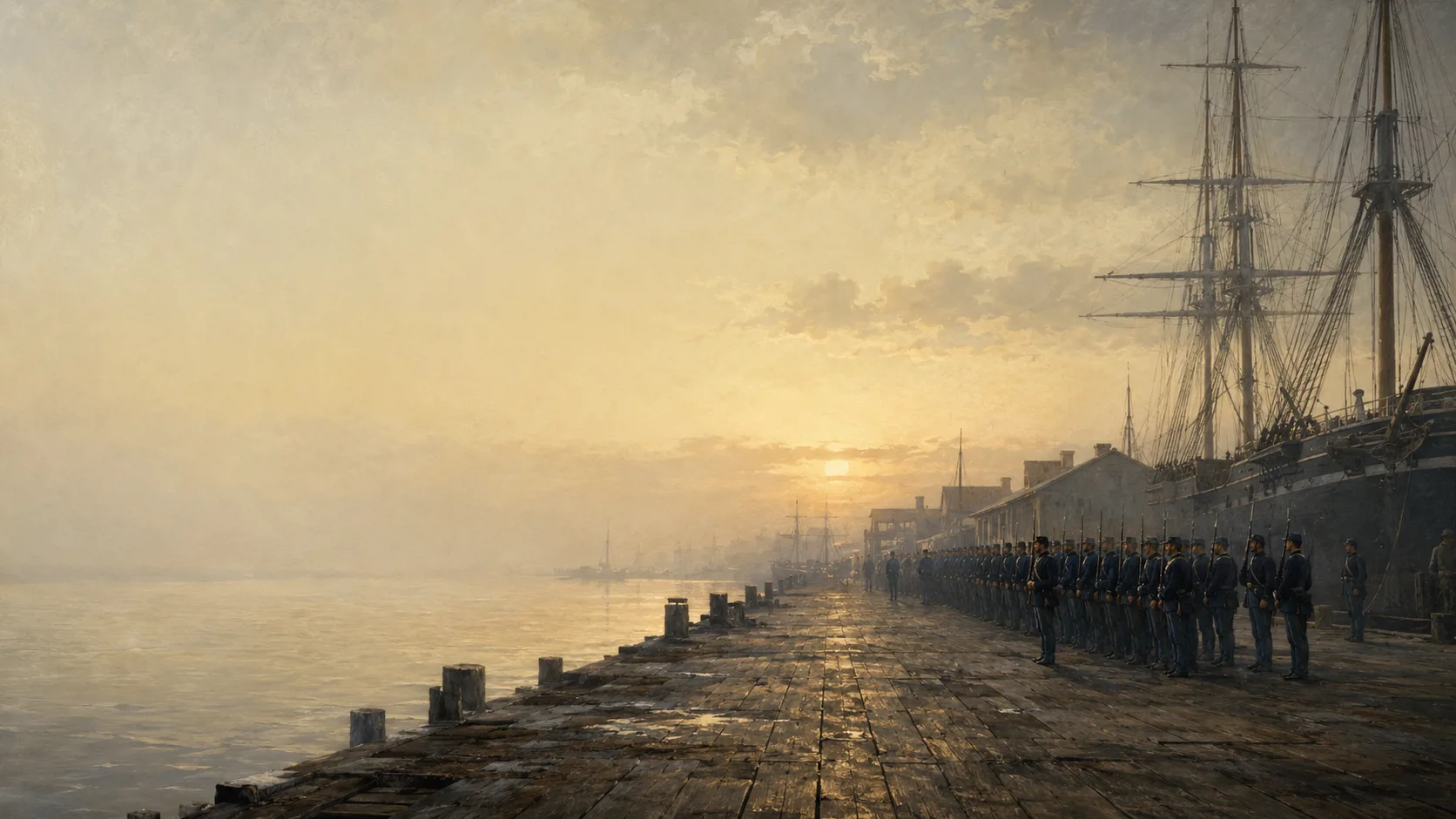
A Morning in Galveston
On the morning of June 19, 1865, a Union general named Gordon Granger stepped onto the wharf at Galveston, Texas, and read aloud a short military order. It was not a battle. No cannon spoke. The war that had consumed the country was already over, its great armies surrendered weeks before. Granger had come not to fight but to announce — to a city, a state, and a people who had managed to hold the news at arm's length for two and a half years — that the men, women, and children held in bondage across Texas were free.
The order he read, General Order No. 3, was four sentences long. But behind those four sentences stood four years of war, six hundred thousand graves, a country that had briefly become two countries, and a quarrel that reached back to the very founding of the republic. To understand why freedom arrived in Texas so late — why it had to be carried there by a soldier with a rifle behind him — you have to go back and watch the house split, beam by beam.
This is the story of how the United States came apart, and how it was put back together at a cost almost too large to imagine.
The Fault Line
From its birth, the United States carried a contradiction at its center. It had declared, in 1776, that all men are created equal. And it had built much of its economy — especially in the South — on the labor of human beings who were owned, bought, and sold as property.
For a long while, the country managed the contradiction by not looking directly at it. The North, with its towns, factories, and small farms, drifted gradually away from slavery. The South, with its vast plantations of cotton, tobacco, and sugar, sank deeper into dependence on it. Cotton in particular became a colossus. The invention of the cotton gin made the crop enormously profitable, and that profit ran on enslaved labor. By the middle of the nineteenth century, the enslaved population of the South numbered roughly four million people — an immense human population held in bondage, and an immense amount of wealth resting upon them.
A nation cannot indefinitely declare that all men are equal while holding millions in chains. Sooner or later the contradiction demands an answer.
The two halves of the country were becoming, in effect, two different civilizations — one industrial and waged, the other agricultural and enslaved. And every time the nation grew, the question grew sharper: as new territories in the West became states, would they be free or slave?
That question was the fault line. And for forty years, American politics was essentially one long, exhausting attempt to keep the fault line from cracking open.
A Series of Fragile Bargains
The bargains came one after another, each buying time, none solving anything.
In 1820, the Missouri Compromise drew an invisible line across the map and declared slavery permitted below it and forbidden above it. It admitted one slave state and one free state together, to keep the balance of power even in the Senate. It held — for a while.
In 1850, another compromise patched the cracks again, admitting California as a free state but handing the South a brutal concession in return: the Fugitive Slave Act, which forced citizens even in free states to assist in capturing escaped enslaved people. The law enraged the North. It made slavery no longer a distant Southern institution but a thing that reached into every town and demanded complicity.
Then in 1854 came the blow that broke the old arithmetic. The Kansas-Nebraska Act threw out the Missouri line entirely and declared that the people of each new territory could vote on whether to allow slavery. The idea sounded democratic. In practice it was a catastrophe.
Bleeding Kansas
Both sides understood instantly what the new law meant: whoever flooded into Kansas first, and voted, would decide whether it became free or slave. So both sides flooded in — not only settlers but armed partisans, ballot-stuffers, and zealots. Rival governments sprang up. Elections were rigged by both camps. And then the shooting started.
Pro-slavery raiders sacked the town of Lawrence. In retaliation, the militant abolitionist John Brown led a party that dragged five pro-slavery settlers from their homes and killed them with broadswords. Guerrilla bands roamed the territory, burning farms and settling scores. The newspapers called it "Bleeding Kansas," and the name stuck.
Before the nation went to war with itself, it rehearsed the war in miniature on the plains of Kansas.
This was no longer a debate in marble halls. This was murder on the frontier, and everyone could see where it pointed. The violence even reached the floor of the Senate, where a Southern congressman beat a Northern senator nearly to death with a cane over an anti-slavery speech. The middle ground was disappearing. The country was beginning to sort itself into two armed camps that no longer trusted, and increasingly hated, each other.
The Spark and the Election
Two events in quick succession lit the fuse.
In 1859, John Brown — the same zealot from Kansas — led a tiny band in a raid on the federal arsenal at Harpers Ferry, Virginia. His plan was to seize the weapons and arm a great uprising of the enslaved. The plan failed within thirty-six hours. Brown was captured, tried, and hanged. But the meaning of the raid terrified the South far more than the raid itself. To the North, Brown became, for many, a martyr. To the South, he became proof of their deepest fear: that the North meant not merely to limit slavery but to incite a slave rebellion and destroy their world by violence.
Then, in 1860, came the election. A new political party, the Republicans, had formed expressly to stop the spread of slavery into the western territories. Their candidate was a self-taught lawyer from Illinois named Abraham Lincoln. He was not a radical abolitionist; he did not promise to abolish slavery where it already existed. But he was firmly against its expansion, and the South did not trust his assurances. His name did not even appear on the ballot in most Southern states.
Lincoln won — without a single Southern electoral vote. And for the South, his victory was the signal that the game was lost. A president had been elected by the North alone, against the will of the South, on a platform of containing the institution the South had built its entire society upon.
They decided they would not live under him. They would leave.
Secession: The Birth of a Breakaway Country
Within weeks of Lincoln's election, South Carolina declared that it was no longer part of the United States. It called the act secession — a formal withdrawal from the Union. Mississippi, Florida, Alabama, Georgia, Louisiana, and Texas followed in quick succession. In February 1861 — a full month before Lincoln was even sworn in — these states met and did something audacious: they founded a new country.
They called it the Confederate States of America. And it was not a gesture or a bluff. It was a functioning state, assembled with startling speed.
It had a constitution, modeled closely on the U.S. one but with slavery explicitly protected. It had a congress that passed laws. It had a president — Jefferson Davis, a former U.S. senator and war hero from Mississippi. It had a capital, eventually fixed at Richmond, Virginia. It printed its own money, the Confederate dollar. It issued its own postage stamps. It raised its own armies and sent diplomats abroad to seek recognition from Britain and France. For four years, a second American nation would exist on the map, with all the machinery of statehood.
What the Confederacy openly declared — Its leaders did not hide the cause. Its vice president, Alexander Stephens, gave a now-infamous address declaring that the new nation's foundation rested upon the institution of slavery and the inequality of the races. The secession declarations of the states themselves name the protection of slavery, again and again, as the reason for leaving. Later generations would invent gentler explanations, but the founders of the Confederacy stated their purpose plainly in their own time.
The new nation's leaders insisted they had every right to leave — that the Union was a voluntary compact of states, and any state could walk away. Lincoln and the North insisted the opposite: that the Union was perpetual, that no state could simply secede, and that the United States remained one country whose authority still ran from sea to sea. Two irreconcilable claims. Only force could now decide between them.
Fort Sumter: The War Begins
The breaking point was a small island fort in the harbor of Charleston, South Carolina, called Fort Sumter. It was federal property, garrisoned by a small Union force, sitting in the waters of a state that now claimed to be a foreign country. The Confederates demanded its surrender. Lincoln refused to give it up, and announced he would send only provisions — food, not reinforcements — to the hungry garrison.
The Confederates would not wait. Before dawn on April 12, 1861, their guns opened fire on the fort. The bombardment lasted some thirty-four hours. The fort surrendered. Astonishingly, not a single soldier on either side was killed in the exchange that began the deadliest war in American history.
But the meaning of those guns was unmistakable. The country was at war with itself.
The firing on Sumter electrified both sides. Lincoln called for seventy-five thousand volunteers to put down the rebellion. The call forced the wavering states to choose — and four more Southern states, including the crucial and powerful Virginia, now joined the Confederacy rather than fight against their fellow Southerners. The Confederacy now numbered eleven states. The lines were drawn.
Two Nations, Counted
Before following the armies into the field, it is worth seeing plainly what each side brought to the fight — because the imbalance shaped everything that followed.
The Union and the Confederacy compared
| Measure | The Union (North) | The Confederacy (South) | ||||||||||||||||||||||||||||||||||||||||||||||||||||||||||||||||||||||||||||||||||||||||||||||||
|---|---|---|---|---|---|---|---|---|---|---|---|---|---|---|---|---|---|---|---|---|---|---|---|---|---|---|---|---|---|---|---|---|---|---|---|---|---|---|---|---|---|---|---|---|---|---|---|---|---|---|---|---|---|---|---|---|---|---|---|---|---|---|---|---|---|---|---|---|---|---|---|---|---|---|---|---|---|---|---|---|---|---|---|---|---|---|---|---|---|---|---|---|---|---|---|---|---|---|
| Population and economy | ||||||||||||||||||||||||||||||||||||||||||||||||||||||||||||||||||||||||||||||||||||||||||||||||||
| Free population | About 22 million | About 5.5 million | ||||||||||||||||||||||||||||||||||||||||||||||||||||||||||||||||||||||||||||||||||||||||||||||||
| Enslaved population | Few (in border states) | About 3.5 million | ||||||||||||||||||||||||||||||||||||||||||||||||||||||||||||||||||||||||||||||||||||||||||||||||
| Industry | The overwhelming majority of the nation's factories | A small fraction | ||||||||||||||||||||||||||||||||||||||||||||||||||||||||||||||||||||||||||||||||||||||||||||||||
| Railroads | Roughly twice the mileage | Sparse and poorly linked | ||||||||||||||||||||||||||||||||||||||||||||||||||||||||||||||||||||||||||||||||||||||||||||||||
| Government and identity | ||||||||||||||||||||||||||||||||||||||||||||||||||||||||||||||||||||||||||||||||||||||||||||||||||
| Government | The existing United States, intact | A newly founded breakaway state | ||||||||||||||||||||||||||||||||||||||||||||||||||||||||||||||||||||||||||||||||||||||||||||||||
| Capital | Washington, D.C. | Richmond, Virginia | ||||||||||||||||||||||||||||||||||||||||||||||||||||||||||||||||||||||||||||||||||||||||||||||||
| President | Abraham Lincoln | Jefferson Davis | ||||||||||||||||||||||||||||||||||||||||||||||||||||||||||||||||||||||||||||||||||||||||||||||||
| Cause | Preserve the Union; later, end slavery | Preserve slavery and independence | ||||||||||||||||||||||||||||||||||||||||||||||||||||||||||||||||||||||||||||||||||||||||||||||||
On paper, the North held nearly every material advantage: more people, vastly more industry, more railroads, a functioning navy, and an existing government recognized by the world. The South had a smaller population, little industry, and no navy to speak of.
But the South had real advantages of its own. It was fighting a defensive war on its own soil, which it knew intimately. It did not need to conquer the North; it needed only to survive, to make the war so long and costly that the North would give up and let it go. And in the war's first years, it had the better generals. What the South lacked in factories, it made up in fighting skill and ferocity — and the war would grind on far longer, and bleed far redder, than anyone in 1861 imagined.
Brother Against Brother
There is a phrase that haunts this war: brother against brother. It was not a metaphor. It was often literally true.
The two armies were drawn from the same nation, the same schools, the same families. The generals who now faced each other across the battlefield had, in many cases, been classmates at the military academy at West Point. They had served together in the same United States Army, fought side by side in earlier wars, worn the same uniform. Now they wore different ones.
The most famous example is Robert E. Lee. He was a celebrated officer of the United States Army, so respected that Lincoln's government offered him command of the Union forces. Lee opposed secession and disliked slavery's politics — but when his home state of Virginia left the Union, he could not bring himself to draw his sword against it. He resigned his U.S. commission and took up command of Virginia's forces, and eventually became the greatest general the Confederacy would have. Families split the same way Lee's loyalties did: brothers, fathers and sons, old friends, found themselves on opposite sides of the line, sometimes facing each other in the same battle.
This was the particular agony of a civil war. The enemy was not a stranger from a far country. The enemy wore your brother's face.
The Long, Bloody Middle
The war that everyone expected to be short was nothing of the kind. The first major battle, at Bull Run in the summer of 1861, shattered the illusion. Civilians had ridden out from Washington with picnic baskets to watch what they assumed would be a quick Union victory and the rebellion's swift end. Instead they watched a chaotic, bloody Confederate victory and a panicked Union retreat. There would be no quick end.
For four years, the armies hammered at each other across the South and the border states, in battles whose names became synonymous with slaughter.
At Antietam, in Maryland in 1862, more men fell dead or wounded in a single day than on any other day in American history — over twenty thousand casualties in one September afternoon. The creek, it was said, ran red.
At Gettysburg, in Pennsylvania in July 1863, Lee gambled on a great invasion of the North and lost. Over three days, the two armies suffered a combined fifty thousand casualties. The Confederate high tide broke against the Union line and receded, never to rise so far again. Gettysburg is often called the turning point of the war — the moment after which the South could win battles but could no longer hope to win the war.
The fighting was savage beyond the experience of any earlier American generation. New rifles were far deadlier than old muskets, but the generals still often ordered men forward in close ranks across open ground, into withering fire. Disease killed even more than bullets did; camps were breeding grounds for dysentery, typhoid, and pneumonia, and for every man who died in battle, roughly two died of sickness. Wounds that today would be minor were death sentences. Amputation was the common treatment, performed often without proper anesthesia.
The Proclamation
In the war's third year, Lincoln changed its meaning forever.
At the start, the North had fought officially to preserve the Union, not to end slavery — Lincoln had been careful about this, fearing to push the slaveholding border states into the Confederacy's arms. But as the war ground on, he came to see that slavery was the war's root, and that striking at it would strike at the South's ability to fight.
On January 1, 1863, he issued the Emancipation Proclamation. It declared that all enslaved people in the rebelling Confederate states were, as of that day, free.
Its reach was, at first, more moral than practical. It freed people in precisely the places where the U.S. government had no power to enforce it — the Confederate states still in rebellion. It did not, by its own terms, free the enslaved in the loyal border states. In a strict legal sense, on the day it was signed, it freed almost no one immediately.
But its true power was enormous. It transformed the war. From that day, the Union armies marched not merely to restore a country but to end slavery. Wherever they advanced into the South, freedom advanced with them, and the enslaved walked out of bondage by the tens and hundreds of thousands. It opened the army's ranks to Black soldiers, and some two hundred thousand would serve. And it made it politically impossible for Britain or France — both of which had abolished slavery — to recognize or aid the Confederacy. The proclamation cut the South off from the foreign help it desperately needed.
The word "emancipation" means, at its root, to be released from ownership — to be lifted out of the condition of being property. The word "proclamation" means, simply, to cry out in public. An official crying-out that men are no longer owned.
The Confederacy's hope had always rested partly on foreign recognition — on Britain or France deciding that this new Southern nation was real and worth supporting, perhaps for its cotton. After the Proclamation, no European power would tie itself to a nation fighting to keep men enslaved. The breakaway country was now utterly alone.
The Vise Closes
By 1864, the North's enormous advantages in men and material were grinding the South down. Lincoln found at last the general he needed in Ulysses S. Grant — a relentless commander willing to accept terrible losses to keep pressing, never letting Lee rest or recover.
In the West, General William Tecumseh Sherman captured Atlanta and then marched his army clear across Georgia to the sea, deliberately destroying railroads, farms, factories, and supplies — breaking the South's will and capacity to keep fighting. It was hard, merciless war, designed to make the Confederacy feel the conflict in its homes and fields, and it worked.
The Confederate armies, starving and shrinking, could not replace their losses. The Union could. Slowly, inexorably, the vise closed.
Appomattox: The End
In the spring of 1865, the end came quickly. Grant's forces finally broke Lee's lines and took Richmond, the Confederate capital. Lee's army, ragged and surrounded, ran out of room and out of hope.
On April 9, 1865, in the parlor of a private house in the small Virginia village of Appomattox Court House, Robert E. Lee surrendered his army to Ulysses S. Grant. The terms were generous. Grant let the defeated soldiers go home, keeping their horses for the spring planting, and ordered no celebration that would humiliate them. The greatest Confederate army had laid down its arms. The other Confederate forces would follow over the coming weeks. The Confederacy — the breakaway nation of four years — was dissolving.
The relief and joy in the North were boundless. And almost immediately, they turned to horror.
On the night of April 14, 1865 — five days after Appomattox — Abraham Lincoln was shot while watching a play at Ford's Theatre in Washington. He died the next morning, killed by a Confederate sympathizer. The man who had held the Union together through its darkest years, and who had spoken of binding the nation's wounds with malice toward none, did not live to see the peace he had won.
The News Reaches Texas
And so we return to where we began.
The war was effectively over. Slavery had been struck down in principle by the Emancipation Proclamation and would soon be abolished in law everywhere. But news and enforcement traveled only as fast as the army did — and Texas, the most remote corner of the Confederacy, was the last to feel the change.
Texas had seen little fighting. It had no large Union army on its soil through most of the war. Indeed, some enslavers from other Southern states had moved their human property into Texas during the war, precisely because it seemed a safe refuge where slavery would continue undisturbed. So even as the Confederacy collapsed elsewhere, the roughly quarter-million enslaved people of Texas remained in bondage, the Proclamation a distant rumor with no soldiers behind it to make it real.
That is what changed on June 19, 1865. General Gordon Granger arrived at Galveston with Union troops — enough force to make the order stick — and read General Order No. 3, proclaiming that all enslaved people in Texas were free. Not as a principle now, but as a fact backed by bayonets. The last great population still held in slavery learned, at last, that the thing was finished.
The freedpeople of Texas did not wait to celebrate. They marked the day immediately, and they kept marking it, year after year. They called it Juneteenth — a folding-together of "June" and "nineteenth" — and the celebration spread across the country as they migrated. For more than a century it was observed largely within Black communities; in 2021 it became a national holiday of the United States. It is, in a sense, the country's second independence day — the day the promise of 1776 was finally extended to those it had so long excluded.
What the War Settled, and What It Did Not
The Civil War ended in the total defeat of the Confederacy and the reunification of the country. Two great questions that had haunted the republic since its birth were answered, and answered by force.
The first question — could a state leave the Union? — was answered: no. The United States was one nation, indivisible, and would remain so. The fifty states of today, rather than two warring confederacies, are the legacy of that answer.
The second question — would the country be slave or free? — was answered: free. In December 1865, the Thirteenth Amendment to the Constitution abolished slavery throughout the United States, forever. Four million people were, in law, no longer property.
The cost was staggering. The best estimates of the dead range from about 620,000 to as many as 750,000 — more Americans than have died in any other war the nation has fought, before or since, including both World Wars combined. As a share of the population of the time, an equivalent loss today would run into the millions upon millions. Whole regions were laid waste. A generation of young men was cut down.
What was settled — The Union was preserved and the question of secession closed forever. Slavery was abolished nationwide by the Thirteenth Amendment. The principle that the nation was one and indivisible was sealed in blood.
What was left unsettled — Ending slavery was not the same as securing equality. The decades after the war saw new systems of segregation and oppression rise across the South, and the struggle for the full citizenship of Black Americans would continue for a hundred years and more. The war answered the question of bondage. It did not, by itself, answer the question of justice.
And there is a final, strange fact that captures the whole tragedy. The men who led the Confederacy — the generals, the president, the architects of the breakaway nation — were never punished as one might expect. There were no mass executions, no long imprisonments for treason. Jefferson Davis spent two years in prison and was never tried. Robert E. Lee was indicted but never prosecuted; he lived out his days as a college president. The federal government, weary of blood and hoping to knit the country back together, chose reconciliation over retribution.
That choice let the nation heal its political wounds quickly. It also let the defeated South build, over the following decades, a softened legend of its own cause — recasting the war as a noble struggle for abstract principle rather than a war to keep human beings in chains. The argument over how to remember the Confederacy, its leaders, and its monuments still divides the country today. The war ended in 1865. The quarrel over its meaning has never entirely ended.
The Weight of a Quiet Morning
Stand again on that wharf in Galveston, on the morning of June 19, 1865. A general reads four sentences. There is no battle. And yet behind that quiet moment lies everything: the contradiction built into the nation's founding, the forty years of fragile bargains, the blood spilled on the plains of Kansas, the guns at Fort Sumter, the brothers who killed each other at Antietam and Gettysburg, a breakaway nation that lived and died in four years, a proclamation that changed the meaning of a war, a beloved president murdered in the hour of victory, and six hundred thousand graves.
A house divided against itself, it was said in those years, cannot stand. The United States had divided against itself, and very nearly did not stand. That it stood at all — that the house was put back together, and built larger — was paid for at a price the country is still reckoning with.
And every year, on the nineteenth of June, the nation remembers the morning the last of the chains came off.