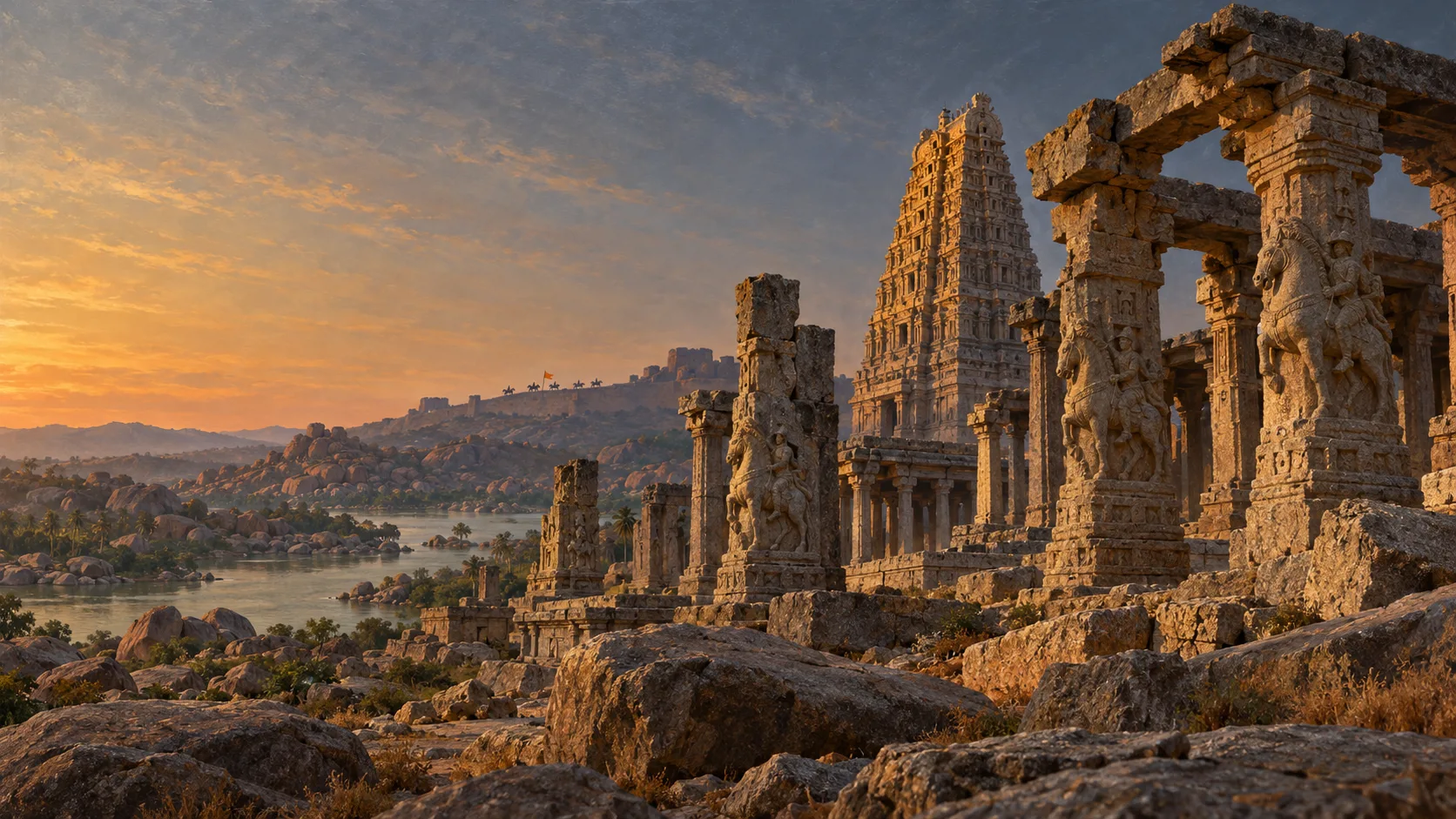
Dawn at Tarāin
The plain of Tarāin lies a little north of Kurukṣetra, on the old road that runs from the Panjab rivers down to Dhillikā. In the winter of 1192 two armies faced each other across it for the second year running.
On one side stood the host of Pṛthvīrāja III, the Cāhamāna king of Śākambharī and Ajmer, with his feudatories around him. Among them was Govindarāja, the lord of Dhillikā, who the year before, on this same ground, had driven his lance into the face of the invader and broken his teeth. That invader was Muhammad of Ghor, the Ghurid prince from the mountains of what is now central Afghanistan. In 1191 he had been carried off the field half dead, slumped over the neck of his horse, his army running behind him. The Cāhamāna army had not chased him into the Panjab. It had turned to besiege the fort of Tabarhind, which the Ghurids held, and taken it back after thirteen months.
Now Muhammad had returned with a different plan.
The Persian chroniclers who served his successors wrote down what he did. He did not offer battle on the terms of the year before. He split his mounted archers into four bodies of about ten thousand each and sent them against the flanks and the rear of the Cāhamāna line. They rode in, loosed their arrows, and rode out before the heavy ranks could close with them. When the Rajput cavalry charged, the archers fell back, and when the charge spent itself, they came again. This went on from morning into the afternoon. Then the Ghurid centre did something the Cāhamāna commanders took for collapse: it turned and ran.
The line of Pṛthvīrāja's army broke formation to pursue. That was the moment Muhammad had been holding back for. Twelve thousand armoured horsemen, kept out of the fighting all day, came in at the gallop against an army that was now strung out, tired, and no longer in order.
Govindarāja fell on the field. A later history, written at Bijapur four centuries after, records that his body was identified by the broken teeth. Pṛthvīrāja left his elephant, took a horse, and rode for the Sarasvatī. He was caught near the river and brought back. He did not live long in captivity.
The numbers the chroniclers give for this battle are not to be trusted in either direction. Contested What is certain is the outcome. Within fourteen years of that afternoon, a slave of Muhammad of Ghor would sit in Dhillikā as the first ruler of what is now called the Delhi Sultanate, and the Gangetic plain from the Panjab to Bengal would be under Turkic garrisons.
Everything that follows, the sultans of Delhi, the Bahmani state in the Deccan, the five sultanates that grew from it, the fall of Vijayanagara, the Mughals and the Maratha answer to them, runs back to that plain and that trick.
The words before the story
The history of these centuries is written largely in the vocabulary of the conquerors, and much of it has no plain equivalent in the languages of Bhārata.
A sultan is a ruler who holds power in fact, by the sword, as distinct from a khalifa or caliph, who claimed to be the successor of the Prophet of Islam and the head of the whole community of believers. The sultans of Delhi sought letters of recognition from the caliph to dress their power in lawful clothing. An amir is a noble or commander. A malik is a senior amir.
A ghulam or mamluk is a slave soldier: a boy bought or captured, usually from the Turkic tribes of the steppe, raised as a soldier, converted, and bound to his master. Slave soldiers could rise to command armies and, as happened at Dhillikā, to take the throne. The first dynasty of the Delhi Sultanate is often called the Mamluk or Slave dynasty for this reason.
An iqta is a grant of the revenue of a territory to an amir in return for military service. The holder, the iqtadar or muqti, kept troops out of that revenue. It was the means by which the Sultanate paid its army and held the countryside.
Kharaj is the land tax, taken as a share of the crop. Jizya is a separate head tax imposed on non-Muslims under Islamic law, the price of being permitted to live under Muslim rule without converting. Those who paid it were called dhimmi, protected subjects, and the protection came with conditions of lowered status.
A ghazi is a fighter in holy war against unbelievers. The title was claimed by raiders and sultans alike and appears on their coins and inscriptions.
A khutba is the Friday sermon, in which the name of the ruler is read out. Having one's name read in the khutba and struck on the coinage were the two public signs of sovereignty.
Turuska, written Tuluska in some inscriptions, is the Sanskrit name for the Turkic invaders, used in the records of the kings who fought them. Yavana, an older word for foreigners from the west, is used in the same way in some texts.
Jauhar is the act by which the women of a besieged Rajput or Deccan fortress, when the fall of the fort was certain, gave themselves to the fire rather than to the captors, while the men opened the gates and went out to die fighting, a last charge called sākā.
A doab, literally two waters, is the land between two rivers. The Rāicūr doab, between the Kṛṣṇā and the Tuṅgabhadrā, was fought over for two hundred years.
Dates in this period come from three kinds of source that rarely agree to the year. The Persian chronicles were written by men in the service of the sultans. The Sanskrit, Telugu, Kannada and Tamil inscriptions were cut by the kings, temples and villages who lived through the events. The accounts of foreign travellers, Arab, Persian, Italian and Portuguese, describe what they saw on particular days. A figure that rests on one source alone, especially a count of soldiers or of the dead, is best read as the claim of that source and no more.
Bhārata before the storm
In the year 1000, when the first of the great raids out of Ghazni began, Bhārata was not a single kingdom. It never had been in the sense a Persian or a Roman would use the word. It was a civilisation held together by a shared dharma, shared sacred geography, shared languages of learning, and a web of kingdoms that fought each other, married into each other, and patronised the same temples and the same schools.
The map of the eleventh and twelfth centuries is a map of great houses.
In the far south, the Coḷas of Tañjāvūr ruled the Tamil country and had sent fleets across the Bay of Bengal to Sri Lanka, the Maldives and the ports of Srivijaya on the straits of Malacca. The temple Rājarāja Coḷa raised at Tañjāvūr around 1010, with its tower of more than sixty metres, stood as the tallest built structure in Bhārata. The Pāṇḍyas of Madurai would rise again as the Coḷas declined.
In the Deccan, the Cālukyas of Kalyāṇī held the country between the Narmadā and the Kṛṣṇā, and from their decline three houses came up in the late twelfth century: the Yādavas of Devagiri in the western Deccan, the Kākatīyas of Orugallu in the Telugu country, and the Hoysalas of Dvārasamudra in the Kannada country, whose temples at Belur and Halebidu are still carved thick with figures from the epics.
In Gujarat, the Caulukyas, also called the Solankis, ruled from Aṇahilapāṭaka, one of the richest cities of the western coast, and guarded Somanātha on the Saurashtra shore. In Malwa, the Paramāras ruled from Dhārā, and one of them, Bhoja, who died around 1055, was remembered as a scholar king who wrote on poetics, architecture and medicine. In Rajasthan and the Panjab plains, the Cāhamānas ruled Śākambharī and Ajmer and had taken Dhillikā from the Tomaras. At Kānyakubja, the old imperial city on the Ganga, the Gāhaḍavālas held the heart of the plain. In Bengal, the Pālas and then the Senas ruled. In Odisha, the Eastern Gangas would build the Jagannātha temple at Puri and, in the thirteenth century, the Sūrya temple at Koṇārka.
It was a rich world. The ports of Gujarat, Malabar and the Coromandel coast sold cotton cloth, pepper, indigo, gems and steel to Arab, Persian, Chinese and Southeast Asian merchants. Arab geographers wrote of the wealth of the western coast as a commonplace. The temples were at once places of worship, treasuries, landholders, patrons of dance and music, and centres of learning. Their wealth was the wealth of centuries of gifts from kings, merchants and villages.
It was a learned world. The monastic universities of Nālandā, Vikramaśilā and Odantapurī in the east held thousands of students and libraries of palm-leaf manuscripts. The mathematician Bhāskara, in 1150, completed the Siddhānta Śiromaṇi, working with methods in algebra and the calculus of motion that Europe would not reach for five hundred years. Rāmānujācārya had lived and taught at Śrīraṅgam in the eleventh and twelfth centuries. The Gīta Govinda of Jayadeva was composed in the twelfth century. Nannaya had begun the Telugu Mahābhārata at the Eastern Cālukya court. The great philosophical schools argued with each other in public debate.
And it was a world in which war had rules. The Sanskrit texts on statecraft and the long tradition of the epics set out a code of dharma-yuddha, the righteous war. A king who conquered another was expected to reinstate a member of the defeated house as a subordinate, to protect temples, to leave the Brāhmaṇas and the ascetics untouched, and to spare those who surrendered, the fleeing and those who did not fight. Wars between the kings of Bhārata were fought hard and were often bloody, but they were fought largely inside this frame. A defeated dynasty lost its supremacy. It rarely lost its gods.
There was one thing this rich world did not produce in quantity. The best warhorses of the age were bred on the steppes of Central Asia, in Persia and in Arabia. The heat, the fodder and the soils of most of Bhārata did not suit them. The kings of Bhārata bought horses by the thousand through the western and southern ports, and Marco Polo, visiting the Pāṇḍya coast around 1290, wrote that the kings there imported thousands every year because the horses died too quickly. The armies of Bhārata relied on elephants, on large bodies of foot soldiers, and on cavalry whose mounts had to be bought abroad at great cost. The armies coming over the passes rode horses they had bred themselves, and could replace them.
Where the raiders came from
The steppe and the slave soldier
The men who broke the north of Bhārata were not Arabs, and for the most part not Persians. They were Turks, from the great belt of grassland that runs from the Black Sea to Mongolia. The Turkic tribes of that belt lived on horseback. Their boys learned to ride and shoot the composite bow before they learned to walk far. A Turkic horseman could turn in the saddle at the gallop and put an arrow into a man behind him.
In the ninth century the caliphs of Baghdad began to buy these boys in large numbers from the slave markets of Central Asia, convert them, and raise them as a professional army owing loyalty to no tribe and no family, only to the master who owned them. The ghulam system spread to every Islamic court from Egypt to Afghanistan. Within two generations, the slave soldiers were making and unmaking caliphs. By the tenth century, Turkic ghulams and their sons were founding kingdoms of their own on the eastern edge of the Islamic world.
One of them was Alptigin, a Turkic slave commander of the Samanid court of Bukhara, who in 962 seized the town of Ghazni, in the hills south of Kabul. His own slave and son in law, Sabuktigin, took power there in 977. Sabuktigin's son was Mahmud.
The first wave, and the wall that held for three hundred years
The story does not begin with Mahmud. The first Islamic army to enter Bhārata came much earlier, in 711 and 712, when the Arab commander Muhammad bin Qasim, sent by the governor of Iraq, took Sindh from its king Dahir. Dahir died fighting at Raor. The chronicle of that conquest, the Chachnama, records the killing of the men of fighting age at Brahmanabad and the carrying off of women and children as slaves, with a fifth of the captives sent to the caliph.
What happened next matters, because it answers the question of whether Bhārata fought. The Arabs pushed east from Sindh into Gujarat and Rajasthan in the 720s and 730s. They were met and thrown back. The Gurjara Pratīhāras under Nāgabhaṭa I stopped them in the region of Malwa and Rajasthan. The Cālukya prince Pulakeśin Avanijanāśraya defeated an Arab army at Navsari in Gujarat around 739, and the Cālukya king honoured him with titles for it. Tradition in Mewar remembers Bappa Rawal of the Guhila house among those who fought them. Contested For the next three centuries, the Arab foothold did not grow beyond Sindh and Multan. The Arab traveller writers themselves called the Pratīhāra king the greatest enemy of Islam in the land.
The north-western gate was held by another house: the Hindu Śāhis. From the late ninth century they ruled from Udabhāṇḍapura on the Indus, and at times from Kabul, over Gandhara and the eastern Afghan hills. They stood directly in front of Ghazni. Their king Jayapāla fought Sabuktigin in the 980s and 990s. In 1001 Mahmud defeated Jayapāla near Peshawar and took him prisoner with fifteen of his family. Released on ransom, Jayapāla handed the kingdom to his son and ended his own life on a pyre, holding that a king twice defeated could not rule. His son Ānandapāla fought on, raising a confederacy of northern kings against Mahmud in 1008 or 1009. His grandson Trilocanapāla fought on after him, and was killed in 1021. The last of the line, Bhīmapāla, died in 1026.
For more than a century the Śāhis had taken the full weight of Ghazni on their own shoulders.
Mahmud and the seventeen raids
Mahmud of Ghazni raided Bhārata, by the usual count, seventeen times between 1000 and 1027. He did not come to rule the plains. He came to take their wealth back to Ghazni, and the ideology he carried was that of the ghazi: every raid was a holy war, every temple broken a victory for the faith. His court historian, al-Utbi, wrote it down in exactly those terms.
He sacked Nagarkot in the Kangra valley, Thanesar, Mathura, where the historian records he found temples he judged would take two hundred years to build, and Kānyakubja, whose Pratīhāra king had withdrawn before him. In the winter of 1025 and 1026 he crossed the Thar desert to Somanātha on the coast of Saurashtra. The defenders held the walls for days. The chroniclers put the dead in tens of thousands. Contested The linga was broken, and pieces of it, as al-Biruni records, were carried to Ghazni and set into the steps of the mosque there so that the faithful would walk over them. Settled
A Persian scholar who travelled with Mahmud's armies, al-Biruni, learned Sanskrit and wrote the most careful foreign account of the learning of Bhārata in that age. He also wrote, plainly, that Mahmud had utterly ruined the prosperity of the country, that the Hindus had become like atoms of dust scattered in all directions, and that this was why Hindu sciences had retreated far away from the parts conquered by the Muslims to places the invaders could not yet reach.
Ghazni itself fell apart after Mahmud's death in 1030. His nephew Salar Masud, according to the later hagiography that grew around his tomb, led a raid deep into the Gangetic country and was killed at Bahraich in 1033 by a confederacy of local kings, whom the tradition of the region remembers under the leadership of Suhaldeva. Contested For a hundred and fifty years after, the Ghaznavids held the Panjab and raided from it, but the plain beyond was not theirs.
The house of Ghor
The house that finished what Ghazni had begun came from Ghor, a country of high valleys between Herat and Kabul. Its chiefs, once vassals of Ghazni, had turned on their masters and in 1151 one of them, Alauddin, burned the city of Ghazni to the ground for seven days, a deed that earned him the name Jahansoz, the world burner. His nephews, Ghiyasuddin and Muhammad, divided the family's power. Ghiyasuddin looked west toward Khurasan. Muhammad, the younger, looked east.
Muhammad of Ghor took Multan in 1175. In 1178 he tried the route through the desert to Gujarat, as Mahmud had done, and was met near Mount Abu, at Kasahrada, by the army of the Caulukya kingdom. The king was a child, Mūlarāja II. The army was led in his name by his mother, the queen regent Nāikīdevī. The Ghurid army was broken and Muhammad fled back across the desert. He did not come to Gujarat again.
He turned north instead. He took the Ghaznavid remnant at Peshawar and Lahore between 1179 and 1186, which put the whole of the Panjab in his hands. From Lahore the road ran straight to Tarāin.
Did Bhārata fight?
The question is often put as though the answer were no. The record answers it the other way.
Principal battles of resistance against the invasions from the north west, 712 to 1206
| Year | Place | Defenders | Outcome |
|---|---|---|---|
| 712 | Raor, Sindh | Dahir of Sindh | Dahir killed fighting, Sindh taken |
| c. 725 to 739 | Malwa, Rajasthan, Navsari | Pratīhāras, Cālukyas of Gujarat | Arab advance thrown back for three centuries |
| 990s to 1026 | Laghman, Peshawar, the Indus | Hindu Śāhis: Jayapāla, Ānandapāla, Trilocanapāla, Bhīmapāla | A century of resistance until the line ended |
| 1025 to 1026 | Somanātha | Temple town and garrison | Walls held for days before the fall |
| 1033 | Bahraich | Local confederacy of kings | Ghaznavid raiding army destroyed |
| 1178 | Kasahrada, near Abu | Caulukyas under Nāikīdevī | Ghurid army routed |
| 1191 | Tarāin | Pṛthvīrāja III, Govindarāja | Ghurid army routed, Muhammad wounded |
| 1192 | Tarāin | Pṛthvīrāja III, Govindarāja | Defeat, the north opened |
| 1194 | Candāwar | Jayacandra Gāhaḍavāla | Jayacandra killed in battle |
| 1206 | Kāmarūpa | King of Kāmarūpa | Bakhtiyar Khalji's army destroyed |
Between the first Arab entry into Sindh and the second battle of Tarāin lie four hundred and eighty years. No other civilisation reached by the armies of the early caliphate held out so long. Persia fell in a generation. Egypt, Syria and North Africa fell in less. Central Asia fell within a century. The core of Bhārata was still unconquered five hundred years after the first attack.
Why they won in the end
The victory at Tarāin and the conquests that followed were not an accident, and they were not the result of any want of courage. The kings of Bhārata who fought the Ghurids died on their fields. The reasons lie elsewhere, and each can be stated plainly.
The first is the horse and the bow. The Turkic mounted archer was the most effective soldier of the age. He could strike from a distance and withdraw, again and again, against an army built around elephants, infantry and cavalry trained to close with the enemy. The same weapon system had already broken the armies of Persia and Byzantium. The Mongols, a generation later, would use it to take China, Persia and Russia.
The second is supply. The invaders could draw fresh horses and fresh men from the steppe year after year. The slave markets of Central Asia and the collapse of the Turkic and Persian world before the Mongols after 1220 sent a steady stream of fighting men and refugees into Dhillikā. The kings of Bhārata fought with what their own kingdoms could raise and buy. A lost battle for them was a lost army. For the Ghurids, it was a lost season.
The third is the standing army. The Ghurid and later the Sultanate armies were professional forces of slave soldiers and paid horsemen, living for war and paid out of plunder and iqta revenue. The armies of the kings of Bhārata were drawn in large part from feudatories and their retainers, who came to the field under their own lords, and who could be slow to assemble and hard to hold together after a reverse.
The fourth is the purpose of war. The kings of Bhārata fought for supremacy among themselves, within the frame of dharma-yuddha, and expected their enemies to do the same. The raiders came under a doctrine that treated the unbeliever's life, property, temples and family as lawfully forfeit. Their chroniclers do not hide this. They celebrate it. An army that aims at the destruction of the other side's gods, priests, libraries and social order fights a different war from one that aims only at tribute and precedence. The first will do things the second has no rules for.
The fifth is persistence. After Tarāin I, the invader was defeated and came back. After Kasahrada, he turned and found another road. The raids did not stop, because the raiders had nowhere else to go and everything to gain. Each defeat of a king of Bhārata was final for that king. Each defeat of the invaders was one setback in a campaign that had no end date.
None of this reflects on the men who stood at Tarāin. It reflects on the kind of war that had come over the passes.
The tipping point: 1192 to 1206
If there was a single turning point, it came in the fourteen years after Tarāin.
In 1192 and 1193, Muhammad's slave general Qutbuddin Aibak took Hansi, Meerut and Dhillikā, and made Dhillikā his base. In 1194 Muhammad came back and met the Gāhaḍavāla king Jayacandra at Candāwar, near the Yamuna. Jayacandra, on his elephant, was struck in the eye by an arrow and fell. Vārāṇasī was sacked. Hasan Nizami, who wrote the court history of Aibak, records that a thousand temples were destroyed there and mosques raised on their foundations. Contested The Gāhaḍavāla kingdom, the heart of the Gangetic plain, was gone.
In the same years a Khalji Turk named Bakhtiyar, too poor and too ugly, the chronicler says, to find service at court, raised a band of horsemen and began raiding into Bihar. His raids fell on the monastic universities. The chronicler Minhaj-us-Siraj, writing half a century later, describes the capture of a walled monastery at Bihar where the inhabitants were shaven headed and all were put to death, and where the conquerors found great numbers of books that no one left alive could read. Odantapurī, Vikramaśilā and Nālandā were destroyed in these years. When a Tibetan monk, Dharmasvāmin, reached Nālandā around 1235, he found it sacked and nearly deserted, with a ninety year old teacher and some seventy students keeping the teaching alive among the ruins, in fear of the Turkic soldiers nearby. Settled
In 1204 or 1205, Bakhtiyar rode into Nadia, the Sena capital in Bengal, with a small party disguised as horse traders, and the aged king Lakṣmaṇasena withdrew east to Vikramapura, where his house held on. In 1206 Bakhtiyar tried to push north through Kāmarūpa toward Tibet. The army was destroyed in the hills and at the river crossings. A rock inscription at Kanai Barasi near Guwahati records the destruction of the Turks in that year. Bakhtiyar came back with a handful of men and died soon after.
In the same year, 1206, Muhammad of Ghor was killed in his tent on the Jhelum while returning from putting down the Khokhars, a people of the Panjab who had risen against him. Contested His slave Aibak, at Lahore, took the power in Bhārata for himself. That is the date usually given for the founding of the Delhi Sultanate.
So the tipping point is real: 1192 to 1206. In fourteen years the north of Bhārata, from the Panjab to Bengal, passed under Turkic rule.
But it is a tipping point for the north, and it did not tip the whole. Gujarat had thrown the Ghurids back. Kāmarūpa destroyed Bakhtiyar. Odisha, the Deccan and the entire south were untouched. The Rajput fortresses of Rajasthan would be fought over for the next five centuries. The conquest of the north took fourteen years. The attempt to conquer the rest would take five hundred, and it would fail.
The conquest of the north took fourteen years. The attempt to conquer the rest would take five hundred, and it would fail.
Dhillikā, and what was built on it
Delhi was not founded by the sultans. The city the Ghurids took was Dhillikā, which the Tomara kings had fortified in the eleventh century as Lal Kot, and which the Cāhamānas had enlarged into the fort that later writers called Qila Rai Pithora, the fort of Rai Pithora, their name for Pṛthvīrāja. Inside it stood a cluster of temples, and in the courtyard of one of them stood the iron pillar, forged in the Gupta age sixteen centuries ago and bearing an inscription to a king named Candra. It has not rusted in all the centuries since.
On the site of that temple complex, Aibak built the first great mosque of the Sultanate. Its name, Quwwat ul Islam, is usually given as the Might of Islam. The inscription over its eastern gateway states in its own words that the materials of twenty seven temples were used in building it. Settled The columns of the cloisters are temple columns, with the carved bells, chains and figures still visible where the builders did not bother to chisel them away. The iron pillar was left standing in its courtyard. Beside the mosque Aibak began, around 1199, the tower now called the Qutb Minar, finished by his successor Iltutmish, as a tower of victory and a minaret for the call to prayer.
Each dynasty built its own Delhi on the same ground. Alauddin Khalji raised Siri, around 1303, as a fortified camp against the Mongols. Ghiyasuddin Tughlaq built the grim walls of Tughlaqabad in the 1320s. His son Muhammad joined Siri and the old city into Jahanpanah. Firuz Tughlaq built Firozabad on the Yamuna and set up on it an Aśokan pillar dragged from Topra. Delhi in these centuries was a garrison capital: a ring of fortified cities, full of soldiers, slaves, amirs and refugees from Central Asia and Persia, sitting in the middle of a countryside that did not accept it.
The Moroccan traveller Ibn Battuta arrived in 1334 and served as a judge in the city for eight years. He called it the largest city in the Islamic east. He also found whole quarters empty, because Muhammad Tughlaq had ordered the population to move to Devagiri in the Deccan a few years earlier, and he recorded that a blind man and a cripple found in the city after the order were dragged the whole way and arrived only in pieces. Contested
The five dynasties of Delhi
The dynasties of the Delhi Sultanate, 1206 to 1526
| Dynasty | Years | Principal rulers | Origin |
|---|---|---|---|
| Mamluk, the Slave dynasty | 1206 to 1290 | Aibak, Iltutmish, Raziya, Balban | Turkic slave soldiers of the Ghurids |
| Khalji | 1290 to 1320 | Jalaluddin, Alauddin, Mubarak | Turkic Khalaj of the Afghan borderland |
| Tughlaq | 1320 to 1414 | Ghiyasuddin, Muhammad, Firuz | Turkic, from the frontier garrisons |
| Sayyid | 1414 to 1451 | Khizr Khan and his line | Governors left in charge after Timur's sack |
| Lodi | 1451 to 1526 | Bahlul, Sikandar, Ibrahim | Afghan |
None of these houses was of Bhārata. The Mamluks were bought men from the steppe. The Khaljis and Tughlaqs came from Turkic and Turco Afghan families of the frontier. The Sayyids ruled as deputies of Timur, the Central Asian conqueror who sacked Delhi in 1398, and read his name and then his son's in the khutba. The Lodis were Afghans. Across three hundred and twenty years, the throne of Delhi passed by murder more often than by inheritance. Aibak's son was deposed within months. Iltutmish's line was cleared away by Balban. Alauddin killed his uncle and father in law Jalaluddin to take the throne. Ghiyasuddin Tughlaq died when a pavilion built to receive him collapsed, a death many at the time laid at his son's door. The invader test is origin, and by that test each of these houses remained what it was when it arrived.
How they ruled
Land, iqta and the countryside
The Sultanate did not govern the way the kings of Bhārata had. It held the towns and forts with garrisons, and it took the revenue of the countryside through the iqta. The sultan granted an amir the revenue of a district. The amir kept troops, collected what he could, and sent the surplus to Delhi. The village headmen and the old landholding families, called khuts, muqaddams and chaudhris in the Persian texts, stood between the collectors and the cultivators. The Sultanate needed them to collect, and spent much of its three centuries trying to break their power.
Alauddin's squeeze
The man who pressed the countryside hardest was Alauddin Khalji, who ruled from 1296 to 1316. His court historian Ziauddin Barani, writing a generation later, sets out the method in detail and with approval.
The land tax was raised to half of the produce, measured field by field. A grazing tax was laid on cattle and a house tax on dwellings. The khuts and muqaddams were stripped of their customary exemptions. Barani writes that the aim was to leave the Hindus with only enough to live on from one harvest to the next, so that they would have neither the means to ride horses, carry arms and wear fine clothes, nor the strength to resist. He writes that the chiefs were reduced to such want that their wives went to work for wages in the houses of Muslims. Settled
Barani also records a conversation between Alauddin and the judge Qazi Mughisuddin of Bayana, in which the judge sets out the legal position as he understood it: that the Hindus were payers of kharaj, that they should pay it with full humility and submission, and that Islamic law intended them to be kept in a state of degradation. Settled This is not an enemy's report. It is the regime describing itself.
This is not an enemy's report. It is the regime describing itself.
Alauddin also fixed the prices of grain, cloth and horses in Delhi by decree, backed by informers and brutal punishment for traders who cheated. The purpose was to let him pay a very large standing army against the Mongols on low wages. The low prices in the capital were bought with the grain taken from the villages at half the harvest.
The tax on belief
The jizya was collected through the Sultanate as a mark of subjection. Firuz Tughlaq, who ruled from 1351 to 1388, went further than his predecessors. In his own account of his reign, the Futuhat i Firuz Shahi, he records that he extended the jizya to the Brāhmaṇas, who had been exempt until then. The chronicler Shams Siraj Afif records that the Brāhmaṇas of Delhi gathered at the palace and declared they would burn themselves to death before it rather than pay. The sultan would not give way. The other Hindu inhabitants of the city finally agreed to pay the tax on the Brāhmaṇas' behalf, at a reduced rate. Settled
In the same memoir Firuz records that he had a Brāhmaṇa of Delhi burned alive before the palace, for the offence of drawing Muslims to his worship, and that he destroyed new temples built near Delhi and killed the leaders of those who worshipped at them. He lists these acts among his good works.
Temples
The destruction of temples ran through the whole period. It is recorded most fully by the sultans' own chroniclers, who counted it as merit. Aibak's historian lists the temples broken at Vārāṇasī and the conversion of Ajmer's temples. The first mosque of Delhi carries its own inscription of twenty seven temples. Iltutmish carried away the images of Mahākāla from Ujjayinī in 1234. Alauddin's armies broke the temple of Somanātha again in 1299. Amir Khusrau, the court poet, describes in verse the breaking of the temples of the south during the campaigns of 1311. Firuz lists the temples he destroyed. Sikandar Lodi, at the end of the period, destroyed the temples of Mathura and forbade Hindus to bathe at the ghats there. Settled
Captives
The trade in captives was part of the economy of war. The chronicles repeatedly count the prisoners taken from a campaign alongside the elephants and the gold. Afif records that Firuz Tughlaq had one hundred and eighty thousand slaves in his service, many sent up to Delhi from the districts as a form of tribute. Contested
The sultan who moved a capital
Muhammad bin Tughlaq, who ruled from 1325 to 1351, was the most learned and the most violent of the Delhi sultans. He moved the capital to Devagiri in the Deccan, which he renamed Daulatabad, and forced a large part of the population of Delhi to make the march of some forty days, many dying on the road, before he let them return. He issued a token currency of copper and brass to stand for silver, which was forged in every household until the treasury had to buy it all back. He raised taxes in the Ganga Yamuna doab until the cultivators burned their crops and fled to the forests, and then sent the army to hunt them down. His reign ended in revolts across the whole Sultanate, and it was in those revolts, in the Deccan, that the Bahmani state was born.
The fortresses that did not bow
The north did not submit quietly. The Sultanate spent much of its strength on the Rajput kingdoms of Rajasthan and Malwa, and it paid for every fort.
At Ranthambhor in 1301, the Cāhamāna king Hammīradeva refused to hand over Mongol rebels who had taken shelter with him. Alauddin besieged the fort for months. When it could hold no longer, the women under Queen Raṅgadevī performed jauhar, and Hammīra went out and died fighting. The Sanskrit poem Hammīra Mahakavya, written in the next century, preserves his memory.
At Citrakūṭa, Chittor, in 1303, Alauddin took the great fort of Mewar after a long siege. Rani Padminī, the queen of Ratnasiṃha, led the women of the fort into the fire. Her jauhar is the one remembered in every village of Rajasthan and in the Padmavat of Malik Muhammad Jayasi, written two centuries later. The men of Chittor went out in sākā. Amir Khusrau, who was in Alauddin's camp, records that thirty thousand Hindus were killed on the sultan's order after the fort fell. Settled
At Jalor in 1311, Kānhaḍadeva of the Cāhamānas held out and died with his son Viramade. The Kanhadade Prabandha of Padmanabha, written in 1455, tells their story. Within a generation, Hammir Singh of the Sisodiya branch had taken Chittor back, around 1326, and Mewar was never again held for long by Delhi. In the next century Rāṇā Kumbhā of Mewar raised the Vijaya Stambha at Chittor, a tower of victory nine storeys high, to mark his defeat of the sultan of Malwa at Sarangpur in 1437.
The Sultanate held the plain. The hills, the forests and the deserts it never held.
Why the sultans turned south
The question of how a Turkic power from Central Asia ended up ruling in the Deccan has a simple answer. It came for the gold, and some of its soldiers stayed.
By 1290 the Sultanate held the north, but the north had been stripped over a century of raiding and heavy taxation. The Mongols pressed on the Panjab every few years and the army to hold them off had to be paid. South of the Vindhyas lay kingdoms that had never been plundered: the Yādavas at Devagiri, the Kākatīyas at Orugallu, the Hoysalas at Dvārasamudra and the Pāṇḍyas at Madurai. Their treasuries held the savings of centuries. Their temples held more.
Devagiri, 1296
The first to go was a nephew of the sultan, acting on his own. In 1296 Alauddin Khalji, then governor of Kara on the Ganga, rode south through the forests of central Bhārata with a few thousand horsemen, telling those he met that he was a noble who had quarrelled with his master and was going to take service in the south. He came on Devagiri while the Yādava king Rāmacandra's son was away with the main army. The city was taken by surprise. Rāmacandra, shut in the citadel, paid a ransom that the chroniclers describe in cartloads of gold, silver, pearls and silk. Contested Alauddin went back north with it, and a few months later had his uncle the sultan killed as he stepped off a boat to embrace him, and took the throne. The treasure of Devagiri paid for the murder and the army that followed it.
The Kākatīyas turn them back, 1303
In 1303 Alauddin sent an army from Bengal against Orugallu, the Kākatīya capital. The Kākatīya forces under Pratāparudra's commanders met it at Upparapalli and routed it. The army returned to Delhi broken, in the same year that Alauddin was taking Chittor. The Persian chroniclers pass over this defeat in a line. The Kākatīya records remember it.
Malik Kafur's campaigns, 1307 to 1311
Alauddin then gave the southern campaigns to Malik Kafur, a slave bought for a thousand dinars at the port of Khambhat during the conquest of Gujarat in 1299, and castrated, who had risen to command the army.
Kafur marched on Devagiri in 1307 and brought Rāmacandra to Delhi to acknowledge the sultan. Then he used Devagiri as a base to go further. In 1309 and 1310 he besieged Orugallu. The city had two walls, an outer one of earth and an inner one of stone. Kafur took the outer wall after a long siege. Pratāparudra, with the inner fort still holding, bought peace with an enormous tribute of elephants, horses and treasure and an annual payment. In 1311 Kafur fell on Dvārasamudra while the Hoysala king Ballala III was away in the south. Ballala came back, found his capital lost, and bought peace. Kafur then went on into the Pāṇḍya country, where two brothers, Sundara Pāṇḍya and Vira Pāṇḍya, were fighting over their father's throne. He chased Vira Pāṇḍya through the country without catching him, and plundered as he went. Amir Khusrau describes the breaking of a great golden temple at a place he calls Barmatpuri, most often identified with Cidambaram, and the smashing of its linga. Contested Madurai was sacked. The temple of Śrīraṅgam was entered. Kafur returned to Delhi in 1311 with a treasure the chronicler Barani says no one could remember the like of: hundreds of elephants, tens of thousands of horses, and gold beyond counting. Contested
Devagiri again, 1318
After Alauddin's death, the Yādava prince Harapāladeva rose at Devagiri and drove out the Delhi garrison. In 1318 Mubarak Khalji came south himself. Harapāla was captured and, according to the Persian histories, flayed alive, and his head was hung over the gate of Devagiri. The Yādava kingdom ended there.
The last siege of Orugallu
In 1321 the new sultan, Ghiyasuddin Tughlaq, sent his son Ulugh Khan, the future Muhammad bin Tughlaq, to finish the Kākatīyas. Pratāparudra had stopped paying the tribute.
The siege of Orugallu went on for months. The Kākatīya garrison held the stone wall. In the Delhi camp, a rumour spread that the old sultan had died in Delhi. Some of the amirs, afraid of what a new reign would bring, broke away with their troops, and the siege fell apart. The Kākatīya army came out of the gates and fell on the retreating columns. Ulugh Khan got back to Devagiri with the remnant.
He returned two years later, in 1323, with a larger army and nothing left to chance. This time the siege was pressed until the granaries of the city were empty. After five months, Pratāparudra surrendered. He was sent north toward Delhi under guard. On the bank of the Narmadā, according to the Vilasa grant cut a few years later by one of his own nāyakas, he gave up his life, choosing the river to captivity. The Kākatīya kingdom, which had ruled the Telugu country for two and a half centuries, came to an end. Orugallu was renamed Sultanpur.
The same campaign swept into the Tamil country. The temple record of Śrīraṅgam, the Koil Olugu, tells what happened there. When word came that a flying column of Turkic horsemen was dashing past Samayavaram, a few miles north of the Kāverī, the priests sent the processional image of Raṅganātha away in a small palanquin in the charge of Piḷḷai Lokācārya and a few carriers. The rest of the Śrīvaiṣṇava community stayed to face the attack. The record puts the number killed at twelve thousand. Contested Vedānta Deśika, then in his fifties, hid among the dead, then escaped with two boys and the only manuscript of the Śrutaprakāśikā commentary, and walked to Satyamangalam in the Kannada country. Piḷḷai Lokācārya died in the forest at Jyotiṣkuḍi, still guarding the image. The Lord of Śrīraṅgam would not come home for nearly fifty years.
Kampili, 1327
In 1327 a cousin of Muhammad bin Tughlaq, Bahauddin Gurshasp, rebelled in the Deccan and, when beaten, fled to the small kingdom of Kampili on the Tuṅgabhadrā, whose king Kampiladeva gave him refuge. Kampiladeva refused to hand over a guest. The Delhi army besieged Kampili. When the fort could not hold, the women of the palace performed jauhar, and Kampiladeva went out and died fighting. His son Kumāra Rāma is still remembered in the ballads of the Kannada and Telugu country. Among the men of the Kampili service taken prisoner to Delhi, according to the tradition of Vijayanagara, were two brothers named Harihara and Bukka.
The Tamil country under the Madurai sultans
The Tughlaqs set up a governor at Madurai in the 1320s. In 1334 or 1335 the governor, Jalaluddin Ahsan Shah, threw off Delhi and made himself sultan. For some forty years the Madurai sultanate ruled the southern Tamil country.
Ibn Battuta visited it in 1344, as the guest of the sultan Ghiyasuddin Damghani, whose wife was a sister of Ibn Battuta's own wife. He went with the sultan on a campaign into the forests against the Hindu villages. He records what he saw. The captured villagers, men, women and children, were brought to the camp at night. In the morning the men were impaled on sharpened stakes they had been made to carry themselves. Their wives were killed and tied to the stakes by their hair. The children were killed on their mothers' bodies and left there. Then the army moved on to the next forest and did the same again. Ibn Battuta writes that he had never seen any other ruler do this, and that he believed God had shortened the sultan's life because of it. On another day he watched the sultan order a Hindu man, his wife and his seven year old son beheaded in front of him, and turned his eyes away. Settled
The inscriptions of the Tamil country for these years are few, and those that exist speak of Tulukkan times: temple lands taxed, worship stopped, villages deserted, weavers and artisans scattered, temple treasure dug up by the occupiers from where it had been buried for safety.
The Deccan rises
In the 1330s, with Muhammad bin Tughlaq's rule falling apart everywhere, the south rose.
The nāyakas of the Telugu country
The first to strike were the nāyakas, the warrior chiefs who had served the Kākatīyas. Prolaya Nāyaka of the Musunūri family gathered the Telugu chiefs into a confederacy and freed the coastal Andhra country from the Delhi garrisons in the late 1320s. His Vilasa copper plate grant, cut to record a gift of land to a Brāhmaṇa, sets out why they fought. It describes the Delhi occupation in detail: the rich tortured for their wealth, the Brāhmaṇas' rites stopped, the temples destroyed and the images broken, the lands of the gods and of the learned seized, the cultivators robbed of the fruit of their labour, and the people unable to protect their wives or their homes. It names Prolaya Nāyaka as the man who restored the dharma. His cousin Kāpaya Nāyaka took Orugallu itself back around 1336, and the Delhi governor fled. Settled
Harihara and Bukka
In 1336, on the south bank of the Tuṅgabhadrā, facing the ruins of Kampili, the brothers Harihara and Bukka of the Sangama family founded a new city. The tradition of Vijayanagara holds that they did it with the blessing of the sage Vidyāraṇya. The city was called Vijayanagara, the city of victory. Within a generation its kings would rule from the Kṛṣṇā to the southern sea.
The last Hoysala
Ballala III, the Hoysala king who had been forced to pay tribute to Kafur, spent his last years fighting the Madurai sultanate from a camp at Tiruvaṇṇāmalai. In 1342 he had the sultanate's army shut up in the fort of Kannanur Koppam near the Kāverī, and was close to starving it into surrender. The garrison came out in a last charge. The Hoysala army broke, and the old king, then about eighty, was taken. Ibn Battuta, who arrived in Madurai two years later, records that the sultan had him killed, his skin stuffed with straw, and hung on the wall of Madurai, where the traveller saw it with his own eyes. Settled With him the Hoysala line ended, and its lands and its men passed to Vijayanagara.
Hasan Gangu and the birth of the Bahmani state
The same collapse produced the Bahmani sultanate, and here the thread from Delhi runs straight through.
When Muhammad bin Tughlaq forced the population of Delhi to move to Devagiri in 1327, he also settled at Devagiri, now Daulatabad, a large body of amirs, soldiers and administrators, Turks, Afghans and Persians, to rule the Deccan for him. These were the amiran i sada, the commanders of a hundred, in charge of the Deccan districts. Twenty years later they were Deccan men by residence, with their own lands and interests, but still foreign by origin, language and loyalty.
In 1344 and 1345 Muhammad bin Tughlaq, suspecting them, ordered their arrest and the confiscation of their wealth. They rose instead. They took Daulatabad, drove out the sultan's officers, and elected one of their own number as king. After a short first choice, the man they settled on in August 1347 was Hasan, called Zafar Khan, also known as Hasan Gangu. He took the title of Alauddin Hasan Bahman Shah, claiming descent from Bahman, a king of ancient Persian tradition. Contested The origin of the name Gangu is disputed. A story told two centuries later by Ferishta makes him the servant of a Brāhmaṇa named Gangu. It rests on nothing earlier. Contested
Hasan moved his capital south to Gulbarga, the old Kalaburagi, and renamed it Ahsanabad.
So the Bahmani state was not a new invasion from Central Asia. It was the Delhi Sultanate's own Deccan garrison, turning on its master and keeping what it held. The ruling class of the Bahmani kingdom was the same class, with the same law, the same faith and the same view of its Hindu subjects, that had come south with Kafur and Ulugh Khan.
Some of the Telugu nāyakas at first helped the rebels, reasoning that anything which weakened Delhi served them. It was a reasonable calculation in 1347. It did not hold. Within a few years the new sultanate turned on the nāyakas themselves.
The Bahmani century
How the Bahmanis ruled
The Bahmani kingdom lasted, in name, from 1347 to about 1527, under eighteen sultans. For most of that time it held the northern Deccan from the Arabian Sea at Dabhol and Goa across to the Telugu country around Golkonda, with Gulbarga and later Bidar as its capitals. Ahmad Shah moved the capital to Bidar around 1429.
Its machinery was the Delhi machinery. The kingdom was divided into four and later eight provinces, called tarafs, each under a governor, the tarafdar, who held it much as an iqtadar did, keeping troops from its revenue. The court language was Persian. The law was the Islamic law of the Hanafi school. The jizya was levied on Hindu subjects. The village administration, the revenue records and much of the day to day work of collecting stayed in the hands of Marathi and Telugu speaking Hindu officials and headmen, because nothing could be collected without them. The Maratha families who would later matter so much, the Bhosales, the Jadhavs, the Ghorpades, the Nimbalkars, first appear in the records as holders of land and military commands in the service of the Bahmanis and their successors.
The court was split for most of its life between two factions. The Afaqis, the newcomers, were Persians, Arabs and Central Asian Turks who kept arriving by sea through the western ports, and whom the sultans favoured for high office. The Dakhnis were the Muslims born and settled in the Deccan, together with the Habshis, Abyssinian soldiers brought in as slaves. The two factions murdered each other in turns. In 1446 or 1447, after a failed campaign in the Konkan, the Dakhni party persuaded the sultan that the Afaqi commanders had betrayed him, and the Afaqis sheltering at Cakan were massacred after being promised safe conduct. Settled
The most capable of the Afaqis was Mahmud Gawan, a Persian merchant who had come by sea and risen to be chief minister from the 1460s. He reorganised the provinces, reformed the revenue survey, took Goa from Vijayanagara in 1472, and pushed the Bahmani frontier to its greatest extent. In 1481 the Dakhni faction forged a letter in his name inviting the Gajapati king of Odisha to invade. The sultan Muhammad Shah III, drunk, had him beheaded without hearing him. The sultan died within a year, and the kingdom never recovered.
The war that never ended
For almost the whole of its life, the Bahmani state was at war with Vijayanagara. The prize was the Rāicūr doab, the rich black soil country between the Kṛṣṇā and the Tuṅgabhadrā, with the forts of Rāicūr and Mudgal. It changed hands again and again for two hundred years.
The first great war came in 1366 and 1367 under Muhammad Shah I and Bukka Raya I. Ferishta, the Bijapur historian, records that the sultan had sworn to kill a hundred thousand Hindus, and that he went through the doab and beyond it killing without regard to age or sex, until the number of the dead was put at half a million. He records that at the end of the war the two sides agreed that in future non combatants would not be slaughtered. Contested The same Muhammad Shah had earlier taken prisoner Vināyakadeva, the son of Kāpaya Nāyaka of Orugallu, and, according to Ferishta, had his tongue cut out and had him thrown from a tower into a fire. Kāpaya was then forced to give up Golkonda and a throne set with turquoise. Contested
Under Ahmad Shah, in 1423, the Bahmani army overran the Vijayanagara country south of the Tuṅgabhadrā. Ferishta records that the sultan killed men, women and children without distinction, and that whenever the count of the dead reached twenty thousand, he halted for three days and held a feast. Contested These are the figures of the sultans' own historian, set down as marks of zeal.
The Bahmanis fought the Velama chiefs of Rācakoṇḍa and Devarakoṇḍa, the Gajapatis of Odisha, and the Konkan chiefs. They never broke Vijayanagara.
Vijayanagara
The first answer
The city founded in 1336 grew quickly into the largest power in the south. Harihara I and Bukka I extended its rule over the old Hoysala lands and down into the Tamil country. It fell to Bukka's son, Kumāra Kampaṇa, to finish the Madurai sultanate.
Kampaṇa first took the Toṇḍaimaṇḍalam country around Kāñcī. Then, in the late 1360s and 1370s, he marched on Madurai. His queen, Gaṅgādevī, wrote a Sanskrit poem of his campaigns, the Madhurāvijayam, the victory of Madurai, and in its eighth canto she describes what the prince found in the south: the temples of Śrīraṅgam with the serpent Ādiśeṣa holding up his hood to keep the falling bricks off the sleeping lord; the doors of shrines eaten through by worms; the mandapas where the drums had sounded now filled with the howling of jackals; the Brāhmaṇa streets where the smoke of the sacrifice had risen now smelling of roasting meat; the coconut groves of Madurai cut down and replaced with rows of iron stakes carrying human heads; and the Tāmraparṇī, once white with sandal paste washed from the bodies of bathers, running red with the blood of cows. In her poem a goddess appears to Kampaṇa in the night, gives him a sword, and charges him to set the land right.
Kampaṇa met the last sultan of Madurai in battle and killed him. The Madurai sultanate was ended in the 1370s.
In 1371, the processional image of Raṅganātha, which had left Śrīraṅgam in a palanquin forty eight years before, came home. It had been kept at Tirumala on the Añjanādri hill, then at Senji, Gingee, by Gopana, the Brāhmaṇa general of Kampaṇa. Gopana set it back on its pedestal at Śrīraṅgam. The event was recorded in a Sanskrit inscription in Grantha letters cut on a wall of the temple, dated by a chronogram to the Śaka year 1293. Śrīvaiṣṇava tradition holds that its first verse was composed by Vedānta Deśika, the same man who had hidden among the dead of Śrīraṅgam in 1323, now past a hundred years of age. Contested
Chandas
Sragdharā: four quarters of twenty one syllables each, falling in three groups of seven, with a pause after the seventh and the fourteenth syllable. Its weight pattern runs ma, ra, bha, na, ya, ya, ya, which gives a line that opens with four heavy syllables, runs through a long passage of light ones, and closes on a firm heavy fall. It is a metre of ceremony, used for praise of kings and gods.
Mūlam
चेञ्च्यामाराध्य कञ्चित्समयमथ निहत्योद्धनुष्कांस्तुलुष्कान् ।
लक्ष्मीक्ष्माभ्यामुभाभ्यां सह निजनगरे स्थापयन्रङ्गनाथं
सम्यग्वर्यां सपर्यां पुनरकृत यशोदर्पणो गोप्पणार्यः ॥
ceñcyām ārādhya kañcit samayam atha nihatyoddhanuṣkāṃs tuluṣkān
lakṣmīkṣmābhyām ubhābhyāṃ saha nijanagare sthāpayan raṅganāthaṃ
samyag varyāṃ saparyāṃ punar akṛta yaśodarpaṇo goppaṇāryaḥ
Padacchedam
चेञ्च्याम् । आराध्य । कञ्चित् । समयम् । अथ । निहत्य । उद्धनुष्कान् । तुलुष्कान् ।
लक्ष्मी-क्ष्माभ्याम् । उभाभ्याम् । सह । निज-नगरे । स्थापयन् । रङ्गनाथम् ।
सम्यक् । वर्याम् । सपर्याम् । पुनः । अकृत । यशो-दर्पणः । गोप्पण-आर्यः ।
ceñcyām / ārādhya / kañcit / samayam / atha / nihatya / uddhanuṣkān / tuluṣkān /
lakṣmī-kṣmābhyām / ubhābhyām / saha / nija-nagare / sthāpayan / raṅganātham /
samyak / varyām / saparyām / punaḥ / akṛta / yaśo-darpaṇaḥ / goppaṇa-āryaḥ
Anvayam
चेञ्च्यां कञ्चित् समयम् आराध्य, अथ उद्धनुष्कान् तुलुष्कान् निहत्य,
उभाभ्यां लक्ष्मीक्ष्माभ्यां सह रङ्गनाथं निजनगरे स्थापयन्, पुनः वर्यां सपर्यां सम्यक् अकृत ॥
ceñcyāṃ kañcit samayam ārādhya, atha uddhanuṣkān tuluṣkān nihatya,
ubhābhyāṃ lakṣmīkṣmābhyāṃ saha raṅganāthaṃ nijanagare sthāpayan, punaḥ varyāṃ saparyāṃ samyak akṛta
Padārtham
Word by word analysis of verse 1 of the Śrīraṅgam inscription of Gopana
| पदम् | व्याकरणम् | అర్థం | Meaning |
|---|---|---|---|
| आनीय | आङ् + नी धातुः, क्त्वा स्थाने ल्यप्, अव्ययम् | తీసుకువచ్చి | having brought |
| आनीलशृङ्गद्युतिरचितजगद्रञ्जनात् | बहुव्रीहिसमासः, पञ्चमी एकवचनम्, अञ्जनाद्रेः विशेषणम् | నల్లని శిఖరాల కాంతితో లోకానికి ఆనందం కలిగించే | whose dark peaks' splendour delights the world |
| अञ्जनाद्रेः | अञ्जन + अद्रि, कर्मधारयः, पञ्चमी एकवचनम् | అంజనాద్రి నుండి, తిరుమల కొండ నుండి | from the Añjana hill, Tirumala |
| चेञ्च्याम् | चेञ्ची, सप्तमी एकवचनम् | చెంజిలో | at Ceñcī, Gingee |
| आराध्य | आङ् + राध् धातुः, ल्यप्, अव्ययम् | ఆరాధించి | having worshipped |
| कञ्चित् | किम् + चित्, द्वितीया एकवचनम्, समयम् विशेषणम् | కొంత | some |
| समयम् | समय, द्वितीया एकवचनम्, अत्यन्तसंयोगे | కాలం | time, for a period |
| अथ | अव्ययम् | తరువాత | then |
| निहत्य | नि + हन् धातुः, ल्यप्, अव्ययम् | సంహరించి | having slain |
| उद्धनुष्कान् | उद्गतानि धनूंषि येषां ते, बहुव्रीहिः, कप् समासान्तः, द्वितीया बहुवचनम् | విల్లులు ఎత్తిన | with bows raised |
| तुलुष्कान् | तुलुष्क, द्वितीया बहुवचनम् | తురుష్కులను | the Tuluṣkas, the Turks |
| लक्ष्मीक्ष्माभ्याम् | लक्ष्मी + क्ष्मा, इतरेतरद्वन्द्वः, तृतीया द्विवचनम् | లక్ష్మీదేవి భూదేవిలతో | with Lakṣmī and the Earth |
| उभाभ्याम् | उभ, सर्वनाम, तृतीया द्विवचनम् | ఇద్దరితో | both |
| सह | अव्ययम्, सहयुक्तेऽप्रधाने तृतीया | కలిసి | together with |
| निजनगरे | निज + नगर, कर्मधारयः, सप्तमी एकवचनम् | తన నగరంలో, శ్రీరంగంలో | in his own city, Śrīraṅgam |
| स्थापयन् | स्था + णिच्, शतृ प्रत्ययः, प्रथमा एकवचनम् | ప్రతిష్ఠిస్తూ | establishing |
| रङ्गनाथम् | रङ्गनाथ, द्वितीया एकवचनम् | రంగనాథుని | Raṅganātha |
| सम्यक् | अव्ययम् | సక్రమంగా | duly, rightly |
| वर्याम् | वृ + यत्, स्त्रीलिङ्गम्, द्वितीया एकवचनम्, सपर्याम् विशेषणम् | శ్రేష్ఠమైన | excellent |
| सपर्याम् | सपर्या, द्वितीया एकवचनम् | పూజను | worship |
| पुनः | अव्ययम् | మళ్ళీ | again |
| अकृत | कृ धातुः, लुङ्, आत्मनेपदम्, प्रथमपुरुषः एकवचनम् | చేశాడు | performed |
| यशोदर्पणः | यशसः दर्पणः, षष्ठीतत्पुरुषः, प्रथमा एकवचनम् | కీర్తికి అద్దం వంటివాడు | the mirror of fame |
| गोप्पणार्यः | गोप्पण + आर्य, कर्मधारयः, प्रथमा एकवचनम् | గోప్పణార్యుడు | the noble Goppana |
Tātparyam
నల్లని శిఖరాల కాంతితో లోకానికి ఆనందం కలిగించే అంజనాద్రి నుండి గోప్పణార్యుడు రంగనాథుని తీసుకువచ్చాడు. కొంతకాలం చెంజిలో ఆ స్వామిని ఆరాధించాడు. తరువాత విల్లులు ఎత్తి వచ్చిన తురుష్కులను సంహరించాడు. కీర్తికి అద్దం వంటి ఆ గోప్పణార్యుడు లక్ష్మీదేవి భూదేవిలతో కలిసి రంగనాథుని తన నగరమైన శ్రీరంగంలో మళ్ళీ ప్రతిష్ఠించి, శ్రేష్ఠమైన పూజను సక్రమంగా జరిపించాడు.
Goppaṇārya brought Raṅganātha down from the Añjana hill, whose dark peaks shine to the delight of the world. He worshipped the lord at Ceñcī for a time. Then he slew the Tuluṣkas who had come with their bows raised. And that Goppaṇārya, a mirror in which fame is seen, set Raṅganātha again in his own city of Śrīraṅgam, with Lakṣmī and the Earth goddess beside him, and once more had the excellent worship performed as it should be.
Vyākhyā
The verse is short, and every clause in it carries a stage of the forty eight years.
It begins at the Añjana hill, Tirumala, where the image had been hidden for most of that time. The compound that describes the hill is long and bright: its dark peaks shine and delight the world. It is a description of shelter. The hill that kept the lord safe is praised before anything else.
Then comes Ceñcī, the fort of Gingee, where Gopana kept the image and worshipped it for some time. The verb is ārādhya, having worshipped. The first act of the liberator is not a battle. It is puja, carried on in a fort while the lord's own house was still in enemy hands.
Only then comes the fighting, in a single participle, nihatya, having slain. The enemy is named once, tuluṣkān, the Turks, and given one adjective, uddhanuṣkān, those whose bows were raised. The verse does not dwell on them. They were armed, they came to fight, they were killed. That is all the space they are given.
The main verb of the whole sentence is akṛta, he performed. What he performed was saparyā, worship, and the verse insists it was varyā, excellent, and done samyak, properly, and done punaḥ, again. The point of the whole war was that the worship should be done again and done rightly. The restoration of the rite, with the lord in his own city and Lakṣmī and Bhūdevī beside him, is the victory.
The point of the whole war was that the worship should be done again, and done rightly.
The inscription is also a date. Śaka 1293 is 1371 of the common era. From the palanquin that left Śrīraṅgam ahead of the Turkic horsemen in 1323, to the image set back on its pedestal, forty eight years had passed. Piḷḷai Lokācārya had died guarding it. The man who, by the tradition, wrote the verse had survived the massacre of 1323 as a man in his fifties. The verse is the record of a civilisation that lost its temple, carried its god into the hills, kept the worship going in forts and caves, fought, and came back.
The glory and the city
Vijayanagara in the fifteenth and early sixteenth centuries was the richest city in Bhārata and one of the largest in the world. The Persian envoy Abdur Razzaq, who came in 1443 in the reign of Devarāya II, wrote that he had never seen or heard of a place like it, with seven concentric walls, bazaars of jewels, and streams of water running through cut stone channels. Settled The Portuguese horse trader Domingo Paes, who saw it around 1520 under Kṛṣṇadevarāya, judged it as large as Rome and the best provided city in the world.
Kṛṣṇadevarāya, who ruled from 1509 to 1529, was the greatest of its kings. In 1520 he met the Bijapur army at Rāicūr and broke it, taking the fort and driving the Adil Shahi sultan back across the Kṛṣṇā. He was also a poet, whose Telugu work Āmuktamālyada tells the story of Āṇḍāḷ, and his court held the eight Telugu poets remembered as the aṣṭadiggajas. Under him and his successors the temples of Hampi, Tirupati, Kāñcī, Śrīraṅgam and Madurai were rebuilt, enlarged and endowed, and the great gopurams of the south were raised.
How the Bahmani state broke into five
After Mahmud Gawan's execution in 1481, the Bahmani sultans became figureheads. The provincial governors made themselves kings one by one, reading the khutba in their own names.
The five sultanates that grew out of the Bahmani kingdom
| Sultanate | Capital | Dynasty | Founder and date | End |
|---|---|---|---|---|
| Bijapur | Bijapur | Adil Shahi | Yusuf Adil Khan, 1489 to 1490 | Taken by Aurangzeb, 1686 |
| Ahmadnagar | Ahmadnagar | Nizam Shahi | Malik Ahmad, 1490 | Ended by Shah Jahan, 1636 |
| Berar | Ellichpur | Imad Shahi | Fathullah Imad ul Mulk, 1490 | Absorbed by Ahmadnagar, 1574 |
| Golkonda | Golkonda | Qutb Shahi | Quli Qutb ul Mulk, 1518 | Taken by Aurangzeb, 1687 |
| Bidar | Bidar | Barid Shahi | Qasim Barid, 1492, openly after 1527 | Absorbed by Bijapur, 1619 |
The last Bahmani sultan, Kalimullah, fled Bidar around 1527. The Bahmani house had ended as the Delhi house had ended before it: its generals took the kingdom.
The five sultanates fought each other constantly. What united them, twice, was Vijayanagara.
Rakkasa Tangadi, 1565
By the 1560s the effective ruler of Vijayanagara was Aḷiya Rāma Rāya, the son in law of Kṛṣṇadevarāya, regent for the young king Sadāśiva. He had played the five sultanates against each other for twenty years, sending his armies to help one against another. In 1564 four of them, Bijapur, Ahmadnagar, Golkonda and Bidar, set aside their quarrels and joined against him. Berar stayed out.
The armies met on 23 January 1565 on the plain between the villages of Rakkasagi and Tangadagi, south of the Kṛṣṇā, near the town of Talikota. Rāma Rāya, around eighty years old, commanded from a litter. The battle went for Vijayanagara in its first hours. Then two things happened. The Ahmadnagar artillery, packed with copper coin as grapeshot, tore into the Vijayanagara centre at close range. And, according to the accounts gathered by Portuguese writers, two Muslim commanders in Vijayanagara service, the Gilani brothers, turned their men against their own side in the middle of the fight. Contested The line broke. Rāma Rāya was pulled from his litter and brought to Husain Nizam Shah of Ahmadnagar, who beheaded him on the spot. His head was carried on a spear.
The army fled. The city of Vijayanagara, a day's march behind the field, had no walls strong enough and no army left. Rāma Rāya's brother Tirumala left with the young king and the treasury, carried, it was said, on hundreds of elephants, for Penukonda. The armies of the sultanates entered the city. The Portuguese chronicler Diogo do Couto, writing from the accounts of those who were there, records that they spent five months destroying it, with fire, axes and crowbars, breaking the temples and the palaces, and killing and plundering without stopping. The Italian traveller Cesare Federici, who passed through two years later, found the houses still standing empty, with nothing living in them but tigers and other wild beasts. Settled
The ruins at Hampi, stretched over twenty five square kilometres along the Tuṅgabhadrā, are what they left.
Vijayanagara did not end there. The Āravīḍu dynasty ruled from Penukonda, then Candragiri and Vellore, until the 1640s. Its great nāyakas at Madurai, Tañjāvūr, Senji, Mysuru and Keladi carried the kingdom's order and its temples on into the seventeenth and eighteenth centuries, and held the south. Bijapur and Golkonda pushed into the Karnataka plateau and the northern Tamil country in the 1640s and 1650s, taking Senji and Vellore. Madurai, Tañjāvūr, Mysuru and the far south they never took.
Where were the Mughals?
Through the whole life of the Bahmani kingdom, the Mughals did not exist as a power in Bhārata. Their story runs in a separate line, and it touches Delhi twice.
The first touch was Timur. Timur was a Turkic warlord of the Barlas tribe from Kesh, near Samarkand, who built an empire from Anatolia to Afghanistan in the late fourteenth century. In 1398 he crossed the Indus, and in December of that year he defeated the Tughlaq army outside Delhi. Before the battle, according to his own court history, he had about a hundred thousand captives in his camp put to death in a single day, for fear they would rise during the fighting. After the battle, his army sacked Delhi for fifteen days, killing and enslaving the population and raising towers of heads. He left in the new year, sacking Meerut and Haridvāra on his way out, and never came back. He left a deputy, Khizr Khan, whose line became the Sayyid dynasty. The Sultanate never recovered its old size.
The second touch came a century and a quarter later. Timur's great great great grandson, Zahiruddin Babur, was born in 1483 in the Ferghana valley, heir to a small principality there. Driven out of Central Asia by the Uzbeks, he took Kabul in 1504. From Kabul he looked at the Panjab and at Delhi, which he claimed as his by right of Timur's conquest. In April 1526, at Panipat, his cannon and matchlocks, arranged behind a line of carts chained together in the Ottoman manner, destroyed the army of the last Lodi sultan, Ibrahim. The Delhi Sultanate ended that day.
The Bahmani kingdom had already dissolved into its five successors by then. The Bahmanis and the Mughals never fought, because they never existed as powers at the same time.
The Mughals in the north
Babur's real enemy in 1527 was Rāṇā Sāṅgā, Saṅgrāma Siṃha of Mewar, who led a confederacy of Rajput kings against him at Khanwa. Sāṅgā had lost an eye and an arm in earlier wars and carried, by the count of the bards, eighty wounds. Babur declared the war a holy war, poured out his wine, and after the victory raised a tower of the heads of the dead, as he records in his own memoirs. Sāṅgā survived the field and died within two years, still preparing to fight again.
Babur's son Humayun was driven out of Bhārata by the Afghan Sher Shah Sur in 1540 and came back only in 1555. When he died the next year, the throne of Delhi was taken by Hemacandra, Hemu, a Hindu general of the Sur house who had won more than twenty battles. He was crowned in Delhi in October 1556 as Vikramāditya. At the second battle of Panipat, a month later, his army was winning when an arrow struck him in the eye. He fell unconscious in his howdah, his army broke, and he was brought before the young Akbar and his guardian Bairam Khan and beheaded.
Akbar, whose tolerance was a policy worn over the aim of making himself the sole religious authority of his empire, laid siege to Chittor in 1567 and 1568. When the fort fell, the Rajput defenders under Jaimal and Patta died fighting and the women performed jauhar. Akbar then ordered a general massacre of the population of the fort, which his own court chronicle puts at about thirty thousand. His victory proclamation, the Fathnama of Chittor, describes the campaign as a holy war against the infidels. Settled Mewar under Rāṇā Pratāp and his successors fought the Mughals from the hills for another half century.
The Mughals in the Deccan
The Mughals came into the Deccan in the 1590s, and from that point the answer to the question of whether the Mughals and the sultanates fought each other is yes, for almost a hundred years.
Akbar's armies besieged Ahmadnagar in 1595. The fort was held by Chand Bibi, the regent of the Nizam Shahi house, and the Mughals bought a peace. They came back and took the fort in 1600. The Nizam Shahi state survived for another generation under Malik Ambar, an Abyssinian former slave who became its regent and fought the Mughals using Maratha light horsemen, the bargirs, in raiding warfare across the western Deccan. Among his commanders was Shāhājī Bhosale. In 1636 Shah Jahan ended the Ahmadnagar kingdom, and Shāhājī, who had kept it alive by setting up a boy of the royal house as king, surrendered at Mahuli and took service with Bijapur, on the condition that he stay away from the Mughal frontier. He sent his wife Jijābāī and their son Śivājī to live on his jagir at Pune.
Aurangzeb, Shah Jahan's son, spent the last twenty six years of his life in the Deccan. He took Bijapur in 1686 and Golkonda in 1687. At Golkonda the brothers Madanna and Akkanna, Telugu Brāhmaṇa ministers who had run the Qutb Shahi state, had been murdered by a court faction the year before, after Aurangzeb had demanded their removal.
By 1687 the Mughals had swallowed all five of the sultanates born from the Bahmani kingdom. They had not swallowed the Marathas.
Who fought whom
The wars between the powers of the Deccan and Delhi
| Contest | Did they fight | When and how |
|---|---|---|
| Delhi Sultanate against the Deccan kingdoms | Yes | 1296 to 1336: Devagiri, Orugallu, Dvārasamudra, Madurai, Kampili |
| Delhi Sultanate against the Bahmanis | Yes | The Bahmani state was born in 1347 out of a revolt against Delhi and fought off its armies |
| Bahmanis against Vijayanagara | Yes, constantly | 1350s to 1480s, above all over the Rāicūr doab |
| Bahmanis against the Mughals | No | The Bahmani kingdom had dissolved before Babur reached Delhi in 1526 |
| Five sultanates against Vijayanagara | Yes | Rāicūr in 1520, and the combined attack at Rakkasa Tangadi in 1565 |
| Five sultanates against each other | Yes, constantly | Through the sixteenth century |
| Mughals against the five sultanates | Yes | 1595 to 1687, ending with the fall of Bijapur and Golkonda |
| Marathas against Bijapur | Yes | From the 1640s, including Pratapgad in 1659 |
| Marathas against the Mughals | Yes | From the 1660s, and the twenty seven years war from 1681 to 1707 |
| Marathas against the Nizam of Hyderabad | Yes | Palkhed in 1728, Bhopal in 1738, Kharda in 1795 |
| Bahmanis against the Marathas | No | The Maratha state rose a century after the Bahmani kingdom ended |
The Maratha answer
The Maratha state grew up in the one part of the Deccan that the sultanates and the Mughals had never really held: the hills and valleys of the Sahyādri, the Māvaḷs west of Pune, where a sultan's collector could reach only as far as the local deshmukh allowed him.
Śivājī was born at Śivnerī in 1630. In his teens he took the hill fort of Torna, then Rājgaḍ, then others, from the Bijapur garrisons. In November 1659 Bijapur sent its general Afzal Khan, who had broken the temples of Tuljapur and Pandharpur on his march, to destroy him. Śivājī met him in a tent below the fort of Pratapgad, killed him, and destroyed his army in the forests below the fort the same day. In April 1663 he entered the Mughal governor Shaista Khan's quarters at Pune at night with a small party during Ramzan, took off three of Shaista Khan's fingers, and killed his son. In 1664 he sacked Surat, the Mughals' richest port. He was forced to terms by Jai Singh in 1665, went to Aurangzeb's court at Agra in 1666, was placed under guard, and escaped. In 1670 his general Tānājī Mālusare took the fort of Kondana, since called Siṃhagaḍ, in a night climb up its cliff, and died in the taking of it.
On 6 June 1674 Śivājī was crowned at Rāygaḍ as Chatrapati, with the full Vedic rites, the first Hindu king to be consecrated in Maharashtra since the fall of Devagiri three and a half centuries earlier. He began a new era, the Rājyābhiṣeka śaka, and struck his own coins. His title, gobrāhmaṇa pratipālaka, the protector of cows and Brāhmaṇas, and the word his letters used for his state, svarājya, the rule of the people of the land over their own land, say plainly what it was for.
He died in 1680. Aurangzeb came south the next year with the whole Mughal army to destroy what he had built.
The war that followed lasted twenty seven years. Śivājī's son Sambhājī was captured in 1689 and, after weeks of torture during which he refused to give up his forts or his faith, was killed at Tulapur. His brother Rājārām carried on the war from Senji in the Tamil country. When Rājārām died in 1700, his widow Tārābāī carried it on in the name of her young son. The Maratha commanders Santājī Ghorpade and Dhanājī Jadhav raided across the whole Deccan, cut the Mughal supply lines and defeated Mughal armies in the field. Aurangzeb took fort after fort, and lost them again. He died at Bhingar near Ahmadnagar in March 1707, in his late eighties, with the Deccan unconquered. He is buried at Khuldabad, a few miles from Devagiri, where the sultans had first come south four centuries before.
After him the tide turned. Under the Peshwa Bājīrāo, the Marathas crushed the Nizam of Hyderabad, the Mughal governor who had made himself independent in the Deccan, at Palkhed in 1728, and again at Bhopal in 1738. In 1737 Bājīrāo rode to the outskirts of Delhi and camped there, to show the emperor that he could. In 1758 Maratha horsemen under Raghunāthrāo stood on the Indus at Aṭaka, the old frontier of the Hindu Śāhis, seven and a half centuries after Jayapāla had lost it. In 1761 at Panipat, the Marathas fought the Afghan Ahmad Shah Abdali to stop yet another invasion from the north west, and paid for it with a generation of their commanders, who died on the field to the last. The Afghan went home, and never came back to hold Delhi.
Within ten years the Marathas were back in the north. In 1771 Mahādjī Śinde brought the Mughal emperor Shah Alam back to Delhi under Maratha protection, and from 1784 Mahādjī ran the empire's affairs in the emperor's name. The throne that Aibak had set up at Dhillikā in 1206 was, by the end of the eighteenth century, a pensioner of the Maratha state.
The conquest that began at Tarāin had not been finished. It had been turned back.
What stands
The Delhi Sultanate came out of the Central Asian slave soldier system, through Ghazni and Ghor. It took the north of Bhārata between 1192 and 1206, after nearly five hundred years in which the kingdoms of the north west had held the invasions from the west at the frontier.
It won the north for reasons of warfare and purpose: the mounted archer, the steady supply of men and horses from the steppe, a standing professional army paid from plunder, and a doctrine of war that recognised no limits against the unbeliever, set against kingdoms that fought within the rules of dharma-yuddha and could not replace a lost army.
It ruled the north for three hundred and twenty years as an occupying garrison, taking half the harvest, taxing belief, breaking temples, and trading in captives, and recording all of this in its own chronicles as merit. Its throne passed from murder to murder through five foreign houses.
It went south for the treasure of the Deccan kingdoms, which had never been plundered, and between 1296 and 1336 destroyed the Yādavas, the Kākatīyas, the Hoysalas and the Pāṇḍya power, and sacked Śrīraṅgam and Madurai.
Its own Deccan garrison, settled at Devagiri by Muhammad bin Tughlaq, rebelled in 1347 and became the Bahmani sultanate, which fought Vijayanagara for a century and a half and broke into five sultanates between 1489 and 1518. Those five combined to destroy the city of Vijayanagara in 1565, and were themselves swallowed by the Mughals, the descendants of Timur, between 1600 and 1687.
At every stage the answer came from Bhārata: the Hindu Śāhis at the gate, the Pratīhāras and the Cālukyas in the west, Nāikīdevī at Kasahrada, Pṛthvīrāja and Govindarāja at Tarāin, Hammīra, Padminī, Kānhaḍadeva, the Kākatīyas at Upparapalli and Orugallu, Kampiladeva, the Musunūri nāyakas, Ballala III, Harihara and Bukka, Kampaṇa and Gopana, Kṛṣṇadevarāya, Rāṇā Sāṅgā and Hemu, Rāṇā Pratāp, and finally Śivājī and the Marathas, who carried the answer back up the same road to Delhi and on to the Indus.
The north tipped in 1192. It did not stay tipped. The siege lasted five centuries, and the city it was aimed at was never taken whole.
The corpus
The record of these five centuries rests on the following sources.
The Persian and Arabic chronicles of the invaders and sultans: the Chachnama on the conquest of Sindh; al-Utbi's Tarikh i Yamini on Mahmud of Ghazni; al-Biruni's Kitab ul Hind; Hasan Nizami's Taj ul Maasir on Muhammad of Ghor and Aibak; Minhaj us Siraj's Tabaqat i Nasiri on the Ghurids, Tarāin and Bakhtiyar Khalji; Amir Khusrau's Khazain ul Futuh on Alauddin's campaigns, Chittor and the south; Ziauddin Barani's Tarikh i Firuz Shahi on the Khaljis and Tughlaqs; Isami's Futuh us Salatin; Firuz Tughlaq's own Futuhat i Firuz Shahi; Shams Siraj Afif's Tarikh i Firuz Shahi; the Rihla of Ibn Battuta for Delhi and Madurai; Sayyid Ali Tabataba's Burhan i Maasir and Muhammad Qasim Ferishta's Gulshan i Ibrahimi, known as the Tarikh i Ferishta, for the Bahmani and Deccan sultanates; Babur's memoirs; Abul Fazl's Akbarnama and the Fathnama of Chittor. These are cited in the translations of Elliot and Dowson's History of India as Told by Its Own Historians, Briggs's translation of Ferishta, and Raverty's translation of the Tabaqat i Nasiri.
The Sanskrit, Telugu and Tamil records of those who resisted: the Śrīraṅgam inscription of Gopana of Śaka 1293, as edited by E. Hultzsch in Epigraphia Indica volume six; the Vilasa grant of Prolaya Nāyaka; the Kanai Barasi rock inscription of 1206; Gaṅgādevī's Madhurāvijayam, in the edition and translation of S. Thiruvenkatachari, Annamalai University, 1957; the Koil Olugu, the chronicle of the Śrīraṅgam temple; Nayacandra Suri's Hammīra Mahakavya; Padmanabha's Kanhadade Prabandha; and the Tamil temple inscriptions of the Tulukkan times collected in the Annual Reports on Indian Epigraphy.
The accounts of foreign travellers: Sulaiman the merchant on the Pratīhāras; Marco Polo on the horse trade of the Pāṇḍya coast; the biography of the Tibetan monk Dharmasvāmin on Nālandā; Abdur Razzaq on Vijayanagara in 1443; Domingo Paes and Fernao Nuniz on Vijayanagara under Kṛṣṇadevarāya, in Robert Sewell's A Forgotten Empire; Diogo do Couto and Cesare Federici on the sack of Vijayanagara.
The modern histories: R. C. Majumdar's History and Culture of the Indian People, volumes five to seven; S. Krishnaswami Aiyangar's South India and Her Muhammadan Invaders; N. Venkataramanayya's Early Muslim Expansion in South India and his study of the Madurai sultanate; K. A. Nilakanta Sastri's The Pandyan Kingdom and A History of South India; H. K. Sherwani's The Bahmanis of the Deccan; Jadunath Sarkar's Shivaji and His Times and History of Aurangzib; and Sita Ram Goel's Hindu Temples: What Happened to Them, for the collected record of temple destruction in the chronicles.
0 responses