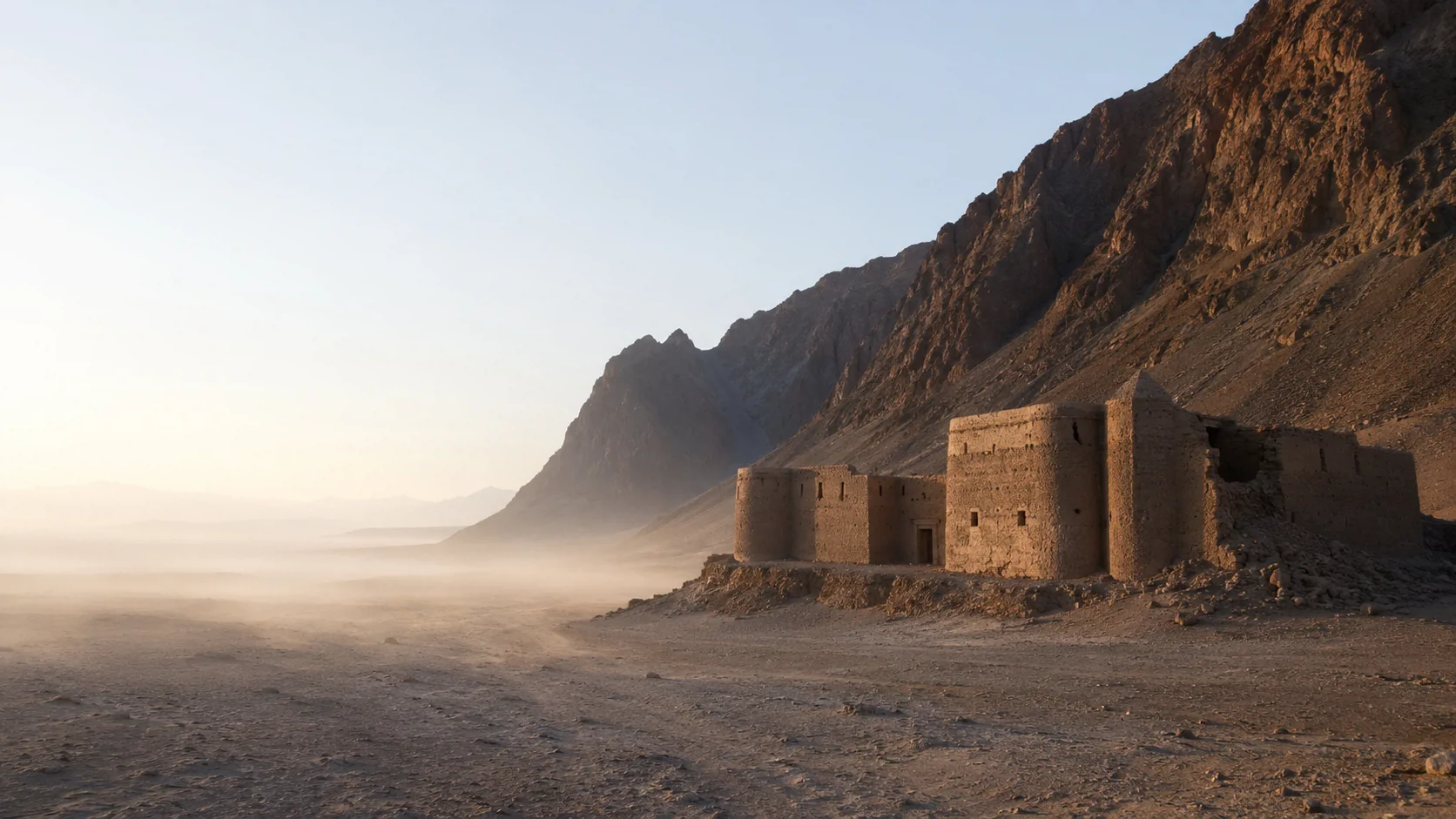
The Gate
There is a gap in the Safed Koh where the mountains fail. It is thirty-three miles long, narrow enough in places that two loaded camels cannot pass abreast, and for the better part of eight hundred years it worked in one direction only.
Through it came Mahmud of Ghazni, seventeen times from 1001, burning his way to Somanatha and back. Through it came Muhammad Ghori. Through it came Timur in 1398, who left Delhi a charnel house and carried its stonemasons away to build Samarqand. Through it came Babur. Through it came Nadir Shah in 1739, who took the Peacock Throne, the Koh-i-Noor, and by the most conservative estimates thirty thousand lives in a single day at Delhi. Through it came Ahmad Shah Abdali, nine times between 1748 and 1767, who sacked Mathura and Vrindavana in 1757 and had the Harmandir Sahib blown up and its sarovar filled with the carcasses of slaughtered cows.
Nothing came back the other way. Bharata's armies had won a thousand defensive victories on this frontier and lost the war of position every time, because a defensive victory at the Indus only means the next army will come next season. The pass itself was never held. It was the permanent open wound of the subcontinent, and by the eighteenth century it had bled for so long that its condition had begun to look like a law of nature.
In 1836 a man from Gujranwala built a mud-and-stone fort at the mouth of that pass, on the flat ground at Jamrud where the hills open onto the Peshawar plain. He built it in fifty-four days. He died holding it the following April.
For eight centuries the Khyber was a door that opened only inward. Hari Singh Nalwa shut it, and the noise of that shutting was heard in Kabul, Bukhara and Tehran.
Gujranwala, 1791
The family were Uppal Khatris out of Majitha, north of Amritsar, and they had already paid the frontier's tax twice over before Hari Singh was born.
His grandfather Hardas Singh had ridden with the Sukerchakia misl and was killed fighting Ahmad Shah Abdali in 1762 -- the year of the Vadda Ghallughara, when the Afghan invader caught the Sikh column near Kup and killed, by the estimates that have come down to us, something close to thirty thousand men, women and children in a single day. Settled His father Gurdial Singh fought through the campaigns of Charat Singh and Mahan Singh, the grandfather and father of Ranjit Singh. He died when Hari Singh was seven.
The boy was raised by his mother, Dharam Kaur, in the house of her brothers. He learned Punjabi and Persian, the sword, the matchlock and the horse. At ten he took khaṇḍe-dī-pāhul and entered the Khalsa. There was no estate to inherit and no title. His father had been a soldier of the misl, not a chief of it.
In 1804, at thirteen, he came to the darbar at Lahore over a property dispute -- the sort of business that filled a Maharaja's mornings. Ranjit Singh, who was twenty-four and had held Lahore for five years, looked at the boy and put him in the army instead. Within the year Hari Singh commanded eight hundred men.
Ranjit Singh's eye for men is one of the underrated instruments of the period. He built a state out of forty-odd quarrelling misls in a generation, and he did it by promoting on demonstrated competence rather than lineage: a fatherless Khatri boy from Gujranwala to commander-in-chief, a Mohyal Brahmana of the Bali clan -- Mahan Singh -- to second in command of the Khalsa army, Dogras, Punjabi Hindus, Muslims and Europeans into the officer corps. The Sarkar Khalsa was a Panjabi state before it was a sectarian one.
The Name
The story is told in a dozen versions and none of them can be finally verified, which is usually a sign that something happened.
He was on a hunt. A tiger took his horse. He refused help from the other hunters and killed the animal at close quarters -- with his bare hands, say some; with a sword drawn after he had forced the jaws open, say others; by splitting its skull after it had already seized him, says the account Henry Prinsep recorded in 1834. Contested From that day he was Bāgh Mār, the tiger-killer, and the cognomen Nalwā attached itself to him: one with claws.
He never used it. His own seal, cut in Persian and Gurmukhi, read simply Akāl Sahāi Hari Singh -- God is my help. The most feared name on the Afghan frontier was a nickname given by other people, and the man himself signed as a servant.
Between 1804 and 1837 he fought in roughly twenty major actions. He was grievously wounded at Multan in 1810 and went back to take the city in 1818. He was at Kasur, Sialkot, Attock, Mahmudkot, Gandhgarh, Shopian, Mangal, Mankera, Pakhli, Damtaur, Nowshera, Sirikot, Saidu, Peshawar and Jamrud. He was governor of Kashmir, of Greater Hazara for fifteen years, and twice of Peshawar. He founded a town, built the forts that anchored a frontier, struck coin, and administered roughly a third of the Sikh state.
He was forty-six when he died.
Attock, 1813
The Indus at Attock is where the subcontinent's arithmetic changes. Every army crossing from the west has to replenish there, and the fort above the ford had been the Durrani hinge since Ahmad Shah's day.
In 1813 Fateh Khan Barakzai, wazir of Kabul, came down with Dost Mohammad Khan to recover it. What he met at Chhachh Hazro on 13 July was a Khalsa force under Diwan Mokham Chand with Hari Singh Nalwa in the line, and what happened there had not happened before in the memory of anyone alive: the Afghans were beaten in open field by an army from Hindustan, and driven back across the Kabul river.
Attock stayed. So did Hazara-i-Karlugh and Gandhgarh. Settled
It is worth pausing on how radical this was. The Durrani state had been built on the assumption that its cavalry could go east whenever the treasury needed refilling and come back richer. That assumption had held for six decades and, in a longer view, for eight centuries. At Chhachh Hazro it stopped holding, and every Afghan campaign after 1813 was fought on the defensive, however the chronicles of Kabul chose to describe it.
The reversal did not begin with the Khalsa. It began with the Marathas. In 1758 Raghunathrao and Tukoji Holkar drove Timur Shah Durrani out of Lahore and Multan and planted the Maratha standard at Attock and Peshawar -- the first time in seven hundred years that a power from within Bharata had taken the Indus crossings back. That was the reconquest of Sanatana sovereignty in its clearest form, and it cost the Marathas everything at Panipat three years later. What Hari Singh Nalwa completed in 1836 was work the Marathas had begun eighty years earlier, and the two efforts are the same effort.
Multan, Kashmir, and the Retreat of Kabul
The decade after Attock was a sustained dismantling of Durrani power east of the Khyber.
Multan fell in 1818 after Muzaffar Khan Saddozai's long defence, and with it went the last Afghan hold on the southern Punjab. In the same year Peshawar became tributary. In 1819 the Khalsa crossed the Pir Panjal and took Kashmir at Shopian, ending five centuries of foreign rule in the valley and bringing to a close a period in which the region's temples, its Sanskrit learning and its Pandit families had been systematically ground down. Nalwa commanded a division in that campaign and became, in 1820, the first Khalsa governor of Kashmir.
Mankera followed in 1822 -- the Saddozai fastness in the Thal desert, taken after a siege that broke the last independent Afghan principality east of the Indus.
Principal campaigns in which Hari Singh Nalwa served or commanded, 1807-1837.
| Year | Place | Outcome |
|---|---|---|
| 1807 | Kasur | Taken from the Pathan chiefs of the Bari Doab |
| 1810 | Multan | First assault fails; Nalwa gravely wounded |
| 1813 | Attock | First Khalsa victory over the Durranis in open field |
| 1815 | Gandhgarh | Hazara hill tracts brought under Lahore |
| 1818 | Multan | City and citadel taken; southern Punjab secured |
| 1818 | Peshawar | Barakzai governor made tributary to Lahore |
| 1819 | Kashmir | Valley taken at Shopian after five centuries of foreign rule |
| 1822 | Mankera | Last Saddozai stronghold east of the Indus reduced |
| 1823 | Nowshera | Azim Khan's army destroyed; Akali Phula Singh falls |
| 1824 | Sirikot | Hazara tribes subdued after a night march |
| 1834 | Peshawar | City annexed outright; Nalwa made governor |
| 1837 | Jamrud | Khyber mouth held; Nalwa killed |
Nowshera, 1823
Azim Khan of Kabul could not accept his brother's submission at Peshawar. He crossed the Khyber with a large force and raised the tribes of the Yusufzai country in a declared jihad, gathering the ghāzī levies on the north bank of the Kabul river.
Nalwa was the first across the Indus at Attock, moving to Khairabad with Diwan Kirpa Ram and Ranjit Singh's teenaged son Sher Singh. He took Jehangira, then Akora, cutting the Khattak country away from the Yusufzai before the two could combine. The battle at Nowshera on 14 March was among the bloodiest of the period. The Akali Nihang commander Phula Singh charged the ghazi position on the Pir Sabak heights and was killed there. The Afghan army broke and Azim Khan recrossed the Khyber a ruined man; he died within months.
After Nowshera the question on the frontier was no longer whether Kabul could take Peshawar. It was whether Kabul could keep the Khyber.
The Governor
The soldier is the half of him that survived into folklore. The administrator is the half that mattered longer.
From 1822 to his death Nalwa held Greater Hazara -- fifteen unbroken years in what was then the least governable country in the Punjab -- and from 1825 he was commander-in-chief along the whole Afghan frontier. His jurisdiction, taken together with his personal jāgīrs, covered close to a third of the Sikh state. The territory he ran later became the British districts of Peshawar, Hazara and Attock, with slices of Jhelum and Mianwali; the British inherited his boundaries and his forts and, for the most part, kept both.
He established mints at Kashmir and Peshawar to put the frontier's revenue on a footing that did not depend on plunder. The Kashmir coinage struck under his authority carried his name, an honour the Lahore darbar extended to no other officer. Contested
He built. Sumergarh, the fort raised on the site of the old Bala Hissar at Peshawar, from which he governed. Jehangira and Nowshera on the two banks of the Kabul river. Harkishangarh in the Hazara valley, its wall four yards thick and sixteen high, with four gates. Fatehgarh at Jamrud. He funded the gold covering of the dome of the Akal Takht at Amritsar and raised the Gurdwara at Panja Sahib in Hassan Abdal.
And in 1822 he laid out a town.
Haripur
There is a habit in writing about frontier soldiers of treating everything they did as an extension of the sword. Haripur resists it.
It was a planned town -- the only one built in that region in the nineteenth century -- set down deliberately in the middle of the most hostile ground in the Hazara plains. It had a grid, a defensive wall, a fort at its shoulder, and a piped water distribution system laid before the town was populated. Nalwa built it to be lived in, not merely garrisoned, and he built it in a place where nobody had thought habitation possible.
It worked. When the Austrian traveller Baron Charles von Hügel came through in the mid-1830s he found a busy, prosperous town with a Khatri trading population that had migrated in and settled. Merchants do not migrate toward danger. They migrate toward the absence of it, which is the most exacting review any frontier administrator ever receives.
The town still carries his name. So does the district around it.
It is a small, hard irony that the two enduring physical monuments to Hari Singh Nalwa -- the town of Haripur and the fort at Jamrud -- both stand today in Pakistan, and that a great deal of the memory attached to them has had to be maintained from outside the country that holds them.
Peshawar, 1834
Peshawar had been paying tribute since 1818 and changing its mind about it roughly every other year. In 1834 the Lahore darbar ended the arrangement and annexed the city outright. Nalwa was made governor.
Dost Mohammad Khan, now Amir at Kabul, tried to reverse it. In 1835 he brought an army down to Shabqadar and proclaimed jihad. Ranjit Singh came up in person; the Afghan force dissolved without a general engagement and Dost Mohammad withdrew, having achieved nothing and spent a great deal.
That left one piece of geography unresolved. Peshawar could be held, but the Khyber above it was still open, and as long as it was open the city was a permanent invitation. In the winter of 1836 Nalwa went and shut it.
Jamrud, 1836
Jamrud sits at the eastern mouth of the pass, on the plain, where the road out of the hills debouches. Whoever holds it holds the exit.
The fort went up in something under two months -- mud, rubble and stone, thrown together at speed by a force working within sight of the Khyberi tribes whose entire economy depended on the pass staying open. It was not elegant. It was placed exactly where it needed to be, which in fortification is worth more than elegance.
With Jamrud built, the border of the Sarkar Khalsa stood at the throat of the Khyber. Kabul's road east now ran through a garrisoned gate held by the army it had lost to at Attock, at Nowshera and at Peshawar. Dost Mohammad understood immediately what had been done to him.
The Khyber had been an artery running one way for eight hundred years. Nalwa put a fort on it and turned it into a wall.
The Thirtieth of April
In the spring of 1837 the Lahore darbar was occupied with a wedding.
Nau Nihal Singh, Ranjit Singh's grandson, was to be married, and the Maharaja intended the occasion as a display of state power for the benefit of his British guests -- Sir Henry Fane, the Commander-in-Chief in India, was in attendance. Troops were drawn to Lahore from across the empire, including the frontier. It was, in the most exact sense, a security decision made for diplomatic reasons.
Nalwa remained at Peshawar, in the Sumergarh fort, ill. Jamrud was left to Mahan Singh with a garrison of six hundred.
Dost Mohammad read the situation correctly. He sent down an army under his sons Muhammad Akbar Khan and Muhammad Afzal Khan with his wazir Mirza Sami Khan: some seven thousand horse, two thousand matchlockmen, nine thousand irregulars and around fifty guns, joined in the pass by perhaps twenty thousand Khyberi tribesmen.
Nalwa wrote to Lahore on 10 March that Dost Mohammad had reached Jalalabad. He wrote again on 21 April that the Afghans had crossed the Khyber and entrenched themselves three kilometres from the fort. He wrote on 28 April that one wall of Jamrud had been demolished by continuous bombardment. He was told reinforcements would come after Sir Henry Fane had departed.
Tradition holds that when no messenger could be found to carry word from the besieged fort to Peshawar through ground entirely overrun, a woman named Harsharan Kaur volunteered and got through. Contested
On 29 April Nalwa left Peshawar with what he had -- some six thousand foot, a thousand regular horse, three thousand irregulars, twenty guns. He was under orders not to engage until Lahore's troops arrived. Jamrud had one wall left standing.
He engaged.
The cannonade opened early on 30 April. The Khalsa drove the Afghan lines back from the fort and into the mouth of the pass. Somewhere in that fighting Hari Singh Nalwa took the wounds that killed him -- matchlock fire, by most accounts -- and was carried inside the walls he had built.
He gave one last order. His death was not to be announced.
The Week the Dead Man Held the Pass
The Afghan commanders knew he had been hit. They could not confirm he was dead, and they did not dare test it.
For the better part of a week the army that had come to take Jamrud sat outside a broken fort held by a fraction of its number and did not go in. Then the relief column arrived from Lahore, and Akbar Khan withdrew to Kabul.
The Afghans had come for Jamrud, Shabqadar and Peshawar. They took none of them. The casualties on both sides were enormous -- the estimates run from six to eleven thousand, depending on which account one follows -- and the border did not move by a yard. Contested
It is the strangest week on the whole frontier: a corpse in a fort, and an empire's road east kept shut by a reputation.
He had made his name into a fortification. When the man was gone the name held for six more days, which was exactly as long as it needed to.
There is a piece of Peshawar folklore that Sayyid Muhammad Latif recorded in his history of the Punjab and that travellers were still hearing decades later: mothers quieting crying children with the warning that Hariā was coming. It is the sort of thing that gets repeated too easily and should be held lightly. Contested But something produced it, and whatever produced it was not produced by any other Indian commander on that frontier in eight hundred years.
What Was Actually Closed
It is easy to read Nalwa as a regional figure -- a Punjabi general in a Punjabi war, absorbed into Sikh martial memory and left there.
That reading gets the geography right and the meaning wrong.
What was at stake at the Khyber was not Punjab. It was the terms on which Bharata existed. From 1001 onward the subcontinent had organised itself around a permanent condition: wealth accumulated here, and periodically an army came through the northwest passes and took it, and the temples came down, and the populations were carried off, and the cycle reset. Every defensive victory bought a season. Nothing bought a settlement, because the gate was never held.
Two powers changed that condition, and both did it in the same century. The Marathas took Attock and Peshawar in 1758 and paid for it at Panipat. The Khalsa took Attock in 1813, Peshawar in 1834 and the Khyber mouth in 1836, and paid for it at Jamrud. Between them, in eighty years, they converted the northwest frontier from an entrance into a border. That is not a Punjabi achievement or a Maratha achievement. It is the recovery of a civilizational position that had been lost since Mahmud, and it was recovered by arms.
Hari Singh Nalwa is the man at the far end of that recovery -- the point of maximum extension, standing on the exact ground where the wound had been open longest.
Contemporaries outside India saw it more clearly than later Indian textbooks would. Mohan Lal Kashmiri, travelling in Persia in East India Company service, reported the Qajar crown prince Abbas Mirza being told that if Hari Singh crossed the Indus, his highness would be glad to get back to Tabriz. A century later K. M. Panikkar called him the noblest and most gallant of the Sikh generals of his age. Europeans on the frontier -- Hügel, Prinsep, Masson, the Company's political officers -- wrote about him with a mixture of alarm and professional respect that they extended to almost nobody else east of Kabul.
1849
Ranjit Singh died in 1839, two years after Jamrud.
What followed is the standard sequence: a disputed succession, a court consumed by faction, four Maharajas in six years, an army with no political master. The British, who had watched the Sarkar Khalsa from across the Sutlej for forty years and had been careful not to touch it while Ranjit Singh lived, moved in 1845. The First Anglo-Sikh War was fought largely by Sikh soldiers whose commanders were negotiating with the enemy while the fighting was in progress. The Second ended at Gujrat in 1849, and Punjab was annexed.
Nalwa's youngest son Arjan Singh refused to submit. He shut himself in the family estate at Gujranwala with a hundred men and beat off the party the Lahore darbar sent to bring him in. It took a company of Skinner's Horse to dislodge him. He got out ahead of them, lived on the run, and died a few years later. The British confiscated the property. Settled
The frontier passed to the Company, and then to the Crown, and the Khyber went back to being a problem rather than a border. The British fought three Afghan wars over the ground Nalwa had held with mud forts and a reputation, lost an entire army in the passes in 1842, and never fully pacified the tribal belt in a century of trying. In 1893 they drew the Durand Line, which was a diplomatic instrument rather than a defensive one, and its consequences are still being lived with.
There is a plaque inside the fort at Jamrud, put up by a local man named Gajju Mall in 1892 -- fifty-five years after the battle, under a different government, in a place where nobody was required to remember. It calls Hari Singh Nalwa a great general of the Sikhs.
The fort is still standing.
Coda
He was born in a house that had already lost two generations of men to the Afghan invasions. He was seven when his father died and thirteen when a Maharaja looked at him across a courtroom and saw a soldier. He killed a tiger and got a name he never used. He fought for thirty-three years, built a town with running water in country where nobody had built anything, put a fort at the mouth of the Khyber Pass, and died in it at forty-six.
The pass had been open for eight hundred years. He shut it, and it stayed shut for as long as there was a Punjabi state to keep it shut, which was twelve years longer than he lived.
That is not a regional memory. That is the last chapter of a very long defence, and it was won.
0 responses