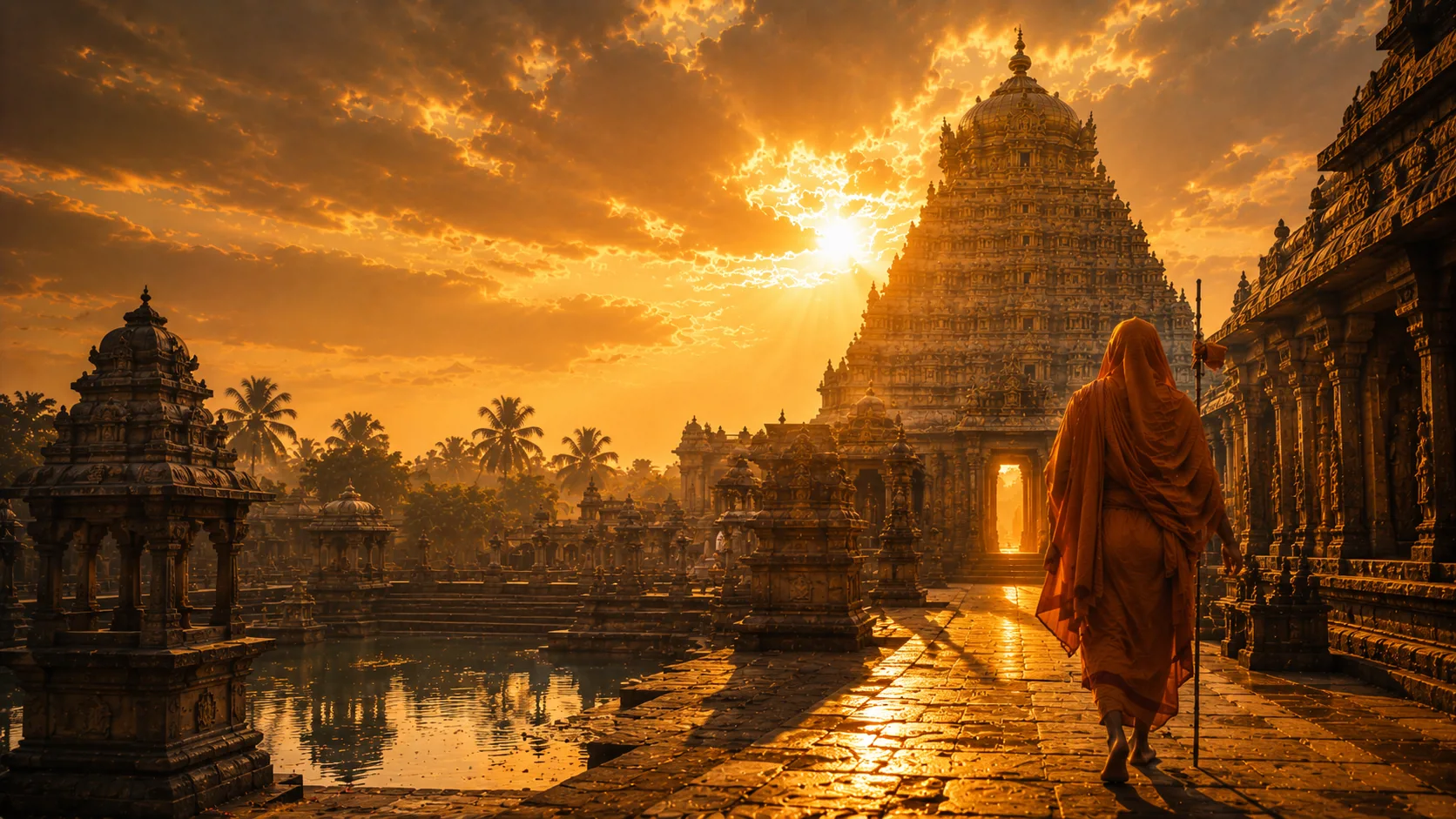
The Seat That Shankara Built
Before we can speak of the crime, we must speak of what was sacred — because the magnitude of the offence cannot be measured until you understand the holiness of the thing that was struck. And that holiness does not begin in 2004. It begins with Adi Shankara himself.
Adi Shankara came to Kanchi. Having composed his bhāṣyas, conquered the four directions in debate, and re-established Sanatana Dharma against the forces that were dissolving it, Bhagavatpada came at last to Kanchi — the ancient city the sages called a gateway to liberation — and there did the thing that binds this place forever to the Mother. Before the Goddess Kāmākṣī, with full scriptural authority, he consecrated the Śrī Chakra, the supreme yantra of Śrī Vidyā, installing Her grace at the heart of Her own shrine for every devotee who would ever come to take Her darśana. The Śrī Chakra he established before Kāmākṣī is worshipped there to this day. This is the living inheritance of Kanchi.
And it is from this consecration that the Kanchi Kamakoti Peetham draws its sanctity — the revered seat of the Shankaracharyas, the Mūlāmnāya seat of the South, bound to Kāmākṣī and to Adi Shankara across an unbroken succession of pontiffs down to the present day. An unbroken line of realised seers has held it, the Śrī Chakra stands where Shankara set it, and to the sanatani heart the Acharya of Kanchi is a living vessel of the grace that Bhagavatpada secured before the Goddess. It was that — that living sanctity — that the state of Tamil Nadu put in a cell on Deepavali night.
It is worth pausing on a single detail from the temple's own sculpture, because it carries the theology in stone. In the Kāmākṣī and Ekāmranātha temples, the Goddess is depicted in deep penance, standing on one leg — and beside Her, Shankara is shown absorbed in tapas in the very same posture. More striking still, Kāmākṣī is shown bearing the daṇḍa, the sacred staff that belongs only to a sannyasi. Why would the Mother hold a renunciate's staff? The answer is breathtaking in its intimacy: to declare that Kāmākṣī and the Acharya are not two. The seer of this seat is not merely Her devotee. He is Her own form — which is precisely why, to this day, sanatanis approach the Shankaracharya of Kanchi as they would approach Kāmākṣī Herself, why they fall full-length before him, why his glance is sought as Her grace. To revere the Acharya is to revere the Goddess. This is not metaphor. It is the living grammar of the faith.
From this seat flowed some of the deepest devotional poetry in the Sanskrit tongue. Among its early Acharyas was Mūka Śaṅkara — Mūka, "the mute" — who by the grace of Kāmākṣī was rendered a poet of the first rank, pouring out the Mūka Pañcaśatī, five hundred verses of incandescent praise of the Goddess of Kanchi, which the Paramācārya himself ranked among the very highest stutis ever composed on Her. A seat that could turn a mute into a master of speech by the Mother's grace is no administrative office. It is a channel of the divine.
The Walking God Who Chose Him
There is one more thing the secular account erases, and without it the wound cannot be felt at full depth: who this seer was, and who had chosen him.
The man arrested in 2004, the 69th Shankaracharya, Jayendra Saraswathi, did not appoint himself. He was hand-picked, at the age of nineteen, by his predecessor — and his predecessor was no ordinary pontiff. He was Sri Chandrasekarendra Saraswathi, the 68th Acharya, whom the whole of Bharata came to know simply as the Paramācārya, the Mahāperiyava — "the great elder" — and whom millions regarded, without exaggeration and across every barrier of region and language, as a living god who walked the earth.
The Paramācārya was a phenomenon Hinduism produces perhaps once in a century: a realised jñānī of such evident purity that statesmen, scientists, and sceptics fell silent in his presence. He took sannyasa in 1907 and lived nearly a hundred years, much of it walking the length and breadth of India on foot, in the old way, refusing comfort, embodying the renunciate's discipline so completely that he became, for the modern age, the very picture of what a sage is. He was widely venerated as an avatāra puruṣa, a realised being. When he spoke, the nation leaned in. When he was silent, that too was teaching.
And it was this man — the walking god, the Mahāperiyava — who looked upon a nineteen-year-old boy in 1954 and chose him to carry the seat of Shankara into the next generation. Sit with the weight of that. The successor to the Kamakoti Peetham, the seat bound to Kāmākṣī herself, was not selected by a committee or an election. He was recognised — picked out by one of the most luminous spiritual presences of the twentieth century, a seer whose discernment the entire tradition trusted absolutely.
So consider what the arrest actually asserted. To jail Jayendra Saraswathi as a common conspirator to murder was, by unavoidable implication, to say that the Paramācārya — the walking god, the realised seer revered by a nation — had erred catastrophically in the one choice that defined his legacy; that his hand-picked successor, the disciple he had raised and anointed, was a killer. The insult did not stop at one seer. It reached backward through the lineage and struck at the discernment of the Mahāperiyava himself, and through him at the whole chain of authority descending from Shankara. That is part of why the blow landed on the Hindu heart with such devastating force. It was not one man being accused. It was the entire credibility of the tradition's holiest line.
What a Sarva-Saṅga-Parityāgī Endures in Silence
And what of the man inside it — not the institution, not the office, but the consciousness held in that cell?
Here we must tread with humility, because we are speaking of the interior of a sarva-saṅga-parityāgī, one who has renounced all attachment, a jñānī established in the knowledge of the Self. We cannot claim to know his mind. But the tradition gives us the frame through which to imagine it, and that frame is itself part of the cruelty and part of the grandeur of what happened.
A realised renunciate is taught — and is held to embody — titikṣā, the serene endurance of the pairs of opposites: heat and cold, honour and dishonour, comfort and pain, met with an equal and unshaken mind. The śāstra describes the sannyasi as one who waits for the body's end "like a servant awaiting his wages," courting neither life nor death, resting in the Self. By this measure, the cell could not touch what he most truly was. The walls held a body; they could not cage the Ātman. There is a real and consoling truth in this, and the devout have always clung to it: that whatever the state did to his body, it could not reach the freedom that was his by realisation.
And yet. To say the jñānī is unshaken within is not to say that nothing was violated — for the renunciate's life is not only inner realisation but a fabric of outer observance offered, daily, as worship and as the upholding of dharma for others. The pain, if we may speak of it at all, would not have been the ordinary prisoner's pain of lost comfort or wounded pride; a sarva-saṅga-parityāgī has burned those away. It would have been something subtler and, in its way, far heavier: the anguish of being prevented from his dharma — forcibly stopped from the worship he existed to perform, severed from the disciplines through which he served Kāmākṣī and, through Her, the welfare of the world. It is the difference between a man grieving his own discomfort and a man grieving that the lamp he was charged to keep had been knocked from his hands. The first is ego. The second is duty. And it is the second, the tradition would say, that a true Acharya would have felt — not for himself, but for the worship interrupted and the devotees bereft.
This is the dimension no charge-sheet could comprehend and no acquittal could repair. The state believed it had detained a suspect. What it had actually done was wrench a consecrated being out of the only life he had — and then stand back, baffled, as a serenity it could not explain settled over the man it had caged. The cruelty was total; and the dignity with which it was met was, to those who witnessed it, the proof of exactly what they had always believed him to be.
The Lamp That They Tried to Put Out
There are nights a civilisation does not forget. For the Hindus of Bharata, the night of 11 November 2004 is one of them.
It was Deepavali. Across the land, a hundred million lamps stood in doorways, kindled on the night that carries the oldest promise our tradition makes — that darkness does not get the last word, that dharma outlasts the forces that come to extinguish it. And on that night, on that of all nights, the police of the Tamil Nadu state drove to Mahbubnagar in Andhra Pradesh, where the 69th Shankaracharya of the Kanchi Kamakoti Peetham sat in the observance of his vrata, and they took him. Not a fugitive. Not a criminal caught in the act. A renunciate in saffron, a man whom millions worshipped as a living incarnation of Adi Shankara himself, lifted out of his devotions near midnight and driven away into the dark.
They put him on a plane to Chennai. They produced him before a magistrate like a pickpocket. And then they locked the head of one of the most venerable monastic seats in all of Sanatana Dharma inside Vellore Central Prison, where he would spend the festival, and the cold weeks after it, as accused number one in a conspiracy to murder.
Sit with the scale of that for a moment, because the mind flinches from it and wants to move on. This had not happened under the Delhi Sultanate. It had not happened under Aurangzeb. It had not happened under the British Raj, in all its contempt for the natives' gods. Through eight centuries of conquest and humiliation, no foreign power had dared to drag a Kanchi Acharya from his seat and cage him like a thief. It took the free, constitutional, democratic republic of India — and one of its own Hindu Chief Ministers — to do what no invader had done.
For lakhs of devotees, the news did not land as information. It landed as bereavement. Grown men wept in the streets. Families who had received the Acharya's blessings, who kept his photograph in their puja rooms beside the deities, sat in stunned silence as the television told them their guru was in a cell. Mothers could not explain to their children why the holy man they had been taught to bow before was now shown on the news flanked by policemen. Elderly devotees who had walked for days to take his darśana now wept before the same television sets that broadcast his humiliation on a loop. This was not the distress of partisans losing a political fight; it was the specific, disorienting anguish of watching something one holds as literally divine be defiled in public — a trauma that lodged in the Hindu psyche and has never fully left it, resurfacing every time the case is named even decades later. Something had broken that could not be unbroken. A boundary that had held for a thousand years had been crossed in a single night, and it had been crossed not by an enemy of the faith but by one of its own daughters.
This is the full account of how that came to pass. It is told without softening, because the truth needs none. But it is also told without invention, because the documented facts are a heavier indictment than any rumour could ever be — and because a story this sacred deserves to be unanswerable.
The Man Who Wrote the Letters
Honesty demands that we begin not with the seer but with the dead.
A. Sankararaman was real, and his death was real, and it was monstrous. On the afternoon of 3 September 2004, a gang of men entered the office of the Sri Varadaraja Perumal temple in Kanchipuram, where he served as manager, and hacked him to death with sharp weapons. There were no eyewitnesses to the killing itself. He was a husband and a father. His blood was spilled on temple ground. And to this hour — through arrests, through a nine-year trial, through a verdict that cleared two dozen men — no one has ever been convicted for it. That wound has never closed, and a Dharmic account does not pretend otherwise.
Who was he? A man once bound to the Mutt by history — his father had served closely under the saintly 68th pontiff, the Mahaperiyava Chandrasekarendra Saraswathi, and Sankararaman himself had been an employee of the Peetham until that beloved seer's passing in 1994. In later years he had fallen into bitter estrangement from the Mutt's management, and had made himself its most persistent public critic. Whatever the merits of his grievances — and an institution's internal disputes are rarely as simple as one aggrieved man's telling — none of it can bear the weight the prosecution would later place upon it. A quarrel, however loud, is not a motive for murder, and a man's letters are not evidence that those he wrote against had him killed.
He became a writer of letters. Hundreds of them, in his own name and under the pen-name Somasekara Ganapadigal, fired off to newspapers, to authorities, to corporate donors, to the seer himself — alleging financial irregularity, nepotism, misuse of the Mutt's funds. He went to court in 2000 to stop the Acharya from travelling to China, invoking the ancient stricture that a sannyasi must not cross the seas, and the trip was cancelled. He was reportedly barred from entering the Kamakshi Amman temple with his family. His last letter, written on 30 August 2004 — four days before his murder — warned the Shankaracharya that he was abusing his office and that he, Sankararaman, would move the court to have him removed.
Four days later he was dead.
And there it was: a motive that wrote itself. The inconvenient accuser, silenced forever, four days after his final threat. It was the kind of narrative that needs no evidence to feel true — which is precisely what made it so dangerous. A theory that satisfies the gut is the easiest thing in the world to build a wrongful case upon.
How a Magazine Story Became a Manhunt
For two full months after the murder, the police did not touch the Mutt. That delay is itself a confession of sorts: there was no smoking gun, no blade with a fingerprint, no witness who had seen the seer give an order. There was only a theory in search of a structure.
The structure was supplied, in large part, by a Tamil weekly. Nakkeeran, through its investigative reporter Damodaran Prakash, ran the story that the murder had been ordered by the Mutt — that Sankararaman's relentless letters were poisoning the well with the seer's wealthy patrons, and that he had been killed to stop the bleeding. The report, by the reporter's own later admission, set off something like an earthquake in the collective Hindu psyche. It gave the inchoate suspicion a spine, a motive, a villain. And it gave the state a map.
From there the chain was assembled, link by link. A history-sheeter named Appu — a man already trailing charges of sandalwood smuggling and sand-quarrying, reportedly connected to politicians across parties — was alleged to have supplied the killers. A civil contractor named Ravi Subramanian, who had built structures for the Mutt, was named as the man who arranged it. Sundaresa Iyer, the Mutt's long-serving manager, was accused of moving the money from the Mutt's own accounts. Twenty-four people in all were eventually named. The junior pontiff and heir, Vijayendra Saraswathi, was made accused number two. The senior seer's own brother was dragged in.
And at the head of the list, accused number one, stood the Shankaracharya of Kanchi.
A Chief Minister Stakes Her Name
Within days of the arrest, the Chief Minister of Tamil Nadu, J. Jayalalithaa, did something no careful prosecutor would ever advise. She went before the public and personally vouched for the case. The arrest had been made, she declared, because the state possessed solid evidence — statements from the prime accused, large sums drawn from the Mutt to pay for the killing, transcripts of telephone conversations between the seer and his hired men.
This was not the language of due process. It was the language of a verdict already reached. And once a Chief Minister has staked her own name, in public, on the guilt of a man before a single witness has been cross-examined, the entire machinery beneath her loses the freedom to find him innocent. Every policeman, every prosecutor, every official in that chain now had a career reason to make the charge stick. The case stopped being an inquiry and became a commitment.
Why did she do it? Here the historian must lay out, in plain daylight, what the record actually shows — and, just as importantly, refuse to smuggle in the insinuations the prosecution and a hostile press used to make the unforgivable look reasonable. The motive that matters is not some imagined failing in the Acharya. It is the conduct of the state.
What is documented, and bitter: Jayalalithaa had, not long before, been a devotee of this very Mutt. She had been photographed at its rituals. She had been close to the seer. The arrest was therefore not the act of a hostile outsider — it was a betrayal from within the fold, which is exactly what made it cut so deep.
What even the opposition came to suspect: that this was personal vengeance and political opportunism dressed in the robes of law. M. Karunanidhi, the DMK patriarch and no friend of the Mutt, first welcomed the arrest — and then, tellingly, retracted, saying he suspected personal motives behind the manner of it. Asked what he would have done in her place, he replied with a politician's blade: had he been Chief Minister, the murder would never have happened at all. He was implying he would have settled the matter quietly. She had chosen, instead, the spectacle of a midnight arrest.
And there is a commercial whisper that has never left the case: that interests around the state had an eye on the Mutt's vast properties and institutions. Speculative That strand was never proven in any court, and it must be named as exactly what it is — an unproven suspicion, not a finding. But given everything the courts later said about how the case was built, it has never been laid to rest either.
It is worth being categorical about what this account will not do, because the temptation is everywhere in the secular literature. It will not turn the Acharya's life of dharma into a catalogue of "political ambitions" offered up as though they explained or softened his persecution. A renunciate who blesses, who mediates, who concerns himself with the welfare of the tradition is doing what the head of such a seat has always done; to recast that as scheming is itself part of the slander that was manufactured around him. Whatever calculations moved Jayalalithaa, the cause of this catastrophe lies in the one who wielded the power of the state — not in the one who wore the saffron.
Strip away the legal costume and what remains is brutally simple. The most total humiliation available to a head of state was reached for, and used: not to defeat a man at the ballot, not to answer him in argument, but to put a Shankaracharya in a cage on the holiest night of the year and let the cameras feast. No imagined failing of the seer can carry the weight of that choice. It rests, wholly, on the one who made it.
The Confession That Never Was
Then came the cruelty that did the deepest, most lasting damage — and it was inflicted not in a courtroom, where it could be tested, but in the press, where it could not.
The prosecution let it be understood, and a senior advocate later asserted in open court, that between 19 and 21 November 2004, at an all-women's police station in Kanchipuram, the Shankaracharya had broken down — had wept, and had confessed to his role in the murder. The image was released into the bloodstream of the nation: the godman, the living Shankara, sobbing out his guilt in a police station. It was broadcast, reprinted, repeated until it calcified into something the public simply knew.
Understand exactly what this was, because the law does. A confession extracted in police custody is, by long-settled Indian law, worth nothing as evidence — inadmissible precisely because of how easily fear, exhaustion, and pressure can manufacture it. It can convict no one. The leakers knew this. The point of the leak was never to win a trial. The point was to win the war for public memory before the trial could even begin — to ensure that for millions who would only ever read a headline, the case was closed the instant the word "confessed" appeared in print.
When the matter finally reached a courtroom that would actually weigh evidence, this confession amounted to nothing. It carried no weight, sustained no charge, survived no scrutiny. It vanished. But the stain it pressed into the reputation of a Mutt that had stood for a thousand years did not vanish with it. That was the design.
This is what it looks like when state power and yellow journalism are welded into a single weapon: float an admission the law can never use, broadcast it as settled fact, let it harden into the public's memory, and rely on the glacial slowness of justice to guarantee that the correction — if it ever comes — arrives a decade too late to matter to anyone.
What a Cell Does to a Sannyasi That It Cannot Do to a Thief
Here we must slow down, and step out of the courtroom and the television studio entirely, because the secular accounts of this case all miss the thing that the devotees never could. They counted the days of imprisonment. They did not count what was broken inside those days. To understand the true magnitude of what was done on Deepavali night, you have to understand what a Kanchi Acharya actually is, and what his life actually consists of — not as a public figure, but as a body and a discipline consecrated to an unbroken thread of worship that is older than most nations on earth.
A Shankaracharya is not a priest who performs a service and goes home. He is a sannyasi — one who has performed his own funeral rites, who has uttered sanyastam mayā, "I have renounced," and in that moment died to the world, to family, to property, to his very name. The tradition teaches that this renunciation is no small thing: that sixty generations of his ancestors and sixty generations of his descendants are lifted by the act of a single man who truly takes it up. He is an ekadaṇḍi, a bearer of the single staff — the daṇḍa that is itself a consecrated emblem of his renunciation, not an ornament but the very sign of his ascetic authority. It is kept covered; it is not to be touched by another; it is not to be handled in a state of impurity. Its sanctity is not a formality; it is the physical sign of a life lived entirely inside ritual law.
And the life that staff presides over is governed, every single day, dawn to night, by anuṣṭhāna — the stipulated, rigorous, non-negotiable observances of a consecrated body. Here a distinction matters, and getting it right is itself a form of respect for the tradition: the sandhyāvandana of the householder, centred on the Gāyatrī and bound to the sacred thread, is precisely what the sannyasi has transcended — at renunciation he sets aside the yajñopavīta and the karma-kāṇḍa that goes with it. What remains, and deepens, is the higher upāsanā: the contemplation of praṇava, the syllable Om, the meditative disciplines of the renunciate, and above all the worship he performs not for himself but as the very office of his seat. The śāstra is emphatic in a way the modern ear barely registers: nityakarma should not be disturbed at any cost. The consecrated observance is not a preference. To break it is not to skip an appointment; in the language of the dharma texts it is a patana, a falling, an injury to the order of things that calls for prāyaścitta — expiation — to repair.
But that personal contemplation is only the inner half of his discipline. His office — the reason the Kanchi Kamakoti Peetham exists at all — is the worship of the Mūlāmnāya deity itself: Sri Chandramouleeśvara, the crystal Sphaṭika liṅga given by Lord Śiva from Kailāsa into the hands of Adi Shankara himself, and by Shankara into the keeping of this seat. Beside it, the Sri Meru of Goddess Tripurasundarī. This is the Chandramouleeśvara Pūjā, and here is the detail that secular reporting never grasped: the trikāla pūjā, the worship offered three times each day, is performed by no one but the reigning Acharya. Not a junior priest. Not a deputy. The Shankaracharya himself, with his own consecrated hands, offers the kṣīra-abhiṣekam, the milk-bath to the accompaniment of Sri Rudram, the ṣoḍaśa-upacāra, the sixteen honours, the alaṅkāram, the Rudra-trishatī, the dhūpa, dīpa, naivedya, the camphor ārati. Three times a day. Every day. For decades. An unbroken current of worship that the devotees believe holds something in balance — not metaphorically, but actually — for the whole of the land.
Now hold those two facts together, and feel the violence of what was done. The one man on earth ordained to place his hands upon the crystal liṅga of Kailāsa, three times each day, was seized at midnight on Deepavali night and locked in a cell — and the worship stopped. For two months, the hands that alone were to touch Chandramouleeśvara could not reach him. That is not an inconvenience. To the tradition, that is a wound in the fabric of the sacred itself.
Think of what those two months actually contained, day after day. The pre-dawn hour arriving and no abhiṣekam offered. The crystal liṅga that had received the milk-bath every dawn for an unbroken span of years, now untouched by the hands appointed to it. The Chaturmāsya vrata — the sacred four-month retreat the Acharya had been in the very midst of observing when they took him, the most ritually intensive period of a sannyasi's year — shattered mid-observance. The pranava-anuṣṭhāna, the disciplines of Om, the japa, the meditation that requires a consecrated and undisturbed setting — all of it now to be attempted, if at all, inside a prison.
And a prison is, in the precise technical language of the śāstra, the single most ritually catastrophic environment imaginable for a consecrated body. The dharma texts are exhaustive about what breaks purity — contact with the impure, with the things of decay, with bodily pollution; the requirement of immediate bathing and prāyaścitta after even accidental contact; the impossibility of performing nityakarma in an impure place or an impure state. A jail is a place of constant, unavoidable, total contamination by these standards. The food is not the bhikṣā prepared in ritual purity that a sannyasi alone may accept — it is common prison fare, untouchable to him. The water is not madi. The company is not fellow renunciates but hardened criminals — men whose very proximity, in the logic of the tradition, the Acharya's lifelong discipline had been constructed to keep at ritual distance, not from contempt for them as souls, but because the consecrated vessel of the daily worship cannot be maintained amid such contact. Every hour in that cell was an hour in which the observances that defined his entire existence were rendered impossible to perform correctly, and the purity they required, impossible to keep.
This is the cruelty that the day-count of "two months in jail" completely conceals. For an ordinary prisoner, jail is the loss of liberty. For this man, it was the forced cessation of the one thing his life had been wholly given to — the severing of a daily thread of worship to Chandramouleeśvara that he, and only he, was ordained to sustain, and which he had sustained without fail. They did not merely imprison a body. They reached into the sanctum of a thousand-year-old seat and stopped the hands of the one man permitted to serve its God. The humiliation that lakhs of devotees felt in their chests was not sentimentality. They understood, correctly, that something far larger than one man's freedom had been violated — that a current which had flowed unbroken from Adi Shankara's own hands had been forcibly dammed, and dammed deliberately, on the night the lamps were lit.
They could keep a thief in a cell and take nothing from him but his days. They kept a sannyasi in a cell and took from him the very thing that made his days sacred. The walls were the same. What was destroyed inside them was not.
The Policeman the Supreme Court Could Not Stomach
If you want to know why this case ultimately collapsed, you do not need a single conspiracy theory. You need only read what India's own courts said about the men who built it.
The investigation was effectively driven by one man: K. Premkumar, then Superintendent of Police at Kanchipuram. And from very early, the judiciary saw that he was not behaving like an investigator searching for truth. He was behaving like a man with an outcome to deliver.
When the Supreme Court granted the senior seer bail in January 2005, it did not do so politely. It censured the Tamil Nadu police for failing to gather credible evidence against him, and it singled out Premkumar by name, condemning him for showing undue interest and active participation that ran far beyond his proper jurisdiction. Read that again: the highest court in the land, looking at the state's own conduct, found a senior police officer to be improperly, suspiciously over-invested in nailing a specific man.
It got worse. When the seer's defence argued that no fair trial was possible in a Tamil Nadu whose own Chief Minister had pre-judged the case, the Supreme Court agreed. In 2005 it took the extraordinary step of lifting the entire trial out of the state and transferring it to Puducherry — a judicial acknowledgment, in effect, that the home government could not be trusted to try this case honestly. And it ordered that Puducherry appoint its own prosecutor, prising the prosecution out of the hands of the very government that had manufactured it.
And Premkumar himself? He was eventually suspended — reportedly for trying to encourage one of the accused to flee custody. Pause on the perversity of that. The lead investigating officer, allegedly nudging an accused man to run. That makes sense only if the goal was never to convict the actual guilty, but to keep the theatre running, to manage a narrative. He was later dismissed from the service in another matter altogether.
When the final acquittal came, the trial court did not mince words. It recorded that a fair and proper investigation had simply not been conducted — precisely because of Premkumar's involvement beyond the limits of law. The chief investigating officer, Sakthivel, the court found, had not conducted an independent investigation and had failed to produce materials collected during the probe. Some witnesses, the court noted, had been pressured to give confessional statements before magistrates.
The men who built the case against the Shankaracharya are remembered today not in the judgments of history as servants of justice, but in the judgments of India's own courts as its abusers. That is not the devotees' claim. That is the record.
Nine Years, 189 Witnesses, and a Case That Turned to Ash
The trial in Puducherry ground on from 2009 to 2013. Four different judges presided over its long life. The prosecution paraded 189 witnesses through the box.
And the case the state had staked a Chief Minister's name on dissolved in front of everyone.
Of those 189 witnesses, roughly 89 — nearly half — turned hostile, abandoning the statements the police had recorded from them. The single most important witness, the approver Ravi Subramanian, the contractor on whose arranged testimony the entire architecture of conspiracy depended, retracted everything. He took back what he had told the police; he took back what he had told the court. The keystone was pulled and the arch fell.
Worse for the prosecution, the murdered man's own family failed to deliver. Sankararaman's widow, his son, his daughter — examined as witnesses — failed to identify the accused in court. The motorcycle said to have carried the killers was never identified. There was, the judge found, no incriminating evidence linking the seers to the crime, and no substantive evidence to corroborate the testimony of the witnesses who had turned. The defence — argued by senior counsel who tore the prosecution's chain apart link by link — needed only to point at the wreckage.
On 27 November 2013, in a packed and heavily guarded courtroom, Principal District and Sessions Judge C. S. Murugan acquitted all of the accused. The conspiracy charge against the two Shankaracharyas was held simply, flatly, not proved. The seers' own counsel said afterward that there had been no witness and no document to establish the involvement of the Acharyas at all — that it was not even a fit case to appeal, because there was nothing there.
Nine years. Two months of a renunciate's life spent in a prison cell. A thousand-year-old institution dragged through every television studio in the country. A confession that was never a confession. An investigation the Supreme Court itself did not trust enough to leave in its own state. And at the end of all of it — against twenty-four human beings — nothing proved against anyone at all.
Who Roared, Who Whispered, and Who Said Nothing
How did the Mutt survive a blow aimed squarely at its heart? And who stood up when the Acharya was taken? The answers are not flattering to everyone, and they must be set down plainly.
The institution endured, in the end, because it had endured worse arithmetic before. A Mutt coordinator pointed out at the time that a Kanchi Shankaracharya had been arrested once before, at the turn of the previous century, over the Mutt's unpaid debts — and had been released and resumed his seat. Arrests, the logic ran, cannot destroy a thing that has stood since antiquity. The daily rituals continued; the deities were still served; the lamps in Kanchipuram were not allowed to go out. But let no one pretend it was unscarred. Observers who knew the institution intimately judged that the Mutt's once-towering influence over the political and social life of South India would never again be quite what it had been. The damage was real, and no acquittal could fully undo it.
Who roared? The protests were loudest in Delhi and among the political Hindu right. The former Prime Minister Atal Bihari Vajpayee, the former President R. Venkataraman, and leaders across several parties gathered in the capital to condemn the arrest. Vajpayee personally went to the Prime Minister, Manmohan Singh, and asked at minimum that the seer be moved out of a common cell to some decent guest house. The Vishwa Hindu Parishad called for a nationwide bandh. The BJP and the broader Sangh Parivar raised the cry of "Hinduism under threat." Sushma Swaraj of the BJP went to visit the seer. Years later, the acquittal would be hailed by the RSS as a victory of truth over a scheme to defame Hindu spiritual leaders.
But here is the bitter part, and it must be said. For all that noise, the agitation largely failed to move the broader public. The honest contemporary record notes that the Sangh Parivar's campaign did not catch fire on the street; that beyond Brahmin groups performing yagnas and lighting protest lamps, there was strikingly little mass response. A spate of follow-on arrests silenced even the murmur of dissent. For a frightening stretch, Jayalalithaa was actually praised for her boldness, and those who called it vendetta were dismissed as cranks. The truth is that the Acharya sat in his cell while much of the country looked away — and that silence is part of this story too.
And the other Shankaracharyas — Sringeri, the other great Advaita seats? Here the record is thinner, and it would be wrong to manufacture what cannot be documented. There are reports that the Sringeri Acharya, Sri Bharati Tirtha, gave voice to the principle at stake — the warning, deep in the tradition, that when the great souls, the mahatmas, are tormented, peace itself deserts the land. But there was no thunderous, unified front of all the maths marching as one to defend a brother seat. Whether from the famous mutual reserve between the lineages, from caution, from institutional self-protection, or from the simple instinct not to be the next one arrested — the wider monastic world did not rise as one body. The Kanchi Acharya, for long stretches of his ordeal, stood substantially alone. The devout have never quite forgiven that silence, and they are not wrong to remember it.
The most chilling lesson of those years is not that a wicked ruler struck at a holy man. Wicked rulers have always existed. It is how few were willing to stand in the street and say so — how easily a society can be made to look away while one of its own sacred pillars is humiliated, provided the humiliation is wrapped in the paperwork of law.
The Fire and the One Who Touched It
A seer was vindicated. But what of the woman who lit the fire?
Let us hold to the discipline that has carried this account, because it is in this final movement that grief most wants to outrun fact — and the truth, told precisely, strikes harder than any curse.
Here is the documented record. Jayendra Saraswathi was jailed on Deepavali night, 11 November 2004, and released on bail by the Supreme Court on 10 January 2005 — roughly two months, about sixty days, of a renunciate's life surrendered to a prison cell for a crime of which he was, in the end, wholly cleared.
And here is the other documented record, the one the devout have turned over and over in their hands like a stone. On 22 September 2016, J. Jayalalithaa was rushed to Apollo Hospital in Chennai. She never walked out. She lay there, on machines, through tracheostomy and ventilator and cardiac arrest, for seventy-five days, before she was declared dead on the night of 5 December 2016. Seventy-five days of confinement to a bed she could not leave, her body failing by inches, the circumstances of it so clouded that they remain the subject of formal inquiry to this day — dysfunctional CCTV cameras, contested testimony, a commission of inquiry, allegations that have never been fully put to rest.
Sixty days for the seer she caged. Seventy-five for the Chief Minister who caged him.
Now — the historian's hand must stay steady here. The numbers are close. They are not identical, and it would be false to pretend otherwise, because a false claim would dishonour a true one. To say her dying confinement was "exactly" as long as his imprisonment would be to invent, and this account does not invent. What can be said, truthfully and without exaggeration, is this: the woman who took a Shankaracharya from his vrata and confined him in a cell for two months herself ended her days confined to a hospital bed for two and a half months, dying slowly, her end shadowed by mysteries no court has ever cleanly resolved. She had returned to power. She had beaten her own corruption case at one stage. She was at the summit. And then she was on the machines, and then she was gone, and the seer she had jailed was alive and free, having outlived the case against him by years.
The devotees of the Kamakshi — the Mother whose own seat sits at Kanchipuram, beside the Mutt — have drawn their conclusion, and it belongs to them by right. Polemical They will tell you that she touched the fire. That she raised her hand against the Acharya, against the Peetham, against the Mother herself, and that the fire she touched did not forget. That reading lives in the register of faith, and faith is entitled to it; a Dharmic publication does not sneer at it, because the moral universe our tradition describes does not run on coincidence. The historian only records the two facts, side by side, and lets them speak: she did not live to see herself vindicated, and the seer she jailed buried her in memory while he yet lived.
What the Lamp Was For
Return, at the last, to the lamp.
Jayendra Saraswathi lived on. He was cleared in a separate case in 2016. He led the Mutt until his final breath, attaining siddhi on 28 February 2018 at the age of eighty-two. On his last morning he asked his successor to perform the day's worship, completed his own observances, and let go. Over five lakh people are said to have come to Kanchipuram to take his final darshan. He was interred beside his own guru, the Mahaperiyava, in the same hallowed ground. And his successor — Vijayendra Saraswathi, the very man who had been made accused number two in this monstrous case, who had himself been arrested and jailed — rose to become the 70th Shankaracharya of Kanchi, and heads the Peetham to this day. The succession the state had tried to break held. The lineage the prosecution had tried to defile continued, unbroken, into the present. And note the shape of his final morning, for it is the perfect answer to the cell: on the last day of his life, the man they had once stopped from worshipping rose and saw to it that the day's pūjā to Chandramouleeśvara would be offered — handing the worship to his successor, and only then departing. The thread they had dammed for two months he carried, in the end, to his very last breath, and handed on intact. The crystal liṅga of Kailāsa is bathed in milk at dawn in Kanchipuram still. The hands that hold it now are the hands of the man they had named accused number two.
That is the shape of the ending, and it is the shape Deepavali itself describes. The festival does not promise that the darkness will not come. It comes every year; the new moon is real. What Deepavali promises is that the darkness does not get to keep the night. The lamp is lit against it, and the lamp endures.
They came for the Acharya on the night of lamps and they put him in the dark. For a thousand years no conqueror had dared it, and a Hindu ruler dared it in free India, and the shame of that will not wash out — it should not, and this account refuses to let it. But the dark did not get to keep him. The courts of the same republic that jailed him cleared him completely and named the state's own hands as the reason the case could never stand. The institution endured. The lineage held. The seer was vindicated, and outlived the woman who jailed him, and his successor sits the throne of Kanchi now.
The lamp was put out for a night.
It was never, for one moment, put out.
A note on method, because a story this charged earns its authority only through discipline. This account rests on the documented record — the Supreme Court's 2005 bail and transfer orders and their censure of the investigating officer, the November 2013 Puducherry acquittal judgment and its findings on the investigation, the published Apollo and AIIMS health timeline of Jayalalithaa's final hospitalisation, and contemporary reporting across the case's nine-year arc. Throughout, the line between what the courts established (the improper investigation, the censured and suspended policeman, the collapsed prosecution, the total acquittal) and what devotees and observers believe (the property motive, the precise political calculus, the karmic reading of Jayalalithaa's death) has been drawn deliberately and kept visible. The proven facts are severe enough that the case needs no embellishment; refusing to exaggerate them is what makes them impossible to dismiss. And the murder of A. Sankararaman remains, to this day, unsolved — a wound this account does not paper over.