In Mumbai the evening trains were pulling out of Churchgate packed to the doors. It was a Tuesday, a little after a quarter past six, and along the busy roads the electronics shops had their television sets stacked in the windows, a dozen screens tuned to the same channel. Shortly before half past six the picture on every screen changed at once. A silver tower stood against a flawless blue sky with black smoke pouring from a wound across its upper floors, and a caption crawled beneath it that nobody on the pavement could quite take in.
A crowd gathered at the glass. At 6:33 by Mumbai clocks, a second airliner slid into the frame from the right, banked hard, and disappeared into the second tower. A ball of burning fuel rolled out of the far side. On the pavement a sound went through the crowd, the same sound being made in that same second on trading floors in London, in tea stalls in Lagos, in kitchens in Lima, in every place on the planet where a screen was switched on.
Many who watched from India that evening felt something beyond shock. They felt recognition. Twenty-one months earlier an Indian airliner had sat for a week on a runway in Kandahar, ringed by armed men, while the same war now arriving in Manhattan was fought over the lives of its passengers. India had already met this enemy, and had already paid it a ransom. The road to that blue Tuesday morning did not begin in New York. It began on Christmas Eve, in the sky over the Himalaya.
The Week in Kandahar
Indian Airlines Flight 814 lifted off from Tribhuvan International Airport in Kathmandu late in the afternoon of 24 December 1999, bound for Delhi. The Airbus A300 was full of people going home for the holidays: families, traders, pilgrims, and young couples returning from honeymoons in the mountains. Among them was Rupin Katyal, twenty-five years old, flying home beside his new wife, Rachna.
Soon after the aircraft entered Indian airspace, five men stood up. They carried pistols, grenades, and knives. They belonged to Harkat-ul-Mujahideen, a jihadist organisation based in Pakistan, and within minutes one of them was standing in the cockpit beside Captain Devi Sharan, ordering him to turn west for Lahore.
The captain told them the fuel would not reach Lahore. The aircraft came down at Amritsar instead, on Indian soil, and for roughly three-quarters of an hour it sat on the tarmac while the hijackers grew frantic and the government in Delhi struggled to decide how to hold it there. The decision never arrived in time. The hijackers forced the captain back into the air. At Lahore the Pakistani authorities switched off the runway lights to keep the airliner out; Captain Sharan put it down anyway, and after a tense interval Pakistan refuelled it and let it go. From Lahore it flew to Dubai.
In those first hours Rupin Katyal was stabbed by one of the hijackers and left to bleed on the cabin floor. At Dubai the hijackers released twenty-seven passengers and handed out his body. Then the aircraft climbed away again, turned north and east, and on the morning of Christmas Day it landed at Kandahar in southern Afghanistan.
Kandahar was the seat of the Taliban, the movement that then ruled most of Afghanistan. It was also home to Osama bin Laden, the Saudi-born founder of al-Qaeda, whose family compound at Tarnak Farms stood a short drive from the airport. Within hours, pickup trucks carrying armed Taliban fighters had drawn a ring around the Indian airliner. The Taliban called themselves neutral hosts. Indian officials read the ring the only way it could be read: the guns were there to make a rescue impossible, not to end the hijacking.
For seven days nearly two hundred people lived inside that aluminium tube. The toilets overflowed. The cabin baked in the afternoon and froze at night. The hijackers moved between mercy and menace, handing out blankets one hour and threatening executions the next. In Delhi, the families of the hostages besieged government offices and demanded that the passengers be brought home at any price.
The price was named early. The hijackers opened with a demand for thirty-six militants held in Indian prisons, two hundred million dollars, and the remains of a slain terrorist. Negotiators flew in from Delhi and bargained through the week, and by its end the demand had come down to three men. On 31 December 1999, India's External Affairs Minister, Jaswant Singh, flew to Kandahar with the three aboard his aircraft. Their names were Maulana Masood Azhar, Ahmed Omar Saeed Sheikh, and Mushtaq Ahmed Zargar.
The passengers walked free on the last day of the millennium. The hijackers and the three released men were driven away from the airport and given hours to leave Afghanistan. They crossed into Pakistan and were gone.
The Men Who Walked Away
Within weeks Masood Azhar was addressing crowds in Karachi. Soon afterwards he founded a new organisation, Jaish-e-Mohammed, the Army of Muhammad. Omar Sheikh, a British-born militant who had studied at the London School of Economics, surfaced two years later in Karachi at the centre of the kidnapping of an American journalist, Daniel Pearl, who was murdered by his captors. A Pakistani court sentenced Omar Sheikh to death for the crime in 2002. In 2021 Pakistan's Supreme Court acquitted him.
In the camps around that same city, in that same winter, something else was taking shape. In November and December of 1999, four young men who had been living in Hamburg, Germany, travelled separately to the al-Qaeda camps around Kandahar. They had set out to fight in Chechnya and been steered to Afghanistan instead. Mohamed Atta, an Egyptian urban-planning student, and Ziad Jarrah, a Lebanese who had studied aircraft engineering, swore allegiance to bin Laden. Marwan al-Shehhi of the United Arab Emirates and Ramzi Binalshibh of Yemen were drawn in with them. Al-Qaeda's military chief, Mohammed Atef, gave them their first instruction: go back to Germany and learn to fly.
A hijacked Indian airliner and the recruitment of the September pilots shared one winter and one city. Delhi read the lesson in blood. The rest of the world was not yet reading.
The Planes Operation
The man who designed the attack was Khalid Sheikh Mohammed, a Pakistani national born in Kuwait, who had earned a degree in mechanical engineering at a university in North Carolina. His nephew, Ramzi Yousef, had driven a truck bomb into the parking garage beneath the World Trade Center on 26 February 1993. The blast killed six people and tore a crater several storeys deep. The towers stood. Khalid Sheikh Mohammed wanted to finish what his nephew had started.
In 1996 he travelled to Tora Bora, the mountain cave complex in eastern Afghanistan, and put a proposal to bin Laden: train pilots, seize airliners inside the United States, and fly them into buildings. Bin Laden listened and did not commit. In late 1998 or early 1999 he gave his approval. The targets were settled in conversation with bin Laden and Atef: the World Trade Center, the Pentagon, and the United States Capitol. Bin Laden also wanted the White House. The whole operation would cost al-Qaeda somewhere between four and five hundred thousand dollars.
The first operatives to reach America were two Saudis, Nawaf al-Hazmi and Khalid al-Mihdhar, who landed in Los Angeles on 15 January 2000. They spoke almost no English and washed out of flight lessons in San Diego. The plan needed different men, and the Hamburg recruits were exactly that: educated in the West, fluent in its languages, able to move through its airports and flight schools without drawing a second glance. Atta and al-Shehhi enrolled at a flight school in Venice, Florida, in the summer of 2000. Jarrah trained at another school in the same small town. A fourth pilot, the Saudi Hani Hanjour, had already earned a commercial pilot certificate in Arizona.
Between late April and late June 2001, thirteen more men arrived. They were the ones the planners called the muscle, the men whose job was to storm the cockpits and hold the cabins. Fifteen of the nineteen hijackers were citizens of Saudi Arabia. They entered the country on tourist and business visas, as visitors. None of them had been welcomed as immigrants; they came as guests and used the courtesy extended to guests as their weapon.
Through the summer of 2001 the warnings multiplied. The director of central intelligence would later describe the threat reporting of those months in a phrase the national commission on the attacks made a chapter title: the system was blinking red. On 10 July an FBI agent in Phoenix wrote a memo warning that extremists might be training at American flight schools. On 6 August the President's daily intelligence brief carried the headline "Bin Ladin Determined To Strike in US." On 16 August agents in Minnesota arrested a French citizen of Moroccan descent, Zacarias Moussaoui, after his instructors at a flight academy near Minneapolis grew alarmed that he wanted to learn to fly a Boeing 747 with no apparent interest in a career. The pieces existed. No one yet had put them on one table. The commission would call it, above all, a failure of imagination.
The Twentieth Man. On 4 August 2001 a Saudi named Mohammed al-Qahtani stepped off a flight from Dubai at Orlando International Airport. Mohamed Atta was waiting somewhere in the terminal. At the immigration desk, a veteran inspector named Jose Melendez-Perez did not like what he saw: no return ticket, too little money for the stay described, and a refusal to say who was meeting him. After about ninety minutes of questioning, Melendez-Perez sent him back to Dubai. Al-Qahtani was captured months later in Afghanistan. On the morning of the attacks, one hijack team flew with four men instead of five. Whether al-Qahtani was meant to be its fifth has never been proven, but a single officer at a single desk in Florida had removed one hijacker from the plot. Speculative
On the evening of 10 September, Mohamed Atta and Abdulaziz al-Omari drove from Boston to Portland, Maine, and checked into a motel. At 5:45 the next morning, a security camera at the Portland airport recorded them passing through the checkpoint. They boarded a commuter flight to Boston to connect to American Airlines Flight 11. Their plane arrived. Atta's checked bag did not make the connection. Investigators would open it within hours and find his instructions and his will.
At Boston's Logan Airport, at Newark, and at Washington Dulles, the others converged. Nineteen men in four teams passed through the checkpoints. Several were flagged by the airlines' computerised screening system, which in 2001 meant only that their checked bags were held until they boarded. The plot rested on luck, on a sequence of warnings unconnected, and on a single assumption: that passengers on a hijacked airliner would behave the way passengers always had, sitting still and waiting for a negotiation. On three aircraft the assumption held. On the fourth it broke.
A Tuesday Out of a Blue Sky
American Airlines Flight 11 pushed back from the gate at Logan and took off at 7:59 a.m., bound for Los Angeles with eighty-one passengers and eleven crew. At about 8:14 the hijackers struck. Two flight attendants, Betty Ong and Madeline Amy Sweeney, found phones and called their company. Calmly, over the next half hour, they reported that crew members had been stabbed, that a passenger had been killed, that the hijackers had sprayed something that burned the eyes, and they gave the seat numbers of the men responsible. Their calls were the first detailed account anyone on the ground received of what was happening in the sky.
At 8:46 and 40 seconds, Flight 11 flew into the north face of the North Tower of the World Trade Center between the 93rd and 99th floors. Every stairwell above the impact was severed in that instant. Within minutes fire chiefs were setting up a command post in the tower lobby, and engine and ladder companies from across Lower Manhattan were rolling toward the smoke.
The morning of 11 September 2001, Eastern Daylight Time and Mumbai time
| Eastern Time | Event | Mumbai Time |
|---|---|---|
| 7:59 a.m. | American 11 departs Boston for Los Angeles | 5:29 p.m. |
| 8:14 a.m. | United 175 departs Boston for Los Angeles | 5:44 p.m. |
| 8:20 a.m. | American 77 departs Washington Dulles for Los Angeles | 5:50 p.m. |
| 8:42 a.m. | United 93 departs Newark for San Francisco | 6:12 p.m. |
| 8:46 a.m. | American 11 strikes the North Tower | 6:16 p.m. |
| 9:03 a.m. | United 175 strikes the South Tower | 6:33 p.m. |
| 9:37 a.m. | American 77 strikes the Pentagon | 7:07 p.m. |
| 9:57 a.m. | Passengers of United 93 storm the cockpit | 7:27 p.m. |
| 9:59 a.m. | The South Tower collapses | 7:29 p.m. |
| 10:03 a.m. | United 93 crashes near Shanksville, Pennsylvania | 7:33 p.m. |
| 10:28 a.m. | The North Tower collapses | 7:58 p.m. |
The Man with the Bullhorn
Across the plaza, in the South Tower, the largest tenant was the financial firm Morgan Stanley, with offices on the 43rd through 46th floors and the 59th through 74th. Its head of security was a sixty-two-year-old named Rick Rescorla. He had been born in Hayle, a small town on the Cornish coast of England, in 1939. He had served as a paratrooper in the British Army and as a police officer in colonial Africa, and at twenty-four he came to America with next to nothing, enlisted in the United States Army, and led an infantry platoon through the Battle of the Ia Drang Valley in Vietnam in 1965.
Rescorla had spent years convinced the towers would be attacked again. After the 1993 bombing he drilled Morgan Stanley's employees relentlessly, marching thousands of irritated bankers down the stairwells again and again until they could do it without thinking. When he saw the North Tower burning, he did not wait. Before nine o'clock an announcement on the South Tower's public address system told workers that their building was secure and that they could return to their offices. Rescorla ignored it. He picked up a bullhorn and ordered his people out.
At 9:03 and 11 seconds, United Airlines Flight 175 flew into the South Tower between the 77th and 85th floors. By then the Morgan Stanley evacuation was already moving. Rescorla stood in the stairwells with the bullhorn, keeping the lines calm and steady, and when the fear rose he sang to them, the old Cornish songs of his boyhood. At one point he called his wife, Susan, and told her to stop crying. He had to get these people out safely, he said, and if something happened to him, he wanted her to know he had never been happier.
Of the roughly 2,700 Morgan Stanley employees in the South Tower that morning, all but thirteen survived. When most of them were out, a colleague told Rescorla he should leave too. He answered that he would, as soon as everyone else was out. He was last seen on the 10th floor, climbing.
The Red Bandana
Seventy-eight floors up, in the South Tower's sky lobby, the transfer floor where express elevators from the ground met the local elevators serving the floors above, dozens of people lay injured and disoriented in the smoke after the impact. A young man with a red bandana tied over his nose and mouth came out of the haze. His name was Welles Crowther. He was twenty-four, an equities trader from the 104th floor, and he had been a volunteer firefighter as a teenager in his hometown north of New York City.
Survivors remembered his voice before they saw his face. He told them he had found the stairs. He carried a woman on his shoulders down to the floors where the air was clearer, set her down, and went back up for more. Then he climbed back into the smoke again. His body was found months later in the lobby, beside firefighters and rescue equipment. In 2006 the New York City Fire Department made him an honorary firefighter.
Higher in the same tower, a battalion chief named Orio Palmer climbed all the way to the 78th floor. His voice on the radio, recorded and later released, is unhurried and precise. He reported the fires he could see and asked for engine companies to come up with hose lines. He believed they could be put out. He was still at work on that floor when the tower fell.
At 9:37 American Airlines Flight 77, which had taken off from Washington Dulles, struck the western face of the Pentagon. One hundred and twenty-five people died inside the building, and all fifty-nine passengers and crew aboard the aircraft. Five minutes later the Federal Aviation Administration did what had never been done in the history of American aviation: it ordered every aircraft in the skies over the United States to land at the nearest airport. Roughly 4,500 aircraft came down out of the sky in the space of a few hours.
At 9:58 and 59 seconds, fifty-six minutes after it was struck, the South Tower collapsed. In the lobby of the North Tower, debris killed the Fire Department chaplain, Father Mychal Judge, who had come to the scene to pray with his men. Firefighters and bystanders carried his body out through the dust. On the list of the dead compiled by the medical examiner, he became victim 0001.
The Fourth Plane
United Airlines Flight 93 had been scheduled to leave Newark at 8:00 a.m. for San Francisco. Morning congestion on the runways held it at the gate, and it did not take off until 8:42. Thirty-three passengers and seven crew were aboard, and four hijackers. That forty-minute delay would decide the fate of the aircraft, and possibly of the United States Capitol.
At 9:24 a United flight dispatcher named Ed Ballinger, who was sending warnings to the airline's transcontinental flights one after another, reached Flight 93 with a text message: beware any cockpit intrusion. Two minutes later the captain, Jason Dahl, typed back asking him to confirm. At 9:28, air traffic controllers heard sounds of a struggle over the radio and a cry of "Mayday." The hijackers had taken the cockpit. Ziad Jarrah, the Lebanese engineering student from Hamburg, strapped into the captain's seat and turned the airliner around toward Washington.
The hijackers herded the passengers and crew to the back of the aircraft. It was a mistake. From the rear rows, the passengers began to use the seatback airphones and their own mobile phones, and the people they reached on the ground told them what the rest of the world already knew: two airliners had flown into the World Trade Center, and another had hit the Pentagon. Nobody was going to land this aircraft at an airport and negotiate. It was a missile, and they were its warhead.
The Vote
What happened next was one of the great acts of self-government in the history of a self-governing people. Tom Burnett, a business executive, called his wife, Deena, four times. In the last call he told her that a group of them was going to do something. Jeremy Glick, who had been a national collegiate judo champion, told his wife, Lyz, that the passengers were taking a vote on whether to rush the hijackers. Mark Bingham, a six-foot-four rugby player, called his mother. A flight attendant, Sandy Bradshaw, told her husband that she was filling pitchers with boiling water in the galley to throw at the hijackers. Another, CeeCee Lyles, a former police officer, called her husband to tell him she loved him and their boys.
Todd Beamer, a software salesman, could not get through to his family. He reached a telephone company supervisor named Lisa Jefferson instead, and stayed on the line with her for about fifteen minutes. He described the hijacking. He asked her to find his wife and tell her he loved her. He and Jefferson recited the Lord's Prayer and the Twenty-Third Psalm together. Then she heard him set down the phone and speak to someone in the cabin. She heard him ask if they were ready. She heard him say: let's roll.
At 9:57 the passengers of United 93 began their assault. The cockpit voice recorder captured it. There is shouting, the crash of dishes and glass, the thud of bodies against the cockpit door. Jarrah began to throw the aircraft violently from side to side, rolling it left and right, pitching the nose up and down, trying to knock the passengers off their feet. The assault kept coming. The recorder captured the passengers at the door, still pushing. At 10:02 and 23 seconds, one of the hijackers in the cockpit was heard shouting to pull the aircraft down.
At 10:03 and 11 seconds, United Airlines Flight 93 plunged upside down into an empty field near Shanksville, Pennsylvania, at about 580 miles an hour. It was roughly twenty minutes of flying time from Washington. The national commission concluded that its target had been either the Capitol or the White House. Settled The forty men and women aboard had given their lives, and the dome of the Capitol still stood against the sky that afternoon.
The plot had counted on passengers behaving like passengers. Thirty-three passengers and seven crew, most of them strangers to each other an hour before, took a vote and behaved like citizens.
The Ones Who Went Up
At 10:28 the North Tower collapsed. In the space of a little over an hour and forty minutes, the two tallest buildings in New York had come down into a mountain of burning steel. The dead at the World Trade Center, the Pentagon, and Shanksville would be counted at 2,977. They had been born in more than ninety nations. Among them were 343 members of the New York City Fire Department, 23 officers of the New York Police Department, and 37 officers of the Port Authority Police.
Those 343 had climbed. The surviving office workers who came down the stairwells that morning all remember the same sight: firefighters going the other way. The men came up the narrow stairs in full turnout gear, carrying air tanks, axes, and rolled lengths of hose, stopping on landings to catch their breath and then climbing again. The civilians flattened themselves against the walls to let them pass. Many of the descending remembered a face, a nod, a word telling them to keep moving, that they were almost out. In the North Tower, radio messages ordering firefighters to withdraw after the South Tower fell did not reach many of the companies still inside. Some who heard them stayed anyway to help the injured and the slow.
In Stairwell B of the North Tower, Captain Jay Jonas of Ladder Company 6 and his men were coming down when they met a fifty-nine-year-old bookkeeper named Josephine Harris, exhausted and barely able to walk. They could have left her. They slowed down and brought her with them, one step at a time. The delay placed them on a small section of stairwell near the fourth floor at the moment the tower collapsed around them. That section held. When the dust cleared, fourteen people were alive inside it, and they climbed out through a hole in the rubble into daylight. Josephine Harris was among them. The firefighters had slowed down to save her, and in slowing down she had saved them.
Kṣātra-dharma is the Sanskrit name for the duty of the protector: the obligation of the one who bears arms, or bears the burden of defence, to stand between the helpless and whatever threatens them, at the cost of his own life if it comes to that. The tradition never limited it to kings. It belongs to whoever takes up the work of protection, and on that Tuesday morning in New York it wore a helmet and a coat of heavy canvas.
There is a verse that Indian children have learned for centuries, a subhāṣita, which is the name given to the short, polished verses of practical wisdom that pass from memory to memory and anthology to anthology, cited by grandmothers and scholars alike. It does not speak of war or of heroes. It speaks of trees, rivers, and cows, and of the human body, and it contains the whole of what those 343 men understood when they walked into the lobby of a burning tower.
Chandas
Chandas is the science of Sanskrit metre, the patterning of long and short syllables in a line. This verse is composed in Upendravajrā, a metre of eleven syllables to each of its four lines. The syllables fall in the fixed sequence short-long-short, long-long-short, short-long-short, long, long. The repeating opening, paropakārāya, lands on that pattern like a drumbeat three times before the fourth line turns the whole verse from the world outside to the body of the one reciting it.
Mūlam
परोपकाराय वहन्ति नद्यः ।
परोपकाराय दुहन्ति गावः
परोपकारार्थमिदं शरीरम् ॥
paropakārāya vahanti nadyaḥ |
paropakārāya duhanti gāvaḥ
paropakārārtham idaṃ śarīram ||
Padacchedam
Padaccheda is the splitting of a verse into its separate words, undoing the sound-joins that Sanskrit makes when one word meets the next.
पर-उपकाराय । वहन्ति । नद्यः ।
पर-उपकाराय । दुहन्ति । गावः ।
पर-उपकार-अर्थम् । इदम् । शरीरम् ।
para-upakārāya | vahanti | nadyaḥ |
para-upakārāya | duhanti | gāvaḥ |
para-upakāra-artham | idam | śarīram |
Anvayam
Anvaya is the prose order, the words rearranged as they would stand in a plain sentence, with any understood word supplied.
गावः परोपकाराय दुहन्ति । इदं शरीरं (च) परोपकारार्थम् (अस्ति) ।
gāvaḥ paropakārāya duhanti | idaṃ śarīraṃ (ca) paropakārārtham (asti) |
Padārtham
Padārtha is the word-by-word meaning, with the grammar of each word set out.
Padartham, word-by-word grammar and meaning of the verse
| पदम् | IAST | व्याकरणम् | Meaning |
|---|---|---|---|
| परोपकाराय | paropakārāya | परोपकार-शब्दः, पुंलिङ्गम्, चतुर्थी विभक्तिः, एकवचनम्; षष्ठीतत्पुरुषसमासः (परस्य उपकारः) | for the good of others |
| फलन्ति | phalanti | फल्-धातुः, भ्वादिगणः, परस्मैपदम्, लट्-लकारः, प्रथमपुरुषः, बहुवचनम् | bear fruit |
| वृक्षाः | vṛkṣāḥ | वृक्ष-शब्दः, पुंलिङ्गम्, प्रथमा विभक्तिः, बहुवचनम्; कर्ता | trees |
| वहन्ति | vahanti | वह्-धातुः, भ्वादिगणः, उभयपदी (अत्र परस्मैपदम्), लट्-लकारः, प्रथमपुरुषः, बहुवचनम् | flow, carry |
| नद्यः | nadyaḥ | नदी-शब्दः, स्त्रीलिङ्गम्, प्रथमा विभक्तिः, बहुवचनम्; कर्ता | rivers |
| दुहन्ति | duhanti | दुह्-धातुः, अदादिगणः, उभयपदी (अत्र परस्मैपदम्), लट्-लकारः, प्रथमपुरुषः, बहुवचनम् | yield milk |
| गावः | gāvaḥ | गो-शब्दः, स्त्रीलिङ्गम्, प्रथमा विभक्तिः, बहुवचनम्; कर्ता | cows |
| परोपकारार्थम् | paropakārārtham | चतुर्थीतत्पुरुषसमासः (अर्थेन नित्यसमासः); शरीरम् इत्यस्य विशेषणम्, नपुंसकलिङ्गम्, प्रथमा विभक्तिः, एकवचनम् | meant for the good of others |
| इदम् | idam | इदम्-शब्दः (सर्वनाम), नपुंसकलिङ्गम्, प्रथमा विभक्तिः, एकवचनम् | this |
| शरीरम् | śarīram | शरीर-शब्दः, नपुंसकलिङ्गम्, प्रथमा विभक्तिः, एकवचनम् | body |
Tātparyam
Tātparya is the settled purport of the verse, its meaning gathered into a single statement. The tree does not eat its own fruit. The river does not drink its own water. The cow does not keep her milk. Each lives by giving, and none of them calls the giving a sacrifice, because giving is what it is. The last line turns to the listener: the human body, too, was made to be spent for others. A life reaches its full meaning when it is poured out in the service of lives that are not its own.
The Verse on the Stairs
The verse asks nothing heroic of the tree. It simply observes what the tree does. That is the key to the men in Stairwell B and the 78th-floor sky lobby. No one who survived that morning describes the firefighters as men working themselves up to a great decision. They describe men going to work. A firefighter's body is trained, conditioned, and equipped for a single purpose, and that purpose is someone else's life. On 11 September 2001 the fire department of New York did what the river does. It flowed toward the place where it was needed and did not turn back.
Rick Rescorla, the Cornish-born immigrant who sang in the stairwell, did not have to climb back up. Welles Crowther, the trader in the red bandana, did not have to go back into the smoke. Orio Palmer did not have to reach the 78th floor. Each of them had already done more than enough. Each of them, having got others out, turned around. Paropakārārtham idaṃ śarīram. This body is for others.
The City That Would Not Kneel
The men who planned the attack expected a nation to break. What they got, within the first hour, was a nation that went to work.
When the South Tower fell, hundreds of thousands of people were trapped at the southern tip of Manhattan. The bridges and tunnels were closed. The subways had stopped. The island had water on three sides and a burning ruin on the fourth. So the water came to them. Ferry captains, tugboat crews, harbour pilots, the crews of dinner cruise boats and private yachts, and the old fireboat John J. Harvey, long retired and kept afloat by volunteers, turned their bows toward the seawall at the Battery without waiting for orders. By the time the Coast Guard broadcast its call for all available boats, the evacuation had already been underway for close to two hours. Roughly eight hundred mariners aboard at least 150 vessels carried nearly half a million people off Lower Manhattan in under nine hours. It was the largest evacuation by water in recorded history, larger than Dunkirk.
That evening, on the steps of the Capitol that Flight 93 had been meant to destroy, members of the House and Senate of both parties gathered before the cameras and, unrehearsed and a little out of tune, began to sing "God Bless America." Across the country, lines formed outside blood banks that stretched around city blocks. Ironworkers, welders, and construction crews drove to New York from other states and joined the firefighters on the pile, passing buckets of rubble hand to hand in long human chains, searching for survivors.
On 14 September the President of the United States climbed onto a crushed fire truck at Ground Zero and put his arm around a retired firefighter named Bob Beckwith. When rescuers at the back of the crowd shouted that they could not hear him, he raised the bullhorn and answered that he could hear them, and that the people who knocked these buildings down would hear all of them soon. The crowd on the pile began to chant the name of the country.
The allies spoke as one. Paris's leading newspaper ran a front-page editorial declaring that all its readers were now Americans. At Buckingham Palace the band of the Coldstream Guards played the American national anthem during the changing of the guard.
On 17 September, six days after the attack, the New York Stock Exchange opened its doors again, blocks from the smoking ruin, after the longest closure since the Great Depression. Firefighters and police officers rang the opening bell. On 21 September, in the first professional baseball game played in New York since the attacks, the Mets trailed the Atlanta Braves in the eighth inning at Shea Stadium when their catcher, Mike Piazza, hit a two-run home run over the centre-field fence, and forty thousand people who had not cheered for anything in ten days stood and roared. On 30 October, at Yankee Stadium, in the third game of the World Series, the President walked alone to the mound wearing a bulletproof vest under his jacket and threw a strike.
The attackers had aimed at the symbols of a free people. A free people answered with boats, blood banks, bucket brigades, a baseball game, and a song sung badly on the Capitol steps.
Ten Years of Hunting
The hunt began within days. On 26 September 2001, a small team of CIA officers led by a veteran named Gary Schroen flew into the Panjshir Valley of northern Afghanistan aboard an old Soviet-built helicopter, carrying cases of cash to bind the anti-Taliban Northern Alliance to the American cause. On 7 October American and British aircraft began striking Taliban and al-Qaeda targets across the country. Within weeks, small teams of American Special Forces soldiers were riding into battle on horseback beside Afghan commanders, calling in precision air strikes from the saddle. Mazar-i-Sharif fell on 10 November. Kabul fell on 13 November. On 7 December the Taliban abandoned Kandahar, the city where the Indian airliner had sat hostage two years before.
In December the trail led to Tora Bora, the same mountain cave complex where Khalid Sheikh Mohammed had first pitched his plan. American bombers pounded the ridges while Afghan militias fought their way up the slopes. The American special operators on the ground wanted to close the passes into Pakistan behind the al-Qaeda leader; the blocking force was never put in place. Around the middle of December, Osama bin Laden slipped over the mountains into Pakistan and vanished. Whether a larger American force on the ground could have caught him there has been argued ever since. Contested
The organisation that had planned the attack was dismantled piece by piece. Mohammed Atef, the military chief who had given the Hamburg pilots their orders, was killed in an American air strike near Kabul in November 2001. Ramzi Binalshibh was captured in a gun battle in Karachi on 11 September 2002, a year to the day after the attacks he had helped coordinate. On 1 March 2003, Pakistani and American officers seized Khalid Sheikh Mohammed in a house in Rawalpindi.
The founder was the one who remained. For years the trail ran cold. Bin Laden released videotapes and audiotapes that proved he was alive but revealed nothing of where he was. He had stopped using telephones. He stopped using the internet. His messages to the world moved by hand.
The Courier
It was the hand that betrayed him. From detainees in American custody, interrogators gathered a nom de guerre that kept surfacing: Abu Ahmed al-Kuwaiti, a courier said to be close to bin Laden. When questioned about the man, Khalid Sheikh Mohammed played him down and claimed he was unimportant, and the analysts noticed how hard he worked to say so. Over years, the CIA pieced together the courier's real name and his family. In 2010 an intercepted phone call placed him in Pakistan. Officers tracked him through the crowded streets of Peshawar and followed his white vehicle east, along the highways toward the hill country north of Islamabad, until in August 2010 it turned through the gates of a large compound on the edge of a garrison town called Abbottabad.
The compound sat in a neighbourhood called Bilal Town, less than a mile from the Pakistan Military Academy at Kakul, the officer-training school of Pakistan's army. It had been built around 2005. Its outer walls stood twelve to eighteen feet high and were topped with barbed wire. Locals called the place the Waziristan Haveli, a haveli being the old term across the subcontinent for a large walled family mansion. The main house rose three storeys, and the balcony on the top floor was screened by a privacy wall seven feet tall, which meant that whoever lived up there could not be seen even from the upper floors of the house next door. The property was worth far more than any house around it, yet it had no telephone line and no internet connection. The residents did not put their rubbish out for collection. They burned it inside the walls.
For months, from satellites and from a CIA safe house rented nearby, analysts watched. They counted the families. They noted that one household on the upper floors never left the compound at all. And they studied a tall man who came out each day to walk slowly back and forth in a vegetable garden inside the walls, partly screened from the sky, around and around, for hours. They could never see his face clearly. They called him the Pacer.
The CIA tried to get proof. It recruited a Pakistani physician, Dr. Shakil Afridi, to run a vaccination campaign in the neighbourhood in the hope of collecting a DNA sample from the children inside the walls. The attempt did not produce the confirmation it sought. Pakistan later arrested Afridi and sentenced him to a long prison term.
The certainty never came. In the rooms where the decision was argued through the spring of 2011, the confidence of the intelligence analysts that the Pacer was Osama bin Laden was expressed in percentages, and none of the percentages was close to one hundred. The President was being asked to send American soldiers deep into the territory of a nuclear-armed country, without that country's knowledge, on the strength of a probability.
The options were a bombing raid that would obliterate the compound and leave no proof of who had died in it, a precision strike on the Pacer during his walk, or a raid by helicopter-borne commandos who would go in, look at the man, and bring back evidence. The raid carried the greatest risk to American lives and the greatest chance of certainty. The task went to Admiral William McRaven, commander of the Joint Special Operations Command, and he gave it to the Naval Special Warfare Development Group, the unit known to the public as SEAL Team Six. In North Carolina and again in Nevada, the SEALs rehearsed the assault on full-size replicas of the compound built from the satellite imagery, again and again, until every man knew every doorway.
On the morning of 29 April 2011, in the Diplomatic Reception Room of the White House, the President gave his advisers the order. The raid would go. Weather over the target delayed it by a day.
Forty Minutes in Bilal Town
At 10:30 on the night of 1 May, local time, two helicopters lifted off from the American base at Jalalabad in eastern Afghanistan. They were MH-60 Black Hawks, the Army's special operations variant, secretly modified with angular panels, special coatings, and muffled rotors to slip past radar and to reduce their sound. Aboard were twenty-three SEALs, an interpreter, and a Belgian Malinois dog named Cairo. Behind them, two much larger MH-47 Chinook helicopters followed into Pakistan carrying fuel and a reserve force. The Black Hawks flew low through the mountain valleys for about an hour and a half, crossing into Pakistani airspace in darkness.
In Washington it was Sunday afternoon. In a small conference room off the White House Situation Room, the President, the Vice President, the Secretary of State, the Secretary of Defense, and the national security team crowded around a screen showing a grainy live feed from a surveillance drone circling high above Abbottabad.
A little after half past midnight, Pakistan time, the first Black Hawk came in over the compound walls to hover above the courtyard. The plan called for its SEALs to slide down ropes onto the roof and into the yard. But the air inside the high walls was warmer than the air in the rehearsals, and the walls themselves trapped the rotor wash. The helicopter lost lift. It began to settle, then to drop. The pilot, fighting the controls, drove it down into the courtyard, and its tail caught the top of a wall as it came in. It landed hard, nose down, broken, and wedged against the wall. In the Situation Room, no one spoke. Then the doors of the stricken helicopter opened and the SEALs came out of it uninjured and went straight to work.
A few kilometres away, a man who worked in information technology and happened to be awake heard the rotors. He posted a message online complaining that a helicopter was hovering over Abbottabad at one in the morning, which he noted was a rare event. Without knowing it, he was describing the raid live to the world.
The second helicopter set its team down outside the walls, and those SEALs blew their way in through the gates. Inside, one assault team went to the guesthouse where Abu Ahmed al-Kuwaiti lived. They found the door locked. As they prepared to breach it, the courier opened fire through the door. The SEALs returned fire and killed him. His wife came out carrying a child, with other children behind her.
In the main house, the SEALs cut through locked gates with bolt cutters and small explosive charges. On the ground floor they killed the courier's brother, Abrar, who was armed, and his wife, who was beside him. On the staircase to the second floor they met bin Laden's twenty-three-year-old son, Khalid, and killed him. Then they climbed the last flight of stairs, toward the floor behind the seven-foot privacy wall, the floor whose occupants never left.
At the top of the stairs a tall man looked out of a bedroom doorway and pulled back. The SEALs followed him in. They found Osama bin Laden in his third-floor bedroom with weapons within reach, and they shot him dead.
Over the radio, the ground force commander sent the code word to McRaven, who relayed it to the watching White House: for God and country, Geronimo. Then the second transmission, the one that meant the target had been found and killed. Geronimo, EKIA, enemy killed in action. In the Situation Room, the President said quietly, "We got him."
The SEALs had no time to celebrate. They swept the house for everything that could be carried: computers, hard drives, thumb drives, notebooks, stacks of paper that would prove to be the private archive of al-Qaeda's founder. They moved the women and children to a safe corner of the compound, away from the wreck. The replacement Chinook came down to take the passengers of the broken Black Hawk, and the SEALs laid explosive charges inside the crippled aircraft so its secret technology could not be recovered. As the helicopters rose, the Black Hawk exploded in the courtyard. Neighbours were gathering in the streets. Pakistani authorities, woken by the blast and the noise, were beginning to scramble a response. By then the Americans were gone. Roughly forty minutes after the first helicopter came over the wall, the raid was over, and not a single American had been killed.
The Burial at Sea
Bin Laden's body was flown back across the border to Afghanistan, where his identity was confirmed, including by DNA. From there it was taken out to the aircraft carrier USS Carl Vinson in the northern Arabian Sea. Within twenty-four hours of his death, in accordance with Islamic practice that requires swift burial, the body was washed, wrapped in a white sheet, placed in a weighted bag, and slid from a flat board into the sea. There would be no grave, no shrine, no place of pilgrimage.
At 11:35 on the night of Sunday, 1 May, Eastern time, the President walked down the long red-carpeted hallway of the East Room and told the country. Before he had even finished, crowds were gathering outside the gates of the White House. In New York, people poured into the streets around Ground Zero. Many of them had been children when the towers fell. They waved flags, climbed lampposts, sang the national anthem, and chanted, over and over, the name of their country.
The questions about Pakistan did not go away. The most wanted man in the world had lived for years, with three of his wives and many of his children and grandchildren, in a garrison town, less than a mile from the academy that trains the officers of Pakistan's army. Pakistan's own inquiry, the Abbottabad Commission, blamed a collective failure and gross incompetence across the state's institutions. Whether elements of Pakistan's military or intelligence services knew and sheltered him has never been proven. Contested India had its own view of that question, formed long before May 2011, on a runway in Kandahar.
The Ledger
Justice was not a single night's work. It was a ledger, kept open for a quarter of a century, and entry by entry it has been filled in.
The men behind the attacks and what became of them
| Name | Role in the attacks | Fate |
|---|---|---|
| Mohammed Atef | Al-Qaeda military chief who assigned the Hamburg pilots | Killed in an American air strike near Kabul, November 2001 |
| Ramzi Binalshibh | Coordinator of the Hamburg cell | Captured in Karachi, 11 September 2002; later found mentally unfit to stand trial |
| Khalid Sheikh Mohammed | Architect of the planes operation | Captured in Rawalpindi, 1 March 2003; held at Guantanamo Bay; military commission trial set for June 2028 |
| Osama bin Laden | Founder of al-Qaeda, who approved and financed the plot | Killed at Abbottabad, 2 May 2011; buried at sea |
| Ayman al-Zawahiri | Bin Laden's deputy and later his successor | Killed by an American drone strike on the balcony of a house in Kabul, 31 July 2022 |
The case against Khalid Sheikh Mohammed and his co-defendants moved through a military commission, a special wartime court convened at the American naval base at Guantanamo Bay, Cuba. It stalled for years in litigation, and in 2024 plea agreements that would have spared the defendants the death penalty were announced and then withdrawn by the Secretary of Defense. In July 2025 a federal appeals court upheld the withdrawal. In late August 2026, a military judge set the trial of Khalid Sheikh Mohammed and three co-defendants to begin in June 2028. The architect of the planes operation has now spent more than twenty years in American custody and will face his accusers in a courtroom.
Ayman al-Zawahiri, the Egyptian physician who had stood beside bin Laden since before the founding of al-Qaeda, outlived his master by eleven years. After the Taliban returned to power in Kabul in August 2021, he moved into a house in the centre of the city. Americans watched it until they had learned his habits, including his habit of stepping out alone onto a balcony in the early morning. At sunrise on 31 July 2022, two missiles from a drone struck that balcony. He was killed. No one else in the house was harmed.
The Indian Ledger
India's ledger has been harder to close. Masood Azhar, freed at Kandahar, built Jaish-e-Mohammed into one of the most lethal organisations in the region. In December 2001, three months after the attacks on America, gunmen stormed the Parliament of India in Delhi; India held Jaish-e-Mohammed and Lashkar-e-Taiba responsible. In February 2019 a Jaish suicide bomber killed forty Indian paramilitary personnel at Pulwama in Kashmir. In May 2019, after years of diplomatic blocking, the United Nations Security Council finally designated Masood Azhar a global terrorist. He has never been handed to India.
In November 2008, ten gunmen from Lashkar-e-Taiba came ashore by boat in Mumbai, the same city whose shop windows had shown the towers falling seven years before. Over sixty hours they killed 166 people in railway stations, hotels, a hospital, a cafe, and a Jewish centre. Six Americans were among the dead. The reconnaissance for the attack had been carried out by an American citizen of Pakistani descent, David Headley, who was arrested in Chicago, confessed, and was sentenced by an American federal court to thirty-five years in prison. The one gunman taken alive in Mumbai, Ajmal Kasab, was tried in an Indian court and hanged in 2012. In March 2022, one of the five men who had hijacked Flight 814 in 1999, living in Karachi under an assumed name, was shot dead by unidentified gunmen.
Two democracies learned the same lesson a generation apart, one on a runway in Kandahar and one on a Tuesday in Manhattan. The terrorist who is set free comes back. The terrorist who is hunted does not.
What They Could Not Kill
The attacks changed the United States, and the change had a price. Airport security became a permanent ritual of long lines and removed shoes. A new Department of Homeland Security was created, and new laws widened the government's powers of surveillance. The war in Afghanistan lasted almost twenty years, and it ended in August 2021 with the Taliban once more in Kabul. Whether the security state built after September 2001 cost the republic more liberty than it needed to spend is a question Americans still argue about fiercely, in their newspapers, their courts, and their elections. Contested
But the fact that they argue it, openly and without fear, is itself the answer to the question the attackers posed. The men who planned 11 September believed that a free society was a soft society: that a people who elected their leaders and argued in public and let strangers from every corner of the earth come to live among them would crack under a single blow. They believed the openness was a weakness. The openness is what answered them.
The dead of that morning came from more than ninety nations. They were Americans by birth, Americans by choice, and people who had come only to work for a few years and go home. Among them were men and women born in India. The man who sang in the South Tower stairwell had arrived from Cornwall at twenty-four with almost nothing. The immigration inspector who turned back the twentieth hijacker in Orlando had simply done, with care, the ordinary job the country asked of him. The hijackers exploited the courtesy America extended to visitors. The country did not answer by closing the door. It kept the door open, and through it kept coming the doctors, engineers, soldiers, scholars, and families who have rebuilt and renewed it every year since.
Rage found innocent targets too. On 15 September 2001, a Sikh gas station owner named Balbir Singh Sodhi was shot dead while planting flowers outside his business in Mesa, Arizona, by a man who mistook his turban for the enemy's. The republic's answer was its courts. His killer was tried, convicted, and sentenced to death; the sentence was later reduced to life in prison. The town of Mesa built a memorial where he fell.
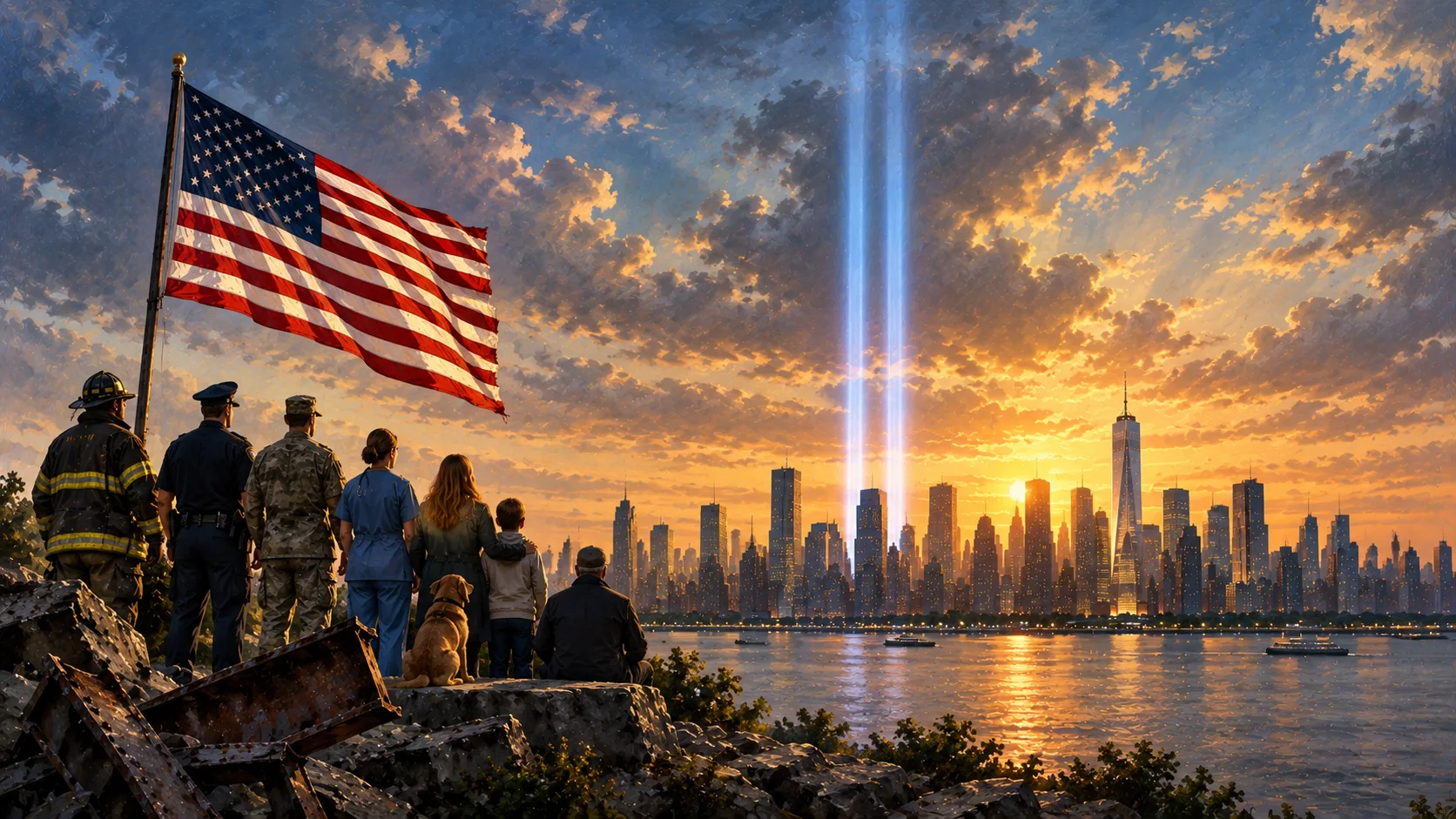
At the foot of Manhattan, where the towers stood, two great square pools now descend into the footprints of the fallen buildings, with water pouring endlessly down their walls into a smaller square void at the centre. The names of the dead of 11 September 2001, and of the six killed in the 1993 bombing, are cut into the bronze parapets around them. Beside the pools rises One World Trade Center, which opened in November 2014. Its spire stands 1,776 feet high, a number chosen for the year the United States declared its independence.
And a few dozen feet from the South Pool stands a tree. It is a Callery pear. In October 2001 recovery workers found it in the rubble of the plaza, a charred stump about eight feet tall with snapped roots and burned branches, and a few green leaves still clinging to it. The city's parks department took it to a nursery in the Bronx and nursed it for nine years. It grew new, smooth limbs out of the gnarled old ones. In 2010 it was brought home to the memorial and planted beside the place where the South Tower had stood. Workers called it the Survivor Tree. Every spring it covers itself in thousands of small white flowers. For a decade its seedlings were sent to communities around the world that had suffered their own great tragedies.
Twenty-five years have passed since the Tuesday evening when a crowd stood on a Mumbai pavement and watched a second airliner vanish into a tower. The children who were not yet born that day are now grown. The man who planned the attack is awaiting trial. The man who approved it lies at the bottom of the Arabian Sea. His successor died on a balcony in Kabul. The towers have been answered by a taller one. The pear tree blooms.
I was one of the people on that pavement. I remember the heat coming off the shopfront glass and the particular silence that fell over a Mumbai street, which is a city that is never silent. What I felt was grief for a country I had never seen, and under the grief something harder to name, because I had watched my own country's airliner sit on a runway in Kandahar twenty-one months earlier and had learned what it costs to bargain with men like these.
I live in that country now. This is the part I did not expect and could not have imagined from the pavement. The nation I watched burn on a shop window became the place where I pay my taxes, where my work is, where my child was raised, where my neighbours wave from their driveways on a Saturday morning. America took me in without asking me to stop being what I was. It let me keep my language, my verses, my gods, and my name, and it handed me a share in itself anyway. That is not a small thing. Most of human history has no example of it.
This is what the nineteen men could not understand and what their successors still cannot. They thought the open door was the soft place in the wall. They were looking at the strongest thing the country has. A nation that lets in the world is a nation the world will come and rebuild. In the weeks after the attack the men digging on that pile spoke dozens of languages, and not one of them had been asked where he was born before he was handed a bucket.
So this is written as a citizen of the place I was born and a citizen of the place I now call home, on the anniversary of the worst morning the second one ever had. India buried its dead from Kandahar and from Mumbai. America buried hers from Manhattan, from a field in Pennsylvania, and from a wall of the Pentagon. Both are still standing, still arguing with themselves in public, still holding elections, still letting strangers in. The men who wanted otherwise are dead, imprisoned, or awaiting trial. That is the whole verdict, and it took twenty-five years to write.
The tree does not eat its own fruit. On a September morning in New York, 343 firefighters, a Cornish-born soldier with a bullhorn, a young trader in a red bandana, and forty passengers on a plane over Pennsylvania lived out a verse they had never heard. This body is for others.
The Corpus
Principal sources: the final report of the National Commission on Terrorist Attacks Upon the United States (2004) and its staff statements, including Staff Statement No. 16, Outline of the 9/11 Plot; the records, oral histories, and exhibitions of the National September 11 Memorial and Museum, including its exhibition on Operation Neptune Spear and its account of the Survivor Tree; the public record of the Presidential Citizens Medal awarded posthumously to Rick Rescorla in 2019; the Fire Department of the City of New York's record of its fallen and of the Stairwell B survivors; the United States Coast Guard and maritime histories of the September 11 boatlift; contemporaneous White House and Department of Defense statements on the Abbottabad raid of May 2011 and the Kabul strike of July 2022; the report of Pakistan's Abbottabad Commission; the court records of the Guantanamo Bay military commissions and of the United States Court of Appeals for the District of Columbia Circuit (2025); Government of India records and public accounts of the hijacking of Indian Airlines Flight 814 (1999); the United Nations Security Council sanctions listing of Masood Azhar (2019); and the trial records of the United States District Court in Chicago (David Headley) and the Indian courts (Ajmal Kasab).