The Stamp
There is a kind of journey that looks ordinary on paper and reveals, while a person is inside it, exactly what a nation values.
This one began with a simple, routine requirement — the ordinary business of being an immigrant who works in this country. To keep his passport stamp current, the traveler had to step outside the border and apply from a consulate abroad. It is a standard process, asked of many, and there is nothing alarming about it. You present yourself with your papers in order, an officer reviews your case, and you are welcomed back. The traveler did not resent a minute of it. If anything, he admired it. A country that keeps its doors with this much care is a country that means what it offers once you are through them — and the small inconveniences of the process are a fair price, gladly paid, for the privilege of belonging to something well-ordered and just.
That conviction steadied him. The standard at the consulate window, he believed, was simply the visible edge of a standard that ran all the way through — and within days, in an empty Los Angeles airport at four in the morning, he would see that belief proven in a way he could never have arranged. A nation that holds itself to a high standard in daylight, it turned out, holds itself to that same standard in the dark, even for a stranger who could offer nothing in return.
Because the process sensibly asks you to come prepared, he came prepared completely. Into one bag and around it went the paper architecture of a life lived between two countries — passports old and current; every approval the government had granted him; diplomas, transcripts, certificates with their seals; the originals one is wisely advised to keep close. And two laptops, because the work did not pause for travel. He carried all of it on his own shoulders — not out of worry, but in the plain good faith of a man giving an honest account of himself to a system he trusted.
The consulate was in Ontario, and Ontario in that season was a study in cold. Snow stood in clean ridges along the roads. The line for the visa window ran long and orderly out into that cold, and he joined it without complaint. He had flown in a day early — you honor an appointment like this by being ready for it — and the next morning he stood among strangers between the snow piles, breath clouding, papers in order, ready to be counted.
And it went exactly as it should. The officer reviewed, asked, stamped. Approved. The door opened to him again, as he had trusted it would.
What he felt was not the relief of a man who had escaped something. It was the quiet satisfaction of having met a fair standard and been welcomed by it. The system had asked something of him and given much in return. All that remained was the long way home.
The Empty Terminal
Home was a city in the American south, and the route there was its own small endurance: Ontario to Los Angeles, then Los Angeles onward, stitched across a continent in the dead middle of the night.
He landed in Los Angeles in the small, abandoned hours — that stretch of the clock that belongs to no proper day, after midnight and long before dawn. His connecting flight was at four, which left him close to three hours in an airport emptied of everyone who had anywhere better to be.
If you have never seen a great airport at that hour, it is a strange and lonely cathedral. The shops are shuttered behind steel. The long corridors run on under lights that never sleep, and your own footsteps come back to you off the floor. The gate where he settled was, without exaggeration, completely empty — rows and rows of vacant seats. A few feet away a young man sat alone, a student by the look of him, headphones on, lost in his own late-night world. Otherwise, no one.
And here the long days caught up with him all at once.
The satisfaction of having met the standard and passed. The cold lines. The cross-country flights, one after another. Even contentment empties a body once the effort behind it is spent. It all came down on him at once like a tide going out, and he simply surrendered to it. He set his bag on the floor beside his feet — that bag, the one holding everything — and against every instinct he had ever trained into himself, he let his eyes close.
He did not mean to sleep. No one ever does.
The Man Walking Away
He woke the way a person wakes when something is wrong before the mind has the words for it.
There was a figure. Walking away from him, up the empty concourse, unhurried. And over the figure's shoulder, swinging slightly with each step, was a backpack.
For a moment he only watched. He was not fully awake; the world had the underwater slowness of half-sleep, and he registered the man the way you register anything at that hour, without meaning — just a shape in motion. Someone is leaving. That was all his mind offered. Someone is walking away.
And then, the way a single drop of cold water can wake the whole body, the understanding arrived.
That was his bag.
The backpack on that stranger's shoulder, growing smaller down the long bright corridor — it was his. Inside it: the passports. The approvals. The certificates with their seals. The originals he had been told never to let out of his sight, now walking out of his sight at a calm, deliberate pace. The laptops. The whole documented proof of a life and a place in it. All of it. Leaving. In a stranger's hands. In real time, before his open eyes.
And here is the part that is hardest to explain.
He did nothing.
He did not leap up. He did not shout. He did not run after the man — or perhaps, somewhere in him, he thought he tried, the way you think you move in a dream and find your legs will not answer. But he did not move. He sat there, rooted, and watched the most important possessions of his life recede down an empty hallway, and something inside him, some load-bearing beam, simply gave way.
It was, perhaps, too much at once — the long effort, the travel, the deep contentment that had hollowed him out and left nothing in reserve to fight with. So he did not fight. He let go. Not in stages, not after weighing it, but all at once and completely, he released his grip on every bit of it — sitting in a plastic chair under fluorescent light, not even feeling himself decide.
He sat in silence. He had not yet begun to count the cost. He was too stunned to grieve. The loss was total and he had not yet looked at any of it. He only sat, emptied out, while the man and the bag and the whole architecture of his belonging went around a far corner and were gone.
The Student
It was the young man beside him who broke the spell.
He had pulled his headphones off and was looking over, and he asked — gently, the way you ask someone who has plainly just been struck by something — what had happened.
The traveler tried to tell him. It is doubtful he managed whole sentences; whatever came out must have been broken, the speech of a man still concussed by his own loss. But the student understood, understood before the telling was finished, and said the simple, saving thing the traveler in his collapse could not reach for himself.
You have to report this. Go tell airport security. Right now.
The truth of his state matters to what came next. He did not believe it would help. The man was gone — gone for what felt like half an hour into the night veins of one of the largest airports in the West. What could anyone do? You do not get back a bag that has vanished into a place that size. He knew it the way you know a stone sinks.
But he nodded — perhaps only because the student's certainty was a railing, and he had nothing else to hold. He rose slowly, like a much older man, and walked the deserted aisle until he found the airport security desk.
He made his report plainly. Calmly. With no emotion at all — describing the theft of everything that mattered to him in the flat, drained voice of a man reading a list. There was no panic left in him to perform; he had already surrendered the outcome. He was, in that moment, something like a man who has set down all attachment — not through wisdom but through sheer shock. They took his details and asked him to wait.
He expected nothing. He returned to the same chair, lowered himself into it, and waited the way you wait for nothing.
Two Men in Uniform
Fifteen minutes, perhaps. And then they came.
Two officers, walking toward him down the empty concourse. Even through his fog he was struck by how they carried themselves — fit, composed, squared-away in the way of people who take their work seriously. They wore their uniforms as though the uniforms meant something.
Who reported the stolen backpack?
It was him, he said.
They did not stand over him. They sat down — one on each side — bringing themselves to his level, two strangers folding into a row of airport chairs in the dead of night to be near a man who had lost everything. And one of them said the words he had decided were impossible.
Your belongings are going to be returned to you. Wait right here.
He did not understand. He told them — and even as he said it he heard how foolish it sounded — that he had a flight to catch, that he needed to go, never pausing to ask how a man with no documents was going to board anything. He was still inside the shock, speaking like a sleepwalker.
And the officer answered him. The traveler would carry that reply for years, almost word for word, for the way it was said — not harsh, but absolutely immovable, kindness and command fused into a single sentence:
You're not going anywhere. As it happens, I'm on that same flight — so we'll board together. But until then, we are going to find the man who took your bag, and you are going to sit right here.
He nodded. He is not sure he had any other answer in him. They rose and left, and he sat with the first faint, unfamiliar thing he had felt in an hour. Not hope, exactly — he had no strength for hope. But the silence around him had changed its quality. Something was in motion that did not depend on him.
The Drive
Twenty minutes, twenty-five. Then one of them was back, standing before him, asking him to come along.
He was afraid, and will admit it. He had never in his life had any dealing with the police — a careful man, law-abiding to a fault, the sort who fears the very idea of trouble. He followed mechanically, his body obeying because his mind had nothing better to offer.
The officer was gentle with him the whole way, explaining as they walked. They had a man. They needed the traveler to look at him and say whether he was the one. They walked him out to a patrol car and settled him carefully in the back seat, and the officer turned and told him, in that same steady voice, exactly how it would go: the traveler would be in darkness; the man would not be able to see him; but he would be able to see the man, because they would put the light on him. He had nothing to fear. The officer said that last part more than once, the way you reassure someone you have decided to protect. You have nothing to fear.
Then he drove.
He took the car away from the bright terminal, back and back, into the vast secluded body of the airport that travelers never see — the dark outer reaches where the working machinery of the place lives. And as they came around, the traveler saw it.
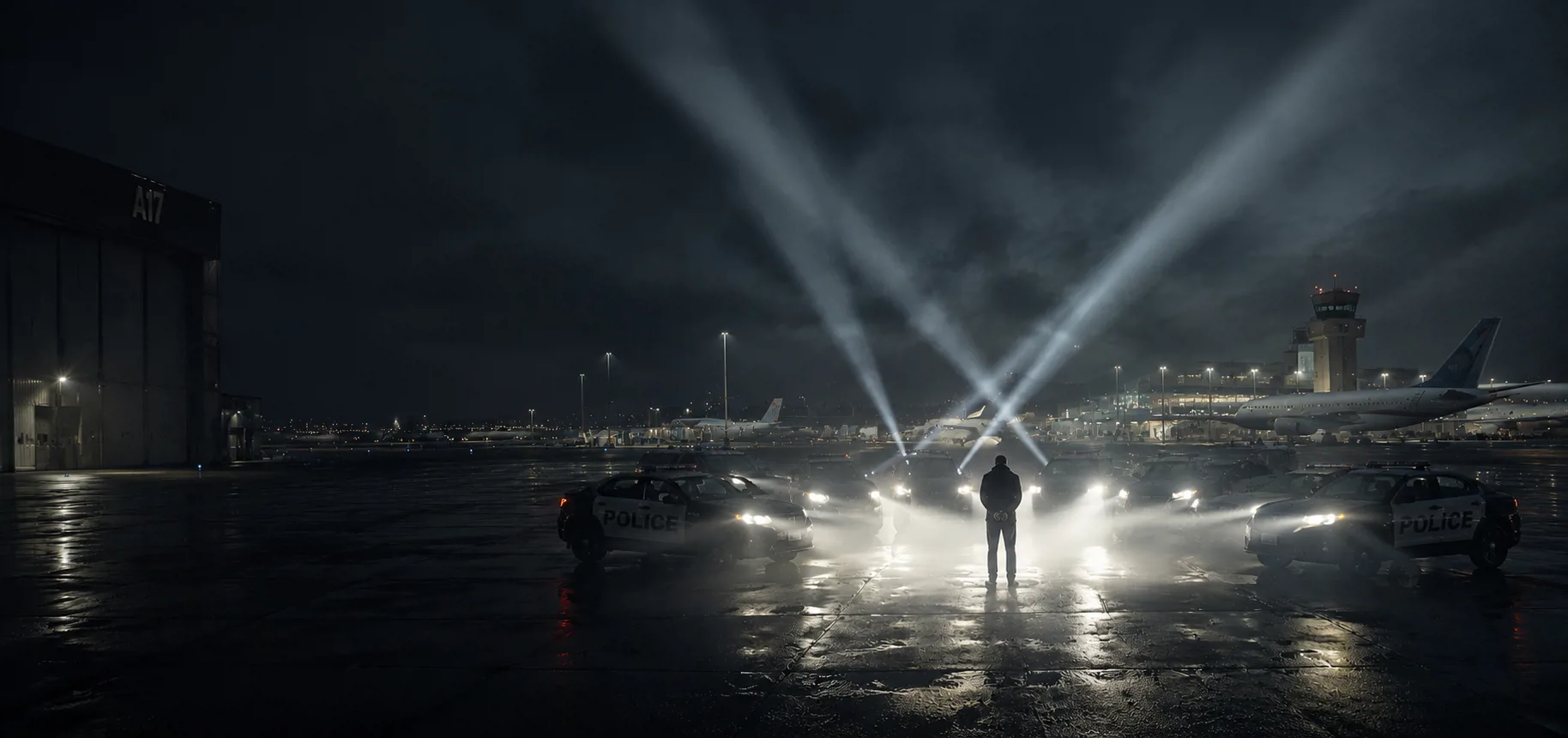
A ring of police cars. Ten of them, more, drawn up in a great circle with their headlights all turned inward, and in the center of that ring of light, blazing in the crossfire of all those beams, a single handcuffed figure.
Their car slid quietly into the circle. The traveler sat in the back in total darkness, exactly as promised, unseen. And there in the center, lit from every side so that he could conceal nothing, was the man.
He knew him at once. There was no hesitation, no flicker of doubt — the unhurried walk, the shape of him, the bag. It was him. The man from the empty gate. The man who had carried a life up the concourse while its owner sat frozen.
Do you recognize him?
Yes, the traveler said. Firmly — for the first time that night with something solid in his voice. Yes. That is the man.
And the instant the word left him, the car wheeled around and drove — fast now, with purpose — back toward the terminal.
The Return
They brought him out of the car with the same care they had shown all night. And then one of them put the backpack into his hands.
His bag. The actual bag. They asked him to check it — every item, take your time, make sure. So he opened it there and went through it with shaking hands, and here is precisely what he found: everything. The passports. The approvals. The certificates with their seals. The originals. Both laptops. Every single thing that had walked away into the night was back in his hands, untouched, complete. Nothing was missing. Nothing at all.
They walked him back to his terminal. They wished him luck. And they turned to go.
And he — finally surfacing, finally able to speak like a person again — said: But you told me you were on my flight. That we would board together.
The officer turned back, and gave a small, gentle smile.
He understood then. Of course the officer was not on his flight. He had said it to hold a broken man in his chair, to give him a reason to stay and a promise to lean on when he had nothing of his own left to stand on. It was a kindness invented on the spot, in the dead of night, for a stranger he would never see again.
He has spent a long time trying to find the bottom of that smile, and the man behind it.
The officer was handsome — it is an ordinary word, and it keeps being inadequate, because what made him so was not the line of his face. He was handsome the way a thing is beautiful when it is exactly what it is meant to be. He cared. Genuinely, without performance, without any possibility of reward, in a deserted airport at four in the morning, he had cared about the trouble of a stranger whose name he did not know, whose origin meant nothing to him, who could do nothing for him in return. He did not see a category. He saw a person who had lost everything, and decided that would not stand.
How does one repay that? How does a single person repay it — and how does a country?
Coda
There is a small ending that has to be told, because it is true and because it complicates the story in a way the traveler has made his peace with.
Some days after he reached home, after his life had quietly closed back over the wound of that night, a subpoena arrived. The state wished to press charges against the man who had taken the bag, and needed him to come and testify.
He did not press charges.
He has turned that decision over many times and is still not certain he can fully defend it. Perhaps he had nothing left in him for anger. Perhaps, having gotten back everything, he could not bring himself to take something from the man who had tried to take everything from him. Perhaps the mercy shown to him that night had done its work, and he wanted, in his own small and inadequate way, to pass a little of it on.
It is not offered as wisdom. It is only what he did.
But the men in that ring of headlights — the two who sat down beside him in an empty row, who invented a flight to keep him from breaking, who drove a frightened stranger into the dark and brought him back whole — them he has never stopped trying to repay, and never will, and never can.
Written for the officer in Los Angeles whose name was never learned, in gratitude that has only deepened with the years. And for all of them who wear the uniform and mean it.