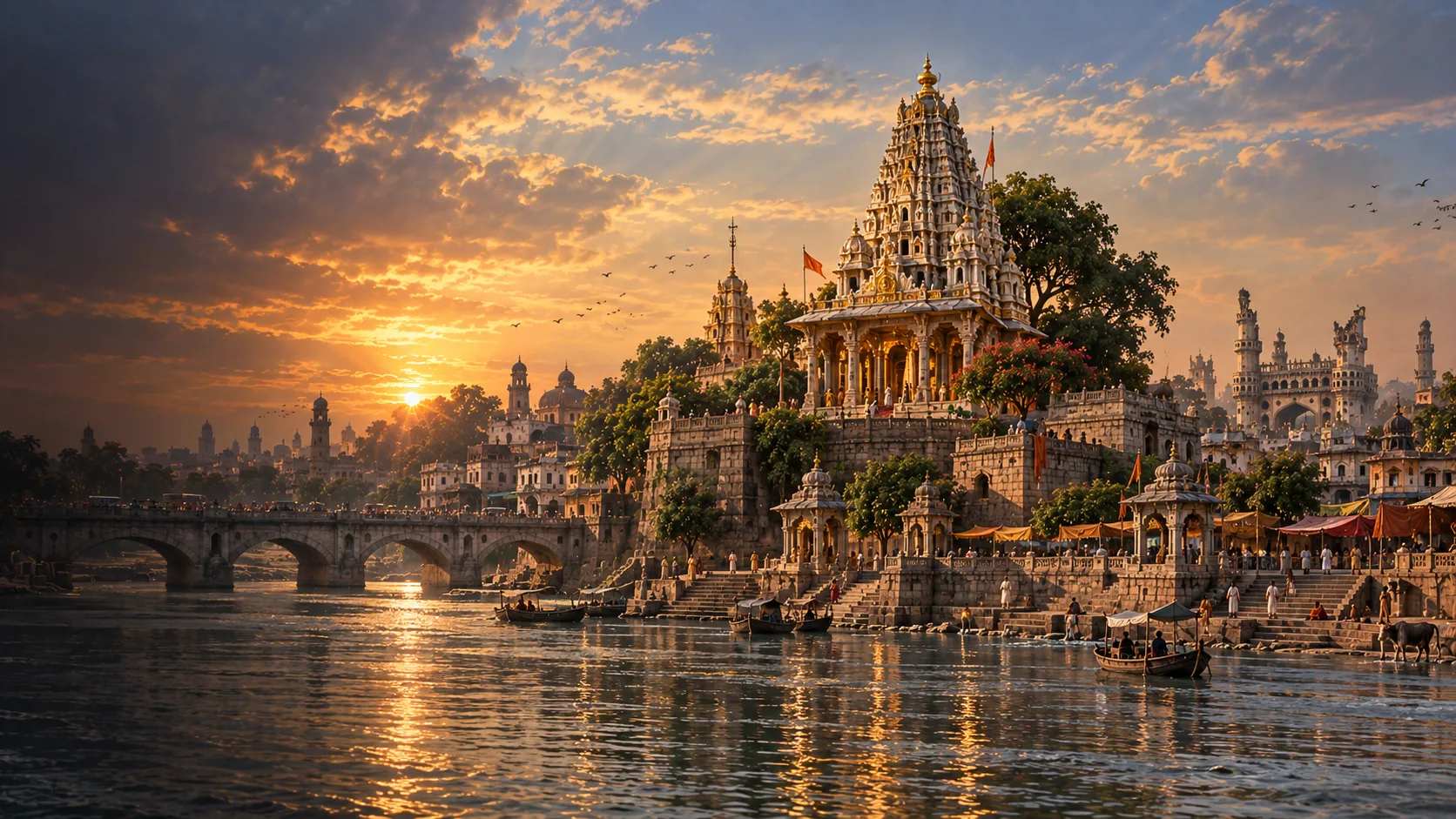
The sleeping king
The river that runs through Hyderabad is older than its name, and older than the city by an order of magnitude no municipal record can hold.
Its name today is the Musi. Its name before that was Muchukunda, and Musi is what four centuries of Telugu speech did to it: Muchukunda, Muchikunda, Musi. A third form, Musunuru, survives in the same sources. Settled
Muchukunda is the son of Mandhata, of the Iksvaku line, the Suryavamsa, and therefore an ancestor in the lineage of Sri Rama. The Bhagavata gives his account. He fought at Indra's side against the asuras for an age, and when the devas offered him a boon he asked only for sleep, and for the condition that whoever woke him should burn to ash under his opening gaze. He took that sleep in a cave.
In the Dvapara Yuga the Yavana king Kalayavana came against the Yadavas, and Krsna, declining to finish him in open battle, drew him into the hills and into that cave. Kalayavana, taking the sleeping figure for Krsna, kicked him awake. The gaze opened and the Yavana was ash. Muchukunda then looked upon Krsna, and received moksa from him.
The cave is held to be in the Anantagiri hills. This is where the naming becomes exact rather than ornamental, because those are the river's actual headwaters. The Musi rises in the Anantagiri forest west of the city in Vikarabad, runs some two hundred and forty kilometres eastward through Hyderabad, and falls into the Krsna near Vadapally in Nalgonda. The river takes its name from the hill it comes out of, and the hill carries the name of what happened inside it.
A river of the Iksvaku line runs through the middle of Hyderabad, and it has done so since before there was a fort on the rock above it.
The other account of the name is hydrographic and is given alongside the first in the same references: the Musa and the Esi, two rivulets that meet near Langar Houz, their confluence naming the river below it. The two readings are not rivals. Both rivulets rise in the same Anantagiri forest. One name belongs to the river's source and the other to its joining, and the city later dammed each arm separately, Osman Sagar on the Musa and Himayat Sagar on the Esi.
This is the ground. Everything that follows happens on it.
Golla Konda
Above the river, ten kilometres west of where the city would stand, a granite dome rises about a hundred and twenty metres out of the plateau. The Telugu country called it what it was: Golla Konda, the shepherd's hill. The account held locally is that a herdsman grazing his flock on that dome turned up an image in the earth, carried word to his king, and the king walled the spot. Settled
The wall was mud, and the fort was named Mankal. It was raised in the twelfth century as the westernmost bastion of the Kakatiya empire, whose capital was Orugallu, Warangal, the one stone, a hundred and thirty kilometres to the north-east.
The Kakatiyas held the Telugu-speaking lands for roughly two centuries, from Rudradeva through Ganapatideva, through the reign of Rudramadevi, who ruled in her own right and whose court the Venetian pages of Marco Polo record, to her grandson Prataparudra. Their monuments stand at Hanamkonda and at Palampet, where the bracket figures of the Ramappa temple are cut so fine that the granite reads as textile. Golconda was rebuilt and strengthened by Rudramadevi and by Prataparudra after her. It was never a capital in that age. It was a watchtower on the western march.
What made it worth watching was under the ground. The alluvium of the Krsna and its tributaries, and the mines around Kollur and Paritala, produced the only diamonds the medieval world knew. Every great stone whose name survives from that age came out of this soil and passed through this fort's markets: the Koh-i-Nur, the Hope, the Regent, the Darya-i-Nur. Golconda never mined a diamond inside its own walls. It was the cutting house, the treasury and the market. For four hundred years, in the trading tongues of Venice, Isfahan and Amsterdam, the word Golconda did not name a fort. It named unimaginable wealth. Settled
Nayankara was the Kakatiya arrangement of the countryside: the empire divided among some seventy-seven nayakas, warrior-chiefs holding land in return for keeping troops ready for the crown. An agrahara was a village, or the revenue of a village, granted permanently to Brahmana households so that recitation, grammar and ritual could continue without their earning a living elsewhere. When such a grant is revoked, an entire scholarly establishment loses its livelihood in a day.
The breaking of Orugallu
In 1310 Alauddin Khalji sent Malik Kafur south. Warangal was besieged, its outer rampart taken, and Prataparudra bought peace with an indemnity the chroniclers itemise: hundreds of elephants, thousands of horses, treasure carried north in cartloads. Among what went to Delhi, by long account, was the great diamond of the Kakatiya treasury. Prataparudra kept his throne and became a tributary. In 1318 a second army came when the tribute lapsed, and a second submission followed.
The end came in 1323. Ghiyasuddin Tughlaq sent his son Ulugh Khan, who would shortly rule Delhi as Muhammad bin Tughlaq, with orders to finish it. The first assault failed and the army withdrew in disorder. The second did not. Warangal fell after a siege of months. Prataparudra was taken and sent north, and did not arrive. The city was renamed Sultanpur. Two centuries of Telugu sovereignty ended. Settled
What the conquest did to the country is described not by a hostile witness but by the charter of the administration that undid it. In 1330 a Telugu chief named Prolaya Nayaka issued a copper-plate grant near Pithapuram, the Vilasa grant. Its Sanskrit is at once a lament and an indictment: the country laid waste, agraharas seized from the learned, temple worship broken off, cultivators driven from the land, the order of village and offering thrown down.
The Vilasa grant is the nearest thing the age left to an eyewitness account of the conquest, and it was cut in copper by the man who set out to reverse it.
The reconquest
Ulugh Khan was recalled to Delhi in 1324 to take the throne, and Warangal was left to a governor. The countryside had not been pacified so much as stunned, and among the surviving Kakatiya nayakas a coalition formed: the Recherla chiefs, the Kolani, the Induluri, the Reddi houses of Addanki and Kondavidu, gathered around two cousins of the Musunuri family. Prolaya Nayaka drew them together from a forest stronghold at Rekhapalli near Bhadrachalam, on the Godavari. His cousin and successor Kapaya Nayaka finished what he began.
Kapaya allied with Vira Ballala III of the Hoysalas. When Delhi's attention was pulled away by revolts in the Doab and by the breakaway sultanate at Madurai, the coalition moved. In 1336, thirteen years after the fall, Warangal was retaken and the Tughlaq garrison expelled. The Kaluvacheru grant of 1423 records that Kapaya was supported by seventy-five nayakas, and names Prolaya Vema Reddi among them. In his own inscriptions Kapaya claimed no ordinary mandate. He held that he had been chosen by Visvesvara of Kasi to protect the Dharma. Settled
For roughly thirty years the Telugu lands governed themselves again. Endowments resume in the epigraphic record, agraharas are re-granted, villages are resettled. The recovery of 1336 is also what made the far larger recovery possible: the same pattern of southern resistance, in the same decade, raised Vijayanagara on the Tungabhadra, which held the south for two hundred and thirty years.
Golconda passed out of Telugu hands in 1364, ceded under treaty to the power that had risen in the western Deccan. To understand what took the rock, one has to ask who that power was.
Who were the Bahmanis
The Bahmani Sultanate is usually introduced as a Deccan kingdom, as though it had grown out of the Deccan's own soil. It did not. It was made by the Delhi Sultanate's own officer corps, in mutiny against Delhi. Settled
In the 1340s Muhammad bin Tughlaq's centralising demands, the forced transfer of the capital, the ruinous exactions, the token currency, provoked revolt after revolt. In the Deccan the rising was led by the Amiran-i-Sadah, the commanders of a hundred, the Sultanate's own officers holding revenue and military charge in the provinces. They rose at Daulatabad in 1345. In 1347 they proclaimed one of their number sultan.
That man was born Zafar Khan. The contemporary historian Abd al-Malik Isami places his birth at Ghazni. The later chronicler Firishta calls him of Afghan birth and concedes that his origins are obscure. He is also remembered as Hasan Gangu. On his accession he took the style Alauddin Hasan Bahman Shah, and the dynasty took its name from his claim of descent from Bahman son of Isfandiyar, the hero of the Shahnama. That claim is a claim and not a pedigree. It is also their claim, chosen by them, and it declares exactly where they wished their prestige to be seen to come from. It was not from the Deccan.
The other origin story, put about by Firishta two and a half centuries later, has Hasan begin as the servant of a Brahmana astrologer named Gangu who discovers treasure for him, foretells his kingship and gives him the name he ruled under. Historians reject it. It is the kind of flourish a dynasty acquires when its real beginning is too plain: a rebel officer raised on the shields of other rebel officers.
The evidence is in their own factions
If any doubt remained about whether the Bahmanis were a foreign-origin establishment, their internal politics settles it. The nobility split, permanently and violently, into two parties: the Afaqis or Pardesis, the horizon-men, newcomers from Persia, Turkestan and Arabia arriving by ship at the western ports, and the Deccanis, those long settled in India. A state does not sustain a lifelong civil conflict between foreigners and locals unless the foreigners are numerous, powerful and continually replenished. The court language was Persian. The greatest of the Bahmani ministers, Mahmud Gawan, who ran the state from 1466 until his execution in 1481, was a Persian of Gilan who arrived as a merchant. Polemical
What the arrangement did to the ruled can be read in the career of Gawan's successor. The minister who engineered his fall and took his office, known as Malik Hasan Bahri, had been born a Brahmana. He was taken captive by Bahmani forces in the 1420s, converted, raised as a military slave, given an education and set on the ladder that ended in the chief ministership. His son founded the Ahmadnagar sultanate. That is the story of a boy carried off in a raid, and it is also the founding story of one of the five successor dynasties of the Deccan.
From Gulbarga, and from 1425 from Bidar, the Bahmanis fought Vijayanagara across the Raichur Doab for the whole of their existence. Golconda came to them in 1364 and became the seat of their eastern province, the taraf of Telangana, held by a governor called a tarafdar. By the last decade of the fifteenth century the kingdom was breaking into five: Ahmadnagar, Bijapur, Bidar, Berar and Golconda.
The Turkoman on the rock
The man who made the shepherd's hill into a throne arrived as an immigrant. Sultan Quli was a Turkoman of the Qara Qoyunlu, the Black Sheep confederation, from Hamadan in western Iran. His clan lost its wars at home. He came to the Deccan as a young man in the 1470s and took service under the Bahmani sultan, rose through the Afaqi party, earned the title Qutb-ul-Mulk, pillar of the realm, and in 1496 was made tarafdar of Telangana. Around 1501 he moved his seat to Golconda.
He then did to the rock what the Kakatiyas had begun and left unfinished. The mud came down and granite went up: three concentric lines of fortification, eight gateways, eighty-seven bastions, an outer wall of some eleven kilometres. The Fateh Darwaza was set with iron spikes at the height of an elephant's forehead. A water system lifted water by Persian wheels, animal-driven chains of buckets, through terracotta pipes into cisterns stepped up the hill, so that the summit pavilion had running water. The acoustics of the entrance portico, by which a clap at the Fateh Darwaza carries to the Bala Hissar above, are a by-product of that geometry which the fort's guides have demonstrated for four centuries.
In 1518, with the Bahmani throne reduced to a fiction, Sultan Quli ruled in his own name. He was the first Muslim ruler to hold the whole Telugu country. He was murdered in 1543, at ninety-odd, at prayer, by his own son Jamshid, who blinded the eldest brother and hunted the rest. One brother got out alive and went south.
Malki Bharama
The brother who escaped was Ibrahim, and where he escaped to changed the Deccan. He spent seven years at Vijayanagara as the guest of Aliya Rama Raya. He learned Telugu there, took the dress and the food and the manners of the court that sheltered him, and married a Hindu woman, Bhagirathi, by Hindu rites. When Jamshid died and Jamshid's infant son died soon after, Ibrahim was called back, and in 1550 he took the throne of the house that had tried to kill him.
He used a Telugu name for himself in official correspondence: Malki Bharama, his own name as a Telugu tongue says it. Telugu poets call him Ibharama Cakravarti. He held musairas, poetry assemblies, in Telugu. On his return in 1550 envoys came to him from the fort of Koilkonda, and the long inscription there records the terms in which the local Hindu chiefs pledged him allegiance: anyone dealing with any other claimant would be held of low birth, and would incur the sin of killing cows and Brahmanas at Varanasi. That is the heaviest oath the tradition has. It was sworn to a Shia Turkoman sultan, in Telugu, on his own frontier. Settled
The poets he kept
Addanki Gangadhara Kavi dedicated to him the Tapati-Samvaranopakhyanam of 1565, a poem that doubles as a chronicle of his eastern campaigns, and it is Addanki who fixes the title Malki Bharama in the literary record. Kandukuri Rudrakavi of Devarakonda wrote the Nirankusopakhyanam and was rewarded with the agrahara of Chintalapalem. Mariganti Singana of Nalgonda served in the same court. The Golconda karanam Sarangu Tammayya wrote the Vaijayanti-Vilasam and the Hari-Bhakti-Subodhayam, in which he calls Golconda a city of the Bhagirathi. Under Ibrahim's officer Amin Khan at Patancheru, Ponnaganti Telaganarya wrote the Yayati-Caritramu, the first accha-tenugu kavya, a full-length poem composed in pure Telugu without a single Sanskrit loanword, a discipline as exacting in Telugu as writing English without a word of Latin. The first Telugu yaksagana, the Sugriva-Vijayam, belongs to the same reign.
He built as well. Hussain Sagar, the lake that still divides the twin cities, was cut in 1563 across a tributary of the Musi and named for Hussain Shah Wali, the Sufi who engineered it. Its embankment is the Tank Bund, and it was Hyderabad's drinking water for three and a half centuries. In 1578 the Purana Pul was thrown across the Musi in twenty-two arches, the crossing that made the south bank buildable.
The same sultan rode in the alliance of four Deccan sultanates that destroyed Vijayanagara at Talikota in January 1565, the empire that had sheltered him for seven years and whose patriarch had been his host. The city was sacked for months and never reoccupied. Both facts belong to one reign and neither cancels the other. Patronage of Telugu letters is a fact about a court. It is not a verdict on its wars.
The city comes off the rock
By the 1580s the fort had outgrown itself. Sixty or seventy thousand people were living inside walls built for a garrison, the water was short, the drains were worse, and epidemics ran the lanes with nothing to stop them. Muhammad Quli Qutb Shah came to the throne in 1580 at fifteen. Around 1590 he ordered a new capital built on open ground five miles east, on the southern bank of the Musi.
It was a planned city, laid out at once rather than accumulated. Two great roads crossed at right angles, the four quadrants held the bazaars and palaces and gardens and tanks, and the streets ran on a grid. At the crossing, in 1591, he set the Char Minar, four minarets, a square arched pavilion twenty metres to a side with minarets rising fifty-six metres, a mosque on its upper floor and a madrasa within. It was not a monument added to a city. It was the survey point the city was measured from, and every road in the old town still answers to it. Settled
Why it was raised is given by the Archaeological Survey of India in the terms the city has always used: it commemorates the ending of a plague. The sultan prayed at that spot for the epidemic to lift and vowed a mosque there if it did. Whatever the private history, the public meaning has not changed. The Charminar is a thanksgiving raised at a crossroads.
He kept building. The Mecca Masjid beside it, its central arch made with bricks fired from clay brought from Mecca. The Dar-ul-Shifa, the house of healing, a free public hospital with physicians on salary. Gardens, caravanserais, and the bazaars that still carry their trades in their names: Lad Bazar for bangles, Moti Galli for pearls, Yaqutpura, the quarter of rubies.
Bhagnagar, Bhagyanagar, Hyderabad
The city has carried two names since the year of its founding. That it was called Bhagnagar in its own lifetime is not in question. Around 1594 Faizi, writing to Akbar from the Deccan, reports that the Golconda sultan had built a city of that name, and European travellers of the seventeenth century use it. Two names ran side by side for a long time before one prevailed.
The romance attached to the name collapses on its own evidence. It makes the city a memorial to Bhagmati, a Hindu dancer of the village of Chichlam. She appears in no Qutb Shahi court chronicle, not the Tarikh-i-Sultan Muhammad Qutb Shah and not the Hadiqat-us-Salatin. The sultan's own collected poems, the Kulliyat, name his attachments, and she is not among them. In his own writing he calls the place Shahr-e-Haidarabad. And the chronology will not hold: the Purana Pul, which the story requires him to have built in order to cross the river to her, was finished in 1578, when he was twelve. What survives of the tale is Faizi's line, written to insult a rival court, and three centuries of repetition. Settled
The Telugu reading takes the name at its word. Bhagyanagaram, the city of bhagya, of fortune and of the goddess of fortune, Bhagyalaksmi. The social historian Suravaram Pratapa Reddi, whose Andhrula Sanghika Charitra is a foundation of Telugu social history, and the folklorist Biruduraju Ramaraju, both held the name to derive from the goddess. Two things support the reading independently. The first is linguistic: Bhagnagar is what a Persian-writing scribe does to Bhagyanagaram, the same clipping that turns Golla Konda into Golconda. The second is habit: a court that had already named a lake for a Sufi, a quarter for a princess and a suburb for a treasurer took its place-names from what stood on the ground, and what stood at that crossroads, in the old city's memory, was a stone of the goddess.
The shrine of Bhagyalaksmi stands today at the south-eastern foot of the Charminar. Its masonry is of the twentieth century. That is a fact about construction and not about worship. In Sanatana practice a shrine is not constituted by masonry: a boundary stone, a naga-kal beneath a tree, a slab reddened with kumkuma at a crossroads is honoured for generations without a roof, and the roof raised over one in the twentieth century dates the roof.
A Brahmana's life under Golconda
The claim that the Qutb Shahis were unlike other Muslim rulers of India is made often, usually without evidence. There is evidence. It is specific, and it is bounded, and the boundary is as much of the answer as the evidence.
Telugu was patronised at court by every sultan of the line. Telugu poets held agraharas by royal grant. The revenue service was staffed at every level by Telugu Niyogi Brahmana karanams, the accountants and record-keepers who made the administration work, and this was structure rather than gesture. The last sultan, Abul Hasan Tana Shah, raised two brothers from Hanamkonda, Madanna and Akkanna, to run the kingdom: Madanna as chief minister with the exchequer and the tax system under him, Akkanna over the army's administration and later resident at Bijapur. For the final fourteen years of Golconda, two Telugu Brahmana brothers governed a Shia sultanate, and the Dutch factory records of the 1680s state it flatly: they held the revenue and the treasury. Madanna also opened negotiations with Chatrapati Sivaji Maharaj and brought him to Hyderabad, where a treaty of mutual defence against the Mughals was concluded. Settled
Against that stands the jizya, the levy on non-Muslims in return for protected status. It was still collected, from a population that was overwhelmingly Hindu, and among the duties Madanna carried was collecting it. That is the exact shape of the accommodation: a Hindu minister administering a discriminatory tax on Hindus. It is a real distinction from Delhi. It is not equality.
The twelve years of Kancharla Gopanna
Kancharla Gopanna of Nelakondapalli in Khammam was Madanna's nephew. Through his uncles he was made tahsildar of the Palvancha pargana, which contained Bhadrachalam, where a small shrine of Rama stood above the Godavari. He rebuilt it into a temple, and paid for the building and for the jewellery of the images, the chintaku pathakam, the kalyana talibottu, the crowns, out of revenue collected for the sultan. Six hundred thousand rupees, by the received account, without sanction.
He was dismissed and imprisoned in Golconda fort, held twelve years in a cell with the order that he be released only when the treasury was made whole. What he did in that cell is why he is remembered. He composed the Dasarathi Satakam and the body of kirtanas that made him Bhadracala Ramadasu: songs of reproach and bargaining and exhaustion and surrender, addressed to Rama, sung in Telugu households and on Carnatic platforms without a break for three hundred and forty years.
A temple raised with the sultan's revenue was a crime. A tax raised on the temple's people was the constitution. The Satakam was written between the two.
The account closes with Rama and Laksmana appearing to the sultan by night and paying the debt in gold struck with their own image, the Rama-mudra, after which Ramadasu was freed and pearls were sent from Golconda to Bhadrachalam each year at Rama Navami. The Telangana government still sends silks and pearls to that temple at Rama Navami.
1687
Golconda's independence was ended by Aurangzeb. Complaints reached him that Hindus had risen too high at Tana Shah's court, and a demand went out that the brothers be dismissed. In 1686 the Mughal armies closed on Hyderabad. Madanna and Akkanna were beheaded, and Hindus in office across the administration were killed with them. The fort held eight months and fell in 1687 through a gate opened from within. Tana Shah was taken to Daulatabad and died in prison in 1699.
The consequence for the countryside is measurable. In the study of temple destruction in India by inscription and chronicle, the late seventeenth century shows a distinct cluster of cases in precisely this region, in the years when the Mughal empire was absorbing the former Qutb Shahi kingdom. Whatever latitude the Deccan sultanate had allowed ended when the Deccan sultanate did. Settled
Seven kulchas
For thirty-seven years after 1687 Hyderabad was a Mughal province. Then the Mughal empire came apart, and its Deccan governor kept the province.
Mir Qamar-ud-din Khan was born at Agra in 1671 into a family that had served the Mughals for generations. In 1712 he was made subedar of the Deccan with the title Nizam-ul-Mulk, and the emperor Muhammad Shah later added the title Asaf Jah, after Solomon's proverbially wise minister. In 1724 he defeated a rival at Shakarkheda, returned south and stopped taking orders from Delhi. He never formally declared independence. Nadir Shah sacked Delhi in 1739 and settled the question for him.
The account of the loaves runs this way. Before leaving for the Deccan he went to take leave of his guide, the Sufi Hazrat Nizamuddin Aurangabadi, whose dargah stands at Shahganj in Aurangabad. The saint gave him kulchas, flat baked loaves, tied in a yellow cloth, and told him to eat as many as he wished. He ate seven and could eat no more. The saint told him he would be a king and that his line would rule for seven generations, one for each loaf. The flag of Hyderabad State was thereafter yellow with a white kulcha upon it.
The prophecy is famous because the arithmetic worked. Asaf Jah I, then Nizam Ali Khan who moved the capital from Aurangabad to Hyderabad, then Sikandar Jah, Nasir-ud-Daula, Afzal-ud-Daula, Mahbub Ali Khan, and Mir Osman Ali Khan, the last, who lost the state in 1948. Seven Asaf Jahs.
Two things are usually left out. There were in fact ten rulers, not seven. After the first Nizam's death three of his sons ruled between 1748 and 1762, fighting one another with French and English help and losing a third of the Deccan while they did it. None of the three was granted the title Asaf Jah, which is why the dynasty counts seven and the throne saw ten: the prophecy is exact only because it is the title being counted and not the reign. And the first Nizam appears to have rejected the story himself. In the anecdotes recorded by his chief secretary Lala Mansa Ram he denied that the kulcha on the flag commemorated the loaves at all, and in that telling the saint is not Nizamuddin but one Shah Inayat, met when the Nizam had lost his way in a forest and was given dry bread and water. Polemical
Koti and Lashkar
In 1798 Nizam Ali Khan signed the Subsidiary Alliance with the East India Company. British troops would defend Hyderabad, Hyderabad would pay for them and surrender an independent foreign policy. Two things followed that are on the city map still.
The first was the Residency. James Achilles Kirkpatrick built a Palladian mansion on the northern bank of the Musi, finished around 1806, with a zenana wing behind it in Mughal style for his wife Khair-un-Nissa. The people of the city did not call it the Residency. They called it the kothi, the mansion, and the whole quarter is Koti still. The building is today the Osmania University College for Women.
The second was the cantonment. The subsidiary force was stationed on high ground north of the Hussain Sagar, and the settlement that grew around it was named for the third Nizam, Sikandar Jah: Secunderabad. Its own people never used that word among themselves. A cantonment in Urdu is a lashkar, an army, a camp, and Secunderabad has been the Lashkar in the city's speech for two centuries. Its temples, its bazaars and its festival carry the name. In the Lashkar's usage the older city across the water is simply Patnam, the town. Two cities, one lake between them, each with a plain word for the other.
The names on the map
Hyderabad's place-names are an archive nobody curated. They are in Telugu and Urdu and English and the pidgin of all three, and almost every one is a person, a trade, a structure or a joke that outlived the thing it named.
The crossings first. The Purana Pul is the old bridge, of 1578, and the Naya Pul the new. Lakdi-ka-Pul is the wooden bridge, a timber span that carried the road over the railway line between the Lashkar and Nampally. The timber went long ago and the name is what remains of it.
Hyderabad place-names and their origins
| Name | Origin |
|---|---|
| Chaderghat | Chadar is a sheet: the ghat where the Musi ran in a broad white sheet over the rock. Briefly renamed Oliphant Nagar under the Residency, after a Company chairman; the city ignored that and kept its own word. Its bridge was carried away in 1908. |
| Koti | The mansion, the Kirkpatrick Residency, which the city declined to call by its official name. |
| Abids | Albert Abid, an Armenian Jewish merchant, valet and wardrobe-keeper to the sixth Nizam, who opened a store on the road from Gunfoundry. Abid Road became Abids and then the city's shopping quarter, with St George's Grammar School of 1834, the Sunday pavement book market and the Deccan Pen Store since 1928. |
| Begum Bazar | Humda Begum, wife of the second Nizam, remembered as having given the land to the city's merchants. It is still the wholesale market. |
| Nampally | Nekh Nam Khan, a Qutb Shahi diwan: a Telugu village ending grafted onto a Persian officer's name, which is the city in one word. |
| Gunfoundry | The cannon and shot works, tope ka sancha, set up in 1786 by the French general Michel Raymond in the Nizam's service. Moosarambagh is also his: Monsieur Raymond, worn down by Deccan tongues into Musa Ram. |
| A. C. Guards | African Cavalry Guards, the quarter of the Nizam's African bodyguard. Barkas nearby is Barracks and is still the Hadhrami Arab quarter, and Habsiguda takes its name from the Abyssinian labourers who built Osmania University. |
| Malkajgiri | Mallikarjuna Giri worn smooth: the hill of Mallikarjuna, that is, of Siva. |
| Masab Tank | A corruption of Ma Saheba Tank, for Hayat Bakshi Begum, daughter of the city's founder, called Ma Saheba by the whole kingdom. Hayathnagar is hers as well. |
| Karwan | Caravan: the road on which the trade convoys came in to Golconda. |
| Banjara Hills | Named by Nawab Mehdi Nawaz Jung for the Banjara, the carrying and grazing communities who lived on those rocks before the rocks became the most expensive land in the state. |
| Tarnaka | Wired checkpost: the guarded gate in the fence the Nizam put around his orchards. |
| Gachibowli | Telugu gachchu, lime plaster, and bavi, a step-well: the lime-lined well. There is no better name for the ground that became the IT corridor. |
| Korenti | Quarantine: the fever hospital, now the Sir Ronald Ross Institute, on the site where Ross identified the malaria vector. |
The Sindhi bakery at Moazzam Jahi Market
One name on that map came out of Partition. In 1947 Khanchand Ramnani, a Sindhi Hindu baker, left Karachi with his family, his recipes and nothing else. In 1953 he opened a shop at Moazzam Jahi Market, the arched granite market built under the last Nizam, and named it for the city he had been driven out of. Karachi Bakery is four generations old, its fruit biscuit and its Osmania biscuit are Hyderabad's most exported objects after biryani, and Ramnani's grandsons run it.
The name has cost the family repeatedly. Outlets have been mobbed and their signboards forced to be covered during periods of tension with Pakistan, and the owners have had to publish advertisements stating that they are Indian. A Sindhi Hindu family that lost its home and its country to Partition kept the name of that home over its door, and is periodically required to prove its loyalty on account of the very fact of its dispossession. There is a Bombay Bakery in Sindh, trading since 1911, which has never once been asked to change its name. Polemical
The Tughyani
The river the city was built on had always been modest. On the night of 27 September 1908 it rained 12.8 inches in twenty-four hours on a catchment full of old irrigation tanks. Some two hundred and twenty tanks upstream breached one after another and their water arrived at the city together.
The first warning came at two in the morning, when water went over the Purana Pul. By six there was a cloudburst. The Musi rose about sixty feet, forty above its normal level, and came through Chaderghat, Purana Pul and Afzal Gunj while most of the city was asleep. Three bridges were carried away, the Afzal, the Mussallam Jung and the Chaderghat, leaving the Purana Pul the only link between the two halves of the city. Over eighty thousand houses were razed and a fourth of the population made homeless. The dead are estimated at about fifteen thousand, most of them in a single day. Hyderabad calls it the Tughyani. Settled
In the compound of what is now Osmania General Hospital stands a tamarind tree. More than a hundred and fifty people climbed into it that night and held on for twelve hours. Among them was the Urdu poet Amjad Hyderabadi, twenty-two years old, who lost his mother, his wife and his daughter to the water and was the only survivor of his household. His Qayamat-e-Soghra, the little doomsday, is what he made of it. The tree is standing, it is called the flood tamarind, and people gather beneath it every September.
The dhoti and the sari
While the water was still running, the court astrologer of Hyderabad State, Jhumar Lal Tiwari, advised the sixth Nizam that the river was a goddess in anger and must be appeased. Mir Mahbub Ali Khan put on a dhoti and the janeu, the sacred thread, went down to the Musi, and performed puja to her with fruits, flowers and coconuts, offering the river a silk sari, pearls and gold, in the form the Sanatana rite prescribes for a river in spate. The waters began to fall within hours. Settled
A Sunni sovereign put on the sacred thread and gave the river a sari, because in this country a river in flood is a goddess and that is what a goddess is given.
He did the rest of it too. He drove into the flooded city himself while the current was still up, and broke down in public at what he found, the scene Sarojini Naidu set down as Tears of Asif. He threw open Purani Haveli, his own palace, as a refugee camp and fed the city from it for three months. The state elephants and horses went into the rescue. Five lakh came from the treasury and ten lakh more by public subscription, the largest donations from the Nizam and from his Hindu prime minister Maharaja Kishen Pershad. Ten relief kitchens ran from 29 September to 13 October, and the government declared ten days' holiday so that people could dig out their own dead.
What the city built afterwards
A City Improvement Board was constituted in 1912 under the seventh Nizam. M. Visvesvaraya was invited to survey the problem and design against its recurrence, and concluded that Hyderabad could be protected only upstream. He proposed two reservoirs on the river's two arms, with embankments, flood channels and a rebuilt drainage system below them. Osman Sagar was begun on the Musa in 1913 and completed by 1920. Himayat Sagar followed on the Esi by 1927, under the engineer Nawab Ali Nawaz Jung. They were flood works first and drinking water second, and they did what they were built to do. The Musi has never again taken the city.
The rebuilding gave Hyderabad the public architecture it is known for: the High Court on the riverbank, Osmania General Hospital, City College, Kachiguda station, the Moazzam Jahi Market, and the stone embankments of the riverfront itself.
Under the Nizam
Hyderabad State covered sixteen districts and about sixteen million people across what is now Telangana, Marathwada and part of north Karnataka. Something over eighty-five per cent of that population was Hindu. Almost none of the state was.
The language of the court, the administration, the schools and the courts was Urdu. Telugu, Marathi and Kannada, the mother tongues of nearly everyone governed, had no official standing in their own districts. A Telugu cultivator could not petition, plead or be tried in the language he spoke. Osmania University, founded in 1918, was a real achievement and taught in Urdu, and the same policy that made it possible made Telugu a domestic language in its own homeland. Settled
In the countryside the instrument was vetti, hereditary unpaid forced labour owed by particular families to the local deshmukh or jagirdar. A household bound to vetti supplied a body for the landlord's fields, house, guests, weddings and funerals, without wages, generation upon generation, and could not leave. Land was concentrated in a few hundred hands, and nearly a third of the state was sarf-e-khas, the Nizam's personal estate, or jagir, where the revenue farmers answered to no court a cultivator could reach.
In the schools the state introduced Diniyat, compulsory religious instruction for Muslim students, and a daily assembly prayer invoking blessings on the Nizam and his state which every student was required to sing.
1938
In the autumn of 1938 students at an Osmania hostel, gathered to keep Dassehra, sang Vande Mataram. They went on singing it in the reading room every day after. The government's answer was a circular forbidding it, and the song was banned across the state's institutions as objectionable on religious grounds.
They kept singing. Hired men were sent into the hostels to break their belongings and cut off their food. Three hundred and fifty Osmania students were rusticated, and roughly as many again from colleges at Gulbarga and Aurangabad. Under the rules then in force a rusticated student could not be admitted elsewhere without a clearance from the institution that expelled him, and the Hyderabad government wrote to the Inter-University Board asking that these students be refused across India. Andhra University and Benares Hindu University, both in receipt of an annual grant from the Nizam, complied. Nagpur University refused and took the science students, and Jabalpur took the arts students. Among those who went to Nagpur was a young man from Karimnagar district named P. V. Narasimha Rao. Settled
The Hyderabad government asked every university in India to close its doors to three hundred and fifty of its own students. Two that took the Nizam's money agreed. Nagpur said no.
The movement ran alongside a satyagraha begun in October 1938 in which the Arya Samaj was the largest organised force. The Samaj had been branded non-mulki, non-resident, and its work curtailed. It answered with civil disobedience, border camps at Sholapur, Osmanabad and Pandharpur, and volunteers who went on protesting from inside the jails. One of them is remembered by no other name than the song: Vandemataram Ramachandra Rao.
The Telugu awakening
The counter-movement was cultural before it was political, and it was built on libraries. The grandhalaya movement put Telugu reading rooms into small towns across Telangana at a time when Telugu had no official existence. Out of it came the Andhra Jana Sangham, and in 1930, at Jogipet in Medak district, a conference presided over by Suravaram Pratapa Reddi turned it into the Andhra Mahasabha. Permission had to be sought from the Nizam's government to hold it, and was granted on condition that it stay non-political.
Pratapa Reddi is the figure to hold. He edited Golkonda Patrika. He compiled Golkonda Kavula Sanchika in answer to a claim that Telangana had produced no poets, and printed three hundred and fifty of them. He wrote Andhrula Sanghika Charitra, the social history of the Telugu people, which remains a standard work. In a state where the language had no standing, he built its case out of its own literature.
The peasant movement grew from the same soil. Chakali Ailamma, a washerwoman of Palakurthi in Warangal district, refused to surrender four acres she had leased to the local deshmukh, and held them. That refusal is taken as the opening of the Telangana armed struggle of 1946 to 1951, in which villages across the districts threw out vetti, seized and redistributed land, and held their own councils. It was the first force in two centuries to break the jagirdari hold on the Telangana countryside.
September 1948
When the British left in August 1947 the seventh Nizam did not accede to India. He signed a Standstill Agreement to hold the position for a year and pursued the possibility of remaining independent: a landlocked state of sixteen million people in the middle of the Indian Union.
Into the space that opened stepped Qasim Razvi, a lawyer from Latur who took over the Majlis-e-Ittehad-ul-Muslimin in 1946 and built its volunteer wing, the Razakars, into an armed militia estimated at up to two hundred thousand irregulars, armed and financed with the state's acquiescence and pledged to keep Hyderabad under Muslim rule. Their operations in the districts pushed the crisis past negotiation: villages burned, cultivators killed, the Hyderabad State Congress and the communists both banned. For long stretches Razvi and not the Nizam was the effective power in Hyderabad. Settled
On 13 September 1948 the Indian Army crossed the border in five columns, in an operation code-named Polo. Aurangabad, Jalna, Latur and Naldurg fell in three days. The Hyderabad State Forces lost 807 men and the Razakars 1,373, with nearly two thousand captured, against Indian losses in single figures. At five in the evening on 17 September the Nizam announced a ceasefire, General El Edroos surrendered, and on 18 September the army entered Hyderabad. Razvi was arrested and held for nearly a decade before being allowed to leave for Pakistan. Hyderabad acceded to India, and the Nizam was made Rajpramukh in 1950.
In the weeks after the army entered, reprisal killings ran through the districts, worst in Marathwada and the Kannada-speaking areas. A committee under Pandit Sunderlal, sent by the Government of India and suppressed at the time, estimated between twenty-seven and forty thousand Muslims killed. Both are what happened when a state that had held a majority under it for two centuries came apart in five days.
The army stayed in the Telangana districts until 1951, because the peasant struggle did not stop when the Nizam did. It had been fighting the landlords and not the flag, and it was called off only in October 1951, after which its leaders contested the first general election.
Bonalu
Hyderabad's oldest continuous public act is not a monument. It is a month of women walking uphill with pots on their heads.
Bonalu is the plural of bonam, from Sanskrit bhojanam, a meal: the offering of cooked food to the Grama Devata, the village goddess, in her form as Mahankali. Through the lunar month of Asadha the goddess has come back from her husband's house to her natal home, her puttinti, and the city is that home. A brass or earthen pot is filled with rice cooked in milk and jaggery, with curd and neem, smeared with turmeric and kumkuma, wound with neem leaves, and a lamp is set burning on its mouth. Women carry it on the head to the temple. Before them goes the Poturaju, bare-chested, smeared in turmeric, bells at his ankles and a whip in his hand, the goddess's brother and the guardian of her procession. Behind comes the Ghatam, the copper pot dressed as the goddess herself, carried by a priest under fast. At the close comes the Rangam, in which an unmarried woman stands barefoot on an earthen pot before the sanctum and, in the goddess's voice, is asked about the year to come. Settled
The order the city keeps is fixed, and is itself a map. It opens at the Sri Jagadamba Mahankali temple inside Golconda fort, where the first bonam of the year goes to the goddess on the rock, the procession climbing from Langar Houz through the Banjara Darwaza to reach her. It moves to Balkampet Yellamma, where the goddess is married. It comes to the Lashkar, to Ujjaini Mahankali in Secunderabad, which draws the largest single crowd. It ends in the old city at Lal Darwaza, Haribowli, Karwan and the temples about the Charminar. Nearly three and a half thousand temples in the metropolitan area keep it. In 2014, when Telangana became a state, Bonalu was made the state festival.
A doli-bearer's vow
The Secunderabad festival has a date on it. In 1813 cholera broke out in the twin cities and killed in thousands. Shortly before, a military battalion from the Lashkar had been posted north to Ujjain. Among the men was Suriti Appaiah, a doli-bearer, a carrier of the covered litter used for the sick, who worked as a mason. In Ujjain he went daily to the temple of Mahakali, one of the Sakti Pithas, and there vowed that if the epidemic at home lifted he would install the goddess in Secunderabad.
It lifted. He returned, and in July 1815 he and his fellow soldiers built a mud-walled shrine at Regimental Bazaar, installed a wooden image of Mahankali, and offered her a bonam in fulfilment of the vow. While the sanctum was being dug another image came out of the ground, Manikyalamma, and she was installed beside the goddess, where she stands still. In 1864 the wooden image was replaced with black stone. Appaiah's descendants kept the temple for a century.
That is the founding of the Ujjaini Mahankali temple, and it is why the offering carries the name it does: it began as soldiers' thanksgiving and the whole city took it up. The rite itself is far older than 1813. Bonam offerings to the Grama Devata are attested across the Telugu countryside for centuries before, and what happened in the Lashkar is that an ancient village practice acquired a city, a date and a name to be organised under.
Naubat Pahad
North of the Charminar and south of the Hussain Sagar stands a rock two hundred and eighty feet high called Naubat Pahad, the drum hill. A naubat is the ceremonial kettledrum ensemble beaten at fixed hours to mark a royal presence, and the city's memory has it beaten from this rock. It was a bare outcrop for most of its history, kept as a viewpoint over both cities.
In 1966 building began on it in white Rajasthani marble, and after ten years the temple was consecrated in 1976 by Swami Ranganathananda of the Ramakrishna Mission. The deity is Venkatesvara, the image eleven feet high beneath a granite lotus canopy, and the shrines around it are laid out so that the Dravida, Nagara and Utkala idioms all stand on one hill. There is no gopuram and there are no bells, the site being within sight and hearing of the old city. From the parapet the whole of Hyderabad is visible in one turn: the lake, the Lashkar beyond it, the Charminar to the south, and Golconda on the western horizon.
Cyberabad
Hyderabad State was broken up in 1956 on linguistic lines. Marathwada went to Bombay, the Kannada districts to Mysore, and the Telangana districts were joined to the Telugu districts of the old Madras Presidency to make Andhra Pradesh, with Hyderabad as its capital. The city that had headed a state where Telugu had no standing became the capital of the Telugu-speaking world.
What was built in the four decades after gave the city a second economy. The national laboratories came: the Centre for Cellular and Molecular Biology, the National Geophysical Research Institute, ICRISAT at Patancheru for the crops of the semi-arid tropics. So did the public-sector engineering works, BHEL at Ramachandrapuram and ECIL, and the DRDO laboratories, with Osmania and its medical college feeding all of them. A pharmaceutical cluster grew out of the bulk-drug industry until Hyderabad was making a substantial share of the world's generic medicines and most of its vaccine doses.
In the mid-1990s the state government set out to build a technology enclave at Madhapur, on scrub land west of the city near a lime-lined step-well. The Hyderabad Information Technology and Engineering Consultancy City opened its first building, Cyber Towers, on 22 November 1998. The Cyberabad Development Authority followed in 2001, covering fifty-two square kilometres across Madhapur, Gachibowli, Kondapur, Manikonda and Nanakramguda. Within a decade the western quadrant held campuses of most of the world's large software firms. The city that traded diamonds out of a granite fort now exports software and vaccines from the same rock's western slope.
On 2 June 2014 Telangana became a state of the Indian Union with Hyderabad as its capital, ending a demand that had run with interruptions since the 1950s. Bonalu was made the state festival that year, and Bathukamma, the flower-stack festival of the Telangana countryside, the other.
The long line
Hyderabad from the Puranic record to Telangana statehood
| When | What |
|---|---|
| Puranic | Muchukunda of the Iksvaku line sleeps in the Anantagiri hills; the river below carries his name |
| 12th c. | A Kakatiya mud fort, Mankal, on Golla Konda, the shepherd's hill |
| 1310, 1318 | Khalji armies take tribute from Prataparudra at Warangal |
| 1323 | Warangal falls to Ulugh Khan and is renamed Sultanpur; the Kakatiya dynasty ends |
| 1330 | The Vilasa grant of Musunuri Prolaya Nayaka records the devastation |
| 1336 | Kapaya Nayaka and seventy-five nayakas retake Warangal and expel the garrison |
| 1347 | The Amiran-i-Sadah revolt; Bahman Shah founds the Bahmani sultanate |
| 1364 | Golconda ceded to the Bahmanis as the seat of the Telangana taraf |
| 1518 | Sultan Quli, Turkoman of Hamadan, declares independence |
| 1550 to 1580 | Ibrahim, Malki Bharama: Telugu at court, Hussain Sagar in 1563, Purana Pul in 1578 |
| 1565 | The four sultanates destroy Vijayanagara at Talikota |
| 1591 | The city founded off the rock; the Charminar raised at its crossing |
| 1672 to 1686 | Madanna and Akkanna govern Golconda; Ramadasu imprisoned in the fort |
| 1687 | Aurangzeb takes Golconda after eight months; the ministers beheaded |
| 1724 | Asaf Jah I keeps the Deccan; the capital moves to Hyderabad under his successor |
| 1798, 1806 | Subsidiary Alliance; the Lashkar founded; the Residency built at Koti |
| 1813, 1815 | Cholera; Suriti Appaiah's vow at Ujjain; Mahankali installed in the Lashkar |
| 1908 | The Tughyani; about fifteen thousand dead in a day; the Nizam's puja at the river |
| 1920, 1927 | Osman Sagar and Himayat Sagar built on Visvesvaraya's plan |
| 1938 | Vande Mataram banned; 350 Osmania students rusticated; Nagpur admits them |
| 1946 to 1951 | The Telangana armed struggle against vetti and the jagirdars |
| 1948 | Operation Polo, 13 to 17 September; Hyderabad accedes to India |
| 1953 | A Sindhi refugee opens Karachi Bakery at Moazzam Jahi Market |
| 1956, 1976 | Capital of Andhra Pradesh; the temple on Naubat Pahad consecrated |
| 1998, 2001 | Cyber Towers opens at HITEC City; the Cyberabad authority follows |
| 2014 | Telangana formed with Hyderabad as capital; Bonalu made the state festival |
A king of the Iksvaku line slept in a cave in the western hills and a river came out of it with his name. A herdsman found something in the ground and a king built a wall around it. Everything since has been argument over who the wall belonged to: Kakatiya, Tughlaq, Musunuri, Bahmani, Qutb Shahi, Mughal, Asaf Jahi, and at last the people who never left. The diamonds went out through Golconda's gates to the crowns of Europe. The songs written in its prison cell are sung in Telugu houses every morning. And once a year the road up the shepherd's hill is closed to traffic, because the women are carrying the Mother her food.
The corpus behind the foregoing: the Bhagavata Purana on Muchukunda and Kalayavana, and the standard hydrographic and reference literature on the Musi as Muchukunda and Musunuru; ASI and Telangana Archaeology records on the Golconda and Warangal forts; the Vilasa grant of 1330 and the Kaluvacheru grant of 1423; Isami and Firishta on the origins of Bahman Shah; the Koilkonda inscription of 1550; Addanki Gangadhara's Tapati-Samvaranopakhyanam, Kandukuri Rudrakavi's Nirankusopakhyanam, Ponnaganti Telaganarya's Yayati-Caritramu and Sarangu Tammayya's Vaijayanti-Vilasam; the ASI note on the Charminar; Faizi's letter to Akbar of about 1594 and the silence of the Qutb Shahi chronicles and the Kulliyat on Bhagmati; Suravaram Pratapa Reddi and Biruduraju Ramaraju on Bhagyanagaram; the Dutch India records on Madanna and Akkanna; the Dasarathi Satakam and the Golconda imprisonment of Kancharla Gopanna; the anecdotes of the first Nizam recorded by Lala Mansa Ram; Narendra Luther's Lashkar: The Story of Secunderabad, Syed Imam's Untold Charminar, Raza Alikhan's Hyderabad 400 Years and Dharmendra Prasad's Social and Cultural Geography of Hyderabad City on the place-names; John Law's Modern Hyderabad of 1914 and Lynton and Rajan's The Days of the Beloved on the flood of 1908, with the account of Jhumar Lal Tiwari's counsel and the sixth Nizam's puja at the river as carried in the Hyderabad press; the Diniyat circular and the Vande Mataram movement at Osmania; the Sunderlal Committee report and the Operation Polo returns; the Ujjaini Mahankali Devasthanam's own account of Suriti Appaiah; and the public record on HITEC City and Telangana statehood.
0 responses