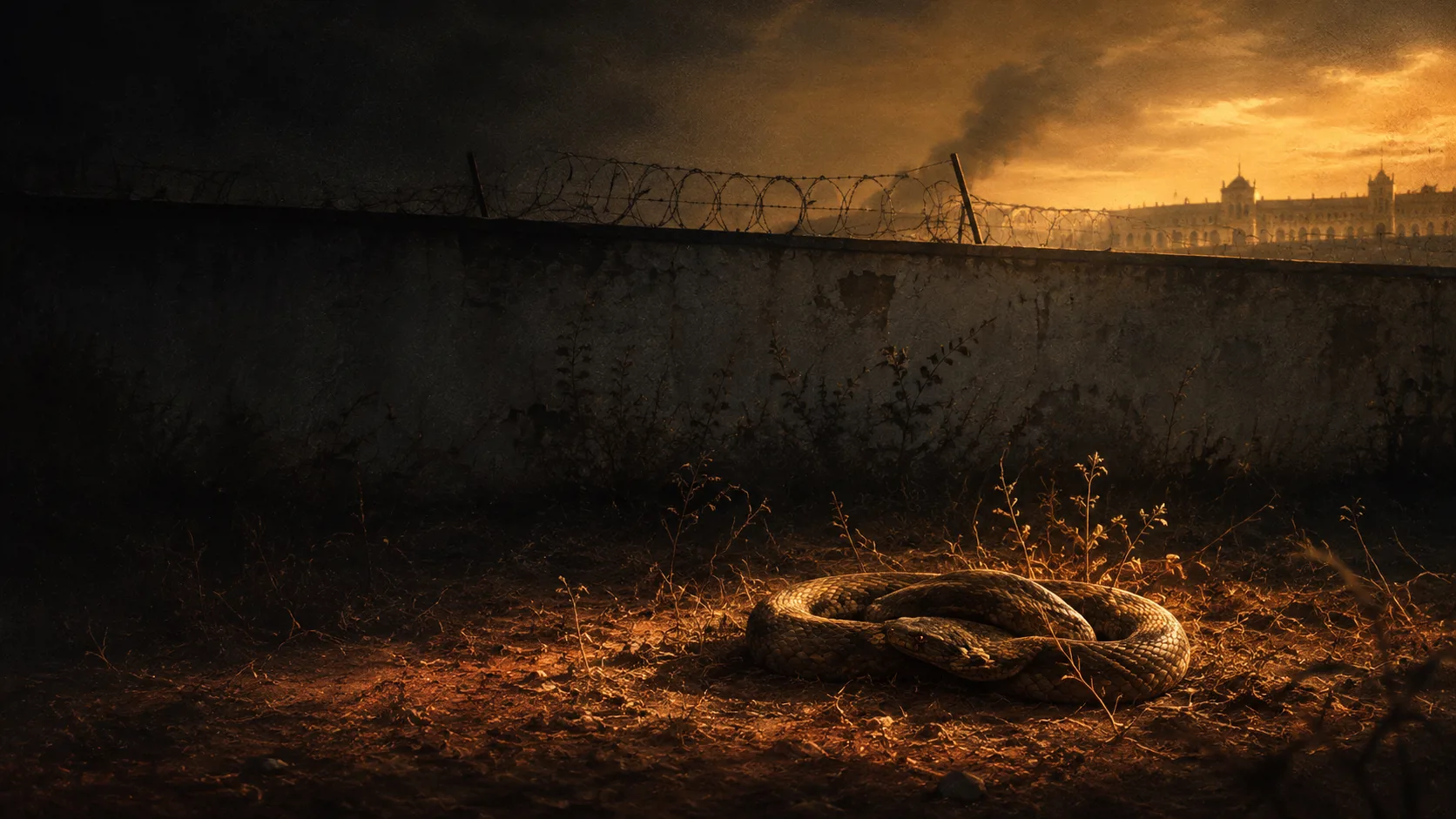
The House With the High Walls
Begin with a man burning his rubbish.
He does it in the yard, most evenings, because rubbish leaves a trail and he has spent a decade thinking about trails. The compound has walls eighteen feet high, topped with barbed wire. It has no telephone line and no internet connection. It is worth perhaps a quarter of a million dollars and it was built in 2005 on land bought under a false name. The upper-floor windows are shuttered. He has not stepped outside them in years.
The house sits in Bilal Town, a residential district of Abbottabad, in the hills of Khyber Pakhtunkhwa. About a kilometre away, along a road any resident could walk in twelve minutes, stands the Pakistan Military Academy at Kakul, where the officers of the Pakistan Army are made. Cadets march there. Bands play. Generals arrive in convoy to review passing-out parades and remind the young men that they are the shield of the nation.
On the second of May, 2011, American helicopters came over the ridge and killed the man in the yard, and the Islamic Republic of Pakistan announced, with a straight face, that it had no idea he was there.
Six months later the American Secretary of State sat in Islamabad and offered her hosts a piece of folk wisdom about backyards and snakes: you cannot keep them and expect them to bite only the neighbours. Settled
Pakistan received this as an insult. It was, in fact, an act of considerable generosity, because it assumed the snakes were being kept for the neighbours.
They were not. They never were. They were kept for domestic use.
The Country Born Owing Someone an Enemy
Every nation needs a story about why it exists, and most of the stories are affirmative. A people. A river. A language. A revolution. A promise kept.
Pakistan's story was subtractive. It was not a claim about what its people were. It was a claim about what they were not, and the thing they were not was standing right next door, enormous, ancient, and entirely uninterested in going away.
The two-nation theory held that the Muslims of the subcontinent constituted a nation irreconcilably separate from the rest. Whatever one thinks of it as history, its consequence as statecraft was fixed on day one: remove India from the equation and there is nothing left on the page. Settled
Jinnah appears to have understood this. On the eleventh of August, 1947, he told the Constituent Assembly that religion had nothing to do with the business of the state, that Hindus would cease to be Hindus and Muslims cease to be Muslims -- not in the religious sense, but as citizens of one country. It is a fine speech. Pakistani liberals have been quoting it for seventy-nine years, the way a family quotes a will that was never executed.
He died thirteen months later. The speech governed nothing.
What governed was the Objectives Resolution of March 1949, passed within seven months of his death, which declared that sovereignty over the entire universe belongs to Allah and that the people of Pakistan exercise authority only as a sacred trust. It became the preamble of every constitution Pakistan has written. In 1985, General Zia-ul-Haq lifted it out of the preamble and inserted it into the operative text as Article 2A, where it could not be removed by anything as vulgar as a parliamentary majority. Settled
Consider what that document does. A trust delegated by the divine can always be reclaimed by whoever claims to hold the deed -- a general, a cleric, a judge, a mob outside a police station. It is a permanent invitation, written into the founding law, for the strong to overrule the elected on the grounds of a higher client.
A state defined by what it is not must keep the thing it is not permanently in the frame. Otherwise the frame is empty, and everyone can see it.
This is why no Pakistani leader has ever normalised relations with India and survived the attempt. It is not that the public would not permit it. It is that the state cannot survive it. Peace with India is not a foreign policy Pakistan has failed to achieve. It is a solvent that would dissolve the thing achieving it.
The Men Who Stopped to Loot
The state was eight weeks old when it went to war.
On the twenty-second of October, 1947, several thousand armed tribesmen crossed from Pakistan's North-West Frontier into the princely state of Jammu and Kashmir, transported in Pakistani lorries, on a route organised by Pakistani officers. The operation had a name, Gulmarg, and a purpose: to take Srinagar before the Maharaja could decide anything, and to do it with men whose deaths the government of Pakistan could disclaim. Settled
They had the road. They had surprise. Srinagar had a garrison of a few hundred and no plan. The airfield was two days away and undefended.
They reached Baramulla on the twenty-sixth, thirty-five miles short, and they stopped.
They stopped because Baramulla was a prosperous town full of things, and the men had been recruited with the understanding that there would be things. They spent two days at it. They burned the bazaar. They went into St Joseph's convent and hospital and killed the priest, a nun, and the European couple sheltering there, and shot a Franciscan sister who tried to stop them. A town of some fourteen thousand was reduced, by the accounts of those who came after, to a few thousand. Settled
Two days. In those two days the Maharaja signed the Instrument of Accession, and Indian troops landed at Srinagar airfield on the twenty-seventh, and the war Pakistan had won on the twenty-fourth became the war it has been re-fighting ever since.
The men who came to liberate Kashmir lost Kashmir because they could not walk past a shop.
Seventy-nine years later this is still being explained.
And in the same season, Kalat
Here is the part of that year which Pakistani textbooks do not carry, and which no Pakistani representative at the United Nations has ever been asked about.
While Pakistan was arguing, correctly under its own logic, that the people of a princely state must decide their own future rather than have a ruler decide it for them, it was in the middle of demonstrating the exact opposite proposition on its own western frontier.
The Khanate of Kalat, the largest of the Baloch states, had declared independence in August 1947. Its two houses of legislature debated accession to Pakistan and declined it. In March 1948 the Pakistan Army moved, and the Khan signed. Within weeks his own brother had taken to the hills with an armed force, beginning the first of five Baloch insurgencies that have now run, with pauses, for seventy-eight years. Settled
So: in a single season, a state eight months old fought a war for the principle of self-determination in one Muslim-majority territory and extinguished it by force in another, and has never once been troubled by the sensation of holding both positions at the same time.
That capacity -- to demand a plebiscite in Srinagar while imposing a curfew in Kalat -- is not hypocrisy in the ordinary sense. Hypocrisy implies embarrassment. This is a load-bearing feature. Kashmir is the argument the state makes about itself. Balochistan is the state.
A Rigged Election, and Seven Thousand Ghosts
Skip forward. The general is Ayub Khan, who took the country in October 1958 and has held it for six years, and who has developed a problem.
He has decided to legitimise himself with an election, of a sort. The electorate is not the people; it is eighty thousand local councillors called Basic Democrats, a mechanism designed to produce the correct answer. In January 1965 the opposition puts up Fatima Jinnah -- the founder's sister, seventy-one years old, universally known as Madar-e-Millat, Mother of the Nation.
She loses, in a result no serious person believed then and no serious person believes now. But she carries Karachi and she carries Dhaka: the largest city of the western wing and the largest city of the eastern. The general who was to be confirmed by acclamation has been repudiated by both capitals of his own country, and the repudiation is public, and it is by a woman his own founding myth cannot allow him to dismiss. Settled
Seven months later, seven thousand men crossed the ceasefire line into the Kashmir Valley.
Operation Gibraltar. The infiltrating columns were named for the conquerors -- Tariq, Qasim, Salahuddin, Khalid -- because if you are going to send irregulars to raise a rebellion, you may as well let them believe they are riding into the eighth century. The plan required the Kashmiri population to rise, the administration to collapse, and Pakistan to arrive as protector of a fait accompli.
The population did not rise.
Kashmiri villagers looked at the armed strangers who had appeared in their pastures, and walked to the nearest police post, and told the Indian authorities where they were. The operation was unravelling within a fortnight. It escalated into a full war that Pakistan did not win and, at Tashkent the following January, did not get anything for. Settled
There is a version of this event in Pakistani memory in which 1965 was a glorious defensive stand against Indian aggression. It is taught in schools. What is not taught is the fortnight in August when the people of the Valley -- the very people on whose behalf the entire enterprise of the Pakistani state claims to speak -- were handed the opportunity to choose, and chose, and informed on the liberators.
The general did not survive it either. His foreign minister, Zulfikar Ali Bhutto, broke with him over Tashkent, built a national career out of the accusation of betrayal, and by March 1969 Ayub was gone. The diversion had eaten the man who ordered it. This will happen again.
The Night the Majority Voted
Now the sequence that settles the matter, because in 1971 there is no ambiguity at all about what Pakistan does when its own people vote.
On the seventh of December, 1970, Pakistan held the first genuinely free general election in its history. The Awami League of Sheikh Mujibur Rahman won 160 of 300 seats. Not a plurality. Not a coalition-forming position. An outright majority of the national assembly, delivered by the votes of East Bengal, which contained the majority of Pakistan's population and always had. Settled
The mathematics of the country had finally been permitted to express itself, and the mathematics said: the Prime Minister of Pakistan is a Bengali.
The assembly was to meet in Dhaka on the third of March, 1971. On the first of March, Yahya Khan postponed it. In the west, Bhutto had already announced that he would break the legs of any member of his party who attended.
On the night of the twenty-fifth of March, the army moved on Dhaka. Operation Searchlight opened with the university, the police lines, and the Hindu neighbourhoods, in that order. The American Consul General, Archer Blood, and twenty of his staff sent a formal dissent cable to Washington using the word genocide, an act of conscience that ended his career. Ten million people crossed into India. Estimates of the dead run from the tens of thousands offered by Pakistan's own suppressed Hamoodur Rahman Commission to the three million of Bangladeshi official memory, with independent scholarship clustering in the hundreds of thousands. Contested Hindus were hunted with particular attention. Settled
Now watch what happens when the internal war is lost.
By late November the Pakistani position in the east is collapsing. On the third of December, 1971, Pakistan launches Operation Chengiz Khan: pre-emptive air strikes on eleven Indian airfields, in the west, twelve hundred miles from the war it is actually losing.
There is no strategic reading of that decision in which it works. The Pakistani air force could not destroy the Indian air force on the ground; it had neither the numbers nor the range nor the surprise. What it could do was convert a civil war against Bengalis, which no army can win and be celebrated for, into a national war against India, which an army can lose and still be mourned for.
It bought thirteen days. On the sixteenth of December, ninety-three thousand men surrendered at Dhaka.
The two-nation theory was not refuted by argument. It was refuted by the Muslims of East Bengal, at the polls in 1970 and with rifles in 1971, who having been offered Islamic solidarity with Punjab chose their own language and their own government and fought a war to get them.
After 1971, Pakistan did not need Kashmir less. It needed Kashmir infinitely more -- because Kashmir was the last place on earth where the founding claim might still be redeemed.
Everything that follows is a footnote to that sentence.
The Grass, the Gallows, and the Gift from Moscow
Two weeks after Dhaka fell, in January 1972, Bhutto assembled Pakistan's scientists at Multan and told them to build a bomb. He had said years earlier that his country would eat grass if that was the price. It turned out to be a reasonably accurate forecast of the national diet. Settled
In 1974 he needed the religious parties, and paid them in the only currency they wanted. The Second Amendment to the constitution declared Ahmadi Muslims to be non-Muslims -- not by a general, not by martial law, but by an elected parliament with a democratic mandate. It remains the most complete demonstration available that Pakistan's civilian politics and its clerical politics were never separate systems. Settled
In the same years he was running an army operation in Balochistan, having dismissed the elected provincial government in February 1973 on the grounds of a weapons cache in the Iraqi embassy. Tens of thousands of troops, helicopters lent by the Shah, four years of it.
In 1977 the general he had promoted over the heads of six seniors, on the theory that a pious Punjabi from a modest family would be safe, overthrew him. In April 1979 Zia-ul-Haq hanged him.
Now consider Zia's position in the autumn of 1979. He has hanged an elected Prime Minister. He has no constituency, no mandate, no ally, and no plan beyond survival. In November a mob burns the American embassy in Islamabad. He is, by any reasonable assessment, a man with eighteen months left.
On Christmas Eve, the Soviet Union invades Afghanistan.
Within a year the general who had hanged a prime minister is the indispensable partner of the free world, receiving American money and Saudi money and a permanent supply of legitimacy from both. He uses it to Islamise the penal code, build a madrasa network, expand the blasphemy provisions, create the Federal Shariat Court, and transform the Inter-Services Intelligence directorate from a modest military bureau into the most powerful institution in the country. Settled
He ruled for eleven years. He never held a real election. He held a referendum in December 1984 whose question, in essence, was whether the voter supported Islam -- and having established that the voter did, announced that he was therefore President for five more years.
In 1984, with martial law in its seventh year and the Movement for the Restoration of Democracy having just been crushed in rural Sindh at a cost of hundreds of lives, the two armies met on the Siachen glacier, twenty-one thousand feet up, where men die of the altitude rather than the enemy. They are still there.
By 1989 Zia was dead in an air crash, the Soviets were leaving, and Pakistan possessed something no state had ever possessed before: a trained, ideologically motivated, internationally financed, and entirely deniable army of irregulars, with no further employment.
The Woman They Could Not Allow
In December 1988 Benazir Bhutto became Prime Minister -- thirty-five years old, the first woman to lead a Muslim-majority state, daughter of the man the army had hanged.
The army's problem was not that she was popular. The army's problem was that she was popular and had every conceivable reason to want the generals cut down to size.
The solution had two halves, and both are documented.
The first was money. In 1990 the ISI distributed funds to politicians to construct and finance an alliance against her. This is not an allegation. In 2012 the Supreme Court of Pakistan, ruling in the Asghar Khan case, held that it had happened, named the amounts, and directed action against those responsible. Nothing consequential followed the ruling, but the finding stands on the record of Pakistan's own highest court. Settled
The second was Kashmir.
The Soviet withdrawal was completed in February 1989. By the autumn, the machinery built for Afghanistan was being pointed east. The insurgency in the Valley began with genuine local grievance and the largely secular Jammu and Kashmir Liberation Front, and was then progressively captured -- funded, armed, trained, and eventually replaced -- by organisations of a different character and a different sponsor: Hizbul Mujahideen, then Lashkar-e-Taiba, then Jaish-e-Mohammed. The drift from a separatist demand to an Islamist one was not radicalisation. It was procurement. Settled
In December 1989 militants kidnapped the daughter of India's Home Minister and secured the release of five prisoners, and every young man in the Valley learned in one week that the state could be made to kneel.
Then, in January 1990, the bill was presented to the oldest people in Kashmir.
The killings had already begun -- the lawyer Tika Lal Taploo in September 1989, a retired judge, a poet, a scholar, men selected for visibility rather than for anything they had done. On the night of the nineteenth of January, 1990, loudspeakers on mosques across the Valley carried the message directly: leave, convert, or die, and the women could stay.
Within weeks, a community that had lived in Kashmir continuously for something like three thousand years was gone from it. Massacres followed for those who lingered or returned -- Wandhama in 1998, Chittisinghpura in 2000 where Sikh villagers were lined up and shot, Nadimarg in 2003. Settled
The removal of an entire indigenous population from its homeland by organised terror satisfies the ordinary meaning of ethnic cleansing without any strain at all. Whether it satisfies the legal definition of genocide under the Convention remains formally unresolved, and the community's own designation is a matter of standing. Contested What is not unresolved is that the Valley was emptied of its oldest inhabitants, that nobody has ever been convicted for it, and that the state that organised the machinery has spent the thirty-six years since lecturing the United Nations about human rights in Kashmir.
Benazir Bhutto was dismissed in August 1990. She had lasted twenty months. The front the army opened while she governed outlived her by decades; she was murdered in Rawalpindi in December 2007, a few miles from General Headquarters, and the crime scene was hosed down within hours.
Three Cities, One Spring
March 1993. Look at Pakistan.
In Karachi the army has been conducting Operation Clean-up against the MQM since June 1992, and the largest city in the country is a war zone. In Islamabad the Prime Minister and the President are locked in a constitutional death match that will, within six weeks, see Nawaz Sharif dismissed, restored by the Supreme Court, and then removed anyway along with the President by an army chief who tells them both to go. In Balochistan the settlement is holding only in the sense that nobody is currently shooting.
On the twelfth of March, 1993, thirteen bombs went off across Bombay in the space of two hours and killed more than two hundred and fifty people. The organiser fled to Karachi, where he has lived, by the assessment of every intelligence service that has looked, ever since. Pakistan's position is that it does not know where he is. Settled
Three cities in one spring: one being pacified by its own army, one paralysed by its own institutions, and one burning at the hands of men who took the ferry.
The Bus and the Mountain
October 1998. Something has happened in Pakistan that has never happened before: a civilian has sacked an army chief and survived it.
Nawaz Sharif has a two-thirds majority. He has already passed the Thirteenth Amendment, stripping the President of the power to dismiss governments -- the instrument by which four elected governments had been removed in eight years. And when General Jehangir Karamat makes a speech suggesting the army deserves a formal role in governance, Sharif demands his resignation and gets it.
He then appoints, over two more senior officers, a Karachi-born commando named Pervez Musharraf, on the reasoning that a man without a Punjabi power base will be dependent on him.
In February 1999, Atal Bihari Vajpayee comes to Lahore by bus. The Lahore Declaration commits both states to reducing nuclear risk and to serious dialogue on Kashmir. It is, for all its limits, the most substantial thing either country has attempted in fifty years.
While the buses were running, soldiers of the Northern Light Infantry were already occupying the vacated winter heights above Kargil, Dras and Batalik. The plan had been developed by a circle of four officers around the new chief. Settled
When India discovered them and counterattacked, Pakistan announced that the men on the mountains were mujahideen, nothing to do with the state, and it declined for a period to accept the bodies of its own dead. Some Pakistani soldiers were buried on those heights by the Indian Army, with military honours, according to Islamic rites, because their own government would not admit they existed. Settled
The war ended in July with a withdrawal secured in Washington. On the twelfth of October, 1999, the army chief overthrew the Prime Minister who had appointed him.
Read the sequence at speed: civilian sacks a general, civilian makes peace with India, general sabotages the peace, sabotage fails, general takes the country. Total elapsed time, twelve months.
Two months into his rule, in December 1999, an Indian Airlines flight was hijacked from Kathmandu and flown, after a tour of the region, to Kandahar in Taliban Afghanistan. India traded three prisoners for a hundred and fifty-five passengers. One of the three was a cleric named Masood Azhar, who within eight weeks had founded Jaish-e-Mohammed at a rally in Karachi and announced his intentions to a crowd of thousands, in public, in a country whose government has since maintained that it does not know his whereabouts.
The Convert Who Had to Prove Nothing Had Changed
On the nineteenth of September, 2001, Musharraf went on television and abandoned twenty years of Afghan policy in a single address, because an American Deputy Secretary of State had made the alternative unattractive.
This was, for the constituency the Pakistani state had spent two decades constructing -- the madrasas, the veterans, the sympathetic officer corps, the entire jihadist infrastructure -- an act of apostasy. He sacked his ISI chief in October. The bases the Americans wanted, they got.
On the thirteenth of December, 2001, five gunmen attacked the Parliament of India in New Delhi.
The timing is worth holding still for a moment. A military ruler had just publicly surrendered the jihad in Afghanistan, and within twelve weeks the jihad in Kashmir demonstrated, spectacularly, that it was intact. He got to keep the American money and keep the constituency, and he got to spend the following months explaining to Washington that he was the only thing standing between them and the men who had just attacked a parliament.
India mobilised for ten months. Then, in April 2002, Musharraf held a referendum to make himself President for five years, producing a turnout and a result that his own election commission struggled to defend. Two weeks after the referendum, on the fourteenth of May, gunmen boarded a bus at Kaluchak, killed the passengers, then walked into the family quarters of an army camp and killed the wives and children of Indian soldiers. Thirty-one dead, most of them women and children. Settled
The Twenty-Sixth of November
August 2008: Musharraf resigns to avoid impeachment. September: Asif Ali Zardari is sworn in as President.
Zardari then does something that, in the arithmetic of Rawalpindi, is far more dangerous than anything India has ever done. He gives interviews. He says that India has never been a threat to Pakistan. He describes the militants in Kashmir as terrorists. He floats a no-first-use nuclear posture and talks about trade.
Meanwhile the western frontier is coming apart. The Marriott Hotel in Islamabad is bombed on the twentieth of September, sixty dead. The Pakistani Taliban are taking Swat, a valley with a ski resort and a hundred and eighty miles from the capital. And in November the government goes to the International Monetary Fund for a seven-and-a-half billion dollar rescue, because the reserves will not cover the imports.
On the twenty-sixth of November, 2008, ten men who had trained in Pakistan and sailed from Karachi came ashore at Mumbai and spent four days killing a hundred and sixty-six people. One was taken alive. A Pakistani-American named David Headley, who had scouted the targets, later testified in an American courtroom about the serving intelligence officers who ran the operation. Settled
The most eloquent moment came after. Under pressure, Pakistan's civilian government announced that the Director-General of the ISI would travel to India to assist the investigation. Within hours the announcement was reversed. The reversal did not come from the Prime Minister's office.
Nobody in Pakistan needed that explained. The elected government had made a promise about the intelligence service, and the intelligence service had informed the elected government that it was mistaken about who governs.
Peace talk in September. Mumbai in November. The civilians never mentioned no-first-use again.
The Speech, the Train, and the Meadow
Three more, tightening.
September 2016. The Panama Papers have detonated under Nawaz Sharif since April. In Balochistan, on the eighth of August, a bomb at Quetta's Civil Hospital killed some seventy people, most of them lawyers who had gathered after the shooting of the president of the provincial bar -- an entire legal profession decapitated in an afternoon. And on the fifteenth of August, from the Red Fort, the Indian Prime Minister thanked the people of Balochistan and Gilgit-Baltistan by name, the first time an Indian leader had reached for that lever in public.
Five weeks later, four men attacked the army base at Uri and killed nineteen Indian soldiers. India crossed the Line of Control eleven days after that and announced it had done so, which was itself the innovation.
February 2019. Imran Khan is six months into a term that began with an election the opposition considers manufactured. The rupee is collapsing. Pakistan has been on the Financial Action Task Force grey list since June and is negotiating its twenty-second rescue. In the tribal districts the Pashtun Tahafuz Movement has put tens of thousands of people on the streets demanding an accounting for disappearances, and the army has no answer for a protest movement that refuses to pick up a gun.
On the fourteenth of February a suicide bomber drove into a paramilitary convoy at Pulwama and killed forty men. Jaish-e-Mohammed claimed it within hours, on video, with the bomber's face.
Three days later the Crown Prince of Saudi Arabia landed in Islamabad with a package of agreements reported at twenty billion dollars. It was, by any measure, an eventful week.
India struck Balakot on the twenty-sixth, inside Pakistan proper rather than the occupied territory, which was the second innovation.
April 2025. Now the record is at its clearest, because the interval is six days.
The context: the most popular politician in the country has been in Adiala Jail since August 2023. The February 2024 election is regarded across the political spectrum as stolen -- a Commonwealth observer mission documented it and the Commonwealth then declined to publish the report. Most damaging of all, on the ninth of May, 2023, Pakistani civilians did something that had never happened in the history of the state: they stormed the Lahore Corps Commander's residence and the gates of General Headquarters in Rawalpindi. The army's popularity, its one durable asset, had collapsed among the young and the urban.
And Balochistan was on fire. On the eleventh of March, 2025, the Baloch Liberation Army stopped the Jaffar Express in a tunnel in Bolan and held four hundred passengers; more than thirty people died. A separatist militia had taken a train, in a province the army has garrisoned for seventy-seven years, and held it.
On the sixteenth of April, 2025, at a convention for overseas Pakistanis in Islamabad, with the Prime Minister sitting behind him, the army chief General Asim Munir delivered a speech resurrecting the two-nation theory in its purest form. Our forefathers thought we were different from Hindus in every possible aspect of life, he said. Our religion, our customs, our traditions, our thoughts, our ambitions. We are two nations, not one. Tell this story to your children so they never forget it. And on Kashmir: it was our jugular vein, it will be our jugular vein. In the same speech he turned to Balochistan and named the separatist organisations one by one, and said that not ten generations of them could undo Pakistan. Settled
Six days later, on the twenty-second of April, gunmen walked into a meadow at Baisaran above Pahalgam, where families were having lunch, and asked the men their religion, and killed twenty-six of them in front of their wives. Settled
India struck nine locations on the seventh of May. Four days of exchanges followed and a ceasefire took effect on the tenth.
On the twentieth of May, General Asim Munir was promoted to Field Marshal, the second man in Pakistan's history to hold the rank.
In November 2025 the National Assembly passed the Twenty-Seventh Amendment to the constitution by 234 votes to four, with the opposition boycotting. It created a new constitutional office, Chief of Defence Forces, held concurrently by the army chief, with command over the navy and the air force and over the machinery that manages the nuclear arsenal. It abolished the post of Chairman of the Joint Chiefs of Staff Committee. It granted lifetime immunity from criminal prosecution to any officer of five-star rank -- a rank held, at that moment, by exactly one man. Removing the Chief of Defence Forces requires a two-thirds majority of parliament. Removing an elected Prime Minister requires a simple one. Settled
Count it out. Speech on the sixteenth of April. Massacre on the twenty-second. War on the seventh of May. Ceasefire on the tenth. Field Marshal on the twentieth. Command of everything, plus immunity for life, by November.
Two hundred and eleven days from a meadow to a constitution.
Nothing was taken at Pahalgam. No territory changed hands. No Kashmiri was liberated. But something was acquired, and it was acquired by exactly one person, and he now controls the bomb and cannot be prosecuted for the rest of his life.
The Ledger
Major Pakistani attacks and escalations against India, set against the internal crisis facing Pakistan's rulers at that moment, and what the ruling institution obtained
| Date | The internal problem | The move against India |
|---|---|---|
| Oct 1947 | State eight weeks old; no constitution, no legitimacy; Kalat refusing accession in the west | Tribal lashkar invades Kashmir; Baramulla sacked; accession and war follow |
| Mar 1948 | Kashmir war under way, needing a principle of self-determination | Kalat annexed by force, first Baloch revolt begins within weeks |
| Aug 1965 | Ayub repudiated by Karachi and Dhaka in a rigged presidential election in January | Operation Gibraltar sends 7,000 infiltrators; Kashmiris report them; full war |
| Mar 1971 | A Bengali majority has won a free election and been denied power | Army destroys East Bengal rather than hand over office |
| Dec 1971 | The eastern war is lost and cannot be presented as anything but a massacre | Pre-emptive strikes on eleven Indian airfields convert civil war into national war |
| Apr 1984 | Martial law in year seven; Sindh uprising crushed the previous autumn | Siachen confrontation opens at twenty-one thousand feet |
| Jan 1990 | Benazir Bhutto in office; Afghan jihad ended, cadres idle; ISI funding her opposition | Kashmir insurgency captured and armed; Kashmiri Pandits expelled from the Valley |
| Mar 1993 | Karachi under army operation; President and Prime Minister destroying each other | Serial bombings in Bombay kill more than two hundred and fifty |
| May 1999 | A civilian has sacked an army chief and made peace at Lahore in February | Kargil intrusion; denial of its own dead; coup follows in October |
| Dec 1999 | Musharraf eight weeks into a coup, needing standing with the jihadist constituency | IC-814 hijacked to Kandahar; Masood Azhar released and founds Jaish-e-Mohammed |
| Dec 2001 | Musharraf has publicly abandoned the Taliban after September 11 | Attack on the Indian Parliament proves the Kashmir jihad is untouched |
| May 2002 | A referendum a fortnight earlier has produced results nobody can defend | Kaluchak: soldiers' wives and children killed in an army family quarter |
| Nov 2008 | Zardari calling militants terrorists; Swat falling; IMF rescue signed that month | Mumbai: ten men, four days, one hundred and sixty-six dead |
| Sep 2016 | Panama Papers engulfing Sharif; Quetta's lawyers massacred; India names Balochistan | Uri: nineteen soldiers killed; India crosses the Line of Control and says so |
| Feb 2019 | FATF grey list, currency collapse, twenty-second bailout, Pashtun protest movement rising | Pulwama: forty paramilitaries killed; India strikes Balakot inside Pakistan |
| Apr 2025 | Imran Khan jailed, election discredited, GHQ stormed in 2023, Jaffar Express hijacked in March | Pahalgam: twenty-six civilians sorted by religion and shot; army chief made Field Marshal within a month |
The strict claim -- that in every one of these cases a ruler consciously ordered an attack on a specific date in order to survive a specific crisis -- is stronger than the evidence will carry, and honesty requires saying so. Contested Some of these were opportunism. Some were institutional reflex. At least one, in 1971, was a lost war being laundered into a national one.
But the structural claim requires no such hedging, and it is the one that matters. Settled In Pakistan, confrontation with India reliably converts a domestic emergency into a national rally. The institution that controls escalation is the same institution that harvests the rally. It has never once been held to account for the outcome, and it has been rewarded, without exception, for the attempt. Ayub after Gibraltar was finished, but the army was not. Musharraf lost Kargil and took the country three months later. Munir lost aircraft in May and had the constitution rewritten in his favour by November.
There is no version of this system in which peace pays better than provocation. That is not a moral failing of individual generals. That is the incentive structure of the Pakistani state, working exactly as designed.
The Snakes Come Home
The doctrine had a name that sounded like strategy: strategic depth. A friendly Afghanistan would give Pakistan a rear area to fall back into if India ever came through the plains. In pursuit of it, Pakistan sheltered, supplied and protected the Afghan Taliban leadership through twenty years of American war, while drawing American money as a partner in that same war. Settled
In August 2021 the strategy succeeded absolutely. Kabul fell. Pakistan's Prime Minister publicly welcomed the breaking of the shackles of slavery. Shortly afterwards the Director-General of the ISI was photographed in the lobby of the Serena Hotel in Kabul, holding a teacup, with the expression of a man who has just been handed a country and cannot quite believe that no one intends to stop him. Settled
It took under four years for the prize to become the emergency.
The Tehrik-e-Taliban Pakistan, formed in December 2007 out of precisely the soil Pakistani policy had spent thirty years fertilising, has never recognised the Pakistani state and regards it as apostate. It had been beaten back at enormous cost -- including the Army Public School at Peshawar in December 2014, where a hundred and forty-nine people were killed, a hundred and thirty-two of them children in their classrooms. After Kabul fell, the TTP recovered sanctuary, weapons and confidence, and the attacks resumed at a scale not seen in a decade.
Islamabad asked Kabul to control them. Kabul replied, with a straight face, that these were not its forces, that it did not control them, and that the border was very difficult terrain.
Pakistan had written that script. It had performed it at the United Nations for thirty years. Hearing it read back was, one imagines, an educational experience.
In October 2025 Pakistan struck inside Kabul. Afghan forces counterattacked along the Durand Line in the worst fighting between the two states since 2021. Qatar and Turkey brokered a ceasefire; the follow-on talks collapsed by year's end. In February 2026, after a mosque bombing in Islamabad and an assault in Bajaur, Pakistani aircraft hit Nangarhar, Paktika and Khost; Afghan forces launched a general offensive across the line; and Islamabad declared what amounted to open war on the government it had spent twenty years installing. Fighting ran through a March ceasefire and its violations in April. Settled
No government in Kabul has ever accepted the Durand Line as an international border. Not the monarchy, not the republic, not the communists, not the mujahideen, not the first Taliban emirate, and not the second. Pakistan's western frontier has never been agreed to by the state on the other side of it, and never will be. Strategic depth was not a policy that failed. It was a policy that could not have succeeded, pursued for forty years by men who preferred it to arithmetic.
They wanted a backyard. They got a second front, opened by their own graduates, from a capital they installed, using the excuse they invented.
The Empire at Home
Pakistan is called a federation. In practice it has run as a metropolis administering peripheries, and every periphery has made the same complaint in turn: the resources travel one way and the authority travels the other.
Punjab holds roughly half the population and has always supplied the overwhelming majority of the officer corps. Bengal made the complaint until 1971 and then left. Sindh has made it since the 1950s. Khyber Pakhtunkhwa makes it now through the Pashtun Tahafuz Movement. Balochistan has made it with rifles five separate times.
The pattern was set immediately. Bengalis were the largest linguistic group in united Pakistan, an absolute majority of its people. In 1948 Jinnah stood in Dhaka and announced that Urdu -- the mother tongue of a small minority in either wing -- would be the sole state language. Students were shot in Dhaka in February 1952 for objecting. The world now observes that date as International Mother Language Day: a global commemoration of what Pakistan did to the language of its own majority. Settled
In 1955 the One Unit scheme abolished the provinces of West Pakistan and fused them into a single administrative bloc, for the express purpose of manufacturing parity with East Bengal in the legislature. A constitutional device was built for no reason other than to prevent a majority from being a majority. When it finally failed at the polls in 1970, the army reached for the other instrument.
Balochistan
Forty-four per cent of the land. Six per cent of the people. Gas piped out of Sui since the early 1950s to warm Punjab and Sindh, while much of Balochistan waited decades for a connection. Copper and gold at Reko Diq. A deep-water port at Gwadar. The coastline that gives the China corridor its outlet to the sea, and all of it administered from elsewhere. Settled
In August 2006 the Pakistan Army killed Nawab Akbar Bugti -- former governor of the province, former chief minister, seventy-nine years old -- in a cave. If a single act converted Baloch grievance into Baloch separatism, that was it.
The instrument of ordinary administration is enforced disappearance. Men are taken from homes, roadsides, campuses and clinics by agencies that neither charge them nor produce them nor acknowledge them. Their mothers and sisters hold photographs outside press clubs and walk hundreds of miles and wait for years. The practice is documented by Pakistan's own Human Rights Commission and by United Nations mechanisms. Settled
And then, in case anyone had misread the offer, the state clarified its terms.
On the twenty-second of June, 2026, an Anti-Terrorism Court in Quetta sentenced Dr Mahrang Baloch to life imprisonment. She is a physician. She leads the Baloch Yakjehti Committee's campaign against disappearances, which is non-violent by doctrine and has been for years. She has been nominated for the Nobel Peace Prize twice. Her colleagues were sentenced with her. Settled
Consider what that verdict says to a twenty-year-old in Turbat. It says: the doctor who marched with photographs and asked the courts for help got life. The armed groups have been making that argument for two decades. In June 2026 the Pakistani state made it for them, from the bench, in writing, and signed it.
The territory Pakistan already holds
Here the argument answers itself, and it does so in real time.
Pakistan-occupied Jammu and Kashmir has no seats in Pakistan's National Assembly and no settled constitutional status. Gilgit-Baltistan, the strategically vital half of it, has been run for most of its existence by executive order. The justification is that final status awaits a plebiscite -- the plebiscite proposed by the United Nations in 1948, whose first condition was the withdrawal of Pakistani forces, which never occurred and was never going to. Settled
Since 2023 that territory has been in open revolt, and the revolt has nothing whatever to do with India. It started with electricity bills and the price of flour. People living in a region that exports hydroelectric power to Pakistan's national grid at preferential rates were paying among the highest domestic tariffs anywhere nearby. The Joint Awami Action Committee grew out of traders' associations and student bodies into a mass movement with a charter about subsidies, taxes, hospitals, colleges, and the abolition of the privileges reserved for the political class. It shut the region down in 2023, in 2024, and again in 2025. Each round ended in an agreement. Each agreement was ignored. Settled
In June 2026 the state stopped negotiating. The Joint Awami Action Committee was proscribed under the region's Anti-Terrorism Act. Paramilitary units were moved in from Punjab and Islamabad. At least eleven people were killed at Rawalakot in Poonch. Curfew was imposed, the internet was cut, and more than a hundred of the movement's organisers were arrested. The protests continued into July anyway. Settled
Pakistan has banned a Kashmiri civil rights movement as terrorist, curfewed a Kashmiri town, shot Kashmiri demonstrators and cut the internet in Kashmir -- while addressing the United Nations on the subject of Kashmiri self-determination.
There is no need to speculate about how Pakistan would govern the Valley if it ever got it. The experiment has been running since 1948 in the only part of Jammu and Kashmir where Pakistani administration can actually be observed, and the results came in this June.
A state that answers a flour-subsidy protest with a terrorism proscription is not a claimant to Kashmir. It is an exhibit.
The Licence
The bomb was ordered at Multan in January 1972, two weeks after the surrender at Dhaka, which tells you what it was for. It was not built to deter an invasion that was not coming. It was built because the eastern wing had been lost and something had to be put in the hole.
The means were theft. Abdul Qadeer Khan, working in the Netherlands for a subcontractor to the URENCO enrichment consortium, removed centrifuge designs and supplier lists and went home with them in 1975. Pakistan tested at Chagai in May 1998.
Then comes the part that ought to govern every international assessment of Pakistan as a nuclear power, and somehow never does.
Khan did not merely build a bomb for his own country. He ran a private proliferation business, supplying centrifuge technology and weapons-related designs to Libya, Iran and North Korea, moving hardware by air over the better part of fifteen years. When it was exposed, he read a confession on state television in February 2004 taking sole personal responsibility and explicitly absolving the army and the government. The President pardoned him the following day. He was never made available to the International Atomic Energy Agency. He died in 2021 a national hero, with a state funeral. Settled
The proposition that a scientist ran a global nuclear smuggling network for a decade and a half, using military transport, without the knowledge of an army that controls the programme absolutely, is not a proposition. It is a hostage note. Polemical The pardon was not mercy. It was a receipt.
The arsenal has since become one of the fastest-growing on earth, and the doctrine attached to it is the genuinely dangerous part. Pakistan fields short-range battlefield systems and speaks of full-spectrum deterrence, a posture designed with precision to deny India any rung on the escalation ladder at all. Settled
Strip the vocabulary away and the logic is simple, and Western scholars have been naming it for twenty years. The bomb is not primarily a shield against invasion, because no invasion is planned. The bomb is what makes terrorism survivable. It is the umbrella under which a state too weak to fight a conventional war can conduct an unconventional one indefinitely and cap the retaliation. It is not a deterrent. It is a licence. Contested
The world tolerated this on the assumption that the consequences stayed in South Asia. That assumption has now been formally abandoned. On the nineteenth of December, 2024, the United States sanctioned Pakistan's National Development Complex and three Karachi companies over the long-range missile programme, and the following day the American Principal Deputy National Security Advisor said publicly that on current trends Pakistan would be able to strike targets well beyond South Asia, including in the United States, and called it an emerging threat to the United States. Settled
Now set that beside November 2025, and hold both in view at once.
The command of Pakistan's strategic forces now sits with a single officer who holds lifetime immunity from criminal prosecution, who cannot be removed except by a two-thirds vote of a parliament that has already demonstrated exactly how it votes, in a state at war on its western border, in periodic armed confrontation on its eastern one, with an insurgency in its largest province and a curfew in the territory it calls Free.
The Arithmetic
Pakistan has entered twenty-five arrangements with the International Monetary Fund since joining in 1950. Settled Twenty-five. There are few states that have needed rescuing so often, and there is none that has needed it so often while maintaining a nuclear weapons programme and one of the largest standing armies on earth.
The current programme is working, and that should be said plainly. Reserves stood at about sixteen billion dollars at the end of 2025, up from fourteen and a half in mid-year. The primary surplus target has been met. The stabilisation is real. Settled
It is also the phase that has worked twenty-four times before. Stabilisation is achieved by squeezing imports, raising tariffs, and taxing the already-taxed. What has never been achieved is the second half: broadening a tax base that excludes vast agricultural and commercial fortunes, selling loss-making state enterprises, clearing a power-sector circular debt in the trillions of rupees, building exports beyond textiles. Each of those requires confronting a constituency the establishment cannot afford to confront, and so each of them is announced, scheduled, and abandoned.
Domestic public debt is near fifty-five trillion rupees, roughly two-thirds of the total, with external liabilities of some twenty-three trillion more. External financing requirements are projected toward a hundred billion dollars by 2029. The reserves cover about three months of imports and depend on rollovers from Beijing, Riyadh and the Gulf. Settled
The single largest source of foreign exchange is not any export. It is money wired home by Pakistanis who left. A country of two hundred and forty-five million people is kept solvent by the earnings of those who concluded it had nothing for them.
Set against that, the opportunity cost. Pakistan's own education ministry reports more than twenty-six million children out of school, among the highest absolute figures in the world. Settled That is not a consequence of poverty alone. It is a consequence of a state that has spent seventy-nine years buying the wrong things, and of a curriculum in which the two-nation theory is a compulsory subject and the grievance is transmitted with the alphabet.
There is a serious counter-argument, made by scholars of real standing: that Pakistan is not a failing state but a stubbornly resilient one, that it has survived seventy-nine years, three lost wars, the loss of half its population and repeated economic near-death because kinship networks, provincial elites and a competent army absorb shocks that would kill a more brittle system. The observation is correct. The inference is wrong. What has proved resilient is the apparatus of control, not the national project it was built to serve. The army's ability to survive every crisis is precisely what prevents any crisis from forcing a resolution. Pakistan does not collapse. It also does not consolidate. It persists, and the persistence is paid for entirely by its citizens.
The Ledger of the Vanished
A state is best measured by what it does to the people it does not count.
The Ahmadis were declared non-Muslim by constitutional amendment in 1974 -- by an elected parliament. Ordinance XX of 1984 then criminalised their use of Islamic vocabulary and practice. Every Pakistani applying for a passport must sign a declaration repudiating the founder of their movement: an act of theological compliance required by a travel document. Attacks on Ahmadi places of worship and the desecration of Ahmadi graves have intensified, by the account of Pakistan's own Human Rights Commission. Settled
The blasphemy provisions, expanded under Zia in 1982 and 1986, carry a mandatory death sentence. More than two thousand people have been charged since 1987. Christians are roughly one and a half per cent of the population and something near a quarter of the accused. The law requires no proof of intent, which makes it perfectly adapted to property disputes. Settled
The consequences leave the courts quickly. Salmaan Taseer, Governor of Punjab, was shot dead by his own bodyguard in January 2011 for questioning the law; lawyers showered the killer with rose petals at his court appearance, and a shrine now stands at his grave. Shahbaz Bhatti, the Christian federal minister for minorities, was murdered two months later. Mashal Khan was beaten to death by fellow students at his university in 2017. Priyantha Kumara, a Sri Lankan factory manager, was lynched and burned by a mob in Sialkot in December 2021. Churches and Christian homes burned across Jaranwala in August 2023. Settled
The abduction, forced conversion and forced marriage of Hindu and Christian girls, concentrated in Sindh and Punjab, is documented by the United States Commission on International Religious Freedom, by United Nations experts, and by Pakistan's own Human Rights Commission, which reported further deterioration in its 2024-25 survey. Courts validate these marriages routinely by accepting a stated conversion and a disputed age. In 2016 the Sindh Assembly passed a bill criminalising forced conversion unanimously; under clerical pressure it was never signed and was quietly abandoned. Settled
The state knows the remedy. It drafted the remedy. It passed the remedy without a single vote against. Then it looked at the men outside the building and put the remedy in a drawer.
On demography, precision matters more than volume. The collapse of the Hindu and Sikh population of what became West Pakistan happened in 1947 itself, in one year of killing and expulsion. The more revealing number is eastern: in the 1951 census Hindus were over twenty-two per cent of East Bengal; by the mid-1970s, after twenty-four years of Pakistani rule ending in a war where they were specifically hunted, that share had fallen by close to half. Settled The widely circulated claim that Pakistan's minorities fell from twenty-three per cent to three per cent conflates the two wings and should be retired. Contested The accurate figures are more than sufficient.
What Is Actually Happening
Prophecies of Pakistan's disintegration have been issued for fifty years and have not arrived, and a nuclear-armed state in genuine collapse is a thing no one in this region should wish for. So set the prophecy aside. The sober reading is not that Pakistan will shatter on some date. It is that Pakistan lost, long ago, the argument it was founded to win, and has spent every year since managing the loss with force.
The evidence is complete and it is current.
The two-nation theory was refuted by Bengalis in 1971 and has never been answered, only re-asserted at conventions for the diaspora. The federation is held by garrison and disappearance rather than consent, in Balochistan for seventy-eight years and counting, with the leading advocate of non-violence now serving life. The one part of Jammu and Kashmir that Pakistan actually administers spent this summer under curfew with its internet cut and its civil movement banned as terrorist. Afghanistan, the strategic depth that was to secure the west, is at war with Pakistan across a border it has never recognised, using an insurgency Pakistani policy created. The economy runs on the twenty-fifth rescue and on remittances from the departed. No head of government has ever completed a term. The most popular politician in the country is in solitary confinement. And the constitution has been amended to hand one soldier command of the nuclear arsenal and immunity from law for the rest of his life.
Through all of it, exactly one instrument still functions. A confrontation with India still converts a domestic emergency into a national rally, at least for a season, and it has never once failed to reward the man who reaches for it.
That is the danger, and it is not the danger people usually name. The danger is not that Pakistan might one day succeed. It is that the instrument is wearing out at precisely the moment the state needs it most. Each cycle now demands a larger provocation to produce the same rally, while on the other side of the line India's tolerance has been falling since 2016 and striking inside Pakistan has moved from unthinkable to routine to expected. A declining state, with a shrinking toolkit, a growing arsenal, a command structure concentrated in one immunised officer, and a war already running on its other border, is not a stable actor. It is a mechanism with a shortening fuse and no one left in the building authorised to say stop.
For seventy-nine years the world treated this as a problem to be managed. It sent money during the Cold War and money during the war on terror and rescue programmes in between, and it counselled restraint to the neighbour who was being bled. The management consisted, throughout, of paying the arsonist a retainer to watch the fire, and being surprised each time by the smell of smoke.
The snakes were never only for the neighbours. They were the household's own arrangement for keeping order in a house that had no other way of holding together, and the household has now been bitten in every room -- in Peshawar, in Quetta, in Bajaur, in Rawalakot, in a classroom full of children in December 2014.
The neighbour who has been bitten longest is under no obligation whatsoever to keep pretending it was an accident.
0 responses