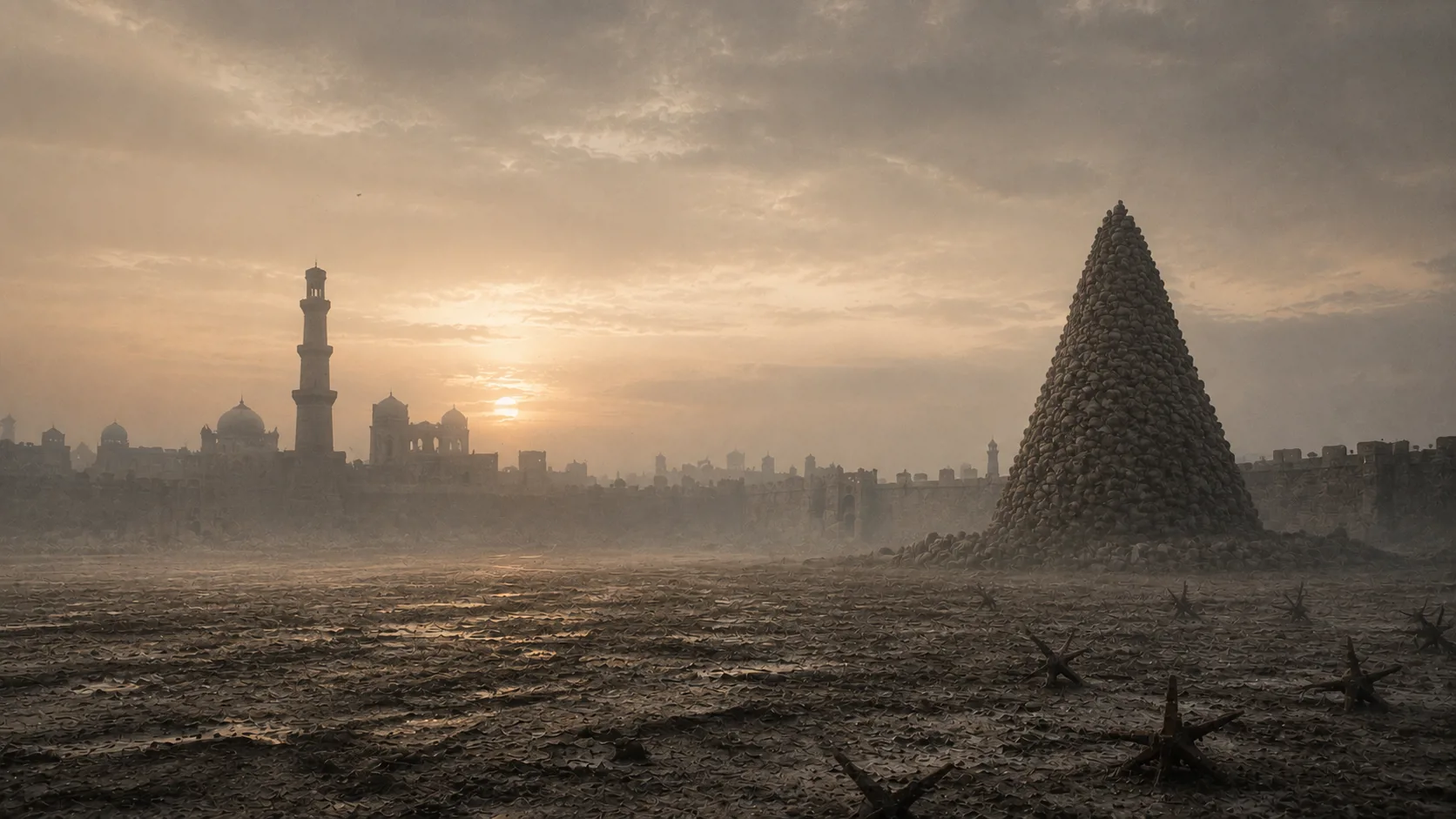
Kesh, in the Chaghatai Winter
Between the Amu Daryā and the Syr Daryā lies a country of irrigated oases, walled towns and open steppe that the Persians called Māwarāʾ al-Nahr, the land beyond the river. In the fourteenth century it belonged, in name, to the descendants of Chaghatai, second son of Chinggis Khān. In practice it belonged to whichever tribal amīr could hold it through a season of raiding.
In or around 1336, in the district of Kesh -- Shahr-i Sabz, the green city, some eighty kilometres south of Samarkand -- a son was born to Taraghai, a minor chieftain of the Barlas. The Barlas were of Mongol origin and had been settled in Transoxiana for over a century, by which time they spoke Turkish, lived among Turks, and had become Muslim. The son was named Tīmūr, which in Turkish means iron.
On the name. Tīmūr is the form his own chancery used. In India the chronicles write Tīmūr and Amīr Tīmūr; the Persian court style was Amīr Tīmūr Gūrkānī. Later in life he walked with a pronounced limp, and his enemies called him Tīmūr-i Lang, Tīmūr the Lame. Europeans took the mocking nickname, not the name, and produced Tamerlane and Tamburlaine. The insult travelled further than the man.
The date of birth is conventionally given as the eighth of April, 1336, and the conventional date is a court construction, arranged so that the founder's birth would fall in the year the last great Īlkhānid ruler of Persia died. Contested The place is not in doubt. The obscurity is not in doubt either. He was not born to power. He acquired it by being better at violence than everyone within reach.
The Man Who Could Not Be Called Khan
One fact governs everything Tīmūr ever did, and it is a fact about blood.
In the Mongol world of the fourteenth century, sovereignty was hereditary in a single family. Only a descendant of Chinggis Khān in the male line could be called Khān. Tīmūr was not one. He was a Barlas amīr of Mongol stock, but he stood outside the sacred line, and no amount of conquest could put him inside it. In fifty years of war he never once took the title.
What he did instead reveals the man. He kept a Chinggisid puppet on a throne -- first Suyurghatmish, then Suyurghatmish's son Sulṭān Maḥmūd Khān -- in whose name coins were struck and decrees issued, while Tīmūr governed as amīr and commander. He married Sarāy Mulk Khānum, a Chinggisid princess, and thereafter styled himself Gūrkān, from the Mongol güregen, son-in-law. Son-in-law of the house of Chinggis. That is the title the dynasty carried into India in 1526, and it is why the Mughals called themselves Gūrkānī and never called themselves Mughals.
A man who cannot inherit legitimacy must manufacture it, and terror is the cheapest material available.
This is not a psychological aside. It is the operating logic of his career. Chinggis had a birthright and could afford, occasionally, to spare a city. Tīmūr had a marriage certificate and a reputation, and the reputation had to be renewed every few years with something spectacular. The towers of heads were not rage. They were advertising.
The Apprenticeship: Twenty-Eight Years of Towers
He appears in the record around 1360 as a captain of a few hundred horse, changing sides with the season. He fought for the Chaghatai khān and then against him, allied with his brother-in-law Amīr Ḥusayn and then destroyed him. During these years he was crippled -- the right leg, and the right arm and hand. His own panegyrists say arrows in a skirmish in Sīstān; the Arab chronicler Ibn ʿArabshāh, who hated him, says he was shot while stealing sheep. Contested The disability itself is beyond dispute: when the tomb at Samarkand was opened in 1941, the skeleton showed a right thigh bone knitted at the knee and a damaged right elbow, in a man taller than most of his contemporaries. Settled
In April 1370 he killed Amīr Ḥusayn at Balkh and was proclaimed sovereign of the Chaghatai lands. He was about thirty-four. He had thirty-five years left, and he spent almost all of them in the field.
Khwārazm
Five campaigns between 1372 and 1388. The last one ended with Urgench, one of the great commercial cities of Central Asia, systematically destroyed, its craftsmen deported to Samarkand, and the site of the city sown with barley so that the ground would carry a crop instead of a town. Settled
Khurāsān and Persia
Herat submitted in 1381, revolted in 1383, and had its walls levelled and a tower raised from the heads of its defenders. At Sabzawār in the same year, some two thousand prisoners were laid alive in courses with brick and mortar and built into towers. The detail is not from a hostile pen; it stands in the chronicles written by his own admirers. Settled
Iṣfahān surrendered without a fight in 1387. A tax party was killed in a night riot. Tīmūr ordered a general massacre, and the heads were counted out to each division as a quota and stacked into pillars around the city. The figure given is seventy thousand, in twenty-eight towers of roughly fifteen hundred heads each. The total is a chronicler's arithmetic and should be read as an order of magnitude. Contested That the towers stood is not in question.
The Steppe and the Caucasus
Georgia was invaded repeatedly from 1386; Tbilisi fell and King Bagrat V was carried off. Then came Tokhtamysh, khān of the Golden Horde -- a man Tīmūr had personally sheltered, financed and installed, and who turned on his patron as soon as he had a throne. Tīmūr broke him at the Kondurcha in 1391 and finished him at the Terek in 1395, then rode north and burned the Horde's river cities, Sarāy among them, and cut the northern trade route out of existence.
Baghdād was taken in 1393. By 1398 he had been at continuous war for twenty-eight years and had not lost a campaign.
Nothing particular about Hindustan provoked him. No local circumstance explains the scale of what happened at Delhi, because Delhi received the standard treatment, administered by the same corps, to the same specification, as Iṣfahān and Herāt and Sabzawār before it. What was particular about Delhi was the wealth, and therefore the size of the operation.
The Condition of Bhārata in 1398
The country the army entered was not a kingdom. It was a field of kingdoms, some of them very strong, none of them in a position to act together, and the northern third of it had been under foreign rule for the better part of two centuries and was in a bad state as a direct consequence.
What the Sultanate had done to the north
Muḥammad bin Tughlaq, who reigned from 1325 to 1351, is the single largest cause of the emptiness Tīmūr found. He ordered the population of Delhi transferred to Devagiri in the Deccan and then, years later, ordered it back, killing an unknown number on both roads. He issued a token bronze coinage against a silver standard and destroyed the currency. And he raised the land assessment in the Doāb -- the richest agricultural tract in the subcontinent, between the Gaṅgā and the Yamunā -- to a level the cultivators could not pay, and enforced it during a failing monsoon. The peasantry abandoned the villages, the revenue collapsed, and the Sultan's response was to hunt the absconders. The Doāb never fully recovered its population or its tillage within the Sultanate period.
Fīrūz Shāh Tughlaq, who followed until 1388, is remembered in the textbooks for canals and rest-houses. His own record, the Futūḥāt-i Fīrūz Shāhī, is a first-person account of a different set of achievements, set down as merits. He records the destruction of temples and the punishment of those who rebuilt them. He records extending the jizya to Brāhmaṇas, who had previously been exempt from it, and he records that when the Brāhmaṇas of Delhi assembled in protest and threatened to burn themselves rather than pay, he held the tax and adjusted only its rate. He records his expedition to Jājnagar in Odisha and what was done to the shrine there, and his expedition to Nagarkot in the hills, where the Jvālāmukhī temple was taken and its Sanskrit library carried off, with some thirteen hundred manuscripts set aside for translation into Persian. Settled
That is the state that was collecting the revenue of northern Bhārata when Tīmūr crossed the Indus, and that is the state whose treasury he came to take. The wealth in Delhi's vaults in December 1398 was not Delhi's. It had been assessed out of the villages of the Doāb and the Punjab and out of the shrines of the hills over two hundred years, and it was carried to Samarkand in a fortnight by somebody who had not even done the collecting.
The map in 1398
The political map of Bharata at the time of the invasion
| Region | Power in 1398 | Standing |
|---|---|---|
| Delhi and the upper Doāb | Tughlaq Sultanate | In civil war, two claimants, revenue collapsed |
| Eastern Gaṅgetic plain | Sharqī Sultanate of Jaunpur | Broken away 1394, hostile to Delhi |
| Gujarāt, Mālwā, Khāndesh | Provincial governors turning dynastic | Effectively independent, not remitting |
| Bengal | Independent since 1352 | A separate theatre altogether |
| The Deccan | Bahmanī Sultanate | Locked in permanent war with Vijayanagara |
| Karnāṭaka and the far south | Vijayanagara under Harihara II | The strongest Hindu state in the world |
| Coastal Āndhra | Reddi kingdoms of Kondavīḍu and Rājamahendravaram | Independent, prosperous, literary |
| Odisha | Eastern Gaṅgas under Bhānudeva IV | Intact, on the eastern seaboard |
| Rājasthān | Mewar under Rāṇā Lākhā, and the clan states | Intact in the hills, small in mobilisable strength |
| Kashmīr | Sikandar Shāh | Conducting the temple destruction that gave him the name Butshikan |
| The Brahmaputra valley | Ahom kingdom | Untouched then and untouched later |
That column contains the answer to the question of resistance. Bhārata in 1398 contained several powers capable of fielding a serious army. Not one of them was within two months of the Yamunā, and the entity that actually held the ground Tīmūr wanted was a broken occupying state that had spent the preceding decade at war with itself.
Why Bhārata
Three reasons, and they are all on the record.
The first reason is the money
There was no other. Bhārata in 1398 held the largest concentration of portable wealth on the planet -- temple treasuries centuries deep, the accumulated bullion of a trade surplus that had run in India's favour since the Roman period, and a Sultanate treasury at Delhi swollen with two hundred years of extraction. Tīmūr's court historians say so without embarrassment. The armies of the steppe did not come for land they intended to farm. They came for metal they intended to carry.
Nothing that happened in the winter of 1398 requires any other explanation, and no honest account has ever produced one. There was no border dispute. There was no injury to avenge. There was no invitation from a threatened ally. A man who already ruled from the Caspian to the Tien Shan crossed five hundred kilometres of desert and the Indus because Delhi was rich and Delhi was weak.
The second reason is the one he gave himself
The chronicles preserve his stated purpose, and it is stated flatly. He came to make war on idolaters, and he complained that the Sultans of Delhi had not been thorough enough about it -- that idol temples still stood in a country under Muslim rule, that unbelief was tolerated for the sake of revenue. Settled Whether this belief was sincere or was assembled to sanctify a robbery is a question about his interior life and cannot be answered. What can be shown is the pattern of his conduct once he was inside the country, and the pattern is not ambiguous. At Bhaṭner, at Loni, at Delhi and at Meerut, prisoners were sorted, and the sorting criterion was religion.
The third reason is that Delhi had made itself easy
Fīrūz Shāh Tughlaq died in 1388. In the six years that followed, five men held the throne of Delhi. By 1394 the Sultanate had split into two rival courts inside the same metropolis: Nāṣiruddīn Maḥmūd Shāh at Sīrī, propped up by the amīr Mallū Iqbāl Khān, and a rival Sultan at Fīrūzābād a few kilometres away. Their partisans fought in the streets for four years. In the same period Gujarāt, Mālwā, Jaunpur and Khāndesh stopped remitting revenue and became kingdoms in their own right.
Every successful invasion of Bhārata through the northwestern passes has the same precondition, and it is never the invader's brilliance. It is the state of the door.
The Council at Samarkand and the Objection of the Amīrs
Before he moved, he put the question to his commanders. The account of that council survives.
His amīrs objected. They pointed out the distance, the deserts, the five rivers to be crossed, the elephants they had never faced, and the heat. Some of them said openly that they saw no reason to go. Tīmūr overruled them, and the argument he used was religious -- that the object was war against unbelievers, and that plunder taken in such a war was lawful.
The grandson had already gone ahead. Pīr Muḥammad Jahāngīr, Tīmūr's grandson and at that point his designated heir, had crossed into the Punjab in 1397 and laid siege to Multan. The city held for roughly six months under its governor Sārang Khān before falling in the spring of 1398. The main army was following a road that had already been opened.
Two things follow. The first is that the invasion was discretionary. It was debated, it was resisted by his own senior officers, and it was ordered anyway by a man who did not need it. The second is that the justification offered to overcome the objection was not strategic necessity or dynastic claim. It was the lawfulness of plunder taken from unbelievers.
The Method
Understanding what happened at Delhi requires understanding that none of it was improvised.
The army was organised on the Mongol decimal system, in tümens of ten thousand, with a mobility no settled state could match and a discipline that could hold a feigned retreat for hours. What Tīmūr added to the inheritance was siege engineering. Steppe armies had historically struggled against walls; his did not. He carried miners, naphtha teams and engineers, and he took Baghdād, Iṣfahān, Damascus, Meerut and every other walled place he seriously attacked. A fortress was an inconvenience, not an obstacle.
The second addition was the systematic destruction of the value of surrender.
The pattern repeats across three continents. A city is summoned. Terms are offered. The city pays. The city is sacked anyway. Tulamba paid and was sacked. Delhi paid and was sacked. The garrison of Sīvās was promised that no blood would be shed and was buried alive, which honoured the promise exactly. Damascus negotiated through Ibn Khaldūn himself and was burned.
This looks like treachery and it functions as doctrine. If surrender saves a city, a commander must fight a hundred sieges. If surrender saves nothing but the news of the sack arrives before the army does, most cities open their gates in the hope of an exception and the campaign runs at four times the speed. The towers of heads were the delivery mechanism for that news. Head-counting was administered with quotas per division, and the stacking was done by men who had done it before at the last city.
The doctrine had one predictable cost, and Bhārata is where it was paid. Meerut had watched Delhi surrender and be destroyed anyway, three weeks earlier and eighty kilometres away, and drew the obvious conclusion. So did the householders in the Delhi markets who fired their own houses rather than accept quarter that had already been granted once and violated. A method that makes surrender worthless produces defenders who fight to the end, and it produced them here.
Crossing: September 1398
He left Samarkand with the main force in the spring of 1398, moved through Kābul and Kohistān, and bridged the Indus in late September. Ninety thousand horse is the figure usually given for the field army. Contested
The march that follows can be reconstructed almost day by day, because it was recorded with pride. Tulamba, on the Rāvī, paid an indemnity and was plundered anyway and its people enslaved. At Jhang, at Shāhnawāz, at each town on the road, the same sequence: a demand, a payment, and then the sack regardless. The Khokhar chief Shaikha submitted. The country between the Jhelum and the Sutlej was stripped.
Then the army turned southeast into the desert, towards a fort that had no strategic value whatever and could have been bypassed.
Bhaṭner
Bhaṭner stands in what is now Hanumangarh district in northern Rājasthān, on the dry bed of the Ghaggar. In November 1398 it was held by Rāi Dūl Chand, a Bhāṭī Rājpūt.
He had perhaps a few thousand men behind a mud-brick wall, against the army that had taken Baghdād and Iṣfahān. The garrison fought. When the outer defences were carried, the fighting went into the fort. There was a negotiation, and the negotiation broke down, and the fighting resumed. When it was clear the fort would fall, the women of Bhaṭner performed jauhar, and the men came out.
Tīmūr's own record of the campaign states the outcome without softening it. The fort was taken, the town burned, and ten thousand were killed. Settled
Bhaṭner is the first name in the answer to the question of who fought him, and it is the answer given in the invader's own dispatches. It was not a strategic engagement and it changed nothing about the campaign. A Rājpūt chieftain with a garrison and a mud wall declined to open his gate to the most successful killer of the century, and the whole of his household died rather than be handed over. That is the record.
The Jāṭs of the Doāb
North and east of Bhaṭner, through Sirsā, Fatehābād, Aḥrūnī and Tohāna, the army entered the country of the Jāṭs.
The Jāṭ cultivators of the Punjab and the upper Doāb had no fortresses, no cavalry arm and no prince. What they had was the ability to move stock, occupy scrub, cut a column's foragers and disappear. They did all of it. Tīmūr's response, set down in his own campaign record with something close to satisfaction, was to detach flying columns for the specific purpose of hunting them, to describe them as a robust and demon-faced people, and to order that they be destroyed wherever found. Thousands were killed and their cattle driven off.
The historiography of this episode is poor. Because the Jāṭs had no dynasty, no court chronicler and no capital, their resistance is filed as banditry and left out of the narrative of the invasion. It should be filed as what it was: the first sustained popular resistance the campaign encountered, offered by farmers, unled and unrewarded, against an army that had frightened Baghdād into surrender.
Loni, and the Order of the Twelfth of December
The army closed on Delhi in the second week of December 1398 and stormed the fort of Loni on the east bank of the Yamunā. By then the column was dragging an enormous train of captives -- everyone taken alive from the Indus to the Yamunā, held for the slave markets of Samarkand and Herat. The figure given in the sources is one hundred thousand. Contested figure
At Loni a sorting was carried out. Hindu prisoners were separated and put to death; Muslims among them were spared. Settled
Then, on or about the twelfth of December, in council before the battle, an officer raised the obvious problem. The prisoners were behind the army. When the army advanced against the Sultan's line, the prisoners would be at its back, and if they broke loose during the engagement the camp and the baggage would be lost. There was also a report that the captives had made some sound of hope at the sight of the Delhi forces.
Tīmūr issued the order. Every man in the army who held prisoners was to kill them, on pain of death and forfeiture of property. It was carried out that day. The chronicles record, as a devotional curiosity, that Maulānā Nāṣiruddīn ʿUmar, a scholar of such gentleness that he had never in his life harmed a bird, was required to put his fifteen prisoners to the sword like everyone else.
A hundred thousand people were killed as an administrative measure, before a battle, by men who had no quarrel with them, to tidy the rear of a column.
The number is his own side's number, and the numbers his side produced were boasts. It may be too high. The direction of the error is unknowable and the object of doubting it is not clear either: an army that had to be ordered to do this, and that did it in a day, was not a small army holding a small number of people.
What deserves the emphasis is not the arithmetic. It is the category. This was not a massacre committed in the heat of a storming, or a punishment for a revolt, or a reprisal. It was a logistical decision taken calmly in a staff meeting about an inconvenience in the baggage train. The victims were not soldiers. They had already surrendered, already been marched hundreds of kilometres, already been sold in principle. They were killed because keeping them was awkward for one afternoon.
The Battle Before the Walls
On the seventeenth of December 1398 the army of Delhi came out.
It was commanded in the field by Mallū Iqbāl Khān, with Sultan Nāṣiruddīn Maḥmūd Shāh Tughlaq present. The strength is given as roughly ten thousand horse, twenty to forty thousand foot, and one hundred and twenty war elephants in armour, with blades fixed to their tusks and, by some accounts, pots of naphtha and burning material carried by the crews. Contested
Tīmūr had never fought elephants and took them very seriously. He dug a trench in front of his line and threw up a rampart. He sowed the approaches with iron caltrops. He tied buffaloes together with crossbars to break the charge and issued long shields and hooks to the infantry.
The famous countermeasure -- camels loaded with dry wood and hay, set alight and driven at the elephant line so that the animals turned and trampled their own army -- appears in the tradition and is repeated everywhere. It is not evenly attested and belongs with the campaign literature rather than with the certainties. Contested
What is certain is the result. The elephant line broke, the Delhi cavalry was enveloped, and the army of the Sultanate came apart in a single afternoon. Maḥmūd Shāh rode out of the field and eventually to Gujarāt. Mallū Iqbāl went to Baran. The capital of Hindustan was left with its gates and its citizens and nothing else.
The Sack
Delhi in 1398 was not one city. It was a cluster of walled foundations laid down by successive occupying dynasties across two centuries -- the old city around the Qutb complex, Sīrī, Tughlaqābād, Jahānpanāh filling the space between, and Fīrūzābād on the river -- and taken together it was among the largest urban concentrations on earth, comparable to Cairo and to anything in Europe.
It held the assembled revenue of northern Bhārata. It also held the people who actually made it work: the Hindu merchant houses that moved the goods, the bankers who moved the money, the weavers, the metalworkers, and above all the masons and stonecutters whose families had been building in this country for a thousand years and who were now building for somebody else. Every quarter of the capital ran on their labour, and every one of them was inside the walls in December 1398 with no army left in the field.
The notables came out and asked for terms. Terms were given. Quarter was granted against payment of a ransom, the khuṭba was read in Tīmūr's name, and officers went in to collect the money and to requisition grain and sugar for the army.
Then it began, and the sources differ on the spark. Collection parties took more than money. Householders resisted in the markets. Fighting spread from one quarter to the next, and within hours the whole army was inside the walls and no order restraining it could have been enforced even if one had been issued.
For the days that followed -- the accounts give three, and describe conditions that plainly continued longer -- Delhi was destroyed. The record on the Hindu quarters is specific, and it comes from the invader's side: rather than be taken, householders shut their doors, set fire to their own houses with their families inside, and came out into the streets to be killed fighting. Jauhar was performed in the lanes of a metropolis, block by block, by people who had no fort and no cavalry and no prince left in the field.
The heads were counted and stacked. Towers were raised outside the walls from the heads of the inhabitants of the capital of Hindustan, in the same manner, by the same corps of specialists, as at Iṣfahān eleven years earlier.
Tīmūr entered the city, held an audience, accepted the submission of the surviving notables, and left on the first of January 1399. He had been in Delhi for roughly fifteen days.
The Indian chronicles written afterwards say that the city was so completely emptied that for two months not a bird moved its wing in Delhi, and that famine and pestilence finished what the sword had begun. That sentence is a fifteenth-century formula, and it is also the plainest available description of what a city looks like when everyone in it is dead or gone.
What Was Carried to Samarkand
The plunder is the least interesting part of the ledger, and it was enormous: bullion, jewels, the accumulated furniture of two centuries of Sultanate revenue, and the elephants, which were walked back over the Hindu Kush.
The consequential theft was people.
Tīmūr's practice everywhere was to strip a conquered city of its skilled artisans and deport them to Samarkand, where they were set to work building his capital. From Delhi he took the stonemasons and the builders -- the men and the families who carried, in their hands, the working knowledge of Indian temple and fortress construction. They were marched across Afghanistān and put to work on the congregational mosque at Samarkand that is still called Bībī Khānum.
This is a form of destruction that leaves no bodies to count and does not appear in casualty figures. A tradition of building is not held in books. It is held in the hands of masters and passed to apprentices in workshops over decades. Remove the masters from a city in a single season and the chain does not resume when the city is repopulated, because the people who knew what to teach are in another country, working for someone else, and their sons are learning a different idiom. Some of what Delhi knew how to build in 1397 was never built again.
Meerut, Haridvāra, and the Hills
He did not go home the short way. He went north and east first, and the last ten weeks of the campaign are, if anything, uglier than the sack.
Meerut refused to open. The fort was held by Ilyās Afghān, his son Maulānā Aḥmad Thānesarī, and a commander named Ṣafī, and they had the credible expectation that surrender would be worth nothing, since Delhi had surrendered. Tīmūr mined the walls, took the place by escalade in the second week of January 1399, killed the garrison and the inhabitants, and raised towers of heads at Meerut as well.
From Meerut he moved up the Gaṅgā. There was fighting on the river itself, where boats came out against his crossing parties, and there was fighting in the Gaṅgā valley at the fords near Haridvāra, where a great concourse of people -- a gathering of pilgrims at a tīrtha, at a season when the crossings would be crowded -- was attacked and cut down.
He then turned west into the Śivālik foothills, took the hill country towards Kāṅgṛā, and moved on Jammu. The Rāja of Jammu was wounded, taken alive, and forced to accept Islām and eat beef as the price of his life. Settled
He recrossed the Indus in March 1399 and did not return.
Before he left he appointed Khiżr Khān as his governor over Multān, Lāhore and Dīpālpur. This appointment is the reason the invasion of 1398 has a legal afterlife. Khiżr Khān took Delhi itself in 1414 and founded the dynasty the chronicles call the Sayyids. He did not claim to rule in his own right. He ruled as deputy, had the khuṭba read in the name of Tīmūr's son Shāh Rukh at Herāt, and sent tribute. For a period after 1414, the throne of Delhi was formally a Tīmūrid dependency.
Who Fought Him
Men fought him at every stage of the campaign, and they are named in his own dispatches. No Sanātana army met him in the field, and the reason is structural and can be stated exactly.
Those who fought, by name and by record
Rāi Dūl Chand of Bhaṭner and his garrison, in November 1398, with jauhar performed when the walls were carried.
The Jāṭ cultivators of the country between the Sutlej and the Yamunā, who were hunted by detached columns for weeks because they would not stop cutting the invader's foragers.
The garrison and townsmen of Loni, who were stormed.
The army of Delhi in the field on the seventeenth of December, which was the Sultanate's army and lost in an afternoon.
The householders of Delhi during the sack, who fired their own houses over their families and came out with whatever they had.
The garrison of Meerut under Ilyās Afghān, Aḥmad Thānesarī and Ṣafī, who had watched Delhi surrender and be butchered anyway and chose not to repeat the experiment.
The boatmen and villagers of the Gaṅgā crossings and the people at the Haridvāra fords.
The Rāja of Jammu, who was taken alive, and the hill chiefs of the Śivāliks and Kāṅgṛā.
Why there was no Sanātana army in the field
There was no confederate Hindu force facing Tīmūr in December 1398 because in December 1398 there was no independent Sanātana power in northern Bhārata large enough to raise one. That is a statement about a structure, not about courage.
For nearly two hundred years the Indo-Gaṅgetic plain had been under Sultanate occupation. The specific work of that occupation had been the systematic dismantling of the region's fighting aristocracy -- kingdoms annexed, ruling houses extinguished or reduced to tributaries, and above all the great forts held by garrisons of the occupier. Delhi, Meerut, Kanauj, Gwalior's approaches, the Doāb: the strongpoints from which a northern kingdom might have mobilised were not in Hindu hands to mobilise from. Muḥammad bin Tughlaq's reign alone had wrecked the demographic and agrarian base of the Doāb through taxation and forced transfer. What Tīmūr walked into had already been hollowed.
The Sanātana powers that did exist were real, but they were elsewhere.
Sanatana powers outside the reach of the 1398 campaign
| Power | Ruler in 1398 | Distance from the campaign |
|---|---|---|
| Vijayanagara | Harihara II | Roughly 1,500 km south, at the height of its strength |
| Mewar | Rāṇā Lākhā | Aravalli hill country, a fraction of the Sultanate's mobilisable strength |
| Gajapati Odisha | Bhānudeva IV | Eastern seaboard, a different theatre entirely |
| Ahom Assam | Sudāṅphā | Beyond the Brahmaputra, never touched by the campaign |
| Tomar Gwalior | Vīr Siṅgh's line | Newly independent, consolidating a single fortress |
None of these could have reached the Yamunā in the winter of 1398 with a force capable of meeting ninety thousand steppe cavalry, and none of them had a reason of state to try. The military problem was insoluble at the time it was posed. The failure had happened two centuries earlier, when the passes were left open and the northwest was conceded.
There is one more thing to be said, and it belongs in the answer. Tīmūr came and Tīmūr left, and the thing he came for was a Sultanate treasury. He did not attempt to hold a single acre of Bhārata. What he removed in fifteen days was the capital of the occupying power. The civilisation he was robbing was not what met him at Delhi, and it was not what he defeated at Delhi, and it is the reason his conquest of Hindustan lasted exactly as long as his own march.
What Is Claimed and What Can Be Shown
Several accounts circulate in which Tīmūr is met and defeated in the Gaṅgā Doāb by a confederate army. The best known is the tradition of a Sarva Khāp assembly of the Haryānā and western Doāb clans, raising a force under commanders named Devapāla and Jograj Siṅgh, which is said to have fought Tīmūr at or near Meerut and Haridvāra and forced his retreat.
The tradition cannot be substantiated. Contested
The tradition rests on a manuscript record preserved in the Sarva Khāp papers at Shoram in Muzaffarnagar district and on a body of oral transmission. It is not corroborated in any fourteenth or fifteenth century source, Persian or Indian, and the Persian sources for this campaign are unusually detailed and were written by men with no interest in concealing a fight, since they record every other engagement including the ones where the army took losses. It is also difficult to reconcile with the campaign's actual movements, which are dated closely: Tīmūr was at Meerut, took it by storm, and then continued north and west on a route of his own choosing for two further months before leaving by the Indus, which is not the itinerary of a repulsed army.
What is defensible, and is enough, is the underlying claim: there was fighting in the Doāb, it was popular and unled, and the invader's own record confirms it. The Jāṭ and Gūjar cultivators of that country did resist, were hunted for it, and are not named in Persian chronicles because Persian chronicles do not name peasants. A tradition that keeps their memory alive is doing honourable work. It does not need a battle that cannot be shown, and a case that rests on one can be destroyed on it.
The invader's figures require the same discipline. One hundred thousand prisoners at Loni, seventy thousand at Iṣfahān, ninety thousand heads at Baghdād -- these are the invader's own figures, produced by an administration that used atrocity as advertising and had an incentive to inflate. Contested They are his claims. His admirers and his enemies agree on the events if not on the arithmetic, and the acts require no exaggeration to condemn him.
The Witnesses
The record of what Tīmūr did in Bhārata does not come from his victims. It comes, almost entirely, from men who admired him.
Niẓāmuddīn Shāmī wrote the first Ẓafarnāma, the Book of Victory, during Tīmūr's lifetime and under his supervision. It is a work of praise.
Sharafuddīn ʿAlī Yazdī completed a second Ẓafarnāma around 1424 under Tīmūr's grandson, drawing on official campaign diaries. It is also a work of praise.
The Malfūẓāt-i Tīmūrī, the memoir written in the first person and attributed to Tīmūr himself, is the source of many of the most quoted passages, including the statement of purpose about war on idolatry and the order at Loni. Its authenticity as an autograph memoir is disputed; the Persian text reached the Mughal court through Abū Ṭālib Ḥusainī, who presented it to Shāh Jahān. Contested Where it stands alone it should be labelled. Where it agrees with Yazdī and Shāmī, as it does on the massacres, it is corroborated.
Ibn ʿArabshāh, an Arab of Damascus carried off as a child when Tīmūr sacked that city, wrote a hostile Arabic biography that hates him on every page.
Ruy González de Clavijo, ambassador of Castile, reached Samarkand in 1404 and left a Spanish eyewitness account of the court, the loot and the man.
Yaḥyā Sirhindī's Tārīkh-i Mubārak Shāhī and the later Indian chronicles supply the view from the ruins.
The panegyrists and the enemy agree. Nobody in this list is inventing the towers, and the ones who describe them most fully are the ones who thought they reflected credit on him.
What He Did After India
He was home in Samarkand for a few months and then went west again.
Sīvās fell in 1400 and the Armenian garrison, promised that no blood would be shed, was buried alive -- a promise kept to the letter. Aleppo fell in the same year. Damascus was taken and burned in early 1401; the historian Ibn Khaldūn, then in the city, was let down over the wall to negotiate and left an account of their conversations. The Umayyad Mosque burned. Baghdād was stormed in the summer of 1401 and, on the report, ninety thousand heads went into a hundred and twenty towers.
On the twenty-eighth of July 1402, at Ankara, he destroyed the field army of the Ottoman Sultan Bāyezīd I and took the Sultan prisoner. Bāyezīd died in captivity the following March.
The Ankara campaign has a consequence usually noted with a kind of gratitude in European histories. Bāyezīd was blockading Constantinople and would probably have taken it. Tīmūr wrecked the Ottoman state so thoroughly that it spent a decade in civil war, and the city survived another half-century. The same sword that emptied Delhi in December 1398 bought Christendom fifty years in July 1402. It bought them by accident, in passing, as a side effect of a robbery, and nobody in Delhi was compensated for the favour.
He returned to Samarkand in 1404 and held a vast assembly there, receiving embassies. Then he announced the next war. He was going to invade Ming China.
Otrar
He left Samarkand in December 1404, with a reported two hundred thousand men, in the worst Central Asian winter in living memory. The Syr Daryā froze hard enough to carry the army across on the ice. Men and horses died on the march.
At Otrar, on the middle Syr Daryā, he fell ill. The accounts describe fever. He was somewhere around sixty-eight years old, had spent forty-five years in the saddle, and had a crippled leg and arm. He died in his tent on the seventeenth or eighteenth of February 1405, several hundred kilometres into a campaign against a country he had never seen, on the wrong side of a river he never crossed.
The army turned around and went home. The invasion of China was cancelled and never revived by anyone.
His body was embalmed, put in a coffin, and carried back to Samarkand, where it was buried in the Gūr-i Amīr under a slab of dark jade.
The Lesson of a Cold Tent
The manner of the death was the exact opposite of the life.
He had spent thirty-five years arranging the deaths of other people with total precision -- quotas issued, heads counted, towers built to a specification. He could order a hundred thousand people killed in an afternoon and have it done. He could not order a fever to leave his body. The most feared man on earth died the way an old man in a cold country dies, of an illness, in a tent, attended by physicians who could do nothing, at the head of an army that immediately went home.
What followed is the second half of the lesson, and it is faster than anyone expects.
He had named Pīr Muḥammad as his heir. The army ignored the will. Within weeks his grandsons were fighting each other; Khalīl Sulṭān seized Samarkand and the treasury; Pīr Muḥammad was murdered by his own vizier in 1407. Tīmūr's son Shāh Rukh eventually imposed order by 1409, but he ruled from Herāt, not Samarkand, and the western half of the empire -- Iraq, Azerbaijan, western Persia -- was gone within his own lifetime, taken by the Turkoman confederations. The empire that had reached from the Gaṅgā to the Aegean was, two generations on, a Khurāsānī principality.
The one Tīmūrid the world remembers with something other than horror is Ulugh Beg, Tīmūr's grandson, who built the great observatory at Samarkand and compiled a star catalogue that was still being consulted in Europe two centuries later. He was deposed and beheaded in 1449 on the orders of his own son. The house produced exactly one man who added to human knowledge, and it killed him.
Nothing he built required his presence less than his presence. That is the definition of a structure that does not hold. A polity assembled entirely out of terror has to renew the terror at the rate the memory of it fades, and the moment the terrorist stops breathing the arithmetic reverses. Delhi's masons were still in Samarkand. Delhi's dead were still dead. But the empire that had taken them was already coming apart in the same month it buried him.
Concerning the tomb. In June 1941 a Soviet expedition under the anthropologist Mikhail Gerasimov opened the grave at the Gūr-i Amīr and removed the remains for study. The German invasion of the Soviet Union began on the twenty-second of June, days later. The remains were reinterred with Islamic rites in November 1942, shortly before the turn at Stalingrad. A story attached itself, involving an inscription warning that whoever disturbed the tomb would loose a greater conqueror on the world. The dates are accurate. The inscription and the causal claim are folklore of the twentieth century, not of the fifteenth. Speculative
The Grandson's Claim
The connection to the Mughals is not a resemblance or a school of thought. It is a pedigree, and it was the legal basis of the invasion of 1526.
Bābur descended from Tīmūr in the male line through Tīmūr's third son Mīrān Shāh, then Sulṭān Muḥammad Mīrzā, then Abū Saʿīd Mīrzā, then ʿUmar Shaikh Mīrzā, Bābur's father. Five generations. On his mother's side, through Qutlugh Nigār Khānum, daughter of Yūnus Khān, he descended from Chaghatai and therefore from Chinggis Khān -- so that Bābur held, in one body, the two bloodlines Tīmūr had spent his life trying to combine by marriage.
The dynasty's own name for itself was Gūrkānī, the house of the son-in-law, which is Tīmūr's title. Mughal is a word other people used about them, from Mongol, and Bābur used it about the tribes he fought.
The claim on Hindustan was explicit and hereditary. Bābur's position, argued in his own memoirs, was that the Punjab had belonged to the house of Tīmūr since Tīmūr took it and appointed governors over it in 1398-99, that Khiżr Khān and his successors had held Delhi as Tīmūrid deputies, and that the territory had merely been usurped in the interval. He was not conquering Hindustan. He was repossessing it.
The hundred thousand at Loni were not a prelude to Mughal rule in Bhārata. They were its title deed.
Three centuries of the Delhi throne rest on that claim, and every Mughal emperor from Bābur to the last one at Delhi bore Tīmūr's name in the genealogy read at his accession. Akbar's court commissioned illustrated copies of Yazdī's Ẓafarnāma. Shāh Jahān received the Persian text of Tīmūr's supposed memoir and had it worked into a court history. Aurangzeb's formal titulature is Tīmūrid. The dynasty never once distanced itself from the man who built the towers at Delhi, because he was the reason they said they were entitled to be there.
The Empty Century
The immediate aftermath is a matter of record and it is short, because there was very little left to record.
Famine and epidemic ran through the ruined capital and the plundered Doāb through 1399. The countryside between the Sutlej and the Yamunā had been stripped of grain, cattle and people by an army that took what it wanted on the way in and again on the way out. There was no sowing in large parts of the tract that season and nothing to eat the next.
The Tughlaq state did not survive. Maḥmūd Shāh crept back to Delhi in 1401 and reigned over almost nothing until 1413. The Sayyids followed as Tīmūrid deputies, and the Lodīs after them, and for the better part of a century the Sultanate of Delhi was a modest regional principality among several larger ones. The jibe that the realm of the king of the world ran from Delhi to Pālam -- a village a few kilometres away -- belongs to this period, and it was not much of an exaggeration.
The provinces did not return. Jaunpur, Mālwā, Gujarāt, Bengal and Khāndesh, which had been drifting since 1388, were fully independent kingdoms after 1399 and stayed that way. The political unification of northern Bhārata under Delhi, which the Tughlaqs had briefly achieved, was not restored for a hundred and thirty years, and when it was restored it was restored by Tīmūr's descendant.
In these same decades, in Kashmīr, Sikandar Shāh conducted the temple destruction that earned him the name Butshikan, the idol-breaker -- Mārtāṇḍa among the losses. The point is not that everything is connected. The point is that the fourteenth century's last decades were not an interruption of an otherwise settled order. They were the low point of a long process, and Tīmūr is its most concentrated expression rather than its only one.
Where Bhārata Was Still Alive
The recovery from 1398 did not happen in Delhi and was not carried out by anybody in Delhi. Delhi did not recover. Delhi was replaced, eventually, by the invader's own descendants.
The recovery happened where the army never reached. It happened in the south, in the hills, in the desert and on the eastern seaboard, and it happened in the fifteenth century, which by any measure of what a civilisation actually produces was one of the strongest centuries Bhārata ever had.
Vijayanagara
Founded in 1336 -- the traditional year of Tīmūr's birth -- on the south bank of the Tuṅgabhadrā, and grown by 1398 into the largest and best-defended Hindu state in the world. Harihara II was on the throne when Tīmūr crossed the Indus. Deva Rāya I followed in 1406, Deva Rāya II in 1424, and the line ran on to Kṛṣṇadeva Rāya in the sixteenth century. It was never touched.
What matters most about Vijayanagara in this connection is not the army or the walls. It is what its kings paid for. Under Bukka I and Harihara II, and under the direction of Vidyāraṇya, Sāyaṇa produced the great commentaries on the Vedic saṃhitās and brāhmaṇas -- a deliberate, state-financed re-grounding of the entire Vedic corpus with authoritative exposition attached, at precisely the moment the north was being emptied.
While towers of heads stood outside Delhi, the Ṛgveda was being furnished with a commentary at Hampi that is still the first thing a student reaches for. That is what recovery looks like from the inside. It does not look like a counterattack.
Mewar
Rāṇā Lākhā held Mewar through the years of the invasion. His grandson Rāṇā Kumbha, who ruled from 1433 to 1468, is the fifteenth century's answer in the north. Kumbha built or rebuilt a system of hill forts, of which Kumbhalgaṛh is the surviving masterpiece, with a wall that runs for kilometres along the Aravalli ridge. He broke Maḥmūd Khiljī of Mālwā and raised the Vijaya Stambha at Chittoṛ to record it -- a nine-storey tower covered in sculpture, which is the honest civilisational reply to a tower of heads.
Kumbha was also a scholar and a musician. He wrote the Saṅgīta-rāja, and a commentary called the Rasika-priyā on Jayadeva's Gīta Govinda, and he had the Ekaliṅga Māhātmya composed. A ruler who fortified a frontier and wrote on the Gīta Govinda is the pattern the tradition regards as complete, and it reappears in the fifteenth century without anyone in Delhi being consulted.
Gwalior
The Tomars took Gwalior in the 1390s, in the collapse, and held it for a century and a quarter. Under Mān Siṅgh Tomar, from 1486 to 1516, the fortress acquired the Mān Mandir and the Gūjarī Mahal, and Gwalior became the seat at which the dhrupad tradition of North Indian classical music was codified and taught. The gharānā that carries the name is the oldest in the northern tradition. It exists because the Tughlaq state fell apart and a Rājpūt house had a hundred and twenty-five years of independence in which to build a court.
Odisha and Assam
Kapilendra Deva, founder of the Sūryavaṃśī Gajapati line, ruled from 1435 and pushed the boundaries of the Jagannātha state south to the Kāverī, making Odisha for a generation the strongest power on the eastern seaboard. In the northeast the Ahom kingdom held the Brahmaputra valley without interruption, and in the sixteenth century produced Śaṅkaradeva, whose Ekaśaraṇa movement, borgeets and Assamese vernacular writing reshaped the region's religious life from the ground up.
The vernacular century
While Delhi was a plague pit, the fifteenth century in Bhārata was doing something the political record entirely conceals. It was putting the tradition into the mother tongues, at scale, permanently.
In Telugu, Śrīnātha -- Kavisārvabhauma, the emperor among poets -- moved between the Reddi courts of Kondavīḍu and Rājamahendravaram producing the Śṛṅgāra Naiṣadhamu and the Kāśīkhaṇḍamu, and established Telugu as a literary language capable of anything Sanskrit could do. After him Bammera Potana rendered the Bhāgavata into Telugu as the Śrīmad Āndhra Mahābhāgavatamu, and refused to dedicate it to a king, which is the reason it is still recited in households rather than studied in courts. At Tirumala, Annamayya composed on the order of thirty-two thousand saṅkīrtanas on Veṅkaṭeśvara, which were engraved on copper plates and stored in the temple, and which lay in a sealed chamber until the twentieth century.
In Kannada, Kumāra Vyāsa produced the Karṇāṭa Bhārata Kathāmañjari, the Mahābhārata in the bhāminī ṣaṭpadi metre, at Gadag. In Karnāṭaka, Purandaradāsa laid down the pedagogy on which the entire Karnāṭaka music system is still taught -- the sarali varisai a child begins with today is his. In Bengal, Caitanya from 1486. In Assam, Śaṅkaradeva. In Braj and Avadhī, Sūrdās and then Tulsīdās.
Not one of these men was working under the protection of Delhi, and most of them were working in languages Delhi did not use for anything. The productive centres of the fifteenth century were Vijayanagara, Kondavīḍu, Gadag, Tirumala, Puri, Chittoṛ, Gwalior and Nabadwip. A map of where Bhārata was thinking in the fifteenth century is very nearly a map of where Tīmūr's army was not.
The thing that could not be sacked
The largest fact about the fifteenth century in Bhārata is not political at all.
Rāmānanda in the north, and after him Kabīr and Ravidās; Vallabha and the Puṣṭimārga; Mīrā in Mewar; and the poets of the vernacular century, from Śrīnātha to Purandaradāsa. Taken separately these are literary and devotional careers. Taken together, inside a single century, they are a structural event.
This was the civilisational immune response. When the political roof came off the north, the tradition moved down into the vernaculars and out into the household and the street and the village temple. It stopped depending on royal patronage and stopped being concentrated in places an army could reach. A treasury can be carried to Samarkand. A workshop of masons can be deported. A library can be burned.
Nobody has ever worked out how to build a tower of heads out of a song that ten thousand people already know by heart.
The recovery was real and it was partial. It restored the interior life of the civilisation and it did not restore the strategic position. The passes stayed open. Bābur came through them in 1526 with Tīmūr's claim in his saddlebag, and Nādir Shāh came in 1739, and Aḥmad Shāh Abdālī came nine times after that. The northwest was not actually closed until the Khālsā did it, Polemical and Hari Siṅgh Nalwā died holding Jamrūd in 1837 -- four hundred and thirty-nine years after Tīmūr crossed the Indus in the other direction without anyone able to contest the crossing.
What the Wound Taught
Four things, and they are not sentimental.
Disunity is the door, every single time. Tīmūr did not defeat a united Bhārata. He arrived in the fifth year of a civil war between two men who both called themselves Sultan of Delhi and who were fighting each other inside the same city while a foreign army came down the Punjab. Every invasion through the northwestern passes, from the first to the last, has the same precondition, and it is never the invader's genius. Ghazni, Ghor, Pānipat, Karnāl, Pānipat again: the invader was competent and the door was open. He always finds it open.
A frontier is a policy, not a line on a map. The passes were not a natural weakness. They were an unmanned position. Tīmūr crossed the Indus and nothing contested the crossing. Nalwā, four centuries later, proved with a garrison at Jamrūd that the position was holdable all along by anyone who decided to hold it, and the moment it was held the invasions stopped -- permanently, after eight hundred years.
Wealth without the will to defend it is an advertisement. The one indisputable reason Tīmūr came is that Bhārata was rich. The wealth was real, it had been accumulated over a very long period, and it was guarded by a state that had spent the previous decade splitting itself in two. Prosperity does not deter. It attracts, and it is the defence budget and not the treasury that determines whether the prosperity is kept.
Surrender to such a man buys nothing, and the ones who understood that were the ones who had watched. Delhi's notables came out, paid the ransom, had the khuṭba read, and were destroyed inside a week. Bhaṭner negotiated and was destroyed. Tulamba paid and was destroyed. Three weeks after the sack, Meerut -- which had watched all of it happen eighty kilometres away -- shut its gates and made him mine the walls. Meerut was destroyed too, and made him pay for it, and that is the whole difference. The choice offered by an invader of this kind is never between destruction and survival. It is between destruction on his terms and destruction on the defender's own, and only one of those is remembered.
What survives is what does not require a capital. Delhi's treasury went to Samarkand. Delhi's masons went to Samarkand. Delhi's dynasty went out of existence, and the throne passed in due course to the invader's own descendant. What did not go anywhere was the Ṛgveda with Sāyaṇa's commentary, the saṅkīrtanas on copper plates at Tirumala, the dhrupad taught at Gwalior, the Vijaya Stambha standing at Chittoṛ. The tower of heads outside Delhi is gone and there is no trace of where it stood. The tower at Chittoṛ is still there and can be climbed.
There is a last observation, and it concerns the present rather than the past. In Tashkent, on the square where a bust of Marx once stood, there is now a large equestrian statue of Amīr Tīmūr, and a state museum built in 1996 to house his cult as founding father of the Uzbek nation. He is a national hero in a country he depopulated on his way to somewhere else.
Nations choose their ancestors. That choice is a statement about what they believe made them, and it is made in public, in bronze, on purpose. What Bhārata has never done, at any point, is build him a plinth. The one civilisation he robbed most thoroughly is the one that has kept the clearest account of what he was.
Notes and Sources
On the primary record. The campaign in India is documented from the invader's side in three principal texts: the Ẓafarnāma of Niẓāmuddīn Shāmī, written during Tīmūr's lifetime; the Ẓafarnāma of Sharafuddīn ʿAlī Yazdī, completed around 1424-25 from official campaign diaries; and the Malfūẓāt-i Tīmūrī, the first-person memoir whose status as an autograph work is disputed. The nineteenth-century English versions in the Elliot and Dowson collection made these accessible and remain the route by which most of the quoted material reaches modern readers.
On the hostile and external witnesses. Ibn ʿArabshāh's Arabic life, written by a man deported from Damascus as a child, is the principal contemporary account by an enemy. Ruy González de Clavijo's embassy narrative gives a European eyewitness view of Samarkand in 1404. The two disagree with the panegyrists about the man and agree with them about the acts.
On the Indian side. Yaḥyā Sirhindī's Tārīkh-i Mubārak Shāhī is the closest Indian chronicle to the events, with the later compilations of Firishta and Badāʾūnī supplying the retrospective view.
On the figures. Every large number above originates with Tīmūr's own administration and should be read as a claim rather than a count. They stand because the acts they describe are independently corroborated by hostile sources, and because an account that suppresses the figures altogether misrepresents what his court believed was to its credit.
On the Sarva Khāp tradition. The manuscript material preserved at Shoram in Muzaffarnagar district, and the associated oral tradition of a confederate resistance under Devapāla and Jograj Siṅgh, stands as tradition. It lacks contemporary corroboration in sources that record the campaign in close detail, and it is at variance with the dated itinerary. The underlying claim of popular armed resistance in the Doāb is separately attested in the invader's own record and does not depend on it.
On the recovery. The fifteenth-century material draws on the epigraphic and literary record of Vijayanagara, Mewar under Kumbha, the Tomars of Gwalior, and the Gajapatis of Odisha, together with the corpus of the bhakti sant and dāsa traditions. The copper plates of the Tallapaka poets were recovered from the Veṅkaṭeśvara temple at Tirumala in the twentieth century and are the physical survival on which the Annamayya corpus rests.
0 responses