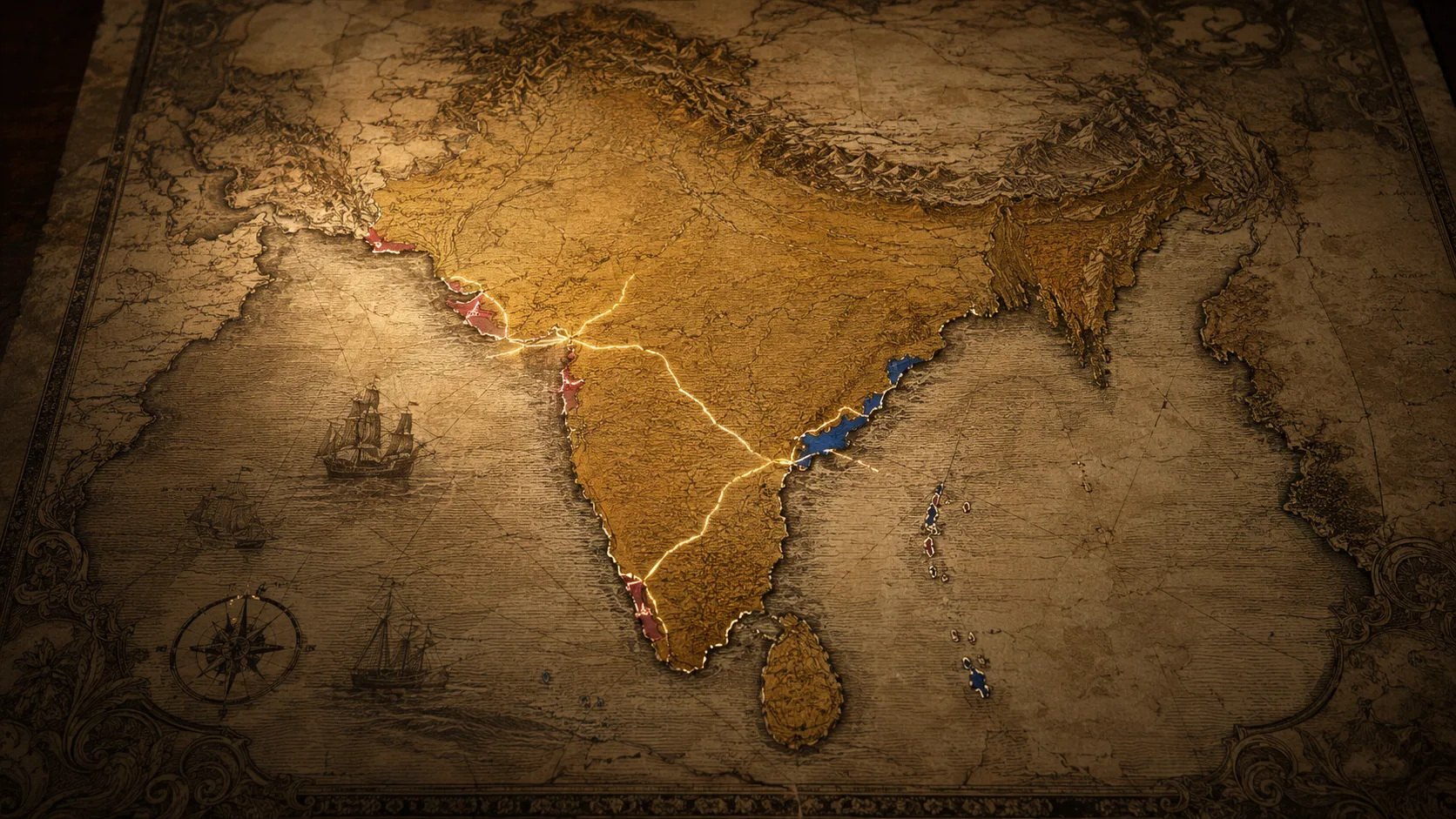
We are taught to remember the fifteenth of August 1947 as the day the land became whole again. It is a beautiful story, and it is not the whole truth. What happened that midnight was that one occupier departed — the largest, the most recent, the most thorough. But the British had never held all of Bhārata, and when they left, they did not clean up after the others. Scattered along the coasts of the subcontinent, like splinters left buried in a healing wound, sat pieces of sacred soil still flying foreign flags: French and Portuguese. Some had been held for four hundred and fifty years. And their masters had not the slightest intention of leaving.
This is the story of the fifteen-year afterword to independence — the slow, tricky, corner-by-corner labour of making the map of Bhārata match the truth of Bhārata. It is a story almost nobody under sixty was ever properly taught. It has villagers storming police stations at dawn, a bureaucrat crowned Prime Minister for twenty-four hours so that he could abolish his own country, a thirteen-minute naval gun-duel, and a single vote in New York that decided whether any of it would be allowed to stand. And underneath all of it runs a question that ought to make certain Western capitals lower their eyes in shame: who, exactly, was the foreigner here?
The Mess They Left Behind
What the British were doing while others sat on the land
To understand the tangle of 1947, you have to see what the British had quietly permitted for a century before it. When the East India Company and then the Crown consolidated their grip over the subcontinent, they did not bother to expel the smaller European powers already dug into the coastline. It was not principle. It was convenience. The French holdings were tiny and commercially spent; the Portuguese enclaves were ageing relics. Rather than spend blood and treaty-ink prying them loose, the British simply fenced them in — ringed them with British India and let them shrink into curiosities, ornamental fossils of an earlier age of European plunder.
So for a century the British played the landlord who lets the older squatters stay because eviction is more trouble than it is worth. And when the British themselves finally walked out the front door in 1947, they left every one of those squatters still sitting in the back rooms. Independence, then, did not arrive with clean edges. It arrived as a subcontinent whose coast was still studded with sovereign foreign territory — and handed a newborn, famine-haunted government the unglamorous job of finishing a decolonization the British had never troubled to complete.
Set aside here the drama of the princely states — Hyderabad, Junagadh, Kashmir. That was a different problem: Indian rulers choosing between India and Pakistan. What concerns us is stranger and more galling. These were not Indian princes haggling over accession. These were European nations still physically sitting on Indian soil years after the empire that had sheltered them was gone. Two of them remained: France, holding five scattered enclaves, and Portugal, holding Goa and its northern outposts. Their stories could not have been more different — one dissolved by the will of its own people, the other broken only by force.
The French Splinters
Five fragments, and the strange, uneven business of what the people actually wanted
France held five small, disconnected pieces, collectively the Établissements français dans l'Inde: Pondichéry (Puducherry) on the Coromandel coast, the capital; Karikal (Karaikal) to its south; Yanaon (Yanam) on the Andhra coast at the mouth of the Godavari; Mahé on the far-western Malabar coast; and Chandernagore, far to the northeast near Calcutta. One administration, stitched across a thousand miles of Indian land that was not France's.
Here we must be honest, because the truth is more interesting than the slogan. The people of these enclaves were not uniformly straining at the leash to join India. This is the part later nationalism tends to airbrush. After two or three centuries under France, a whole class of Indians in these towns had been made French — French-educated, French-speaking, French in law and often in loyalty. In Pondicherry a French India Socialist Party, openly pro-French, swept the 1948 municipal elections. In Yanam, the pro-French feeling was so entrenched that when the nationalist leader arrived to raise the flag of merger, his own friends and relatives warned him he would be captured or killed. The soil was Indian; the sentiment, in places, was genuinely divided. This is what makes the reclamation a real human story rather than a fairy tale — it had to be won, not merely proclaimed.
Chandernagore: the clean break
The Bengali enclave went first and went cleanly. A 1949 plebiscite returned a crushing verdict — roughly seven and a half thousand for union with India against barely a hundred against. It was handed over in 1950 and folded quietly into West Bengal. If they had all been Chandernagore, the story would be short. They were not.
Yanam: the dawn coup nobody remembers
Yanam is the episode that deserves to be famous and is not. In 1954, with negotiations in Delhi and Paris going nowhere, India's consul-general Kewal Singh delivered a piece of hard strategic advice to the pro-merger leaders: stop petitioning, and seize one of the enclaves outright to break the deadlock. The man who took up the task was Dadala Raphael Ramanayya — and his life is itself a rebuke to the idea that this was some elite affair. Orphaned at four, raised by his grandmother working in the fields of landlords for food, educated only because Catholic priests took him in, he had risen to become a nationalist organizer.
His first attempt failed hard. Arriving in Yanam in April 1954, he found the town thick with pro-French feeling and "no living signs of nationalism." He was ambushed by French police at the village of Farampeta, fired his revolver into the air, and escaped over a flood-bank back into Indian territory. Undeterred, he crossed to the neighbouring Indian town of Kakinada, bought armfuls of Congress flags, and went house to house building a movement from nothing.
In the pre-dawn dark of Sunday, 13 June 1954, he marched at the head of several thousand volunteers from Kakinada toward the French administrator's bungalow in Yanam. Walking fifty yards ahead of his own column with a megaphone, he called on the French police to surrender. They answered with grenades — which fell short and exploded harmlessly — and gunfire. The volunteers sheltered behind a zamindar's choultry and returned fire; four French policemen fell wounded; the rest bolted and locked themselves inside the police station, in fear of the crowd. Ramanayya surrounded them, disarmed them, and by morning the Indian tricolour flew over Yanam. The pro-French interim mayor was left the lone holdout. All India Radio announced the liberation. A provisional government was declared, with the orphan-boy from Farampeta at its head.
The last French administrator, George Sala, was recalled by the Governor-General in Pondicherry; rumours flew that France would send a cruiser to retake the town. It never came. But mark the discomfort even in victory: Nehru, ever the careful statesman, was actually annoyed that Indian police had been visibly involved, and wrote asking that any Indian hand be withdrawn. India wanted these enclaves, but wanted them to fall by the will of their people, not by an obvious shove from Delhi — a scruple that says something about the young republic's care for legitimacy.
Pondicherry, Mahé, and the vote at Kizhur
Through 1954 the pressure became unstoppable. In Mahé, on the western coast, volunteers marched on the administrator's residence. Village by village, commune by commune, the pro-French elite peeled away — even Edouard Goubert, once the pro-French strongman, switched to the merger camp. The decisive act came on 18 October 1954, at a referendum of elected representatives held at Kizhur near Pondicherry. Of 178 members, 170 voted to merge with India. Days later, on 1 November 1954, France transferred de facto control of all four remaining enclaves — a date Puducherry still honours as Merger Day.
France, being a democracy rather than a dictatorship, chose negotiation over defiance — but it did drag its feet on the legalities for years. The Treaty of Cession was signed in 1956 and only ratified by the French Parliament in 1962, with instruments exchanged on 16 August 1962. This is why, to this day, Puducherry marks its own de jure day on the sixteenth — one day after the rest of India's Independence Day.
Two flags: the afterlife that still walks the streets of Pondicherry
Here is the living tail of the story, the part that startles people who assume 1962 closed the book. The Treaty of Cession gave residents a choice: become Indian, or keep French nationality. Thousands chose France. They are called the renoncants — from "renounce," because to keep France they renounced India. And their choice did not die with them: it passes down by descent. To this day several thousand French citizens of Tamil and Telugu blood live in Puducherry — governed in matters of marriage and inheritance by the French Civil Code rather than Indian law, voting in French elections for French presidents, holding French passports on Indian soil. A 2017 documentary followed them literally choosing between French candidates from a town in Tamil Nadu. French remains an official language of the territory. A male renoncant may lawfully marry at an age Indian law would forbid, because the Napoleonic Code still governs him. The occupation ended in 1954; its citizens, in a sense, are still here — a soft, strange, permanent watermark left on the map.
And note the sting in that arrangement, still felt today: because India forbids dual citizenship, the descendants who kept French papers have no rights as Indian citizens in the land of their ancestors. In 2015 an association of these Indo-French elders took to the streets of Pondicherry protesting over nationality and voting rights. The enclave is gone; its human tangle endures.
The Portuguese Refusal
Four hundred and fifty years, a dictator's pride, and a forgotten little republic that governed itself for seven years
Portugal was another matter entirely, and a darker one. Where France was a foot-dragging democracy, Portugal was an authoritarian dictatorship under António de Oliveira Salazar, wedded to the fantasy of a single, global, pluricontinental Portugal reaching from Europe across Africa to India. Salazar did not classify Goa as a colony. He called it an "overseas province" — an integral limb of the nation. To surrender it was, in the regime's theology, to amputate Portugal itself.
Beneath the theology sat cold arithmetic. Portugal held vastly richer colonies in Africa — Angola, Mozambique, Guinea — where liberation wars were igniting in 1961. To let Goa go peacefully would be to concede that the whole empire was negotiable. So Salazar could not bargain. For him it was all or nothing — and he was prepared to make it nothing.
Diplomacy therefore died. Portugal fired on unarmed satyagrahi marching into Goa in 1955. Portuguese guns fired on Indian fishing boats and on the tiny island of Anjidiv. India closed its consulate in Panjim in 1955 and imposed an economic blockade. And still, for fourteen years, Lisbon sat immovable on Indian soil.
Dadra and Nagar Haveli: the republic that ran its mail through Vapi
But the people did not all wait for Delhi. In 1954 — the same year the French enclaves fell — a remarkable thing happened in two landlocked Portuguese specks north of Goa: Dadra and Nagar Haveli, seventy-two villages wedged between what are now Maharashtra and Gujarat, held by Portugal since a 1779 treaty with the Marathas. Volunteers of nationalist organizations, together with local residents, simply took them. On the night of 22 July they overran the police station at Dadra. By 2 August the capital, Silvassa, was liberated as the Portuguese administrator fled without a fight. The Portuguese flag came down; the tricolour went up.
What followed is one of the strangest, most charming footnotes in the whole saga of Indian unification. For seven years, this liberated pocket governed itself — a tiny de facto republic called Free Dadra and Nagar Haveli, run by a council, the Varishta Panchayat. Cut off from India's postal system on paper, it routed its mail through the Indian border town of Vapi; it overprinted leftover Portuguese stamps with the words "LIBERATED AREAS." A speck of land, self-ruled, in the seam between colony and country.
And here the law itself sided with the occupier — a fact worth sitting with. Portugal took India to the International Court of Justice, and in 1960 the Court ruled that Portugal retained legal sovereignty over the enclaves (though India was entitled to deny Portuguese troops passage across Indian soil to reach them). The highest court of international law had, in effect, declared the Indian villagers' liberation of their own land illegitimate.
India's answer was quiet and surgical. When the little territory's council voted in 1961 to join India, an Indian civil servant named Kishinchand Gobindram Badlani, who had been administering it, was for a single day designated the Prime Minister of Free Dadra and Nagar Haveli — so that, as a head of government meeting a head of government, he could sign the instrument of merger with Nehru. A man was made sovereign of a nation for one day, purely so that the nation could lawfully dissolve itself into Bhārata. On 11 August 1961, it was done. Dadra and Nagar Haveli was the rehearsal. Goa would be the reckoning.
Operation Vijay
Thirty-six hours, hour by hour, to end four and a half centuries
By late 1961, diplomacy was ash and Salazar was granite. In October the decision was taken: force. The plan bore the name Operation Vijay — Vijaya, "Victory," in Sanskrit. The final trigger came on 24 November 1961, when Portuguese troops on Anjidiv island fired on the passenger steamer Sabarmati, killing a passenger and wounding the chief engineer. On 10 December, Nehru told the press plainly: the continuance of Goa under Portuguese rule was an impossibility. Washington's response was to warn India that if the matter reached the UN Security Council, it could expect no American support. That warning would matter enormously in seventy-two hours' time.
The forces
The land assault fell to Major General K. P. Candeth's 17th Infantry Division, with the elite 50th Parachute Brigade under Brigadier Sagat Singh attached, all under Lt Gen J. N. Chaudhuri of Southern Command. The Air Force under Air Vice Marshal Erlic Pinto flew from Pune and Sambre. The Navy threw a full blockade around the coast, centred on the light aircraft carrier INS Vikrant, positioned to head off any amphibious counter or foreign intervention. Against this stood a Portuguese garrison that Salazar's own generals had already written off: reduced from 12,000 men in 1954 to fewer than 4,000 by 1960, with a single ageing warship, the sloop Afonso de Albuquerque, and three small patrol boats. In 1960 Portugal's own Army Minister had called sustained resistance "a suicide mission in which we could not succeed." Salazar ordered it anyway.
The order to burn Goa down
On 14 December, Salazar cabled Governor-General Manuel António Vassalo e Silva a monstrous instruction: fight to the last man and the last bullet; hold out at least eight days while he sought international rescue; and, failing that, destroy Goa rather than surrender it — a scorched-earth command to immolate a four-and-a-half-century-old land and its people for the vanity of a regime five thousand miles away. Remember this order when you next hear that the "invasion" was the act of aggression.
The thirty-six hours
1 December — Indian frigates INS Betwa and INS Beas begin patrolling the Goa coast; "Operation Chutney," the naval precursor, opens to secure shipping and prepare the taking of Anjidiv island.
17 December — Preliminary ground moves; the border town of Maulinguem is taken. A reconnaissance Vampire over Dabolim airfield draws anti-aircraft fire — the gun later found jammed, a round stuck in its breech, a small emblem of the whole mismatched fight.
18 December, first light — The main assault opens. Sagat Singh's paratroopers drive the northern thrust in three columns toward the capital, Panaji; the 63rd Infantry Brigade pushes from the east on the Ponda axis; a battalion feints from the south. IAF strikes begin; the Dabolim runway is cratered but deliberately left repairable. Indian sailors raise the tricolour over Anjidiv — the first time in that outpost's colonial history.
18 December, around noon — The war's sharpest moment. Off Mormugao harbour, the lone Portuguese sloop Afonso de Albuquerque — now the sole naval defence, tasked with keeping Lisbon's radio link alive after airstrikes destroyed the shore station — is engaged by INS Betwa and INS Beas under Commander Rusi Ghandhi. Between salvoes from their radar-directed 4.5-inch guns, the Indians tapped out surrender demands in Morse code. Outgunned — four slow 120mm guns against modern rapid-firing frigates — the Afonso lifted anchor, turned, and fought back. In roughly thirteen minutes her steering was wrecked; she took some four hundred rounds, turned 180 degrees, and ran aground burning on Bambolim beach. Her wounded captain evacuated his crew to the sand.
18 December, evening — Margao and much of southern Goa fall. Indian columns close on Panaji from multiple axes; Portuguese units blow the Borim bridge behind them as they retreat.
19 December — Dabolim airport and the Mormugao port town are taken by evening. More than two thousand Portuguese troops, cornered at Vasco da Gama, do not fight to the last man. At 20:30 on 19 December, Vassalo e Silva — defying Salazar's order to burn the land — signs the instrument of surrender.
It was over in some thirty-six hours. Four hundred and fifty-one years of Portuguese rule ended at the cost of roughly 22 Indian and 30 Portuguese lives — a mercifully small toll, made small precisely because the Governor-General had the conscience to disobey a tyrant. There is a grace note worth keeping: the Indian frigate captains, Ghandhi among them, later visited the wounded Portuguese commander Aragão as he lay recovering in a bed in Panaji. Victors calling on the vanquished. This was liberation, not vengeance.
Shame, Shame, Shame
On the breathtaking gall of calling this "aggression"
And now to the outrage — because it deserves to be named plainly. When Goa was freed, Portugal cried "invasion." Britain and the United States moved to condemn India at the United Nations. Portugal, a founding member of NATO, wrapped itself in the language of international law and territorial sovereignty. Let us hold that claim up to the light and ask the only questions that matter.
Who came across the ocean, uninvited, to this land? Who arrived at Calicut in 1498 and repaid the welcome with the cannon? Who stormed Goa in 1510 under Afonso de Albuquerque — the very man whose namesake sloop we just watched burn — and planted four and a half centuries of foreign rule by the sword? Who ran the Goa Inquisition? Who sat, thousands of miles from Lisbon, on soil to which they had not the faintest ancestral claim, and called it a "province of Portugal"? And who, in 1961, dared to stand at the world's podium and accuse the rightful people of that soil of "aggression" for the crime of walking home?
To call India's reclamation of Goa an "invasion" is to call the returning owner a burglar while the actual burglar, caught in the kitchen after four hundred years, demands the protection of the law.
The hypocrisy runs deeper still, and it is worth saying without flinching. These were the powers of empire — nations whose wealth was quarried out of other people's countries, whose museums are furnished with looted stone, whose maps were drawn in other peoples' blood. And it is these nations, and their descendants, who now most love to lecture the formerly colonized on democracy, on equality, on the rules-based order, on human rights. The lecture might land better had the lecturer first returned what he took. There is no aggression in a people reclaiming their own home. The aggression happened in 1498, and in 1510, and in every year of occupation thereafter. December 1961 was not the crime. It was the end of the crime.
The Raised Hand
How the veto was possible — and the friendship, born of famine and steel, that lay behind it
Winning Goa on the ground took thirty-six hours. Keeping it was decided in a chamber in New York — and to understand how, you must understand a friendship that had been quietly built over the previous six years.
On 18 December 1961, as Indian troops moved through Goa, the United States brought a draft resolution before the UN Security Council demanding that India cease fire and withdraw — in effect, hand Goa back to Portugal. And it had the votes: the Western draft carried a seven-to-four majority. In any ordinary vote, seven beats four. By that count, the highest body of the world was about to order Bhārata to restore a colonizer to her own coast.
It did not happen — because the Security Council is not a democracy of equals. Five nations, the victors of the Second World War, hold permanent seats, and with them an absolute veto. Any one of the five can kill any resolution with a single "no," no matter how many others vote yes. Seven votes, ten votes — it makes no difference. This is the Yalta formula, written into Article 27 of the Charter at the UN's founding as the price the great powers demanded for joining at all. On that December day, one of the five raised its hand against the Western resolution. The Soviet Union cast its veto. The seven-to-four majority collapsed into nothing. No lawful order to return Goa was ever issued. The liberation held.
Goa was won by Indian arms — but preserved by a Russian hand.
Why did Moscow spend a veto on Bhārata? Not from sentiment — the Cold War ran on interest, not affection — but the interest had by then grown into something that genuinely resembled friendship. And that is the story worth telling, because it is the real answer to "how was the veto possible."
From Stalin's cold shoulder to a feast of friendliness
It had not always been so. Under Stalin, Moscow regarded Nehru's India with suspicion — a bourgeois democracy, too friendly with the West, not a true revolutionary state. The thaw began only with Stalin's death in 1953. His successors — Malenkov, Bulganin, and above all Nikita Khrushchev — grasped something Stalin had missed: that the newly decolonized nations of Asia and Africa were the great prize of the Cold War, and that India, leader of the non-aligned world, was the prize's centrepiece. Stalin's rule of "who is not with us is against us" gave way to a shrewder one: "who is not against us is potentially with us."
In June 1955, Nehru made his first official visit to the USSR, and was received as no foreign leader had been — the entire Politburo at the airport, open limousines through Moscow, crowds in the streets. That autumn, Khrushchev and Bulganin returned the visit and were met in India by crowds of literal millions — a reception Nehru called a "feast of friendliness." And here is the detail that ties this entire essay together in a single knot: on that 1955 visit, standing on Indian soil, Khrushchev publicly declared Soviet support for Indian sovereignty over Kashmir — and specifically over Goa. The veto of 1961 was not an improvisation. It was a promise made in public six years earlier, and kept.
Why each side needed the other
The friendship grew because it answered a real need on both sides. For India, Western help came with a price tag written in humiliation: the United States was arming Pakistan, pressing India to compromise on Kashmir, and using food aid as leverage. When India needed to industrialize, Western capital shied away from funding state-owned heavy industry. The Soviets stepped into exactly that gap. The flagship was the Bhilai Steel Plant, agreed in 1955 — not a mere loan but a full transfer of technology, the seed of India's public-sector industrial base, followed by Bokaro and dozens of plants in metallurgy, energy, and machine-building. Crucially, this aid came, in the words of one historian, "without the political strings" the West attached — no demand to privatize, no demand to pick a side, no quiet pressure on Kashmir. And where the West would later deny India the technology to build the MiG-21 fighter, Moscow handed it over.
For the Soviets, India was a triple opportunity: a vast non-aligned nation to be kept from drifting into the American camp; a diplomatic partner in every global forum; and, after the Sino-Soviet split, a strategic counterweight to a hostile China on their southern flank. When the West aligned with Pakistan, the logic only sharpened. Protecting India at the UN cost Moscow little and won it the goodwill of the largest democracy in the decolonizing world.
So when the hand went up in New York in December 1961, it was not charity and it was not whim. It was the harvest of six years of steel mills and state visits and public promises — a relationship that would deepen through the 1965 war, in which Soviet Premier Kosygin brokered the peace, and reach its apex in the 1971 Treaty of Peace, Friendship and Cooperation, when a Soviet naval flotilla shadowed the American carrier Enterprise into the Bay of Bengal and gave India the cover to finish the liberation of Bangladesh. The veto over Goa was the first great gift of that friendship. It would not be the last.
It is a sobering thing to hold. The final removal of the last European occupier from the soil of Bhārata was won by Indian soldiers — and then guarded, in its last and most vulnerable hour, by the raised hand of a distant power in a room India did not control. Such is the nature of sovereignty in an unequal world: it must be seized by one's own strength, and then it must be defended in chambers built by others, with the help of whatever friends one has managed to make. In 1961, at the one table where Goa could have been lost, India had exactly one friend among the mighty — and that friend stood firm.
The Map Made Whole
What it truly cost to finish what 1947 began
Portugal, like the dictatorship that ruled it, refused reality. It would not recognize Indian sovereignty over any of it — clinging for thirteen more years, keeping "occupied provinces" symbolically seated in Lisbon's assembly. Only in 1974, after the Carnation Revolution finally overthrew the regime, did a free Portugal at last acknowledge what had been true since 1961.
Step back and see the whole shape of it. The British left in 1947 and were praised for a clean handover. But the map they left was not clean — it was pierced. French splinters on three coasts, some of whose people did not even wish to leave France. Portuguese relics on two more. A self-governing republic routing its post through a border town and overprinting its stamps by hand. A World Court ruling that the occupier, not the villager, held the law. Every corner had its own tangle; every enclave its own referendum, its own uprising, its own peculiar path home. There was no single stroke that healed it. There was Chandernagore's plebiscite, and Kizhur's vote, and the orphan Ramanayya walking ahead of his column into grenade-fire at Yanam, and Badlani's one-day premiership, and the thirteen-minute gun-duel off Mormugao, and — at the very last — a hand raised in New York by a friend made over steel and famine.
It took from 1947 to 1962 to make the map of Bhārata finally tell the truth. This is the part the tidy version omits: that independence was not a moment but a labour; that the wounds the invaders left did not close on their own; and that the whole, unbroken body of the land we know today was reassembled, corner by patient corner, in the fifteen hard years after the celebrations had already ended.
The invaders came uninvited across the sea. They took by the sword. They lingered for centuries past any welcome, and when at last they were made to go, they called their eviction an outrage and their theft a right. It fell to a poor, newborn republic — drafting a constitution, fighting famine, holding a fractured people together — to do the unglamorous work the empires had refused: to gather up every scattered fragment of sacred soil and make Bhārata whole again. That labour — not merely the midnight of 1947 — is what her wholeness cost. And the next time a former empire clears its throat to lecture her on freedom, she is entitled to remember exactly who walked home in December of 1961, and who was finally shown the door.