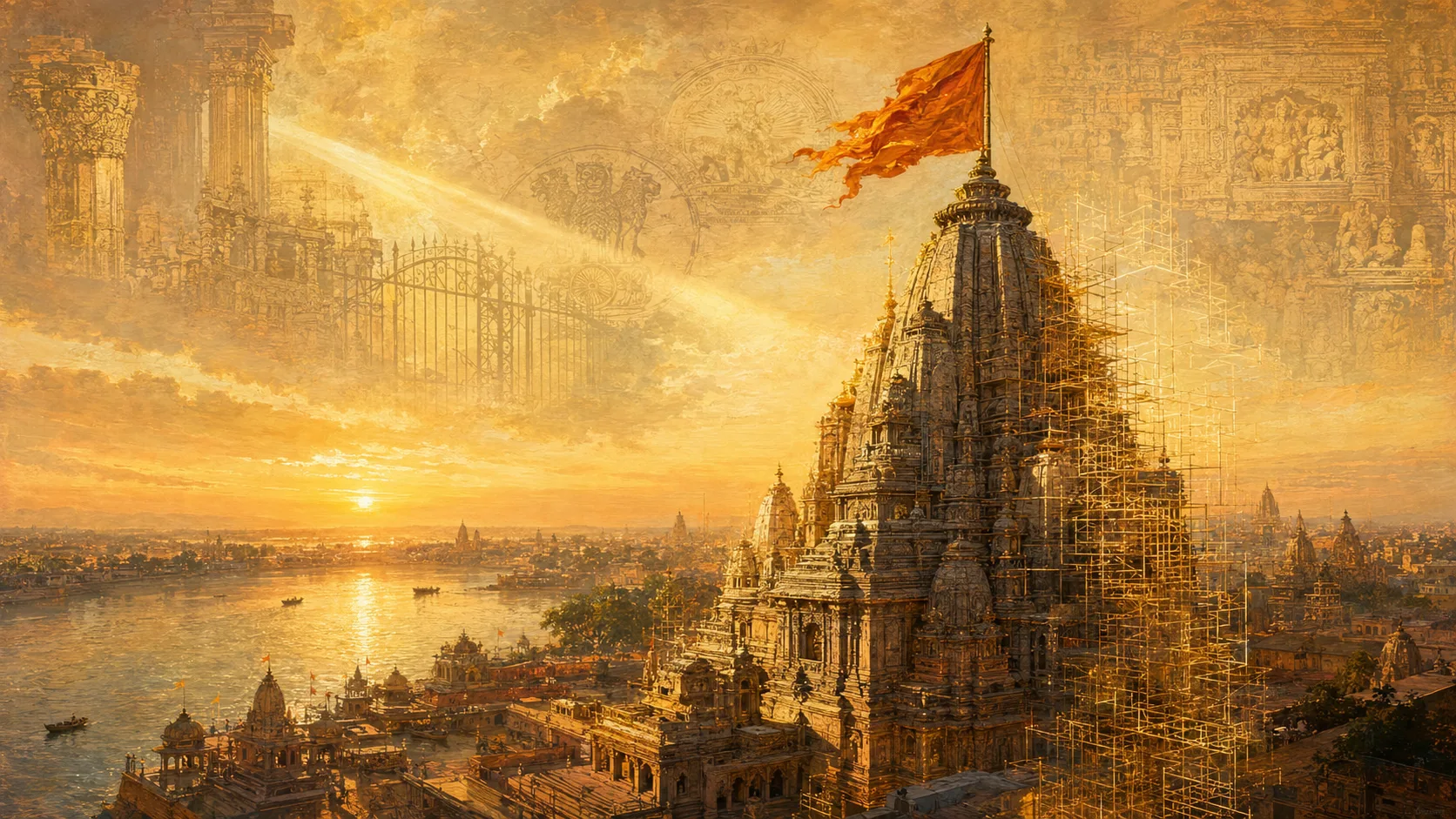
There is a kind of patience that no chronicle of nations has ever quite recorded. Not the patience of a people waiting out a winter, or a dynasty biding its time before a campaign. Something stranger and far longer — a patience measured not in reigns but in centuries, carried not by a state or an army but by an unbroken thread of memory that refused, generation after generation, to forget where a child was said to have been born.
On the banks of the Sarayū, in the city the Ikṣvāku kings called their own, that memory held for nearly five hundred years against every instrument an empire could bring against it. It was buried under a mosque, fenced off by the British, locked behind iron gates by an independent republic, and shot at by the police of a constitutional state. It was declared lost, declared illegitimate, declared a fiction of communal fervour. And still it held — until, in a courtroom in New Delhi in November 2019, the highest court of the Indian republic found that the people who had never stopped believing had, in the language of evidence and law, been right all along.
This is the story of that vow. It is the longest continuous civilizational litigation in recorded human history — first as faith, then as fire, and finally as law. And it is worth saying plainly at the outset why it has no real parallel anywhere on earth.
A note on what this essay is and is not. This is a work of civilizational history written from within the Sanātana tradition that sustained the struggle. It does not pretend to the false neutrality that treats the destroyer and the dispossessed as morally equivalent. It does, however, hold itself to a strict standard of fact: every date, suit number, and finding below is drawn from the public record, including the Supreme Court's own 1,045-page judgment. Where scholars dispute the evidence, that dispute is named, not hidden.
I. The City Older Than Memory
Before the wound, there was the city. And to understand what was taken at Ayodhyā in 1528, one must first understand what Ayodhyā was — for the thing the conqueror tried to overwrite was not a provincial shrine but one of the oldest continuously sacred sites in the living world.
The name itself is a vow. A-yodhyā — "that which cannot be warred against," the unconquerable, the citadel no army can take. The Vālmīki Rāmāyaṇa, composed in its formative layers somewhere between the seventh and fourth centuries before the common era, opens by describing it as a divinely ordered city on the southern bank of the Sarayū: broad avenues, towering palaces, fortified gates, a people excelling in governance and trade and the martial arts, the capital of the Ikṣvāku kings and the birthplace of Rāma, son of Daśaratha, seventh descent of Viṣṇu. This is not a vague legend dropped into later texts. It is the structural foundation of the epic, the still point around which the whole Rāmāyaṇa turns.
And the sanctity was never confined to one text or one sect. The Skanda Purāṇa, largest of the eighteen Mahāpurāṇas, devotes an entire section — the Ayodhyā-Māhātmya — to the city, naming it among the seven mokṣa-purīs, the seven cities in all of Bhārata where death or pilgrimage grants liberation from the wheel of rebirth. The verse that fixes them is known to every traditional Hindu:
Ayodhyā Mathurā Māyā Kāśī Kāñcī Avantikā | / Purī Dvārāvatī caiva saptaitā mokṣadāyikāḥ ||
Ayodhyā, Mathurā, Māyā (Haridwār), Kāśī, Kāñcī, Avantikā (Ujjain), and Dvārakā — these seven are the givers of liberation. Ayodhyā does not merely appear on the list. It heads it. And the Skanda Purāṇa is precise in a way that matters enormously to what came later: it refers explicitly to the Rāma-janmasthāna — the birthplace — and prescribes the circuit of tīrthas a pilgrim must walk, promising that one who bathes at the Svargadvāra and worships at the Rāma temple has fulfilled his whole duty and has nothing left undone.
So the reverence for this specific place as the birthplace, with a temple upon it, is attested in the sacred literature centuries before Bābur was born.
What the spade found. The textual antiquity is matched by the ground itself. Excavations across the twentieth century — by Alexander Cunningham (1862–63), by A.K. Narain of Banaras Hindu University (1969–70), by the eminent B.B. Lal (1975–76) — established that the site of Ayodhyā has been continuously inhabited since at least the fifth century BCE, with the glossy Northern Black Polished Ware of the Mahājanapada age lying in its strata, the pottery of India's second urbanization. This was no mythical never-place. Kosala, with Ayodhyā as its capital, was one of the sixteen great mahājanapadas of ancient India. The city was a seat of Vedic, Buddhist, and Jain learning alike — so revered across Asia that the kings of Siam named their own capital Ayutthaya in its honour, a Thai echo of the Sanskrit "unconquerable" that survives on the map to this day.
This, then, is what stood at Ayodhyā: not a building that could be replaced, but a node in the sacred geography of a civilization — a place woven into Purāṇa and pilgrimage, epic and liberation-theology, the imagination of Hindus from Kashmir to Rāmeśvaram and of Buddhists from Ayodhyā to Ayutthaya. To grasp the magnitude of what was attempted in 1528, one must hold this in mind. The conqueror did not aim at a shrine. He aimed at the unconquerable city itself — and at the proposition that it could be conquered after all.
II. The Wound: 1528
The fact around which everything else turns is brutally simple. Sometime around 1528, in the early years of Mughal rule in Hindustan, a mosque was raised at Ayodhyā on a spot that Hindus had for untold generations revered as the birthplace of Rāma — Rāma Janmabhūmi, the Janmasthāna. The structure came to be called the Babri Masjid, after the first Mughal emperor, Bābur, on whose order it was built; the work itself is attributed to his commander, Mīr Bāqī.
The mosque carried an inscription naming Bābur and the year. It stood, in the heart of one of Hinduism's seven holiest cities, as a permanent statement: that the conqueror could plant his house of worship precisely where the conquered held their God to have entered the world.
What was taken at Ayodhyā was not a building. It was a claim about who Bhārata belonged to — and the answer the Sanātana civilization gave, across five centuries, was that it belonged to its own.
It is essential to be clear about the historiography here, because a great deal of effort has gone into muddying it. The editorial position of this publication is unambiguous and is grounded in the documentary and archaeological record rather than in sentiment: the Vedic and Purāṇic tradition that revered Ayodhyā as Rāma's birthplace was native to the soil, not an import; the mosque was raised by an invading power; and the continuity of Hindu worship at the site was never genuinely broken, only obstructed. The Supreme Court of India, after examining the evidence at exhaustive length, would arrive at conclusions strikingly consonant with this — finding that Hindus had furnished the better evidence of continuous worship, and that the structure beneath the mosque was not Islamic in character.
Consider for a moment the audacity of the original act, and its calculated meaning. Bābur had crossed the Khyber not as a settler but as a conqueror, and the mosque at Ayodhyā was, in the grammar of conquest that the Indo-Islamic sultanates had practised for three centuries before him, a statement written in stone. The temple-breaking of Mahmūd of Ghazni at Somnāth — seventeen times, by tradition, the great Śiva shrine looted and razed — the desecrations at Mathurā, the birthplace of Kṛṣṇa, and at Kāśī, the eternal city of Śiva, where Aurangzeb would later raise the Gyānvāpī mosque over the Viśvanātha temple; the systematic conversion of the sacred geography of Bhārata into a map of dominance — Ayodhyā was of a piece with all of it. The pattern was neither accidental nor incidental. The historian Meenakshi Jain has shown that the very choice of these sites was deliberate: the conqueror did not build on vacant ground when a sacred Hindu site was available, because the entire point was the overwriting. At Sambhal, a Babur-era mosque rose where Hindu tradition held the final Kalkī avatāra would appear; the place had been known as Hari Mandir. To raise a mosque on the Janmasthāna of Rāma was not an act of devotion in a vacuum. It was a message: your God was born here, and here we have placed ours over him.
There is a haunting detail that the local memory preserved and that the scholarship later confirmed. Oral tradition held that the pīr who incited Bābur to the demolition was one Fazl Abbās, called Mūsā Āshikhān, and that his grave at Ayodhyā is marked by two temple pillars — kasauti stones identical to the fourteen built into the Babri mosque itself, driven upside-down into the earth beside his tomb. The instruments of the desecration and the relics of the temple lay, quite literally, side by side, for anyone willing to read the ground.
The Sanātana civilization received that message. And here is the first thing that distinguishes this story from the ordinary fate of the conquered: it did not accept it. Across most of the medieval and early-modern world, when a dominant power overwrote a sacred site, the memory of what had stood there faded within a generation or two into legend, then into nothing. The conquered forgot, because forgetting was the price of survival. At Ayodhyā, the conquered did not forget. The very specificity of the loss — this spot, the Janmasthāna, the place of the birth — was transmitted intact, parent to child, pilgrim to pilgrim, century to century, with a fidelity that the eventual courts would find astonishing.
That, however, is to leap ahead by five centuries. The remarkable thing is what happened in between.
III. The Memory That Would Not Die: 1528–1857
Empires assume that what they build will outlast what they destroy. The Mughals were no exception. And yet from almost the moment the mosque went up, the record shows a population that simply refused to accept the substitution.
The Marāṭhā powers, at the height of their ascendancy in the eighteenth century, are recorded as having demanded Ayodhyā — along with Kāśī and Mathurā, the other two great wounded cities — from the Nawab of Awadh in 1751 and again in 1756. The third battle of Pānipat in 1761 broke Marāṭhā power before that demand could be pressed home, but the demand itself tells us something: the reclamation of these three sites was already, two and a half centuries before independence, an explicit civilizational objective, not a modern invention.
The colonial-era documentary trail is even more striking. In 1822, an official of the Faizabad court named Hāfizullāh recorded that the mosque had been built by Bābur on the birthplace of Rāma, beside the Sītā Rasoī. This is a Muslim official, in a formal record, stating the matter as established fact. The same understanding surfaces in the Hanumāngarhī clashes of 1855, when, by the report of the British officer Outram to Nawab Wajid Ali Shah, Hindus led by Nāgā sādhus and bairāgīs secured the Janmasthāna. A year later, the chronicle Hadīqa-i-Shuhadā records an armed attempt on the Janmabhūmi.
But the single most remarkable witness from this long middle passage is a European — and almost no popular account of Ayodhyā mentions him. Joseph Tieffenthaler was an Austrian Jesuit, one of the earliest serious European geographers of India, who spent some four decades wandering the subcontinent and visited Ayodhyā around 1767. His account, written in Latin and published in French in 1788, is the earliest European description of the site — and it is devastating in its matter-of-factness, because Tieffenthaler had no stake in any of this. He recorded that the fortress and the house held by Hindus to be Rāma's birthplace had been demolished and a triple-domed mosque raised in its place; that fourteen black stone pillars stood at the site. And then he described what the Hindus were doing there, in his own time, despite everything:
They called a spot the Bedi — "the cradle" — because, he wrote, it was the house where Rāma was born with his three brothers; and although the Mughals had razed the place to stop their devotions, the Hindus still came, circling the spot three times and prostrating themselves on the ground, and gathering in great crowds from across India every year on the ninth of Chaitra to celebrate the birth of Rāma.
That is an outside observer, in 1767, recording an unbroken cult of the birthplace — the circumambulation, the prostration, the Rāma Navamī festival — being practised on the very ground of the mosque, two and a half centuries after the demolition and two centuries before the verdict. The Supreme Court would cite Tieffenthaler by name in 2019. The cradle had never been empty.
The deity who already owned the land. There is a still earlier and stranger record. In 1717 the Rajput king Sawāī Jai Singh II of Amber — astronomer, city-builder of Jaipur — quietly acquired land around the Janmasthāna and established a Jaisinghpura there. The documents survive in the Kapad-Dvāra collection of the Jaipur City Palace, studied by Professor R. Nath, and they include a 1723 note recording that the new establishment had removed the impediments Muslims had placed on Hindus bathing in the Sarayū. Most striking of all: in Jai Singh's arrangement, the ownership of the sacred land was vested in the deity himself. Two and a half centuries before the Supreme Court recognized Rāma Lallā as a juristic person who could own property, a Hindu king had already deeded the Janmasthāna to God as its legal owner. The idea that won in 2019 had been law on the ground in 1717.
Why this period matters. The standard secular framing treats the Janmabhūmi claim as a creation of late-twentieth-century politics. The record refutes this completely. The belief, the demand, and the willingness to fight for the site are all documented across the eighteenth and nineteenth centuries — in Marāṭhā diplomacy, in Mughal-era court records, in British military reports. The twentieth-century movement did not invent the memory. It inherited it.
By the time the British formally fenced the site in 1859 — erecting a railing to separate a Muslim place of worship from an outer courtyard where Hindus were permitted to worship — they were not creating a dispute. They were freezing one that was already more than three hundred years old.
IV. The Warrior-Monks Who Held the Ground
Here we must pause to honour the party that the grand narrative treats as a footnote and that the final verdict, in a bitter irony, left empty-handed — yet without whom there would have been no ground left to litigate. For across the centuries between the demolition and the modern movement, the Janmabhūmi was not held by a political party or a court filing. It was held, physically, by sādhus.
The Nirmohī Akhāṛā — the "order without attachment" — is a monastic fighting brotherhood of the Rāmānandī Vairāgī tradition, the Vaiṣṇava ascetics who take Rāma as their deity. They trace themselves to the bhakti teachings of Rāmānanda; the akhāṛā as an organized armed body was established in Ayodhyā around 1720, when, at a great Rāmānandī conclave at Galtā near Jaipur, the sect resolved to raise military wings to defend its shrines, and one Govindadās founded the first Rāmānandī akhāṛā in Ayodhyā. These were not gentle mendicants. New recruits, often boys in their teens drawn from any caste, were drilled in the Vedas and Upaniṣads and in archery, swordsmanship, and wrestling. Their mandate was explicit: to protect the devotees of Rāma and the places sacred to him, by force where force was needed.
While kings negotiated and courts deliberated, it was these armed monks — celibate, casteless, trained to the bow and the sword — who actually stood on the ground at Ayodhyā and would not be moved. The vow had a body, and the body wore saffron.
It was the Nirmohīs and their fellow Rāmānandīs who, in the Hanumāngarhī conflicts of the 1850s, fought to hold the Janmasthāna; it was they who maintained the worship at the Rāma Chabūtrā and the Sītā Rasoī through the long colonial freeze; it was their claim of śebaitship — the right, under Hindu law, to manage the deity's shrine and property as its servant-custodian — that anchored the Hindu legal position. The akhāṛā insisted, across all its filings, that there had never truly been a functioning mosque there at all; that the site was a temple held in unbroken Hindu charge "from time beyond the memory of man." When the Nirmohīs filed their suit in 1959, seeking restoration of their management of the inner court, they were not opening a new claim. They were formalizing a custodianship they said reached back, by their own account, some seven centuries.
The custodians who won everything and received nothing. Here is the cruelest irony in the whole legal saga. In 2019, the Supreme Court awarded the entire site to the deity Rāma Lallā — the very deity the Nirmohī Akhāṛā had guarded for generations — and yet it dismissed the Akhāṛā's own suit as barred by limitation and ruled that it held no śebait rights at all. The warrior-monks who had physically kept the ground, fought for it, worshipped on it across the centuries, were told in law that they were neither owners nor even the deity's recognized managers. The Court did direct that the Akhāṛā be given representation on the temple's board of trustees — a consolation. But the deeper meaning stands: the sādhus held the Janmabhūmi for so long, and so selflessly — the "order without attachment," true to its name — that when the prize finally came, it went to God, and not to them. They had never been fighting to own it. They had been fighting to give it back to Rāma. And that, in the end, is exactly what happened.
V. Into the Courts: 1885
Here the story takes the turn that makes it unique in world history. For when the avenue of force was closed by colonial power, the Sanātana side did something that almost no dispossessed sacred community anywhere has sustained for so long: it went to court, and it never left.
On 29 January 1885, Mahant Raghubar Das, describing himself as Mahant Janmasthān, filed suit in the court of the Sub-Judge at Faizabad. He sought permission to build a temple over the Rāma Chabūtrā — the raised platform in the outer courtyard, seventeen feet by twenty-one — which bore the Charaṇ Pādukā and a small shrine already in worship. He asked for very little: not the mosque, not the inner sanctum, merely the right to roof the platform where pilgrims already prayed.
The judgment that came back on 24 December 1885 is one of the most quietly devastating documents in this entire history. The Sub-Judge accepted the Hindus' possession and ownership of the chabūtrā. He acknowledged the idol of Ṭhākurjī in worship there, the offerings taken by the mahant, the long-standing railing. And then he refused permission to build — not because the Hindu claim was weak, but because, in his words, a temple beside the mosque might "lead to great conflict resulting in a massacre of thousands."
"It is most unfortunate that a masjid should have been built on land specially held sacred by the Hindus, but as that event occurred 356 years ago, it is too late now to remedy the grievance."
That sentence, written by a colonial judge in 1885, is the hinge of the whole tragedy. The wrong was admitted. The remedy was denied — on grounds of public order and the passage of time. The appeals that followed, Civil Appeal No. 27 in 1886 and a second to the Judicial Commissioner's court, were dismissed on the same logic. The district judge, F.E.A. Chamier, even visited the disputed site in person before ruling — and recorded that he had seen the chabūtrā in Hindu possession, the idol worshipped upon it. The colonial judiciary, in other words, looked directly at the evidence, described it accurately, and then declined to act on it. This became the British pattern at Ayodhyā: acknowledge the Hindu sacred claim, document it meticulously in gazetteer and judgment, and then freeze the status quo to keep the peace. The grievance was filed, stamped, and shelved — but never, crucially, erased. Each colonial record that admitted the temple's prior existence became, decades later, a brick in the evidentiary wall the Hindu side would finally raise in 2019.
The deep continuity the British recorded. The 1885 suit did not arise from nowhere. The site had already seen open conflict: in 1855, communal clashes around the Hanumāngarhī had ended with Hindus, led by Nāgā ascetics, holding the Janmasthāna; the British response was to erect a railing in 1856–57 dividing inner from outer courtyard. And in an 1858 petition, the very muazzin of the mosque complained that Hindus had been worshipping in the precinct for generations — while a police report of the same year recorded a Nihang Sikh performing havan inside the structure. By the time Raghubar Das filed his suit, the documentary record of Hindu worship at the site under colonial eyes already stretched back three decades, and the living memory of it indefinitely further. The British did not discover a dormant claim. They administered a live one.
The lesson the Hindu side drew from 1885 was not despair. It was procedure. The grievance was real; the courts had said so in writing. What remained was to keep the case alive — to never let the file close, never let the claim lapse, never concede in law what had never been conceded in faith — until a court would, at last, also grant the remedy. That resolve would have to last another 134 years. It is worth pausing on that number, because it is the heart of what makes this history singular. One hundred and thirty-four years is longer than most nations have existed in their current form. It is four, five, six generations of plaintiffs, advocates, and witnesses, each inheriting a case file from the dead and handing it on to the unborn. No other civil litigation in the recorded history of any legal system has run so long on a single continuous question — and won.
VI. The Idol Appears: 1949
For decades the matter lay, in the words of one chronicler, in suspended animation. Then, on the night of 22–23 December 1949, the idols of Rāma Lallā — the infant Rāma — appeared beneath the central dome of the mosque itself.
The accounts of how they came to be there differ, and this publication does not pretend the question is simple; the prevailing Hindu understanding held it a divine manifestation, while others recorded it as a placement by devotees. What is not in dispute is what followed. Hindu worshippers poured toward the site. The local administration, to keep order, declared the area disputed, attached it under Section 145 of the Criminal Procedure Code, and locked the gates — with the idols inside.
The documentary trace of that night survives, and it is worth reading. On the morning of 23 December 1949 a constable named Mata Prasad — under the station officer Ramdeo Dubey — lodged a First Information Report at the Ayodhyā police station. Stripped of legalese, it recorded that a group of some fifty to sixty persons had broken the locks of the compound, scaled the walls, placed an idol of "Śrī Bhagavān" beneath the central dome, and scrawled figures of Sītā and Rāma in saffron and yellow on the inner and outer walls — and that by dawn a crowd of five to six thousand had gathered, chanting bhajans, pressing at the gates. The FIR named three men: Abhirām Dās, Rām Sakal Dās, and Sudarśan Dās, with the fifty-to-sixty unnamed. It is one of history's quiet ironies that the legal life of the Rāma Janmabhūmi — the case that would run seventy years to the Supreme Court — opens with a police complaint against the men who brought the deity in, framed in the language of trespass and the desecration of a place of worship. The Janmabhūmi's first entry in the record of independent India is a crime report.
This is a moment of extraordinary significance, and it is usually misread. From December 1949 onward, the deity was physically present in the inner sanctum, and worship of that deity, however constrained, never again ceased. The mosque had not functioned as a mosque since. In the eyes of the tradition — and, decades later, in the eyes of the law — the Janmasthāna had been reoccupied by its God.
But the events of that December conceal a story far stranger than the timelines admit, and it turns on a single man whom history has very nearly forgotten — a man from Kerala, a thousand miles from Ayodhyā, who chose his conscience over the direct order of the Prime Minister of India.
When the idols appeared and the news travelled to Delhi, Jawaharlal Nehru's reaction was immediate and characteristic: remove them, at once, before they inflamed communal passions and complicated relations with Pakistan over Kashmir. The order went down the chain to the District Magistrate of Faizabad — a forty-two-year-old ICS officer named Kandankalathil Karunakaran Nayar, a Malayali from Alappuzha who had taken charge of the district only that June. Nehru's instruction was unambiguous. So was the instruction from the Uttar Pradesh Chief Minister, Govind Ballabh Pant.
Nayar refused.
The man who defied Nehru. In writing, on 26 and 27 December 1949, K.K. Nayar conveyed to the state government that to forcibly remove the idols would provoke a catastrophe — and, in a now-famous formulation, that he could not find a single Hindu official or constable in Faizabad willing to carry out the act. Rather than evict the deity, he secured the structure, locked it, and permitted worship to continue from outside the railing. A career civil servant, at the height of Nehru's authority, simply declined to be the instrument of the deity's removal. He was later transferred and eventually left the service; he and his wife Shakuntala both went on to be elected to Parliament. Whatever one makes of the controversies that surround his role, the bare fact remains: had Nayar obeyed, the idols would have been gone by Christmas 1949, and there might have been no inner-sanctum deity for the law to vindicate seventy years later. A single officer's refusal held the door.
And behind Nayar stood a stranger figure still: the sādhu Abhirām Dās — a powerfully built warrior-monk of the Rāmānandī tradition, head-priest at Ayodhyā's Hanumāngarhī and pūjārī of the small Rāma shrine on the chabūtrā just outside the domes. He had come to Ayodhyā from Bihar, and he told his disciples of a recurring dream in which Rāma himself disclosed that his birthplace lay beneath the central dome. The city magistrate, Guru Dutt Singh, was said to have received a similar vision. Ayodhyā's old families still remember the night in vivid, physical detail: how a sādhu was confronted by the Muslim guard at the gate and struck him with a brass bell; how the idol was carried in and fixed beneath the dome; how, by the account of devotees, others secured it with iron nails and mesh so that it could not easily be removed; how Abhirām Dās kept watch over the deity through the dark hours until the thousands arrived at dawn. For this he was hailed ever after as Uddhārak Bābā — the Liberator. Whatever the literal mechanics of that December night — and this publication does not pretend to adjudicate them — what is historically certain is that the men at the centre of it understood themselves to be acting under a command that was not merely human. The Sanātana account has never regarded 1949 as a real-estate manoeuvre. It has regarded it as the moment the deity returned to claim what was his, using as his instruments a Bihari ascetic's dream and a Keralite magistrate's conscience. To this day, the city marks the anniversary — Bhagavān Prakaṭya Mahotsav, the festival of the Lord's appearance — every year without a break.
Within weeks the litigation of independent India began. On 16 January 1950, Gopāl Singh Visharad of the Hindu Mahāsabhā filed suit in the Faizabad civil court seeking the right to offer worship before the idols and an injunction against their removal. A temporary injunction was granted and confirmed by the Allahabad High Court. The idols would stay. A second suit by Paramhans Rāmacandra Dās followed and was later withdrawn.
On 17 December 1959 came the third suit, filed by the Nirmohī Akhāṛā, the order of Rāmānandī bairāgīs who had held the ground as custodians — the śebaits — of the shrine. And on 18 December 1961, just days before the twelve-year limitation period would have extinguished its claim forever, the Uttar Pradesh Sunni Central Waqf Board filed the fourth suit, seeking the mosque and the removal of the idols.
Title suits in the Ayodhyā litigation
| Suit | Year | Filed by | Sought |
|---|---|---|---|
| 1 (1885) | 1885 | Mahant Raghubar Das | Permission to build on the Chabūtrā |
| Visharad | 1950 | Gopāl Singh Visharad | Right of worship; idols to remain |
| Nirmohī | 1959 | Nirmohī Akhāṛā | Custody as śebait |
| Waqf Board | 1961 | U.P. Sunni Central Waqf Board | Possession of mosque; removal of idols |
| Ram Lalla | 1989 | Deoki Nandan Agarwal (next friend) | Title in the name of the deity and the Janmasthāna |
The board's suit, filed at the very edge of the limitation deadline, would prove fateful. Decades on, the courts would hold parts of the Muslim and Nirmohī claims time-barred — while the deity, being a perpetual juristic person, could never be barred by mere lapse of years. The patience of the tradition had, without anyone quite planning it, become a legal asset.
VII. The Deity Goes to Court: 1989
The most original legal move in the entire saga came in 1989, and to understand it one must understand a peculiar genius of Hindu jurisprudence as it had developed under both classical śāstra and Anglo-Indian law: the idol is a person.
In Hindu legal theory, the consecrated deity is a juristic person — capable of owning property, of suing and being sued, holding its property through a human śebait who serves it but does not own on its behalf. On 1 July 1989, the retired Allahabad High Court judge Deoki Nandan Agarwal filed the fifth suit — not on his own behalf, and not on behalf of any community, but as the next friend of two juristic persons: Bhagavān Śrī Rāma Lallā Virājmān, the installed deity, and Asthān Śrī Rāma Janmabhūmi, the birthplace itself.
Agarwal is a figure worth knowing. He had served as a judge of the very High Court that would hear the case — a man who had spent his career inside the machinery of the secular republic's law. On retiring, he became a working vice-president of the Viśva Hindū Pariṣad and, in 1985, a founder of the Rāma Janmabhūmi Nyās, the trust created for the single purpose of building the temple. His standing to represent the deity rested on his being a devout Vaiṣṇava — a worshipper of Viṣṇu, of whom Rāma is the avatāra — and therefore, in the logic of the suit, a fit "friend" to speak for a deity who could not speak for himself in court. The very day he filed, 1 July 1989, the High Court provisionally allowed him to conduct the suit on Rāma Lallā's behalf. It was, in a sense, the culmination of his whole life: a judge who had administered the law of men spending his last years as the courtroom voice of a god.
The birthplace was not a piece of land claimed by Hindus. The birthplace was a party to the case. The Janmasthāna sued in its own name — and a retired judge gave it that voice.
This was not a lawyer's trick. It flowed from the deepest logic of the tradition: that the place of Rāma's birth is itself sacred, self-existent, and eternal — a svayambhū presence that does not depend on any human's faith to exist, and therefore cannot be defeated by any human's lapse of time. The principle had a long pedigree in Anglo-Indian jurisprudence: as early as the nineteenth century, courts in British India had recognized the consecrated Hindu idol as a juristic person capable of holding property, with the śebait as manager rather than owner. What Agarwal's suit did was push that principle to its logical and theological limit — asserting that not only the idol but the birthplace itself, the Asthān, was a juridical entity with standing to sue.
The implications, once grasped, are extraordinary. A claim by a community can be defeated by the law of limitation — the doctrine that says a right not asserted within a fixed period is lost. But a perpetual juristic person is never sleeping on its rights, because it never ceases to exist and never ceases to assert them. The deity's claim could not be time-barred for the simple reason that the deity is timeless. The metaphysics of Sanātana Dharma — in which the divine is eternal, self-existent, beyond the reach of kāla, of time itself — had been translated, without distortion, into the cold machinery of the law of property. And it would win there.
There is a quiet poignancy in what followed, because the deity outlived its human friends. Deoki Nandan Agarwal died on 8 April 2002, never seeing the verdict. The role of "next friend" passed to T.P. Verma, a retired history professor of Banaras Hindu University, who in turn relinquished it in old age and ill-health; and then, in 2010, to Triloki Nath Pandey, who carried the deity's cause through the final decade to the Supreme Court. Three mortal men, in succession, lending their voices to an immortal plaintiff — each holding the brief for the length of his own life and handing it on, exactly as the worshippers had handed on the vow across the centuries. And the cause was argued, at the last, by the venerable K. Parāsaran — the "pitāmaha of the Indian bar," then in his nineties — who would stand before the Supreme Court itself as counsel for an infant God. There is something almost unbearably fitting in the image: the oldest living master of the republic's law, near the end of his own long life, rising to plead the cause of a child who, in the theology of the case, has no end at all.
All prior suits were consolidated and, in time, transferred to the Allahabad High Court. The stage was set for the legal endgame. But the law moves slowly, and the people had grown impatient.
VIII. The Bricks and the Blood: 1989–1990
What turned a set of civil suits into one of the largest mass movements of the twentieth century was a brick.
In the 1980s the Viśva Hindū Pariṣad, with the broader Saṅgh Parivār behind it, transformed the Janmabhūmi from a legal claim into a national saṅkalpa. The instrument was the Rāma Śilā Pūjan: across thousands of villages and towns, ordinary Hindus consecrated bricks inscribed with the name of Rāma — Śrī Rāma — and sent them toward Ayodhyā for the temple that did not yet exist and that no court had yet authorized. Villages that had never sent a representative anywhere sent a brick. Money poured in from people who had little of it. The temple was being built, brick by consecrated brick, in the imagination of a civilization before a single stone was laid.
On 9 November 1989, after the Rajiv Gandhi government conveyed permission through Home Minister Buta Singh to the VHP leader Ashok Singhal, the Śilānyās — the foundation-stone ceremony — was performed on the edge of the disputed land. In a gesture of deliberate and moving significance, the first Rāma Śilā was laid by Kāmeśvar Chaupāl, a Dalit — a statement that this was the saṅkalpa of the whole Hindu samāja, not of any caste within it.
The civilizational meaning of the brick. No state organized the Śilā Pūjan into existence. It was a decentralized act of faith by millions, each brick a small personal vow. This is why the movement cannot be reduced to politics: the political parties rode a current of devotion they did not create and could not fully control. The bricks came from the people. The people had been waiting, in some sense, since 1528.
Then, in 1990, came the chariot — and the firing.
On 25 September 1990, L.K. Advani, president of the BJP, set out on a Rath Yātrā, a ceremonial chariot procession, from Somnāth — itself a site of medieval desecration and modern restoration — bound for Ayodhyā, ten thousand kilometres distant. The symbolism was total: from one reclaimed temple to another still awaiting reclamation. The yātrā electrified the country and terrified the political establishment. On 23 October, Advani was arrested in Bihar on the orders of the Lalu Prasad Yadav government, halting the chariot.
But the kar sevaks — the volunteers — kept coming. In Uttar Pradesh, the government of Chief Minister Mulayam Singh Yadav had pre-emptively arrested some 150,000 of them. Tens of thousands still reached Ayodhyā. And there, the constitutional state did what the Mughal had done and the British had threatened: it used force to keep Hindus from their God's birthplace.
On 30 October 1990, kar sevaks broke through the cordon; a sādhu commandeered a police bus and drove it through the barricades, and a group reached the dome and raised a saffron flag. The police, under orders not to permit any approach to the structure, opened fire with live ammunition on unarmed devotees. They returned on 2 November, and the firing came again — on men sitting in the road singing bhajans.
Among the dead were two brothers from Kolkata, Rām Kothārī and Śarad Kothārī, aged twenty-two and twenty. Their story deserves to be told in full, because it is the story of the movement in miniature. On 22 October 1990 they had set out from Kolkata at the head of a band of some sixty-nine volunteers, wearing saffron headbands marked on the back with a single word: kafan — shroud. They had come, that is, already prepared to die. When the railways were barred ahead of Ayodhyā, their group was halted at Varanasi; they took a taxi as far as Kolhapur and then walked the final two hundred kilometres on foot to reach the city. On 30 October they were among the very first to scale the dome and raise the saffron flag. They had survived that day. They did not have to return. But on 2 November, drawn back by the unfinished vow, they came again to join the kīrtan — and there, near the Hanumāngarhī, the bullets found them. Their bodies were recovered from the lane days later. It came to be called Shahīd Galī — the Martyrs' Lane.
The keepers of the wounded. The martyrs were not alone, and neither were they unsheltered. In the chaos of those days, ordinary residents of Ayodhyā hid kar sevaks in their homes against the police sweeps — one woman is recorded as having sheltered some one hundred and twenty-five of them under her roof. This is the texture of the thing that the grand political narrative omits: not only leaders on podiums and advocates at benches, but anonymous householders who risked themselves for strangers because the strangers had come for Rāma. The vow was carried as much by the woman who hid the living as by the brothers who became the dead.
The official toll was sixteen or seventeen. Hindu organizations and contemporary newspapers — Jansatta, Dainik Jagran, Aaj — recorded figures from forty into the hundreds. A serving police officer at the Janmabhūmi station would later say the dead were "countless." The exact number may never be known. What is known is that, for the second time in the modern era, the Indian state had fired on Hindus to keep them from Rāma Janmabhūmi, and that the memory of those deaths became fuel that no government could extinguish.
The Kothārī brothers' sister, Purṇimā Kothārī, would wait thirty-three years. In January 2024 she was invited to the consecration of the temple her brothers had died for — the first joy, she said, in three decades of waiting.
IX. The Foot-Soldiers of the Law
It would be a distortion of this history to let the famous names — Advani on his chariot, Singhal at the Śilānyās, Parāsaran before the bench — stand in for the whole. The struggle was also sustained, year upon unglamorous year, by figures who fought it in the dry medium of pleadings and petitions, where no crowds gather and no flags are raised.
Foremost among them was a father-and-son line of advocates, Hari Shankar Jain and Vishnu Shankar Jain, who made the legal pursuit of Hindu sacred sites something close to a family vocation. On 21 December 1992 — in the very days surrounding the demolition — Hari Shankar Jain filed a petition before the Lucknow bench of the Allahabad High Court asserting that the worship of Rāma Lallā was his inalienable right, and that the deity, once installed, could not be displaced. Through the long years that followed, the elder Jain and then his son carried an unbroken thread of litigation on behalf of the deity and the worshippers, arguing the right of darśana, resisting every attempt to reverse the de facto worship that had continued since 1949.
The chariot moves a nation in a season. The petition moves the law across a generation. Both were needed; the second is simply less often sung.
This is a feature of the whole saga that deserves emphasis, because it is precisely what the dismissive framing misses. The Janmabhūmi was never won in a single dramatic act. It was won in the accumulation of thousands of patient, technical, almost invisible labours — a suit filed at the edge of a limitation deadline, an injunction renewed, an appeal lodged, a deity's standing defended, an excavation demanded and overseen. The mass movement supplied the will; the litigators supplied the instrument. A civilization that wished to reclaim its sacred ground through the rule of law, rather than around it, needed both — and, across 134 years, it produced both, generation after generation, without the chain ever breaking.
X. The Demolition: 6 December 1992
Two years later, the dam broke.
The morning of 6 December 1992 was a Sunday. The RSS, the VHP, and the BJP had summoned some 150,000 supporters to Ayodhyā for what had been declared, in undertakings given to the courts and the Centre, a symbolic kar seva — the bringing of sand and water from the Sarayū, nothing more. A foolproof security apparatus had been assembled: a command centre beside the structure with three hotlines, one to the Chief Minister's office and one to the army's Faizabad brigade; some thirty-eight battalions of paramilitary forces, roughly 750 men each, waiting on orders; the Rapid Action Force trained specifically in non-lethal crowd control to protect the mosque. On a podium a few metres away sat the leaders of the movement — L.K. Advani, Murli Manohar Joshi, Uma Bharti — while Ashok Singhal of the VHP directed the proceedings.
For the first hours, the announced plan held. Then, a little after noon, a young man slipped past the cordon, scaled the structure, and raised a saffron flag from its dome.
It was a signal, and the crowd read it as one. What had been a rally became, in minutes, a human tide. Tens of thousands surged the barricades. The police cordon — vastly outnumbered, and visibly unwilling to fire on Hindu devotees at the Janmabhūmi — broke and fell back. And then, with axes, hammers, iron rods, grappling hooks, and bare hands, the kar sevaks set upon the mosque. They climbed the three domes and worked at them from above and below at once.
One by one, through the long afternoon, the domes came down. The last fell between four and five o'clock, as the winter light was going. By dusk the structure that had stood for four hundred and sixty-four years was a mound of brick and dust — and in the cleared space, by torchlight, a small shrine to Rāma Lallā was raised that very night. The deity slept, for the first time in centuries, beneath open sky on his own ground.
The unresolved question of design. Was it spontaneous or planned? The official inquiry — the Liberhan Commission, which sat for sixteen years and 399 sittings before reporting in 2009 — concluded the events were "neither spontaneous nor unplanned," and faulted the movement's leaders for making, at most, "feeble requests" to the kar sevaks to come down. Yet in 2020, after a twenty-eight-year trial, a special CBI court acquitted all thirty-two accused — Advani, Joshi, Bharti, and the rest — finding the evidence of criminal conspiracy inconclusive and holding that anti-social elements, not the leaders, brought the structure down. Both findings now stand in the record. This publication does not pretend to resolve what two state inquiries left contested; it notes only that the legal question of who willed it was answered, in the end, with acquittals.
It is necessary to be honest about this day, because honesty is the only foundation on which a durable civilizational account can rest. The demolition was an extra-legal act. The Supreme Court would later describe it, in unambiguous terms, as a violation of law — as it also described the 1949 placing of the idols. This publication does not celebrate lawlessness, and the destruction triggered communal violence across the subcontinent in which many died, with reprisal attacks on Hindu temples in Pakistan and Bangladesh in the days that followed. Those deaths are a wound, not a trophy.
Holding two truths. A mature civilizational history can hold two things at once: that the demolition was unlawful and its aftermath tragic; and that it was the eruption of a five-hundred-year grievance that the lawful avenues had, for over a century, admitted to be real while declining to remedy. The 1885 judge had written that the wrong was genuine but "too late" to fix. December 1992 was, in part, the bill for that century of admitted-but-deferred justice. To understand this is not to endorse the method. It is to refuse the comfortable fiction that the rage came from nowhere.
The political consequences were immense. The BJP's seats in the Lok Sabha had already surged from 85 in 1989 to 120 in 1991, partly on the energy of the firing. The state government was dismissed. And the Union government of P.V. Narasimha Rao — a scholar-statesman whose role remains among the most debated of the era — moved on two tracks at once. By the Acquisition of Certain Area at Ayodhya Act, 1993, the government acquired some 67 acres encompassing the disputed site, and it referred to the Supreme Court, under Article 143, the question of whether a temple had pre-existed the mosque.
In the 1994 Ismail Faruqui judgment, the Court declined to answer the historical reference but made a finding that would echo for twenty-five years: that a mosque is not an essential part of the practice of Islam, that namāz may be offered anywhere, and that the state's acquisition of the land was therefore constitutionally permissible. The legal road to a temple was, quietly, being cleared.
XI. The Spade and the Sequence: 1976–2010
If the sixteenth century had buried the temple, the late twentieth and early twenty-first would dig it up — and the man who first put a spade into that ground, and never stopped insisting on what it revealed, was a Muslim.
His name is Karingamannu Kuzhiyil Muhammed — K.K. Muhammed — and he is one of the most extraordinary figures in this entire history precisely because he had every reason, by the logic of communal allegiance, to say the opposite of what he said. Born in Kozhikode, Kerala, in 1952, he rose to become Regional Director of the Archaeological Survey of India, a scholar later honoured with the Padma Shrī. And in 1976–77, as a young trainee archaeologist, he was the only Muslim member of the team that B.B. Lal led to Ayodhyā under the "Archaeology of the Rāmāyaṇa Sites" project. What he saw there he would defend for the rest of his life, against the fiercest pressure his own intellectual class could bring.
What did they find? Muhammed has been specific, repeatedly and on the record. Built into the very fabric of the Babri mosque were temple pillars — he counted fourteen such kasauti columns, carved with Hindu motifs. At their bases he identified the Pūrṇa Kalaśa — the overflowing pot, one of the eight auspicious Aṣṭamaṅgala signs — a device found at the base of temples of the twelfth and thirteenth centuries and meaningless in a mosque. On the western side the team uncovered terracotta figurines of human and animal forms — images that are ḥarām, forbidden, in Islamic sacred architecture, and therefore could not have belonged to any mosque. The temple, he concluded, had been built between the tenth and eleventh centuries, under the Gurjara-Pratihāra kings.
"Even now the time has not elapsed," Muhammed would say before the verdict came. "Before the Supreme Court gives its judgement, Muslims should hand over the place to Hindus and create an example." He believed the evidence was overwhelming — and he believed his own community had been misled about it.
The man who would not be silenced. Muhammed's account, set down in his Malayalam autobiography Njān Enna Bhāratīyan — "I, an Indian" (2016) — is an indictment not of Muslims but of a coterie of historians. He charged that a group of influential Marxist academics — naming Irfan Habib, Romila Thapar, R.S. Sharma, D.N. Jha and others — had gone to the press to declare that Lal's team "did not get anything associated with temples at all," and that their grip on the Indian Council of Historical Research and the major newspapers was strong enough to bury his findings for years. His sharpest point was professional: that virtually no one in that group of historians was an archaeologist, and so none had standing to pronounce on what the spade had or had not found. He paid for his candour — his own credentials were later publicly disputed by AMU historians, a charge the 98-year-old B.B. Lal and three other archaeologists rose to rebut, confirming Muhammed as the team's sole Muslim member. He is, by his own insistence, no partisan of any party; he calls himself a liberal in the Congress tradition. That is exactly what makes his testimony so difficult to dismiss.
He is, as it happens, the second Keralite Muslim to stand against the current of his community's litigation at Ayodhyā — the first being K.K. Nayar, the magistrate of 1949. Two men from the same small southern state, a generation apart, each placing what he took to be the truth above the expected loyalty. It is a strange and haunting symmetry, and it belongs in any honest telling.
When the Allahabad High Court's three-judge bench — Justices S.U. Khan, Sudhir Agarwal, and D.V. Sharma — began hearing the consolidated title suits in April 2002, it confronted the oldest question in the case directly: what lay beneath the mosque? In 2003, on the Court's order, the ASI returned to excavate in earnest, this time under B.R. Mani, with court-appointed observers and a workforce deliberately including Muslim labourers so that no one could later cry partiality.
What the 2003 dig produced, across a 574-page report, was a stratified record of the ground reaching back more than two thousand years — Northern Black Polished Ware at the deepest levels, then Śuṅga, Kuṣāṇa, Gupta, and post-Gupta layers, and above them the remains of a massive structure, on the order of fifty metres north-to-south, raised in continuous structural phases from about the tenth century onward. The report described some fifty pillar-bases laid in ordered rows; a great quantity of carved architectural members; fragments the excavators identified as belonging to the temple's superstructure — the āmalaka, the grīva, the śikhara; a makara-spout; a lotus medallion; and a mutilated sculpture of a divine couple. The decorated bricks and the absence of any animal bones or other markers of Islamic habitation in the relevant layers led the ASI to its central finding: the features were those "distinctive... associated with the temples of north India," and the structure beneath the Babri mosque was not Islamic in character.
Naming the dispute honestly. The ASI findings were and remain contested, and this publication will not pretend otherwise. Archaeologists including Supriya Varma and Jaya Menon — who observed the dig for the Sunni Waqf Board — together with D. Mandal and Shereen Ratnagar argued that the "pillar-bases" were irregularly shaped and spaced, belonged to four different floor levels rather than one structure, could not have borne the roof of any "massive" building, and were in places the product of selective digging. They alleged the survey had worked toward a predetermined conclusion. This publication's editorial judgment is that the cumulative weight of the evidence — the reused kasauti pillars, the Pūrṇa Kalaśa bases, the forbidden terracotta images, the architectural fragments, the non-Islamic character of the underlying layers, and the independent corroboration of nineteenth-century surveyors and the 1986 work of Hans Bakker — supports a pre-existing temple, and that both the Allahabad High Court and the Supreme Court found likewise. But the dissent is real and is named here, because the Sanātana case is strong enough that it need not hide from the argument.
On 30 September 2010, the High Court delivered a strange, Solomonic verdict. By 2:1 it held the Sunni Waqf Board's and the Nirmohī Akhāṛā's suits barred by limitation — yet still divided the 2.77 acres three ways: one-third to the deity Rāma Lallā (the site of the idol, beneath the central dome), one-third to the Nirmohī Akhāṛā, one-third to the Waqf Board. The bench affirmed that the disputed land was Rāma's birthplace and that a temple structure had pre-existed the mosque.
No one was satisfied. All three parties appealed to the Supreme Court. The final act was at hand.
XII. The Witnesses History Forgot
Here we must slow down, because the popular account of the Janmabhūmi rushes from the demolition to the verdict as though the intervening years were merely procedural waiting. They were not. They were a war of evidence, fought witness by witness, document by document, in the dry trenches of cross-examination — and some of the most decisive blows were struck by people whose names appear nowhere in the timelines.
Consider first a truth that ought to be far better known: the strongest admissions in favour of the Hindu claim came, again and again, from Muslim records and Muslim witnesses themselves. This is not a polemical flourish; it is in the evidence.
In 1858 — nine years after the Revolt, decades before any organized temple movement — the muazzin of the Babri mosque itself, one Muhammad Asghar, petitioned the British authorities complaining that the courtyard had been used by Hindus for worship for hundreds of years. The man who called the faithful to prayer at the mosque was, in writing, acknowledging the Hindu presence at the very heart of the site. In that same period, the thanedar of Oudh, Sheetal Dubey, filed a report recording that a Nihang Sikh of the Khalsa had performed a havan and pūjā inside the structure and installed a symbol of the divine within it — a detail the Supreme Court itself would later weigh.
The call to prayer at the mosque and the testimony for the temple came, on occasion, from the same throat. The deepest proof of continuity was written by the hands of those who contested it.
The 1723 sanad and the Persian record. The documentary trail runs deeper than the colonial period. A Mughal sanad — a formal land grant — issued in July 1723 refers to the Rāma Janmabhūmi temple at the site as worshipped by Hindus. Abū'l Fazl, Akbar's own court historian, in the Āīn-i-Akbarī, named Ayodhyā as among the holiest places of antiquity and recorded the great festival held on the ninth of Chaitra — Rāma Navamī, the birthday of Rāma. The historian Meenakshi Jain, whose two volumes Rama and Ayodhya (2013) and The Battle for Rama (2017) assembled this evidence into an unanswerable mass, showed that across Persian, Arabic, and Sanskrit sources from the seventeenth to nineteenth centuries, not one contemporaneous document claimed the mosque had been built on vacant ground. Every record that spoke to the question pointed the same way.
Then there are the black pillars — the kasauti stones. Long before the 1992 demolition or the 2003 excavation, every serious nineteenth-century British surveyor who examined the mosque recorded that it incorporated columns of dark, close-grained "touch-stone" — kasauti — carved with Hindu devices, plainly salvaged from an earlier temple. The German Indologist Anton Führer, Archaeological Surveyor of the North-Western Provinces, wrote it plainly: the old temple of Rāmacandra at the Janmasthāna must have been a very fine one, for many of its columns had been reused by the builders of Bābur's mosque. The Dutch scholar Hans Bakker, whose authoritative study of Ayodhyā appeared in 1986 — before the dispute became a national firestorm, and therefore beyond suspicion of motive — independently catalogued fourteen such temple pillars built into the mosque, and two more driven upside-down into the earth beside the grave of the very pīr whom oral tradition held to have incited Bābur to the demolition.
And then, on the day of the demolition itself, the earth gave up a witness. As the structure came down on 6 December 1992, a large inscribed slab — roughly five feet by two — fell from its wall. This was the Viṣṇu-Hari inscription: some twenty lines of twelfth-century Sanskrit, naming a king of the Gāhaḍavāla line, alluding to Viṣṇu's incarnations including Rāma, and recording the building of a great temple. The Marxist historians who had testified for the Muslim parties — Irfan Habib foremost — claimed the slab had been stolen from a museum and planted in the rubble. But the publication of a photograph of the separate Treta Kā Ṭhākur inscription later established that the two were distinct epigraphs, that no substitution had occurred, and that the Viṣṇu-Hari slab was exactly what it appeared to be: the temple's own testimony, sealed in its wall for eight centuries, falling free at the very moment of the mosque's end.
Most damning of all was what happened to the expert witnesses for the other side under oath. When the eminent historians who had signed the famous "Historians' Report to the Nation" — the document that had insisted no temple ever stood there — were finally cross-examined in the Allahabad High Court, the edifice of their authority crumbled in the witness box. One professor of ancient history, deposing for the Waqf Board, admitted under oath that she had never read the Bābur-nāma, and that her statement was given "not on the basis of my knowledge, rather... on the basis of my opinion." Others conceded they had never visited Ayodhyā, had not studied the site, and had formed their conclusions from newspaper articles and each other's reports. The scholars who had shaped a generation of received opinion were revealed, under the discipline of cross-examination, to have been testifying to a faith of their own — a faith in a conclusion they had not investigated.
This is the deepest and least-told truth of the whole saga: the Hindu side did not win Ayodhyā by force in 1992. It won by evidence — and much of the decisive evidence had been hiding in plain sight, in Muslim petitions, Mughal grants, colonial gazetteers, foreign scholarship, and the temple's own buried stones, for centuries. The demolition settled nothing in law. The witnesses did.
XIII. The Verdict: 9 November 2019
For forty days in the autumn of 2019 — after court-ordered mediation had failed — a five-judge Constitution Bench heard the case in continuous daily hearings, among the longest in the Court's history. On one side, Rajeev Dhavan for the Muslim parties, formidable and uncompromising. On the other, K. Parāsaran, C.S. Vaidyanathan, and Harish Salve for the deity and the Hindu parties. The arguments closed on 16 October. The judgment came on 9 November 2019 — a date that, by quiet coincidence, fell three decades after the Śilānyās of 1989.
It was unanimous. All five judges — Chief Justice Ranjan Gogoi, and Justices S.A. Bobde, D.Y. Chandrachud, Ashok Bhushan, and S. Abdul Nazeer, the last himself a Muslim. 1,045 pages, with a 116-page addendum on the question of faith. Not one dissent.
But the question that matters most — and the one almost never explained properly — is on what basis the Court decided. It did not award the land because Hindus believe Rāma was born there. The Court was emphatic, at paragraph 788, that title cannot be established on faith and belief alone. Faith told the Court that the belief existed and was sincere; it could not, by itself, transfer property. The Court had to decide as any civil court decides a title suit — on evidence, and specifically on the preponderance of probabilities, the standard by which the more probable account prevails.
So the bench did something painstaking. It set aside the ASI report as decisive of title — archaeology could show what lay beneath, but a temple beneath a mosque does not by itself settle who owns the surface. It set aside the travelogues and gazetteers as history rather than proof of possession. And it came down, in the end, to the dry civil-law question of possession: who had actually used and held this ground, and for how long?
Here the evidence broke decisively one way. The Hindu parties proved open, continuous, and effectively exclusive possession and worship of the outer courtyard — the Rāma Chabūtrā, the Sītā Rasoī — going back beyond living memory. As to the inner courtyard, beneath the domes, the Court found on the preponderance of probabilities that Hindus had worshipped there too, believing it the Janmasthāna, from well before the British annexation of Oudh in 1857 — while the Muslim parties could not establish the exclusive possession of the inner court that their title claim required. The deity's worship had never truly ceased since 1949; the mosque's congregational use had. On the balance of the whole record, the Hindu claim to the integral site was simply the more probable.
The reasoning, and its critics. This is the architecture of the judgment, and it is worth stating plainly because it is so often caricatured from both sides. The Court did not rule "by faith"; it ruled on possession assessed by probabilities, with faith admitted only as evidence that the belief was genuine and old. It also did not whitewash the wrongs: it called the 1949 installation of the idols and the 1992 demolition egregious violations of law, and it granted the Waqf Board five acres precisely as restitution for the mosque unlawfully lost — invoking its extraordinary power under Article 142 to "do complete justice." Critics, including serious legal scholars, have pressed hard on the seams: that the burden placed on the Muslim parties to prove possession across 1528–1857 was heavier than that placed on the Hindu side; that faith crept back in through the addendum; that using Article 142 for a religious restitution stretched the provision. This publication holds that the judgment was, on the whole, soundly reasoned and rightly decided — but a definitive history records the critiques rather than pretending the verdict was beyond argument. It was a court of law doing difficult law, not an oracle.
The Court held:
That the entire 2.77 acres be handed to a trust, to be constituted by the Government of India, for the construction of a temple to Rāma — overturning the 2010 three-way split as legally unsound.
That the structure beneath the mosque was not Islamic in character, on the strength of the ASI evidence.
That the Hindu parties had furnished the better evidence of continuous worship — that Hindus had worshipped at the site, believing it Rāma's birthplace, without true interruption; the Court noted even that the Sikh tradition recorded Guru Nānak's pilgrimage to a Rāma temple at Ayodhyā around 1510–11, before the mosque was built.
That the Muslim parties had failed to establish exclusive possession of the inner courtyard.
That the 1949 desecration and the 1992 demolition were both unlawful — the rule of law affirmed even as the title was settled.
And, in an act of equitable balance, that the Sunni Waqf Board be granted five acres elsewhere in Ayodhyā to build a mosque.
A deity that had first gone to court in the name of the birthplace in 1989 — and a memory that had first gone to court in 1885 — had won. Not by force. By evidence, in the highest court of a constitutional republic, unanimously.
The eighteen review petitions were dismissed on 12 December 2019. It was over. After 134 years of litigation, after the suit of 1885 and the suit of the deity in 1989, the law had at last granted the remedy that the colonial judge had admitted was deserved and declined to give.
There is one more thing about that day that the tradition has not failed to notice, and which the secular chronicles record only as curiosity. The Court could have delivered its verdict on any of a hundred days. It came on 9 November 2019 — and that date was the 550th Prakāś Parv of Guru Nānak, the founder of the Sikh faith, whose own pilgrimage to a Rāma temple at Ayodhyā around 1510, before Bābur ever crossed into Hindustan, the Court had cited as evidence of the temple's existence. On that same morning, hundreds of miles away, the Kartārpur Corridor opened, allowing Indian pilgrims to walk to Guru Nānak's shrine across the Pakistan border. And it was, by the calendar, the thirtieth anniversary of the fall of the Berlin Wall — the day a different wall, raised by a different ideology to divide what belonged together, had come down.
On reading the signs. A historian is not obliged to call these things miracles, and this essay does not insist upon the word. But there is a difference between superstition and the disciplined recognition that some convergences are too apt to pass without remark. That the verdict vindicating a five-century-old memory should fall on the birthday of the very saint whose testimony helped prove it; that it should coincide with the reopening of a sacred road and the anniversary of a wall's fall — the Sanātana sensibility does not experience this as coincidence at all. It experiences it as ṛta, the deep order of things asserting itself; as the quiet signature of a justice that works on a timescale longer than any court's. One may take it as one wishes. It is, at the least, a fact worth setting down.
XIV. The Temple Rises: 2020–2025
On 5 February 2020 the government constituted the Śrī Rāma Janmabhūmi Tīrtha Kṣetra trust. On 5 August 2020, the bhūmi pūjana was performed, breaking ground for the temple. And on 22 January 2024, the prāṇa pratiṣṭhā — the consecration that breathes life into the mūrti — was performed in the garbhagṛha, the infant Rāma Lallā installed at last in a permanent shrine on the spot the tradition had never stopped marking as his birthplace.
The temple is built in the Nāgara style, in the Māru-Gurjara idiom — a garbhagṛha crowned with śikhara and ringed by maṇḍapas, a self-consciously Indic architecture refusing the colonial and the borrowed, asserting continuity with a thousand years of temple-building that the mosque had interrupted. The detail of its making is itself a kind of statement. It stands 161 feet tall, 250 feet wide, 380 feet long, on a raised plinth, carried by 392 pillars carved with the deities of the Sanātana pantheon and pierced by 44 doors. It uses no iron and no steel — for iron corrodes within a century, and this temple is engineered, with pink Mirzapur sandstone and Rajasthani marble locked together without cement or mortar, to stand for a thousand years. Beneath it lies a fourteen-metre raft of engineered stone; the consecrated bricks of the Rāma Śilā movement, inscribed with the name of Rāma, are built into its fabric.
The circle that closed. There is a detail here almost too perfect for fiction. The temple was designed by Chandrakant Sompura and his sons, of the Sompura family of Ahmedabad — temple-architects for fifteen generations. And the most famous work of that same lineage is the reconstructed Somnāth temple in Gujarat: the shrine Mahmūd of Ghazni had razed, rebuilt after independence at the insistence of Sardar Patel. The family that raised again the temple at Somnāth, first and most symbolic of the medieval wounds, also raised the temple at Ayodhyā, the longest-contested of them. The same hands that healed the first wound closed the last. A civilization's restoration, carried in one family's craft across the very arc of its dispossession and return.
And then there is the light. On Rāma Navamī — the birthday of Rāma, the festival the Āīn-i-Akbarī had recorded at Ayodhyā four centuries before — at solar noon, a beam of sunlight now falls precisely upon the forehead of the infant deity in the sanctum. This is the Sūrya Tilaka, engineered by scientists of the Central Building Research Institute and the Indian Institute of Astrophysics through a calibrated apparatus of mirrors and lenses set into the temple's structure, so that the sun itself anoints Rāma — Sūryavaṃśī, of the solar dynasty — on the day of his birth. Vedic saṅkalpa and modern optics, bhakti and astrophysics, working as one. The Skanda Purāṇa's pilgrim and the CBRI's engineer reaching, across two thousand years, for the same instant of light.
On 5 June 2025 the Rāma Darbāra was consecrated on the upper floor — Rāma enthroned as Rājā Rāma with Sītā, Lakṣmaṇa, and Hanumān, the form South India knows as Rāma Paṭṭābhiṣeka. On 25 November 2025, with the hoisting of the Dharma Dhvaja — the sacred flag — atop the completed śikhara, the temple was declared finished.
Five hundred years, very nearly to the lifetime, after Mīr Bāqī raised the mosque.
On the men and movements named here. This essay names Mahant Raghubar Das, Gopāl Singh Visharad, Deoki Nandan Agarwal, Ashok Singhal, L.K. Advani, the Kothārī brothers, K. Parāsaran, and many institutions — the Nirmohī Akhāṛā, the VHP, the RSS, the BJP — because the struggle was carried by human beings across generations, each picking up a thread the previous had been unable to complete. To honour them is not to flatten the moral complexity of every act in a five-century campaign. It is to recognize that civilizations endure only because particular people, in particular generations, refuse to let a memory die on their watch. The vow was kept because someone always kept it.
XV. Why Nothing Like It Exists Anywhere
Now to the claim made at the outset — that this struggle has no true parallel in the history of the world. This is not rhetoric. It is, on examination, simply accurate, and it is worth stating precisely why.
First — the unbroken continuity of the claim. Sacred sites have been lost and reclaimed across history. But name another where the same community held the same belief about the same spot, in continuous documented assertion, for half a millennium — from Marāṭhā diplomacy in the 1750s, through Mughal court records of the 1820s, through colonial suits from 1885, through the litigation of the republic, to a verdict in 2019. The claim never lapsed. It was renewed by every generation that inherited it.
Second — the resort to law over a span no legal system was built to measure. The genius of this struggle is that, again and again, when force failed or was foreclosed, the Sanātana side returned to procedure. A grievance was first admitted by a court in 1885 and finally remedied by a court in 2019. There is no other instance in legal history of a single civilizational dispute litigated continuously across colonial and post-colonial regimes, across 134 years of formal suits, to a unanimous resolution. Other peoples lost their sacred places and either forgot them or fought wars over them. This people filed suit — and kept filing, for over a century, until the law itself caught up with the truth.
Third — the juristic personhood of the divine. The legal architecture that ultimately prevailed — the deity and the birthplace as eternal juristic persons, immune to limitation precisely because they are timeless — is found nowhere else on earth. It is a direct expression of a metaphysics in which the sacred is not a human projection but an independent, self-existent reality. The svayambhū logic of the tradition became, literally, the winning legal argument. No other civilization's law contains the concept, because no other civilization's metaphysics demanded it.
Fourth — the participation of an entire people, unbidden. The bricks did not come from a state. They came from villages no government had to mobilize, sent by people enacting a personal vow. A civilization that had no single church, no single authority, no central command, nonetheless coordinated a five-century act of remembrance through nothing but shared dharma and inherited memory. That is not a political achievement. It is a civilizational one.
Set this beside the other great contested sacred sites of the world, and the singularity comes into focus. The Temple Mount in Jerusalem is bitterly disputed — but as a matter of active war, diplomacy, and unresolved sovereignty, never settled by a single nation's own supreme court awarding it on the weight of evidence. The Córdoba Mezquita-Catedral, a mosque raised over a Visigothic church and later reconsecrated as a cathedral, changed hands by conquest and reconquest, not by a continuous five-century legal claim pursued by the dispossessed themselves. Constantinople's Hagia Sophia passed from church to mosque to museum to mosque again by the decree of whichever power held the city — never by the patient litigation of a remembering people. The Parthenon's deity is not worshipped; no living community has carried its cult unbroken to press a claim. What makes Ayodhyā unique is not that a sacred site was contested — sacred sites are contested everywhere. It is that the same civilization, worshipping the same deity, at the same spot, pursued its claim continuously for five hundred years and finally won it not by reconquest but by evidence, in its own courts, under its own constitution. That conjunction — continuity, legality, metaphysical personhood, and mass devotional participation, all at once, across half a millennium — exists in exactly one place on earth.
Other peoples have mourned what was taken from them. This people refused to concede that it had been taken at all — and then, across five centuries and three legal systems, proved the point.
XVI. The Vow, Kept
There is a temptation, looking back, to read the whole arc as inevitable — as though the temple was always going to rise and the only question was when. It was not inevitable. At every step the memory could have died. The 1885 defeat could have been final. The locked gates of 1949 could have been permanent. The firing of 1990 could have broken the will rather than hardening it. The contested archaeology could have buried the truth in academic doubt. The mediation could have produced a tired compromise.
It did not happen that way, and the reason it did not is the deepest theme of this entire history: a saṅkalpa, once truly made, does not recognize the death of the individuals who make it. It passes intact from the mahant of 1885 to the worshipper of 1949 to the brick-carrier of 1989 to the martyr of 1990 to the ninety-year-old advocate standing before the Supreme Court in 2019. Each held the thread for the length of one life and handed it on unbroken.
That is the thing no empire ever understood about the civilization it tried to overwrite at Ayodhyā. An empire's memory lives in its institutions, and institutions can be destroyed. A dharmic civilization's memory lives in its vow — and a vow, carried in the heart of a people who will not forget, outlives the empire, outlives the mosque, outlives the century, outlives even the men who carry it.
Five hundred years. Three legal systems. One hundred and thirty-four years of unbroken litigation. A deity who sued in his own name and a birthplace that was a party to its own case. And, in the end, on the banks of the Sarayū where the Ikṣvāku kings once ruled, a child returned to the spot the tradition had never once stopped marking as the place where he was born.
The vow outlived the empires. It was always going to. That is what a vow is, in this civilization — and that is why, of all the world's long struggles for a sacred place, there has never been, and will likely never be, another quite like it.
This essay is part of Dhārā's ongoing civilizational series. Sources include the Supreme Court of India's judgment in M. Siddiq (D) Thr Lrs v. Mahant Suresh Das (2019), the Allahabad High Court judgment of 30 September 2010, the ASI excavation report of 2003, and the contemporary documentary record. Where the evidence is contested, the contest has been named.