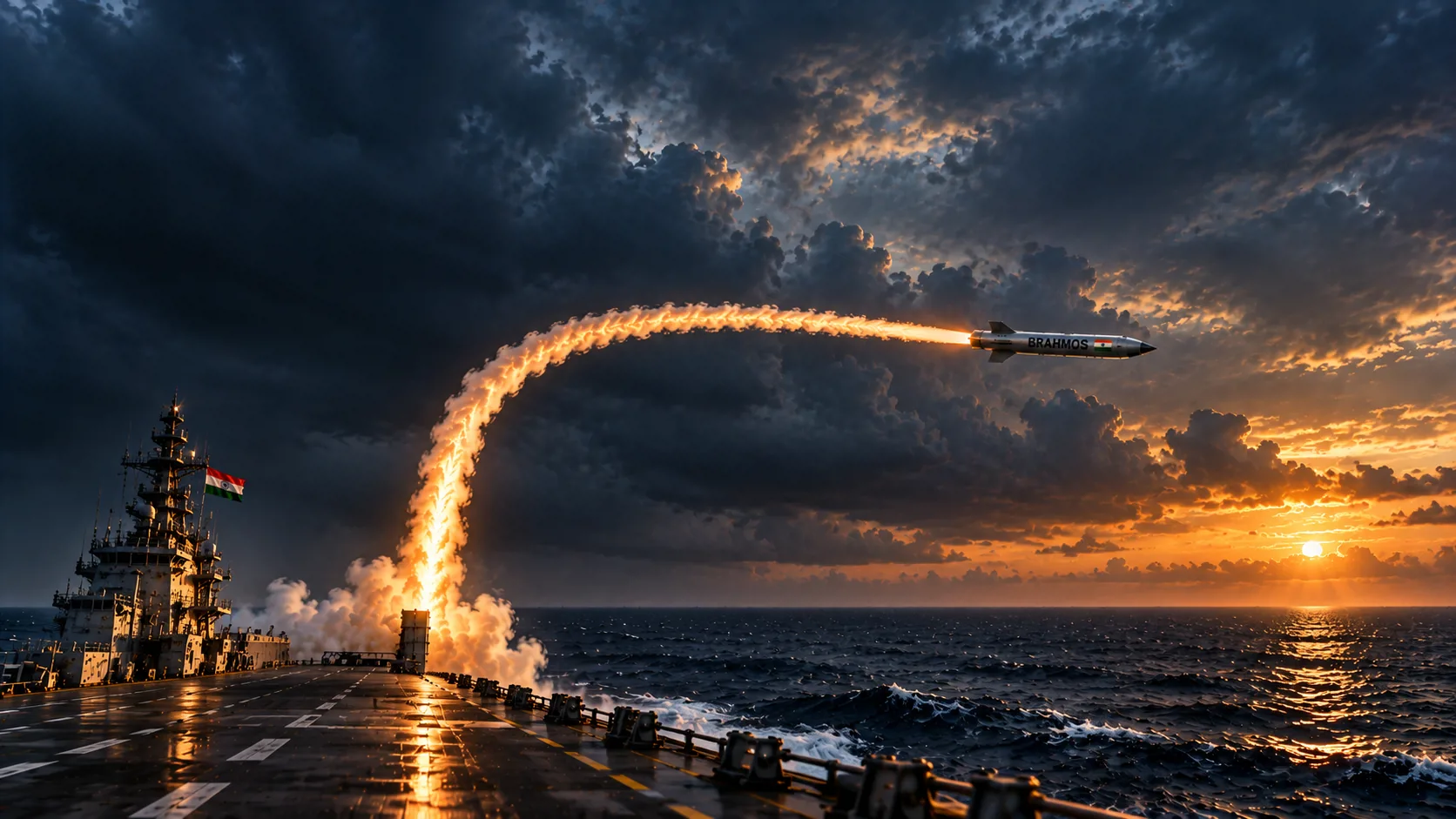
Two Rivers
The name
The missile is named for water.
Brahmaputra, brahma-putra, the son of Brahma, is among the very few great rivers of Bharata to carry a masculine name. It rises behind Kailasa as the Yarlung Tsangpo, runs east along the spine of the Himalaya for a thousand kilometres, turns north of Namcha Barwa through one of the most violent hydrological bends on the planet, and comes down into Asama as a moving sheet of water several kilometres across. It is not a gentle river. It carries a sediment load per unit of flow matched by almost nothing else on earth, abandons and recuts its own channel between seasons, and has drowned more of Asama more often than any adversary ever has. The Brahmaputra is what force looks like when it is patient.
Moskva is the river on which the Russian capital sits and for which it is named. Four hundred and seventy kilometres of cold, meandering, modest water, frozen a third of the year. Not a great river. A river that happens to run through the place where decisions are made.
The first syllables joined give BrahMos. The joint venture chose the name in 1998 and has had no cause since to regret it, because the name performs an unusual amount of work. It states that the object is not a Bharatiya weapon with Russian components, nor a Russian weapon assembled in Bharata. Two sovereign design bureaux put their names into one word and could not afterwards be separated out of it.
The name also records, quietly, who brought what. Bharata brought the mass and the momentum and the sediment load: the industrial base, the money, the platforms, the operational requirement, the sustained political will across four decades and several governments. Russia brought the design lineage. In the years since, the proportion has shifted heavily towards Bharata, and that shift is the part of the story most foreign commentary still gets wrong.
The gap that had to be closed
The inception is best understood as a response to a specific and long-standing frustration.
Through the nineteen-eighties and nineties, the armed forces of Bharata had a capability gap that was not academic. Aircraft could be flown to a target and bombs released over it, at grave risk to aircraft and aircrew both. Artillery could reach a few tens of kilometres. What could not be done was to reach out three hundred kilometres and place a warhead inside a particular building, at a chosen minute, without putting a single Bharatiya life across the frontier.
That capability, long-range conventional precision strike, is the defining military competence of the present era. It is what the United States demonstrated over Baghdad in 1991, and what every serious military establishment on earth concluded from that night it would have to possess. Before proceeding, the term needs defining precisely, since a great deal of confused writing follows from confusing it.
A cruise missile is, functionally, an unmanned aeroplane that flies once and does not return. It has wings, an air-breathing engine, a guidance system and a warhead. It stays inside the atmosphere for the whole of its journey, usually low, and it is guided throughout: it can turn, follow a route, and correct its aim in the final seconds. A ballistic missile is a different object entirely. It is thrown up out of the atmosphere by a rocket, coasts along a path fixed almost wholly at the moment of burnout, and falls back down. A ballistic missile is an artillery shell fired from a very long barrel. A cruise missile is a suicidal aircraft.
The distinction governs everything that follows: interception, escalation, treaty law, and the reason the officer at the Rawalpindi radar had thirty seconds rather than ten minutes.
By the mid-nineties Bharata held part of an answer in the Integrated Guided Missile Development Programme presided over by Dr. A. P. J. Abdul Kalam: Prithvi, Agni, Akash, Nag, Trishul. That programme was a genuine achievement, and in the cruise-missile domain it was incomplete. Building a supersonic cruise missile from a standing start requires an air-breathing propulsion system, a compact airframe with the aerodynamics of a supersonic aircraft, a terminal seeker, and a guidance chain, each of which represents a decade of accumulated institutional learning. Bharata had perhaps two of the four.
Russia in 1998 had all four, and something more useful still: a finished, tested, formidable design that it could no longer afford to build.
The Oniks inheritance
At NPO Mashinostroyeniya, the bureau founded by Vladimir Chelomey, the general designer Herbert Yefremov had spent the late Soviet decades building anti-ship missiles for one purpose: sinking American aircraft carriers. The Soviet Navy could not match the United States Navy hull for hull and did not attempt to. It built missiles fast enough and numerous enough that a carrier group's defences could be saturated, presented with more incoming objects than could be engaged in the seconds available.
The last and finest of that line was the P-800 Oniks, offered for export as Yakhont. It flew at close to three times the speed of sound. It could climb high to conserve fuel and then plunge, or run the entire distance at wavetop height. Its active radar seeker lit in the final stretch and found the target for itself. Western analysts who studied it regarded it as among the most dangerous anti-ship weapons ever designed.
In 1998 it was very nearly stillborn. The Soviet Union had dissolved seven years earlier. NPO Mashinostroyeniya held a masterpiece and no customer with money.
Kalam and Yefremov met. On the twelfth of February 1998 the two governments signed an inter-governmental agreement establishing BrahMos Aerospace Private Limited, a joint venture in which the Defence Research and Development Organisation of Bharata holds the controlling stake of 50.5 per cent and NPO Mashinostroyeniya holds 49.5.
The arrangement was not a purchase. Bharata did not buy missiles. Bharata bought into the design authority. That single structural choice is the reason that, nearly three decades on, the extended-range work, the software, the seeker development and the airframe modifications are increasingly Bharatiya work, and the reason that New Delhi, not Moscow, now largely determines to whom the weapon is sold.
There is an irony in the lineage worth stating plainly. A weapon conceived to sink carriers in the North Atlantic has become, in Bharatiya hands, the instrument by which a chain of Southeast Asian republics hold the South China Sea littoral at risk. Designs outlive the intentions that produced them. The Brahmaputra does not care what the Tsangpo was called upstream.
The founding decision
At the outset the joint teams made one choice that determined all the rest, and it ran directly against the prevailing judgement of the world's most powerful navy.
The Americans had chosen subsonic. The Tomahawk cruises at roughly Mach 0.7, around 240 metres per second, slower than an airliner. That choice buys a great deal: a small efficient turbofan, very long range now exceeding two thousand kilometres in current blocks, a modest heat signature, a small radar cross-section, the ability to loiter and be retargeted in flight, the ability to fly a serpentine route around defended ground, and a unit cost low enough to permit firing in dozens.
BrahMos chose supersonic. Mach 2.8 to 3.0, close to a kilometre every second. That choice surrenders nearly everything the subsonic weapon gains. A ramjet consumes fuel at a rate that collapses range. Flight at Mach 3 in dense low air heats leading edges into the hundreds of degrees, so the skin must be exotic and costly. The missile is large and heavy, so fewer are carried. Unit cost is several times a Tomahawk's.
In exchange it buys exactly one thing, and buys it in abundance.
Time. Specifically, it takes time away from the defender.
The entire design is a wager that the defender's time is worth more than everything the attacker surrenders to steal it. The arithmetic of that wager follows. So, later, does the night the wager was collected on.
The Engine That Cannot Start
Squeeze, burn, expel
Every air-breathing engine performs the same three operations in the same order. It squeezes air, it burns fuel in that air, and it throws the result out of the back. The squeezing is not optional. Combustion requires oxygen at pressure; fuel burnt in thin slack air produces a great deal of noise and almost no thrust.
A turbofan on an airliner squeezes air with machinery. At the front sits a compressor, a stack of bladed discs turning at enormous speed, each stage pressing the air harder into the next, until at the combustion chamber the air stands at perhaps thirty or forty times the pressure at which it entered. Behind the combustor sits a turbine whose sole function is to be spun by the exhaust and to drive that compressor through a shaft running down the axis of the engine. The arrangement is elegant and self-sustaining. It is also heavy, intricate, expensive, and full of components operating at the outer limit of what metal will tolerate.
A ramjet deletes all of it.
A ramjet is an air-breathing engine with nothing moving in its airflow. No compressor, no turbine, no shaft. It flies fast enough that the air is compressed simply by being rammed into the intake: the vehicle's own velocity performs the work the compressor stages would otherwise perform. Fuel is sprayed into that naturally compressed air, ignited, and the hot gas expands out through a nozzle.
In cross-section the engine approaches a tube. Air enters through a shaped intake, is slowed and squeezed by a deliberately positioned pattern of oblique shock waves, meets an atomised spray of liquid fuel in the combustor, burns, and departs hotter and faster than it arrived. That change in momentum is thrust. There is no shaft, no rotating disc, no bearing, nothing to fail.
The price of the simplicity is absolute and unforgiving. A ramjet produces no useful thrust at rest. With no forward motion there is no ram compression, and with no compression there is nothing that will burn properly. Below roughly Mach 2 a ramjet is not an engine, it is a pipe. Its efficiency becomes worth having only somewhere above Mach 2, and it performs at its best between roughly Mach 2.5 and Mach 4, which is precisely the band the missile occupies.
That is not a defect. It is a constraint that dictates the entire architecture of the weapon, and it explains the shape of the object sitting on the launcher.
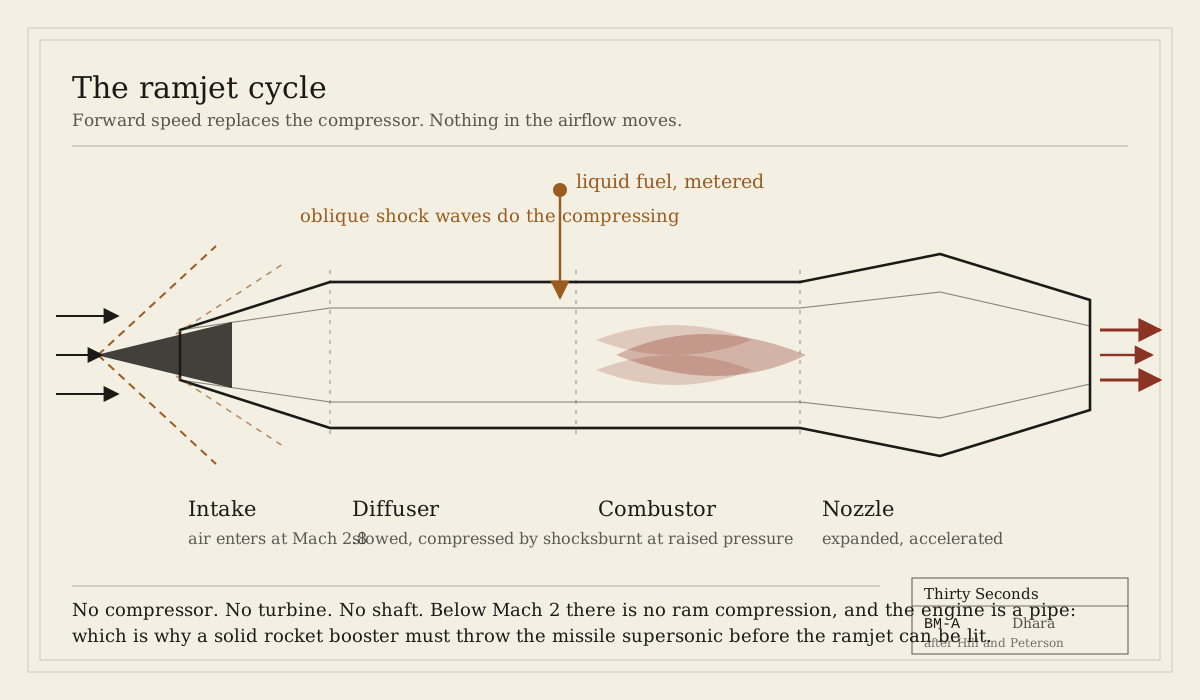
The ramjet cycle. A shaped intake and a pattern of oblique shock waves perform the compression a turbofan performs with machinery. The simplicity is total, and so is the dependence on already being supersonic. Delete this line after inserting the image node.
Two stages, and why
BrahMos is a two-stage missile, and the reason is now plain.
The first stage is a solid-propellant rocket booster. A rocket carries its own oxidiser and is therefore indifferent to airspeed, altitude and air density; it works in a canister, underwater, or in vacuum. Its task is short and violent: lift the missile off the launcher and accelerate it past the threshold at which the ramjet becomes viable. It burns for a few seconds and is then jettisoned, and in test footage the spent booster can be seen tumbling away.
The second stage is the liquid-fuelled ramjet. It lights as the booster separates and sustains the missile at Mach 2.8 through the whole of the cruise. Liquid rather than solid fuel, because a liquid can be metered: throttled up and down as altitude and air density change, and shut off in a way a solid grain cannot be.
Published characteristics of the baseline BrahMos
| Characteristic | Published figure |
|---|---|
| Length | About 8.4 metres |
| Diameter | About 0.6 metres |
| Launch weight | About 3 tonnes for ship and land variants, about 2.5 tonnes air-launched |
| Speed | Mach 2.8 to Mach 3.0, roughly 950 metres per second |
| Warhead | 200 to 300 kilograms, conventional semi-armour-piercing |
| Propulsion | Solid rocket booster, then liquid-fuelled ramjet sustainer |
| Cruise ceiling | About 15 kilometres on the high profile |
| Terminal altitude | As low as 3 to 10 metres in the sea-skimming profile |
| Guidance | Inertial with satellite update in mid-course, active radar homing in the terminal phase |
Three tonnes and eight and a half metres describes an object heavier than a small motor car, arriving faster than a rifle bullet. What that combination costs, and what it buys, is a matter of arithmetic rather than adjectives.
The Air It Flies Through
Nothing about the missile can be understood without first understanding the fluid it moves in, because every property that matters, thrust, drag, heating, range and speed itself, is a function of the state of the air at the altitude chosen.
Mach 2.8 is not a speed
The most persistent error in popular writing on the subject is the treatment of Mach 2.8 as though it were a velocity. It is not. It is a ratio, and the quantity it is a ratio to changes with altitude.
The speed of sound in a gas is given by the square root of gamma times R times T, where gamma is the ratio of specific heats, 1.4 for air, R is the specific gas constant for air, 287.05 joules per kilogram per kelvin, and T is the absolute temperature. Pressure does not appear. Density does not appear. The speed of sound depends on temperature alone.
In the standard atmosphere the temperature at sea level is 288.15 kelvin and at fifteen kilometres, inside the lower stratosphere, it is 216.65 kelvin. Working the arithmetic gives a speed of sound of 340.3 metres per second at the surface and 295.1 metres per second at fifteen kilometres.
The same Mach number, two different velocities
| Condition | Temperature | Speed of sound | Mach 2.8 in metres per second |
|---|---|---|---|
| Sea level, standard atmosphere | 288.15 kelvin | 340.3 metres per second | 953 |
| Fifteen kilometres, lower stratosphere | 216.65 kelvin | 295.1 metres per second | 826 |
A BrahMos on its high cruise is flying at Mach 2.8 and moving at 826 metres per second. The same missile on the deck at the same Mach number is moving at 953 metres per second, fifteen per cent faster in absolute terms. The low-flying missile is genuinely the quicker of the two, and the earlier reaction-time arithmetic was correct to use the sea-level figure.
Dynamic pressure, and why altitude is worth so much
Aerodynamic force scales with dynamic pressure, written q, equal to one half of air density times velocity squared. Drag is that quantity multiplied by a drag coefficient and a reference area. Every newton of thrust the ramjet produces is spent overcoming it.
Air density at sea level in the standard atmosphere is 1.225 kilograms per cubic metre. At fifteen kilometres it is 0.1937, about one sixth.
Working both cases at Mach 2.8 gives the number that governs the entire flight-profile decision.
Dynamic pressure at the two cruise conditions
| Condition | Density | Velocity | Dynamic pressure |
|---|---|---|---|
| Sea level | 1.225 kilograms per cubic metre | 953 metres per second | 556 kilopascals |
| Fifteen kilometres | 0.1937 kilograms per cubic metre | 826 metres per second | 66 kilopascals |
Five hundred and fifty-six kilopascals against sixty-six. A factor of eight and a half.
The velocity is lower at altitude, and velocity enters squared, which works against the high profile. But density is down by a factor of six and a quarter, and that dominates. The missile on the deck is pushing against eight and a half times the aerodynamic pressure of the missile at fifteen kilometres.
Five hundred and fifty-six kilopascals is five and a half atmospheres of pressure standing on every square metre of frontal area. That is the toll the sea-skimming profile pays, and it is paid in fuel, in structure, and in range.
Five hundred and fifty-six kilopascals is worth converting into something graspable. It is the pressure at a depth of fifty-six metres of sea water, applied continuously to the nose of an object for the whole of its flight, while that object is simultaneously being heated to the temperature of a domestic oven at its maximum setting. The airframe is not merely fast. It is a pressure vessel and a furnace at once, and it must remain both for the several minutes the flight lasts.
Why Mach Two Is a Floor
The claim made earlier, that a ramjet is not an engine below roughly Mach 2, was asserted rather than demonstrated. It can be demonstrated, in one equation, and the demonstration is the most elegant thing in the whole subject.
The compression the missile gets for nothing
When a gas moving at high speed is brought to rest, its kinetic energy converts into thermal energy, raising its temperature and, if the process is efficient, its pressure. That is what happens inside a ramjet intake, and the relationships are the standard isentropic ones.
The stagnation temperature ratio is one plus one half of gamma minus one, times Mach number squared. With gamma at 1.4 that is one plus 0.2 times M squared.
The stagnation pressure ratio is that same quantity raised to the power gamma over gamma minus one, which is 3.5.
At Mach 2.8 the temperature ratio is one plus 0.2 times 7.84, which is 2.568. Raised to the power 3.5 that gives a pressure ratio of 27.1.
Twenty-seven to one. That is the compression the missile obtains by the simple act of flying fast, with no compressor, no turbine, no shaft and no moving component of any kind. For comparison, the overall pressure ratio of a large modern turbofan, achieved with many stages of precision machinery turning at enormous speed, is in the region of forty to one.
What the missile gets from its own velocity, by Mach number
| Mach number | Stagnation temperature ratio | Ideal stagnation pressure ratio | Ideal thermal efficiency |
|---|---|---|---|
| 1.0 | 1.20 | 1.9 | 0.167 |
| 1.5 | 1.45 | 3.7 | 0.310 |
| 2.0 | 1.80 | 7.8 | 0.444 |
| 2.5 | 2.25 | 17.1 | 0.556 |
| 2.8 | 2.57 | 27.1 | 0.611 |
| 3.0 | 2.80 | 36.7 | 0.643 |
| 4.0 | 4.20 | 151.8 | 0.762 |
The equation that chose the speed
The last column is the one that decides everything. The ideal thermal efficiency of a ramjet, treated as a Brayton cycle, is one minus the reciprocal of the stagnation temperature ratio. Written out, it is 0.2 times M squared, divided by one plus 0.2 times M squared.
That expression contains no property of the engine. Not the fuel, not the combustor, not the nozzle, not the materials. It contains only the Mach number. The thermodynamic efficiency of a ramjet is a function of how fast it is going and of nothing else whatsoever.
A ramjet's efficiency is not engineered. It is bought with speed, and the price list is fixed by thermodynamics rather than by any design bureau.
Read the column downward and the design decision of 1998 writes itself. At Mach 1 the cycle throws away five sixths of the heat it releases. At Mach 2 it is still discarding more than half. Somewhere past Mach 2.5 the efficiency crosses into the region where the engine is worth its weight, and by Mach 4 it is very good indeed.
So the lower bound is thermodynamic. The upper bound is material. Efficiency continues climbing past Mach 4, but so does stagnation temperature, and at some point the air entering the combustor is already too hot for the addition of fuel to raise it further without destroying the engine. Between the thermodynamic floor and the material ceiling lies a window from roughly Mach 2.5 to Mach 4, and BrahMos sits at 2.8, close to the bottom of it.
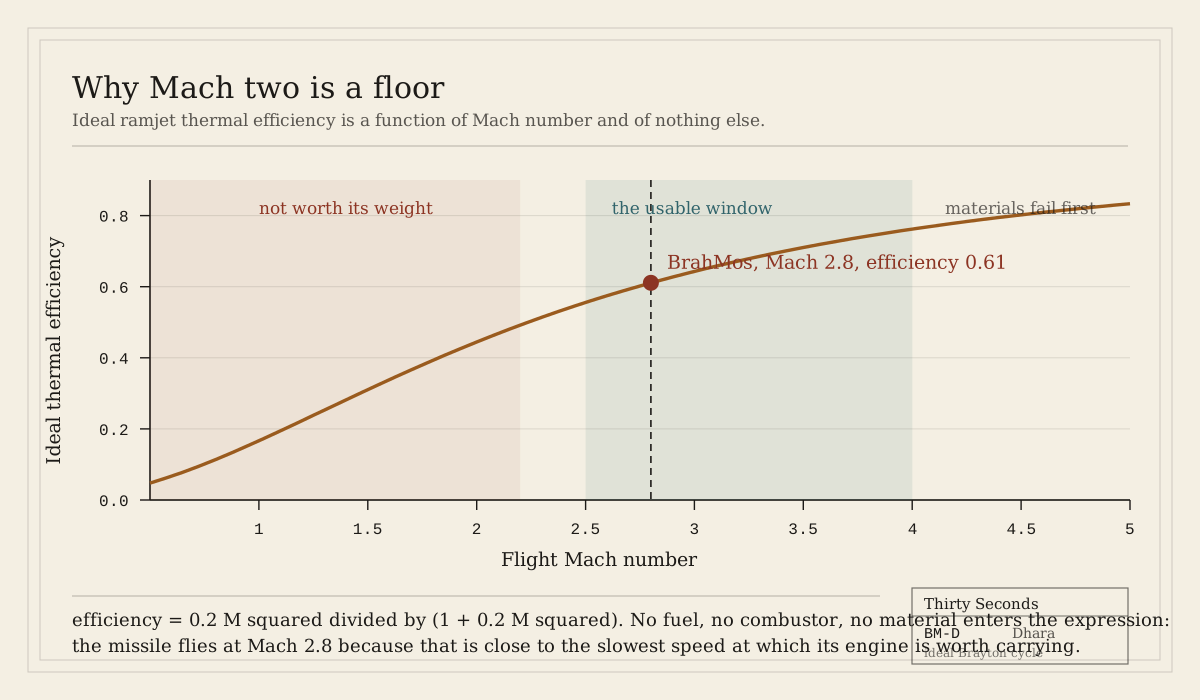
Ideal ramjet thermal efficiency against flight Mach number. The expression contains no property of the engine, only its speed. The floor at Mach 2 and the window from 2.5 to 4 are thermodynamic facts, not design choices. Delete this line after inserting the image node.
Settled The missile does not fly at Mach 2.8 because faster was unavailable or slower was insufficient. It flies at Mach 2.8 because that is very nearly the slowest speed at which its engine is worth having.
What the intake actually has to do
The twenty-seven to one figure is ideal, meaning it assumes the deceleration happens without loss. It does not.
Slowing supersonic air necessarily involves shock waves, and shock waves destroy stagnation pressure. A single normal shock at Mach 2.8, the crudest possible arrangement, recovers only 0.39 of the incoming stagnation pressure. Fully sixty-one per cent of the compression the missile paid for in fuel is thrown away in one discontinuity.
This is why the intake has a shaped centre body projecting forward of the lip. Its purpose is to generate a series of oblique shocks instead of one normal shock. Each oblique shock decelerates the flow a little and destroys only a little stagnation pressure, and a well-designed sequence of two or three of them followed by a weak terminal normal shock can recover eighty-five to ninety per cent rather than thirty-nine.
Why the intake spike exists
| Intake arrangement | Stagnation pressure recovered at Mach 2.8 | Effective compression ratio delivered |
|---|---|---|
| Single normal shock | About 0.39 | About 10.6 to 1 |
| Multiple oblique shocks with terminal normal shock | About 0.88 | About 23.8 to 1 |
The difference between those two rows is the difference between a missile that flies three hundred kilometres and one that flies rather less than half of that. An engine with no moving parts turns out to have its most important component immobile, invisible, and made of air: the shock structure standing in front of the intake lip, which must be held in position across changes of altitude, speed and angle of attack, and which unstarts catastrophically if it is not.
The Fuel Bill
Why an air-breathing engine at all
A rocket carries its own oxidiser. A ramjet does not. That single difference sets the entire economics of the weapon, and it can be quantified exactly.
Burning a hydrocarbon fuel to completion requires roughly fourteen and a half kilograms of air for every kilogram of fuel, of which the useful oxygen is about a fifth. A rocket must lift every kilogram of that oxidiser from the launcher. A ramjet scoops it out of the sky as it passes and pays nothing for it beyond the drag of the intake.
The consequence appears in specific impulse, the standard measure of propulsive economy. Specific impulse is the thrust obtained per unit weight of propellant consumed per second, expressed in seconds, and it answers the question of how long one kilogram of propellant can produce one kilogram of thrust.
Specific impulse across propulsion classes
| Propulsion type | Typical specific impulse | Carries its own oxidiser |
|---|---|---|
| Solid rocket motor | About 240 to 260 seconds | Yes |
| Liquid rocket engine | About 300 to 450 seconds | Yes |
| Ramjet on liquid hydrocarbon | About 1,000 to 1,400 seconds | No |
| Turbofan at subsonic cruise | About 3,000 to 6,000 seconds | No |
The ramjet is four to five times more economical than the rocket it replaces and three to four times less economical than the turbofan it declined to be. Both of those ratios are load-bearing. The first is why BrahMos is a cruise missile rather than a tactical ballistic weapon. The second is why it does not have the range of a Tomahawk and never will.
Working the range
Cruise range for an air-breathing vehicle is given by the Bregeut relation. Range equals velocity, multiplied by specific impulse, multiplied by the lift-to-drag ratio, multiplied by the natural logarithm of the ratio of the mass at the start of cruise to the mass at the end of it.
The four terms are the four levers, and the missile's designers pulled them in a very particular pattern.
Take a plausible working case. After booster separation the missile weighs about 2,500 kilograms and carries roughly 450 kilograms of usable ramjet fuel, leaving about 2,050 kilograms at burnout. The logarithm of 2,500 divided by 2,050 is 0.199.
The same missile, the same fuel, two profiles
| Term | High cruise at fifteen kilometres | Sea-skimming at low level |
|---|---|---|
| Velocity | 826 metres per second | 953 metres per second |
| Specific impulse | About 1,050 seconds | About 1,000 seconds |
| Lift-to-drag ratio | About 3.2 | About 1.1 |
| Logarithm of mass ratio | 0.199 | 0.199 |
| Resulting range | About 550 kilometres | About 210 kilometres |
Illustrative The specific impulse and lift-to-drag figures are representative values for the class rather than published data for this weapon, and the result should be read as an order-of-magnitude demonstration rather than a specification. What survives the uncertainty is the ratio between the two columns.
That ratio is roughly two and a half to one, and it is the quantitative statement of everything the earlier discussion of flight profiles asserted qualitatively. The missile that hides beneath the radar horizon buys its concealment by surrendering some sixty per cent of its reach. Velocity is up fifteen per cent in the low column and still the range collapses, because lift-to-drag has fallen by a factor of nearly three under eight and a half times the dynamic pressure.
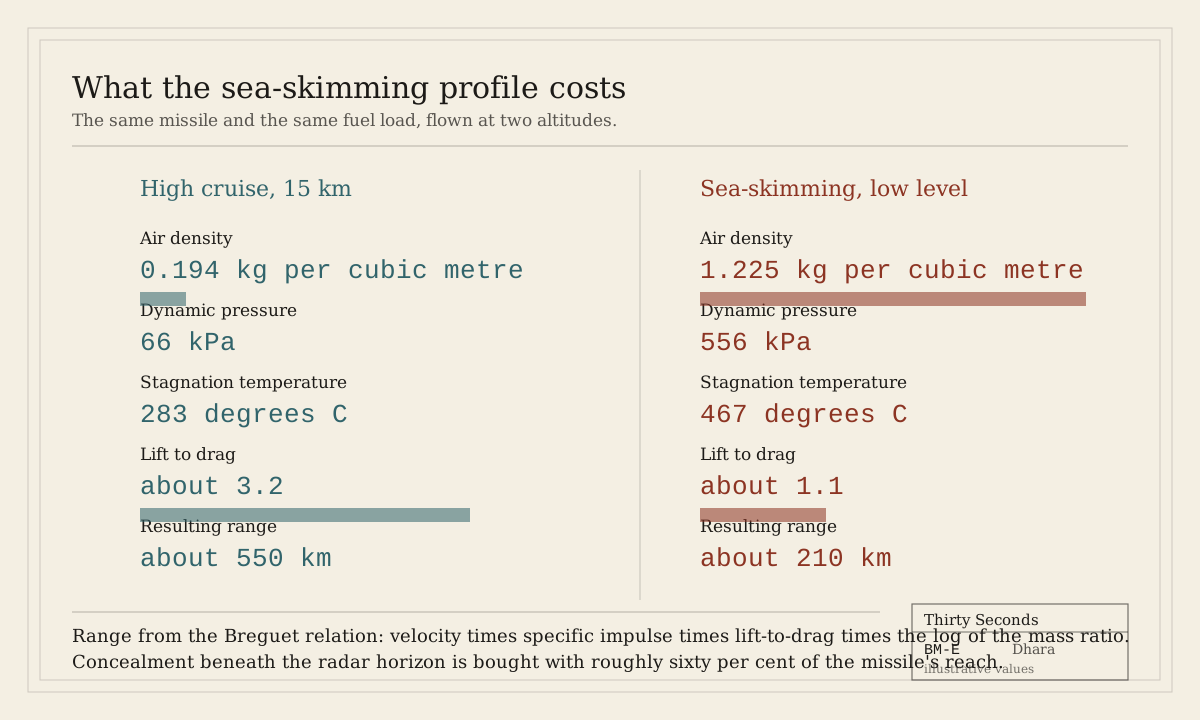
The exchange rate between concealment and reach. Velocity is higher on the deck and range still collapses, because lift-to-drag falls by a factor of nearly three under eight and a half times the dynamic pressure. Delete this line after inserting the image node.
A cruise missile does not choose between range and survivability once, at the design stage. It chooses again on every mission, in the flight plan, and the exchange rate is fixed by the atmosphere.
This is also the reason a real strike profile is neither of the two columns but a splice of both: high and economical for the transit, then a descent to low level for the last stretch where the defence lives. The missile spends its cheap kilometres at altitude and its expensive ones where they are worth buying.
The Booster
The ramjet cannot start itself, so something must throw the missile past Mach 2. The size of that something is fixed by the rocket equation and is larger than intuition suggests.
Tsiolkovsky's relation states that the velocity change achieved equals specific impulse, multiplied by standard gravity, multiplied by the natural logarithm of the ratio of initial mass to final mass. Rearranged, the mass ratio required equals the exponential of the velocity change divided by specific impulse times standard gravity.
The booster must deliver roughly 680 metres per second to reach Mach 2 at sea level, and it must also overcome drag and gravity during the seconds it burns, which at these dynamic pressures is not a small addition. Taking 820 metres per second as the total including losses, and a solid motor specific impulse of 240 seconds, the exponential of 820 divided by 240 times 9.81 gives a required mass ratio of about 1.42.
A mass ratio of 1.42 means that roughly thirty per cent of everything leaving the launcher is booster propellant, before the case, the nozzle, the igniter and the separation hardware are counted. For a three-tonne round the booster assembly is a substantial fraction of the total, and every kilogram of it is discarded within seconds.
This is the hidden tax on all ramjet propulsion and the reason ramjet-powered weapons are large for their payload. A turbofan cruise missile can be launched at low speed and accelerate itself. A ramjet weapon must carry a rocket to the point where its real engine begins to function, and then throw that rocket away. The booster is dead weight for the whole of the boost phase and dead mass for none of the flight that matters.
The next-generation development, in shortening the airframe and halving the launch mass, is in substantial part an attack on this arithmetic. A lighter round requires a smaller booster, and a smaller booster leaves more of the total mass available for fuel and warhead.
The Heat
What the air does to the nose
The same stagnation relations that supply the compression also supply the temperature, and the temperature is a problem.
Stagnation temperature is the free-stream temperature multiplied by one plus 0.2 times Mach number squared. At Mach 2.8 that multiplier is 2.568.
Stagnation temperature at the two cruise conditions
| Condition | Free-stream temperature | Stagnation temperature | In degrees Celsius |
|---|---|---|---|
| Sea level | 288 kelvin | 740 kelvin | About 467 |
| Fifteen kilometres | 217 kelvin | 556 kelvin | About 283 |
Four hundred and sixty-seven degrees Celsius on the nose and the intake lip of a sea-skimming missile, sustained for the whole of a flight lasting minutes. That is above the temperature at which ordinary aluminium alloys lose their strength, which is why supersonic airframes of this class use titanium, steel or high-temperature aluminium alloys in the hot regions and pay for them in weight and in cost.
Note also that the cold column is the high-altitude one, by nearly two hundred degrees. The missile that flies low is not only fighting eight and a half times the dynamic pressure. It is also doing so almost two hundred degrees hotter. The sea-skimming profile is the punishing one in every respect except the one that matters, which is being seen.
The window the seeker looks through
The hardest single component is the one nobody photographs.
The nose of the missile contains an active radar seeker, which must transmit and receive through whatever covers it. That cover, the radome, has to satisfy four requirements simultaneously, and they conflict.
The four conflicting demands on a supersonic radome
| Requirement | Why it is difficult |
|---|---|
| Transparent at radar frequencies | Rules out metals entirely, and constrains the choice to ceramics and composites |
| Structurally sound under aerodynamic load | The nose carries the highest local pressures on the airframe |
| Stable at several hundred degrees Celsius | Many radar-transparent materials lose either strength or dielectric consistency when hot |
| Aerodynamically sharp | A blunt nose is easier thermally and structurally, and worse for drag at Mach 2.8 |
Worse, the electrical properties of most candidate materials change with temperature. A radome that refracts the beam correctly when cold may deflect it slightly when hot, and a slight deflection at the seeker introduces a boresight error that the guidance law then faithfully converts into a miss. Radome error slope is a real and much-studied contributor to terminal miss distance in every high-speed homing weapon, and it is a problem of materials science rather than of aerodynamics or electronics.
Thirty One Kilometres
Everything reduces to one geometric fact and one division.
The curve of the earth
Radar is line of sight. A radar beam travels in very nearly a straight line and the earth is not straight. Beyond a certain distance the surface curves out from under the beam, and anything flying low enough is on the far side of that curve: physically below the horizon, invisible not because it is stealthy but because there is a planet in the way.
The distance to that horizon is given by an equation every naval officer knows. In kilometres, d equals 4.12 multiplied by the sum of the square root of the radar height in metres and the square root of the target height in metres. The constant 4.12 rather than the pure geometric 3.57 accounts for atmospheric refraction, which bends radar waves slightly downward and extends the radar horizon by roughly fifteen per cent beyond the optical one.
Real numbers make the point. Take a warship carrying its main air-search radar twenty metres above the waterline, and a missile skimming the sea at ten metres. The square root of twenty is 4.47. The square root of ten is 3.16. Their sum multiplied by 4.12 gives approximately thirty-one kilometres.
Thirty-one kilometres. That is the number, and it is nearly immovable. It does not matter how good the radar is. A radar rated to a thousand kilometres and a radar rated to fifty kilometres acquire a ten-metre sea-skimmer at the same instant, because the limit is not sensitivity or power or aperture. The limit is the shape of the earth.
Settled This is the single most under-appreciated fact in popular discussion of missile defence, and it returns with force when the S-500 is examined further on.
The division
Now divide. BrahMos near sea level travels at roughly 950 metres per second. Thirty-one thousand metres divided by 950 metres per second gives approximately thirty-three seconds.
Thirty-three seconds from the moment the missile crosses the horizon to the moment it arrives. And those seconds are not thirty-three seconds of shooting. They must be spent, in order, on a sequence that cannot be compressed.
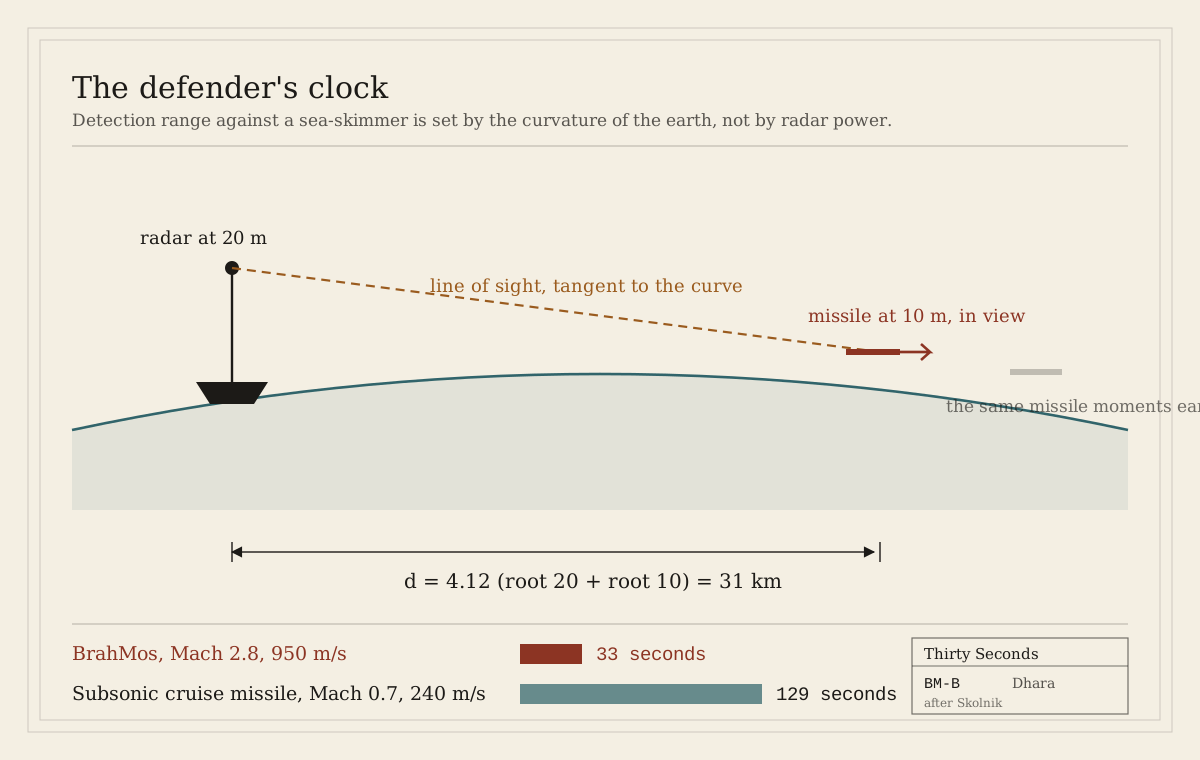
The defender's clock. A radar rated to a thousand kilometres and one rated to fifty acquire a ten-metre sea-skimmer at the same instant, because the limit is the shape of the earth and not the radar. Only the crossing time then differs. Delete this line after inserting the image node.
How the defender's thirty-three seconds are consumed
| Stage | What must happen | Cost |
|---|---|---|
| Detection | Enough returned energy across enough sweeps to declare a contact rather than noise or sea clutter, which is worst at exactly the low grazing angles a sea-skimmer occupies | Several seconds |
| Track formation | Successive returns resolved into a course and a speed, since one return is not a track | Several more seconds |
| Classification | Hostile or not, missile or aircraft or flock, and whether the platform is weapons-free | Seconds, and in a crisis potentially many |
| Decision | Human authorisation where doctrine requires it | Unpredictable |
| Engagement | Interceptor assigned, fire-control radar or illuminator cued, round launched | Seconds |
| Interceptor flight | The interceptor must physically fly out to meet a target closing at 950 metres per second | Most of what remains |
| Re-engagement | A second shot if the first misses | Usually unavailable |
Thirty-three seconds does not comfortably contain that list. It was never intended to.
The comparison that carries the argument
Run the identical arithmetic against a subsonic cruise missile on the same sea-skimming profile at Mach 0.7, about 240 metres per second. Thirty-one thousand metres divided by 240 metres per second gives approximately one hundred and twenty-nine seconds.
More than two minutes. Two minutes is a different tactical universe. Two minutes permits detection, classification, consultation, engagement, observation of the miss, re-engagement, and a close-in gun system still held in reserve as a backstop. Two minutes is a defensible problem.
The supersonic missile does not deliver four times the damage. It removes three quarters of the defender's time, and time is the material out of which the entire air-defence enterprise is built.
The honest objection
A sceptical reader will observe that no serious navy relies on its own masthead for warning, and the objection is correct and important. It is precisely why fleets fly airborne early warning aircraft and helicopters, and why land-based air-defence networks are constructed around elevated and dispersed sensors.
Raise the radar from a twenty-metre mast to a nine-thousand-metre orbit and the same equation transforms. The square root of nine thousand is about 94.9. Added to 3.16 and multiplied by 4.12, the horizon against the same ten-metre target moves out to roughly four hundred kilometres. This is why an airborne radar platform is worth more to a fleet than another destroyer, and why the loss of one is a catastrophe out of proportion to its tonnage.
So the honest statement is this. Against an isolated ship with no organic airborne radar, a supersonic sea-skimmer approaches an unanswerable problem. Against a properly constituted task group with warning aloft, layered interceptors and a functioning combat-management system, it is a hard problem rather than an impossible one, and the defender's answer costs him an aircraft in the air every hour of every day, which is itself a permanent imposition the attacker has extracted for nothing.
That, and no claim of invincibility, is the real strategic effect. BrahMos does not make defence impossible. It makes defence expensive, continuous, and dependent on assets that can themselves be attacked first.
What Arrives
The kinetic energy, corrected
A popular claim holds that a BrahMos strikes with the energy of a small tactical warhead before its own warhead functions. The claim is worth working, because the honest answer is more interesting than the exaggerated one.
Kinetic energy is one half of mass times velocity squared. The temptation is to use the launch mass of three tonnes and the cruise speed of 953 metres per second, which gives 1,362 megajoules, and to convert that at the standard 4.184 megajoules per kilogram of trinitrotoluene into 326 kilograms of explosive equivalent.
That figure is wrong, and it is wrong in a way that matters. The three-tonne launch mass includes a booster discarded in the first seconds and several hundred kilograms of ramjet fuel that has been burnt by the time the target is reached. The mass that actually arrives is substantially less.
Arriving kinetic energy at realistic terminal mass
| Assumption | Mass | Velocity | Kinetic energy | Explosive equivalent |
|---|---|---|---|---|
| Launch mass and cruise speed, the exaggerated figure | 3,000 kilograms | 953 metres per second | 1,362 megajoules | About 326 kilograms |
| Plausible terminal mass, fuel largely consumed | 1,800 kilograms | 900 metres per second | 729 megajoules | About 174 kilograms |
| Conservative terminal mass and speed | 1,500 kilograms | 880 metres per second | 581 megajoules | About 139 kilograms |
So the arriving kinetic energy is on the order of one hundred and forty to one hundred and seventy-five kilograms of explosive equivalent, against a warhead of two hundred to three hundred kilograms. Comparable to the warhead, then, and not several times it.
Corrects a common claim The kinetic energy is real and substantial and it is not the dominant term. Anyone asserting that the warhead is incidental to the effect has multiplied the wrong mass by the wrong velocity.
Why the energy is nonetheless the point
Comparing energies, however, is the wrong comparison, and this is where the physics becomes genuinely interesting.
An explosive charge releases its energy in all directions from wherever it happens to be. A kinetic penetrator delivers its energy along one axis, into a very small area, over a very short time. The two are not interchangeable at equal joules, and the reason is momentum rather than energy.
A first approximation to penetration depth, attributed to Newton and crude but instructive, states that a projectile penetrates a distance roughly equal to its own length multiplied by the ratio of its density to the target's density. The result is independent of velocity, which is counter-intuitive and approximately true over a wide range of impact speeds, provided the projectile does not shatter.
For a hardened steel-cased penetrator with an effective length of about one and a quarter metres striking reinforced concrete, the density ratio is roughly 7,800 to 2,400, or about 3.25. The estimate that follows is on the order of four metres of concrete.
First-order estimate Real penetration depends on impact obliquity, yaw at impact, case strength and target reinforcement, and Newton's approximation ignores all of them. The figure indicates a class of capability rather than a performance guarantee.
Four metres of reinforced concrete is the difference between damaging a hardened aircraft shelter and opening it. And this explains the whole architecture of the warhead: the semi-armour-piercing case exists so that the kinetic energy is spent getting the explosive to the inside of the structure, after which the explosive does the work. The two effects are sequential, not additive.
The kinetic energy is not a second warhead. It is the delivery mechanism for the first one.
For calibration against the energies of spaceflight: a BrahMos cruises at about 0.95 kilometres per second. Low orbital velocity is about 7.8, and escape velocity from the earth is 11.2. Because specific energy scales with the square of speed, putting the same mass into low orbit requires roughly sixty-seven times the energy per kilogram that this missile carries, and sending it away from the earth entirely requires about one hundred and forty times. A cruise missile is a fast object by the standards of weapons and a very slow one by the standards of rocketry, and that gap is precisely why it can be built by the hundred while launch vehicles cannot.
The Radar Equation, and Why Stealth Was Declined
The decision not to pursue a low radar cross-section looks like a concession forced by the ramjet. It is better understood as a calculation, and the calculation can be performed.
The fourth-power law
The power a radar receives back from a target is proportional to the transmitted power, the square of the antenna gain, the square of the wavelength and the target's radar cross-section, all divided by the fourth power of the range. The fourth power appears because the energy spreads on the way out and spreads again on the way back.
Invert it. Detection range varies as the fourth root of radar cross-section. That single fact governs the economics of stealth, and it is brutal.
What a reduction in radar cross-section actually buys
| Radar cross-section reduced by a factor of | Detection range multiplied by | Reduction in detection range |
|---|---|---|
| 2 | 0.84 | 16 per cent |
| 4 | 0.71 | 29 per cent |
| 10 | 0.56 | 44 per cent |
| 16 | 0.50 | 50 per cent |
To halve the range at which a missile is detected, its radar cross-section must be cut by a factor of sixteen. That is not achieved with paint. It requires shaping the entire airframe to deflect energy away from the illuminating radar, absorbent structure, and the suppression of every corner reflector and cavity on the body, which for a vehicle with a large forward-facing air intake is close to impossible. The intake is a cavity pointed at the threat, and it is not optional.
The comparison the designers made
Now set the two approaches side by side, using the same thirty-one kilometre horizon established earlier.
Two routes to reducing the defender's reaction time
| Approach | Method | Effect on the defender's clock |
|---|---|---|
| Stealth | Cut radar cross-section by a factor of sixteen, at very great cost, on an airframe with a forward-facing intake | Detection at about 15.5 kilometres instead of 31, giving about 16 seconds at subsonic speed against 129 |
| Speed | Fly the same route at Mach 2.8 instead of Mach 0.7 | Detection unchanged at 31 kilometres, giving 33 seconds instead of 129 |
The stealth column is better, if it can be achieved. But it can only be achieved on an airframe that does not have a large supersonic intake in its nose, and the arithmetic in the speed column is obtained for nothing but propulsion choice, on an airframe that is loud, hot and entirely visible.
Settled Against a sea-skimming target the horizon caps detection range regardless of cross-section, which means stealth and speed are competing for the same twenty or thirty kilometres. Below the horizon the missile is already invisible. Stealth buys nothing until the target rises into view, and then it buys a fourth root.
That is the calculation. Two competing philosophies of survivability, one bought with materials and shaping and the other bought with thermodynamics, and a design bureau that chose the second because its engine had already made the first unattainable.
Skip, Shift, Skim
A missile is not a bullet. Between the launcher and the target it makes a journey in distinct phases, each governed by a different sensor and answering a different objective. Grasping those phases is what separates informed discussion from noise.
Leaving the launcher
BrahMos departs in one of two ways.
From ships and from land-based launchers the missile is typically launched vertically from a canister, ejected upward under booster thrust and then turned onto its course in the air. Vertical launch carries an under-rated tactical virtue: the launcher does not need to be pointed. A ship with vertical cells can engage a target on any bearing without turning the hull, and can empty a magazine in rapid sequence rather than cycling a trainable launcher. Land-based mobile autonomous launchers, wheeled transporter-erector-launchers carrying three rounds apiece, raise their canisters and fire skyward from a road, a field, a treeline.
From aircraft the missile is released from a hardpoint and falls clear before the booster lights, so that the launching aircraft is not scorched by its own weapon.
In every case the sequence is identical. The solid booster fires, drives the missile past Mach 2, burns out in seconds and separates. The ramjet lights. The missile settles onto its cruise.
Skip
The high profile. The missile climbs to around fourteen or fifteen kilometres and cruises there. Thin air means low drag, low drag means low fuel consumption, and low fuel consumption means range. A BrahMos flying high travels substantially further than one flying low.
It is also, of course, visible from a very long way off at that altitude, so the profile is chosen when reach matters more than surprise: a strike deep inland against an adversary whose radar coverage has already been assessed, or a shot at a target well beyond the low-altitude fuel envelope. At the end of the cruise the missile pitches over into a steep terminal dive, which adds impact velocity and presents defenders below with a descending target at high crossing rate, geometrically among the most awkward engagements an air-defence radar can be handed.
Shift
The route. The missile is not obliged to fly a straight line. It carries a programmed sequence of waypoints and can be told to approach from an unexpected bearing, to skirt a known air-defence site, or to arrive from the quarter where the target's radar coverage is thinnest.
The tactical consequence is larger than it first appears. Several missiles fired in a salvo can be given different routes and timed to converge on one target within seconds of each other from several azimuths at once. This is the saturation logic on which the entire Soviet anti-carrier tradition was built, and it is arguably more important than any individual missile's performance. A defence able to engage four targets simultaneously fails against five. Saturation does not defeat the defence by being better than it. It defeats the defence by arithmetic.
Skim
The sea-skimming run. For the final approach, and for the whole flight in the anti-ship role, the missile descends to a few metres above the surface, published figures placing it as low as three to ten metres, and holds there.
Holding that altitude at 950 metres per second over a moving sea is a serious engineering achievement in itself. The radar altimeter must sample fast enough, and the control system respond fast enough, that the missile neither balloons up into view nor strikes a wave. At three metres over open ocean the margin for error is measured in fractions of a second.
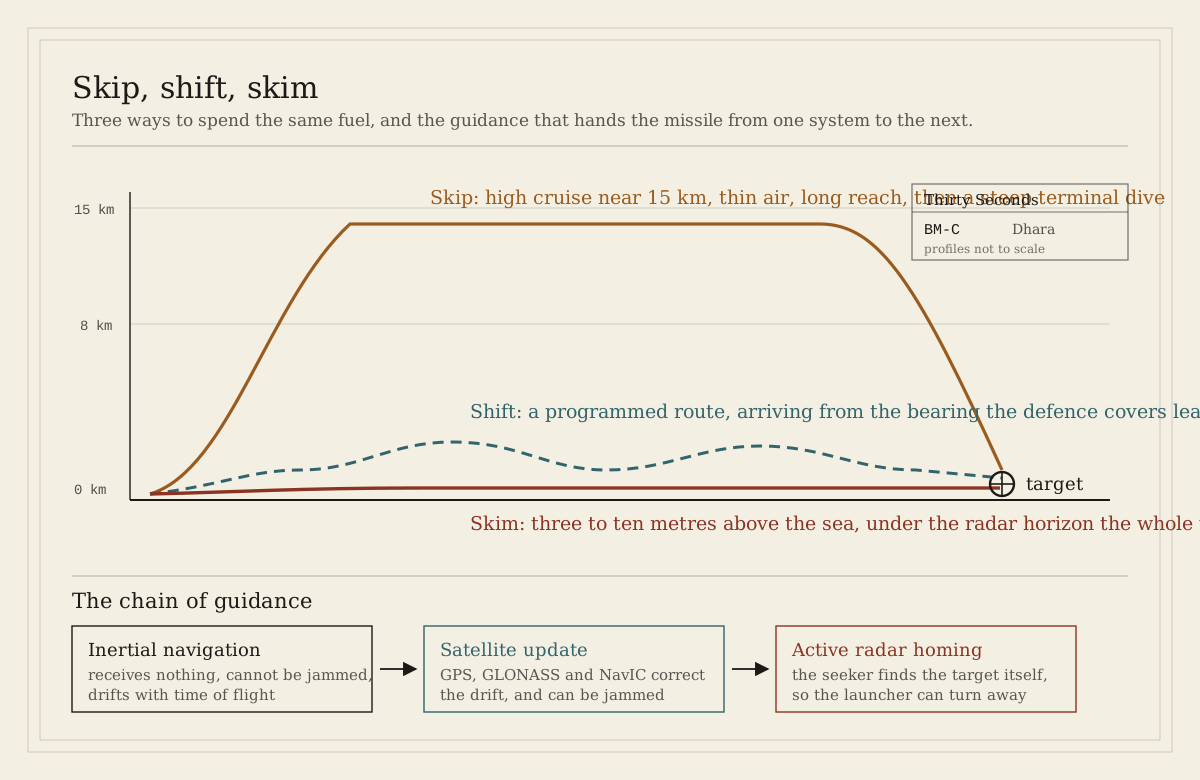
Skip, shift, skim, and the guidance chain beneath them. Inertial navigation cannot be jammed because it receives nothing; satellite correction can be jammed but its loss degrades rather than defeats; active homing releases the launcher entirely. Delete this line after inserting the image node.
The chain of guidance
Three systems hand the missile from one to the next.
Guidance phases and what governs each
| Phase | System | What it does | Vulnerability |
|---|---|---|---|
| Boost and initial | Inertial navigation | Accelerometers and gyroscopes integrate motion from a known start point, requiring no outside signal at all | Drift accumulates with time of flight |
| Mid-course | Inertial with satellite update | Position fixes from GPS, GLONASS and the Bharatiya NavIC constellation correct the accumulating inertial drift | Satellite signals can be jammed or spoofed |
| Terminal | Active radar homing | The seeker in the nose transmits, receives its own returns, identifies the target and steers onto it without further outside help | Seeker can be jammed, decoyed by chaff, or confused by clutter |
The architecture matters strategically. Inertial navigation cannot be jammed, because it receives nothing. Satellite updates can be jammed, but their loss degrades accuracy rather than destroying the mission, since the inertial system continues to fly. Active radar homing means the missile does not depend on the launching platform once it is away: the ship or aircraft that fired it can turn and leave. This is the fire-and-forget property, and it is the difference between a weapon that exposes its launcher and one that does not.
NavIC, the Bharatiya regional navigation satellite constellation, matters here for reasons beyond accuracy. A weapon whose mid-course correction depends on a foreign constellation is a weapon whose accuracy is held at another government's discretion. Sovereign navigation is not a prestige project. It is the difference between a missile that works in a crisis and a missile that works until the crisis.
Published accuracy claims for the system are extremely tight, circular error probable figures of a very few metres being cited by the manufacturer. Contested Manufacturer accuracy claims for any missile system are marketing documents as well as technical ones, and independent verification of terminal accuracy is by its nature scarce. What can be said with confidence is that the demonstrated behaviour in 2025 was consistent with a weapon that hits specific buildings rather than general areas.
Three Services, One Weapon
The rarity of what was built
Most missiles are built for one medium and adapted grudgingly to others, at cost, with compromise. Naval weapons put to sea and stay there. Air-launched weapons are optimised around an aircraft's carriage limits. Land systems are built around a vehicle.
BrahMos is one of very few weapons in the world designed from inception to be common to all three services, and the commonality is not cosmetic. The same missile body, the same ramjet, the same seeker and much of the same software serve a land regiment, a destroyer, and a fighter aircraft.
The consequence is logistical rather than glamorous, and logistics is where wars are decided. One production line. One training pipeline for maintainers. One stockpile that can be surged towards whichever service needs it. One set of spares. When a nation with a defence budget under strain can amortise a single expensive weapon across three services, it can afford more of them than a nation that must fund three separate programmes.
Land
The Army fields BrahMos in mobile regiments on wheeled transporter-erector-launchers, each vehicle carrying three rounds, with a mobile command post and a replenishment train. The regiments are road-mobile and disperse, which is the whole point: a fixed launcher is a target with coordinates, a mobile launcher is a search problem.
Bharatiya land regiments have been positioned along the northern frontier in Ladakh and in Arunachal, and along the western frontier. The land role has two faces. Against an adversary's depth, the missile is a deep-strike weapon reaching command centres, airfields and logistics nodes. In the coastal-defence role, the same weapon from a truck on a beach holds warships at risk hundreds of kilometres out to sea, which is precisely the configuration being exported.
Sea
The Navy carries BrahMos across its frontline surface fleet. Older platforms carry inclined launchers; modern destroyers and frigates carry the missile in vertical cells, which permits salvo firing on any bearing.
The naval role restores something Bharata had lacked. A destroyer with BrahMos does not have to close to gun range or aircraft range to threaten another ship. It threatens from beyond the horizon, which changes the geometry of every naval encounter in the Indian Ocean.
Air
The air-launched variant, lightened to approximately 2.5 tonnes, is carried by the Su-30MKI on a centreline hardpoint, the first firing from that aircraft against a sea target having been conducted in 2017.
The air-launched version is strategically the most consequential of the three, because the aircraft moves the launch point. A missile with a 450-kilometre reach carried by an aircraft with a combat radius of a thousand kilometres or more is not a 450-kilometre weapon. It is a weapon whose engagement envelope is drawn wherever the air force chooses to put the aeroplane, and it can be fired from inside friendly airspace without the aircraft ever crossing a frontier. That property was the operative one in May 2025.
The family
Principal BrahMos variants and their published envelopes
| Variant | Platform | Published range | Note |
|---|---|---|---|
| Baseline | Ship, land, submarine | About 290 kilometres | The original envelope, capped by treaty considerations |
| Extended Range | Ship and land principally | About 450 to 500 kilometres in service | Enabled after Bharata acceded to the Missile Technology Control Regime in 2016 |
| Air-launched | Su-30MKI | About 450 to 500 kilometres | Lighter airframe at about 2.5 tonnes |
| Export configuration | Shore-based batteries | 290 kilometres | Held at the regime threshold for export |
| Next Generation | Wider fighter fleet, submarine tubes | Comparable, lighter airframe | Roughly half the weight and considerably shorter, extending carriage to lighter aircraft |
Contested Reported test ranges for ship and land configurations well beyond 500 kilometres circulate widely and are treated here as reported rather than established, since the distinction between a demonstrated test envelope and a fielded service capability is one that official releases rarely draw and commentary rarely respects.
The Next Generation development is the most strategically important line of work now under way. Halving the weight and shortening the body extends carriage from a single heavy fighter type to a much larger fleet, and to submarine torpedo tubes. A weapon carried by one aircraft type is a capability. A weapon carried by most of an air force is a doctrine.
The Mathematics of Hitting
Proportional navigation
The terminal guidance law used by essentially every homing missile in service is proportional navigation, and it is worth stating because it is beautiful and because it explains the interception problem from both ends.
A pursuer that simply points at its target and chases it flies a curved tail-chase and arrives late. Proportional navigation does something else. It measures the rate at which the line of sight to the target is rotating in space, and commands lateral acceleration proportional to that rate.
The command is written as acceleration equals N, multiplied by closing velocity, multiplied by the rotation rate of the line of sight, where N is the navigation constant, usually between three and five.
The insight underneath is geometric. If two objects are on a collision course, the line of sight between them does not rotate; it merely shortens. Any rotation of the line of sight is proof that they will miss. Proportional navigation therefore does not steer towards the target at all. It steers so as to drive the rotation of the line of sight to zero, and collision follows as a consequence.
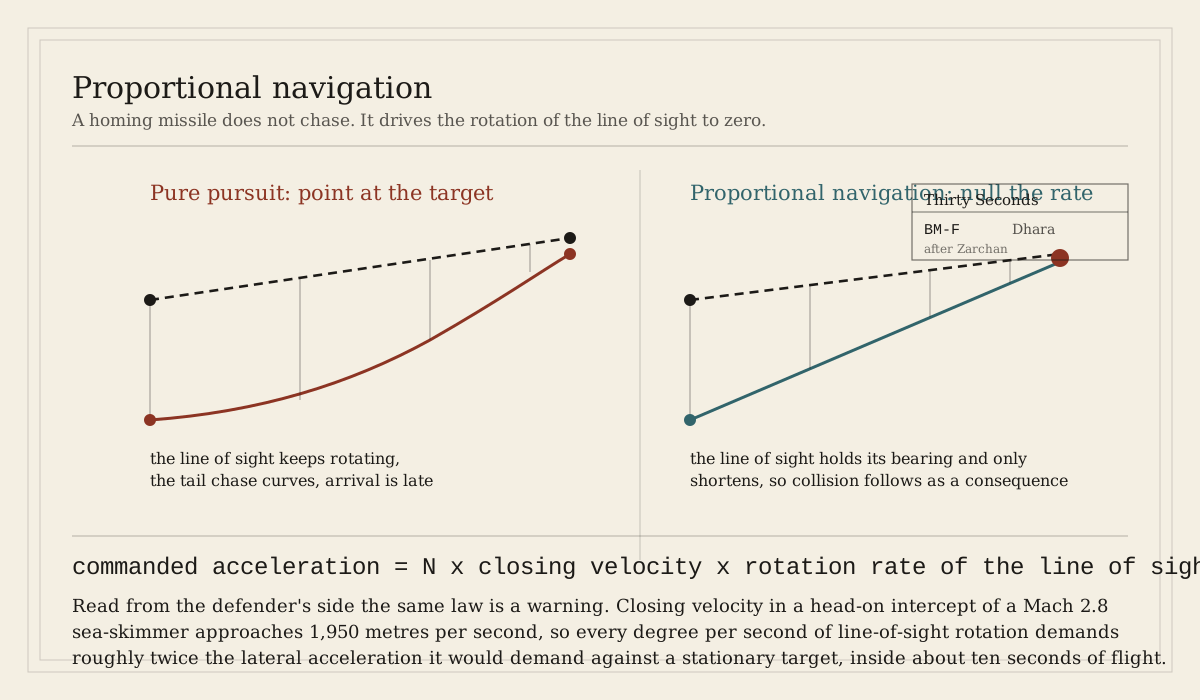
Proportional navigation, and the same law read from the defender's side. A homing missile steers to null an angular rate rather than to point at anything; an interceptor doing the same against a Mach 2.8 target must do it at nearly twice the closing velocity and in a tenth of the time. Delete this line after inserting the image node.
A homing missile is not chasing anything. It is nulling an angular rate, and the impact is a by-product of having done so.
The same equation, read from the other side
Now apply the identical law to an interceptor attempting to engage a BrahMos, and the difficulty of the defensive problem falls out of it.
The commanded acceleration is proportional to closing velocity. In a head-on engagement between an interceptor flying at, say, one thousand metres per second and a missile approaching at 950, the closing velocity is about 1,950 metres per second. Every degree per second of line-of-sight rotation therefore demands roughly twice the lateral acceleration that the same rotation would demand against a stationary target.
Two consequences follow directly.
First, time is desperately short. An interceptor launched when the target is twenty kilometres out has about ten seconds of flight before the engagement is decided, and much of the first second or two is spent leaving the launcher and acquiring.
Second, any manoeuvre by the target must be answered with a multiple of it. If a terminal weave imposes even a modest lateral acceleration on the incoming missile, the interceptor must generate the navigation constant times that figure to correct, which for N of four means four times the target's manoeuvre, on top of whatever acceleration the basic intercept geometry already demands. Interceptors are built to pull very high accelerations for exactly this reason, and at low altitude they can, because there is dense air for their fins to work against. This is one of the few respects in which the sea-skimming profile helps the defender.
Circular error probable
Accuracy claims are quoted as circular error probable, and the term is routinely misunderstood.
Circular error probable is the radius of the circle, centred on the aim point, within which half of all impacts fall. It is a median, not a maximum. Half of the rounds land outside it.
Impact dispersion is generally modelled as a two-dimensional Gaussian, from which the radial miss distance follows a Rayleigh distribution. The standard deviation relates to the circular error probable by division by 1.1774. The probability of landing within any radius is then one minus the exponential of minus that radius squared, divided by twice the variance.
Working a stated circular error probable of five metres
| Radius from aim point | Probability of impact within it |
|---|---|
| 5 metres, the circular error probable itself | 0.500 |
| 10 metres, twice it | 0.938 |
| 15 metres | 0.996 |
| 20 metres | Effectively certain |
The practical reading is what matters. Against a target with a dimension of twenty metres or more, which describes a hardened shelter, a hangar, a runway intersection or a command building, a weapon with a five-metre circular error probable strikes the structure essentially every time. Against a point target of a few metres, a vehicle or a single aperture, it strikes it about half the time and a second round is required.
Contested Manufacturer accuracy figures for any missile are promotional as well as technical, and independent verification of terminal accuracy is scarce for every system in this class. What the arithmetic shows is that even a considerably looser figure than the one claimed would be sufficient for the target set actually engaged.
Measured Against the World
Claims of primacy are cheap. The useful exercise is to place the weapon beside the systems it would actually meet, state honestly where it leads and where it does not, and let the comparison stand.
The subsonic school
The Tomahawk is the reference weapon of the subsonic school and remains, by a wide margin, the most combat-proven cruise missile ever fielded. Current blocks reach well beyond two thousand kilometres, loiter over a target area, accept retargeting in flight, and cost little enough to be fired in quantity. Against fixed targets in a permissive environment it is close to the ideal instrument.
Its weakness is the one the arithmetic already exposed. It arrives slowly, and against a modern layered defence with warning aloft, slow arrival means the defender gets his full sequence and often a second attempt.
The Naval Strike Missile and its air-launched sibling occupy a different corner of the same school. They are subsonic, but shaped and coated for a small radar cross-section, and they navigate terminally by comparing what a camera sees against a stored image rather than by radiating radar energy that announces their presence. Against a target that must be identified precisely among several ships, that approach has real merit. The American LRASM extends the philosophy further, adding autonomy in target selection.
The subsonic school's bet is the opposite of the Bharatiya one. It bets on not being seen. BrahMos bets on being seen too late.
The supersonic school
The Russian Kalibr family, in its various anti-ship and land-attack forms, adopts a hybrid answer that deserves respect: subsonic cruise for range and economy, then a supersonic sprint in the final stretch to compress the terminal engagement. It attempts to buy both properties by paying for each only where it matters.
Chinese development runs along parallel lines and at considerable scale. Supersonic anti-ship weapons in the YJ series, some air-launched and some ship-launched, combine long reach with terminal speed, and the associated anti-ship ballistic weapons pursue the same objective by an entirely different physical route.
Taiwan's Hsiung Feng III is the closest analogue to BrahMos in concept, a ramjet-powered supersonic anti-ship missile fielded by a smaller power that has concluded, for the same geographic reasons, that speed is what it needs to buy.
The hypersonic frontier
Above all of these sits a category that is genuinely faster and genuinely less mature. The Russian Zircon is the most-discussed example, a scramjet-class weapon claimed to operate at speeds several times those of BrahMos.
A scramjet is a ramjet in which the airflow through the combustor remains supersonic rather than being slowed to subsonic speeds before burning. Igniting and sustaining combustion in air moving at those velocities has been compared to keeping a match alight in a hurricane. It is why hypersonic air-breathing propulsion has taken so much longer to field than the confident announcements suggested it would.
Contested Claimed hypersonic performance figures across all national programmes, Russian, Chinese and American alike, should be treated as claims. Very few have been independently verified, and the gap between a demonstrated test article and a reliable fielded weapon in numbers has been the graveyard of many programmes. Development of a hypersonic successor within the BrahMos joint venture has been discussed for well over a decade and remains, on the public record, prospective.
Where it stands
BrahMos placed against comparable systems on the properties that matter
| Property | Where BrahMos stands |
|---|---|
| Speed | At or near the front rank of anything in operational service, exceeded only by weapons whose fielded maturity is unproven |
| Range | Mid-field and structurally limited by the propulsion choice; comprehensively out-reached by the subsonic school |
| Stealth | Not a strength and not intended to be |
| Accuracy | Demonstrated against specific structures in combat conditions |
| Cross-service commonality | Close to unmatched anywhere in the world |
| Magazine depth per platform | A weakness, imposed by size and weight |
| Unit cost | High compared with subsonic weapons, low compared with hypersonic development programmes |
| Combat proof | Demonstrated at scale in 2025, which very few weapons in its class can claim |
| Export availability | Actually purchasable, which several superior paper systems are not |
The honest verdict is that BrahMos is not the longest-ranged cruise missile in the world, nor the stealthiest, nor the cheapest, nor the newest. It is the most mature and most widely fielded supersonic strike weapon in service, the only one common to all three services of a major power, and one of very few in its class that has been fired in anger at defended targets and observed to work.
Maturity beats novelty. A weapon that exists in regiments, on ships, under wings, in numbers, with trained crews and a working supply chain, outranks a superior weapon that exists in a press release.
Can It Be Stopped
The question is asked constantly and answered badly in both directions. The manufacturer's own literature has described the weapon as non-interceptable by any known system. Adversary commentary insists routinely that it is trivially handled. Neither statement survives contact with the physics.
What interception actually requires
To stop an incoming missile, six things must all succeed, in sequence, inside the time available. Failure at any one of them ends the attempt.
The interception chain and where a supersonic sea-skimmer attacks it
| Link | Requirement | Effect of a supersonic sea-skimming profile |
|---|---|---|
| Detect | The target must be within radar line of sight and distinguishable from clutter | Attacked directly: horizon geometry delays detection to roughly 31 kilometres |
| Track | Successive returns must resolve a course and speed accurate enough to shoot at | Compressed: fewer sweeps available before impact |
| Classify and decide | Hostile intent established and authority to fire given | Compressed to seconds |
| Commit | An interceptor assigned and launched with fire control cued | Compressed |
| Fly out | The interceptor must physically reach a target closing at 950 metres per second | Severely compressed: closing geometry consumes the interceptor's flight time |
| Kill | Warhead detonation close enough, and lethal enough, to defeat a heavy hardened body | Hard: the target is massive, fast, and structurally robust |
The last link deserves emphasis, because it is routinely ignored. Many interceptors kill by fragmentation, spraying metal into the path of a target and disabling it. A light, thin-skinned subsonic missile is destroyed by that treatment. A three-tonne hardened body travelling at 950 metres per second may be damaged and continue on ballistically into the target anyway, because its momentum does not care whether its guidance still works. Achieving a hard kill requires either a hit-to-kill interceptor or a very close, very energetic detonation.
Layers, and honesty about them
A serious defence does not consist of one interceptor. It consists of layers, each covering the failures of the one outside it.
The outer layer belongs to long-range systems such as the S-400 family, the Aegis combination of radar and standard missiles, and comparable national equivalents. Against a high-flying target these are formidable. Against a sea-skimmer they are largely irrelevant until the target crosses the horizon, at which point their long reach is wasted.
The middle layer belongs to medium-range point-defence weapons, and this is where a sea-skimmer is genuinely at risk. Systems in the class of Barak-8, the Evolved Sea Sparrow and their equivalents are designed precisely for fast low targets at short notice, and they are quick to react.
The inner layer is the close-in weapon system, a radar-directed rotary cannon throwing a wall of metal across the last kilometre or two. Against a target arriving at 950 metres per second, the engagement window is a fraction of a second, and even a successful hit may only convert a guided missile into an unguided one still travelling towards the ship at nearly a kilometre a second.
Outside all of these sits the soft-kill layer: chaff to present false radar targets, decoys, and jamming aimed at the missile's seeker. Against a radar-homing weapon this is frequently the most effective single measure available, and it is the least discussed.
Settled Every one of these layers has non-zero probability of success. The relevant question is never whether interception is possible. It is what fraction of a salvo gets through, and whether that fraction is enough to accomplish the mission. Against a defended target, some BrahMos would be stopped. The attack is not designed on the assumption that none would be.
The S-500 question
Which brings the argument to the system most often invoked as the answer.
The S-500, designated Prometheus, is the most advanced air and missile defence system Russia has fielded. Almaz-Antey developed it as a strategic complement rather than a replacement to the S-400, and Russian announcements have placed its first regiment on combat duty, with an engagement envelope cited at around six hundred kilometres and a design brief aimed at ballistic missiles, hypersonic vehicles, and targets in near space, including satellites in low orbit. Reports have credited it with a substantially reduced reaction time compared to its predecessor.
Every one of those figures is real, and almost none of them is relevant to a sea-skimming supersonic cruise missile. Understanding why is the most valuable thing in the whole discussion.
The S-500 is optimised for the wrong problem. Its design case is a target that is very fast, very high, and arriving on a trajectory that a long-range radar can see coming for a considerable time. A ballistic warhead entering from near space is visible at enormous range precisely because it is at altitude. That visibility is what makes the long engagement envelope useful: a six-hundred-kilometre interceptor is worth having only against a target that can be detected at six hundred kilometres.
A BrahMos flying at ten metres cannot be detected at six hundred kilometres by any ground-based radar, no matter how large, because of the equation in the earlier section. The interceptor's reach is not the binding constraint. The sensor's horizon is. A six-hundred-kilometre interceptor cued by a thirty-kilometre detection is a thirty-kilometre system.
The S-500's difficulty against a sea-skimmer is geometry, not interceptor performance. The problem is not that its missiles are too slow. The problem is that the earth is round.
Contested Two further qualifications are owed. First, the operational maturity of the system remains substantially unverified in open sources, and its combat record against cruise missiles specifically is not established. Second, integration matters more than any single component: an S-500 fed by airborne early warning aircraft, aerostats and a networked sensor grid is a different proposition from an S-500 relying on its own ground radars, and Russian doctrine assumes the former.
The correct conclusion is therefore neither of the popular ones. BrahMos is not uninterceptable. It is a weapon that attacks the sensor layer rather than the interceptor layer, which is why the counter to it is not a better missile but a better sensor, put somewhere high, and kept there.
The Mathematics of Stopping
The interception discussion earlier concluded that the question is never whether interception is possible but what fraction of a salvo arrives. That fraction can be computed, and computing it is more instructive than any assertion.
Single-shot kill probability and the shoot-look-shoot cycle
Give a defending system a single-shot kill probability of 0.7 against a supersonic sea-skimmer, which is a generous figure for a difficult target. Firing two rounds at one incoming missile leaves a survival probability of 0.3 times 0.3, or 0.09.
Nine per cent leakage per engaged target sounds acceptable. It is not the number that decides the outcome, because the binding constraint is not accuracy. It is capacity.
Working a salvo
Take a defended installation with four simultaneous fire-control channels and an engagement cycle of six seconds from commitment to assessment. Detection occurs at the thirty-one kilometre horizon, giving thirty-three seconds. Allow twelve seconds for detection, track formation, classification and the decision to fire, which is not generous.
That leaves twenty-one seconds of engagement time, which at six seconds a cycle is three cycles. Three cycles across four channels gives twelve engagement opportunities.
Eight incoming rounds against twelve engagement opportunities
| Quantity | Value |
|---|---|
| Missiles in the salvo | 8 |
| Rounds required for a two-shot engagement of each | 16 |
| Engagement opportunities available in the time window | 12 |
| Missiles engaged twice | 6 |
| Missiles not engaged at all | 2 |
| Expected leakers from those engaged twice | 6 times 0.09, or 0.54 |
| Expected total arrivals | About 2.5 |
Two and a half arrivals out of eight, against a defence with a seventy per cent single-shot kill probability, which is to say against a good defence that is working correctly.
Saturation does not defeat a defence by being better than it. It defeats a defence by arithmetic, and the arithmetic is a division of the available seconds by the seconds each engagement consumes.
Now run the same installation against eight subsonic missiles. The detection window becomes 129 seconds. Allowing the same twelve seconds of overhead leaves 117 seconds, or nineteen cycles, or seventy-six engagement opportunities against a requirement of sixteen. Every incoming round is engaged twice with capacity to spare, and expected leakage falls to 8 times 0.09, or 0.72.
The same defence against the same salvo size at two speeds
| Quantity | Supersonic salvo | Subsonic salvo |
|---|---|---|
| Detection window | 33 seconds | 129 seconds |
| Engagement cycles available | 3 | 19 |
| Engagement opportunities | 12 | 76 |
| Rounds required for two-shot engagement of eight | 16 | 16 |
| Expected arrivals | About 2.5 | About 0.7 |
Settled Between the two columns nothing changed about the defender's radar, interceptors, crew or kill probability. The only variable altered was the speed of the incoming weapon, and expected arrivals rose by a factor of three and a half.
That is the entire case for a supersonic cruise missile, expressed as a number rather than an adjective, and it is why the design bureau of 1998 accepted a collapsed range, a punishing thermal environment, a discarded booster, a hot and visible signature and a high unit cost, in exchange for one thing.
The Tenth of May
What preceded it
On the twenty-second of April, 2025, at Pahalgam in Kashmir, civilians were murdered in an act of terrorism whose organisers and sponsors were not in doubt. The response was named Operation Sindoor, and the choice of name was itself a statement, since sindura is what a married woman wears and what the widows made at Pahalgam had been stripped of.
On the seventh of May, Bharatiya forces struck nine locations of terrorist infrastructure in Pakistan and in Pakistan-occupied Jammu and Kashmir. The named targets included the Markaz Taiba complex of Lashkar-e-Taiba at Muridke, the Markaz Subhan Allah complex of Jaish-e-Mohammed at Bahawalpur, a Hizbul Mujahideen facility at Sialkot, the Markaz Ahle Hadith at Barnala, and a camp at Shawai Nalla near Muzaffarabad. The strikes were confined to terrorist infrastructure and were declared as such.
Over the eighth, ninth and tenth of May, Pakistan attempted retaliation against Bharatiya military installations, employing loitering munitions of Turkish origin, rocket artillery, and air-launched weapons. Bharatiya air defence, a layered arrangement of long-range systems, indigenous medium-range systems and dedicated counter-drone equipment, held. Settled The material damage inflicted on Bharatiya airbases by that phase was negligible, a conclusion since supported by satellite imagery rather than by claim.
Then came the tenth.
Three hours
Between roughly two and five in the morning, the Bharatiya Air Force flew coordinated waves of long-range precision strikes against Pakistani air bases, launching from within Bharatiya airspace. The weapons employed were BrahMos, the French SCALP-EG, and the Israeli-origin Rampage. Not one aircraft crossed the international boundary.
The targeting was not a raid on a base. It was the systematic dismantling of an air force's ability to operate, distributed deliberately across the whole depth of the country so that no regional command could be reinforced from another. Reporting has placed the number of bases struck at eleven, among them Nur Khan at Chaklala near Rawalpindi, Sargodha, Bholari, Jacobabad, Rafiqui, Murid, Sukkur and Rahim Yar Khan. Reporting in Bharatiya media has placed the number of BrahMos rounds expended at nineteen, with a comparable number of SCALP.
Nineteen missiles. Eleven bases.
Reported targets of the tenth of May and their function
| Base | Location | Function struck |
|---|---|---|
| Nur Khan | Chaklala, Rawalpindi | Air transport hub adjacent to the seat of military authority, with command and control functions |
| Murid | Chakwal district | Principal hub of medium-altitude long-endurance drone operations |
| Sargodha | Punjab | Major fighter base of long standing |
| Bholari | Sindh | Modern fighter base with high-value aviation assets |
| Jacobabad | Sindh | Forward operating base |
| Rafiqui | Shorkot, Punjab | Fighter base |
| Sukkur | Sindh | Operating base |
| Rahim Yar Khan | Punjab | Runway and facilities |
Why Nur Khan was the sentence
Of all of them, Nur Khan is the one that carried the message, and the message was not about Nur Khan.
The base sits at Chaklala, inside Rawalpindi, less than twenty-five kilometres from Islamabad and immediately adjacent to the infrastructure of Pakistan's military leadership. It is not a peripheral airfield. It is the airfield closest to the room where the decisions are taken, and to the organisation that holds custody of the country's nuclear arsenal.
A missile arriving there is not a tactical event. It is a demonstration, addressed to a specific audience at a specific address, that the address is reachable.
And here the arithmetic of the earlier section arrives in the physical world.
Rana Sanaullah, adviser to the Prime Minister of Pakistan, subsequently stated in a broadcast interview that when the BrahMos came in at Nur Khan the Pakistani military had thirty to forty-five seconds to determine whether the warhead was nuclear, and described the situation as dangerous. Settled The admission is on the record from the Pakistani side and requires no Bharatiya corroboration.
That statement is the entire design philosophy of the weapon, spoken aloud by the man it was pointed at.
Consider what those thirty seconds contained. A supersonic object, on a trajectory whose terminus was the neighbourhood of the national command authority, of a type known to be capable of carrying either a conventional or a nuclear warhead, and no means whatsoever of establishing which. The doctrine of nuclear deterrence assumes a decision-maker with time to decide. The physics of a supersonic cruise missile removes the time and leaves the decision.
The consequences, immediate and doctrinal
Within hours of the tenth of May, an understanding to halt military action across land, air and sea was announced by the Bharatiya Foreign Secretary. The sequence of events on the record is that Pakistan requested the cessation after the strikes of that morning.
Satellite imagery in the following weeks and months corroborated damage substantially beyond initial assessments. Analysts working from commercial imagery documented the demolition of a complex adjacent to the Nur Khan strike location, and repair work under concealment at Murid continuing into December.
Contested The wider battle-damage picture of the eighty-eight hours was contested from the first day, and the early international narrative, which leant heavily on Pakistani claims of Bharatiya aircraft losses and gave those claims uncritical circulation, has not held up. A reconstruction published in January 2026 by the Centre d'Histoire et de Prospective Militaires in Switzerland, working from operational data rather than early claims, found that Pakistani claims of damage to Bharatiya airbases were unsupported, and that the decisive phase was the coordinated strike waves of the tenth. The pattern is an old one: rapid claim-making by one side, restraint and silence by the other, and a slow correction by evidence that arrives long after the impression has set.
The chief executive of BrahMos Aerospace later described the weapon's performance as flawless against every assigned target. Manufacturer claim A manufacturer's assessment of its own product is not independent verification, and is recorded as what it is. What is not in dispute is that eleven bases were struck, that the strikes were attributed to the weapon in reporting on both sides of the frontier, and that the war stopped the same morning.
The doctrinal shift
The strategic significance of the tenth of May exceeds the damage inflicted.
For three decades Pakistan's strategic posture rested on a proposition: that its nuclear arsenal placed a ceiling on Bharatiya conventional retaliation, and that terrorism could therefore be conducted beneath that ceiling with acceptable risk. The proposition worked because it was never tested.
Operation Sindoor tested it. Deep conventional strikes were carried out against military targets across the whole depth of Pakistan, including the immediate environs of the national command authority, and no nuclear response followed. The ceiling was found to be higher than advertised, and the finding is now on the record for every future crisis to reason from.
Nuclear blackmail is a claim about what an adversary will not dare to do. It survives only as long as nobody dares.
Settled There is also a cost to that finding which honesty requires stating. A doctrine that relies on compressing an adversary's decision time to thirty seconds is a doctrine that removes the margin in which mistakes are caught. The same physics that made deterrence credible on the tenth of May makes miscalculation faster in every crisis that follows, on both sides of the frontier. The weapon did what it was designed to do. What it was designed to do is dangerous by construction.
The Belt
From buyer to seller
For most of its independent existence Bharata bought weapons. It bought them at bad prices, on the seller's schedule, with the seller's conditions attached, and with the constant knowledge that a supply line running through a foreign capital is a supply line that can be closed by a foreign decision. Bharata remains among the largest arms importers in the world and one of the largest military spenders, and the import dependence is not yet broken.
But something has changed at the margin that matters more than the aggregate, and BrahMos is the instrument of the change.
The Philippines
In January 2022, the Department of National Defence of the Republic of the Philippines signed a contract with BrahMos Aerospace, valued at approximately 375 million United States dollars, for shore-based anti-ship missile batteries. It was the first export order for the weapon and the largest single defence export order Bharata had ever secured.
Delivery began in April 2024, the first battery flown in by a Bharatiya Air Force transport aircraft, with subsequent batteries shipped by sea. The final consignment, configured in Philippine Marine Corps markings, was observed in 2026, completing the contract. The systems are operated by a coastal defence formation.
The configuration matters. These are not ship-launched weapons. They are trucks on the coast of an archipelago that fronts the South China Sea.
Vietnam and Indonesia
In May 2026 the sale of BrahMos to Vietnam was confirmed publicly by Bharatiya officials during the Shangri-La Dialogue.
In July 2026, during a visit by the Bharatiya Prime Minister to Jakarta, Indonesia was announced as a customer, an outcome preceded by years of negotiation and technical evaluation, with reported values in the range of several hundred million dollars, and by the expansion of manufacturing capacity at Lucknow specifically to serve domestic and export demand together.
Interest has been reported from Malaysia, the United Arab Emirates, South Africa, Chile, Thailand and others, with a proposal submitted to the UAE.
The constraint nobody mentions
There is a structural limit on the export programme that is rarely stated and is essential to understanding it. Because the weapon is a joint venture, it can only be sold to a country regarded as friendly by both Bharata and Russia.
That restriction is not a formality. It removes from the customer list every state whose alignment is exclusively Western, and it means the export map of BrahMos is drawn by the intersection of two foreign policies rather than one. It is also the strongest single argument for the Next Generation programme and for the progressive indigenisation of the missile's components: a weapon that is wholly Bharatiya is a weapon whose customers are chosen in New Delhi alone.
What the map means
Take the customers together and look at where they sit.
The export map and the water it overlooks
| Customer | Configuration | Water within reach |
|---|---|---|
| Philippines | Shore-based coastal defence batteries | The South China Sea, the Luzon Strait and the western approaches to the Philippine archipelago |
| Vietnam | Confirmed sale | The South China Sea along its entire western rim |
| Indonesia | Agreement announced 2026 | The North Natuna Sea, the Malacca approaches and the Indonesian archipelagic straits |
Laid on a chart, those three customers describe an arc along the southern and western edges of the South China Sea, each holding several hundred kilometres of water at risk from mobile launchers on their own sovereign territory.
Anti-access and area denial is the doctrine of making a body of water expensive for a stronger navy to enter. It does not require a fleet. It requires sensors, and missiles that outrange the intruder's weapons, fired from land that the intruder would have to invade in order to silence. It is the cheap answer to naval superiority, and China has spent two decades building the most extensive such system in the world in precisely these waters.
The strategic joke, and it is a serious one, is that Bharata is now selling anti-access weapons into the anti-access zone. Coastal states that could never contest the South China Sea with warships can contest it with trucks. A shore battery does not need to win a naval battle. It needs only to make the cost of a particular stretch of water unacceptable, and then to be difficult to find.
Why they are buying
The motive is not affection for Bharata. Regional analysts have been direct: the purchases are driven by the perception of Chinese pressure in the South China Sea, and in the Indonesian case by a specific dispute over the North Natuna Sea.
Bharata is being chosen for reasons that compound. It supplies a weapon of the first rank. It attaches no alliance obligation and no basing demand. It is a supplier without a colonial record in the region, which in Southeast Asia is not a small consideration. And it is a supplier that no purchasing state need fear becoming dependent upon in the way it might fear dependence on a great power.
The most significant thing about the BrahMos belt is not the missiles. It is that a group of states chose Bharata as the country to be armed by.
The Northern Frontier
Two mirrors
The strategic relationship between Bharata and China is often described as a competition. On the missile question it is better described as a pair of mirrors.
Bharata deploys BrahMos regiments along the northern frontier in Ladakh and in Arunachal, at ranges that hold Chinese forward airfields, road and rail heads, supply depots and command nodes on the Tibetan plateau at risk. The logic is precise. Chinese logistics across that plateau run on a small number of fixed, expensive, hard-to-replace nodes at extreme altitude, and a supersonic weapon that can reach them changes the arithmetic of any attempt to mass forces there.
China, in the same period, has supplied Pakistan with the aircraft, the air defence systems and the missiles that constitute the greater part of Pakistan's modern combat capability. In May 2025 Chinese-supplied equipment was in action on the western frontier.
Each state therefore arms the other's adversary, and each is deterred partly by weapons it has never seen.
The maritime dimension
The more consequential contest is at sea, and there BrahMos has a different significance.
Chinese naval presence in the Indian Ocean has grown steadily, in port access, in survey activity, in submarine deployments, in the infrastructure of what is generally called the string of pearls. The Indian Ocean is not a peripheral theatre for China; the greater part of its energy imports transit it, through the chokepoints at Hormuz and Malacca.
A Bharatiya navy equipped with supersonic anti-ship weapons across its frontline fleet, and with shore batteries that can be moved to the Andaman and Nicobar islands astride the western approach to the Malacca Strait, is a navy that holds the most important commercial artery in Asia at risk.
Settled That is the deepest strategic fact in the relationship and it is geographic rather than technological. China's maritime lifeline passes through water that Bharata sits upon. No amount of shipbuilding relocates the Andaman Islands.
The export dimension
The export programme adds a second front to the same competition, and it is the one Beijing is likely to find most irritating.
For two decades China's regional strategy has rested on bilateral asymmetry: dealing with Southeast Asian claimants one at a time, each too small to resist alone. That strategy is complicated considerably when the small states acquire weapons that make their own coastlines dangerous, from a supplier whose relationship with Beijing gives no leverage over the sale.
Speculative Whether the belt materially alters Chinese behaviour in those waters is not yet demonstrable, and prudence suggests it will alter calculation at the margin rather than transform the balance. A shore battery is a real capability and it is not a fleet.
The Western Frontier
The problem BrahMos was asked to solve
The military problem on the western frontier has a peculiar shape. Pakistan is narrow. Its strategic depth from the frontier to the Indus corridor, where its principal bases, its main north-south communications and its centres of decision all sit, is small. Almost the entire military infrastructure of the country lies within a few hundred kilometres of Bharata.
Under a subsonic strike regime this geography was survivable, because subsonic weapons take long enough in flight for warning to be given and aircraft to be dispersed. Under a supersonic regime the same geography becomes acute. Flight time from a launch point inside Bharatiya airspace to a target in the Indus corridor is measured in minutes, and the interval between the target's radar seeing the weapon and the weapon arriving is measured, as the tenth of May established, in tens of seconds.
The result is that Pakistan cannot use depth to buy time, because it does not have depth, and cannot use warning to buy dispersal, because it does not get warning.
Deterrence by punishment
Two things must be distinguished, and their conflation causes most of the confusion in commentary on South Asia.
Two forms of deterrence and what each requires
| Form | Proposition | What it requires |
|---|---|---|
| Deterrence by denial | An attack will not succeed | The ability to defeat the attack physically, which is expensive and unreliable |
| Deterrence by punishment | An attack will be answered at a cost exceeding its value | The ability to reach what the adversary values, reliably, at a time of choosing |
Bharata cannot practise deterrence by denial against terrorism, because terrorism is not the kind of attack that can be physically prevented at a frontier of that length. What BrahMos supplies is deterrence by punishment, and specifically punishment that can be delivered without crossing the frontier, without risking aircrew, and without the escalation ladder that an air raid over hostile territory necessarily climbs.
That last property is the crucial one and it is widely misunderstood. Because the aircraft never crosses the boundary, and because the weapon is precise enough to strike a specific structure rather than an area, the response can be calibrated. It can be made proportionate, targeted at military infrastructure, and terminated cleanly. A capability that can be used in a measured way is more credible than one that can only be used totally, and credibility is the whole of deterrence.
The ninth of March, 2022
There is an episode in the record that a partisan account would omit and an honest one must include.
On the ninth of March, 2022, during routine maintenance at a unit in Haryana, a BrahMos was fired accidentally. It flew into Pakistan and came down near Mian Channu in Khanewal district, in Pakistani Punjab, damaging property. There were no casualties. The missile carried no warhead.
Pakistan tracked it through its flight and lodged a strong protest. Bharata described the incident as deeply regrettable and constituted a Court of Inquiry, which found that deviation from standard operating procedures by three officers had caused the launch. On the twenty-third of August, 2022, the services of all three were terminated with immediate effect, an unusually severe step, and the standard operating procedures for operation, maintenance and inspection of the system were revised. Pakistan rejected the closure and continued to demand a joint investigation, which was declined.
The episode deserves recording for three reasons.
First, accountability was real and public. An inquiry was completed within six months, responsibility was fixed at the level of the officers who had deviated from procedure, and the outcome was announced rather than buried.
Second, it demonstrated the danger the weapon's own physics creates. Pakistani air defence had minutes rather than seconds in that instance, and the object was correctly assessed as not constituting an attack. Had the assessment gone the other way, a maintenance error would have begun a war between two nuclear-armed states. Wars have been started by less.
Third, it is a reminder that the property which makes the weapon effective, the compression of an adversary's decision time, is not a property that can be switched off for accidents.
Settled A weapon that leaves an adversary thirty seconds to decide leaves that adversary thirty seconds to decide whether the launch was deliberate. The system does not distinguish between an act of policy and a violated checklist.
What changed in 2025
Before Operation Sindoor, the strategic proposition on the western frontier was that terrorism could be sponsored beneath a nuclear ceiling. After it, the proposition is that the ceiling sits considerably higher than had been advertised and that the cost of finding out is levied on airbases across the whole depth of the country within seventy-two hours.
Whether that changes behaviour over the long term is a question the record has not yet answered. What can be said is that the doctrine of the last three decades was tested for the first time and did not perform as its authors had promised.
A Nation That Builds
What the object actually represents
Strip away the geopolitics and consider the object.
A country that in 1947 could not manufacture a rifle barrel to standard now co-designs, manufactures and progressively indigenises a supersonic cruise missile of the first rank. It holds the controlling stake in the design authority. It has integrated the weapon across three services. It has fired it in combat against a defended adversary and observed it work. And it is selling it to three sovereign states in a region where the alternative suppliers are the great powers.
The engineering underneath is not borrowed. The ramjet, the airframe that survives Mach 3 at low level, the seeker, the guidance chain, the navigation constellation that corrects it, the software, and the industrial base at Lucknow that produces it at rate, represent competences that cannot be purchased and can only be accumulated.
The right frame
There is a habit in commentary of treating Bharatiya achievement as surprising, as though the natural condition of the civilisation were dependence and each departure from it required explanation. The frame is wrong and it is worth naming.
Bharata was among the great manufacturing civilisations of the world for most of recorded history, in metallurgy, in shipbuilding, in textiles, in mathematics and in astronomy, and the interruption of that condition was an event with a date and a cause rather than a natural state. What is happening in the missile programme is not an anomaly requiring explanation. It is a resumption.
The tradition itself never treated the making and holding of arms as separate from dharma. The kṣatriya's weapon is not incidental to his obligation; it is the instrument of it. A civilisation that produced the Dhanurveda as a limb of learning did not regard the science of arms as beneath scholarship. It regarded the unwillingness to defend as the failure.
What it does not settle
Restraint is owed at the close.
A missile is not a strategy. It is an instrument, and instruments do not decide what they are used for. The BrahMos did not create the conditions on the western frontier and cannot resolve them. It did not create Chinese pressure in the eastern seas and will not remove it. The belt of customer states is a diplomatic achievement whose consequences will be determined by diplomacy, not by ordnance.
And the weapon's central virtue is inseparable from its central danger. Thirty seconds is the reason it works. Thirty seconds is also the reason that every future crisis in the subcontinent will be conducted at a tempo that removes the margin in which errors are caught, misidentifications corrected and tempers cooled. That was true on the ninth of March, 2022, when a checklist failure flew across a frontier, and it was true on the tenth of May, 2025, when an operations room outside Rawalpindi had half a minute in which to guess.
The Brahmaputra is patient and it is not gentle. It drowns what stands in the channel it has chosen and it does not consult about the choosing. A civilisation that names its weapon after that river has said something accurate about the weapon and something more uncomfortable about the age it is being used in.
The capability was necessary. Its acquisition was overdue. Neither of those facts makes the world it produces a safer one, and a serious civilisation is capable of holding both propositions at once.
The Corpus
The account above was built from the following bodies of material. Where a claim rests on a single interested source it has been marked in the text rather than in this list.
Primary and official
Primary and official sources
| Source | Material drawn from it |
|---|---|
| BrahMos Aerospace Private Limited, product literature and public statements | Two-stage architecture, ramjet sustainer, cruise speed, published range envelopes, service integration across the three services, statements by the chief executive on performance in 2025 |
| Ministry of Defence, Government of Bharata, press releases and parliamentary statements | The 2022 export contract with the Philippines, the 2022 accidental firing and the outcome of the Court of Inquiry, procurement approvals for naval rounds, defence export targets |
| Indian Air Force statement of 23 August 2022 | Findings of the Court of Inquiry into the accidental firing and the termination of three officers |
| Ministry of External Affairs statements, 7 to 10 May 2025 | The declared target set of the opening strikes and the announcement of the cessation of military action |
| Government of Pakistan, Ministry of Foreign Affairs statements, March and August 2022 | The Pakistani account of the Mian Channu incident and the rejection of the Bharatiya inquiry's closure |
Propulsion, aerodynamics and guidance
Technical literature underlying the physics sections
| Work | Relevance |
|---|---|
| Philip G. Hill and Carl R. Peterson, Mechanics and Thermodynamics of Propulsion | Ramjet thermodynamic cycle, intake compression, the absence of static thrust, the operating band above Mach 2 |
| Nicholas Cumpsty, Jet Propulsion | Comparative treatment of compressor-driven and ram-compressed air-breathing cycles |
| William H. Heiser and David T. Pratt, Hypersonic Airbreathing Propulsion, AIAA Education Series | The distinction between ramjet and scramjet combustion, and why supersonic-combustion propulsion has proved so difficult to field |
| Paul Zarchan, Tactical and Strategic Missile Guidance, AIAA Progress in Astronautics and Aeronautics | Guidance phases, inertial drift, terminal homing geometry, interceptor closing-velocity problems |
| Merrill I. Skolnik, Introduction to Radar Systems | The four-thirds-earth radar horizon relation, sea clutter at low grazing angles, and the detection limits governing sea-skimming targets |
Reference works on the systems compared
Reference and analytical works on missile and air-defence systems
| Work | Relevance |
|---|---|
| James C. O'Halloran, editor, IHS Jane's Weapons: Strategic | The BrahMos entry, the P-800 Oniks lineage, and the comparative cruise-missile field |
| Christopher F. Foss, Jane's Land Warfare Platforms: Artillery and Air Defence | The S-500 and the wider Russian ground-based air-defence family |
| Missile Defense Project, Center for Strategic and International Studies, Missile Threat database entries on BrahMos and on the S-500 Prometheus | Development chronology, repeated slippage in S-500 serial production, and the status of hypersonic successor programmes |
| Stockholm International Peace Research Institute, SIPRI Yearbook 2026 | Bharatiya military expenditure and arms-transfer standing |
The events of May 2025
Reporting and assessment of Operation Sindoor
| Source | Material drawn from it |
|---|---|
| Hindustan Times reporting, June 2025 | The count of nineteen BrahMos rounds and eleven Pakistani airbases, and the accompanying account of the air-defence engagement |
| Centre d'Histoire et de Prospective Militaires, Switzerland, reconstruction published 15 January 2026 | Operational reconstruction of the eighty-eight hours, the timing of the strike waves between two and five in the morning of 10 May, the weapons employed, and the finding that Pakistani claims of damage to Bharatiya airbases were unsupported |
| Broadcast interview with Rana Sanaullah, adviser to the Prime Minister of Pakistan, 2025 | The statement that the Pakistani military had thirty to forty-five seconds to determine whether the warhead at Nur Khan was nuclear |
| Commercial satellite imagery analysis by Damien Symon and The Intel Lab, May 2025 onward | Assessment of damage at Nur Khan beyond initial estimates, and repair activity under concealment at Murid into December 2025 |
| Prasar Bharati News Services reporting, May and December 2025 | Imagery-based assessments of Nur Khan and Murid |
| Deccan Herald reporting on the Pakistani document concerning Operation Bunyan-um-Marsoos | The Pakistani enumeration of targets struck, useful as an adversary's own accounting |
The export programme
Reporting on the export programme
| Source | Material drawn from it |
|---|---|
| Reuters reporting, 2022 to 2026 | The Philippines contract, the protracted Indonesian negotiation, and the March 2026 Indonesian confirmation |
| The Tribune, January 2022 | The signature of the first export contract and its value |
| Business Standard and Hindustan Times, April 2024 and April 2025 | First and second delivery batteries to the Philippines, by air and by sea respectively |
| The Week, May 2026 | Confirmation of the Vietnamese sale at the Shangri-La Dialogue, and the constraint that sales require a customer friendly to both Bharata and Russia |
| CNBC, July 2026 | The Indonesian agreement announced in Jakarta, and regional analysis of the motives of purchasing states |
| The Defense Post, October 2025 | Export orders announced by the Defence Minister without disclosure of customers |
Air defence
Sources on the interception question
| Source | Material drawn from it |
|---|---|
| Russian Ministry of Defence announcements, December 2025 | The entry of the first S-500 regiment into combat duty |
| Almaz-Antey public statements | Serial production claims and reaction-time comparisons against the S-400 |
| Missile Defense Project, CSIS, S-500 entry | Programme delays across four announced production dates, and the unverified status of claimed anti-hypersonic capability |
A note on the sources for May 2025
Accounts of the eighty-eight hours divide sharply by origin, and no reader is served by pretending otherwise. Pakistani official claims, Bharatiya official statements, and early international reporting that leaned on the former, cannot all be correct. Where the account above states something as settled, it rests either on an admission from the side it disadvantages, on commercial satellite imagery which is indifferent to both governments, or on the January 2026 operational reconstruction. Where it rests on interested reporting, it is marked.
0 responses