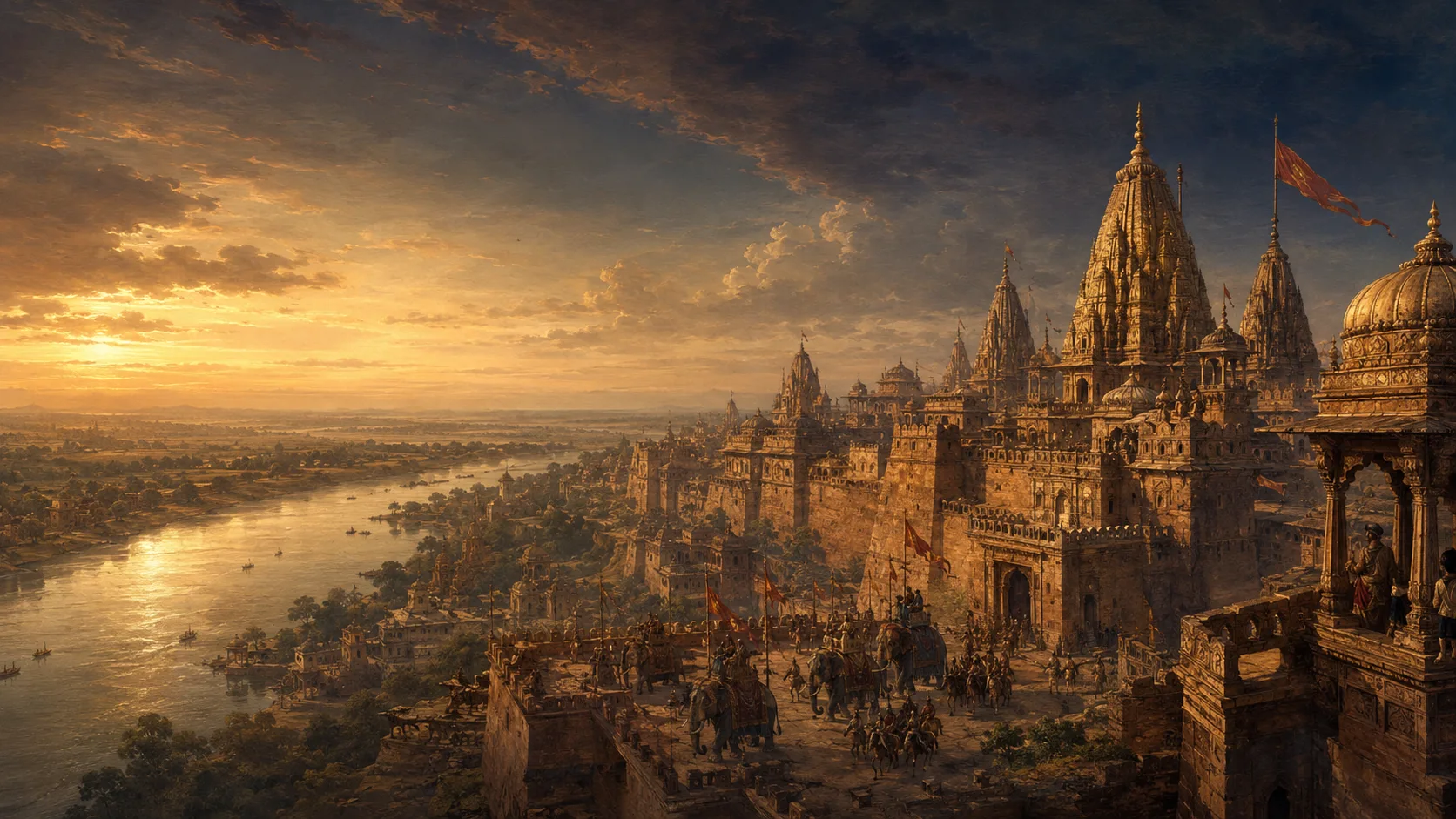
There is a particular kind of city that history keeps returning to, as though the land itself insists that power be exercised from one spot. In the Ganga–Yamuna doab, on the high bank where the river bends, that spot was Kanyakubja — the city the Persians would later flatten into "Kanauj." To sit on its throne was to claim the title that mattered above all others in early-medieval India: Maharajadhiraja of Aryavarta, great king over the kings of the northern heartland. Three of the most formidable dynasties of the age would spend two hundred years killing one another for the privilege.
This is the story of that city — why it mattered, who held it, and how its rulers became, for a crucial span of three centuries, the principal shield behind which the older civilisation of the Sanatana Dharma continued its life. It is also the story of how that shield was worn down: not by a single blow, but by the slow attrition of brothers fighting brothers while a new and patient enemy gathered on the western horizon.
The City That Was a Claim
Kanauj is old in the way few places are old. In the Vedic geography it appears as Kanyakubja, capital of one of the great Panchala realms; the Mahabharata knows it; the Chinese pilgrim Xuanzang, who walked through it in the seventh century, measured its circuit and recorded its monasteries and Brahmanical schools with the careful eye of a man who knew he was in a centre of learning. The very name carried weight far beyond the walls. By the medieval period the term Kanyakubja meant not only the city but the surrounding territory and even the kingdom of which it formed the core, while the Persian chronicler Rashid-ud-din recorded that for his countrymen "Kanauj" simply stood for Madhyadesha, the Middle Land — one of the nine traditional divisions of Bharata.
What made the city a prize was geography married to memory. It commanded the upper Ganga valley and the trade that moved along it; it lay at the meeting of routes; and crucially, it had been the seat of Harsha, the last emperor to hold the north together. To take Kanauj was therefore to inherit a claim. The throne came pre-loaded with imperial meaning, and that meaning was worth more than the revenue of any single province.
Settled — Kanauj's identity as the imperial capital of north India is firmly attested. Harshavardhana (r. 606–647 CE) shifted the seat of northern empire from Magadha to Kanyakubja, the first such westward shift in centuries, and made it his administrative and political core. Xuanzang's first-hand account independently confirms the city's scale and prominence in the 630s–640s.
From the Maukharis to Harsha
Before Harsha, Kanauj had belonged to the Maukharis, a vigorous line whose kingdom under Avantivarman stretched from Thanesar in the west to the Nalanda district in the east. The Maukharis and the Pushyabhuti (Vardhana) house of Thanesar bound themselves by marriage — the Pushyabhuti princess Rajyashri was wed to the Maukhari king Grahavarman — and it was the murder of Grahavarman by Devagupta of Malwa, and the capture of Rajyashri, that drew the young Harsha into the field. He rescued his sister, absorbed the Maukhari inheritance, and in 606 took the throne at Kanyakubja.
Harsha's empire covered much of north and north-western India, reaching toward Kamarupa in the east and the Narmada in the south. His one great check came from the south, where the Chalukya emperor Pulakeshin II held the line on the Narmada and denied Harsha the Deccan. But within Aryavarta, Harsha was paramount, and his court — recorded by Banabhatta in the Harshacharita and by Xuanzang in the Si-yu-ki — became the model of what a Kanauj king should be: a warrior, a patron, a protector of dharma and of learning alike.
When Harsha died without an heir in 647, the throne of Aryavarta did not simply pass to a successor. It became an open question — and the answer would be settled in blood.
The Long Anarchy and a New Enemy
Harsha's death opened a century of confusion in the north. Kanauj passed to a minor line, the Ayudhas; Bengal sank into the lawlessness the Sanskrit sources called matsya-nyaya, "the law of the fishes," in which the strong devoured the weak. Into this fractured landscape, in the early eighth century, came a force the subcontinent had not faced before.
The Arab Caliphate had taken Sindh in 712 under Muhammad bin Qasim. For a generation the conquest seemed contained to the lower Indus. Then, in 738, the Sindh governor Junaid launched a deep raid — splitting his army to plunder southern Rajasthan, western Malwa, and Gujarat. This was not a border skirmish. It was a probe aimed at the heart of western India, and the question of the age was suddenly posed: would the Caliphate's eastward advance, which had swallowed Persia and was pressing on Central Asia, roll on into the Gangetic plain as well?
It did not. And the reason it did not is one of the most consequential and least celebrated facts of Indian history.
Nagabhata I and the Wall in the West
The army that Junaid sent east reached Avanti — the Malwa country around Ujjain. There it met a ruler of the Gurjara-Pratihara house named Nagabhata I, and there it was broken. The southern arm of the same Arab thrust, pushing into Gujarat, was repulsed at Navsari by the Chalukya viceroy and the Rashtrakutas. Between them, these defeats of 738 sealed the eastern frontier of the Caliphate's Indian ambitions for centuries.
The memory of it was preserved in the dynasty's own voice. The Gwalior inscription of Nagabhata's descendant Mihira Bhoja records that Nagabhata "crushed the large army of the powerful Mlechcha king" — the Arab governor's host of Syrian cavalry, Sindhi levies, and Turkic mercenaries. The Arab geographer al-Baladhuri, writing from the other side, confirms that the governor of Sindh was driven back. The Pratiharas had found their founding purpose.
Settled — The Arab advance into India was checked in the west in the 730s–740s by a combination of Indian powers, with Nagabhata I of the Pratiharas repulsing the eastern arm at Avanti and the Chalukya–Rashtrakuta forces stopping the southern arm at Navsari. This is corroborated from both sides: Indian inscriptions (Gwalior, Nausari copper plate) and the Arab historian al-Baladhuri.
Characterization — To call the Pratiharas "the shield of India" or "the defenders of Sanatana Dharma" is an interpretive frame, not a fact the sources state in those words. The dynasty's own inscriptional epithet was mlechcha-nivaha-nivapana — roughly, "destroyer of the host of barbarians." The judgement that they protected a civilisation is reasonable given the outcome, but it is a reading of consequences, and contemporaries fought for the throne of Kanauj as much as for any creed.
The Three-Cornered War
By the late eighth century, three great powers had risen out of the wreckage of Harsha's empire, and all three understood that legitimacy in the north ran through Kanauj. The Sanskrit and modern sources alike call the contest that followed the Tripartite Struggle, or simply the Kannauj Wars — a two-century slow-motion collision among the Gurjara-Pratiharas of the west, the Palas of Bengal in the east, and the Rashtrakutas of the Deccan in the south.
The shape of it was almost geometric. The Pratiharas would seize Kanauj; the Rashtrakutas would erupt out of the Deccan, cross the Narmada, and humble whoever held it; the Palas would push west from Bengal to claim it for themselves; and the cycle would turn again. The first phase opened around 790, when the Pratihara king Vatsaraja defeated the Pala emperor Dharmapala near Prayaga — only for the Rashtrakuta Dhruva to cross the Narmada and defeat Vatsaraja in turn, then withdraw south, leaving the field to the Palas.
Nagabhata II Wins the Throne
The struggle's first great resolution came with Nagabhata II. He suffered an early, crushing defeat at the hands of the Rashtrakuta Govinda III — the Deccan armies were, again and again, the most dangerous force on the board. But Nagabhata II recovered. He reclaimed Malwa, drove east to take Kanauj from its ruler Chakrayudha (a Pala client), pushed the frontier as far as Bihar, and checked the Muslims of Sindh once more in the west. Around 816 the throne of Aryavarta was, decisively, Pratihara. Kanauj — now sometimes styled Mahodaya, "the Great Rising" — became their imperial capital.
It is worth pausing on what this meant. For the next century and more, the single most important political fact in northern India was that one dynasty held both the symbolic throne of the heartland and the military frontier against the west. The two roles reinforced each other. The legitimacy of Kanauj funded the armies; the armies guarded the realm whose centre Kanauj was.
Mihira Bhoja and the Zenith
The Pratihara empire reached its summit under Mihira Bhoja (Bhoja I), who reigned roughly from 836 to 885, and his son and successor Mahendrapala I. Under them the realm rivalled the Gupta empire in extent: from the border of Sindh in the west to Bengal in the east, from the Himalaya in the north to the country south of the Narmada. Bhoja was a devotee of Vishnu who took the title Adivaraha — the primordial Boar incarnation who, in the Puranic telling, lifts the drowning earth from the cosmic waters on his tusk. He stamped it on his coins. For a king who saw his task as raising and holding the land, no image could have been more deliberate.
It is here that the foreign testimony becomes precious, because it comes from observers with no reason to flatter. The Arab merchant Sulaiman, writing around 851, described the army of the Gurjara ruler in terms that have echoed down every history since. The king of Gurjara, he wrote, maintained great forces, and no other Indian prince had so fine a cavalry; and — the line that matters — among the princes of India he was the foremost enemy of the Muslims and their faith.
No other Indian prince has such fine cavalry. He is the greatest of the foes of the faith of Islam.
Two generations later, around 915–916, the Baghdad geographer al-Masudi travelled to Gujarat and recorded the same realm, which he called Al-Juzr (his rendering of "Gurjara") under a king he named Baura — almost certainly a mangling of the title Adivaraha. Al-Masudi marvelled at the scale of the kingdom and the size of its standing army, divided into great divisions and locked in perpetual war on three fronts: against the ruler of Multan in the north-west, the Rashtrakutas in the south, and the Palas in the east.
Contested — The size of the Pratihara army is genuinely uncertain. Some retellings of al-Masudi credit the dynasty with cavalry forces numbering in the hundreds of thousands — figures as high as seven or eight lakh appear in popular accounts. Medieval numbers of this kind are routinely inflated by chroniclers on all sides, and modern historians treat them as impressionistic testimony to a large and feared army rather than as a reliable count. The qualitative judgement — that the cavalry was exceptional and the kingdom vast — is well supported; the precise figures are not.
A Civilisation, Not Only an Army
The Pratiharas were not merely soldiers. Their century was a flowering. The great Sanskrit poet and dramatist Rajashekhara — author of the Karpuramanjari and the Kavyamimamsa — lived at the court of Bhoja's grandson Mahipala. The dynasty raised temples across the north, and the sculptural style of the period is one of the high achievements of medieval Indian art. There is a striking detail preserved in the Arab record: the Pratiharas sent scholars and embassies to the Caliph's court at Baghdad, where Indian mathematics and astronomy passed into Arabic learning — and from there, eventually, through the Moors into Europe. The dynasty that fought the Caliphate on the battlefield was, at the same time, exporting to it the decimal numerals and the science that would one day be called "Arabic." The frontier was a wall against armies and a membrane through which ideas still moved.
The Wall Is Worn Down
The tragedy of Kanauj is that it was undone less by its enemies abroad than by the structure of its own politics. The Tripartite Struggle had no winner in the long run; it had only survivors, and even they emerged exhausted. Every decade the three great powers spent grinding against one another was a decade in which none could consolidate, none could build the deep, durable state that might have weathered what was coming.
The first deep wound came from the south, as it so often had. Around 963 the Rashtrakuta emperor Krishna III drove north and sacked the Pratihara heartland. The dynasty never fully recovered. Its great feudatories — the very Rajput houses it had raised up: the Chandelas, the Chauhans, the Paramaras, the Chalukyas of Gujarat, the Tomaras — began to fall away, each carving out its own kingdom. By the end of the tenth century the empire that al-Masudi had described as a single vast realm had fragmented into a constellation of proud, capable, and mutually hostile states.
Characterization — The familiar moral — that "Indian disunity" invited conquest — is a real pattern but should be stated carefully. The Rajput successor states were individually formidable; several would resist the Ghaznavids and Ghurids fiercely. What they lacked was not courage or even military skill but a unifying political structure and a shared strategic horizon. The contrast with the centralised, single-minded war-states of Ghazni and Ghur is the analytically useful point, not any supposed failure of valour.
1018: Mahmud at the Gates
The enemy that finally came was of a different order from the Arabs of Sindh. Mahmud of Ghazni led not a provincial governor's raiding column but the army of a consolidated Central Asian war-state, mounted on the swift horses of the steppe and animated by a doctrine that made the plunder and desecration of temples an act of piety as well as profit. Between roughly 1000 and 1027 he struck into India again and again.
In December 1018 he reached Kanauj itself. The Pratihara king Rajyapala — a shadow of his ancestors, ruling a rump of the old empire — did not give battle. He fled across the Ganga, leaving the city undefended. Mahmud took its seven forts in a single day and plundered the ancient capital, along with Mathura and the other towns of the doab, before withdrawing to Ghazni in January 1019, his camels loaded with the wealth of the heartland.
What happened next is the most revealing episode of all. Rajyapala's flight — his refusal to die defending the throne of Aryavarta — so disgraced him in the eyes of his fellow Hindu rulers that the Chandela king Vidyadhara of Kalinjar marched against him and killed him. The other kings of the north could not unite to fight Mahmud; but they could and did punish one of their own for surrendering to him. It is a moment that captures the whole predicament: a fierce, living code of honour and resistance, and no machinery to turn it into common action.
Settled — Mahmud of Ghazni stormed Kanauj in late 1018 / early 1019; the Pratihara ruler Rajyapala fled rather than fight and subsequently submitted; and he was afterward killed by the Chandela ruler Vidyadhara of Kalinjar in retaliation for that submission. This sequence is attested in the Persian chronicles (al-Utbi, later Ibn al-Athir) and corroborated by Indian sources on the Chandela response.
The Last Throne and the End of an Age
After the Pratiharas the throne of Kanauj passed, in time, to the Gahadavalas, a line that rose in the late eleventh century and reached real splendour under Govindachandra, who pushed back the Ghaznavid governors of Punjab and ruled a wide and wealthy kingdom from the old imperial city. For a moment it seemed the throne of Aryavarta might be revived in earnest. The Gahadavalas patronised Sanskrit learning, endowed the tirthas, and styled themselves protectors of Kashi and the sacred geography of the Ganga.
The last of them to matter was Jaichand — Jayachandra — whom popular memory, fairly or not, has cast as the great villain of the Rajput epics. Whatever the truth of the legends that set him against Prithviraj Chauhan, the hard fact is stark. In 1192 the Ghurid sultan Muhammad of Ghur destroyed Prithviraj at the second battle of Tarain and took Delhi and Ajmer. Two years later, in 1194, he turned on Kanauj.
The two armies met at Chandawar, on the Yamuna near Etawah. Jaichand brought a host the chroniclers called countless as the grains of sand, with hundreds of war elephants. He fought, and for a time the battle hung in balance — until, in the Persian historian Hasan Nizami's telling, an arrow found the Rai on his high elephant-seat and pitched him to the earth. His body, it was said, could only be identified by the artificial teeth held in place with golden wire. The Ghurids took the treasury, the elephants, the fort of Asni where the wealth was stored, and then Banaras, where they threw down its temples by the hundred.
With the fall of Jaichand at Chandawar, the throne that had defined northern India since Harsha ceased to exist as a thing men could win. The age of Kanauj was over; the age of the Sultanate had begun.
The symbolism is almost unbearably neat. The Pratiharas had taken their dynastic name from pratihara, "door-keeper" — from the legend that Lakshmana had stood as gatekeeper for Rama. For three centuries the kings of Kanauj had kept the door of the Gangetic heartland, holding it shut against the west. At Chandawar the door was finally forced, and behind it lay no second wall. Within a generation Qutb-ud-din Aibak would rule from Delhi, and Bakhtiyar Khilji would ride east to burn Nalanda and extinguish the last great monastery of the old learning.
What Kanauj Was For
It is tempting, looking back, to read the whole arc as a single tragedy — a civilisation that defended itself brilliantly for three hundred years and then, through its own divisions, lost everything in two decades. There is truth in that reading. But it flattens something important.
For three centuries the kings of Kanauj — Nagabhata and his line, and the Gahadavalas after them — did in fact do the thing that mattered most. They held the heartland. The Caliphate that had swallowed Persia, Egypt, North Africa, and Spain reached the Indus and could not cross the desert of Rajasthan into the Ganga plain. The reason was not geography alone; it was that a war-state stood in the gap and won, decisively, in 738 and again under Nagabhata II and again under Bhoja. In those three centuries the Sanatana Dharma was not merely surviving but flourishing — building the temples of Khajuraho and Bhubaneswar, composing the poetry of Rajashekhara, refining the mathematics that would teach the world to count.
When the wall finally broke, it broke for reasons the men of 738 could not have foreseen: a more concentrated kind of enemy, and a fatal want of unity among heirs who had spent two centuries fighting one another for a throne whose meaning none of them could finally keep. The throne of Aryavarta had been a claim worth dying for. In the end it proved to be a claim no single house was strong enough to hold against an enemy who had learned to want it more.
That is the lesson the city leaves, and it is older than any creed: that valour without union is a wall with a gate left open, and that the longest defence in the world ends the moment its defenders turn their swords on each other.