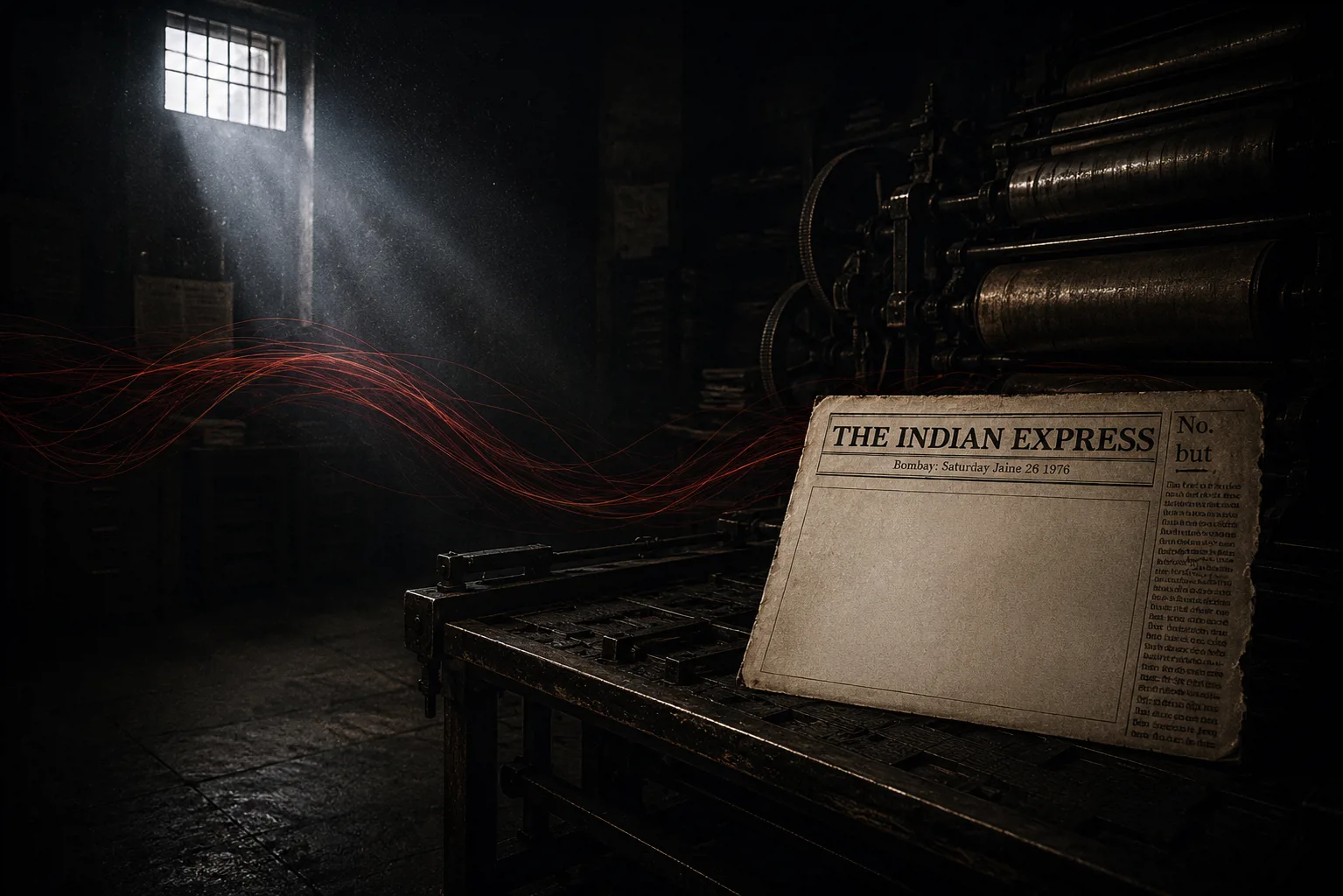
It was a coup with no soldiers. No tanks grinding through Connaught Place, no colonel clearing his throat into a radio mic, no flag hauled down at gunpoint. Instead: a tired President signing a paper handed to him after dark, the electricity to Delhi's newspaper presses snipped like a phone line in a hostage film, and a nation that went to bed in a democracy and woke up in something else entirely — without being told. That is the genius and the horror of the Emergency. It wasn't a tank rolling over the Constitution. It was the Constitution itself, picked up by the handle and swung like a club, by the very people sworn to guard it.
The Emergency is too often remembered as a single villain's bad fortnight, a regrettable wobble, an "excess." It was nothing so small. This was twenty-one months of premeditated, paperwork-perfect tyranny, and the most damning thing about it is precisely how legal it all looked. Every cell door, every blank editorial, every man dragged to a sterilisation table had a file number. The fuse, then, is where the account must begin.
The Long Fuse
Rewind to 1971. Indira Gandhi is colossal. She has just won a landslide on the irresistible promise of Garibi Hatao — abolish poverty — and then, for an encore, dismembered Pakistan and midwifed Bangladesh in a fortnight. Opposition leaders are calling her a goddess. It is, as these things always are, the absolute peak. From here the only direction is the one nobody at the summit ever believes in: down.
The descent was brisk. The 1973 oil shock detonated prices. The monsoon sulked. Grain vanished from shelves and reappeared on black markets. The factories struck. And the goddess of 1971 discovered the iron law of incumbency: voters who garland a leader for winning a war will garrotte the same leader over the price of cooking oil. The adoration curdled. And into the souring mood walked two movements and one very inconvenient old man.
In Gujarat, the Nav Nirman agitation — sparked, gloriously, by students furious about hostel mess fees — swelled until it dissolved an entire state assembly. In Bihar, the same student fury found a leader who could not be bought, bullied, or embarrassed, because he wanted nothing.
The man who wanted nothing
Jayaprakash Narayan — JP — was the establishment's nightmare: a politician with no price tag. A freedom fighter who had walked away from ministerial office to live among the rural poor in Vinoba Bhave's Sarvodaya movement, he had spent two decades pointedly not grabbing power while everyone around him grabbed with both hands. When Bihar's students summoned him, the seventy-two-year-old came out of retirement and handed their rage a banner: Sampoorna Kranti — Total Revolution. Peaceful, sweeping, total.
Around the throne, meanwhile, the courtiers were perfecting the straight face. Congress president D. K. Barooah supplied the era's defining piece of bootlicking, a slogan with the structural integrity of wet cardboard: "Indira is India and India is Indira." One woman was now, officially, the nation itself. Disagreeing with her was therefore unpatriotic by definition. It was the sort of line that reveals exactly what kind of mind was running the show — and exactly what JP was about to hurl back in its face.
The fractured opposition — the Jana Sangh, the socialists, the Congress (O), Charan Singh's Lok Dal, parties that agreed on precisely nothing — began, miraculously, to orbit him. JP went further. He appealed directly to the police and the army to refuse orders that were illegal or immoral. To a government bleeding authority by the day, this was the unforgivable sin. Never mind that disobeying an illegal order is the textbook definition of a conscience; to the ruling camp it was sedition with a beard and a Gandhi cap. The fuse was lit well before the spark everyone remembers.
The Verdict That Lit It
The spark, when it came, was almost insultingly small. A nation of six hundred million would be plunged into autocracy over what amounted to a campaign-finance parking ticket.
Raj Narain — the gloriously theatrical socialist Indira had thrashed in Rae Bareli in 1971 — had refused to lose gracefully. He filed an election petition crying foul, and the case crawled through the courts for four years. On 12 June 1975, Justice Jagmohan Lal Sinha of the Allahabad High Court delivered the verdict.
He found the Prime Minister of India guilty of corrupt electoral practices. Not of stuffing ballots or buying votes wholesale — of two clerkish technicalities: her aide Yashpal Kapoor had still been on the government payroll when he started running her campaign, and she'd used state officials to rig up rostrums and electricity for her rallies. For this, her election was declared void and she was barred from elected office for six years.
A sitting Prime Minister, unseated by one judge, on a paperwork foul, at the exact moment the streets were already chanting her name as a curse.
Here is the part history likes to forget: the system was working fine. The court even granted a twenty-day stay to allow an orderly handover. The legal off-ramp was wide, paved, and well-lit — appeal to the Supreme Court, step aside for a few months, let a caretaker mind the chair, come back vindicated or retire with dignity. Plenty of democracies survive a leader tripping over the rulebook. India's would have too.
But stepping aside, even for a season, was unthinkable — not so much to her, perhaps, as to the small, airless circle that now did her thinking. On 24 June the Supreme Court threw her a half-lifeline: she could stay on as Prime Minister and draw her salary, but could not vote in Parliament until the appeal was heard. Conditional. Humiliating. The opposition, which had already turned the verdict into a street chant — "Indira Hatao!", Remove Indira, a deliberate, mocking inversion of her own Garibi Hatao — now smelled blood.
On the evening of 25 June 1975, JP and the opposition leaders filled Delhi's Ramlila Maidan — the very ground where, every year, the people watch Rama slay Ravana. There, the old man recited the lines of the Hindi poet Ramdhari Singh Dinkar, from Jantantra ka Janm — "The Birth of Democracy" — and one line detonated across the country and never stopped echoing:
सिंहासन खाली करो कि जनता आती है
"Sinhāsan khāli karo ki janata aati hai." — Vacate the throne, the people are coming.
It was poetry as detonator. The people are coming. JP then did the thing the regime would call treason and history would call conscience: he appealed to the police, the army, and the bureaucracy to refuse any order that was illegal or immoral. To a frightened government, this was the final provocation — proof, they would later claim, of a coming "internal disturbance." So the choice was framed, in that windowless room, with maximum melodrama: surrender power, or seize all of it. They chose all of it. The throne would not be vacated. It would be barricaded.
And so, that very night, the throne gave its answer to "the people are coming": the people would be locked up.
The Midnight Signature
What followed was executed with a speed and secrecy that revealed exactly how few hands were really on the wheel. This was not a Cabinet decision. The Cabinet, that quaint body of elected ministers, would learn about it the way the rest of the country did — afterward. The legal contraption is widely credited to Siddhartha Shankar Ray, the constitutional lawyer and Chief Minister of West Bengal, who reached past the External Emergency already running since the 1971 war and produced a shiny new one: Internal Emergency, justified by that gorgeously elastic phrase, "internal disturbance."
How it was actually possible — the machinery
This is the engine room, and the gears must be seen plainly, because the whole nightmare ran on legitimate fuel. The instrument was Article 352 of the Constitution. As written then, it let the President declare an Emergency if he was "satisfied" that India's security was threatened by war, external aggression, or — the fatal phrase — internal disturbance. Not armed rebellion. Not invasion. Disturbance. A word vague enough to swallow a protest march, a strike, an inconvenient rally.
Pull that one lever and a whole cascade unlocks. Article 358 automatically suspended the freedoms of Article 19 — speech, assembly, movement, association — the instant the Proclamation took effect; no debate required. Article 359 let the President switch off the right to even approach a court to enforce fundamental rights; an order duly went out suspending Articles 14, 21 and 22 — equality before the law, the right to life and liberty, and protection from arbitrary arrest. Those rights technically still existed. There was simply nowhere to go to claim them: a locked door with the key thrown down a well. And Article 353 let Delhi command every state directly, folding India's federal map into a single fist.
And the masterstroke: as the Constitution was then read, a Proclamation under Article 352 did not need the Cabinet's prior nod. The Prime Minister's advice alone would do. One person could advise. One person could sign. And that is exactly how many people it took.
The rubber stamp in Rashtrapati Bhavan
On the night of 25 June 1975, the paper went to President Fakhruddin Ali Ahmed — a man elevated to the highest office in the land in large part for his reliable willingness to do as told. He signed. He signed before the Cabinet even met. The cartoonist Abu Abraham immortalised the moment with a drawing of the President signing from his bathtub, casually asking whether there were any more ordinances to autograph while he was in there. The literal truth of the bathtub matters less than the image's accuracy as portraiture: the constitutional check meant to restrain the executive had been reduced to a damp man with a pen, asking if there was anything else.
The Cabinet was rounded up the next morning, 26 June, and handed the decision pre-made — invited not to deliberate but to applaud. By then the real work had already been done in the dark, by men who did not wait for permission.
The Night of the Knock
While the presidential ink was still wet, the police were already at the doors. The operation had been planned in advance with a thoroughness the family-planning programme would have envied. In the small hours of 26 June, before the country opened its eyes, the entire opposition was lifted from its beds.
They came for Jayaprakash Narayan first. The man who had fought the British for India's freedom was now arrested by free India's own government; his health, already fragile, began the slow collapse that detention would finish. Then Morarji Desai, Atal Bihari Vajpayee, L. K. Advani, Charan Singh, and Raj Narain — the man whose petition started it all, now jailed for winning. George Fernandes slipped the net and went underground. Hundreds more were taken under MISA. At dawn, someone cut the power to the newspaper presses on Bahadur Shah Zafar Marg — no electricity, no print, no news. The blackout wasn't a metaphor; it was an actual switch, and someone flipped it. By morning, Indira Gandhi was on All India Radio, in the flat tone of a woman announcing a minor schedule change: "The President has proclaimed an Emergency. There is nothing to panic about."
The legal cosh for all this was MISA — the Maintenance of Internal Security Act — which allowed preventive detention without trial. The cruelty of it was elegant: with Article 21 suspended, a detainee could not even ask a judge whether the imprisonment was lawful. No charge. No hearing. No date. No door. The state could hold a man until it got bored, and he had precisely no one to appeal to. Over twenty-one months, the number locked away without trial is reckoned at more than one hundred thousand — politicians, students, unionists, lawyers, journalists, and a vast anonymous crowd of ordinary people scooped up on suspicion, rumour, or the grudge of a local official.
For the record. The "100,000-plus detained" figure is the commonly cited estimate, drawn from later inquiry and contemporary accounts. Precise numbers are inherently slippery for events the government was simultaneously censoring. Where this account gives a figure for a deliberately hidden act, treat it as the best-supported estimate, not a settled census. Contested
The Blank Page
A free press is the immune system of a republic, so naturally it was the first organ they cut out. Pre-publication censorship landed at once. Censors were planted physically inside newspaper offices, blue pencils sharpened, vetting every editorial, every news item, every cartoon before it could breathe. The rules forbade anything that might bring the government into "hatred or contempt" or stir "disaffection" — which is to say, journalism.
The papers reacted across the full human spectrum, from valour to grovelling. The Indian Express ran its editorial column as a blank white box — a wordless scream that said more than any leader could. The Statesman left its own gaps. A few mourned the death of democracy in the obituary columns, daring the censor to object. Many others discovered, overnight, a deep and abiding talent for obedience.
"You were asked only to bend, but you crawled." — L. K. Advani, later, on the press that didn't have to grovel but volunteered.
And the architecture of free information was demolished beam by beam. The four independent news agencies — PTI, UNI, Hindusthan Samachar, Samachar Bharati — were force-fused into one government-controlled outfit with the Orwellian-by-accident name Samachar: "News," singular, state-issue. Foreign correspondents who wouldn't kneel to the censor were deported. Newspapers that misbehaved lost their government advertising — a quiet financial throttling — or simply found their power and newsprint mysteriously rationed. By the end, the regime didn't just control the news. It owned the wholesale supply of reality.
The absurdities multiplied, as they always do when frightened men are handed blue pencils. Aandhi — a film loosely rumoured to echo Indira's own life — was banned outright. Kuldip Nayar, one of the country's most respected editors, was arrested. So was the Rajmata Gayatri Devi of Jaipur, jailed when she came to Delhi to attend Parliament — because in a country where the Prime Minister is India, even a former queen is just another inconvenience to be filed away. And so Indians did what people under every censorship have always done: they pressed their ears to shortwave radios after dark, hunting through the static for the BBC and Deutsche Welle, because the only place left to hear the truth about India was a transmitter in another country.
What They Did Behind the Curtain
Censorship was the curtain. What follows is what it was drawn across. Two campaigns define the Emergency's true face, and both were conducted not by a minister, not by an MP, not by anyone the Constitution had ever heard of — but by a young man whose sole qualification for power was his mother.
Sanjay Gandhi held no office. None. He was answerable to no voter, no ministry, no law. For twenty-one months he was among the most powerful — and the most feared — men in India.
The knife: coerced sterilisation
Sanjay decided India's problem was that there were too many poor people, and the solution was to make sure fewer of them happened. Family planning — a perfectly humane goal when it runs on consent — was converted into a campaign of forced sterilisation run on quotas, like a sales department with scalpels.
Government clerks, schoolteachers, even ration-shop owners were handed sterilisation targets and told their jobs, pay and licences depended on filling them. The pressure rolled downhill, as it always does, until it crushed the people with the least power to refuse. Men were rounded up from villages, bus stands and slums and carted to camps. Wages, ration cards, irrigation water, electricity, withheld salaries — all could be held hostage until a man produced a sterilisation certificate. Sometimes his own. Sometimes just someone's. The poor, the Muslim, the Dalit, the landless paid first and paid most. In 1976 alone, official records log over six million sterilisations — many times the normal rate — performed in conditions ranging from the merely coercive to the frankly butcherous. Botched operations killed people. The camps, busy hitting their numbers, did not trouble to count the dead carefully.
For the record. The "over six million in 1976" figure comes from the government's own family-planning statistics for that year; the death toll from botched procedures was never reliably tallied, precisely because no free press was permitted to count. Stated unflinchingly, and stated as an estimate, because honesty requires both. Contested
The bulldozer: Turkman Gate
The second signature atrocity was Sanjay's dream of a "beautified" Delhi — a clean, orderly capital, achieved by aiming bulldozers at the homes of people too poor to object effectively. The campaign's blackest hour came in April 1976 at Turkman Gate, in the old walled city: a dense, largely Muslim quarter where slum demolition and the sterilisation drive arrived together, in the same week, with the same contempt.
When residents refused to watch their homes flattened and their men herded off to the camps, the state replied with bullets. Police opened fire on the crowd. The death toll vanished into the censorship blackout and has never been pinned down — but people died defending their houses, the bulldozers rolled over the rubble anyway, and the survivors were trucked to bleak resettlement colonies on the city's far edge, conveniently out of sight. The newspapers, of course, could report none of it. The truth travelled the only way truth travels under a boot: by whisper, mouth to mouth, until the whole city knew what the front pages were forbidden to say.
The cells
Inside the jails, fortune depended on rank. Some senior politicians were kept in tolerable conditions; many ordinary activists, especially the underground resisters, were tortured outright. George Fernandes, captured at last, was paraded in chains in the trumped-up "Baroda Dynamite Case." His brother Lawrence, who had committed the crime of being related to him, was detained and brutally tortured to squeeze out George's whereabouts. The Shah Commission would later document custodial deaths, illegal detentions, and the systematic abuse of MISA in unsentimental administrative prose that is, if anything, more chilling for its calm.
The guest list
The roll of the imprisoned reads like the cast of the next two decades of Indian politics. JP, the movement's conscience, broken in health behind bars. Morarji Desai, a Prime Minister-in-waiting. Vajpayee and Advani, a future PM and his deputy. Charan Singh, another future PM. Raj Narain, jailed essentially for having been right. Madhu Limaye, Jyotirmoy Basu, a young student organiser named Arun Jaitley, Lalu Prasad Yadav, Ram Vilas Paswan, and tens of thousands of names that never made any headline because there were no headlines. To raise one's voice in those months was to wager one's freedom in a game where the house had abolished the referee.
The Constitution in Chains
Jailing the opposition and gagging the press wasn't enough. The regime now set about rewriting the rulebook so that nothing it did could ever be challenged — laundering the Emergency into permanence, with the Constitution's own signature on the deed. The mood music for all this had a name: the call, pushed within the establishment, for a "committed judiciary" and a "committed bureaucracy" — committed, that is, not to the law or the public, but to her. Judges who ruled correctly could be superseded. Civil servants who hesitated could be transferred to the administrative equivalent of Siberia. The word "committed" did a lot of quiet work in those months. It meant: obedient.
The day the Supreme Court lost its nerve
The judiciary's most disgraceful hour arrived in Additional District Magistrate, Jabalpur v. Shivkant Shukla (1976) — the Habeas Corpus case. The question was as basic as questions get: with Article 21 suspended, if the state imprisoned a citizen illegally — or simply killed him — could he go to any court at all? The government's own Attorney General stood up and argued, out loud, in the highest court in the land, that no, the citizen could not; that even the right to life was unenforceable. He was asked directly about a hypothetical of a policeman shooting a man dead out of personal enmity. The state's position, in essence: nothing to be done.
And by four votes to one, the Supreme Court of India agreed with him. It held that during the Emergency a detainee had no standing to seek habeas corpus, no matter what was done to him. Four of the country's finest legal minds looked at naked, lawless power and bowed. Their names belong to that verdict forever.
The fifth man did not bow. Justice H. R. Khanna wrote alone in dissent that the rule of law and the sanctity of life do not switch off in an emergency, and that detention without lawful authority is the mark of a society that has stopped being civilised. He knew the bill would arrive. He was next in line to be Chief Justice of India. For his dissent he was passed over — a junior promoted above him — and he resigned rather than serve the insult. He traded the highest judicial office in the country for the right to have been correct. History has paid him back with interest: the four who surrendered are a cautionary tale; Khanna is a synonym for spine.
The "mini-Constitution"
Then, in 1976, a Parliament scrubbed clean of its jailed opposition and squatting on a term it had simply extended to avoid the indignity of an election, passed the Forty-second Amendment — so sweeping it was nicknamed the "mini-Constitution." It tried to shove the fundamental rights beneath the directive principles, gut judicial review, make the Emergency-era amendments unchallengeable in any court, and inflate executive power past the horizon. It even tried to declare that Parliament's power to amend had no limits at all — a frontal assault on the basic-structure doctrine the Court had laid down in Kesavananda Bharati a mere three years earlier. The prisoners had been locked in; now the captive Parliament was bolting the door from the inside and posting the key to itself.
The Gamble Nobody Asked For
So why, sitting on absolute power with the opposition behind bars and the press housetrained, did Indira Gandhi suddenly call an election in January 1977 and unlock the cells? Nobody can say with certainty, and the honest answer is: several reasons, badly stacked. Contested
Part of her, by inheritance and temperament, was still a democrat who found the dictator's costume an uncomfortable fit and knew it couldn't be Nehru's daughter's permanent wardrobe. Her intelligence reports — and here is the exquisite irony — assured her she would win, that the masses were grateful for the restored "discipline" and the tamer prices, that the opposition was rubble. The world's opinion of a democracy-gone-rogue nagged at her. And underneath it all sat a perfect, self-inflicted blindness: she had censored the press so completely that she had also blinded herself. She'd taped over the country's mouth and then leaned in, baffled, wondering why it sounded so content. The silence she'd manufactured to fool the people had ended up fooling the only person who mattered.
On 18 January 1977 she announced March elections and ordered the prisoners released. The grip loosened. The opposition walked out of jail and straight onto a podium.
The Silent Verdict
What happened next is one of the most stirring things any democracy has ever done. Given a few short weeks, the released, exhausted, mutually-allergic opposition finally managed the one trick that had eluded it for thirty years: it merged. The Jana Sangh, the Congress (O), the Lok Dal and the socialists dissolved themselves into a single body — the Janata Party — under JP's ailing blessing. Jagjivan Ram, a senior Congress heavyweight, chose the last possible moment to walk out on Indira and throw his weight behind the challengers.
The pitch was brutally simple: this was not an election but a referendum on whether India wished to remain a free people or a herd. And the people understood it down to the marrow. The villagers terrorised by the sterilisation vans, the Muslims of Turkman Gate and a thousand quarters like it, the farmers and slum-dwellers and the throttled middle class — they walked to the booths and cast their answer.
The result, in March 1977, was a political earthquake. The Congress was annihilated across the entire Hindi heartland — the north, where the knife and the bulldozer had cut deepest, returned almost nothing for the ruling party. Indira Gandhi lost her own seat in Rae Bareli. Sanjay Gandhi lost in Amethi. The two architects of the Emergency were personally fired by their own neighbours. The Janata alliance swept in. For the first time since 1947, the Congress was out of power at the Centre. The people the regime had gagged, jailed, bulldozed and cut had said nothing — and then said everything, all at once, in the only language a tyrant cannot censor.
Twenty-one months earlier, JP had stood at Ramlila Maidan and warned the throne that the people were coming. In March 1977, on millions of folded ballots, they arrived. The throne was vacated after all — not by the woman who said she was India, but by the India that turned out not to be her.
They could blank the editorials. They could not blank the ballot.
And then a small, perfect coda. JP and the venerable Gandhian Acharya Kripalani — two old men who had fought the British and lived to watch free India jail them — led the newly elected MPs to Raj Ghat, to the spot where Mahatma Gandhi's ashes lie, and administered an oath: to serve the people honestly, and to never again let the Republic be silenced. The men who had been prisoners eighteen months earlier now stood at the cremation ground of the father of the nation, putting democracy back on its feet.
The Morning After, and the One After That
Morarji Desai, fresh from detention, became independent India's first non-Congress Prime Minister in March 1977, at eighty-one. The new government's finest acts were restorative. It convened the Shah Commission under former Chief Justice J. C. Shah to document the Emergency's excesses — a report so meticulous and damning that later governments would try to make copies vanish. And it passed the Forty-fourth Amendment in 1978 to disarm the booby-traps the Forty-second had set.
But the Janata Party was less a party than a hostage-pact between people who loathed each other and had been held together by a single shared enemy. Defeat that enemy and the glue dissolves. JP, the moral adhesive, died in 1979. The egos — Desai, Charan Singh, Jagjivan Ram — turned on one another; the old quarrel over the Jana Sangh men's RSS ties was reopened and picked at until it bled. Charan Singh broke away to become Prime Minister for a few weeks with the outside "support" of the very Congress he'd helped jail, then couldn't even bring himself to face Parliament. The whole thing collapsed into farce. Fresh elections were called for January 1980.
And the Indian voter, with the same magnificent unpredictability shown in 1977, brought Indira Gandhi back — the Emergency now competing in memory with the slapstick of Janata's implosion, the opposition having spectacularly proven it couldn't run a government. She returned to office in January 1980. The wheel had spun full circle in under three years. Months later, Sanjay Gandhi — re-elected, ascendant, untouchable — died when the aerobatic plane he was personally flying, doing stunts he had no business doing over a residential city, fell out of the Delhi sky. One of the Emergency's two central figures was gone, as abruptly as the Emergency itself.
Bolting the Door — This Time From the Right Side
The Emergency's most important legacy isn't a memory. It's a set of locks. The Janata government's Forty-fourth Amendment of 1978 rebuilt the constitutional defences so the exact trick of 1975 could never be turned again so cheaply.
The trigger was tightened: the blancmange phrase "internal disturbance" in Article 352 was replaced with armed rebellion — a government can no longer summon dictatorship simply because the protests are loud and the polls are bad. The Cabinet was put back in the loop: the President can now proclaim an Emergency only on the written advice of the Union Cabinet, not one person whispering after dark — the midnight signature is dead. Parliament was handed the leash: a Proclamation must be ratified by both Houses by special majority within a month, renewed every six months, and can be killed at any time by a simple-majority Lok Sabha resolution. Most important of all, Articles 20 and 21 were made un-suspendable, ever — the right to life and personal liberty can never again be switched off, Emergency or no, and the obscenity of ADM Jabalpur was rendered constitutionally impossible. Khanna's lonely dissent was poured into concrete. The right to property, meanwhile, was demoted from a fundamental right to an ordinary legal one, removing a favourite pretext for constitutional brawling.
The courts, shamed, also got to their feet. In Maneka Gandhi v. Union of India (1978) the Supreme Court reread Article 21 to mean that any procedure stripping a person of life or liberty must be just, fair and reasonable — quietly cremating the cramped logic that had enabled the Habeas Corpus surrender. And in 2017, in K. S. Puttaswamy, a nine-judge bench did the thing the institution owed history: it formally, unanimously overruled ADM Jabalpur, branded it gravely wrong, and threw it on the fire. Forty-one years late, Justice Khanna's dissent became the law of the land. He did not live to see all of it. He didn't need to. He was always going to win this argument; it just took the Court four decades to admit it.
Why This, of All Wounds, Is the Darkest
India has bled worse. Partition, famine, wars, assassinations — all spilled more blood than the Emergency. So why crown these twenty-one months the darkest chapter of the modern Republic?
Because every other catastrophe was something that happened to the nation. The Emergency was something the Republic did to itself, with its own clean constitutional hands, and then notarised. Partition could be grieved without putting democracy in the dock. The Emergency could not. It proved that the whole gleaming apparatus of liberty — the Articles, the courts, the elected Parliament, the free press — could be captured, reversed, and aimed at the people in a single night, by one determined leader, one obliging President, one frightened bureaucracy, and one entitled son with no job and total power.
That is the dark at the centre of it. Not the body count, but the ease. It took no army. No revolution. No storming of anything. Just paper, fear, and a flipped switch. The Emergency is the moment the Republic caught its own reflection and saw, with horror, how thin the wall is between democracy and dictatorship — and that the same Constitution that promised freedom was carrying, in Article 352, the loaded weapon of its own murder.
What Remembrance Demands
What does Smṛti — remembrance — require to be carried out of those twenty-one months? Three hard truths and a standing order.
That paper protects no one; people do. The President signed. The Cabinet clapped. Four judges folded. The bureaucracy obeyed with depressing efficiency. The Constitution didn't fail on its own — it was failed, name by name, by individuals who chose the comfort of obedience over the cost of duty. Exactly one man in a position of real power refused — Khanna — and he paid in full. The lesson is not to worship the document but to grow the rare nerve that makes a document mean anything.
That a free press is not a luxury; it is the nervous system. When the papers went blank, the rulers went deaf and the ruled went blind. The sterilisation camps and the Turkman Gate bulldozers worked precisely in the darkness the censors had manufactured. Light is the first thing tyranny kills and the first thing freedom needs back. Remember which papers blanked their editorials in protest — and which discovered, overnight, that they could crawl.
That the last guardian of liberty is the ordinary voter — the one the powerful are always sure they've tamed. Every elite institution wavered or broke. The courts blinked, the press grovelled, the Parliament was stuffed. But the supposedly cowed, supposedly grateful, supposedly manageable poor man walked to a booth in 1977 and ended the whole thing with a folded slip of paper. The deepest safeguard in the Indian system is written in no Article. It stands in the queue outside the polling station.
And the standing order: vigilance does not expire. The Forty-fourth Amendment slammed the specific door of 1975. But tyranny is a creative tenant, and the urge to rule by decree instead of consent is permanent in every government that has ever existed or ever will. The price of liberty is what it always was — eternal, unglamorous, un-outsourceable vigilance. This memory is itself a form of that vigilance: a scar the Republic presses on purpose, to remind itself how close it once came, and how quietly.
On 21 March 1977, the Emergency was formally lifted. The presses spun back up. The cells emptied. A government born of a people's flat refusal took office. For twenty-one months the world's largest democracy had held its breath in the dark — and then, finally, it breathed.
That breath is the inheritance. Smṛti is refusing to let anyone call it just an "excess."
॥ इति ॥
A note on sources and method. This is a work of civic remembrance for Dhārā's Smṛti section — pointed in voice, but disciplined on fact. It rests on the public historical record of the Emergency (25 June 1975 – 21 March 1977): the Shah Commission of Inquiry's findings; the constitutional text of Articles 352–360 before and after the Forty-second and Forty-fourth Amendments; the judgments in Indira Nehru Gandhi v. Raj Narain, ADM Jabalpur v. Shivkant Shukla, Maneka Gandhi v. Union of India, and K. S. Puttaswamy v. Union of India; and the substantial memoir and historical literature on the period. Figures for sterilisations and detentions derive from official statistics and inquiry records; because these were censored events, the exact tallies are debated, and the text flags each such figure as an estimate rather than a closed count. Where the record is uncertain, the account says so plainly — that is the whole point of remembering honestly.