What a Rocket Is Actually Doing
Start by dismantling the intuition, because almost everybody has the wrong one.
The common picture is that a rocket pushes against the air, the way a swimmer pushes against water or a car's tyres push against a road. This picture is not merely imprecise. It is exactly backwards, and the mistake was made in print by the editorial board of the New York Times on 13 January 1920, in a notice ridiculing Robert Goddard for supposing that a rocket could function in the vacuum of space. A rocket, the paper explained, needs something to push against, and space offers nothing. Goddard, it concluded, appeared to lack the knowledge ladled out daily in high schools.
A rocket in vacuum works better than a rocket in air. Settled physics
The reason is Newton's third law, applied not to the outside of the vehicle but to the inside. Consider a rifle. When it is fired, a small mass leaves at very high speed in one direction and the rifle moves in the other direction. Nothing external is pushed. The total momentum of rifle-plus-bullet was zero before firing and remains zero after; the bullet carries momentum one way and the rifle carries an equal momentum the other way. The air in the room is irrelevant to this exchange. Remove the air and the recoil is identical.
A rocket engine is a rifle that fires continuously. Instead of one bullet it throws several tonnes of hot gas per second out of a hole in its back. The vehicle accelerates forward because the propellant accelerates backward, and the bookkeeping of momentum is exact. The atmosphere contributes nothing useful to this. In fact it does two positive harms: it drags on the vehicle, and it presses back into the mouth of the nozzle, reducing the effective thrust. Which is why the same engine, unchanged, produces more thrust in space than it does at sea level.
An F-1 engine on the pad at Cape Canaveral produced about 6.77 million newtons. The same engine at high altitude produced about 7.77 million. It gained a million newtons -- fifteen percent -- purely by having less air in its way.
The Times printed a correction on 17 July 1969, the day after Apollo 11 launched, noting that further investigation had confirmed the workings of Newton in the seventeenth century, and regretting the error.
The Thrust Equation
Thrust has two components, and the distinction between them will matter constantly once we start looking at real engines.
The first component is momentum thrust. If the engine expels propellant at a mass flow rate m-dot, at an exhaust velocity ve relative to the vehicle, the momentum leaving per second is m-dot multiplied by ve, and that is the force felt by the vehicle. This is the rifle term.
The second component is pressure thrust. The gas leaving the nozzle exit is at some pressure pe, and the surrounding atmosphere is at some pressure p0. If the exit pressure exceeds ambient pressure, the excess pushes on the exit plane over its area Ae and adds to the thrust. If ambient exceeds exit pressure, it subtracts.
Put together:
F = (m-dot x ve) + (pe - p0) x Ae
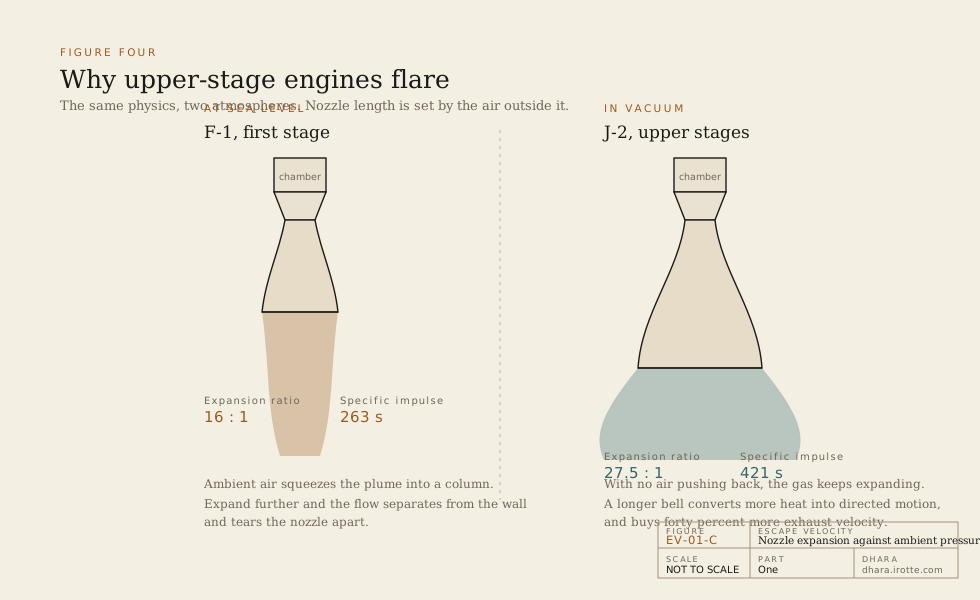
At sea level, p0 is 101,325 pascals and the pressure term is usually working against you. In vacuum, p0 is zero and the pressure term is pure gain. This single fact drives one of the most visible design differences in rocketry: engines built for vacuum have enormous bell nozzles, and engines built for sea level have short stubby ones.
The reason is that a nozzle's job is to convert the random thermal motion of hot gas into ordered motion in one direction, and the longer the bell, the more expansion it permits and the more thermal energy it converts. But if you expand the gas too far, its pressure at the exit drops below ambient, the outside air pushes back into the bell, and the flow separates from the wall in a violent unsteady way that can physically tear the nozzle apart. So a sea-level engine must stop expanding early, and accept lower efficiency, in order to survive.
The J-2 engine on the upper stages of the Saturn V had an expansion ratio of about 27 to 1. The RL10 and the Space Shuttle Main Engine, operating mostly above the atmosphere, ran ratios of 69 to 1 and above. When you look at photographs of upper-stage engines and think they look absurdly flared, you are looking at the atmosphere's absence.
The visual signature of nozzle expansion is something anyone can see. Watch footage of a Saturn V in the first seconds after release: the exhaust plumes are narrow, tight columns, because at sea level the ambient air squeezes them. Watch the same vehicle at eighty seconds, near maximum dynamic pressure and climbing: the plumes have bloomed outward into vast translucent bells far wider than the engines themselves. Nothing about the engines changed. The air went away.
Specific Impulse, and Why It Is Measured in Seconds
Every discussion of rocket performance turns immediately to specific impulse, usually written Isp, and every newcomer is confused by it for the same reason: it is quoted in seconds, and seconds are not an obvious unit for the goodness of an engine.
The underlying quantity is simple and physical: it is the exhaust velocity. An engine that throws its propellant out faster gets more momentum out of every kilogram, and is therefore better. If you measure specific impulse as exhaust velocity, in metres per second, everything is clean.
The seconds convention is a historical artefact. Engineers defined specific impulse as thrust divided by the weight flow rate of propellant rather than the mass flow rate, and dividing by weight rather than mass introduces a factor of standard gravity, 9.80665 metres per second squared. The units of mass cancel, and what survives is time.
The conversion is one multiplication:
exhaust velocity in metres per second = Isp in seconds x 9.80665
So an engine quoted at 300 seconds is throwing its exhaust out at about 2,942 metres per second. An engine at 450 seconds is throwing it at about 4,413. The seconds figure has a loose physical reading -- it is roughly how long one kilogram of propellant could hold up one kilogram against Earth's gravity -- but nobody actually thinks that way in practice. The number is a proxy for exhaust speed, and the reason the industry never abandoned it is that the seconds figure is the same in metric and imperial units, which mattered enormously in an American programme staffed partly by German engineers, running on imperial drawings and metric physics.
Here is what the real numbers look like, and it is worth pausing on them, because these five figures constrain everything else in this series.
Specific impulse and exhaust velocity of the principal engines in this series
| Engine | Propellants | Isp, sea level | Isp, vacuum | Vacuum exhaust velocity |
|---|---|---|---|---|
| V-2 | Ethanol and liquid oxygen | 203 s | 239 s | 2,344 m/s |
| F-1 | RP-1 kerosene and liquid oxygen | 263 s | 304 s | 2,981 m/s |
| J-2 | Liquid hydrogen and liquid oxygen | 200 s | 421 s | 4,129 m/s |
| Space Shuttle Main Engine | Liquid hydrogen and liquid oxygen | 366 s | 452 s | 4,436 m/s |
| Raptor | Liquid methane and liquid oxygen | 327 s | 380 s | 3,727 m/s |
Note the ceiling. Across seventy years, across four generations of engineering, across the entire span from a wartime weapon to the most advanced machine currently flying, the exhaust velocity moved from roughly 2.3 kilometres per second to roughly 4.4. It did not double. It will not double again. The reason is chemistry, and we will come to it, but hold that number in mind: about 4.4 kilometres per second is the practical ceiling on how fast a chemical rocket can throw its own exhaust.
The Equation Itself
Konstantin Eduardovich Tsiolkovsky was born in 1857 in Izhevskoye, in Ryazan province. Scarlet fever at the age of nine left him almost completely deaf, and the deafness removed him from formal schooling entirely. He educated himself out of his father's library, qualified as a teacher of arithmetic and geometry, and spent his working life in provincial schools, latterly in Kaluga, about 180 kilometres southwest of Moscow. He built a wind tunnel in his house. He was refused funding by the Russian Academy of Sciences. He wrote science fiction to popularise ideas nobody would let him publish as science.
In 1897 he derived the relationship that governs all rocket flight, and he did it from momentum conservation alone.
The argument runs like this. Take a vehicle of total mass m, moving at velocity v. In a small interval, it expels a small mass of propellant, dm, at exhaust velocity ve relative to itself. Momentum must be conserved, so the momentum carried away by the propellant equals the momentum gained by the remaining vehicle. Setting those equal and rearranging gives a small change in vehicle velocity equal to the exhaust velocity multiplied by the fractional change in mass. Integrate that from the starting mass to the final mass, and the integral of a fractional change is a natural logarithm.
What emerges is this:
delta-v = ve x ln(m0 / mf)
Or, in the form usually written with specific impulse:
delta-v = Isp x g0 x ln(m0 / mf)
Where delta-v is the total change in velocity the vehicle can achieve, ve is the exhaust velocity, m0 is the mass at the start including all propellant, and mf is the mass at the end after all propellant is burned.
Read it plainly. The velocity you can gain depends on only two things: how fast you throw your propellant out, and the ratio between your full mass and your empty mass. Nothing else. Not thrust. Not burn time. Not the size of the vehicle in absolute terms. Two numbers.
And one of those two numbers sits inside a logarithm.
The logarithm is the villain of this entire series. Every strange decision in the history of spaceflight is an attempt to get around a logarithm, and the logarithm always wins.
The Cruelty of the Logarithm
A logarithm grows slowly. That is its nature and its whole reputation. But here it is not growing -- it is being inverted, and what a slow-growing function does when you invert it is punish you exponentially.
Rearrange the equation to ask the practical question. If I need a certain delta-v, and I have an engine with a certain exhaust velocity, what mass ratio do I require?
mass ratio = e raised to the power of (delta-v divided by ve)
Suppose your engine gives an exhaust velocity of 3 kilometres per second, which is roughly a good kerosene and oxygen engine. Now watch what happens as the mission gets more ambitious.
Required mass ratio and propellant fraction at an exhaust velocity of 3 kilometres per second
| Required delta-v | Mass ratio | Propellant fraction of vehicle | Everything else |
|---|---|---|---|
| 1 km/s | 1.40 to 1 | 28.4 percent | 71.6 percent |
| 3 km/s | 2.72 to 1 | 63.2 percent | 36.8 percent |
| 6 km/s | 7.39 to 1 | 86.5 percent | 13.5 percent |
| 9 km/s | 20.1 to 1 | 95.0 percent | 5.0 percent |
| 12 km/s | 54.6 to 1 | 98.2 percent | 1.8 percent |
| 15 km/s | 148 to 1 | 99.3 percent | 0.7 percent |
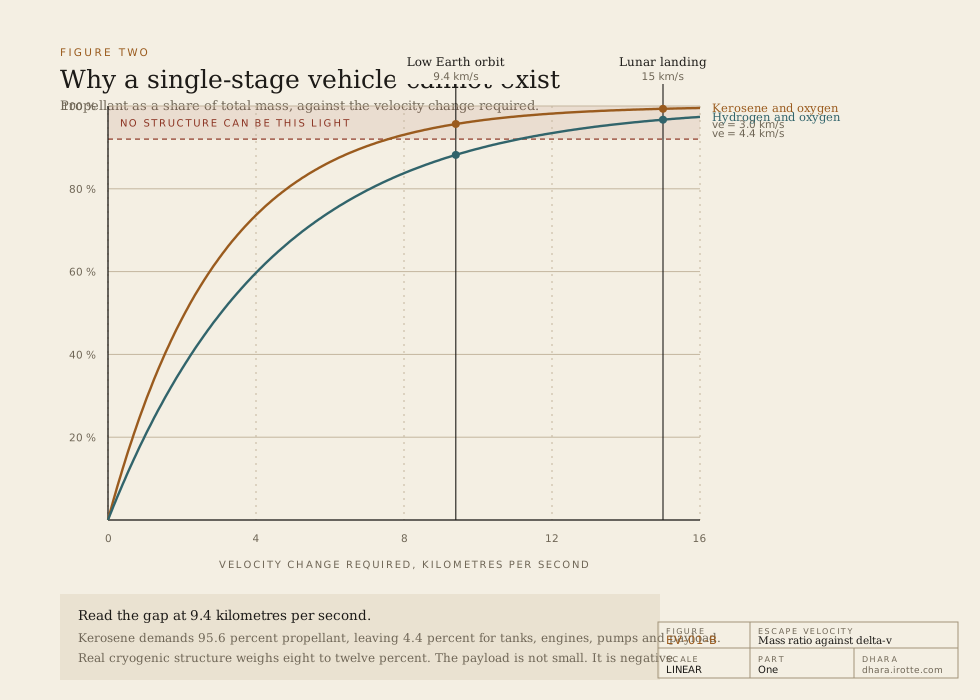
Look at the last column, because that is the one that decides whether a vehicle can exist. The last column is everything that is not propellant: the tanks, the engines, the pumps, the plumbing, the structure, the guidance, the wiring, the paint, and, eventually, the payload and the crew.
At a modest one kilometre per second, you can spend seventy percent of your vehicle on hardware. That is an aeroplane. That is comfortable.
At nine kilometres per second, which is roughly what it costs to reach orbit, you have five percent left for everything. Five percent. And an aluminium tank strong enough to hold cryogenic liquids under pressure, with engines and pumps attached, typically weighs six to ten percent of the mass it contains. Which means the payload is not small. The payload is negative. The vehicle cannot be built.
At fifteen kilometres per second, the total cost of a lunar mission, you have seven-tenths of one percent -- and now the arithmetic is not merely hard, it is a joke.
This is the tyranny. It is not that going to space is expensive in the way that building a bridge is expensive. It is that the equation, for a single vehicle burning chemistry, returns a physically impossible answer. Every kilogram of structure you add requires propellant to lift it; that propellant requires tank to hold it; that tank is more structure; that structure requires more propellant. The spiral does not converge.
There is a rule of thumb in the industry that captures this and has been quoted at every design review since the 1950s. To put one extra kilogram of payload into lunar orbit, the vehicle on the pad must grow by roughly a tonne. The Apollo Lunar Module's design team fought for grams. They drilled holes in tool handles, removed the seats so the crew flew standing up, used aluminium foil thin enough to tear under a fingernail as thermal shielding, and specified wall panels in places as thin as three-thousandths of an inch. A dropped screwdriver could have punctured the pressure hull. That was not carelessness. That was the logarithm being obeyed.
Escape Velocity
The series takes its name from a number, and the number deserves to be derived rather than merely recited, because the derivation is short and it explains something surprising.
To leave a gravitational field permanently, you must arrive with enough kinetic energy to pay the entire remaining gravitational potential debt. Set the kinetic energy of the vehicle equal to the gravitational binding energy at the surface, cancel the vehicle's mass from both sides -- and note that it does cancel, so escape velocity is the same for a pebble and a battleship -- and solve for velocity.
v-escape = square root of (2 x G x M / r)
Where G is the gravitational constant, M is the mass of the planet, and r is the distance from its centre. For Earth, G multiplied by M is 3.986 x 10 to the fourteenth, in units of cubic metres per second squared, and the mean radius is 6,371,000 metres. Doing the arithmetic gives 11,186 metres per second.
Eleven point one eight six kilometres per second. About 40,270 kilometres per hour. Roughly thirty-three times the speed of sound at sea level.
Two features of that formula are worth dwelling on. First, escape velocity has nothing to do with the mass of the escaping object, which is why the phrase is used loosely as a metaphor for a threshold that applies to everyone equally. Second, it depends on r, the distance from the centre -- so escape velocity is lower the further out you already are. At the altitude of a typical low Earth orbit, about 200 kilometres up, escape velocity has already fallen to about 11,015 metres per second.
And here is the fact that surprises nearly everybody, including many people who work adjacent to the field.
The Moon Is Not Outside
Apollo never reached escape velocity. It never needed to. Not once, on any of the nine lunar missions.
The Moon is not somewhere else. The Moon is inside Earth's gravitational well, orbiting within it at a mean distance of 384,400 kilometres. To reach it you do not have to escape the Earth. You have to climb high enough within Earth's well that the Moon comes and collects you.
The manoeuvre that sent Apollo to the Moon was called Trans-Lunar Injection, and it was a single burn of the third stage's J-2 engine lasting about five and a half minutes, performed after one and a half orbits of the Earth. Before the burn, the stack was travelling at about 7,790 metres per second in a circular parking orbit. The burn added roughly 3,050 metres per second. Final speed at the end of the burn: approximately 10,840 metres per second.
Escape velocity at that altitude was about 11,015.
Apollo departed for the Moon travelling roughly 175 metres per second slower than the speed required to leave the Earth permanently. Flight record
That deficit was not an accident and it was not a marginal miss. It was the entire design. The resulting trajectory was an enormously elongated ellipse still bound to the Earth -- a path that, if the Moon had somehow not been there, would have carried the spacecraft out to near-lunar distance, slowed almost to a standstill, and fallen all the way back. That property had a name, the free-return trajectory, and it was the reason three men came home alive in April 1970 after an oxygen tank ruptured in the service module of Apollo 13. They did not need to fire an engine to come back. They needed to not fire one. The Earth was still holding them.
Apollo 13 survived because Apollo was never designed to escape. It was designed to be thrown, very high, and caught.
The distinction between reaching the Moon and escaping the Earth is the difference between throwing a ball to the top of a very tall building and throwing it off the planet, and the second is not what anyone did in 1969. Escape velocity in the true sense was achieved by other American machines -- Pioneer 10, Voyager 1 and 2, New Horizons -- and those are a different story for a later part of this series.
What the Trip Actually Costs
Because the rocket equation cares only about total delta-v, mission planning reduces to a single ledger: add up every velocity change the mission requires, and that sum is the bill.
Here is the Apollo bill, approximately, in the order it was paid.
Approximate delta-v budget for a full Apollo lunar landing mission
| Manoeuvre | Approximate delta-v | Performed by |
|---|---|---|
| Launch to low Earth orbit | 9,400 m/s | S-IC, S-II, S-IVB first burn |
| Trans-lunar injection | 3,050 m/s | S-IVB second burn |
| Mid-course corrections outbound | 30 m/s | Service Propulsion System |
| Lunar orbit insertion | 900 m/s | Service Propulsion System |
| Descent to lunar surface | 2,100 m/s | LM Descent Propulsion System |
| Ascent to lunar orbit | 1,850 m/s | LM Ascent Propulsion System |
| Rendezvous and docking | 50 m/s | LM reaction control |
| Trans-earth injection | 1,000 m/s | Service Propulsion System |
| Mid-course corrections inbound | 20 m/s | Service Propulsion System |
| Atmospheric entry and descent | 0 m/s | Heat shield and parachutes |
The total is a little over eighteen kilometres per second of powered delta-v, and the largest single line item is the first one.
Two things in that table deserve attention.
The first is that reaching low Earth orbit costs 9,400 metres per second, which is more than half the entire mission, before the vehicle has gone anywhere at all. The old aphorism is that low Earth orbit is halfway to anywhere in the solar system. Judged by delta-v rather than distance, that is very nearly literal.
The second is the last line. Coming home cost zero delta-v of propulsion. The vehicle arrived at 11 kilometres per second and shed all of it into the atmosphere as heat, using a shield made of epoxy that was designed to burn. Doing that deceleration with rockets instead would have required carrying the propellant for another 11 kilometres per second all the way to the Moon and back, which by the mass ratio table above would have multiplied the vehicle on the pad by a factor no launch vehicle could have supplied. The heat shield is not a safety device bolted on at the end. The heat shield is a propulsion decision, and one of the most consequential in the programme. We will spend a full part of this series inside it.
The Tolls Nobody Quotes
Look again at that first line. Orbital velocity at low Earth orbit is 7,790 metres per second. Why does the table say the launch costs 9,400?
Because 1,600 metres per second of the burn is spent on nothing at all. It is paid to three tolls that do not appear in any textbook diagram, and understanding them is what separates a real trajectory from a homework problem.
The first and largest is gravity loss. A rocket climbing vertically is fighting gravity for the entire duration of the burn, and every second spent thrusting upward at less than infinite acceleration is a second in which gravity has clawed back 9.8 metres per second of velocity. If a vehicle takes 160 seconds to clear the thickest atmosphere while pointed substantially upward, it has given away a large fraction of 1,568 metres per second simply by existing during that time. For the Saturn V the gravity loss came to roughly 1,530 metres per second. Flight data
The way to reduce gravity loss is to accelerate harder and get the burn over with. The way to reduce the second toll is the opposite.
The second toll is aerodynamic drag. The atmosphere resists, and the resistance rises with the square of velocity and with air density. Go too fast too low and the drag penalty explodes -- and, more dangerously, the dynamic pressure on the structure exceeds what the vehicle can survive.
These two tolls pull in opposite directions, and the resolution is the reason every launch you have ever watched looks the way it does. The vehicle rises slowly at first, deliberately, accepting gravity loss in order to get out of the dense air before going fast. Then, as the air thins, it pitches over into a gravity turn -- a curving trajectory in which the vehicle does not steer at all but simply lets gravity rotate its flight path -- and pours on velocity in the near-vacuum where drag is cheap. There is a moment about eighty seconds into a launch called max Q, maximum dynamic pressure, where the product of density and velocity squared peaks and the vehicle is under the greatest aerodynamic load of its life. On the Saturn V, the engines were throttled and the centre engine of the first stage was shut down early in part to manage exactly these loads.
Total drag loss on a Saturn V was small, only about 40 to 50 metres per second, and that smallness is itself the proof that the trajectory was designed correctly.
The third toll is steering loss, or cosine loss. Any time the engine points in a direction other than the direction you want to accelerate, only the cosine of the angle between them does useful work; the rest is thrown away sideways. Good guidance minimises this. On Apollo, an algorithm called Iterative Guidance Mode did something remarkable for 1960s computing: rather than following a pre-stored trajectory, the onboard computer continuously recalculated the optimal remaining path to the target orbit and steered to it, adapting in real time to engine underperformance or atmospheric variation. It is the reason Apollo 6, which lost two engines on its second stage, still reached orbit.
There is a fourth cost, and it is a gift rather than a toll. The Earth rotates eastward at 465 metres per second at the equator, and a vehicle launched eastward starts with that velocity already in hand. Cape Canaveral sits at 28.5 degrees north latitude, where the rotational speed is about 408 metres per second. That free contribution is a substantial part of why American, European, and Russian launch sites are placed as far south as their geography and politics permit, and why every Saturn V turned east over the Atlantic within seconds of clearing the tower.
Why Chemistry Has a Ceiling
We have established that the mission costs roughly 18 kilometres per second, and that the mass ratio required depends brutally on exhaust velocity. So the obvious question is why nobody simply built a better engine. Why stop at 4.4 kilometres per second of exhaust?
The answer is that chemical rockets are limited by the energy stored in chemical bonds, and that limit was set by the structure of the periodic table long before anyone thought to exploit it.
The exhaust velocity achievable from a combustion reaction depends on two quantities. It rises with the temperature of the combustion, because temperature is a measure of the random kinetic energy available to be converted into directed motion. And it rises as the molecular weight of the exhaust falls, because for a given energy, light molecules move faster than heavy ones.
That second dependence is why hydrogen won. Burning hydrogen with oxygen produces water, molecular weight 18, and if the mixture is run deliberately fuel-rich -- which every hydrogen engine does -- the exhaust also carries free hydrogen at molecular weight 2, dropping the average dramatically. Burning kerosene with oxygen produces carbon dioxide at molecular weight 44 and water, a much heavier mixture. The kerosene reaction actually releases more energy per kilogram in some respects, but the products are heavier, and the heaviness dominates. Hydrogen delivers roughly forty percent more exhaust velocity than kerosene, and that forty percent, sitting inside a logarithm, is the difference between a lunar mission that closes and one that does not.
The temperature side runs into a wall of a different kind. Combustion temperature in an F-1 was about 3,300 kelvin. In the Space Shuttle Main Engine it reached about 3,600. For comparison, the melting point of iron is 1,811 kelvin, of pure nickel 1,728, of tungsten -- the highest-melting metal there is -- 3,695. The gas inside a rocket combustion chamber is hotter than the melting point of every substance the chamber could conceivably be made of, with one metal in the entire periodic table left as a marginal exception.
A rocket engine is a device that contains a fire hotter than any metal it is made of, for eight minutes, without failing.
How that is possible -- and the answer involves flowing cryogenic fuel through hundreds of brazed tubes that form the chamber wall itself, so that a surface with 3,300 kelvin on one side has 100 kelvin on the other -- is the subject of the fifth part of this series, and it is the finest single piece of engineering in the American programme.
For now the conclusion stands. Push the temperature higher and you cannot hold the fire. Push the molecular weight lower and there is nothing below hydrogen. Exotic combinations exist -- lithium, fluorine and hydrogen as a tripropellant reached 542 seconds in a laboratory, an exhaust velocity of 5.3 kilometres per second -- but the exhaust was a torrent of hydrogen fluoride, which is to say a river of acid capable of dissolving glass and bone, and nobody was ever going to fly it. Tested, never flown
Chemistry gives you about 4.4 kilometres per second and no more. The mission demands 18. And that gap is not a gap that a better engine closes.
Staging Is Not a Preference, It Is a Proof
So the vehicle has to be cut into pieces and the pieces thrown away. Not because it is convenient. Because it is the only remaining move.
Work the single-stage case honestly. Take a vehicle that must reach low Earth orbit, delta-v 9,400 metres per second, using a kerosene and oxygen engine averaging perhaps 3,100 metres per second of exhaust velocity across the flight as ambient pressure falls. The required mass ratio is e raised to 9,400 divided by 3,100, which is e to the 3.03, which is 20.7.
A mass ratio of 20.7 means the propellant is 95.2 percent of the vehicle, and everything else is 4.8 percent. Now try to build the everything else. The tanks alone, in aluminium alloy, sized to hold cryogenic oxygen at pressure with enough margin not to buckle under thrust loads, come to perhaps four percent of the propellant mass. Engines, turbopumps, thrust structure, and plumbing add several percent more. Guidance, avionics, wiring, and separation hardware add a fraction. The realistic empty mass of such a vehicle is somewhere between eight and twelve percent of its loaded mass.
You need it to be 4.8 percent. It is at least 8. The payload is not merely zero. It is substantially negative. The vehicle cannot lift itself, let alone anything else.
Now stage it. The trick is not that staging reduces the total delta-v required, because it does not. The trick is that when a stage is discarded, the logarithm is restarted with a much smaller m0, and the empty mass of the discarded stage no longer has to be accelerated by the propellant of the next.
Apply the equation stage by stage to the actual Saturn V, and the sum is what matters.
Saturn V stage masses and the delta-v contribution of each
| Stage | Fuelled mass | Empty mass | Engines | Approximate delta-v contributed |
|---|---|---|---|---|
| S-IC first stage | 2,290,000 kg | 131,000 kg | Five F-1 | 3,660 m/s |
| S-II second stage | 481,000 kg | 36,000 kg | Five J-2 | 4,500 m/s |
| S-IVB third stage | 120,800 kg | 13,500 kg | One J-2 | 4,200 m/s to orbit, then 3,050 m/s for lunar injection |
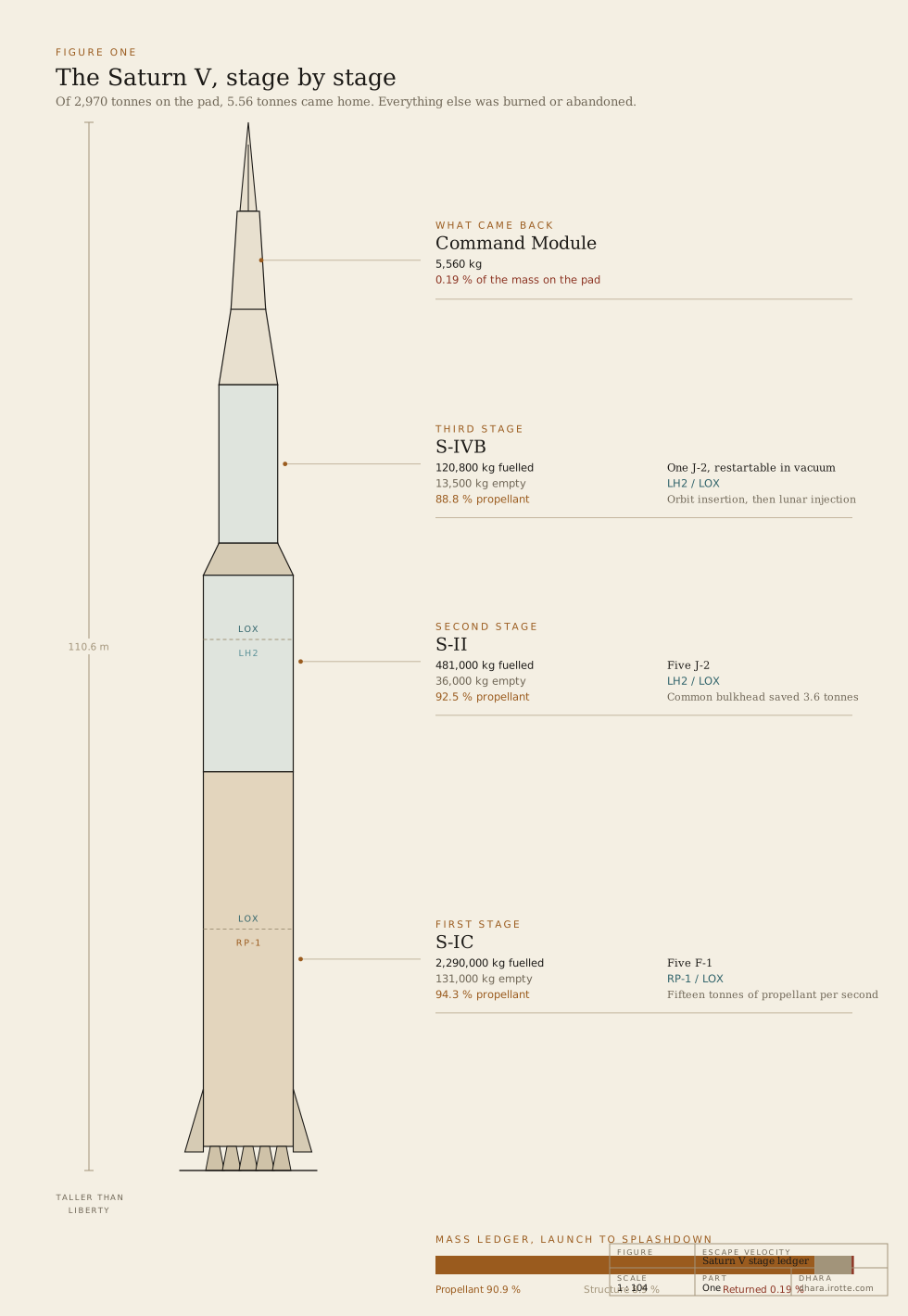
Read the empty-mass column against the fuelled-mass column. The first stage was 94.3 percent propellant. The second stage, 92.5 percent. The third, 88.8 percent. These are structures whose walls, in proportion to their volume, are thinner than the shell of a hen's egg. The Saturn V's tanks could not have supported their own contents without internal pressurisation and the stiffening of milled isogrid patterns machined into aluminium plate.
And each of those structures, having done its work, was cut loose and destroyed -- the first stage falling into the Atlantic about 650 kilometres downrange, the second stage burning up on re-entry, the third stage either deliberately crashed into the Moon to give the seismometers something to measure or flung into solar orbit.
Nothing about this was wasteful. Every kilogram of first-stage tankage that had continued upward would have consumed second-stage propellant that could otherwise have accelerated payload. The logarithm demanded amputation, and the vehicle was designed to amputate itself three times in twelve minutes.
There is one more scaling fact that explains why the Saturn V had to be so large in absolute terms, quite apart from mass ratio. The rocket equation is scale-invariant: a model rocket and a Saturn V with the same mass ratio and the same engine reach the same velocity. But structures are not scale-invariant. As a tank gets larger, its volume grows as the cube of its dimensions while its surface area grows only as the square, so the mass of wall needed per unit of propellant contained actually falls. Large rockets are structurally more efficient than small ones. This is why the answer to a hard delta-v problem is so often simply a bigger vehicle, and why the Saturn V was 110.6 metres tall -- taller than the Statue of Liberty from foundation to torch.
The Shape of the Answer
Everything you have ever seen in a photograph of a Saturn V is now explicable, and it is worth walking the vehicle once from bottom to top with the equation in hand.
It was enormous because square-cube scaling rewards size and because the payload fraction was so small that a useful payload demanded a vast vehicle around it.
It was almost entirely propellant, 2,700 tonnes of the 2,970 on the pad, because a mass ratio near 25 to 1 leaves nothing else.
It was built in three stages that destroyed themselves in sequence because a single stage was arithmetically impossible.
Its first stage burned kerosene, despite kerosene's inferior exhaust velocity, because kerosene is dense -- 810 kilograms per cubic metre against liquid hydrogen's 71 -- and in the lower atmosphere, where drag and structural loads dominate, a compact heavy propellant beats an efficient bulky one. Hydrogen tanks sized for the first stage would have made the vehicle grotesque.
Its upper stages burned hydrogen, despite the cryogenic misery of a liquid that boils at 20 kelvin and leaks through joints no other substance finds, because above the atmosphere nothing matters except exhaust velocity, and hydrogen's forty percent advantage is decisive there.
Its upper-stage engine nozzles flared wide because there was no air to push back.
Its tanks were thinner in proportion than an eggshell because every gram of aluminium was a gram of payload not delivered.
Its third stage carried an engine that could be shut down in orbit and restarted an hour and a half later in vacuum -- an ability nobody had needed before -- because the trans-lunar injection had to be timed to a specific point in the parking orbit, and a stage that could only burn once could not do the job.
And its crew came home behind a shield of burning epoxy rather than under power, because carrying the propellant to decelerate would have compounded through the mass ratio until the vehicle on the pad grew beyond any possibility of construction.
None of it was a style. All of it was a solution.
What Comes Next
There is one more thing to say about the equation before we leave it, and it concerns the men who wrote it.
Tsiolkovsky derived it in 1897 in a house without electricity and published it in 1903, the same year the Wright brothers flew for twelve seconds at Kitty Hawk. He was ignored. Robert Goddard rederived it independently in America and flew the first liquid-fuelled rocket in his aunt's cabbage field in Auburn, Massachusetts, on 16 March 1926 -- a flight of 2.5 seconds, reaching 12.5 metres, at an average speed slower than a bicycle. He was mocked. Hermann Oberth published his version in Germany in 1923 after a doctoral committee rejected it as too speculative, and the young men who read it formed an amateur society in Berlin, one of whom was an eighteen-year-old aristocrat named Wernher von Braun.
Three men, in three countries, none of whom knew of the others' work when they began, arrived at the same logarithm. It was not a discovery in the way a new continent is a discovery. It was there in Newton's laws the whole time, waiting for somebody to ask the right question about a machine that throws away part of itself.
What none of them could supply was the metallurgy, the turbomachinery, the combustion physics, and the industrial organisation required to actually build a vehicle with a mass ratio of 25 to 1 that would not explode. That took another fifty years, an enormous amount of money, and an act of national will that has not been repeated. Author's judgement It also took a weapon built by slave labour in a German mountain, and a decision by the United States to bring the men who built it to Alabama, which is a debt this series will state plainly rather than skirt.
The next part goes to Kaluga, to Auburn, and to Transylvania -- to the three men who worked out how to leave, decades before anyone would let them try.
Then we go to Peenemunde, where the mathematics first became a machine, and where the cost of it was paid by people whose names are not on any plaque.
0 responses