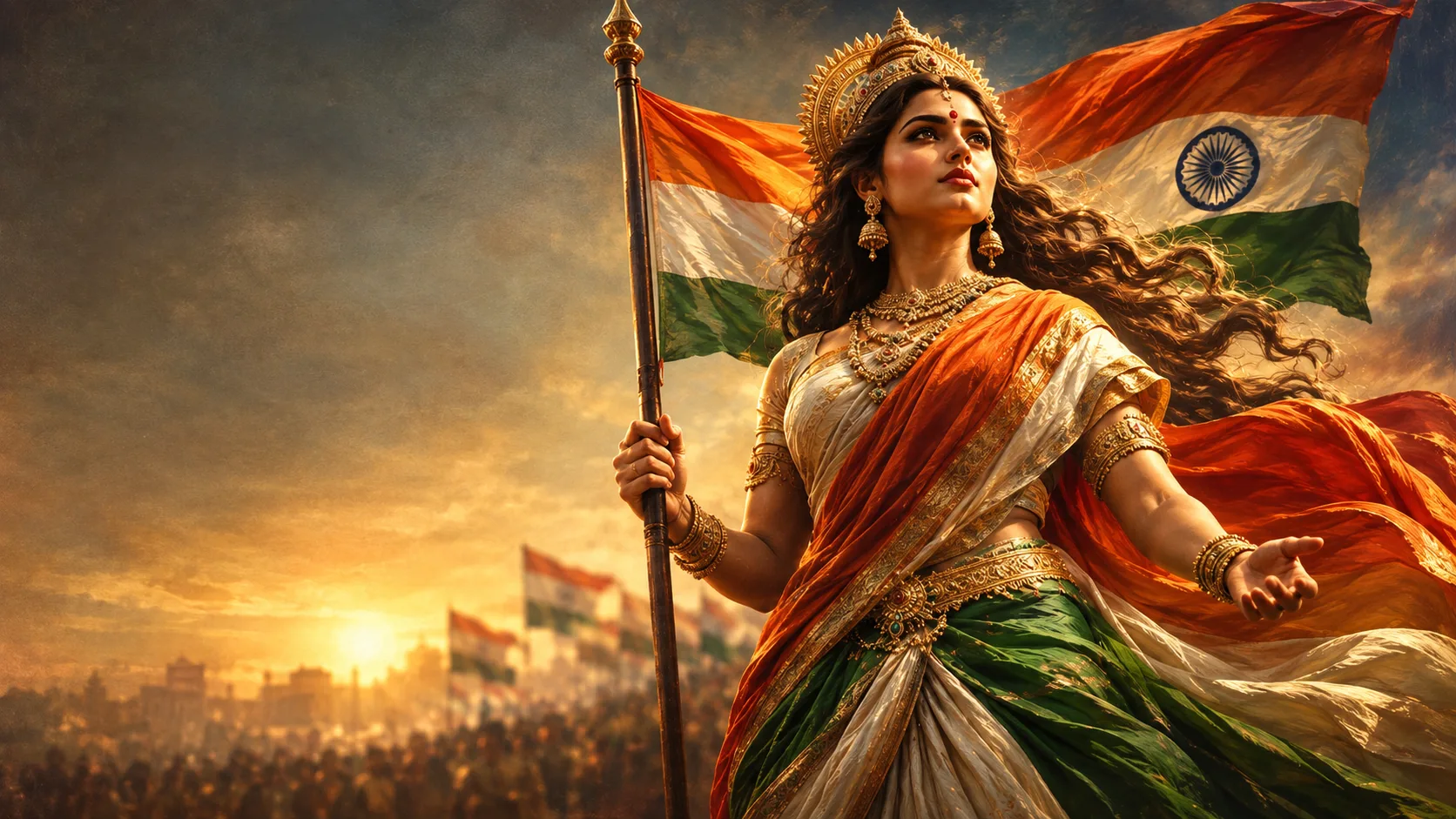
On the morning of 15 August 2026, from the ramparts of the Red Fort, Vande Mataram was sung at an Independence Day ceremony for the first time. Four days earlier the President had signed the amendment that placed the national song under the same statutory protection as the national anthem. One hundred and fifty-one years after a deputy magistrate in the Bengal Presidency wrote it down, the song had finally acquired the one thing it had never had: a legal existence.
It had never lacked any other kind. It had been sung on scaffolds. It had been banned in three provinces. It had been prosecuted as sedition, cut in half by a Working Committee, given equal honour and unequal status by a Constituent Assembly, and argued over in Parliament in the summer of 2026 with a heat that suggested nothing about it had ever been settled.
What follows is the song itself. All six stanzas, in the order Bankim left them, with the apparatus a Sanskrit text is owed -- padaccheda, anvaya, padartha, tatparya, vyakhya -- and then the history of what was done to it.
The Song That Was Written Before Its Novel
Bankim Chandra Chattopadhyay was a deputy magistrate in the Indian Civil Service, one of the first two graduates of the University of Calcutta, and by 1875 the most consequential prose writer in the Bengali language. He had founded the journal Bangadarshan in 1872. He would go on to write Anandamath, Devi Chaudhurani, Krishnacharitra. He served the government he despised for thirty-three years and retired as a deputy magistrate, which is roughly the rank at which the Company and then the Crown parked educated Indians who could not be trusted with anything larger.
The song was published in Bangadarshan on 7 November 1875. Settled The precise circumstances of its composition are not documented in Bankim's own hand, and the accounts that exist -- a train journey to Kantalpara, greenery after the closeness of Calcutta, the countryside opening out -- come from later biographers rather than from the author. Contested The reference works split between 1875, 1876, and a window running from 1872 to 1875, which is itself evidence that Bankim did not think the moment worth recording.
What is not in dispute is the sequence, and the sequence is the whole point. Anandamath was serialised in Bangadarshan between 1880 and 1882 and published as a book in 1882. The song is seven years older than the novel. It was not written to serve a plot. The plot was built around it.
The song is seven years older than the novel. It was not written to serve a plot. The plot was built around it.
This is visible in the novel's construction. Vande Mataram does not arrive at a climax. It arrives in the tenth chapter, sung by Bhavananda to Mahendra as they move through moonlit water, sung for no audience and to no purpose, simply because the singer cannot hold it in. Mahendra does not understand it. He asks who this Mother is, fed by rivers, heavy with fruit, cooled by the mountain wind. Bhavananda does not stop to answer. He goes on singing. Only afterwards does he explain, and his explanation is a single line of Sanskrit that the novel treats as self-evident: the mother and the motherland are greater than heaven. By the time the song ends, Mahendra is weeping and is a different man.
That is the actual function of the poem inside the book. It is a conversion device. Bankim wrote a novel in order to demonstrate what his song did to a person who heard it.
Jadunath Bhattacharya, a musician of the Chattopadhyay household, is generally credited with setting the first tune, close to the time of composition. Rabindranath Tagore set his own tune and sang it at the Calcutta session of the Congress in 1896, which is the performance that turned a literary composition into a political instrument. Both attributions circulate; they are not in conflict, because there was more than one tune.
What Kind of Poem This Is
Three technical facts govern every reading of Vande Mataram, and all three are usually skipped.
It changes language mid-song. The first two stanzas are Sanskrit, or Sanskrit close enough that no Bengali inflection intrudes. The third opens in Sanskrit compound and then breaks, in its third line, into plain Bengali. The fourth is almost entirely Bengali with one Sanskrit line embedded in it. The fifth returns to Sanskrit. The sixth is Sanskrit again. The song descends from liturgical Sanskrit into mother tongue at exactly the moment its subject shifts from the land to the people who defend it, and climbs back into Sanskrit at the moment the Mother is named as Durga, Kamala and Vani. The register is doing theological work.
It is not in a classical metre. There is no anustubh here, no sardulavikridita, no named varnavrtta at all. Settled The organising principle is end-rhyme, which Sanskrit prosody does not use and Bengali song does: -alam against -alam in the first stanza, -inim against -inim in the second, -arine against -avale in the third. The lines are governed by matra and by breath, not by a fixed pattern of light and heavy syllables. Bankim was writing a song for voices, not a stanza for a commentator.
It has almost no verbs. In six stanzas there are exactly three finite verbs in the Sanskrit portions: vande (I bow), namami (I bow, twice). Everything else is an adjective in the accusative feminine singular, agreeing with one noun. That noun is mataram. The rivers, the fruit, the sandal-cooled wind, the grain-dark fields, the moonlit nights, the flowering trees, the sweet smile, the sweet speech, the seventy million throats, the fourteen crore arms, the ten weapons, the lotus, the stainless, the incomparable, the upholder, the nourisher -- every one of these is grammatically a description of a single accusative object, and the only thing the speaker does to that object is bow.
Every epithet in the poem is an accusative feminine singular. The Mother is not the subject of the sentence. She is what the sentence falls upon.
The Full Text: How the Six Stanzas Stand
Stanza one names the land: water, fruit, the sandal wind, the dark grain. Stanza two names its beauty at night: moonlight, flowering trees, the smile, the speech. These two were the stanzas the Congress Working Committee adopted in 1937 and they are the ones ordinarily sung.
Stanza three names the population and arms it. Stanza four moves the Mother inward, into knowledge, dharma, the heart, the breath, the strength in the arm. Stanza five identifies her outright as Durga, Lakshmi and Sarasvati. Stanza six closes on the earth herself, dark, upright, smiling, adorned, bearing and feeding.
The first two stanzas describe a country. The last four describe a goddess. That is the whole of the quarrel, and it is a quarrel the text creates rather than one imposed on it.
Stanza One
Chandas
No named varnavrtta. The stanza runs on matra and on end-rhyme: -alam closing three of its four feet (sujalam / suphalam / malayajasitalam / sasyasyamalam). Sanskrit prosody does not organise by rhyme; Bengali song does. The stanza is Sanskrit in vocabulary and Bengali in architecture.
Mulam
सुजलां सुफलां मलयजशीतलां
शस्यश्यामलां मातरम् ॥
Padacchedam
Anvayam
Padartham
Word-by-word analysis of stanza one
| पदम् | IAST | व्याकरणम् | Meaning |
|---|---|---|---|
| वन्दे | vande | वन्द् धातुः, आत्मनेपदम्, लट्, उत्तमपुरुषः, एकवचनम् | I salute, I bow, I praise |
| मातरम् | mātaram | मातृ, द्वितीया विभक्तिः, एकवचनम्, स्त्रीलिङ्गम् | the Mother |
| सुजलाम् | sujalām | सु + जल, बहुव्रीहिः, द्वितीया एकवचनम् | her whose waters are good |
| सुफलाम् | suphalām | सु + फल, बहुव्रीहिः | her whose fruits are good |
| मलयजशीतलाम् | malayajaśītalām | मलयज + शीतला, तृतीया-तत्पुरुषः | cooled by the sandal wind |
| शस्यश्यामलाम् | śasyaśyāmalām | शस्य + श्यामला, तृतीया-तत्पुरुषः | darkened by her standing crops |
Tatparyam
The stanza is an act, not a statement. Vande comes first and everything after it is the object of that act. What the speaker bows to is not an idea of country but four physical facts: the water, the harvest, the wind off the sandal hills, and the colour of a field heavy with grain in the week before cutting. There is no history in the stanza, no battle, no king, no temple. There is only the land as a body that produces, and the recognition that what produces is a mother.
Syamala is the load-bearing word. It means dark, and in Sanskrit it is the colour of Kali, of Krsna, of rainclouds, and of ripe fields. Bankim uses it of crops. The reader who has stood at the edge of a rice field before harvest knows the shade exactly, and the reader who knows the Devi literature hears the other meaning underneath it without being told.
Vyakhya
Malayaja is the most literary word in the stanza and the least accidental. The Malaya range in the far south is the classical source of sandalwood, and the sandal-cooled breeze is one of the oldest set-pieces in Sanskrit poetry, running from Kalidasa through the whole Sanskrit and Prakrit lyric tradition. Bankim, writing in Bengal about Bengal, reaches for a wind that blows in the deep south. The gesture is deliberate. The mother whose waters and fruit are being praised is described in a vocabulary that belongs to the entire subcontinent, and the first stanza therefore already contains the claim that later stanzas make explicit.
Sujalam suphalam is the compound by which the song is popularly known, and the pairing is Vedic in shape: the prefix su attached twice, the two nouns naming water and food, the two things a land is for. The Sri Sukta praises Lakshmi in the same grammatical shape. Nothing in the stanza yet names a goddess, and the grammar has already begun to.
Stanza Two
Chandas
Four feet, all closing in -inim or -am, with the two longest compounds placed first and the two shortest last. The stanza narrows as it goes: twenty-two syllables in the first foot, eight in the last. The effect is a descent from ornament to plain address, and it is repeated in every stanza of the song.
Mulam
फुल्लकुसुमितद्रुमदलशोभिनीं
सुहासिनीं सुमधुरभाषिणीं
सुखदां वरदां मातरम् ॥
Padacchedam
Anvayam
Padartham
Word-by-word analysis of stanza two
| पदम् | IAST | व्याकरणम् | Meaning |
|---|---|---|---|
| शुभ्र | śubhra | विशेषणम् | white, bright, clear |
| ज्योत्स्ना | jyotsnā | संज्ञा, स्त्रीलिङ्गम् | moonlight |
| पुलकित | pulakita | पुलक + इतच्, भूतकृदन्तम् | thrilled, with the hair standing on end |
| यामिनीम् | yāminīm | यामिनी, द्वितीया एकवचनम्, बहुव्रीहिः | her whose nights are so thrilled |
| फुल्ल | phulla | फुल्ल् धातुः, भूतकृदन्तम् | blossomed, opened |
| कुसुमित | kusumita | कुसुम + इतच् | come into flower |
| द्रुमदल | drumadala | द्रुम + दल, तत्पुरुषः | tree-leaf, foliage |
| शोभिनीम् | śobhinīm | शुभ् धातुः + णिनि, स्त्रीलिङ्गम्, द्वितीया | shining with, made resplendent by |
| सुहासिनीम् | suhāsinīm | सु + हस् धातुः + णिनि | sweetly smiling |
| सुमधुरभाषिणीम् | sumadhurabhāṣiṇīm | सु + मधुर + भाष् धातुः + णिनि | speaking with great sweetness |
| सुखदाम् | sukhadām | सुख + दा धातुः + कः | giver of happiness |
| वरदाम् | varadām | वर + दा धातुः + कः | giver of boons |
Tatparyam
The second stanza turns the land from a producer into a presence. Stanza one had water and grain; stanza two has moonlight, flowers, a smile and a voice. The land acquires a face.
Pulakita is the decisive word and it cannot be carried across in one term. Pulaka is the physical horripilation of intense emotion, the standing of hair on the skin, and in the aesthetic vocabulary it is a sattvika-bhava, one of the involuntary bodily signs of genuine feeling. Bankim applies it not to a lover but to the night. The night is thrilled. What is being described is a landscape in a state of rapture, and pulakita imports the entire apparatus of Sanskrit erotic and devotional poetics into a description of moonlight on Bengal.
Vyakhya
The three nini-suffixed feminines in this stanza -- sobhini, suhasini, sumadhurabhasini -- are agent nouns. The suffix denotes habitual or characteristic action. She is not smiling at the moment; smiling is what she is. The grammar establishes permanence, which is precisely what a national song requires and what a merely descriptive stanza would not supply.
Sukhadam varadam closes the stanza on the two words that shift its footing. Varada is not a landscape adjective. It is an iconographic term. The varada-mudra, the boon-giving gesture with the open palm turned downward, is one of the standard hand positions in image-worship across the Devi, Visnu and Siva traditions. The first two stanzas are widely described as the secular portion of the song. The last word of the second stanza is a term of image-worship.
This bears on the 1937 argument in a way that neither side of it has usually acknowledged. The two adopted stanzas are not free of religious vocabulary. They are free of proper names. Varada is temple language; Durga is a person. The line the Working Committee drew was a line between an unnamed goddess and a named one.
Stanza Three
Chandas
The two opening feet are the longest in the poem, each a single compound of sixteen syllables ending in the vocative -e, and they rhyme with each other. Then the metre breaks. The third foot is short, colloquial Bengali, and the rhyme scheme resets. The prosodic rupture and the linguistic rupture happen in the same line.
Mulam
द्विसप्तकोटिभुजैर्धृतखरकरवाले ।
के बोले मा तुमी अबले ।
बहुबलधारिणीं नमामि तारिणीं
रिपुदलवारिणीं मातरम् ॥
Padacchedam
Anvayam
Padartham
Word-by-word analysis of stanza three
| पदम् | IAST | व्याकरणम् | Meaning |
|---|---|---|---|
| सप्तकोटि | saptakoṭi | सङ्ख्यासमासः | seven crore, seventy million |
| कण्ठ | kaṇṭha | संज्ञा | throat |
| कलकल | kalakala | अनुकरणशब्दः | confused roar, tumult of many voices |
| निनाद | nināda | नि + नद् धातुः | sounding, outcry |
| कराले | karāle | करालाः, सम्बोधनम् एकवचनम् स्त्रीलिङ्गम् | O formidable one, O terrible one |
| द्विसप्तकोटि | dvisaptakoṭi | द्वि + सप्त + कोटि | twice seven crore, fourteen crore |
| भुजैः | bhujaiḥ | भुज, तृतीया विभक्तिः बहुवचनम् | by the arms |
| धृत | dhṛta | धृ धातुः, क्तप्रत्ययः | held, borne |
| खर | khara | विशेषणम् | sharp, keen |
| करवाले | karavāle | करवाला, सम्बोधनम् एकवचनम् | O sword-bearing one |
| के बोले | ke bole | बङ्गभाषा, प्रश्नवाचकम् | who says |
| तुमी अबले | tumī abale | बङ्गभाषा | that you are without strength |
| बहुबलधारिणीम् | bahubaladhāriṇīm | बहु + बल + धृ धातुः + णिनि | bearer of abundant strength |
| नमामि | namāmi | नम् धातुः, लट्, उत्तमपुरुषः एकवचनम् | I bow |
| तारिणीम् | tāriṇīm | तॄ धातुः + णिनि | she who carries across, the deliverer |
| रिपुदलवारिणीम् | ripudalavāriṇīm | रिपु + दल + वृ धातुः णिजन्तः + णिनि | she who drives back the enemy host |
Tatparyam
This is the stanza in which the song stops describing and starts counting. Seventy million was approximately the population of the Bengal Presidency in Bankim's lifetime. Fourteen crore is that number doubled, because each of those seventy million has two arms, and each arm has a sword in it. The arithmetic is the argument.
The third line is the hinge of the entire composition. After two and a half stanzas of ornate Sanskrit compound, the language collapses into everyday Bengali and asks a blunt question: who says you are weak? The Sanskrit tradition would have used abala, the standard and rather condescending word for a woman, literally the one without strength. Bankim puts the word in the mouth of an imagined slanderer and answers it with three feminine agent nouns in a row -- bearer of strength, deliverer, repeller of armies.
Vyakhya
Karale and karavale are vocatives, and the shift into direct address is the formal signal that the poem has changed mode. Stanzas one and two spoke about the Mother in the third person, to a listener. Stanza three speaks to her.
Karala carries a specific weight. It is a standard epithet of the fierce forms of the Devi -- the gaping-mouthed, the terrible, the one whose appearance cannot be looked at. It is not a word one applies to a river valley. From this line onward the identification that stanza five will state outright is grammatically already in force.
Tarini deserves separate note. The root tr means to cross over, and tarini is a standard epithet of Durga as the one who ferries the devotee across the ocean of worldly existence, the bhava-sagara. Bankim places a soteriological term inside a war stanza. She who drives back the enemy host and she who carries the soul across are, in his grammar, the same feminine agent noun.
The line printed in some editions as abala kena ma eta bale is a later Sanskritised gloss on the Bengali ke bole ma tumi abale, supplied by editors to smooth the language shift. The Bengali is Bankim's. The Sanskrit paraphrase is not, and any recension that presents it as the original text is silently repairing the poem's most deliberate rupture.
Stanza Four
Chandas
Bengali payar-like couplets in rhyming pairs: dharma with marma, sakti with bhakti. One Sanskrit line, tvam hi pranah sarire, is set in the middle of them and does not rhyme with anything. It is the only line in the stanza that does not, and it is the line that says she is the breath in the body.
Mulam
तुमि हृदि तुमि मर्म ।
त्वं हि प्राणाः शरीरे ।
बाहुते तुमि मा शक्ति ।
हृदये तुमि मा भक्ति ।
तोमारइ प्रतिमा गडि मन्दिरे मन्दिरे ॥
Padacchedam
Anvayam
The stanza is Bengali. The Devanagari anvaya above is a Sanskrit chaya, a shadow-rendering supplied for construing, not a variant reading of Bankim's text.
Padartham
Word-by-word analysis of stanza four
| पदम् | IAST | भाषा एवं व्याकरणम् | Meaning |
|---|---|---|---|
| तुमि | tumi | बङ्गभाषा, मध्यमपुरुष सर्वनाम | you |
| विद्या | vidyā | संस्कृतम्, स्त्रीलिङ्गम् | learning, knowledge, the science |
| धर्म | dharma | संस्कृतम् | dharma, the sustaining law |
| हृदि | hṛdi | संस्कृतम्, हृद्, सप्तमी एकवचनम् | in the heart |
| मर्म | marma | संस्कृतम् | the vital point, the innermost core |
| त्वं हि | tvaṃ hi | संस्कृतम्, सर्वनाम + अवधारणे | you indeed |
| प्राणाः | prāṇāḥ | प्राण, प्रथमा बहुवचनम् | the vital breaths |
| शरीरे | śarīre | शरीर, सप्तमी एकवचनम् | in the body |
| बाहुते | bāhute | बङ्गभाषा, अधिकरणम् | in the arm |
| शक्ति | śakti | संस्कृतम् | power, capacity, the Devi as power |
| हृदये | hṛdaye | हृदय, सप्तमी एकवचनम् | in the heart |
| भक्ति | bhakti | संस्कृतम् | devotion |
| तोमारइ | tomārai | बङ्गभाषा, षष्ठी + अवधारणे | yours alone |
| प्रतिमा | pratimā | संस्कृतम् | image, the fashioned icon |
| गडि | gaḍi | बङ्गभाषा, क्रिया, उत्तमपुरुषः | we shape, we mould |
| मन्दिरे मन्दिरे | mandire mandire | सप्तमी, वीप्सायाम् द्विरुक्तिः | in temple after temple |
Tatparyam
The fourth stanza performs the interiorisation. The Mother has been a landscape, then a face, then an army. Now she is inside the body of the person singing: she is the prana in the frame, the strength in the arm, the devotion in the heart. Nothing external remains.
The last line is the most consequential sentence in the poem and the one most often passed over. Tomarai pratima gadi mandire mandire does not say that the Mother is like a goddess. It says that every image installed in every temple in the country is, in fact, an image of her. It is a claim about what has always been going on inside Indian worship, made retrospectively.
Vyakhya
The reduplication mandire mandire is a vipsa, the device by which a repeated locative distributes across every member of a class: in each and every temple, without exception. Bankim uses a grammatical form whose entire function is universality.
The stanza's sequence runs from vidya to dharma to hrdi to marma to prana, that is, from the outermost human faculty to the innermost. The Taittiriya Upanisad's sequence of kosas moves the same way, from the sheath of food inward to the sheath of bliss, and readers trained in that sequence will recognise the descent. Whether Bankim intended the parallel cannot be established from the text. Speculative What can be established is that the stanza ends where the kosa sequence ends, at what is nearest and least separable.
The stanza does not say that the Mother is like a goddess. It says that every image in every temple in the country has always been an image of her.
Stanza Five
Chandas
Three rhyming feet in -ini naming the three goddesses, then a break into short parallel clauses, then the return of sujalam suphalam from the opening of the poem. The stanza is built as a ring: it ends in the words the song began with, now attached to a proper name.
Mulam
कमला कमलदलविहारिणी
वाणी विद्यादायिनी ।
नमामि त्वां नमामि कमलाम्
अमलाम् अतुलां सुजलां सुफलां मातरम् ॥
Padacchedam
Anvayam
Padartham
Word-by-word analysis of stanza five
| पदम् | IAST | व्याकरणम् | Meaning |
|---|---|---|---|
| त्वं हि | tvaṃ hi | प्रथमा एकवचनम् + अवधारणे | you indeed |
| दुर्गा | durgā | संज्ञा, स्त्रीलिङ्गम् | Durga |
| दशप्रहरणधारिणी | daśapraharaṇadhāriṇī | दश + प्रहरण (प्र + हृ) + धृ धातुः + णिनि | bearer of the ten weapons |
| कमला | kamalā | लक्ष्म्याः पर्यायः | Kamala, the lotus one |
| कमलदलविहारिणी | kamaladalavihāriṇī | कमल + दल + वि + हृ धातुः + णिनि | she who moves upon the lotus petal |
| वाणी | vāṇī | सरस्वत्याः पर्यायः | Vani, speech itself |
| विद्यादायिनी | vidyādāyinī | विद्या + दा धातुः + णिनि | giver of learning |
| नमामि | namāmi | नम् धातुः, लट्, उत्तमपुरुषः एकवचनम् | I bow |
| अमलाम् | amalām | अ + मल, बहुव्रीहिः, द्वितीया | stainless, without impurity |
| अतुलाम् | atulām | अ + तुला, बहुव्रीहिः | without comparison, unweighable |
Tatparyam
Stanza five states what stanzas one to four have been building. The Mother is Durga with ten weapons, Lakshmi on the lotus, Sarasvati who gives learning: the three principal forms under which the feminine is worshipped across the whole of the tradition, named in the order of power, wealth and knowledge.
The stanza then closes by returning to sujalam suphalam, the words of the first line of the poem. The waters and the fruit of stanza one are restated in stanza five as attributes of a named goddess. The circle closes, and the closing is the argument: the land described at the opening and the goddess named at the end are one referent, and the poem has been saying so all along.
Vyakhya
Dasapraharana is precise iconography, not poetic licence. The Durga of the Bengal autumn festival is the Mahisasuramardini, and the standard image gives her ten arms bearing ten weapons received from ten gods -- Siva's trident, Visnu's discus, Indra's thunderbolt, and the rest. Bankim, writing for a Bengali readership, invokes the exact form standing in the pandals every Asvina.
Amala and atula are the two adjectives in the poem that cannot apply to a country. A land can be well-watered and fruitful. Stainlessness and incomparability are properties of the divine, and in Vedantic usage amala is what is predicated of consciousness when every superimposition has been removed. The stanza has crossed a line the earlier stanzas approached and did not cross.
The order Durga, Kamala, Vani is not decorative. It is the order of the Devi Mahatmya, whose three carita sections are governed in turn by Mahakali, Mahalakshmi and Mahasarasvati, and it is the order in which the three are invoked across the Navaratri sequence. Bankim writes for a reader who will recognise the order without being told, and the recognition is the point: the song does in nine lines what the ritual year does in nine nights.
Stanza Six
Chandas
Two feet only, the shortest stanza in the song. Four adjectives in the first, two agent nouns and the governing noun in the second. After the ten weapons and the fourteen crore swords, the poem closes in fourteen syllables.
Mulam
धरणीं भरणीं मातरम् ॥
Padacchedam
Anvayam
Padartham
Word-by-word analysis of stanza six
| पदम् | IAST | व्याकरणम् | Meaning |
|---|---|---|---|
| श्यामलाम् | śyāmalām | श्यामला, द्वितीया एकवचनम् स्त्रीलिङ्गम् | dark, dusky, of the colour of rainclouds |
| सरलाम् | saralām | सरला, द्वितीया | straight, upright, without crookedness |
| सुस्मिताम् | susmitām | सु + स्मित, बहुव्रीहिः | of the fair smile |
| भूषिताम् | bhūṣitām | भूष् धातुः, क्तप्रत्ययः, द्वितीया | adorned, ornamented |
| धरणीम् | dharaṇīm | धृ धातुः + अनिप्, स्त्रीलिङ्गम् | she who bears up, the earth |
| भरणीम् | bharaṇīm | भृ धातुः + अनिप्, स्त्रीलिङ्गम् | she who nourishes, the sustainer |
Tatparyam
The closing stanza is the shortest and does the work of a phalasruti. Four adjectives and two agent nouns, and then the word the whole poem has been governed by. After Durga and the ten weapons, after fourteen crore arms, the song comes to rest on two words that mean holding up and feeding.
Syamala returns from the first stanza, where it described crops. Here it describes the Mother herself, with no crop attached. The word that opened the poem as a colour of agriculture closes it as a colour of the divine, and nothing has been added in between except recognition.
Vyakhya
Dharani and bharani are a matched pair built on two roots that Sanskrit lexicography treats as near-synonyms and that this poem separates by function. Dhr is to hold, to support, to keep from falling. Bhr is to bear, to carry, to nourish, and it is the root behind bharata itself. The final line therefore places, in the last two words before mataram, the two verbs from which the words dharma and Bharata are derived. Whether the etymological chime is designed cannot be shown. Speculative That it is there is a matter of morphology.
Sarala is the quiet word. In a poem of ten-armed goddesses and fourteen crore swords, the penultimate description of the Mother is that she is straight, plain, without crookedness. The register drops entirely at the end, which is what a song does when it wants to be believed.
Aurobindo and the Reading of the Mother
The English translation that made the song intelligible outside Bengal was made by Aurobindo Ghose and printed in Karmayogin in November 1909. It is not literal. It is a verse rendering that treats the poem as an English hymn, and it made three decisions that shaped every subsequent reading.
It gave the opening as an address rather than a description: the Mother is spoken to from the first line, which flattens Bankim's careful progression from third person in stanza one to vocative in stanza three. It rendered the compound epithets as clauses, which unavoidably added verbs to a poem that has almost none. And it translated saptakoti as seventy million and left the doubling intact, which preserved the arithmetic that most later translators have quietly rounded away.
Aurobindo's opening: Mother, I bow to thee! / Rich with thy hurrying streams, / bright with thy orchard gleams / Cool with thy winds of delight
Aurobindo also supplied the interpretation that the defenders of the full song have relied on ever since. Pressed on the objection that the poem's later stanzas were idolatrous, he held that the Durga to whom homage is paid in stanza five is Bharata Mata herself, and that the goddess-names stand for knowledge, power, greatness and glory rather than for a cult image. Contested
That reading is available in the text and it is not the only reading available in the text. Stanza five names dasapraharanadharini, a specific iconographic form with a specific festival attached to it, and stanza four says that every temple image in the country is hers. A reading that treats the goddess-names as allegory has to treat those two lines as figurative, and the grammar of the poem gives no signal that they are. Polemical Aurobindo's gloss is best understood as a defence mounted in 1909 conditions, honest in intent and interpretively generous, rather than as a neutral description of what Bankim wrote.
Aurobindo described Vande Mataram at one point as the national anthem of Bengal. The text itself never names Bengal, and its geography -- the sandal wind of the Malaya hills in the deep south -- is subcontinental rather than provincial. The Mother of the poem is not identified with any province in any line of it, which is one reason the song travelled as fast as it did.
From Page to Street
The song entered politics on a date that can be given exactly. Rabindranath Tagore sang it at the Calcutta session of the Indian National Congress in 1896. Settled Until then it had been a set piece from a popular novel. After that it was a proceeding.
Nine years later, on 7 August 1905, the announcement of the partition of Bengal turned it into a slogan. Vande Mataram was shouted rather than sung. It became the greeting of the Swadeshi movement, the inscription on its banners, and the two words a man said before he was hanged. The British administration responded as administrations do: prosecutions for sedition, prohibitions on the public utterance of the phrase in several provinces, and the extraordinary spectacle of a government banning a greeting.
The Cambridge History of India would later describe the song as the uncrowned national anthem that the Swadeshi movement produced, and Aurobindo, Tilak's biographers, and Nehru's own retrospective accounts all use some version of the same formula: an unofficial anthem, adopted by acclamation rather than by resolution.
There is an episode from 1923 that later polemics have leaned on heavily. At the Kakinada session of the Congress, the musician Vishnu Digambar Paluskar rose to sing Vande Mataram, as he had at every session since 1915, and the president of that session, Maulana Mohamed Ali, objected on the ground that music was forbidden by his religion. Paluskar sang it anyway, and the delegates applauded. Contested The account descends chiefly from Paluskar's biography published by the National Book Trust and from partisan retellings of it; the exchange as usually quoted has the polish of anecdote rather than the roughness of a record. The objection itself is well attested. The dialogue attributed to it should be treated as reconstruction.
1937: The Two Stanzas
The Congress Working Committee met in Calcutta between 26 October and 1 November 1937, and on 29 October it resolved that only the first two stanzas of Vande Mataram would be sung at national gatherings. A sub-committee of Jawaharlal Nehru, Subhas Chandra Bose, Maulana Azad and Acharya Narendra Dev was appointed to consider other national songs. Present at those sessions were Gandhi, Patel, Rajendra Prasad, Sarojini Naidu, Kripalani, Bhulabhai Desai and Jamnalal Bajaj, among others. Settled
The resolution did not arrive from nowhere. Rajendra Prasad had written to Patel on 28 September 1937 asking that the Working Committee take a position. Three days before the Calcutta meeting, on 26 October, Tagore wrote to Nehru. It was Tagore who proposed that the first two stanzas be separated from the rest and adopted, on the ground that those stanzas praise the land in terms that any Indian could sing while the remainder is bound to a specific form of worship. On 30 October Tagore issued a press statement to the same effect. The Working Committee's resolution follows his letter closely.
That is the documentary record, and it is not seriously disputed by anyone who has looked at it. What is disputed is what it means.
The first reading is that this was an act of considered nation-building. The Working Committee, advised by the poet who had set the tune and first sung it in public, distinguished between the parts of a song that belonged to everyone and the parts that belonged to one tradition, and adopted the former for a movement that needed all of the country in it. On this account nothing was mutilated. A national movement chose which of its own inheritances to make official, which is a thing national movements do.
The second reading is that the truncation was a concession extracted under communal pressure, that the pressure came from an organisation committed to partition and was therefore not offered in good faith, and that yielding to it established the precedent by which the demands of an irreconcilable party would be met by amputating something Indian. On this account the resolution is the first entry in a long ledger.
Both readings are held by serious people and both were argued in Parliament in the summer of 2026 by the two largest parties in the country. Contested The further claim, advanced from the government benches, that the 1937 truncation sowed the seeds of Partition, is a causal proposition about the following decade that the evidence for 1937 cannot by itself establish. Contested
What the text can establish is narrower and is worth stating precisely, because it is generally lost between the two political readings.
The two adopted stanzas are not the secular half of a half-religious poem. They are the descriptive opening of a poem whose grammar has one object throughout. Stanza two ends on varada, a term of image-worship. The identification of the Mother with Durga in stanza five is not appended to the song; it is the resolution of a figure that stanzas one and two set up. Cutting after stanza two does not remove the theology. It removes the statement of the theology and leaves the theology in place, unexplained. Polemical
That is a literary observation and it does not settle the political question. It does mean that the frequent claim that the first two stanzas are religiously neutral is false as a description of the text, whichever conclusion is drawn from it.
1950: Equal Honour, Unequal Status
The Constituent Assembly deferred the question of a national anthem repeatedly. The objection recorded against Vande Mataram was technical: that it did not lend itself to band arrangement and orchestral performance in the way an anthem played abroad would need to. Master Krishna Rao produced a setting intended to answer exactly that objection, and demonstrated it. Settled Whether the technical objection was ever the real objection was disputed at the time and has been disputed since. Contested
Nehru's stated reasoning survives and is unusually candid. He held that Vande Mataram was indisputably the premier national song of India, that no other song could displace it, and that its position was secure; but that for the specific purpose of an anthem tune, to be played by foreign orchestras and military bands, Jana Gana Mana was the more serviceable composition. The significance of a national anthem, on his account, lay more abroad than at home.
On 24 January 1950, Rajendra Prasad, presiding over the Constituent Assembly, made the statement that has governed the matter for seventy-six years: that Jana Gana Mana is the national anthem, and that Vande Mataram, which had played a historic part in the struggle for Indian freedom, shall be honoured equally with it and shall have equal status with it. Settled
That statement is not a provision of the Constitution. It is a declaration from the Chair, recorded in the debates, and its legal weight was for seventy-six years precisely nil. Vande Mataram had equal status and no statute. Jana Gana Mana acquired, in 1971, the protection of the Prevention of Insults to National Honour Act. The national song did not.
For seventy-six years the national song had equal honour by declaration and no protection by law. The gap between those two facts is the entire subject of 2026.
2026: The Statute and the Ramparts
On 7 November 2025 the government inaugurated a year-long commemoration of the song's hundred and fiftieth anniversary, and the commemoration immediately became an argument about 1937, conducted at the level of the Prime Minister and the Leader of the Opposition. The exchange ran through the winter and into the following session.
The legislative outcome arrived the next summer. The Prevention of Insults to National Honour (Amendment) Bill, 2026 was introduced in the Rajya Sabha on 24 July 2026, passed by that House on 29 July and by the Lok Sabha on 30 July, and received the assent of the President on 11 August 2026. Settled The amendment inserts the national song into Section 3 of the 1971 Act. Intentionally preventing the singing of Vande Mataram, or disturbing an assembly engaged in singing it, is now punishable by imprisonment of up to three years, or a fine, or both, with a minimum of one year on a second conviction.
The Act does not make singing the song compulsory. It penalises obstruction, which is a different thing, and it mirrors exactly the protection the anthem has had since 1971. Opposition members in both Houses objected to the timing, to the manner of passage and to the political use being made of the occasion rather than to the principle of parity. Contested
Four days after the assent, on 15 August 2026, Vande Mataram was sung from the ramparts of the Red Fort at an Independence Day ceremony for the first time.
There is an older Independence Day connection that the parliamentary debate revived. On 15 August 1947, at half past six in the morning, Omkarnath Thakur sang Vande Mataram on All India Radio, and the first day of the republic-to-be opened with the full song rather than the two stanzas. The truncation of 1937 governed Congress platforms. It never governed the radio.
Coda: What the Grammar Knows
The quarrel over Vande Mataram is usually conducted as a quarrel about religion in public life, and it is that. It is also, and more precisely, a quarrel about a grammatical fact that neither side has much use for.
The poem has one object. Every adjective in it, across six stanzas and two languages, is an accusative feminine singular agreeing with mataram. There is no second object anywhere in the song. The waters and the fruit, the moonlight and the flowering trees, the seventy million throats and the fourteen crore swords, the ten weapons and the lotus and the giving of learning, the stainless and the incomparable, the upholder and the sustainer -- all of it lands on one word.
A poem constructed that way cannot be divided into parts that mean different things. It can only be stopped early. Whatever is said about the first two stanzas is said about the same Mother the fifth stanza names, because Sanskrit agreement does not permit the epithets to be separated from what they agree with.
The 1937 resolution stopped the song after two stanzas. It did not, and could not, change what those two stanzas describe.
Bankim wrote a hymn and put it in a novel to show what it did to a man who heard it. Mahendra, in the tenth chapter, hears three lines and asks who the Mother is. He is not answered. He is made to listen to the rest, and by the end of it he is weeping and is someone else.
The book knew, in 1882, that the song works by being finished.
Sources for the text: the Sanskrit and Bengali readings follow the standard recension of the six stanzas as printed in the sanskritdocuments.org edition, checked against the text as it stands in Anandamath. Aurobindo's translation is that of Karmayogin, November 1909. The 1937 sequence follows the Congress Working Committee record and Sabyasachi Bhattacharya's Vande Mataram: The Biography of a Song. The 1950 statement is from the Constituent Assembly Debates, Volume XII, 24 January 1950. The 2026 legislative history is from the record of the Monsoon Session and the assent notified on 11 August 2026. Grammatical analysis throughout is the author's.
0 responses