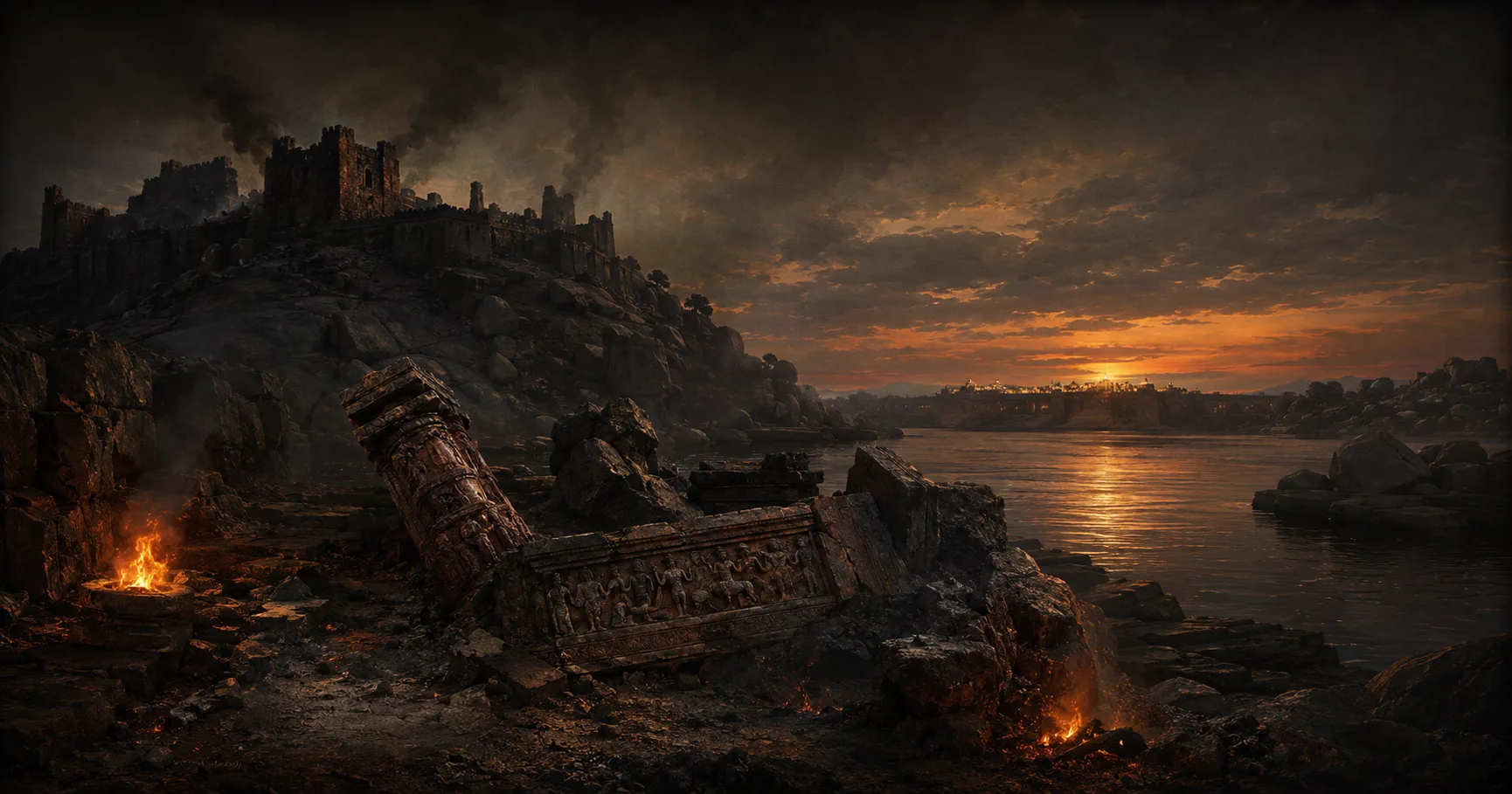
Where We Are in the Story
This is Part I of a nine-part history of the Vijayanagara Empire — the City of Victory that stood as the great shield of the South for over two hundred years. Before we can raise the city, we must walk through the ruin it was built to answer. This first movement is the catastrophe: the fall of the Hindu South to the armies of Delhi in the early fourteenth century, and the first defiant sparks of resistance that Vijayanagara would gather into a flame.
A City Built on Ash
Every great founding has a founding myth, and the myth of Vijayanagara is one of light kindled in darkness. But the darkness was not a metaphor. It was real, it was recent, and the men who founded the City of Victory had lived through it with their own eyes.
To stand at the beginning of this story properly, we must refuse the textbook's tidy sentence — that the Vijayanagara Empire was founded in 1336 by Harihara and Bukka. That sentence is true the way "the phoenix was born" is true. It omits the fire. It omits the ash. It omits the half-century of slaughter and collapse that made the founding not an ambition but a necessity — an act of civilizational triage performed on a body that was bleeding out.
The empire was not the beginning of a story. It was the answer to one. And the question it answered was written in the smoke rising from a hundred broken temples.
So let us begin where the founders' own memory began: with the end of the world they were born into.
The Kakatiya Sun Goes Down
The Glory That Was Warangal
In the thirteenth century, the Telugu country was ruled from Warangal — Orugallu, the "single stone" — by the Kākatīya dynasty. It was, by any measure, one of the jewels of Bhārata: a kingdom of black-soil prosperity, of soaring temples, of the thousand-pillared hall at Hanamkonda, of the great tank-irrigation works that turned the dry Deccan into a granary, of a martial nobility organized under a system called the nāyaṅkara that would echo through everything that came after.
Settled The Kākatīyas had divided their realm among some seventy-seven nāyakas — warrior-chieftains who held land in exchange for military service. Under the great queen Rudramadevi — one of the very few women to rule a major Indian kingdom in her own name — and then under her grandson Pratāparudra, Warangal stood as the paramount Telugu power, confident and unbroken. It would not stay unbroken.
The Hammer From the North
Settled The hammer fell from Delhi. Beginning under Alā-ud-dīn Khaljī and his general Malik Kāfūr in the first years of the fourteenth century, and completed under Ghiyāth-ud-dīn and then Muhammad bin Tughluq, the armies of the Delhi Sultanate drove south into the Deccan in wave after wave. The Yādavas of Devagiri were the first great power to fall. The Hoysaḷas of Dvārasamudra were battered and reduced. And Warangal, twice besieged, twice bought temporary peace with tribute — the second time surrendering, by tradition, the colossal diamond that the world would later know as the Koh-i-Noor, then a Kākatīya temple jewel.
Settled Peace bought with treasure is never peace. In 1323 the Delhi army returned under the prince Ulugh Khan — the future Sultan Muhammad bin Tughluq himself — and this time there would be no tribute and no reprieve. Warangal was stormed. Pratāparudra was taken captive and sent in chains toward Delhi.
Contested By the tradition preserved among Telugu people for seven centuries, Pratāparudra never reached the Sultan's court. Somewhere on the long northward road, on the banks of the Narmada — the river that marks the edge of the Deccan, the threshold of the South — the captive emperor took his own life rather than be paraded before his conqueror. Whether one reads it as despair or as a final act of sovereignty, the meaning the people drew from it was unmistakable: the last Kākatīya would not bow.
Settled With Pratāparudra gone, the kingdom was annexed. Warangal — Orugallu, the single stone — was renamed Sultanpur. A Muslim governor was installed. The Telugu heartland, the most cultured and prosperous region of the southern Deccan, passed under foreign administration. And the catastrophe rippled outward across the entire South at once.
Within a single generation, every major Hindu throne south of the Vindhyas had been broken, bought off, or occupied. The map of the South in the 1320s is a map of collapse.
The Testimony of the Vilasa Grant
We are not reconstructing this darkness from imagination. The people who lived through it left us their own words — and those words are among the most searing documents in all of Indian epigraphy.
Settled Around 1330 a Telugu chieftain named Prolaya Nāyaka issued a copper-plate land grant near Pithāpuram, in the coastal Andhra country. We call it the Vilāsa grant, and buried in its formal Sanskrit is an eyewitness lament for what the conquest had done to the Telugu land. It describes a world turned upside down: cultivators unable to till their fields, the wealth of temples seized, Brahmins stripped of the agrahāras — the tax-free villages that sustained Vedic learning — and the orderly dharmic society of the Kākatīyas dissolved into terror and plunder.
Settled The historical importance of the Vilāsa grant is hard to overstate. It is not a later chronicle written with the benefit of hindsight, nor a partisan polemic composed centuries afterward. It is a contemporary administrative document, issued by a man living through the events, recording — in passing, as context for a routine land grant — the devastation of his country. When such a record describes desecrated temples and a shattered social order, it carries an evidentiary weight that no later retelling can match.
Settled And the grant records something else: the beginning of the fightback. Prolaya Nāyaka presents himself not merely as a survivor but as a restorer — one who rebuilt temples, returned the agrahāras to Brahmins, re-established cultivation, and gathered the scattered survivors of the Kākatīya nobility into a new resistance. From his forest stronghold at Rekapalli, deep in the wild Godavari country near Bhadrāchalam, he and his allies began the patient, dangerous work of taking the country back.
The driving out of the invader and the rebuilding of the temple were, from the very first, a single indivisible act. This is the pattern Vijayanagara would inherit and perfect.
Kampili: The Phoenix That Burned Itself
Now we come to the small kingdom whose ashes Vijayanagara was literally built upon — for the city would rise on the very ground that Kampili died to defend.
A Kingdom of a Few Districts
Settled Kampili was a minor power, a kingdom of a few districts in what is now the Bellary–Raichur–Dharwar region of Karnataka — the rich wedge of land in the Krishna–Tungabhadra doab. It had been founded by a general, Mummadi Singeya Nāyaka, who had served the Yādavas of Devagiri and declared independence as that kingdom fell. His son, Kampilideva, ruled it from the twin fortresses of Kummaṭa and Hosadurga — the latter at Anegondi, on the northern bank of the Tungabhadra.
Settled Hold that geography in your mind. Anegondi, on the north bank. Across the river, on the south bank, lay the rocky ground where, within a decade, a new city called Vijayanagara would be founded. The empire was born across the water from the fortress where its prologue ended in fire.
The War of One Year
Settled The catastrophe came, as these things often do, through someone else's quarrel. In 1327 Bahā-ud-dīn Gurshāsp — a cousin of Sultan Muhammad bin Tughluq and governor of Sāgar — rebelled against Delhi, was defeated, and fled south seeking refuge. He found it with Kampilideva.
Settled The Sultan demanded the fugitive be handed over. Kampilideva refused. By the account preserved in the chronicles, the Rāya replied that he had given his word to protect Gurshāsp and would defend it with his life. It was a point of kṣatriya honour — the sheltered guest is inviolable — and it would cost him his kingdom and his life. The full weight of the Tughluq Sultanate, an empire then sprawling across half of South Asia, descended on a kingdom of a few districts.
Settled What followed was astonishing. The tiny kingdom of Kampili threw back the armies of Delhi not once but twice. The first expedition crossed the Krishna and besieged the fortress of Kummaṭa — and was routed. By one account, in a sally from the fort, the defenders captured two thousand horses and drove the imperial army in retreat all the way back to Devagiri. A second, better-equipped expedition came; it too was beaten back, Kampilideva himself leading the defence.
A kingdom of a few districts, twice defeating the armies of an empire that stretched from the Indus to the Bay of Bengal. For one extraordinary year, the impossible held.
Settled The Reddi nobles who fought alongside Kampili earned, in this war, a title that tells you everything about the spirit of the resistance: Gujjari-tattu-vibhāla — "the destroyers of the Gujjar cavalry," the breakers of the Sultanate's horse. These were not men resigned to conquest. These were men who had learned they could win.
The Last Day at Anegondi
Settled But an empire can afford to lose twice. Kampili could afford to lose once. The third expedition came in overwhelming force. Kummaṭa fell. Kampilideva and his son, the celebrated warrior-prince Kumāra Rāma, fell back to the island fortress of Anegondi, and there the Delhi army encircled them completely — no escape, no relief, no allies coming. The siege ground on. Provisions failed. Starvation set in. And surrender, for these men, was unthinkable.
Settled When the end was certain, the rite that the South would come to know too well was performed. The women of the royal household and the fortress committed jauhar: collective self-immolation, choosing the fire over capture and enslavement. The medieval traveller Ibn Baṭūṭa, who was in India in these years, recorded the event. Then Kampilideva, his son Kumāra Rāma, and the surviving warriors flung open the gates and rode out to die in battle rather than within the walls.
Settled The kingdom was annexed. And in a detail the chronicles preserve with stark cruelty, the victorious general sent word of his triumph to the Sultan by dispatching the severed, straw-stuffed head of the Hindu king northward — a trophy of conquest. Kampili was erased from the map.
Characterization This is the ground zero of our entire story. The fortress of Anegondi, where the women walked into the fire and the king rode out to his death, sits on the north bank of the Tungabhadra — directly across the river from where Vijayanagara would rise. When Harihara and Bukka chose the south bank for their new city, they were not choosing empty ground. They were choosing ground sanctified by a sacrifice they had witnessed, building their fortress of dharma in sight of the smoke.
The Eleven Captives
Contested Here the threads of our story knot together, though the knot is genuinely disputed. Among those taken captive at Kampili's fall, the sources tell us, were a number of the kingdom's officers and princes — by some analyses as many as eleven of Kampilideva's sons and retainers. They were carried to Delhi. There, following what the chronicles describe as the Sultanate's standard practice with captured Hindu elites, they were pressed to convert to Islam, and then — their loyalty presumed secured — released and even sent back south to help administer the turbulent frontier they had once defended.
Contested And it is here, in the most widely repeated tradition, that two of these captives enter history under their own names: Harihara and Bukka, treasury officers of the fallen order, converts under duress, returning to the South as the Sultan's agents — and carrying, beneath the imposed faith, the unextinguished memory of Anegondi.
Characterization Whether Harihara and Bukka were truly Kampili men, or Kākatīya treasury officers from Warangal, or Hoysaḷa commanders — this is one of the genuine debates of Indian history, and we will weigh it carefully in Part II. But the shape of the tradition is what matters here: the founders of Vijayanagara emerge directly out of the wreckage we have just walked through. They are not conquerors arriving from outside. They are survivors of the catastrophe, rising from within it.
The Forest Kings: The Musunuri Liberation
Before we cross the river to the founding itself, one more movement of the resistance must be told — because it proves that Vijayanagara was not an isolated miracle but the greatest wave in a rising tide.
Kapaya Nayaka and the Seventy-Five
Settled In the Telugu country, the resistance that Prolaya Nāyaka had begun from the Rekapalli forests was carried forward by his cousin, Kāpaya Nāyaka. And Kāpaya did what had seemed impossible: he united the scattered survivors of the Kākatīya order — by the testimony of the later Kaluvacheru grant, some seventy-five Nāyakas rallied to his leadership — into a single coordinated war of liberation.
Settled Knowing they could not meet the Sultanate's cavalry in open battle, the Nāyakas fought from the forests, in a long guerrilla campaign — harassing, ambushing, retaking fort after fort across the coastal belt between the Krishna and the Godavari. One by one the Sultanate's governors were driven out. And in 1336 — the very same year that, far to the southwest, Vijayanagara was being founded — Kāpaya Nāyaka stormed and recaptured Warangal itself, expelling the Tughluq governor, thirteen years after the Kākatīya capital had fallen.
In a single year, 1336, the Telugu country took back its imperial capital and the Karnataka country founded its imperial city. The South was rising in two places at once.
Settled For his achievement Kāpaya took the resonant title Andhra-Suratrāṇa — "the Sultan among the Andhras," a deliberate, defiant appropriation of the conqueror's own word of power — and another inscription records that he held his mandate to protect dharma. The resistance understood itself, exactly as Vijayanagara would, as a sacred commission.
A Tide, Not a Miracle
Characterization This is the essential context that the isolated founding-myth obscures. Across the whole of the southern Deccan in the 1330s, the conquered were rising — the Musunuri Nāyakas in Telangana, the Reddis in coastal Andhra, the remnant Hoysaḷas in the south, and the Sangama brothers on the Tungabhadra. These were not unconnected accidents. They were a single civilizational reflex: a society that had been struck down and was, everywhere at once, getting back to its feet.
Settled Vijayanagara was the wave that did not recede. The Musunuri achievement, brilliant as it was, proved fragile — Kāpaya would lose Warangal again to the rising Bahmani power and fall in battle in 1368, his confederation dissolving into rival principalities. The Reddi kingdom flourished and faded. But the city across the river from Anegondi would do what none of the others managed: it would endure, gather the whole rising tide into itself, and stand for over two hundred years.
The Threshold
So we arrive at the river's edge, in the year 1336, with the smoke of Anegondi still in the air and the news of Warangal's liberation traveling the roads.
Behind us lies the wreckage: Devagiri fallen, Dvārasamudra broken, Warangal sacked and its emperor dead on the Narmada, Madurai occupied by a Turkic sultanate within sight of Rameshwaram, Kampili burned to ash with its women in the fire and its king's head stuffed with straw. A generation of catastrophe. The near-extinction of Hindu sovereignty across the entire South.
And before us, on the south bank of the Tungabhadra, two brothers and a sage are about to do something that will answer all of it.
They had seen the worst that conquest could do. Now they would build the thing that conquest could not undo. They would call it the City of Victory — and for the next two hundred years, they would make the name true.
In Part II — The Brothers and the Sage — we cross the river: the genuine debate over who Harihara and Bukka really were, the towering figure of Vidyāraṇya of Śṛṅgeri and the Vedic mind behind the throne, the consecration and founding of the city in 1336, and the first great campaign of liberation — Kumāra Kampaṇa's reconquest of the Tamil south, immortalized in Sanskrit by the hand of a queen who watched it happen.
Characterization A note on the telling. This series leans, without apology, toward the civilization it describes — but it does not invent. Where the record is firm it is marked Settled; where the sources genuinely diverge, as with the founders' origins, it is marked Contested; and where the account expresses the empire's own sense of sacred purpose, it is named for what it is. The grief of the Vilāsa grant, the fire at Anegondi, the liberation of Warangal — these are not embellishments. They are the documented ground on which the City of Victory was raised.