Where We Are in the Story
In Part I we walked through the catastrophe: the fall of the Kakatiyas, the burning of Kampili at Anegondi, the near-extinction of Hindu sovereignty across the South, and the first defiant sparks of resistance from the forests of Telangana. We left two brothers and a sage at the river's edge in 1336. Now we cross the water. This is the founding itself — who the founders really were, the extraordinary mind that consecrated their mission, the birth of the city, and the first campaign that proved the new empire could not merely defend the South but liberate it.
A Question With No Settled Answer
Let us begin with honesty, because the honesty is part of the grandeur.
Who were Harihara and Bukka, the brothers who founded the greatest Hindu empire of the medieval South? The truthful answer is that historians have argued about it for over a century and have not fully agreed. And rather than paper over that with a confident fiction, we should look squarely at the debate — because every one of the competing theories tells us something true about the world that produced these men.
Contested This is one of the genuine open questions of Indian history. The sources disagree, the inscriptions are read different ways by different scholars, and the founders themselves left us titles and grants but no autobiography. What follows is the real spread of evidence — not a settled verdict dressed up as one.
The Four Theories
Contested The Kakatiya-treasury theory, championed by the British scholar Robert Sewell — whose 1900 book A Forgotten Empire recovered Vijayanagara for the modern world — holds that the brothers were treasury officers of the Kakatiya court at Warangal who escaped the fall of that kingdom. Sewell's source was a Sanskrit text, the Vidyāraṇya Sikka, shown to him in Mysore in 1801, which named Harihara and Bukka as guards of the treasury of King Pratāparudra.
Contested The captivity-and-reconversion theory, drawn largely from later Persian chronicles, holds that the brothers were captured after the fall of Kampili (or Warangal), taken to Delhi, converted to Islam under duress, and sent back south as the Sultan's agents — and that there, under the influence of the sage Vidyāraṇya, they renounced the imposed faith, returned to dharma, and threw in their lot with the Hindu resurgence led by the Musunuri Nāyakas.
Contested The Hoysaḷa-commander theory, supported by much modern epigraphic work, holds that Harihara and Bukka were Kannada-speaking commanders in the army of the last Hoysaḷa king, Vīra Ballāḷa III, stationed on the Tungabhadra frontier to ward off the invasions — and that when the Hoysaḷa power collapsed after Ballāḷa's death in 1342, they inherited and absorbed it, building their own empire on its foundations.
Settled What is not in dispute is the weight of the Kannada evidence. The Sangama brothers signed their records as Śrī Virūpākṣa — invoking the guardian deity of Hampi — and bore resounding Kannada titles: Pūrva-Paścima-Samudrādhīśvara, "Lord of the Eastern and Western Oceans," and Bhāṣege-tappuva-rāyara-gaṇḍa, "Punisher of kings who break their word." Over seven thousand of their inscriptions are in Kannada. Their patron was the Jagadguru of Śṛṅgeri. By the weight of their own records, these were men of the Karnataka country.
They left us their victory titles in Kannada and their devotion to Virūpākṣa in stone. Whatever road brought them to the Tungabhadra, the throne they built there spoke the language of the land.
Why the Debate Itself Matters
Polemical Here is the deeper point, and it is one the dry textbook misses. Notice what every theory has in common. Whether the brothers were Kakatiya treasurers from Telugu Warangal, or Hoysaḷa commanders from Kannada country, or captives who shook off an imposed faith — in every version, they emerge from the defeated side of the catastrophe. They are not adventurers carving out a private kingdom. They are survivors of a civilizational collapse, rising from inside the wreckage to rebuild what the invasions had broken. The argument is only about which fallen Hindu kingdom they came from — never about whether the empire they built was a project of Sanātana restoration. On that, the sources are unanimous, and that unanimity is the real historical fact.
The Sage on the Hill
If the brothers are contested, the man who consecrated their mission is not a shadow but one of the towering intellects of medieval India.
Who Was Vidyāraṇya?
Settled Vidyāraṇya — "the forest of learning" — is associated in scholarship with Mādhava (Mādhavācārya), and stands among the greatest names of fourteenth-century Indian thought. To him is attributed the _Sarvadarśanasaṅgraha_, the "Compendium of All Philosophical Systems" — a magisterial survey that reviews the sixteen schools of Indian philosophy then current, laying out the strongest case for each and arranging them as an ascending ladder culminating in Advaita Vedānta. He is connected to the _Pañcadaśī_, one of the essential manuals of non-dualism, and to the Śaṅkara Digvijaya, the great life of Ādi Śaṅkara. He became the Jagadguru of Śṛṅgeri — the southern monastery established by Ādi Śaṅkara himself — and guided three generations of Vijayanagara kings.
Contested The exact identity is itself debated. The Śṛṅgeri tradition holds Vidyāraṇya to be distinct from the court-minister Mādhava — making Mādhava and his brother Sāyaṇa his disciples rather than his own earlier self. Other scholars identify Vidyāraṇya as Mādhava, the minister who later took sannyāsa and ascended the Śṛṅgeri seat. The chronology is genuinely tangled. But the civilizational role — the Vedic ācārya who blessed and shaped the empire — is constant across every version.
The Vedas Made Living Again
Settled Whatever the precise identities, the circle around Vidyāraṇya accomplished something staggering: the great project of commenting on the Vedas themselves. Mādhava and his brother Sāyaṇa — sons of Māyaṇa of the Bhāradvāja gotra — produced the bhāṣyas on the Ṛg, Yajur, Sāma and Atharva Saṃhitās that remain, to this day, the standard gateway through which scholars enter the Vedic corpus. By tradition Vidyāraṇya entrusted his unfinished Veda commentaries to the brothers, blessing them to complete and publish the works under their own names — the renowned Mādhavīyam and Sāyaṇīyam.
Consider the symmetry. The same circle of minds that restored the Vedas to living interpretation also helped restore a kingdom to defend them. To re-found the śāstra and to re-found the rāṣṭra were, for these men, a single act.
Characterization This is the order of operations that matters. Vijayanagara was not a conquest that later acquired a religious gloss. The founders sought out a Vedic ācārya, and the ācārya gave them a civilizational mandate. The sword followed the śāstra — not the other way around. An empire blessed by the editors of the Vedas understood exactly what it was for.
The Tapas on Matanga Hill
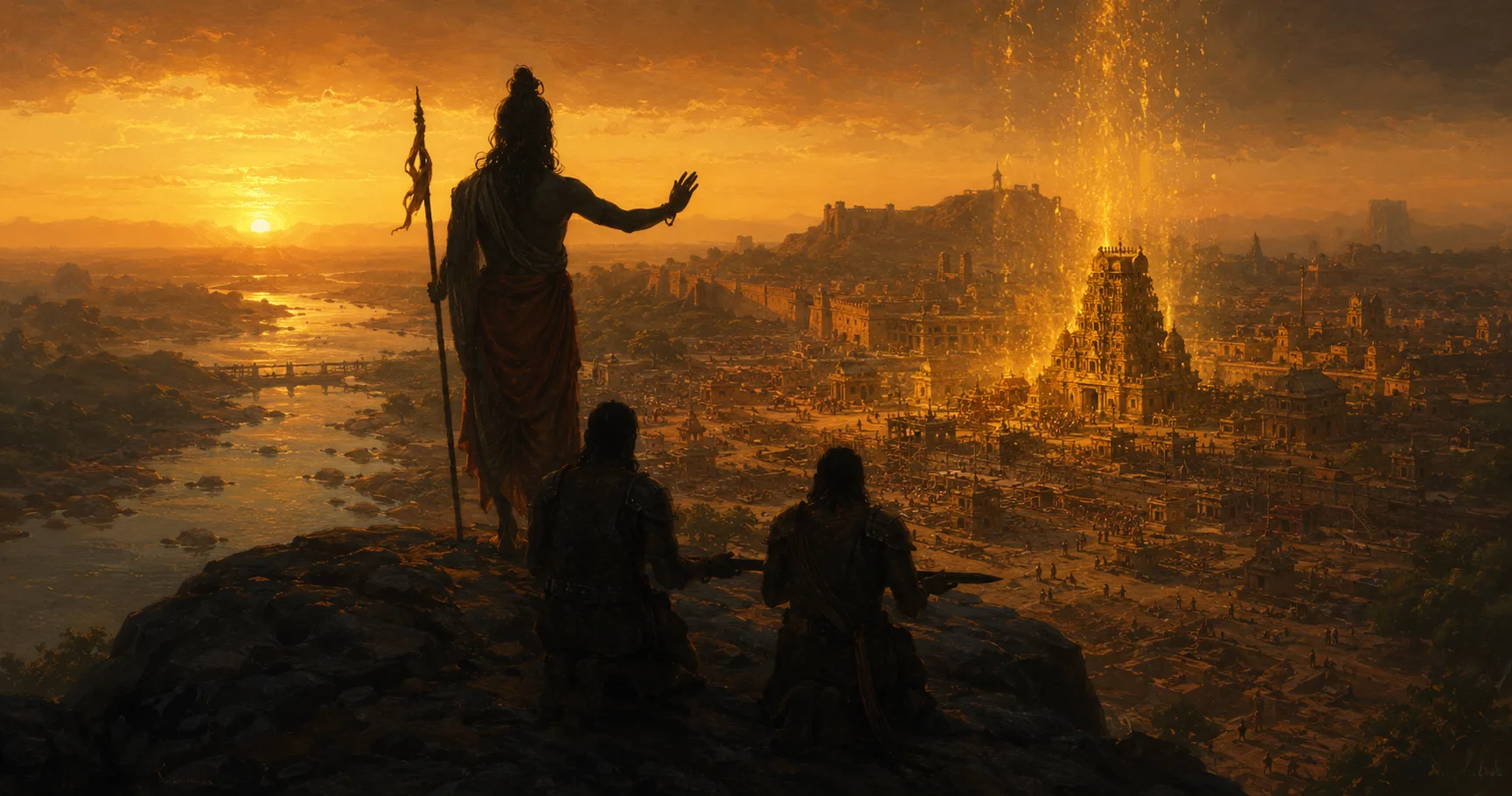
Settled Tradition places Vidyāraṇya in deep austerity on Mātaṅga Hill, overlooking Hampi — the very hill that the Rāmāyaṇa associates with the sage Mātaṅga and the Kiṣkindhā of Rāma and Sugrīva. There, by the accounts preserved in the tradition, he bathed each dawn in the Tungabhadra, worshipped at the Virūpākṣa temple, and waited — for years, like a man watching a clock — for the one who would come to found the empire he had foreseen.
Polemical And here the history passes, as it must, into the empire's own sense of the sacred. Tradition holds that Vidyāraṇya performed tapas to summon the wealth a new kingdom would need, and that the goddess Bhuvaneśvarī — or in some tellings Lakṣmī — rained gold upon the chosen ground, so that an army could be raised and dharma defended. The rationalist historian will call this a pious legend, and as bare fact it cannot be verified. But it is not decoration. It encodes the conviction the founders lived and died by: that the treasury of Vijayanagara was consecrated, its purpose ordained, its war a war for the gods. To strip that conviction out in the name of skepticism is to misunderstand the men who built the city.
1336: The City Is Born
Settled In 1336, on the south bank of the Tungabhadra — the harder bank to assault, shielded by the river and the wild granite hills — the city was founded and Harihara was crowned its first king. By an inscription of 1346 recording a grant to the Śṛṅgeri maṭha, Harihara I is already styled king of "the whole country between the eastern and the western seas," ruling from a capital called Vidyānagara — the City of Learning, named, the tradition holds, for the sage himself — which history would remember as Vijayanagara, the City of Victory. In its earliest references the site appears also as Hosapaṭṭana, the "new city."
Characterization The site was chosen with a soldier's eye and a priest's heart, exactly as the catastrophe demanded. The Tungabhadra guarded the north. The boulder-strewn hills made natural fortress walls. And the land was already holy — here, by ancient tradition, stood Kiṣkindhā of the Rāmāyaṇa, where Rāma met Hanumān and Sugrīva. The defenders of dharma planted their capital on ground already sanctified by the great defender of dharma himself, across the river from the ashes of Anegondi.
The Gradual Inheritance of the South
Settled The new kingdom did not spring up overnight as a finished empire; it gathered the South to itself. When the last Hoysaḷa king, Vīra Ballāḷa III, died in 1343 fighting the Madurai Sultanate, his realm flowed — by most accounts gradually and with little bloodshed — into the rising Sangama power, as Hoysaḷa officers melted away from a crumbling throne to a vigorous new one. A revealing detail survives: in 1346 Harihara I made a grant to the Śṛṅgeri ācārya in the presence of the widowed Hoysaḷa queen, who made her own grant the same day — the old order and the new standing together at the altar, the succession sealed not by slaughter but by shared devotion.
The empire did not so much conquer the South as inherit its defense. Where the Hoysaḷas fell, Vijayanagara rose to take up the same burden — and to carry it for two hundred years where they had carried it for one generation.
Settled Bukka understood that an empire lives by more than the sword. He is recorded sending a diplomatic mission as far as Ming China. The court gathered scholars under Vidyāraṇya's shadow; the Vedic commentary project flourished under royal patronage; the nāyaṅkara system — the warrior-chieftains holding land for military service, inherited from the very Kakatiya order whose fall had begun the whole story — became the backbone of the new state. From its first generation, Vijayanagara understood itself as a cultural mission housed in a military frame.
The First Liberation: The Sword at Madurai
The new empire's defining test came not in defense but in liberation — and it produced one of the most extraordinary documents in all of Indian literature.
The Wound in the Deep South
Settled Of all the invasions, the deepest affront lay at the very tip of the peninsula: the Madurai Sultanate, a Turkic state planted in the heart of the Tamil country in the 1330s, ruling within sight of Rāmeśvaram itself. The Moorish traveller Ibn Baṭūṭa, who passed through Madurai in 1342, left a record of the Sultanate's brutality. Famine and plague compounded the misery. The Pāṇḍya land — Meenakshi's own city, the golden hall of Chidambaram, the great reclining Viṣṇu of Śrīraṅgam — lay under foreign occupation, its temples shuttered or desecrated.
Kumāra Kampaṇa and the Goddess's Sword
Settled Bukka I sent his son, the prince Kumāra Kampaṇa — named, by tradition, so that enemies would quake (kampa) at the mention of it — to break the Sultanate. First he subdued the Sambuvarāya chieftain blocking the road south, defeating him in single combat, and secured Kāñcīpuram. Then he turned toward Madurai.
Polemical What happened at Kāñcī is told in the epic that immortalized the campaign. There, a divine vision came to Kampaṇa: a figure embodying the suffering Pāṇḍya land lamented its fate under occupation and placed in his hands a sword — the ancient royal blade of the Pāṇḍyas, symbol of the South's lost sovereignty — charging him "to undertake the righting of vast wrongs." The passage of that sword into Kampaṇa's hand is the passage of the South's kingship from the broken Pāṇḍyas to Vijayanagara. He marched under the yellow banner of the Varāha — Viṣṇu's boar, the emblem of the empire — and the Sangama armies swept the Sultanate's forces before them.
Settled The campaign culminated around 1370 in the fall of Madurai and the decisive defeat of the Sultan — by the epic's account, beheaded by Kampaṇa himself in combat. Almost five decades of foreign rule in the deep South ended. And then came the part that mattered most: the restoration. The reclining Viṣṇu of Śrīraṅgam was returned to worship; the dance of Śiva resumed in the golden hall of Chidambaram; the garlands bloomed again before Meenakshi at Madurai. The land of the Pāṇḍyas, in the epic's words, breathed in dharma once more.
A prince did not merely win a war in the Tamil south. He reopened the temples. The measure of the victory was not the Sultan's head but the relit lamp before the goddess.
A Queen Writes the Epic
Settled And here is the detail that almost no one knows — the jewel of the whole story. The chronicle of this liberation was written by Gaṅgādevī (Gaṅgāmbikā), Kumāra Kampaṇa's own queen, who witnessed the events. Her Sanskrit mahākāvya, the _Madhurāvijayam_ — "The Conquest of Madurai," also called the Vīrakamparāya Caritam — stands as a contemporary eyewitness epic of the campaign, composed by a royal woman in the high classical idiom.
Settled The Madhurāvijayam is doubly precious. It is among the few contemporary accounts of the period, and it is the work of a learned woman of the fourteenth century — her royal status having given her an education in Sanskrit poetics most women of the age were denied. At the poem's opening she eulogizes the great Sanskrit poets of the Telugu country, particularly Tikkana of the Andhra Mahābhāratam, suggesting her own roots in the Telugu-speaking world. She laments the desecrated temples of the Tamil land in lines of genuine grief, then sings their liberation. It is literature and history at once — a queen's testimony, in her own hand.
Settled The poem itself was nearly lost. It survived in palm-leaf, rediscovered only in the early twentieth century in a private library at Thiruvananthapuram, bound by chance between two unrelated works, and first published in 1924. Nine chapters, some verses lost to time — a fragment of a fourteenth-century queen's voice, recovered five hundred years later, telling us how the South was set free.
A queen wrote the epic of her husband's war, lamented the broken temples in Sanskrit verse, and sang their reopening. The restoration of the South was recorded by the hand of a woman who watched it happen — and her poem nearly vanished, surviving by accident to reach us at all.
The Shield Is Raised
So the empire is born — not as an accident of ambition but as the deliberate answer to a catastrophe. Two brothers out of the wreckage of the fallen kingdoms. A sage who had restored the Vedas and now consecrated a realm to defend them. A city planted on holy, defensible ground, named for learning and for victory. And a first great campaign that proved the new power could do more than hold the line: it could march to the peninsula's tip, break the deepest occupation, and relight the lamps before the gods.
By the end of the first generation, the map of the South had begun to reverse. Where there had been collapse, there was now a sovereign Hindu empire, expanding, patronizing scholarship, restoring temples, gathering the broken kingdoms into a single shield.
In Part I the South was nearly lost. In Part II it is taken back. What remains is to see how the shield was made to last — and how it grew, over the century that followed, into the colossus that diamonds and roses and foreign ambassadors would come to marvel at.
In Part III — The Sangama Century — we follow the dynasty through its first hundred years: Harihara II and the two Deva Rāyas; the long, grinding war with the Bahmani Sultanate across the Raichur Doab; the pragmatic military genius of Deva Rāya II; and the eyewitness wonder of Abdur Razzaq, the Persian ambassador who came to the City of Victory and could find no city on earth to equal it.
Characterization A note on the telling. Where the record is firm, it is marked Settled; where the sources genuinely diverge — above all on the founders' origins — it is marked Contested; and where the account enters the empire's own sense of sacred purpose, that is named for what it is. The origins debate is real and unresolved, and it is presented as such. But the meaning of the founding — a Sanātana restoration consecrated by a Vedic sage — is not in doubt. On that, the founders' own stones speak plainly.