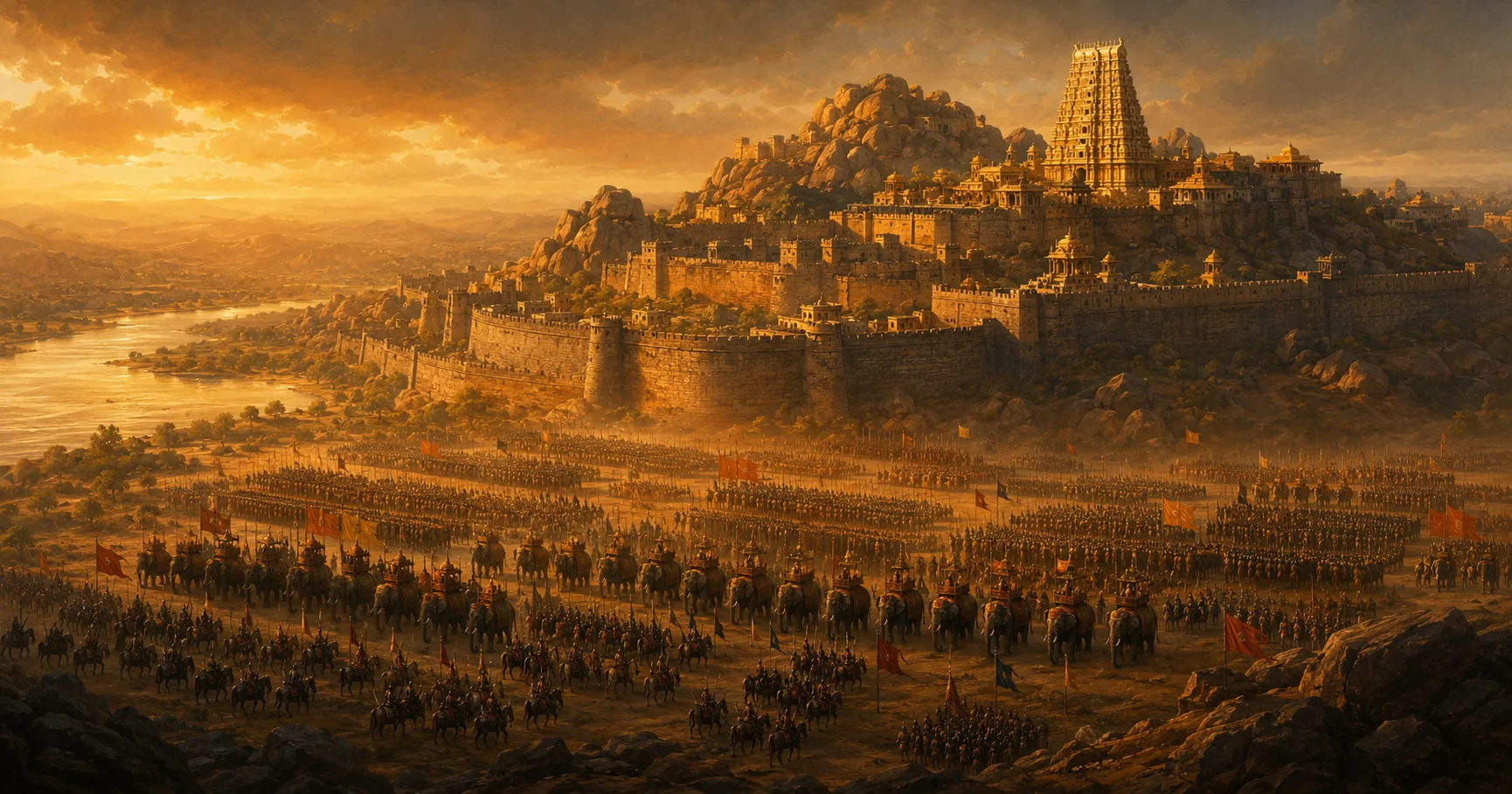
Where We Are in the Story
In Part II the empire was born and proved itself: founded in 1336, consecrated by Vidyāraṇya, and tested in the great liberation of Madurai under Kumāra Kampaṇa. Now we follow the first dynasty — the Sangamas — through the hard century that turned a fortified town into a coast-to-coast empire. This is the story of consolidation by fire: the long, grinding war with the Bahmani Sultanate across the contested river-country, the kings who held and extended the line, and the foreign eyes that began to record the wonder of the city itself.
The Adversary Across the River
Before we follow the kings, we must name their great rival clearly, because the whole century is shaped by it.
Settled The northern adversary was not the Mughals — they did not yet exist as an Indian power. It was the Bahmani Sultanate, founded in 1347 in the northern Deccan, a breakaway Muslim kingdom that had rebelled against Delhi and carved out its own state across the Krishna river. For nearly two centuries the history of the Deccan is the history of these two powers locked together: Hindu Vijayanagara south of the Krishna and Tungabhadra, Muslim Bahmani to the north.
Settled Between them lay the prize that would be soaked in blood for generations: the Raichur Doab — the rich, cotton-growing wedge of land between the Krishna and the Tungabhadra, studded with the fortress-towns of Raichur, Mudgal, and Adoni. Whoever held the Doab held the gateway between the two empires. It changed hands again and again, and almost every war of the Sangama century was fought, in the end, over those forts.
Two empires, one river-wedge between them, and two hundred years of war to decide who held it. The Raichur Doab is the hinge on which the whole age turns.
Harihara II: The Empire Reaches Both Seas
Settled When Bukka I died in 1379, his son Harihara II (r. 1377–1404) took the throne — though not without a fight, for revolts broke out in the Tamil country, said to be stirred by partisans of the late Kumāra Kampaṇa, who had been seen as the natural heir before his death. Harihara II crushed the revolts, placed his own sons in command of the provinces to prevent further trouble, and then turned to expansion.
Settled His reign pushed Vijayanagara to its widest extent yet. He took control of coastal Andhra from Nellore toward Kalinga, conquered the Addanki and Śrīsailam regions, and extended the empire over most of the territory south of the Krishna. On the western coast he seized the great ports — Goa, Chaul, and Dabhol — opening Vijayanagara to the lucrative overseas trade in horses, the one commodity the empire's cavalry desperately needed and could not breed at home. He earned the resonant titles Vaidikamārga-Sthāpanācārya and Vedamārga-Pravartaka — "establisher of the Vedic path," "promoter of the way of the Veda." The continuity from Vidyāraṇya's founding vision is written into the king's own throne-names.
Settled Note what these titles announce. A generation after the founding, the empire still defines its kingship in explicitly Vedic terms — not as a generic monarchy but as the established protector of the Vedic order. Under Harihara II an important work on the Vedas was completed at court, continuing the Mādhava–Sāyaṇa commentary project begun in the founder's circle. The crown and the Veda remained a single institution.
Settled The wars with the Bahmanis under Harihara II ran hot and cold with the temperament of the sultans across the river. While the peaceable Muhammad Shah II held Gulbarga, the northern frontier stayed quiet and Harihara concentrated southward. But the accession of the warlike Firuz Shah in 1397 changed everything. The Doab became a battleground again: Harihara's son Bukka II led an expedition against Mudgal and Raichur, and Firuz came out in full force to defend them, both armies encamping on the banks of the Krishna in 1398. The seesaw had begun in earnest, and it would not stop for a century and a half.
The Disputed Succession and Deva Rāya I
Settled Harihara II's death in 1404 plunged the dynasty into a succession struggle among his sons — Virūpākṣa Rāya, Bukka Rāya II, and Deva Rāya I. Virūpākṣa held the throne only a few months; Bukka II took over briefly; and in 1406 Deva Rāya I ousted his brother and made himself king, reigning until 1423. The brief chaos is a reminder that Vijayanagara, for all its strength, never solved the problem that broke so many Indian dynasties: the absence of a settled rule of succession. Each throne-passing was a potential civil war.
Settled Deva Rāya I proved a capable and consequential ruler. He is remembered above all for two things: water and walls. He built a great dam across the Tungabhadra and a network of aqueducts to carry water into the capital — the hydraulic engineering that allowed the city to swell into one of the largest in the world in a dry land. And he began the serious modernization of the army, upgrading the artillery and recruiting skilled mounted archers, including Turkish and Central Asian horsemen, to close the cavalry gap with the Bahmanis.
Characterization The cavalry problem haunted Vijayanagara for its entire existence and shaped its strategy and its diplomacy. The Deccan plateau could not breed war-horses of the quality the steppe and Arabia produced; the empire had to import them, at ruinous cost, through the western ports — which is why control of Goa and the coast mattered so much, and why the Portuguese horse-traders would later become such welcome guests. The Bahmani sultans, with easier access to Persian and Arab bloodstock, often held the edge in cavalry. Much of Vijayanagara's military ingenuity was an answer to this single, stubborn disadvantage.
The War of the Goldsmith's Daughter
Contested One episode of Deva Rāya I's reign passed into legend as the War of the Goldsmith's Daughter. As the chronicles tell it, a Brahmin returning from pilgrimage to Banaras described to the court a goldsmith's daughter of Mudgal named Parthal — praising her beauty, her musical gift, her virtue. Word spread; the Bahmani sultan Firuz Shah is said to have demanded her, and the demand became a casus belli, dragging the two empires into another round of war over the Doab. Whether the romance is history or the embroidery of chroniclers, the underlying truth is plain: the powers needed only the thinnest pretext, because the real quarrel — the Doab itself — was always there beneath the story.
Deva Rāya II: The High Noon of the Sangamas
Settled The greatest of the Sangama kings was Deva Rāya II (r. 1424–1446), whom history remembers by his sobriquet Gajabetekara — the "Hunter of Elephants," a name that meant both his love of the hunt and his victories over enemies as strong as elephants. By the account of the Persian visitor Abdur Razzaq, his empire stretched from Ceylon to Gulbarga and from Orissa to the Malabar coast. He repulsed the Reddis of Kondavidu, crossed the Tungabhadra in 1443 to recover lands toward the Krishna, defeated the army of Kalinga, and extended his authority as far as Rajahmundry.
The Pragmatic Reform
Settled But Deva Rāya II is remembered most for a hard military decision. Again and again in the 1430s and 1440s the Vijayanagara armies were bested by the Bahmanis, who fielded superior mounted archers — horsemen who could shoot from the saddle at the gallop, a skill the Vijayanagara cavalry lacked. After paying a heavy tribute to buy peace, Deva Rāya II resolved to close the gap directly. He recruited skilled Muslim archers and cavalrymen into his own army to train his troops in the technique — giving them freedom to practice their faith, granting them jāgīrs, and building a mosque in the capital for their use. By the chronicles' reckoning his archery corps came to number some two thousand Muslim and sixty thousand Hindu bowmen. In 1436 he moved against Mudgal and pressed the war back into the Doab.
Polemical This episode is worth weighing carefully, because it is easily misread. Vijayanagara was, root and branch, a dharmic empire — its kings styled themselves protectors of the Vedic path, its armies marched to reopen desecrated temples, its whole reason for existing was the defense of Sanātana civilization against the invasions. And that same confident empire could, in its own military administration, recruit Muslim horse-archers and build them a mosque to learn their skill. There is no contradiction here, and it should not be mistaken for some symmetrical "tolerance" on both sides. The defending empire absorbing skilled men into its service is not the same act as the aggressor sultanates razing temples and putting cities to the sword. A strong civilization defends itself fiercely and takes useful talent where it finds it; that is confidence, not capitulation. The asymmetry between the two — restoration on one side, desecration on the other — remains exactly what it was.
The Scholar and the Builder
Settled Deva Rāya II was no mere soldier. He was himself a poet, author of the _Sobagina Sone_, a collection of romantic tales in Kannada framed as a narration to his wife, and he wrote Sanskrit works as well. His court gathered scholars across languages — the Sanskrit poet Gunda Dimdima, the mathematician and astronomer Parameśvara of the Kerala school among them. Many of the temples that still stand at Hampi took shape or were enriched under his patronage. The empire at its first golden noon was, as it would always be, a place where the sword and the stylus were wielded by the same hand.
The City Through Foreign Eyes
It is in this century that the outside world began to see Vijayanagara — and to struggle for words.
Nicolo Conti
Settled Around 1420 the Venetian merchant Nicolo Conti reached the city, which he rendered as Bizenegalia. His description already strains toward the superlative: a city near very steep mountains, sixty miles in circumference, its walls climbing up into the hills and enclosing the valleys at their feet, with — by his estimate — ninety thousand men within fit to bear arms. Conti judged the king of Vijayanagara more powerful than any in India.
Abdur Razzaq
Settled The fullest early witness came in 1443: Abdur Razzaq, ambassador of the Timurid ruler Shāhrukh (son of Tīmūr), sent from Herat by way of Calicut. His account is one of the treasures of medieval travel-writing. He described a city of concentric fortifications — seven walls, one within another — with cultivated fields, gardens, and houses between the outer rings, and a dense, thronging metropolis at the heart. He marvelled at the bazaars: broad, arcaded streets where jewellers sold pearls and precious stones openly, where every trade had its own quarter, where roses were sold everywhere because, he noted, the people of this land could not live without roses.
A Persian ambassador, far from home, recorded that in this Hindu capital roses were a daily necessity sold on every street. Empires are remembered for their walls and their wars. This one should also be remembered for its roses.
Settled Abdur Razzaq was a Muslim envoy from a rival civilization, not a partisan of Vijayanagara — which is precisely what makes his wonder so valuable. When such a witness writes that his eye had seen no city like it and his ear had heard of none to equal it anywhere on the round of the globe, that is not Hindu self-praise but the considered judgment of an outsider who had seen the great cities of Persia and Central Asia. The grandeur was real, and the world's most sophisticated travelers confirmed it.
Settled Razzaq described the royal court in similar terms — the throne, the audience halls, the Mahānavami festival with its processions of caparisoned elephants and ranked troops, the sheer apparatus of a great state. Through his eyes, and Conti's, we glimpse the city at the close of the Sangama century: not yet at the absolute summit it would reach under Krishnadevaraya, but already among the largest and richest cities on earth.
The Dynasty Falters
Settled After Deva Rāya II died in 1446, the Sangama line declined. His successors — Mallikārjuna and Virūpākṣa II — were weaker men, and under them the empire lost ground: territory slipped away, the Bahmanis and the rising coastal powers pressed in, and the central authority frayed. The dynasty that had founded the empire and carried it to a coast-to-coast colossus could no longer hold what it had built.
Settled By the 1480s the situation was grave enough that a powerful general would step in to seize the throne and save the state from disintegration — an act of usurpation that nonetheless preserved the empire and opened the way to its absolute summit. That is the hinge of our next movement.
The Sangamas built the shield and carried it for a hundred and fifty years. When their grip finally failed, the empire did not fall — it found new hands strong enough to lift it higher than it had ever been.
In Part IV — The Machine of Empire — before we reach those new hands, we pause to look inside the state itself: how Vijayanagara actually worked. The nāyaṅkara military-feudal system, the ayagar village officers, the gold varāha and the revenue that filled the treasury, the standing army, the guilds, and the great Mahānavami festival where the whole empire displayed its power. To understand how the City of Victory rose to its peak — and why its fall was so catastrophic — we must first understand the machine that made it run.
Characterization A note on the telling. The Bahmani wars are recorded by chroniclers on both sides — Vijayanagara inscriptions and Persian historians like Ferishta — and their accounts often conflict on detail (who held Mudgal in 1436, what triggered the 1443 war). Where the sources diverge, this account says so. What is not in doubt is the shape of the age: a sustained two-power struggle over the Deccan, in which Vijayanagara stood as the southern Hindu shield, expanding, building, and patronizing the Vedic and literary traditions even as it fought year after year for the river-country in the north.