A Gap in the Treaty
The Treaty of Versailles, signed in June 1919, was extremely specific about German armaments. It capped the army at 100,000 men. It abolished the general staff, the air force, and conscription. It enumerated permitted artillery by calibre, restricted armoured vehicles, and prohibited heavy guns above stated limits.
It said nothing at all about rockets, because in 1919 no serious person believed a rocket could be a weapon.
The German Army Ordnance Office noticed. In 1929 Colonel Karl Becker, head of the ballistics section, commissioned a study on whether rocket propulsion could deliver a militarily useful payload. The officer assigned to pursue it was a young artillery captain and engineer named Walter Dornberger.
Dornberger went looking for people who knew anything about the subject and found, essentially, amateurs. The Society for Space Travel was flying small liquid-fuelled rockets from a disused ammunition dump outside Berlin. Their engineering was poor, their finances worse, and their ambitions were interplanetary. In 1932 Dornberger watched a demonstration launch that failed, and afterwards approached the most technically capable of the group.
Wernher von Braun was twenty. He accepted a salaried research position with the Army in October 1932 and set up at the Kummersdorf proving ground south of Berlin with a staff of one mechanic. He wrote his doctoral thesis on the combustion of liquid propellants; it was submitted in 1934, classified immediately, and not published until 1960.
The amateur society was gone within two years. Civilian rocketry in Germany was subsequently banned outright.
The bargain von Braun made in 1932 is the moral spine of this entire series, and it is worth stating without decoration. He wanted to build spacecraft. No one on Earth would fund spacecraft. One organisation would fund large rockets, and its interest was in delivering explosives onto cities. He took the money, and he kept taking it through the establishment of the dictatorship, through his own membership of the Nazi Party in 1937 and of the SS in 1940, through the use of concentration camp labour in the factories, and through to the end. He said afterwards that his interest had always been space and that the weapon was the price of the laboratory. That is very probably true. It is also not a defence, and this series will not offer it as one. Author's judgement
By 1936 Kummersdorf was too small and too close to Berlin. Von Braun's mother suggested the family's old duck-hunting grounds on Usedom: flat, isolated, sparsely populated, with 300 kilometres of open Baltic to the east over which a vehicle could fly without passing over anyone.
Construction at Peenemunde began in 1937. At its height the establishment employed roughly 12,000 people and had consumed on the order of 300 million reichsmarks. It had its own power station, its own airfield, its own oxygen liquefaction plant producing tonnes of liquid oxygen per day, a supersonic wind tunnel, and a measurement house full of instrumentation that did not exist anywhere else.
It was, in 1942, the most advanced engineering establishment in the world, and it existed to build one object.
The Machine
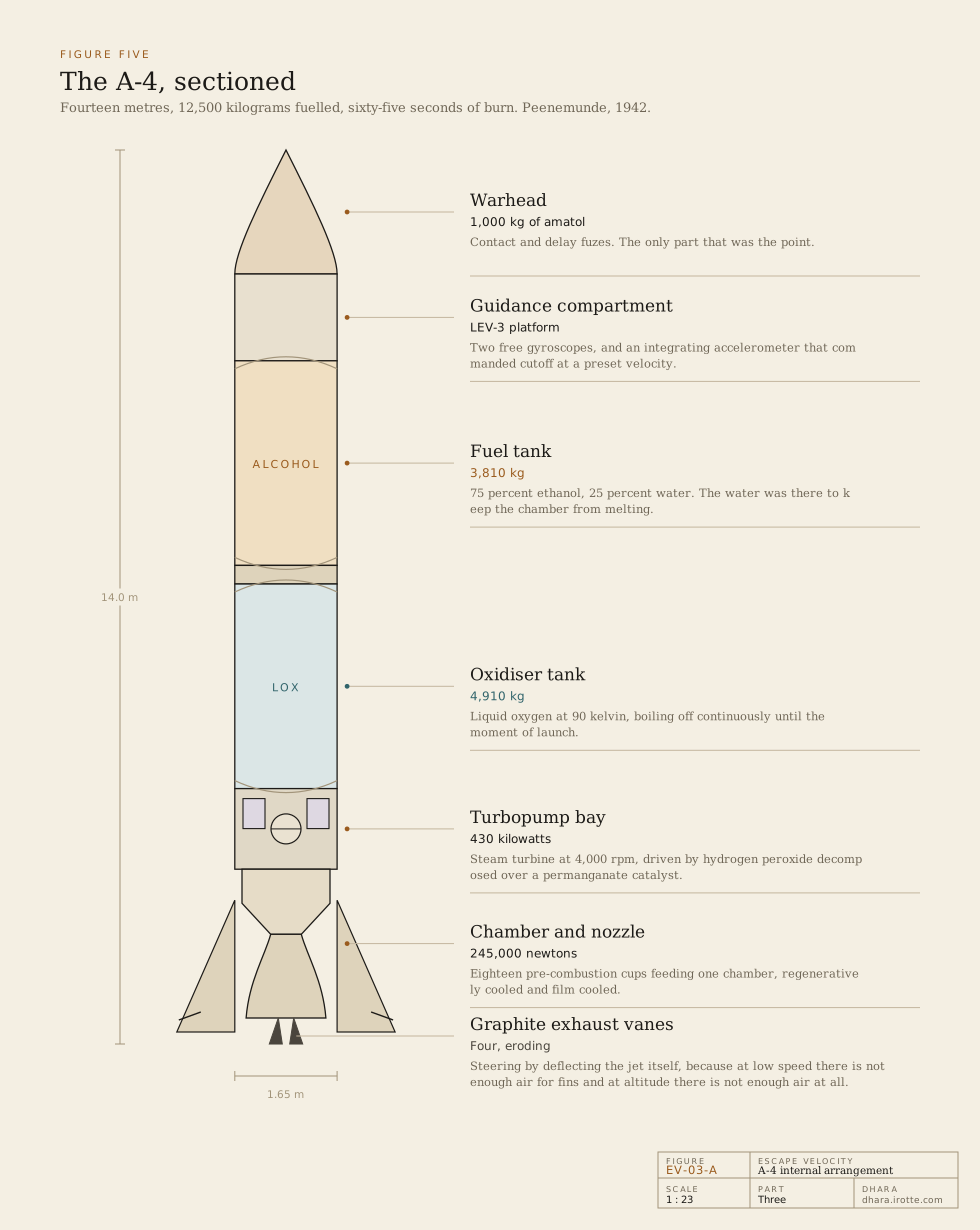
The A-4 -- the designation V-2, for Vengeance Weapon Two, was a propaganda name applied later by the Ministry of Public Enlightenment -- was fourteen metres tall, 1.65 metres in diameter, and weighed 12,500 kilograms fuelled. It carried a warhead of about 1,000 kilograms of amatol.
Principal specifications of the A-4 vehicle
| Parameter | Value |
|---|---|
| Length | 14.0 metres |
| Body diameter | 1.65 metres |
| Fuelled mass | 12,500 kilograms |
| Empty mass at cutoff | About 4,000 kilograms |
| Warhead | 1,000 kilograms of amatol |
| Fuel | 3,810 kilograms of 75 percent ethanol, 25 percent water |
| Oxidiser | 4,910 kilograms of liquid oxygen |
| Thrust at sea level | 245,000 newtons |
| Specific impulse, sea level | 203 seconds |
| Specific impulse, vacuum | 239 seconds |
| Propellant flow rate | About 125 kilograms per second |
| Burn time | 65 seconds |
| Velocity at cutoff | About 1,600 metres per second |
| Typical apogee | 80 to 90 kilometres |
| Maximum range | 320 kilometres |
| Impact velocity | About 800 metres per second |
Take that specification apart, because nearly every line of it encodes a problem that had to be solved for the first time.
Why the Alcohol Was Watered
The fuel was not ethanol. It was ethanol deliberately diluted with a quarter of its mass in water, and the dilution was the single most revealing engineering decision in the vehicle.
Pure ethanol burning with liquid oxygen produces a flame temperature above 3,000 kelvin. The chamber wall was mild steel. Steel melts at about 1,700 kelvin. Adding water lowers the flame temperature to roughly 2,700 kelvin, because the water absorbs energy in vaporising and then in heating as an inert diluent, and it lowers the average molecular weight of the exhaust slightly as well.
It also throws away performance. Every kilogram of water is a kilogram of dead mass carried to altitude that contributes nothing but thermal protection. The specific impulse of a watered-alcohol engine is lower than that of a pure-alcohol engine, and the mass ratio suffers on top.
They did it anyway, because the alternative was a chamber that destroyed itself.
The history of rocket engines is largely the history of arrangements for not melting.
The water was only one of three cooling schemes operating simultaneously, and the combination is worth understanding because the same three ideas, refined, appear in the F-1 twenty years later.
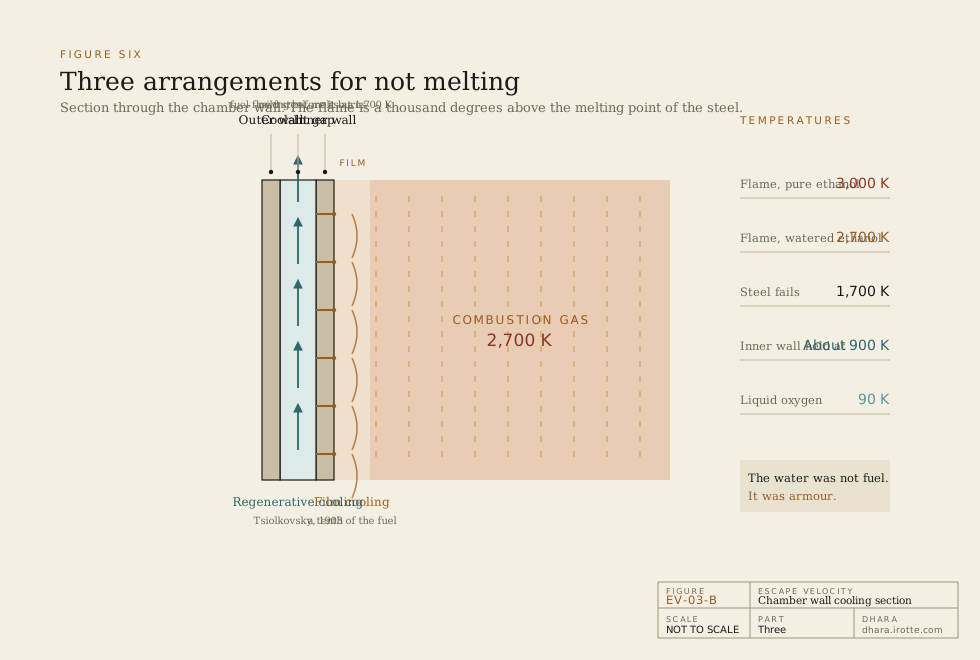
The first was regenerative cooling. The chamber and nozzle were built as a double wall with a gap between the inner and outer skins, and fuel was pumped through that gap before being burned. The fuel absorbed heat from the inner wall, keeping it below its failure temperature, and arrived at the injector preheated, which improved combustion. Tsiolkovsky had described this in 1903. Peenemunde was the first place it was made to work at scale.
The second was film cooling. Four rings of small holes around the chamber wall injected raw alcohol directly along the inner surface, creating a thin flowing layer of relatively cool fluid between the wall and the flame. Roughly a tenth of the fuel was spent this way, burned inefficiently or not at all, purely to protect the metal.
The third was the dilution itself.
Together they kept a steel chamber intact inside a fire that would otherwise have consumed it in seconds.
The Pump
The most sophisticated single component in the vehicle was not the engine. It was the machine that fed it.
An engine consuming 125 kilograms of propellant per second must have that propellant delivered at a pressure above the chamber pressure, or nothing flows. There are only two ways to do it. You can pressurise the tanks themselves, which means building tanks strong enough to hold twenty atmospheres, which means heavy tanks, which means a mass ratio that destroys the mission. Or you can keep the tanks nearly unpressurised and thin, and put a pump between them and the engine.
The A-4 used a pump, and the pump had to come from somewhere.
Peenemunde's solution was a steam turbine driven by a chemical decomposition rather than by combustion. Hydrogen peroxide at 80 percent concentration, called T-Stoff, was fed into a reaction chamber together with a sodium permanganate catalyst solution called Z-Stoff. The peroxide decomposed violently into steam and oxygen at about 400 degrees Celsius, and that gas drove a turbine at about 4,000 revolutions per minute, developing roughly 430 kilowatts. On the same shaft sat two centrifugal impellers, one for alcohol and one for liquid oxygen, delivering the propellants at about 24 atmospheres.
The design was subcontracted to a firm that built fire-fighting pumps, because pumping large volumes of liquid quickly was a solved problem in that industry and nowhere else.
Pumping liquid oxygen is not like pumping water. It boils at 90 kelvin, so any local pressure drop at the impeller inlet flashes it to vapour, the vapour bubbles collapse violently against the metal, and the impeller is eroded away from the inside -- cavitation. The bearings cannot be lubricated with oil, because oil freezes solid and, worse, oil in contact with liquid oxygen can detonate. The seals must work across a temperature difference of two hundred degrees between one end of the shaft and the other. Every large rocket built since has fought these same four problems, and the F-1's turbopump, at ninety times the power, fights them in exactly the same terms.
Eighteen Cups
The A-4's combustion chamber had a problem that would nearly destroy the F-1 programme twenty years later, and Peenemunde solved it by accident and by brute force.
When a combustion chamber is small, the burning is stable. When it is large, the burning can couple with the acoustic resonances of the chamber volume, so that a pressure wave crossing the chamber momentarily enhances the burning, which strengthens the wave, which enhances the burning further. The oscillation can reach thousands of cycles per second and pressure swings large enough to destroy the engine in a fraction of a second.
The Peenemunde team, under propulsion chief Walter Thiel, could not build one stable large chamber. So they built eighteen small ones.
The injector head consisted of eighteen separate pot-shaped pre-combustion cups, each of which mixed and ignited its own alcohol and oxygen, and all of which discharged into the single main chamber below. Each cup was small enough to burn stably. The main chamber simply received eighteen already-burning streams.
It worked, and it was a nightmare to manufacture -- eighteen precision assemblies with their own injectors and passages, welded into one head. Thiel spent years trying to replace it with a single flat injector plate, and by 1943 had a workable design.
He never finished it. He was killed in the bombing.
Steering a Rocket That Has No Air
For the first seconds after release the A-4 is moving too slowly for aerodynamic surfaces to do anything. Later, at altitude, there is not enough air for them to work. Between those two conditions there is a brief window where fins are useful, and it is not enough.
The solution was to steer the exhaust.
Four vanes of graphite were mounted in the engine's exhaust stream, immediately behind the nozzle, and could be deflected to push the jet sideways, tilting the vehicle. Graphite was chosen because it does not melt; it sublimes, and it retains strength at temperatures that destroy every metal. Four aerodynamic rudders on the fin tips worked in concert with them once the vehicle had speed.
The vanes eroded rapidly in the exhaust -- their useful life was on the order of the burn duration and no more, which was acceptable in a vehicle that was expended anyway.
Attitude was sensed by a gyroscopic platform, the LEV-3, carrying two free gyroscopes: one for pitch and yaw, one for roll. Deviation from the commanded attitude generated an electrical signal that drove servos on the vanes.
The subtler instrument was the one that decided when to stop.
Range in a ballistic trajectory is determined almost entirely by the velocity and angle at engine cutoff. An error of one percent in cutoff velocity moves the impact point by kilometres. So the vehicle carried an integrating accelerometer -- a device that measured acceleration continuously and integrated it with respect to time to yield velocity -- and when the integral reached a preset value, it commanded engine shutdown. The Germans called that moment Brennschluss, the end of burning.
That is precisely what the Saturn V's instrument unit did in 1969, with better instruments and a digital computer in place of an analogue integrator, and for exactly the same reason.
Where the A-4's subsystems reappear in the Saturn V
| A-4 subsystem, 1942 | Saturn V equivalent, 1967 | What changed |
|---|---|---|
| Regeneratively cooled double-wall chamber | F-1 brazed tube-wall chamber | 178 Inconel tubes instead of a jacket |
| Alcohol film cooling rings | F-1 turbine exhaust film cooling | Turbine gas used instead of raw fuel |
| Peroxide steam turbopump | F-1 gas generator turbopump | Fuel-rich combustion gas, 90 times the power |
| Eighteen pre-combustion cups | Baffled single injector | Acoustic damping instead of subdivision |
| Graphite exhaust vanes | Gimballed engine mounts | Whole engine pivots, no erosion |
| LEV-3 gyroscopic platform | ST-124-M3 inertial platform | Gas bearings, three axes, far lower drift |
| Integrating accelerometer for cutoff | Launch Vehicle Digital Computer | Continuous trajectory recalculation |
The Instruments
The part of Peenemunde that mattered most to postwar science was not the rocket. It was the apparatus built to understand it.
Rudolf Hermann's supersonic wind tunnel could sustain flow up to about Mach 4.4 in a forty-centimetre test section, driven by evacuating enormous vacuum spheres and letting atmospheric air rush through. There was nothing comparable anywhere. Almost everything then known about the behaviour of bodies at supersonic speed -- shock wave formation, base drag, fin effectiveness, aerodynamic heating -- was measured in that tunnel or in tunnels built on its pattern.
The measurement house at Test Stand VII recorded chamber pressure, propellant flow, thrust, temperatures at dozens of points, and vibration, continuously, during static firings of a full engine held down on a thrust frame. The idea that you instrument an engine heavily and fire it on the ground hundreds of times before flying it is now so standard that it seems obvious. It was invented here.
The Americans took the wind tunnel apart after the war and shipped it to the Naval Ordnance Laboratory at White Oak, Maryland, where it ran for decades.
Hydra
On the night of 17 to 18 August 1943, RAF Bomber Command sent 596 aircraft against Peenemunde in an operation code-named Hydra. It was flown in full moonlight, at low level, with a master bomber directing, and it was one of the most precisely aimed area raids of the war.
The intelligence had come from aerial photography and from the Polish and Luxembourgish resistance. The raid was aimed at three targets: the housing estate where the scientists lived, the development works, and the production plant.
Forty aircraft were lost. About 180 Germans were killed, including Walter Thiel, the propulsion chief, with his wife and children, and Erich Walther, the chief engineer of the motor pool. The loss of Thiel set engine development back significantly.
The heaviest casualties fell on the forced labour camp at Trassenheide, immediately south of the site, where the bombing killed roughly 500 to 600 Polish, Russian and other conscripted workers who were locked in wooden barracks. Documented
The raid did not stop the programme. It delayed it by perhaps two months. What it did do was convince the SS, which had been steadily taking the project over from the Army, that production must be moved somewhere bombers could not reach.
The Mountain
Fifty kilometres northwest of the Harz town of Nordhausen stands the Kohnstein, a hill of anhydrite rock into which the Germans had already driven a network of tunnels for petroleum storage.
In September 1943, less than a month after Hydra, the SS began converting those tunnels into an underground V-2 factory called Mittelwerk. The labour was supplied by concentration camp prisoners transferred from Buchenwald, and the camp built to hold them was Mittelbau-Dora.
For the first six months there was no camp. The prisoners lived inside the tunnels, sleeping in wooden bunks stacked four high in side galleries, in permanent darkness, in air thick with rock dust and the ammonia of the blasting, with no daylight, no sanitation, and open barrels for latrines. They worked twelve-hour shifts extending the tunnels and installing the production line. Dysentery, tuberculosis, pneumonia and starvation killed continuously. Prisoners caught attempting sabotage were hanged, sometimes in groups, from a crane on the production floor, in front of the assembled workforce.
Roughly 60,000 prisoners passed through the Mittelbau camp system. At least 20,000 of them died. Documented
The ledger of the A-4 programme
| Measure | Figure |
|---|---|
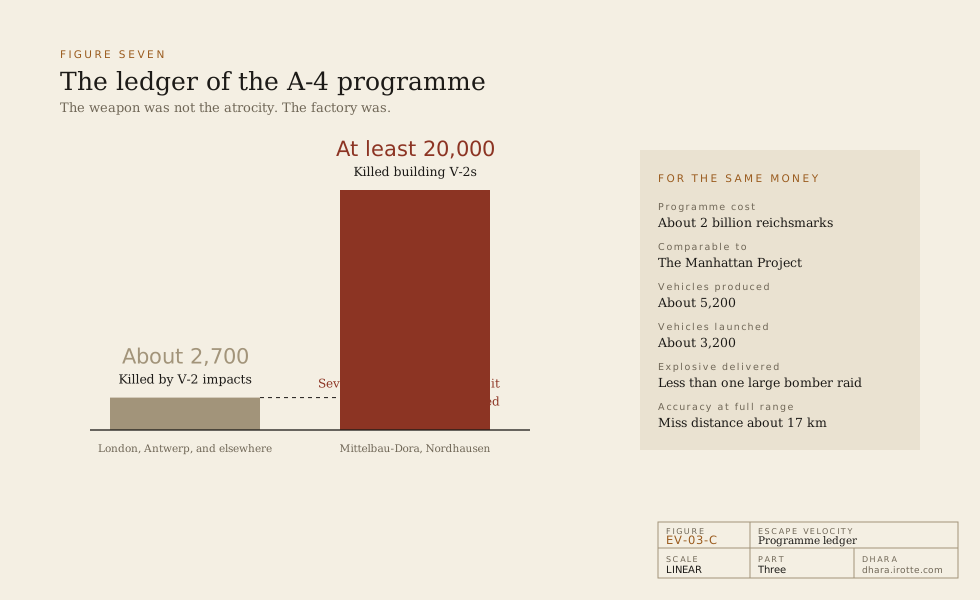
| Vehicles produced | About 5,200 |
| Vehicles launched at targets | About 3,200 |
| People killed by V-2 impacts | About 2,700 |
| People killed producing V-2s | At least 20,000 |
| Programme cost | Estimated 2 billion reichsmarks |
| Comparable programme | Roughly the scale of the Manhattan Project |
| Explosive delivered, entire campaign | Less than a single large bomber raid |
Read the third and fourth rows together. The V-2 killed roughly seven or eight people for every one it was aimed at, and it killed them in a tunnel rather than in a city. There is no reading of that programme in which the weapon is the atrocity. The factory is the atrocity.
Von Braun's personal position remains argued. What is documented is that he visited Mittelwerk on a number of occasions, that he was aware of the conditions, and that in a letter of August 1944 he discussed obtaining additional skilled prisoners from Buchenwald for the work. What is disputed is the degree of his authority over the camp regime, which was SS-run and formally outside his technical directorate, and whether refusal was available to him at a point when he had already been arrested once by the Gestapo in March 1944 on suspicion of insufficient commitment to the weapon. Disputed
The American government, in 1945, decided the question was not worth answering.
The First Object in Space
Set the moral ledger down for one paragraph, because a technical milestone belongs here and it is easy to get wrong.
The 3 October 1942 flight reached 84.5 kilometres. That is above the fifty-mile boundary the United States uses to define spaceflight, but below the hundred-kilometre Karman line used internationally.
The unambiguous crossing came later. On 20 June 1944, a vertically launched test designated MW 18014 reached an altitude of about 174.6 kilometres.
That flight is the first time a human artefact left the atmosphere entirely. It carried no instruments, no camera, and no payload of any kind. It went up, and it came down, and nobody outside a closed programme knew it had happened. Flight record
Paperclip
By early 1945 the Soviet armies were approaching Peenemunde from the east and the western Allies were crossing the Rhine. Von Braun assembled his senior staff and put the question to them directly: which occupying power did they intend to surrender to.
They chose the Americans, on the reasoning that the United States had money, had not been bombed, and might eventually fund space work.
The team moved south to Bavaria with forged movement orders. On 2 May 1945, von Braun's brother Magnus rode a bicycle down a mountain road near Reutte in Austria and encountered a private of the US 44th Infantry Division named Fred Schneikert. What followed was the surrender of roughly 120 of the most senior rocket engineers in the world, together with fourteen tonnes of documentation that had been hidden in an abandoned mine shaft in the Harz.
Simultaneously, Colonel Holger Toftoy of US Army Ordnance ran an operation to strip the Mittelwerk tunnels before the agreed Soviet occupation zone boundary took effect. His team removed enough components to assemble about a hundred complete V-2s, filling roughly 300 railway wagons, and shipped them to Las Cruces, New Mexico.
The programme that brought the engineers themselves was eventually named Operation Paperclip, after the paperclips attached to the files of those whose records had been sanitised to permit entry. Around 1,600 German scientists and engineers came to the United States under it.
Von Braun and 118 of his colleagues arrived at Fort Bliss, Texas, in late 1945, and began firing captured V-2s at the White Sands Proving Ground. In 1950 the group moved to Redstone Arsenal at Huntsville, Alabama.
The V-2s fired at White Sands between 1946 and 1952 were not weapons tests. They were the first scientific sounding rocket programme in history. They carried cosmic ray detectors, spectrographs, and cameras, and on 24 October 1946 one of them returned the first photograph of the Earth taken from above the Karman line -- a grainy black-and-white frame of the American southwest curving away under the blackness of space, shot from 105 kilometres. The camera survived because the film was in a steel cassette. The rocket did not.
What They Actually Brought
It is tempting, and it is wrong, to say that America went to the Moon on German technology.
The A-4 produced 245,000 newtons of thrust. A single F-1 produced 6,770,000 -- twenty-eight times as much -- and the Saturn V's first stage had five of them. The A-4 burned watered alcohol; the Saturn's upper stages burned liquid hydrogen, which the Germans never attempted. The A-4's guidance was an analogue integrator; Apollo's was a digital computer solving an optimisation problem in flight. The A-4 had a mass ratio of about three; the Saturn V's first stage alone reached seventeen.
Every one of those advances was made in the United States, mostly by American engineers, funded on a scale the Germans never approached.
What the Peenemunde men brought was not hardware. It was the knowledge that a large liquid-fuelled rocket can be made to work at all, and a body of hard-won practice about how to organise the attempt: instrument everything, fire on the ground until you understand it, expect the first several to fail, treat the vehicle as a system rather than as a collection of parts. Von Braun's real gift, by the account of nearly everyone who worked under him at Huntsville, was not as a designer. It was as a manager of very large technical programmes who could hold the whole machine in his head and talk to a senator in the morning and a welder in the afternoon.
That is what was purchased in 1945, and the price was that the United States gave a home, a salary, and eventually national honours to men who had built their careers inside a system that worked prisoners to death in a tunnel.
Both halves of that sentence are true, and neither cancels the other.
What Comes Next
The next part goes to Huntsville, White Sands, and Cape Canaveral, and to the fifteen years in which the United States turned a captured weapon into a family of American launch vehicles.
It covers the Redstone, the direct descendant of the A-4, and the fuel called hydyne that was blended to squeeze the last performance out of it. It covers the Atlas and its extraordinary balloon tank -- a vehicle of stainless steel one hundredth of an inch thick that would collapse under its own weight if the pressure were released, and which had no internal framework at all. It covers Titan II and the storable hypergolic propellants that ignite on contact, need no igniter, and will dissolve human tissue.
And it covers the four years in which the United States discovered that it was losing: Sputnik on 4 October 1957, the Vanguard rocket rising four feet off the pad on live television that December and collapsing into fire, and the decision by a young president in May 1961 to commit a nation that had accumulated fifteen minutes of human spaceflight experience to landing a man on the Moon before the decade was out.
0 responses