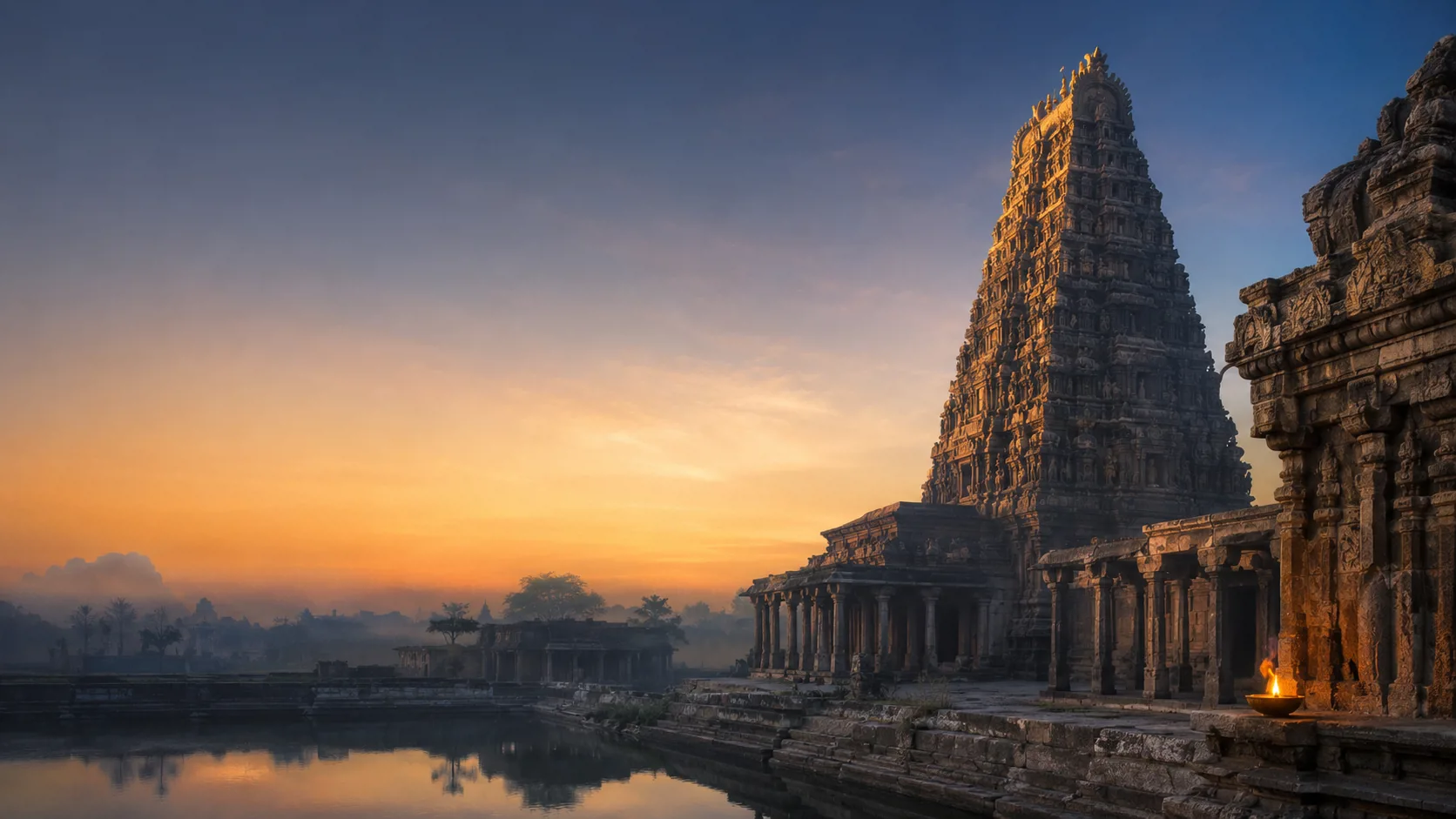
Stand inside the Bṛhadīśvara temple at Thanjavur, built by Rājarāja Chola I around 1010 CE, and the first thing that registers is the sound. Specifically, the absence of certain sounds. The vimana—the central tower—rises 216 feet, and inside the inner sanctum the acoustics are so engineered that footfall, breath, and voice take on a particular quality. It is not the acoustics of a Western cathedral. It is something more enclosed, more intimate, more dense.
This is not accident. The treatises that governed temple construction—the Mānasāra, the Mayāmatam, the Kāśyapaśilpa, and various Āgamas—treat acoustics, light, and proportion as integrated problems. The sthapati (architect) inherited a system in which the temple was understood as a tuned instrument.
What the temple knew can be summarized in four principles.
First, that orientation is meaning. The temple is oriented along the cardinal directions. The garbhagṛha (inner sanctum) faces east. This is not symbolism; it is a statement about how cosmic geometry intersects human geometry. The east is where the sun rises. The temple as a whole is a small brahmāṇḍa—cosmic egg—and the orientation makes the analogy literal.
The vastu-mandala (वास्तुमण्डल) on which the temple is laid out is divided into 64 or 81 squares, each presided over by a specific deity. The architect is not free to place doors arbitrarily. The placement encodes who lives where in the temple-as-cosmos.
Second, that proportion is the unit of meaning. Temple proportions are governed by the tāla system, in which the height of the deity image determines the proportions of everything else. The garbhagṛha is so many talas; the vimana is so many; the sphere of effective influence (the prākāra) extends so many. The proportions are not aesthetic conventions; they are functional. Different tālas produce different acoustic, visual, and devotional effects.
Bṛhadīśvara is built on the nīca-tala-pratimā system. The proportions are explicit in the Mānasāra. They can be measured. They are precise to the centimeter.
Third, that material is participation. The granite of which Bṛhadīśvara is built was quarried at Sarapallam, about 60 kilometers away. Recent geological studies have shown that the specific granite chosen has acoustic and thermal properties that explain the temple's interior climate—cool in summer, warm in winter, resonant in the particular range of the chanted Vedic recitation.
The choice of material was made knowing what the material would do. This is engineering, not aesthetics.
Fourth, that the temple is alive. Sanskrit treatises insist the temple is not finished when its construction ends. It must be consecrated (prāṇa-pratiṣṭhā)—the "establishment of life"—in which the deity is invited to take residence. The image is "eye-opened". The temple becomes a body.
This is not pre-rational magic. It is a particular ontology in which the distinction between living and non-living is differently drawn. A consecrated image is a participant. It eats, sleeps, has its day. The schedule of services in a major temple is not symbolism; it is hospitality.
What Bṛhadīśvara knew, a thousand years ago, was how to build a place that integrated cosmic mathematics, acoustic engineering, material science, and theological participation into a single working artifact. Most of what European modernism "discovered" about phenomenological architecture in the twentieth century—the felt qualities of space, the perceptual effects of proportion, the integration of light and time—was understood here, with great precision, in the early medieval period.
To stand inside the vimana at dawn, watching the morning service, is to be inside a building that knows more than its builders did, because it is the accumulated knowledge of a tradition that took a thousand years to learn what it learned.