I. A man at a desk, composing
He is sixty years old, small, famously shabby, and he is having trouble with the second line.
The room is magnificent and he is not. He wears a fez going green at the band and slippers with the backs trodden down, and there is a story, probably true, that he knits his own socks. Outside the window is a city he does not much go into. Beyond the city is a dominion the size of England and Scotland together, containing eighteen million people, nine in ten of them Hindu, every office of it staffed in a language most of them cannot read.
He is a poet. This gets left out.
He has a takhallus. He has a collected divan. He writes short ghazals in the plain idiom, one qata set above each, in a manner taking something from Lucknow and something from the Deccan, and he is genuinely good, and he was formed in the court where Dagh Dehlvi passed his last years. Contested His subjects are tasawwuf and ishq -- the annihilation of the self in God, and love.
This afternoon he is writing something else.
The first line came whole and he is pleased with it. It has the conch in it -- naaqoos, the old word, the good word, the one with the shell still in its mouth -- and it has the takbeer, and it has them in the right order, which is to say the one silencing the other.
He wants a second line about the ground opening. Something with an earthquake, and the soil coming up, and the soil covering -- and he has had the object of that covering in his head since before he had any of the words, because the object is the entire point.
Zunnaar. The thread. The cord a Hindu wears across his chest from boyhood to the pyre.
He gets it at about four o'clock and it is not, he feels, quite as good as the first.
He will not put it in the divan. The divan is for God and for love. This goes to the Rahbar-e-Deccan, where men will read it over their tea and understand it perfectly.
Band naaqoos huaa, sun ke nidaa-e-takbeer;
Zalzalaa hi aa gayaa, rafta yeh zunnaar mein bhi.
The conch fell silent on hearing the call of the takbeer. The earthquake came, and reached even into the sacred thread.
Two words hold the couplet together, and both come down garbled. Naaqoos survives in one printed transcription as nakheen and in another as naa khoon. Zunnaar survives as junnar. One circulating version gives nidaa-e-takdeer, the call of fate, where the word is takbeer. Contested
Corrected, it is not a meditation on the turning of an age. It is a boast in two clauses. One sound stopped another sound, and the upheaval went down as far as the thread against a man's skin.
Sardar Patel is said to have recited it back to him after the surrender. Contested
What is not in dispute is that a sovereign of eighteen million people published a verse in praise of the silencing of their rite, and signed it. Nobody accused him of it. He printed it himself.
For seventeen months, between 1946 and 1948, a private militia of two hundred thousand men moved through the villages of Telangana, Marathwada and the Kannada districts to make the silence permanent. They were called Razakars. The word is Persian -- raza-kar, one who acts of his own will. Volunteer.
When they had finished, tens of thousands of people were dead, over fourteen hundred villages had been raided, and a country the size of Britain had been frightened into a quiet that outlasted the militia itself by seventy years.
They murdered Hindus in their thousands, and Brahmins with a particular and documented relish. They murdered the Muslims who objected. They were fought by Arya Samajists, by Congress satyagrahis, by communist peasants, by Gond tribals and by washerwomen with chilli powder. And when the Indian Army came at last, some of those who had suffered took a revenge that was itself indefensible, and the government of India buried the report that said so.
All of it happened.
II. The architecture
Begin with the arithmetic, because the arithmetic is the crime before any blood is spilt.
In 1941 the literacy rate in the Nizam's dominions is 9.3 per cent. His personal fortune is at one point reckoned the largest in the world. Those two facts sit in the same sentence because they belong in the same sentence.
Urdu is the medium of instruction from the primary class to the university. State-aided education is available in Urdu or English and in nothing else. Private institutions are not permitted to impart education in the language of the people who live there. Telugu, Marathi and Kannada -- the mother tongues of about eighty-six in every hundred of the population -- have no place in the classroom of the state that governs them.
Take one child through it. A Telugu boy of Warangal cannot be taught to read Telugu at the state's expense. He cannot be taught it at a private school either, because private schools are forbidden to teach it. If he is to be literate at all he will be literate in the language of the court. The single instrument by which a civilisation hands itself to its children is taken out of its hands and replaced with the instrument of the men who rule it.
That is not neglect. It is an amputation, conducted slowly, under law, for the better part of a century, and it is completed before a single Razakar is armed.
There are no panchayats and no zilla parishads. When a Legislative Assembly is finally conceded in 1946 it is constituted to give Muslims a majority of ten in a house of a hundred and thirty-two -- a majority manufactured out of a ninth of the people. A subject of the Nizam has no vote worth casting and no recourse worth seeking.
And in some places he still pays jizya, the tax by which unbelief is licensed, in the twentieth century -- a fact recorded not by the Nizam's enemies but in the confidential notes of the committee later sent to investigate atrocities against Muslims, which found that the Razakar depredations consisted chiefly of levying monthly amounts, that is, jizya, on every town.
Only at the very bottom are Hindus dominant: as patwaris and patels and deshmukhs, the men who collect the revenue and absorb the hatred of the peasants they collect it from, on behalf of a court that speaks another language. The visible face of extraction is Hindu. The treasury it fills is not.
The dominion is itself a remainder, and the Telugus know exactly what was sold and when. The Sarkars -- the Circars -- are the coastal districts, made over to the French as the price of French protection against the Marathas and Mysore, then taken off the French by the Company and formally ceded in the 1760s. The Ceded Districts, Datta Mandalamu, are Bellary, Anantapur, Kadapa and Kurnool, handed over in 1800 under the Subsidiary Alliance in place of cash for the troops quartered on him; Telugu opinion never accepted the colonial label and in 1928 the region took the name Rayalasima, the land of the Rayas.
What is left is called the Nizam's districts, and it needs a name of its own because the Telugu country has been cut in three.
That name is Telangana.
The word is a residue. It exists to distinguish the Telugu districts he kept from the Telugu districts he had already paid away. Twice in fifty years a dynasty that could not defend itself bought its survival with Telugu land, and then spent the following century instructing the Telugus who remained that sovereignty in the Deccan belonged to somebody else.
The sixth Nizam had a Hindu Prime Minister once, Maharaja Kishen Pershad. His son removed him, and the line has passed into Telangana memory: tu Kishan Pershad hai, to main Khuda Pershad hun. You may be Kishen Pershad. I am Khuda Pershad.
After that, every Prime Minister was a Muslim, and most were imported from outside the dominion altogether.
III. Anal Malik
The doctrine that made the machine turn had a name, and the name was two words long.
Anal Malik.
I am the king.
It is Arabic -- ana al-malik -- and its force is in its shape.
The construction ana al- followed by a divine attribute is the most charged formula in the whole Islamic mystical vocabulary, and it is charged because of one man. In Baghdad in the year 922 the Sufi Mansur al-Hallaj was executed for saying Anal Haq -- ana al-Haqq, I am the Truth, al-Haqq being a name of God. His defenders held that he meant the annihilation of the self in God. His judges held that he had claimed divinity. They killed him for it, and the Deccan has known the story for a thousand years.
Anal Malik takes that formula and swaps the attribute.
Where al-Hallaj said I am the Truth and lost his life for it, the Majlis-e-Ittehad-ul-Muslimeen taught every Muslim in Hyderabad to say I am the king. The ecstatic utterance of a mystic dissolving into God becomes a political claim of sovereignty, held individually, by every member of one community, over every member of the others.
That is the theory of the state in two words, and it explains what would otherwise look like contradiction. The Ittehad professed loyalty to the Nizam and systematically overrode him -- because if sovereignty vests in the kaum, in the community, and every Muslim is a king, then the man on the throne is not the source of authority but its servant, and may be corrected when he errs.
Twenty years after the slogan was coined, twenty-five thousand Razakars would surround the Nizam's own delegation at three in the morning and forbid it to fly to Delhi. They were not rebelling. By their own doctrine they were exercising sovereignty. The Nizam was the one out of line.
The Ittehad was founded in the mid-1920s by Mahmood Nawaz Khan, a former servant of the Nizam's government. Under Bahadur Yar Jung, who led it from 1928 until his death in 1944 and was the most formidable orator the Deccan produced in that generation, the premise was stated without ambiguity. We are the sovereign in the Deccan.
In 1938 it went into the constitution. The person and the throne of the ruler of Hyderabad, that document declared, were emanations of the political sovereignty and social supremacy of the Muslim community, and shall be maintained forever.
Everything that follows is in that clause. It does not claim a right to govern. It declares that the supremacy of one community over the others is the metaphysical foundation of the state, permanently, and that the king exists only as its expression.
Under such a doctrine a Hindu majority is not a constituency. It is a defect to be managed.
The management ran on several fronts at once. Seven Urdu dailies and six weeklies. Men placed in the Railways, the Road Transport Corporation, Deccan Airways, Radio Deccan, the telephone and telegraph. Ethiopian Muslims settled, Yemeni Arabs settled at Barkas, hundreds of thousands of Muslims brought in from northern India through 1947 and 1948 to thicken the base. The Hyderabad State Congress banned and ten thousand of its members in jail.
And at the margin, the Deendars -- founded in 1926 by one Siddique Deendar, who claimed to be an avatar of Channabasaveshwara and equipped four lieutenants as avatars of Krishna, Narasimha and Veerabhadra, the better to convert Dalit Hindus by fraud, enticement, inducement and force. Five hundred militants in green turbans and saffron robes. His book Amanul-Aas told his readers that the Qur'an taught one thing only: to turn the country they lived in into Pakistan. A bowl containing one quarter milk and three quarters dung cannot be called clean. Whether it is Arabia or Turkestan or Afghanistan, so long as it contains kafiristan in its territory, it cannot be called Pakistan. He declared a jihad and called for five hundred thousand volunteers. When the Razakars rose, the Deendars folded into their ranks.
None of it was secret. It was preached, printed and published. The Ittehad was not a conspiracy; it was a public programme, and it had thirty years to prepare the ground.
The vocabulary is a record in itself. Razakar, one who acts of his own will -- an organisation that armed two hundred thousand men chose for itself the gentlest available noun. Majlis, a council; ittehad, unity: the name announcing at the outset that the body existed for one community and not for the country it sat in. Kaum, the community, in which sovereignty was placed instead of in the throne or the soil. Jizya, the price of unbelief. Zunnaar, the sacred thread, which had stood in Persian and Urdu poetry for centuries as the emblem of the Hindu, which is why it turns up in the last Nizam's verse and why its appearance there is not an accident. Kafiron ko maaro -- kill the unbelievers -- which is what two hundred men shouted in the streets of Hyderabad in December 1939 on their way from Friday prayers to a murder. And maafinama, a written petition of apology: the document the students of Osmania were required to sign to be readmitted, and the document a condemned man would later refuse to sign to walk out of a death cell.
Two generations of Telangana are legible in that last word, and in who would and would not write it.
IV. God Preserve Osman
Every school day in the dominion begins with a prayer.
It is sung by compulsion, by every child, whatever his language and whatever his gods. In English it is called God Preserve Osman. Its proper name is the Nizam-e-Saltanat ka Qaumi Tarana, the state anthem, and it opens by addressing the sovereign directly.
Ta abad khaaliq-e-aalam yeh riyasat rakhe;
tujh ko Osman, basad ijlaal salamat rakhe.
May the Creator of the world preserve this state to eternity, and keep you, Osman, in safety and in all honour.
It continues in the same direction, and the direction is the whole of it. God is asked to grant the ruler's children the lifespan of Khizr and to keep his house of fortune peopled by them; to shame the bounty of Hatim with his bounty and put the justice of Khusrau to the blush with his justice; to make his wellwishers open like roses.
And then this.
Khanda-zan soorat-e-gul tere khair-khwaah rahen;
aa ke qadmon pe adu faqr-o-itaat rakhe.
May your wellwishers stay laughing open like the rose, and may the enemy come and lie at your feet in destitution and obedience.
The last couplet asks that fortune act as his cupbearer and keep him drinking in the tavern of pleasure.
A Telugu child in Warangal sang that. A Marathi child in Parbhani sang it. A Kannada child in Bidar sang it. Not a prayer for the country, nor for God alone, nor even for good government: a petition for the personal health, honour, dynasty, wealth and pleasure of one man, and for his enemies to be brought to his feet in want.
In a state where nine people in ten were Hindu and could not be taught to read their own languages, the school day opened with children asking heaven to keep the ruler's adversaries destitute and obedient.
Some of them worked out, before they left school, which category the composer had in mind for them.
It began at Aurangabad. Students there stopped singing it and sang Vande Mataram instead.
The idea travelled. Osmania University had three hostels and each hostel had two prayer halls, one for Hindu students and one for Muslim, and in September 1938 the Hindu boarders of B Hostel began reciting Vande Mataram in theirs.
They had been singing to Rama and to Krishna in that hall for years and nobody had objected. Vande Mataram was different. The authorities forbade it on the ground that it was not a religious song and that it offended the susceptibilities of Muslim students.
The whole state is in that reasoning. In their own prayer hall, at their own prayer, boys were told that what they might sing was determined by whether it discomfited somebody else -- and that a hymn to the motherland did not count as devotion.
They refused. They were thrown out of the hostels. On the twenty-eighth of November the government banned the song outright, and the next day the students struck.
The police cleared the hostels in the dead of night.
And then the detail that goes unrecorded.
They came to the picket in shirt and dhoti.
The uniform was not incidental. Osmania prescribed a blue sherwani and pajama, and accounts of the period record that the dhoti and the kurta were barred at the university outright, alongside the singing of Vande Mataram. Contested Written ordinance or the practical effect of a compulsory uniform, the daily proposition was identical: to be educated in this state is to be dressed as its rulers are dressed.
Which is what made the answer so exact. To strip off the sherwani in public and stand at the gate of the university in a dhoti was to reply, in the plainest language available, that the body underneath had a civilisation of its own and did not propose to apologise for it. No slogan was required and no pamphlet.
It could also be seen across a courtyard by anybody who wished to expel them.
Many were. They also demanded that postgraduate classes be taught in Telugu, Marathi and Kannada, which was not conceded. The strike ran from the twenty-ninth of November to the tenth of December and spread to Warangal, Gulbarga, Parbhani, Nanded, Mahabubnagar and Aurangabad. Readmission was offered on one condition: a maafinama. Most would not write it.
Three hundred and fifty were expelled from Osmania, about two hundred from Gulbarga, five hundred from Aurangabad.
Then the Nizam's government wrote to the Inter-University Board of India asking that these students be admitted nowhere in the country, and the Board passed a resolution to that effect.
Andhra University, under C. R. Reddy, complied. Benares Hindu University, under Sarvepalli Radhakrishnan, complied. Two of the most distinguished Indian academics of the century shut the door on boys expelled for singing Vande Mataram.
One man did not. Justice Kedar, Vice-Chancellor of Nagpur, relaxed his admission rules and took all of them -- science students at Nagpur, arts students at Jabalpur -- and was accused of communal bias for it.
While they waited, the Jain Mandir at Sultan Bazar housed them and the Vaman Rao Naik Bhavan fed them. Gandhi, Nehru, Subhas Chandra Bose, Savarkar and Patel all wrote in support, and Gandhi told them they had every right to sing the national song in their own prayer hall.
One boy shouted the slogan so loudly and so often that it displaced his surname for the rest of his life. He was known thereafter, and is known now, as Vandemataram Ramachandra Rao.
And one of the boys in a dhoti that winter was named Pamulaparthi Venkata Narasimha Rao.
He was from Laknepalle, a village near Karimnagar. He would not apologise, so he was thrown out, and he went north to Nagpur to finish his degree because no university inside the dominion, and none that had accepted the Board's resolution, would have him.
Forty-three years later he was sworn in as the ninth Prime Minister of India.
The state that expelled a boy for wearing a dhoti and declining to praise its ruler was, in the end, outlived by the boy.
Also on the roll: Devulapalli Venkateswara Rao, who would command in the Telangana armed struggle. Marri Chenna Reddy, a future Chief Minister. Dharma Bhiksham. Achyuta Reddy.
It took a princely state, a university, a police force and the Inter-University Board of India to stop a few hundred boys from singing.
V. The flag that could not be raised
The Arya Samaj had been in Hyderabad since 1892, with its most active centre at Sultan Bazar -- the Hindu commercial quarter outside the walls of the old city, which served as the organising ground for nearly every nationalist body in Hyderabad. Sultan Bazar sheltered the expelled students at its Jain Mandir. Sultan Bazar carried the Samaj. King Kothi, a mile away, was the Nizam's palace, and a road out of King Kothi will matter later.
By 1938 the Samaj had two hundred and fifty branches in the state, twenty of them in the twin cities. It ran schools and libraries and took converts back into the Hindu fold, and by the standards of its time it was reformist and casteless.
The government's answer was Circular No. 53 of 1937, which forbade all meetings of every character. The Samaj held its celebrations anyway, without sanction.
The restrictions around the circular were wider and reached into the liturgical. The Samaj might not conduct religious ceremonies, hold nagar kirtans or processions, run schools, or carry on literary activity. Its Urdu weekly Vedic Adarsh was refused publication in 1935 for printing frank opinion. At Umerga a worker named Ramachandra was found with a copy of the Satyartha Prakash and the police seized it as a seditious book; it took a considerable agitation to get it back. At Bidar a yajna kund was destroyed and morning processions were broken up.
And the flag bearing the syllable OM was forbidden to be raised. In temples, and in private houses.
That last prohibition is not about assembly or sedition or public order. A banner in a man's own home threatens nothing and addresses nobody. What it does is declare, silently, that the household is what it is. To forbid it is not the regulation of conduct. It is an instruction about what a family may be seen to be inside its own walls.
Which is exactly why the resistance took the form it did. Through the following decade the Samaj organised Hindus to perform the havan and unfurl the OM flag at Basava Jayanti and at Dasara, in one place after another, until the restriction was worth nothing.
The satyagraha began on the twenty-fourth of October 1938 and reached full force by February 1939, under Mahatma Narayan Swami and then Kunwar Chandrakaran Sharda. Waves came in from across India and filled the jails at Hyderabad, Gulbarga, Aurangabad and Chanchalguda. About twelve thousand were arrested, some five thousand of them Hyderabadis. In August 1939 the government climbed down and announced reforms, and the satyagraha was withdrawn on the seventh.
Patel afterwards acknowledged that this movement had prepared the ground for accession, ten years before it happened.
The Samaj's own account holds that the decrees went further and forbade the recitation of Om, and that Narayan Swami and the students of the Arya Gurukul entered Hyderabad chanting it in order to be arrested. That version is not corroborated in the academic literature, which records the ban on the emblem rather than on the sound. Contested
Two things about the movement deserve emphasis, and they point in opposite directions.
The first is the price. The government branded the Samaj non-mulki -- foreign -- and anti-Muslim, and from 1942 to 1948 treated its members as effectively outside the protection of the state.
This is what killed Vedprakash. He had converted to Islam and returned to the Hindu fold under the Samaj's shuddhi work, and he was pressed to convert back. On his refusal he was murdered. The academic accounts place the killing at Gunjoti in Osmanabad district; Chowdary's lecture places it in Hyderabad city in December 1939, in a riot in which two hundred Razakars coming from Friday prayers looted shops and molested women in the street shouting kafiron ko maaro. Contested The sources agree on the man, the reason and the refusal.
The second is who came. One of the movement's leaders, broadcasting on it half a century later, was insistent: the satyagraha of 1938 and 1939 was launched not against Muslims but against the oppressive rule of the Nizam, and Sikhs, Jains and a few Muslims took part in it alongside Hindus.
That distinction was maintained by the men who went to jail for it, at a time when maintaining it cost them something. It is not a modern softening laid over the record. It is the record.
VI. Charcoal
A state that takes away a language has to be answered in that language, and the answer came out of schoolrooms and prison cells.
In 1940 Pandit Vinayak Rao Vidyalankar founded the Keshav Memorial Educational Society in Hyderabad, in memory of his father, Justice Keshav Rao Koratkar of the Hyderabad High Court. Its purpose was stated without embarrassment: education through the mother tongue, Telugu and Hindi, at a time when instruction in the dominion was in Urdu and effectively in Urdu alone. Vidyalankar was among those who prepared to court arrest in the Arya Samaj satyagraha of July 1939. His campus became a centre of nationalist activity, and the tricolour was hoisted on its grounds against serious restriction, in a city where the Nizam's flag still flew after the fifteenth of August 1947.
Founding a school in Telugu was, in that state, civil disobedience conducted with a blackboard.
Older and stranger is the school at Secunderabad. In 1862 a Tamil educationist named Somasundaram Mudaliar founded an Anglo-Vernacular school there. In 1884, after the sixth Nizam made a generous contribution, it was renamed for him: Mahbub College. Under that name it survived and flourished, and Vivekananda spoke on its grounds on the thirteenth of February 1893, on his way to Chicago.
Telangana memory holds that the naming was a manoeuvre, and that an institution teaching the local languages bought its life by taking the ruler's name for a signboard. The surviving records show the endowment and the renaming and no more. Contested What is not in dispute is the condition itself: to run a vernacular school in the Nizam's Hyderabad and be left in peace, it helped enormously to have the sovereign's name over the door. Trick or endowment, it was a shelter, and the need for shelter is the fact.
And then there were the poets, and one of them was Dasarathi.
Dasarathi Krishnamacharya was born on the twenty-second of July 1925 at Chinnagudur, in what is now Mahabubabad district. Vaishnava, orthodox, prodigiously learned -- Telugu, Sanskrit, Tamil, Urdu -- and, being a subject of the Nizam, he matriculated in Urdu, because there was no other way to matriculate. He gave up higher study for the movement, and in 1947 he was arrested and sent first to Warangal jail and then to the fort prison at Nizamabad.
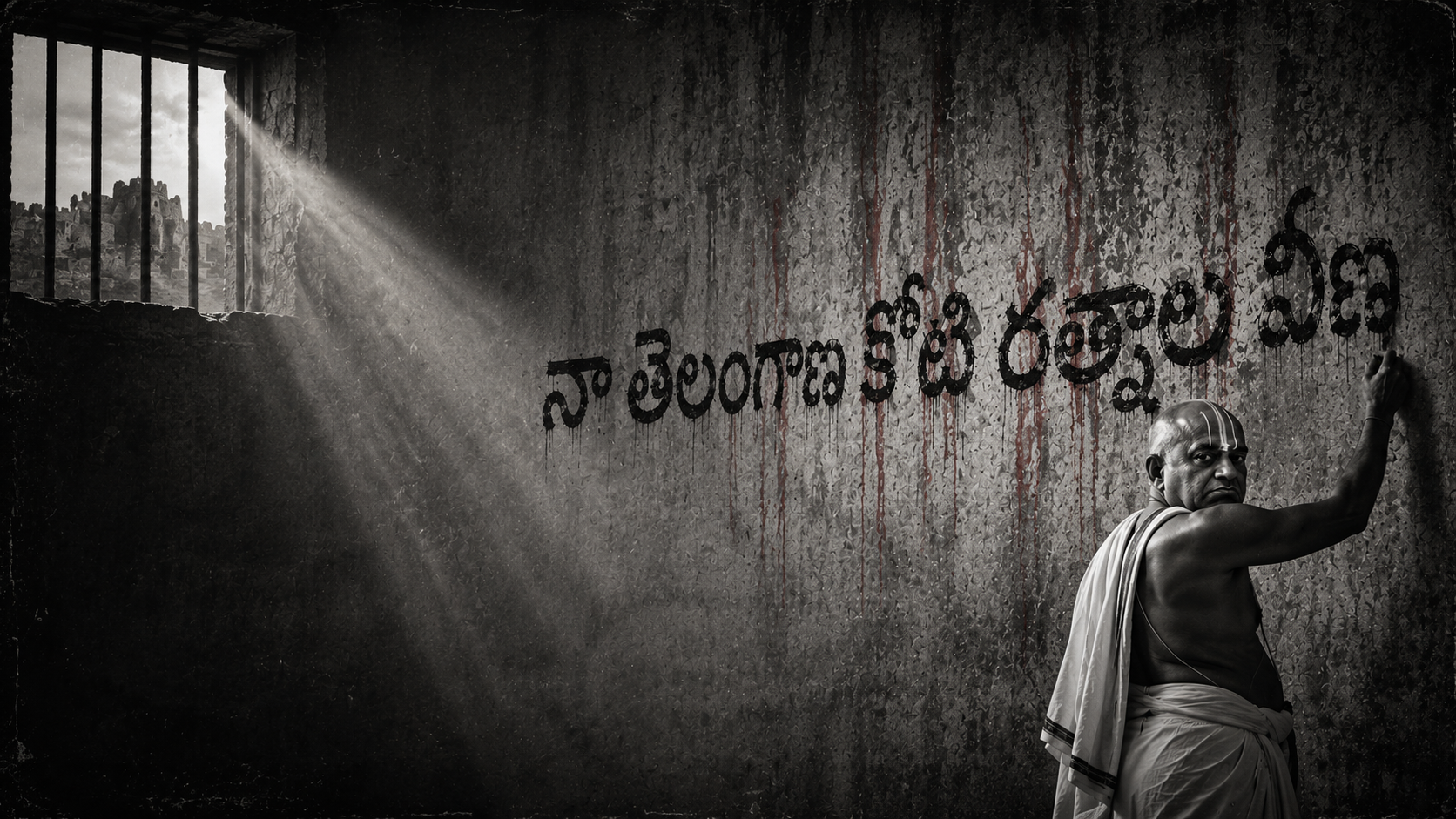
They would not give him pen or paper.
The jail issued its prisoners a stub of charcoal for cleaning the teeth.
He wrote on the wall of the cell.
He could not carry the wall out with him, so he said the poems over and over to the men in the barrack until they had them by heart, on the understanding that whoever got out first would write them down. That is how the verses survived. Assembled after his release they became Agnidhara, Stream of Fire, published in 1947.
This is what a man wrote in charcoal on the wall of a Nizamabad cell.
ఓ నిజాం పిశాచమా, కానరాడు నిన్ను బోలిన రాజు మాకెన్నడేని
తీగలను తెంపి అగ్నిలోకి దింపినావు నా తెలంగాణ కోటి రత్నాల వీణ
O Nizam pisachama, kanaradu ninnu bolina raju makennadeni;
tigalanu tempi agniloki dimpinavu, na Telangana koti ratnala vina.
O Nizam, demon, never in our lives has there been a king to match him. He tore out the strings and cast it into the fire: my Telangana, a veena strung with ten million jewels.
The half-line that gets quoted -- నా తెలంగాణ కోటి రత్నాల వీణ, na Telangana koti ratnala vina -- is almost always quoted alone, and quoting it alone ruins it. Alone it is a pretty compliment to a region. In place it is the second half of an accusation. The veena is named only to say who broke it and what he threw it into. Telangana is the instrument. The Nizam is the man who snapped the wires.
And on the same walls, this.
మా నిజాం రాజు జన్మజన్మల బూజు
ముసలి నక్కకు రాజరికము దక్కునే
Ma Nizam raju janma-janmala buju;
musali nakkaku rajarikamu dakkune?
Our Nizam the king is the mildew of birth upon birth. Shall an old fox be allowed to keep a kingdom?
Buju is the fur of mould that grows on a thing left too long in the dark.
To call a dynasty of two centuries a mildew, and its sovereign an old fox, in Telugu, on the wall of that sovereign's own prison, with the charcoal his jailers issued for cleaning teeth -- there is not much in the literature of any Indian language that is braver, and the authorities are said to have pushed two common criminals into the political prisoners' barrack to find out who was doing it.
His younger brother took the same road and paid in a different currency.
Dasarathi Rangacharya, born at Chinnagudur on the twenty-fourth of August 1928, was thrown out of school for his politics and had to cross into British India, to Vijayawada, to finish his education at all. He went into the movement young, was arrested and severely beaten by a police officer, and then went underground with the armed struggle and stayed under until Hyderabad was liberated in September 1948. By one account he carried bullet wounds out of it. Contested
What he did with the rest of his life is the point. He wrote the Nizam's Telangana into Telugu fiction -- Chillara Devullu in 1969, Modugu Poolu in 1971, Janapadam after -- and he wrote them in the Telangana dialect, against the explicit advice of the literary establishment, because the people he was writing about could not read anything else. In a region the state had deliberately left barely literate, he refused to write in a register its own people could not follow. Chillara Devullu took the Sahitya Akademi's award. Later he put the four Vedas into Telugu, and the Ramayana and the Mahabharata after them.
The arc is worth setting beside the state that shaped it. Hyderabad made his language contraband and jailed and beat him for objecting. He answered by spending sixty years putting everything -- the atrocity, the epics, the Veda itself -- into that language, in the dialect of the villages the Razakars would burn.
One detail settles the matter.
In 1961 Dasarathi Krishnamacharya published Ghalib Geethalu: the poems of Mirza Ghalib, rendered into Telugu.
The man who wrote the Nizam is the mildew of birth upon birth with a stub of charcoal on a prison wall spent part of his later life giving the greatest of Urdu poets to Telugu in its own tongue.
He had no quarrel with Urdu. He had no quarrel with Ghalib. His quarrel was with a state that made his own language contraband and put him in a cell for singing about it.
That is the distinction this whole history turns on, and a Telugu poet in a Nizamabad barrack had already made it, in practice, before anybody needed to argue it.
VII. The rehearsal: Malabar, 1921
When the Razakars came they knew exactly what to do, in a repertoire so specific and so consistent across hundreds of villages that it can only have been taught somewhere.
It was taught a generation earlier, eight hundred kilometres to the south-west.
In August 1921 the Moplahs of Malabar rose. The proximate cause was the Khilafat agitation -- the campaign to restore the Ottoman Caliphate, which the Indian National Congress under Gandhi had embraced in the hope that Muslim gratitude would translate into nationalist unity. Gandhi had promised swaraj within a year. Among the Moplahs, led by Ali Musaliar, swaraj was understood to mean something quite specific: the Caliphate, in Ernad and Walluvanad.
What followed over the next five months was not an agrarian revolt with communal overtones, whatever the later textbooks made of it. Contemporary official records and survivor accounts describe a consistent pattern: the wholesale slaughter of Hindu men, women and children; forced conversions in the thousands and the murder of those who refused; the flaying and burning alive of victims; the dishonouring of women and the stripping of the clothes from their bodies; the throwing of the half-dead into wells to struggle for hours until death released them; the looting and burning of practically every Hindu and Christian house in the disturbed area, with Moplah women and children participating; the desecration of temples; and -- a detail that recurs with signature precision -- the slaughter of cows within temple precincts, their entrails draped over the murtis and their skulls hung from the walls and roofs.
It took the British Indian Army five months and the deployment of Gurkha units, Chin-Kachin troops from Burma and the Malabar Special Police to subdue some forty-two thousand Moplah men and women.
Gandhi did not condemn it. He described the Moplahs as God-fearing people who were fighting for what they considered religion, in a manner which they considered religious. The response from the other side was instructive. However pure Mr Gandhi's character may be, wrote one Muslim critic, he must appear, from the point of view of religion, inferior to any Musalman, even though he be without character. Yes, according to my religion and creed, I hold an adulterous and a fallen Musalman to be better than Mr Gandhi.
The rehearsal had two results. It established a template of atrocity -- precise, repeatable, ritually charged. And it demonstrated that the template could be deployed without meaningful moral cost, because the most authoritative Hindu voice in India would decline to name it for what it was.
Both lessons were learned. Twenty-five years later, in the Nizam's dominions, both were applied.
VIII. Kasim Razvi
The difference between Malabar and Hyderabad was structural, and it was almost entirely to Hyderabad's advantage. The Moplahs had to build a caliphate, which meant fighting the British Indian state. The Razakars already had a state. It was called the Nizam's dominion, and all they had to do was terrorise the subjects into staying inside it.
The man who understood this was Sayyid Kasim Razvi.
He was, by background, nobody. A law graduate of Aligarh, a small-time lawyer in Latur with a thin voice and spectacles, the sort of man a town produces one of and forgets. Bahadur Yar Jung died in 1944 and was succeeded by a nonentity whom the Nizam removed in 1946. Into that vacuum stepped Razvi, who took the presidency of the Ittehad and within eighteen months had made himself the most powerful man in the Deccan -- more powerful, in every operational sense, than the king.
What Razvi did to the Ittehad was to convert a supremacist political association into a fascist party in the full technical sense of that word: a mass organisation with a paramilitary wing, a cult of the leader, a monopoly on public speech, and a redemptive theory of violence. He had an adviser, Syed Taqiuddin, a former ICS officer -- the machinery of the modern state placed at the service of the militia. By March 1948 the Ittehad claimed a million members, of whom perhaps a tenth had been trained in arms.
The paramilitary wing were the Razakars. Razvi drilled them, armed them, and indoctrinated them through a relentless programme of public speeches. Their oath was explicit: In the name of Allah, I hereby promise to fight to the last to maintain the supremacy of Muslim power in the Deccan. He established fifty-two command and control centres across the state.
Nobody who heard him could afterwards reconstruct a speech. That is the first thing to understand about him. What men carried away was three or four sentences and a sensation in the chest.
The sentences were not coded. On 31 March 1948, inaugurating a Hyderabad "Weapons Week" dressed in a Field Marshal's uniform and taking the salute at a march-past of his militia, he urged the Muslims of Hyderabad not to sheathe their swords until Islamic supremacy had been achieved, and to march forward with the Qur'an in one hand and the sword in the other to hound out the enemy. And then the sentence that ought to have ended the negotiations that day: the forty-five million Muslims in the Indian Union will be our fifth columnists in any showdown.
Twelve days later he went further. The day is not far off when the waves of the Bay of Bengal will be washing the feet of our Sovereign. He promised to plant the Asaf Jahi flag on the Red Fort in Delhi.
Elsewhere, and repeatedly: he insisted on the right of Muslims to enslave Hindus. He threatened to burn sixteen and a half million people -- the Hindu population -- if Indian troops entered Hyderabad. He told his followers we are the grandsons of Mahmud of Ghazni and the sons of Babur. He declared that Muslims had always created new geography and would not be content with one Pakistan in the Deccan, but would knit India and the world into Pakistan. He said Allah had created the Islamic state of Hyderabad and would never let it down. To a Hindu audience he said that had he wished it, he could have exterminated them.
He was in his mid-forties and he had, by the middle of 1948, roughly two hundred thousand armed men. By September the figure was higher, perhaps three hundred thousand. Contested
IX. The throne overawed
It is a commonplace of apologia that the Nizam was a mild and cultured ruler whose subjects' suffering was the work of extremists beyond his control. The record does not support it, but it does support something more interesting: that by 1947 the king was no longer the author of events in his own state.
At three o'clock in the morning of 2 August 1947 -- twelve days before Partition -- twenty-five thousand Razakars surrounded the Lake View Guest House and the residences of the Nizam's own delegation, who were due to fly to Delhi to negotiate with the Government of India. They would not permit the delegation to board its aircraft. They forced the resignation of the Prime Minister, the Nawab of Chattari, and of the others inclined to seek terms.
In their place, in January 1948, came Mir Laik Ali: an industrialist, an Ittehad financier, a man who had served as Pakistan's delegate to the United Nations and who came recommended by Jinnah himself. His mandate was to negotiate with India while arming the Nizam's forces and the Razakars for the war that negotiation was designed to postpone.
The pattern was established and it held. Moderate Prime Ministers who showed any inclination to settle -- Mirza Ismail among them -- were removed. Prime Ministers lasted precisely as long as they toed Razvi's line. Every senior office was filled by an Ittehad placement. The Ittehad and the Razakars were funded by state-owned enterprises -- the Nizam's railway, the road transport corporation -- and by Muslim-owned firms including Laik Ali's own construction company. Lobbies were established in Delhi, in London and in Karachi.
A Standstill Agreement was signed with India in November 1947, nominally freezing the position for a year. Under its cover the Nizam advanced a loan of twenty crore rupees to Pakistan without informing Delhi; contracted for arms from Czechoslovakia; sought weapons from the Portuguese through Goa; and engaged an Australian adventurer named Sidney Cotton to run guns in by air from Karachi, landing by night at the Bidar and Warangal airfields. He then issued ordinances restricting the export of precious metals to India and declaring Indian currency no longer legal tender -- a declaration of economic war by a state that had signed a standstill four months earlier.
The state had been captured by its own militia, and the militia had a programme.
X. Loha, and the man who could not lend his name
Here is the document that should sit at the centre of any account of what the Razakars did, and which is almost never quoted.
In 1948 J. V. Joshi was a member of the Nizam's own Executive Council. A minister of the government of Hyderabad. An insider with a salary, a motor car and every professional and personal reason to look away.
Reports had been coming up from Nanded and Parbhani that he did not believe. It seemed to him, sitting in the capital with the punkah going, that a man in his position who did not go and look was not really a man in his position at all.
He went. He looked.
Afterwards he sat at his own desk with a clean sheet in front of him, and there were words he had been trained out of using in official correspondence for thirty years, and every one of them was necessary. One did not write devastation to a Prime Minister. One wrote that the situation in the district had deteriorated.
He recorded that law and order had completely broken down in Jalna, Aurangabad, Parbhani and Nanded; that there was no shortage of incidents in which the police had joined the Razakars in looting, arson, murder and the rape and molestation of women; and that Hindus in despair were fleeing the state.
And then this.
A complete reign of terror prevails in Parbhani and Nanded districts. I have seen in Loha a scene of devastation which brought tears to my eyes -- Brahmins were killed and their eyes were taken out. Women had been raped; houses had been burnt down in large numbers. My heart wrung in anguish... Under the circumstances, I cannot continue to lend my name to a Government which is powerless to prevent these heartrending atrocities which I have seen with my own eyes.
Brahmins were killed and their eyes were taken out.
The sentence carries three separate weights.
First, the source. This is not a survivor's recollection recorded forty years later, not a pamphlet, not a partisan historian. It is a serving minister of the Nizam's government, describing what he personally saw, in a document written to end his own career. There is no more unimpeachable class of evidence in the whole of this history. The regime's own council member looked at Loha and concluded he could not lend his name to the state that permitted it.
Second, the selection. He does not write Hindus were killed. He writes Brahmins. In a village in Nanded district, in the middle of a general devastation in which houses were burnt and women were raped indiscriminately, one category of victim was singled out with enough consistency that the minister of the Nizam's government, walking through the wreckage, registered it as the defining fact.
Why Brahmins? Not economics. The Brahmins of a Marathwada village were not the deshmukhs and were frequently poorer than the peasant castes around them.
They were the carriers. They performed the rites, kept the calendar, conducted the samskaras that marked a Hindu from birth to cremation, recited what had been recited in that place for a thousand years.
A village priest holds no land worth taking and commands no militia worth breaking. What he holds is the thread of the thing.
A movement whose written constitution declared the supremacy of one community to be the eternal foundation of the state did not need to kill every Hindu. It needed only to break the transmission. Kill the men who carry a tradition in their hands and the tradition does not have to be argued with. It simply stops being handed on.
Third, the method.
The eyes.
There is no military purpose in blinding a corpse. There is no loot in an eye. It belongs to the same grammar as the cow's entrails on the murti at Malabar and the naked bathukamma at Bhairanpally: the atrocity is built to be read. It is addressed to the people who will find it in the morning, and what it says to them is that these men will never look upon anything again, and neither will what they saw be seen by anybody else.
The Marathwada districts Joshi named -- Jalna, Aurangabad, Parbhani, Nanded -- were among the heaviest-hit in the state. A Government of India white paper of 1948 documented fifty-three separate incidents of Razakar atrocity in four Marathwada districts alone. And that white paper, and Joshi's resignation, were describing a region where -- unlike Telangana -- there was no armed peasant resistance to slow the militia down. The villages of Marathwada took what came.
XI. The repertoire
The Razakar method was, as noted, an exact reproduction of Malabar -- less ferocious in scale, contemporaries judged, but identical in kind. It had a purpose, and the purpose explains the form. This was not random predation. It was pedagogy. Each act was designed to teach a village something specific about what would happen to it if it looked towards Delhi.
They raided villages reported to be harbouring agitators for union with India: communists, Congress workers, Arya Samajists, Hindu Mahasabha men. They looted, molested, raped, abducted, burned. They lifted cattle, sheep, lambs and poultry; rice and pulses; even firewood. They tore nose-studs -- mukku pudakalu -- and ear-studs -- pogulu -- gold bangles and chains from the bodies of women, leaving them bleeding.
They hung men upside down from tree branches, tied by the legs, and lit fires beneath their heads.
At Kodakandla in Medak district they did it to five Brahmins of that village, and stood and watched, and it takes a long time. Contested
The selection at Kodakandla is the same selection J. V. Joshi recorded at Loha, and it recurs too often to be accident. A village priest holds no land worth taking and commands no militia worth breaking. What he holds is the rite -- the calendar, the samskaras, the recitation that has been carried in that place for centuries -- and a movement that intended the permanent supremacy of one community over another had no need to kill everybody. It needed only to kill the carriers.
They identified suspected leaders and those who resisted, and cut them apart -- hands, legs, noses, necks -- before hanging them by the legs over fires to roast alive.
They set fire to whole villages.
The Nizam's police did not merely stand aside. The pattern in Warangal, described afterwards by Allaudin, a Pathan police officer who could not stomach what he was made to watch, was that the Razakars struck a village at night and the police arrived the next morning to register false cases against the survivors and extort what was left. At Errupalem the sub-inspector Chand Khan went in with twenty-five policemen and eighty Razakars. Contested Allaudin's account belongs beside Shoebullah Khan's newspaper and the sub-inspector who sheltered in the Lakshmi temple at Gorta: the terror was a state policy carried out by a party, not a war of one community upon another, and Muslims who said so recorded it at their own risk.
Prisons were not a refuge either. Pandit Shyamlal, a Vedic scholar held in Bidar jail on no charge, was tortured and poisoned there. In Nizamabad prison some hundred and twenty-three Hindu inmates are said to have been killed by fellow prisoners with the connivance of the staff -- the same prison in which Dasarathi was writing on the walls with a stub of charcoal. Contested At Humnabad in Bidar district a Dussehra procession was attacked with spears, swords and rifles; more than a hundred were injured and Shivachandra, Lakshman and Narsimha Rao were stabbed to death.
And they collected the women of a village, stripped them naked, and forced them to dance bathukamma -- the flower festival of Telangana, in which women build tiered arrangements of seasonal blossoms and circle them singing, invoking Gauri, the consort of Śiva -- and outraged them in front of their husbands and their children.
What the bathukamma is has to be understood before what was done to it can be.
For nine nights in September the women of a Telangana village build a goddess out of flowers -- tiers of gunugu and tangedu and chamanti on a brass plate, wide at the bottom, narrowing to the white at the top -- and circle her, clapping and turning, singing songs that are mostly complaints and mostly funny. On the ninth night they carry her down to the tank and set her in the water and let her come apart. Nothing is kept. That is the entire meaning of the rite. She dissolves, and next year the women build her again, and the building again is the whole of the religion.
That is what was chosen. There is no military logic in it, no loot, no strategic gain. It was chosen because it was the most precise instrument available for the desecration of a people's self-respect. It said that the festival was now theirs to command, that the goddess watched and did nothing, and that the men of the village watched and could do nothing. It was, in the exact sense, the silencing of the conch.
They did it on the railways too. In the first week of September 1947 they stopped a train at Gandlapur near Wadi, pulled the women out, disrobed them, forced them to perform bathukamma, beat them on the tender parts of the body and raped them. Nehru narrated the incident to the press in Delhi. Nothing was done.
The raids were relentless, and they were counted. K. M. Munshi -- the Government of India's own agent-general in Hyderabad, sitting in the capital and watching it happen -- recorded 260 incidents of Razakar brutality between October 1947 and April 1948 alone. The official reckoning afterwards put the total at 1,431 villages raided, property worth ten crore rupees looted, 921 people murdered and 1,150 women raped. Contested Those are the figures that were written down. At Wadlakonda in Warangal district nine villages were burnt to the ground in a single operation, the men killed and the women taken. That is roughly one and a half a day, every day, for six months, in the incidents serious enough to reach the desk of a foreign agent in the capital.
XII. Kadavendi: 4 July 1946
The countryside was already in revolt before the Razakars became a mass force, and it did not rise over religion. It rose over vetti.
Vetti was forced unpaid labour, extracted as of right by the deshmukhs and doras who held the Nizam's countryside on his behalf. Visnur Ramachandra Reddy, deshmukh of the Jangaon country, controlled something in the region of sixty villages and forty thousand acres. In Kadavendi village his authority was exercised through a dorasani the people called Janakamma. Under the Andhra Mahasabha and the Communist Party, the peasants of Kadavendi had organised themselves into a sangham and had stopped paying her.
Among them was Doddi Mallaiah, a member of the Mahasabha committee, and his younger brother Doddi Komaraiah -- a boy of nineteen from a poor shepherd family of the Kuruma caste.
The deshmukh's people came for them. Cases were filed against tens of villagers and fifteen sangham leaders were arrested. The sangham raised sixty volunteers to guard its members. On the evening of 4 July 1946 some forty armed men under a retainer named Muskin Ali came into Kadavendi, abused the villagers and threw stones at their houses. The village came out -- over a thousand of them by one account, with lathis and slings, shouting for the Andhra Mahasabha -- and marched on the deshmukh's fortified gadi on the main road.
The gunmen fired from a shed beside the house.
Doddi Komaraiah went down shouting Jai Andhra Mahasabha, Jai Communist Party, and died. He was nineteen.
The village burned the deshmukh's carts and mango groves and tried to fire the house itself before armed police dispersed them. The next day they convened a people's court to try the landlord and his men for the murder. Within days the peasants of neighbouring Dharmapuram seized two hundred acres from the deshmukh's estate and redistributed it.
Within a month the thing had spread to three or four hundred villages. In the end it reached something like four thousand, and cost roughly four thousand lives.
Two things follow from Kadavendi that matter for everything after it.
The first is chronology. The armed struggle in the Telangana countryside began in July 1946 -- before Kasim Razvi took the Ittehad, before the Razakars became a mass militia, before Partition. It began against the Nizam's feudal machinery, over land and forced labour, and it was organised by communists and by the Andhra Mahasabha. The Razakars did not create the revolt. They were the answer to it, and the reason the terror of 1947 and 1948 fell hardest on exactly the districts where the sanghams were strongest.
The second is what the fight actually was. Doddi Komaraiah did not die for a temple or against a mosque. He died because a boy from a shepherd family declined to work for nothing. Chakali Ailamma, a washerwoman of Palakurthi, held her leased land against the same deshmukh's goondas for the same reason. The Nizam's order was a religious hierarchy at the top and an extortion racket at the bottom, and the men who broke it were mostly peasants who wanted to keep their own crop.
The communists cannot be left out of these years. In the villages, in 1946 and 1947, when the Razakars came at night, it was very often the sangham that stood in the road.
A distinction has to be held here that is routinely collapsed, and collapsing it serves one party very well.
What began at Kadavendi in July 1946 was a peasant rising against the Nizam's feudal order and, from 1947, against the Razakars sent to break it. It was fought by villagers with slings and country guns, organised through the sanghams of the Andhra Mahasabha, and it was on the same side as every other force in the Deccan that wanted the dominion in India.
What is commemorated as the Telangana Sayudha Poratam does not stop there. It runs to 1951, and its second half is a different war. When the Nizam surrendered on 17 September 1948 the Razakars handed their arms and ammunition to the communist guerrillas, and those guerrillas turned them on the Indian Army. Under the line B. T. Ranadive brought back from the Cominform, the object was no longer the removal of an autocrat. It was the overthrow of the government of India and the establishment of a communist state, with liberated Telangana serving as the base, on the model of Yenan. The party's own leadership described the years from 1949 to 1951 as a partisan resistance against the Nehru government's armed forces.
And in April 1948, with the Razakars still burning villages, the Ittehad opened a channel to the communists and the two found common ground against the government in Delhi. Razakar raids on the liberated villages stopped. Congress workers continued to be hunted.
The three years to 1951 were not a continuation of Kadavendi. They were a war against the sovereignty that Kadavendi's dead had wanted to belong to. Doddi Komaraiah went down shouting for the Andhra Mahasabha in 1946; the men who claimed his memory were shooting at Indian soldiers three years later. Telling those two things as one story is what allows a party to inherit the moral credit of the first while never being asked about the second -- and it is the reason the archive of the anti-Razakar resistance has never been opened by the people who hold it.
XIII. Parkal: the first flag
On 2 September 1947 -- eighteen days after India became independent, in a state that had refused to join it -- more than fifteen hundred people from villages around Parkal in Warangal district converged on the town to hoist the Indian tricolour. The police had prohibited all gatherings. They came anyway.
According to eyewitnesses, the police and the Razakars opened fire indiscriminately. Twenty-two people were killed on the spot and more than a hundred and fifty seriously wounded -- figures which local memory has always held to be far too low. Three men were tied to a tree and shot. The militia then moved on to the neighbouring village of Laxmipuram, where they sexually assaulted women, looted, and burned the huts.
Parkal is where the seventeen months begin, and what was punished there sets the pattern. Not an insurrection. Not an attack on the state. A flag. Fifteen hundred villagers had said, in the only way available to them, that they wished to belong to the country next door. The answer was bullets.
XIV. The Paritala Republic
The Nizam's dominion was not a solid block. It had outliers -- enclaves of his territory sitting inside British India, held for reasons that were usually about revenue. Nanaj in the west was one such enclave, and it is where the Razakars ambushed a column of Indian soldiers in July 1948. Another lay far to the east, in the Krishna country, and what happened there is one of the least known episodes of the whole struggle.
Seven villages -- Paritala, Gani Atkur, Battinapadu, Mogulur, Kodavatikallu, Usthepalli and Malavalli -- had been under the Nizam for over two hundred years. They had been taken and kept for a specific reason: diamonds. This is the country of the Kollur mines, Gani Kollur, the workings that gave the world some of the greatest stones ever cut. The Khanat taluka of Paritala carried the full apparatus of the state on that account -- a police station, a magistrate's court, a sub-treasury, hospitals -- with appeals running to the High Court at Hyderabad.
So on 15 August 1947, a cluster of Telugu villages surrounded on every side by free India remained the property of a sovereign who had refused to join it.
They celebrated anyway. They hoisted the tricolour, took out processions, and shouted against the Nizam and his police in his own taluka.
Then they organised. Under Madiraju Devaraju, men were brought from Janagama to Kothapet Lanka to manufacture hand grenades and firearms. On the night of 12 November 1947 they attacked the Paritala taluka police station and took its guns. Within three days, by 15 November, they had driven the Razakars and the Nizam's officials out of all seven villages and declared Paritala a republic.
It was not a gesture. A central panchayat committee of twenty-one men drawn from the seven villages, under Devaraju, governed the territory for the next thirteen months. The Union and provincial governments recognised it and kept the Nizam's army out. Jayaprakash Narayan came. T. Prakasam came.
Seven villages of diamond country, with a homemade arsenal and a committee of twenty-one, held themselves free of the Nizam for over a year while Bhairanpally was being shot in lines and Gorta was burning -- and on 17 September 1948 the republic dissolved itself into the Indian Union along with the rest.
The men who did it were not written into any history. One of them, Gude Mallikharjuna Rao, who was present at the taking of the taluka office, spent his later years writing the story into magazines; his son records that his father's complaint was simply that the fight for Paritala had never been recognised. It surfaced at all only because a journalist from Gottumukkala, Yaramasa Sivarama Prasad, sat down with Devaraju in 1981 and took the account from him directly. A stupa was raised to the men in 2009.
The taluka office is a revenue building now. The police station the villagers stormed is a high school.
XV. Gorta: the flag again
On the border of Bidar district, in what is now Karnataka, the villagers of Gorta hoisted the national flag.
A Razakar commander named Shamsuddin came to take it down. The villagers fought him and killed him.
On 9 May 1948 the Razakars returned in force -- some three hundred of them, with the Nizam's police in support. The villagers held out for two days and were overwhelmed. Every house belonging to a Hindu was burned -- except those of the Harijans, and those of the Muslims, which were spared with a precision that marks the burning as a sorting rather than a frenzy. More than two hundred people were murdered. The bodies were left half-burnt where they had fallen.
Through the whole of it, a Muslim sub-inspector of the Nizam's police and six constables sheltered in the village's Lakshmi temple and did not come out.
Between mid-February and the end of May 1948 the same combination -- Razakars, Ittehad auxiliaries and the Nizam's own police -- devastated a hundred and twenty-nine villages in Bidar district. A thousand houses burned. Lakhs of rupees looted. Several hundred villagers of both sexes killed. Dozens of women raped. On 21 February alone, fifty-five houses burned in a single place and two women carried off; in Chitanoka taluka, loot, arson, murder and rape in twelve villages.
XVI. Bhairanpally: 27 August 1948
The village that Telangana remembers above all others sits in what was then Warangal district. Its people had organised themselves -- first as a lathi sangham, farmers and labourers with wooden staves, then as something more serious, with slings and muzzle-loaders and a watch posted on the buruju, the mud watchtower at the village edge.
The Razakars came in May 1948, about fifty of them, and were driven off. They came again, and were driven off again. Twice beaten by a village with slings.
They came the third time on 27 August 1948, in the dark before dawn, and this time the Nizam's regular army came with them -- with cannon, with Bren guns, with fire bombs. That detail is itself an indictment: to take one village of peasants, the sovereign of Hyderabad deployed field artillery.
They cut down the watch on the buruju first. Then they came into the village firing.
What followed is recorded in the testimony of the men who survived it. The villagers were bound and lined up two and three deep, and a single bullet was fired down each line.
It was not only ammunition they were economising. By one account the killing at Bhairanpally became a competition among the officials present, to see how many men one bullet could be made to pass through, and the Deputy Collector of Bhuvanagiri, Iqbal Hasim, shot through eight at a stretch. Contested The men in the line were not being executed. They were being used as a scoring instrument.
N. Mallaiah, interviewed by The Hindu sixty-five years afterwards, remembered it this way: the bullet missed him and went through his left hand; believing him dead, they threw him onto the heap of bodies. He lay in it. His hand never worked again. He was, for many years, the last survivor of that morning.
Then the Razakars took the women of Bhairanpally. They stripped them, paraded them naked, tore the gold from their ears and noses, raped them -- and made them dance bathukamma around the bodies of their own dead.
Accounts of the toll vary. Village elders and historians say two hundred over that day and the days preceding; the figure most often engraved in memory is ninety-six. Contested There is a memorial on the outskirts of the village now, with the names cut into it.
Three weeks later the Indian Army entered Hyderabad.
XVII. Perumandla Sankeesa: 1 September 1948
Twelve days before Operation Polo, twenty-five or thirty Razakars rode into Perumandla Sankeesa in Dornakal mandal, Warangal district, on horses.
They gathered the villagers. They wanted the whereabouts of Thumma Seshaiah, who commanded the armed squad in that area. They took the people to the outskirts, made them stand in a circle, and shot them. Then they lit the haystacks and threw the wounded and the still-living into the fire.
The women had run at the first sight of the horses and hidden in the maize. They were chased down through the standing crop and raped in the open, in daylight.
Chettu Kommalu, who was ninety-nine when he told this to The Hindu in 2016, had been taken alive. They hung him upside down and tortured him for Seshaiah's whereabouts. He gave them nothing. He was jailed for a year and a half, moved between Warangal, Gulbarga and Jalna, and released six months after the police action. The Razakars had raided his village three times in six months.
And there was Bibinagar, 10 January 1948, where Razvi himself was felicitated, and where the crowning event of the felicitation was the looting and firing of houses and the rape of women, after which Razvi warned the assembly not to oppose the Nizam's independence. And Amarchinta, and Nellikondi, and Appampalli. And the Lambada tandas, invaded because they had sheltered fighters -- where the women blew chilli powder into the eyes of the men who came to rape them, and cut off the organs of those who persisted.
And at Janagaon there was a baithak of the Ittehad, convened ostensibly to promote peace between Hindus and Muslims. A Hindu named Sathagopachari stood up at it, described a Razakar atrocity, and pleaded that they be stopped. On the second day he was waylaid and shot dead. A witness was told he would meet the same fate if he named the killers.
That is the whole logic of the seventeen months, compressed into a single village and two days. Speak and die; witness and be silent.
XVIII. Shoebullah Khan
On 19 August 1948 the Razakars observed what they called Nanaz Day, in memory of an engagement at Nanaj -- a Nizam's enclave inside Indian territory -- where a Razakar party had ambushed Indian soldiers on the road to Barsi the previous month and been wiped out to a man.
Razvi spoke at the observance. He called for the death of every Muslim who wrote against the Nizam and the Razakars, or in favour of accession to India.
Two nights later, Shoebullah Khan was walking home from his office.
He was twenty-eight, and he edited an Urdu daily called Imroze -- Today.
Every other Urdu daily and weekly of consequence in the state -- and the Ittehad ran seven dailies and six weeklies, with the Razakars running more -- existed to tell the Muslims of Hyderabad that their supremacy was the foundation of the state and that accession to India was apostasy. Imroze was published in the same language, in the same city, for the same readers, and it said the opposite: that Hyderabad belonged in India, that the Nizam's independence was a fantasy, and that what was being done in the villages in the name of the community was a crime against it.
He was not writing for Delhi. He was not writing for Hindus. He was writing for the people the Ittehad claimed to speak for, in the only language they read, and he was telling them their leaders were lying to them. There is no more dangerous thing a man can do to a supremacist movement, and Razvi had said as much from a platform two days earlier.
He was shot three times. He fell. His killers then severed his hands and cut him about the body with swords, and he died.
The Ittehad's newspapers reported it as a matter of personal enmity.
Shoebullah Khan is the fact that breaks the frame, and he belongs at the centre of any honest account rather than in a footnote. The Razakars did not kill him despite his being a Muslim. They killed him because he was a Muslim who dissented -- because a Hindu arguing for accession was merely an enemy, whereas a Muslim arguing for accession was a refutation. The hands were cut off for a reason. They were the hands that had written.
Shoebullah Khan's severed hands and the gouged eyes of the Brahmins of Loha are the method in two images: the eyes that saw and the hands that wrote. This was a movement that understood, with real precision, where the memory of a people is stored, and went for those organs specifically.
What the Ittehad was defending was not a religion. It was a claim of supremacy that had wrapped itself in a religion, and it murdered the co-religionists who saw the difference. Every Muslim in Hyderabad who wanted to live quietly under an Indian constitution -- and there were very many -- was, by Razvi's own declared standard, marked.
The moral shape of the history clarifies at that point rather than blurring. The line does not run between Hindu and Muslim. It runs between those who believed a Deccan of equal citizens was possible and those who had sworn, in the name of God, to fight to the last to prevent it.
XIX. Those who refused
They were not passive, and this is the part of the story Telangana kept even when India forgot.
At first it was petitions to the Nizam, which achieved precisely nothing.
Then the Arya Samaj, whose satyagraha is described above, and which went on absorbing the cost of it.
The Hyderabad State Congress offered petitions and satyagraha of its own, was banned, and saw ten thousand of its members imprisoned.
And when petitions and satyagraha proved insufficient against men with rifles, Telangana armed itself.
The Andhra Mahasabha -- its communist wing -- took to arms. Village-level defence squads were raised, dalams, fighting with slings, axes, lances, spears and country-made guns. They raided police stations for weapons and engaged the Razakars and the Nizam's police in open fights. At the peak they claimed some three thousand villages liberated, officials and police expelled, revenue to the Nizam stopped, and around ten lakh acres redistributed.
There was individual resistance too, in a thousand houses on a thousand nights: chilli powder, lathis, knives, swords, boiling water thrown at men coming through the door.
And there were figures whom Telangana has made into something close to deities. Chakali Ailamma -- Chityala Ailamma, a washerwoman of Palakurthi in Warangal -- who refused to surrender her leased land to the deshmukh Visnur Ramachandra Reddy, held it against his goondas, and became the emblem of the whole peasant revolt. Komaram Bhim of the Gond tribe of Adilabad, who raised the cry jal, jangal, zameen, held twelve villages in armed defiance of the Nizam's administration, and died with his companions when his gudem at Jodeghat was surrounded by the Nizam's police in September 1940. He fell before the Razakars were raised -- but he died fighting the same state, and Telangana has always understood the two struggles as one.
It should be said plainly: while the Union's political class was still weighing options, it was villagers with slings who were holding the line at Bhairanpally, and holding it twice.
XX. The bomb at King Kothi
On most evenings the Nizam was driven from King Kothi Palace towards the Mecca Masjid. The route was known. On 4 December 1947 three young men decided to use it.
They had four bombs between them, two revolvers, and a bottle of poison each. They did not expect to survive. Narayan Rao Pawar took up position in All Saints lane; Gangaram Arya waited at Boggulkunta; Jagdish Arya a little further down.
Pawar was twenty-one, an Arya Samajist, working at the High Court. As the Nizam's car turned the corner he pulled a bomb, shoved past the police constable posted at the lane mouth, and charged the speeding car. The bomb missed. It injured five bystanders. The constable was on him in an instant, holding his arms while a second man kicked him in the ribs until the pain immobilised him, so that he could neither throw the second bomb nor reach the poison. The car went on. His two friends never got their chance.
The sessions court sentenced Pawar to death and Jagdish Arya to life.
He was still under sentence of death when the Indian Army entered Hyderabad on 17 September 1948. The sentence was commuted. Swami Ramananda Tirtha, acting as intermediary, suggested he write a maafinama, a petition of apology, to secure his release. He refused. He served twenty-one months and walked out on 10 August 1949 having apologised to nobody.
Telangana called him the Bhagat Singh of Hyderabad. He lived until December 2010.
Whether one approves of the method is a separate question, and the honest answer is that the bomb was thrown into a public street and hurt five people who had nothing to do with anything. But a twenty-one-year-old law clerk had concluded, by December 1947, that the only remaining address for a grievance was the road to the Mecca Masjid, and that conclusion measures what every other address had come to be worth.
XXI. The man who ended it
On 12 June 1947, two months before Independence, the Nizam declared that the departure of the paramount power would entitle him to resume the status of an independent sovereign. He had reason to think it would be allowed. He had money without limit; he had Walter Monckton, King's Counsel and an intimate of Mountbatten, retained as his adviser; and he had, in New Delhi, a Governor-General and a Prime Minister who wanted above all things not to have to use force.
He had one problem, and it was the Deputy Prime Minister.
Vallabhbhai Patel's assessment never moved in fourteen months. An independent Hyderabad, he said, would be a cancer in the belly of India. Five days after saying it, on 25 December 1947, he appointed K. M. Munshi as Agent-General in Hyderabad -- a man with no diplomatic career to protect and no inclination to be charmed -- and Munshi's despatches from the capital became the record on which everything later rested.
Patel lost the first round. He objected to the Standstill Agreement; it was signed over his objection on 29 November 1947, freezing the position for a year. What the Nizam did with that year is set out above: twenty crore rupees loaned to Pakistan, arms contracted from Czechoslovakia, weapons sought through Goa, Sidney Cotton's aircraft landing at Bidar and Warangal by night, the Razakars raised from a party militia to two hundred thousand men, and the villages of Telangana and Marathwada burning.
The argument inside the Indian cabinet through 1948 was not about whether the Razakars were killing people. It was about what a state may do when they are.
Nehru's instinct was to internationalise: to take Hyderabad to the United Nations as Kashmir had been taken, against Patel's advice, and to avoid at almost any cost an action that would be reported in London and Washington as an invasion. When the cabinet nonetheless came round to Patel, Nehru is recorded as having remonstrated privately with Syama Prasad Mookerjee for supporting him, warning that Pakistan would retaliate against Bengal and bomb Calcutta -- and receiving the reply that the people of Bengal had patriotism enough to bear it. Contested Munshi's own account in Pilgrimage to Freedom records the disagreement at close range; a further account has Patel walking out of a cabinet committee meeting after a sharp exchange. Contested
Patel's position rested on three points, and they have worn well.
The first was that a sovereign enclave the size of Britain, hostile, arming, and in correspondence with Karachi, could not be tolerated in the centre of the country whatever the diplomatic cost. The second was that the Standstill Agreement had been answered with a loan to Pakistan and a gun-running operation, which disposed of the argument that more time would produce a settlement. The third was the one the files of the period actually turn on: that people were being killed. By late July 1948 the American Embassy in Delhi was reporting to Washington both the Razakar ambush of Indian troops crossing Hyderabad territory towards Barsi, in which five soldiers died, and the atrocities described by Joshi -- the same J. V. Joshi, member of the Nizam's own Executive Council, whose resignation letter recorded what he had seen at Loha. The evidence had passed out of Indian hands and into diplomatic traffic. It was no longer deniable anywhere.
The military advice was against him too. General Roy Bucher, the British officer commanding the Indian Army, objected to the operation on the ground that Hyderabad would open a second front while Kashmir was still running. When Jinnah died on 12 September, the eve of the operation, Bucher advised Patel to postpone lest the two events be connected in the world's mind.
Patel refused, and the army went in at four in the morning on 13 September.
The whole of it took five days and the disproportion is the point. Fewer than ten Indian soldiers were killed. On the other side the Hyderabad State forces lost eight hundred and seven dead and sixteen hundred prisoners, and thirteen hundred and seventy-three Razakars were killed with nearly two thousand taken. The militia that had spent seventeen months hanging villagers over fires and stripping women at Bhairanpally could not hold a position for a week against regular troops. Every British officer serving with the Hyderabad army had already resigned rather than fight India.
Afterwards Patel did two things that belong together.
He let the Nizam live in his palaces, kept him on as Rajpramukh, and took away nothing but the sovereignty. There were no executions, no confiscation of the private fortune, no humiliation beyond the remark he is said to have made about His Exalted Highness having become His Exhausted Highness. Kasim Razvi was tried in open court and imprisoned; there were no summary hangings.
And he refused to accept the Sunderlal Committee's report, on the ground that the record was full of what the Razakars had done to Hindus. That refusal is the darker half of the same man, and it cost the country the documented truth about the reprisals for sixty years.
The case against Patel has been made, and it should be stated. A. G. Noorani's reading is that Patel detested the Nizam and the composite culture of Hyderabad, that Munshi was a partisan appointment, and that the action was driven by animus rather than necessity. Contested What the argument has to overcome is the paper: the Ittehad's constitution of 1938, the Weapons Week address, the loan to Karachi, the Czech arms contracts, Cotton's night flights, the 260 raids counted by Munshi in six months, and a serving minister of the Nizam's own government resigning over what he saw at Loha.
The Deccan had been governed for two centuries on the principle that sovereignty belonged to one community and the rest were a defect to be managed. It took five days to end, and one man in Delhi who would not be talked out of it.
XXII. Five days in September
The Standstill Agreement expired into farce. Razvi's men were raiding across the border into Indian Union territory under the protection of the Nizam's constabulary. The Nizam was appealing to the United Nations, running guns, and lending money to Pakistan. Refugees -- more than forty thousand of them, by one count, from around a hundred and fifty Telangana villages -- were streaming into the Central Provinces.
On 17 September the Nizam surrendered. He went on the radio, denounced Razvi, and blamed him for everything.
Mir Laik Ali escaped to Pakistan. Patel is said to have observed, after the surrender, that His Exalted Highness had become His Exhausted Highness.
Six hundred years of Muslim rule over the Telugu country -- Bahmani, Qutb Shahi, Mughal, Asaf Jahi, from 1347 to 1948 -- ended in five days, because in the end it had almost no roots at all.
XXIII. What justice was done
Two men were principally responsible for what happened in the Deccan between 1946 and 1948. Neither was punished for it.
Kasim Razvi was placed under house arrest after the surrender and tried under Indian law for sedition and for inciting communal violence. Three criminal cases were prepared against him and six others: the Aland murder case, the Shoebullah Khan murder case, and the Bibinagar dacoity case. Askar Yar Jung, a former member of the state judicial committee, was appointed to defend him. At the stage of argument Razvi dismissed his counsel and argued his own case.
The Aland murder case was withdrawn by the government for want of sufficient evidence. On the murder of Shoebullah Khan he was not found guilty. On 10 September 1950 he was convicted in the Bibinagar dacoity case and sentenced to ten years' rigorous imprisonment.
That is the whole of it. The man who raised two hundred thousand armed men, who swore them to fight to the last for the supremacy of Muslim power in the Deccan, who threatened to burn sixteen and a half million people, who called the Muslims of the Indian Union his fifth column and promised the Asaf Jahi flag on the Red Fort -- was convicted of a robbery.
He served his sentence at Trimulgherry and was released in 1957 on an undertaking that he would leave India within forty-eight hours. His family had been in Pakistan since 1949. He went to Karachi and died there in 1970.
Before he left he did one further thing. He called together what remained of the Majlis-e-Ittehad-ul-Muslimeen, told them he was going, and asked whether anyone would take the organisation. The men in that room had reason to be afraid of the answer. A young lawyer named Abdul Wahed Owaisi, by one historian's account the youngest man present and not then even a member, took it. He rewrote the constitution and reorganised the body as the All India Majlis-e-Ittehad-ul-Muslimeen. His son led it after him. His grandson leads it now.
The chain is unbroken and it is not an inference. Razvi handed it over personally, on his way to the airport, to the grandfather of the man who holds it today.
The Nizam was never charged with anything.
He surrendered on 17 September 1948, went on the radio to denounce Razvi and disclaim all knowledge, and was placed under military administration for a period. On 26 January 1950 he was appointed Rajpramukh -- constitutional head -- of Hyderabad State, and held the office until the state was dissolved in the reorganisation of 1956. He kept his palaces. He kept the fortune. He kept the style of His Exalted Highness. He was for a time reputed the richest man in the world and he died in his own bed on 24 February 1967, nineteen years after the surrender, having answered for nothing.
The state whose railway and road transport corporation had funded the Ittehad, whose police had joined the Razakars in the burning at Loha, whose ordinances had forbidden the recitation of Om and the singing of Vande Mataram, and whose sovereign had published a verse celebrating the silencing of the conch -- that state produced exactly one conviction, and it was for dacoity.
XXIV. The whitewash
Everything above is documented. Almost none of it is commemorated. And the reason is not that the record is thin. It is that the record is inconvenient to a governing arrangement.
One document should be dealt with before the rest, because it is invariably produced whenever the subject is raised.
After the Army's entry there were reprisals against Muslims in Marathwada and the Kannada districts, and the Nizam's nobility petitioned Nehru alleging a genocide by the Indian Army and Hindu militants. On Maulana Azad's insistence Nehru appointed a committee under Pandit Sunderlal, a fellow traveller of the communists and chairman of the All India Peace Council, a communist front organisation.
The committee's report was never adopted and never published. Patel refused to accept it, on the ground that the record was full of what the Razakars had done to Hindus. It was filed, and stayed out of sight for over sixty years. Its standing is therefore not that of a finding: it is a submission that no government of India has ever accepted, whose methodology was never publicly scrutinised, whose evidence was never tested, and which was never laid before any legislature or court. Contested The figures universally attached to it in argument -- fifty thousand, a hundred thousand, two hundred thousand -- appear nowhere in it; they come from Wilfred Cantwell Smith's extrapolation from leaked contents and have been recycled for seventy years as though the committee had certified them.
What the committee did put its name to is quoted far less often. It recorded that the four districts it found worst affected had been the main strongholds of the Razakars, and that the people of those districts had been the worst sufferers at Razakar hands. Its confidential notes carry an entire section on Razakar atrocities and on the levies it describes as jizya. And it recorded instances, given to it by Muslims, of Hindus who died protecting their Muslim neighbours.
That is the document. It establishes the jizya and the Razakar terror in the same file, no government has ever accepted it, and it is cited by people who have not read past its first number.
The fate of a single date measures it.
The Centre notified 17 September as Telangana Liberation Day in 2022 and began holding official ceremonies. The state government of the day, the TRS -- later BRS -- under K. Chandrashekar Rao, which had itself demanded exactly this observance while campaigning for statehood, declined once in power. For eight years it marked nothing at all. When at last it acted, days after the Centre announced its own programme and a year before an election, it declared the day Telangana National Integration Day, and the Chief Minister skipped the Liberation Day ceremony in his own capital. The AIMIM likewise called it National Integration Day and maintained that the country has only one Independence Day and needs no other. In 2024 the succeeding Congress government under Revanth Reddy renamed the date again, to Praja Palana Day.
Three names in three years for one morning in 1948, and not one of them the word the villagers of Bhairanpally would have used.
The AIMIM's position in this is not incidental, and it is not an insinuation to state it. The Majlis-e-Ittehad-ul-Muslimeen was Kasim Razvi's organisation. It was proscribed after 1948. It was revived in 1957 by Abdul Wahed Owaisi as the All India Majlis-e-Ittehad-ul-Muslimeen, and it has been led by his family ever since, now into the third generation. The party carries the name of the organisation whose constitution declared the social supremacy of one community to be the permanent foundation of the state, and whose volunteers did what was done at Gorta and at Loha. A party may of course change; parties do. But a party that keeps the name owes the public an account of the name, and no such account has ever been given. What has been given instead is a veto -- exercised through coalition arithmetic -- over whether the state may say aloud what happened to its own villages.
And over the whole of it is laid the softest and most effective of all the coverings: Ganga-Jamuni tehzeeb, the composite culture of the Deccan, invoked whenever the subject comes up, as though the argument were settled by naming two rivers.
The phrase does not survive contact with the record.
A composite culture does not make Urdu the compulsory medium from the primary school to the university and forbid private institutions from teaching a child his mother tongue. It does not leave a state 9.3 per cent literate while its ruler is called the richest man in the world. It does not forbid the recitation of Om, or the display of a flag in a private house. It does not ban a song because it offends. It does not levy jizya in the twentieth century. It does not answer fifteen hundred villagers hoisting a flag at Parkal with rifle fire. It does not gouge the eyes of Brahmins at Loha. It does not strip the women of Bhairanpally and make them dance the bathukamma around their own dead. And it does not sever the hands of a Muslim editor for writing, in Urdu, that this ought to stop.
What was actually built in the Deccan was a hierarchy of extraordinary cultural refinement -- genuinely refined; the poetry and the architecture and the cuisine are real and are ours to enjoy -- resting on the political nullification of the great majority of the people who lived in it. Refinement at the top and nullification underneath are not in contradiction. They usually go together. Naming the refinement and declining to name the nullification is not history. It is decoration.
So let the charge be stated plainly, because it is a fair charge and it survives scrutiny: political formations in Telangana across party lines have for years subordinated the memory of a documented atrocity to the arithmetic of a coalition, and they have used the vocabulary of composite culture to make the subordination sound like magnanimity. That is a real dereliction. The villagers of Gorta held out for two days against three hundred armed men. The least their descendants are owed is a state willing to say the word.
The Nizam's state stands indicted on its own paperwork. Circular No. 53. The Ittehad's constitution of 1938. The Weapons Week speech. The jizya. A minister's letter of resignation describing what he saw at Loha. An indictment assembled from a regime's own documents is not an opinion about a community and cannot be answered as though it were one.
And the witnesses are not all of one kind, which is what gives the record its force. Shoebullah Khan died for the proposition that Hyderabad belonged in India, and his hands were cut off for writing it in Urdu. A Muslim sub-inspector sheltered in the Lakshmi temple at Gorta while the village burned around him. Sikhs, Jains and Muslims went to jail in the Arya Samaj satyagraha of 1939. J. V. Joshi's resignation records that the men who joined the Razakars in the killing at Loha were the Nizam's police.
The line in the Deccan never ran between Hindu and Muslim. It ran between those who held that a Deccan of equal citizens was possible and those who had sworn, in the name of God, to fight to the last to prevent it. The Ittehad understood the distinction perfectly, which is why it killed the editor of Imroze before it got to anybody else.
That is the charge, and it is unanswerable: this was done, it was done by a state and a party working from a written doctrine, it was done to Hindus and to the Muslims who objected, and it is being covered over now for votes.
XXV. The uses of forgetting
The Razakars are not a marginal episode. In seventeen months they conducted a campaign of village-level terror across a territory the size of Britain, with the funding of a state, the participation of its police, and the acquiescence of its king, in service of a written doctrine that a minority's supremacy over a majority was the eternal foundation of the polity. Tens of thousands died. The number of women who were raped has never been counted and now never will be.
And it has almost no place in the national memory. The Bengal famine is common knowledge. Loha, Gorta, Bhairanpally and the trains stopped at Gandlapur are not. Malabar 1921 is taught, where it is taught at all, as an agrarian uprising against landlords and colonialism. Hyderabad 1948 is taught, where it is taught at all, as police action -- a bloodless administrative tidying-up, a princely state brought into line, a paragraph.
The forgetting was assembled from several decisions, each defensible alone and catastrophic together. The Congress had a national investment in the proposition that communal violence in India was symmetrical, and Hyderabad was inconveniently asymmetrical. The communists, who had genuinely fought the Razakars in the villages, made an accommodation with them in April 1948 against the common enemy in Delhi, took their arms when the Nizam surrendered, and fought the Indian Army until 1951 -- which left the party that owned the archive of resistance with an excellent reason not to open it. And the Government of India, having buried the Sunderlal report, could hardly then commission a companion volume on the atrocities that had provoked the reprisals.
So Telangana was left to remember alone -- in ballads, in village memorials with names cut into stone, in old men telling reporters sixty-five years afterwards about the bullet that went through the left hand -- and the word Razakar stayed alive there as an insult with a temperature that outsiders find inexplicable.
Santayana's line about those who do not learn from the past has gone soft from overuse. Let me put the point more narrowly. It is not that forgetting an atrocity invites its literal repetition. It is that forgetting how an atrocity was assembled -- the thirty years of published doctrine, the newspapers, the placements in the transport corporation, the demographic engineering, the militia raised in plain sight, the moderates removed one by one, the minister who resigned and was ignored, the murdered dissenter within the community -- leaves a society unable to recognise the assembly of the thing until it is finished.
The Deccan produced, in the middle of the twentieth century, an unusually complete specimen of a supremacist movement capturing a state. It is documented. It has victims still within living memory. It has heroes: Shoebullah Khan, and Ailamma, and Vedprakash of the Arya Samaj, and the Lambada women, and the villagers of Gorta who held for two days, and the men on the buruju at Bhairanpally who were beaten only on the third attempt and only by artillery.
It ought to be taught. Not as a grievance to be brandished, and not as an indictment of a faith -- Shoebullah Khan's severed hands forbid that reading, and so does the Muslim sub-inspector who sheltered in the Lakshmi temple at Gorta, and so does J. V. Joshi's finding that the police who joined the killers were the state's, not the community's. It ought to be taught as what it was: an account of what happens when a doctrine holds that some men are the permanent rulers and the rest are a defect to be managed, and everyone else agrees, for reasons that seem sufficient at the time, to say nothing.
XXVI. What the Deccan was for
The Ittehad never concealed what it wanted, and the value of that candour is that the counterfactual does not have to be invented. It was announced from platforms in Hyderabad by men who expected to win.
Razvi said that Muslims had always created new geography and would not be content with one Pakistan in the Deccan, but would knit India and the world into Pakistan. He said the day was not far off when the waves of the Bay of Bengal would wash the feet of his sovereign. He promised the Asaf Jahi flag on the Red Fort at Delhi. He called on the forty-five million Muslims of the Indian Union to rise as a fifth column the moment Indian troops moved. The Ittehad's constitution had fixed the social supremacy of one community as the permanent foundation of the state, and the word it used was forever.
Against the map, this was not raving. It was a programme with a geography.
Hyderabad was not a border province that could be allowed to drift. It was two hundred and twelve thousand square kilometres in the centre of the peninsula, sitting across the Deccan plateau and across every road and railway that joins the north of India to the south. An independent, hostile Hyderabad meant that Delhi and Bombay were separated from Madras and Bangalore by a foreign power with a standing militia of two hundred thousand men, an arms pipeline out of Karachi, a lender's relationship with Pakistan, and a stated intention to expand to the sea.
To the sea is the direction that matters. The Nizam was landlocked because his predecessors had paid away the coast: the Circars in the 1760s, the Ceded Districts in 1800. A state committed to permanence and expansion, holding the interior and possessing no port, has exactly one strategic requirement, and it lies to the east. Every Telugu district of the coast would have been a standing objective.
The linguistic reorganisation of 1956 could never have happened. Telugu, Marathi and Kannada would each have been permanently cut in two -- half in India, half in a state that had already legislated their mother tongues out of its schools, had made Urdu compulsory from the primary class to the university, and had left its people 9.3 per cent literate while its ruler was called the richest man in the world. There would be no Telangana in Telugu and no Marathwada in Marathi. There would be a Telugu, Marathi and Kannada population of some sixteen and a half million living permanently as the managed defect of a state whose founding document declared them one.
Kashmir shows what the rest would have looked like. An unsettled Hyderabad in 1948 becomes a second internationalised dispute, permanently before the United Nations, permanently available to Karachi as a second front, and permanently a reason for foreign powers to hold a lever in the middle of India. The Nizam had already appealed to the UN and to London, and had already put twenty crore rupees into Pakistan's treasury. Two hostile fronts on the flanks and a third in the heart is not a state that can be defended; it is a state that must permanently negotiate its own existence.
And the model, once established, propagates. Professor Samar Abbas's proposition, published as recently as the year 2000, envisaged a third Islamic state on the subcontinent and a federation of eighty further Muslim-majority districts drawn out of the Indian union. That is a proposal made in a country where the Hyderabad precedent failed. Had it succeeded, it would not have been a proposal.
None of this required the conquest of India. It required only that a state of eighteen million be permitted to constitute itself on the principle that sovereignty belongs to one community and the rest are subjects, and be permitted to keep it. The Deccan is the natural laboratory for that experiment because it is the centre; whatever holds the Deccan divides the country. Every empire in Indian history has understood this, which is why the Deccan is where the Bahmanis went, and the Mughals, and the Marathas, and Vijayanagara before them all.
Five days in September 1948 closed the experiment. That is the whole margin.
What was actually at stake is not a matter of speculation, because the men who intended it wrote it down, printed it in their newspapers, put it in their constitution and shouted it from their platforms, and then went into the villages and demonstrated the method at Loha, at Gorta, at Parkal and at Bhairanpally, on people who had done nothing but hoist a flag.
The conch was not broken in the Deccan. It was silenced for seventeen months, and the difference between silence and breaking is the difference between a country that exists and one that does not.
XXVII. Sources
Nothing in the foregoing is invented. Every scene, every figure, every line of verse and every name is drawn from the record. The record is set out below in full, including the places where it is thin, partisan or in conflict with itself.
The two retrieval projects
Dr T. H. Chowdary, Razakars' Atrocities Towards Hindus, Parts 1 and 2, delivered for SangamTalks, a project of the Sarayu Trust, March 2020. This two-part lecture supplies the structural spine followed here: the Moplah precedent, the Asaf Jahi descent and dominion, the Muslimification of the state through the Deendars and the Ittehad, Kasim Razvi's ideology and the raising of the Razakars, the overawing of the Nizam, the catalogue of atrocities village by village, the Telangana resistance, the communist-Razakar accommodation, and the Pandit Sunderlal Committee. Chowdary, a Telangana engineer and public figure who lived through the period, is a first-order witness as well as a compiler, and the lecture preserves detail difficult to find in print: the Gandlapur train of September 1947, the Janagaon baithak and the killing of Sathagopachari, the Bibinagar felicitation of 10 January 1948, the fifty-two Razakar command and control centres, the Nizam's verse, the Ittehad funding through state-owned companies, and the figures for Razakar strength.
K. Raka Sudhakar Rao, Razakar Atrocities in Nizam State, from the numbered September 17 series on the Telugu channel Raka Lokam. Raka Sudhakar Rao is a senior journalist and author, and the series treats the Razakar period at length in Telugu, for a Telugu audience, drawing on regional press and oral sources never carried into English. In Telugu it is the fullest video treatment available of this material.
Both bodies of work exist because the institutional history did not. They are sustained acts of retrieval by men who saw a record going unkept.
Documents of the Nizam's state and the Ittehad
The constitution of the Majlis-e-Ittehad-ul-Muslimeen as amended in 1938, on the person and throne of the ruler as emanations of the political sovereignty and social supremacy of the community, to be maintained forever.
Circular No. 53 of 1937 of the Nizam's administration, forbidding meetings of every character, together with the associated prohibitions on religious ceremonies, nagar kirtans, processions, schools and literary activity, and on raising the Arya Samaj flag bearing OM in temples and in private houses. The refusal of publication to the Urdu weekly Vedic Adarsh in 1935. The seizure of the Satyartha Prakash at Umerga as a seditious book. The destruction of the yajna kund at Bidar.
The Nizam's declaration of 12 June 1947 that the departure of the paramount power would entitle him to resume the status of an independent sovereign.
The Standstill Agreement of 29 November 1947, and the ordinances that followed restricting the export of precious metals to India and declaring Indian currency no longer legal tender.
Kasim Razvi's Weapons Week address of 31 March 1948 -- the Field Marshal's uniform, the march past, the Quran in one hand and the sword in the other, and the forty-five million Muslims of the Indian Union as fifth columnists -- and his statement of 12 April 1948 on the Bay of Bengal and the Red Fort, as reported in the contemporary press.
The Razakar oath, in the name of Allah, to fight to the last to maintain the supremacy of Muslim power in the Deccan.
Siddique Deendar's Amanul-Aas, for the passage on turning the country one lives in into Pakistan and on kafiristan within the territory.
The Nizam as poet
The couplet on the conch and the sacred thread as published by Mir Osman Ali Khan in the Hyderabad newspaper Rahbar-e-Deccan. The Perso-Arabic original has not been consulted; only Roman transcriptions survive in the available sources, and they are corrupt. The reconstruction argued in Section I -- naaqoos for the conch where the transcriptions give nakheen and naa khoon, zunnaar for the sacred thread where they give junnar, and takbeer where one version gives takdeer -- rests on the meanings of the words themselves and is marked as contested.
For the poet rather than the verse: Rekhta carries an author page and an ebook collection under Meer Usman Ali Khan Bahadur, including selections of his ghazals, from which the register of the collected work is taken -- short ghazals in the plain idiom, a qata set above each, Lucknow and Deccan influence, subjects of tasawwuf and ishq. The tutelage under Dagh Dehlvi is widely reported and is marked as contested; what is documented is that Dagh passed his last years at the Hyderabad court under the sixth Nizam.
The state anthem, Nizam-e-Saltanat ka Qaumi Tarana, known by its address to the sovereign as Ay Osman, quoted in Sections IV from surviving transliterations of all six couplets.
The resignation of J. V. Joshi
The letter of resignation of J. V. Joshi, member of the Executive Council of the Nizam's government, 1948, recording the breakdown of order in Jalna, Aurangabad, Parbhani and Nanded, the participation of the police alongside the Razakars in looting, arson, murder and rape, the flight of Hindus from the state, and what he saw at Loha -- Brahmins killed and their eyes taken out, women raped, houses burnt in large numbers.
Joshi's account was not confined to Hyderabad. The United States Chargé d'Affaires in India cabled Washington on 26 July 1948 concerning the Razakar ambush of Indian troops moving from Sholapur to the enclave of Barsi, in which five soldiers were killed, and referred in the same traffic to the atrocities described by Joshi, citing an embassy telegram of 24 July. The evidence had passed out of Indian hands into diplomatic channels within days.
The counting of the raids
K. M. Munshi, The End of an Era: Hyderabad Memoirs, and his contemporary tally of 260 incidents of Razakar violence between October 1947 and April 1948, compiled as Agent-General of the Government of India in Hyderabad from December 1947.
The Government of India white paper of 1948 on Hyderabad, documenting fifty-three incidents in four Marathwada districts.
The official reckoning afterwards: 1,431 villages raided, property worth ten crore rupees looted, 921 persons murdered and 1,150 women raped, with nine villages burnt out in the Wadlakonda area of Warangal district in a single operation. These figures circulate in compilations rather than in an accessible official return and are marked as contested in the text.
Village testimony
Bhairanpally: the three Razakar attempts from June 1948, the repulse by villagers using slings, the third assault of 27 August 1948 with the support of the Nizam's armed forces, the binding and lining up of the men, the single bullet fired down each rank, and the stripping of the women and their being made to play bathukamma around the bodies. The survivor testimony of N. Mallaiah, who was shot through the left hand and thrown onto the heap of dead, recorded in The Hindu in 2013. The account of the killing as a competition among officials present, and of the Deputy Collector of Bhuvanagiri, Iqbal Hasim, shooting through eight men at a stretch, is marked as contested.
Perumandla Sankeesa, Dornakal mandal, Warangal district, 1 September 1948: the testimony of Chettu Kommalu, aged ninety-nine, recorded in The Hindu in 2016 -- the horsemen, the villagers made to stand in a circle and shot, the haystacks lit and the wounded thrown in, the women run down in the maize, and his own hanging upside down and torture for the whereabouts of Thumma Seshaiah.
Parkal, 2 September 1947: the gathering of more than fifteen hundred to hoist the tricolour in defiance of a prohibition on assembly, the firing by police and Razakars, the twenty-two killed and more than a hundred and fifty wounded, the three men tied to a tree and shot, and the assault on Laxmipuram afterwards.
Gorta, Bidar district, 9 and 10 May 1948: the killing of the Razakar commander Shamsuddin by villagers after the national flag was hoisted, the return of some three hundred Razakars with the Nizam's police, the two-day resistance, the burning of every Hindu house except those of the Harijans and the Muslims, the more than two hundred dead left half-burnt, and the Muslim sub-inspector and six constables who sheltered in the Lakshmi temple throughout.
Bidar district generally, mid-February to end of May 1948: 129 villages devastated, a thousand houses burnt, several hundred villagers of both sexes killed, dozens of women raped; on 21 February fifty-five houses burnt in one place and two women carried off; loot, arson, murder and rape in twelve villages of Chitanoka taluka.
Kodakandla, Medak district: five Brahmins hung upside down from a tree and roasted alive. Marked as contested; the fullest source is a compilation rather than an archive.
Also from that compilation, and similarly marked: the eyewitness account of Allaudin, a Pathan police officer, on the pattern of night raids by Razakars followed by the registration of false cases and extortion by police the next morning, and on Sub-Inspector Chand Khan entering Errupalem in Warangal district with twenty-five policemen and eighty Razakars; the imprisonment, torture and poisoning of the Vedic scholar Pandit Shyamlal in Bidar jail; the attack on the Dussehra procession at Humnabad in Bidar district in which more than a hundred were injured and Shivachandra, Lakshman and Narsimha Rao were stabbed to death; the killing of some hundred and twenty-three Hindu inmates in Nizamabad prison by fellow prisoners with the connivance of staff; the murder of the merchant Radhakrishna near Nizamabad; and the atrocities at Ameerpet and Punjagutta.
The Gandlapur train, first week of September 1947, near Wadi: the women pulled from the carriages, disrobed, made to perform bathukamma, beaten and raped, and Nehru's narration of the incident to the press in Delhi.
The Hyderabad liberation chronicles prepared by the National Council of Science Museums in collaboration with the Salar Jung Museum, Ministry of Culture, for the general course of the Razakar campaign and the arms-smuggling arrangements with Sidney Cotton.
The Paritala Republic
The account given by Madiraju Devaraju to the journalist Yaramasa Sivarama Prasad of Gottumukkala in 1981, which is the only reason any of it is known; the writings of Gude Mallikharjuna Rao, who was present at the taking of the taluka office; and subsequent reporting in The New Indian Express. For the seven villages of the Khanat taluka -- Paritala, Gani Atkur, Battinapadu, Mogulur, Kodavatikallu, Usthepalli and Malavalli -- their retention for the diamond workings of the Kollur country, the manufacture of grenades at Kothapet Lanka, the storming of the police station on 12 November 1947, the expulsion of Razakars and officials by 15 November, the twenty-one-man central panchayat, the thirteen months of self-government, the recognition by the Union and provincial governments, and the visits of Jayaprakash Narayan and T. Prakasam. The stupa raised in 2009.
Shoebullah Khan
His editorship of the Urdu daily Imroze; the Ittehad's observance of Nanaz Day on 19 August 1948 following the Razakar ambush of Indian soldiers en route to Barsi on 24 July; Razvi's speech at that observance calling for the death of every Muslim writing against the Nizam and the Razakars and for accession to India; the shooting on the night of 21 August 1948 at Kacheguda, the severing of his hands, and his death; and the description of the killing in the Ittehad's papers as arising out of personal enmity.
The language, education and cultural resistance
The 1941 literacy figure of 9.3 per cent for the Nizam's dominions; Urdu as the compulsory medium from the primary class to the university; the restriction of state-aided education to Urdu or English; the prohibition on private institutions imparting education in the people's languages; and the founding object of Osmania University. The Abliyakat requirement on Hindu students.
The library movement: Komarraju Venkata Lakshmana Rao's Sri Krishnadevaraya Andhra Bhasha Nilayam of 1901, the Sri Rajaraja Andhra Bhasha Nilayam at Hanumakonda of 1904, the Andhra Samvardhini Grandhalayam of 1905, and the Vijnana Chandrika Mandali of 1905, whose operations the Nizam's restrictions forced to Madras.
The Andhra Jana Sangham founded at the house of Tekmal Ranga Rao on 12 November 1921 by twelve men including Madapati Hanumantha Rao and Burgula Ramakrishna Rao; its renaming as the Andhra Mahasabha in 1930 and the government's objection to the word Andhra; and its demands against vetti, against the devadasi system, and against Urdu as the compulsory medium for Hindu girls.
The Vande Mataram agitation of 1938: the compulsory state anthem in schools, the Aurangabad precedent, the recitation in the prayer halls of Osmania beginning with B Hostel, the prohibition on the ground that the song was not religious and offended Muslim susceptibilities, the ban of 28 November, the strike of 29 November to 10 December, the clearing of hostels at night, the substitution of shirt and dhoti for the prescribed blue sherwani and pajama, the demand for postgraduate teaching in Telugu, Marathi and Kannada, the expulsion of some 350 from Osmania, 200 from Gulbarga and 500 from Aurangabad, the Inter-University Board resolution and the compliance of Andhra under C. R. Reddy and Benares under Sarvepalli Radhakrishnan, the admission of the students by Justice Kedar at Nagpur and Jabalpur, the shelter at the Jain Mandir at Sultan Bazar and food at the Vaman Rao Naik Bhavan, and the letters of support from Gandhi, Nehru, Bose, Savarkar and Patel. The report of a ban on dhotis and kurtas at Osmania is marked as contested. Among those rusticated: Devulapalli Venkateswara Rao, Marri Chenna Reddy, Dharma Bhiksham, Achyuta Reddy, Vandemataram Ramachandra Rao, and Pamulaparthi Venkata Narasimha Rao of Laknepalle near Karimnagar.
The Keshav Memorial Educational Society, founded 1940 by Pandit Vinayak Rao Vidyalankar in memory of Justice Keshav Rao Koratkar, with Telugu and Hindi as media of instruction, and the hoisting of the tricolour on its campus.
Mahbub College, Secunderabad, founded 1862 by Somasundaram Mudaliar as an Anglo-Vernacular school and renamed in 1884 after the sixth Nizam's endowment; Vivekananda's address on its grounds on 13 February 1893. The tradition that the naming was a protective manoeuvre is marked as contested.
The Arya Samaj satyagraha of 1938 and 1939: 250 branches by 1938, twenty in the twin cities; the satyagraha from 24 October 1938 under Mahatma Narayan Swami and Kunwar Chandrakaran Sharda; some twelve thousand arrested, about five thousand of them Hyderabadis; the jails at Hyderabad, Gulbarga, Aurangabad and Chanchalguda; the government's climbdown and the withdrawal of 7 August 1939; and Patel's later acknowledgement that the movement prepared the ground for accession. The murder of Vedprakash, placed at Gunjoti in Osmanabad district by the academic accounts and in Hyderabad city in December 1939 by Chowdary, is marked as contested. The radio broadcast of 21 August 1989 by Brahmadatt Snathak, that the satyagraha was launched not against Muslims but against the oppressive rule of the Nizam, and that Sikhs, Jains and a few Muslims took part in it.
The bomb at King Kothi, 4 December 1947: Narayan Rao Pawar, then twenty-one and employed at the High Court, with Jagdish Arya and Gangaram Arya; four bombs, two revolvers and a bottle of poison each; the positions taken in All Saints lane and at Boggulkunta on the Nizam's customary evening route from King Kothi towards the Mecca Masjid; the failure of the throw and the injury of five bystanders; the death sentence and Jagdish Arya's life sentence; the commutation after 17 September 1948; the refusal to write the maafinama urged by Swami Ramananda Tirtha; and the release on 10 August 1949 after twenty-one months.
The peasant rising and the armed struggle
Kadavendi, 4 July 1946: the deshmukh Visnur Ramachandra Reddy, his some sixty villages and forty thousand acres, and the dorasani known as Janakamma; the sangham's refusal of vetti; the arrests; the sixty volunteers; the entry of some forty armed men under Muskin Ali; the procession on the gadi; the firing from the shed; and the death of Doddi Komaraiah, aged nineteen, of a Kuruma shepherd family, brother of Doddi Mallaiah of the Mahasabha committee, shouting for the Andhra Mahasabha and the Communist Party. The people's court convened the following day and the seizure and redistribution of two hundred acres at Dharmapuram. The spread to three or four hundred villages within weeks and eventually to some four thousand, at a cost of roughly four thousand lives.
Chityala Ailamma of Palakurthi, and her refusal to surrender her leased land to the same deshmukh.
Komaram Bhim of the Gond tribe of Adilabad, the cry of jal, jangal, zameen, the twelve villages held, and his death with his companions when his gudem at Jodeghat was surrounded by the Nizam's police in September 1940 -- before the Razakars were raised, against the same state.
Puchalapalli Sundarayya, Telangana People's Struggle and Its Lessons, 1972, which is the communist movement's own account and the source for its own description of the phase after September 1948 as partisan resistance against the armed forces of the Nehru government.
For the change of line: the replacement of P. C. Joshi by B. T. Ranadive as general secretary of the CPI in early 1948; the Cominform direction; the approach to the communists through Maqdoom Mohiuddin in April 1948 and the cessation of Razakar raids on liberated villages while Congress workers continued to be hunted; the handing over of Razakar arms and ammunition to the guerrillas on the Nizam's surrender; and the continuation of the fighting against Indian forces until 1951.
Accession, the operation and the reckoning
The loan of twenty crore rupees to Pakistan; the arms contracts with Czechoslovakia; the approach to the Portuguese through Goa; and Sidney Cotton's night flights into Bidar and Warangal.
The retention of Walter Monckton, King's Counsel and an associate of Mountbatten, as the Nizam's adviser, and his representation that Hyderabad might seriously consider joining Pakistan if pressed.
Patel's assessment of an independent Hyderabad as a cancer in the belly of India, spoken to K. M. Munshi five days before Munshi's appointment as Agent-General on 25 December 1947; his objection to the Standstill Agreement, signed over it; Nehru's preference for referring Hyderabad to the United Nations; the private remonstration with Syama Prasad Mookerjee over Pakistani retaliation against Calcutta and Mookerjee's reply, marked as contested; and the account of Patel walking out of a cabinet committee meeting, which rests on M. K. K. Nayar's Malayalam memoir with Munshi's Pilgrimage to Freedom cited in corroboration, also marked as contested.
General Roy Bucher's objection to the operation on the ground of a second front while Kashmir was open, and his advice to postpone after the death of Jinnah on 12 September 1948; Patel's refusal; and the commencement of Operation Polo on 13 September.
Casualties: fewer than ten Indian soldiers killed; 807 of the Hyderabad State forces killed and 1,647 taken prisoner; 1,373 Razakars killed and some 1,911 captured. The prior resignation of all British officers serving with the Hyderabad army rather than fight India.
The Nizam's surrender on 17 September 1948, his broadcast denouncing Razvi, his appointment as Rajpramukh on 26 January 1950, his tenure until the dissolution of the state in 1956, the absence of any charge against him, and his death on 24 February 1967.
The three prosecutions of Kasim Razvi: the Aland murder case, withdrawn for want of sufficient evidence; the murder of Shoebullah Khan, on which he was not found guilty; and the Bibinagar dacoity case, on which he was convicted on 10 September 1950 and sentenced to ten years' rigorous imprisonment. The appointment of Askar Yar Jung to defend him and his dismissal of counsel to argue his own case. His imprisonment at Trimulgherry; his release in 1957 on an undertaking to leave India within forty-eight hours; his family's presence in Pakistan since 1949; his death at Karachi in 1970.
The handing over of the Majlis before his departure to Abdul Wahed Owaisi, by one historian's account the youngest man present and not then a member, and the reorganisation of the body as the All India Majlis-e-Ittehad-ul-Muslimeen, led since by his son and his grandson.
The Pandit Sunderlal Committee
The report of the committee appointed by Nehru in late 1948 on Maulana Azad's insistence, together with its covering letter and its confidential notes, the latter containing the section on Razakar atrocities and the record of the levies described as jizya, and the finding that the four worst-affected districts had been the main strongholds of the Razakars and their people the worst sufferers at Razakar hands, and the instances given to the committee by Muslims of Hindus who died protecting their Muslim neighbours. Sunderlal's position as a fellow traveller of the communists and chairman of the All India Peace Council. The report was never adopted and never published; Patel declined to accept it; it remained out of public sight for over sixty years, surfacing through leaks in 1988 and subsequently through the Nehru Memorial Museum and Library. The figures of 50,000 and 200,000 in general circulation derive from Wilfred Cantwell Smith's extrapolation from leaked contents and do not appear in the report.
The memory of the date
The notification of 17 September as Telangana Liberation Day by the Union government in 2022; the eight years in which the state government did not observe it; the declaration of the day as Telangana National Integration Day by the TRS government of K. Chandrashekar Rao, days after the Union announcement and a year before elections, and his absence from the Liberation Day ceremony; the AIMIM's position that the country has one Independence Day and needs no other; and the renaming of the date as Praja Palana Day by the Congress government of Revanth Reddy in 2024.
Professor Samar Abbas's proposition of a third Islamic state and a federation of Muslim-majority districts, published in the Economic and Political Weekly, 1 to 7 December 2000.
Where the sources are thin
Claims resting on a single testimony are attributed to that witness in the text. Claims carrying an epistemic pill are those where the sources diverge or where the attestation rests on a compilation rather than an archive. Razakar strength is given at 200,000 by mid-1948 in most accounts and higher thereafter. The Bhairanpally toll stands at 96 in some sources and 200 in others.
Three widely repeated details have been left out for want of any source: the heaping of the sacred threads of murdered Brahmins after mass killings, which appears to derive either from the last Nizam's own verse or from a recent dramatisation; and two figures named in Telangana oral memory, Chintapudi Ramireddy and Dhanji Purohit, whom no available record identifies.
A note on citation
The Quick Publish format carries no hyperlinks. The lecture series, the video series, the memoirs and the press reports named above are traceable by title, author and date, and the archival material by the repositories named.
నా తెలంగాణ కోటి రతనాల వీణ!