Thirteen days. That is how long the formal war lasted - from the evening of 3 December 1971, when Pakistani jets struck Indian airfields, to the afternoon of 16 December, when a Pakistani general signed away an army of more than ninety thousand men on a racecourse in Dhaka. It was the most complete victory Indian arms have ever won, the largest military surrender since the Second World War, and the only war in modern history whose direct result was the birth of a new nation. If 1962 was India's season of humiliation, 1971 was its hour of vindication.
I. A country with a thousand miles of enemy in the middle
Pakistan, as drawn up at Partition in 1947, was a geographical absurdity: two wings separated by roughly 1,600 kilometres of hostile Indian territory. West Pakistan held the army, the capital, the Punjabi-dominated officer corps and the money. East Pakistan - Bengali-speaking, more populous, and treated as a colony - grew the jute that earned the foreign exchange and received little of it back. The two wings shared a religion and almost nothing else: not language, not culture, not cuisine, not climate.
The fuse was an election. In December 1970, Pakistan held its first free general election. The Awami League, led by Sheikh Mujibur Rahman on a platform of Bengali autonomy - his famous Six Points - won 167 of 169 East Pakistani seats and an outright majority in the national assembly. By any constitutional logic, Mujib should have become prime minister of all Pakistan. The West Pakistani establishment - President General Yahya Khan and Zulfikar Ali Bhutto, whose party had swept the West - could not stomach a Bengali running the country. On 1 March 1971, Yahya indefinitely postponed the assembly. Bengal erupted.
Operation Searchlight: the crackdown
On the night of 25 March 1971, the Pakistan Army launched Operation Searchlight - a premeditated military assault on its own citizens. Dhaka University was shelled. Intellectuals, students, Hindus and Awami League workers were targeted for systematic killing. Lieutenant General Tikka Khan, who directed it, earned the name by which Bengalis would remember him: the Butcher of Bengal. Mujib was arrested and flown to West Pakistan; before his arrest he proclaimed the independence of "Bangladesh."
What followed over the next nine months is, by the estimate of most historians, one of the worst atrocities of the twentieth century: hundreds of thousands - by some accounts far more - killed, and a deliberate campaign of mass rape. And then there were the refugees. By autumn 1971, an estimated ten million people had crossed into India - into West Bengal, Assam, Tripura and Meghalaya - a human flood no country could absorb, and the single fact that turned a Pakistani civil war into India's war.
The refugee figure is the hinge of the whole story. India did not march into East Pakistan out of pure altruism, nor purely to redraw the map. Ten million destitute people, arriving in months, made the crisis materially India's - economically ruinous and politically impossible to ignore. Indira Gandhi later called the intervention one undertaken for "purely humanitarian reasons." The truth is more layered, and more interesting.
II. "I guarantee you, I will win" - the general who refused to fight in April
In late April 1971, with refugees pouring in and the cabinet baying for action, Indira Gandhi summoned her Army Chief, General Sam Manekshaw, to a cabinet meeting. Present were the senior ministers - Jagjivan Ram (Defence), Sardar Swaran Singh (External Affairs), Fakhruddin Ali Ahmed and Y. B. Chavan. The Prime Minister wanted the Army to march into East Pakistan immediately. Manekshaw said no.
His reasons were professional and absolute. The monsoon was about to break over East Bengal, turning its rivers into seas and its land into bog - impossible country for armour and mechanised columns. His armoured divisions were not concentrated. The Himalayan passes were about to open; if China chose to intervene on Pakistan's behalf, India could face a two-front war. The harvest was being gathered and rolling stock was committed to moving it. He told her so bluntly.
When it rains there, the rivers become oceans.
I guarantee you one hundred per cent defeat."
It was an extraordinary act of moral courage: a serving chief telling the Prime Minister, in front of her cabinet, that her instinct would lead to disaster, and putting his resignation on the table to prove he meant it. Gandhi held him back after the meeting. He told her he could guarantee victory - if she let him fight on his own terms and his own timetable. She agreed. The famous exchange has a coda; when she later asked whether he was ready, the laconic Parsi general is supposed to have answered, "I am always ready, sweetie."
That single decision - to wait eight months, from April to December - is the hinge on which the victory turned. It gave India time to do four things: train and arm the Bengali resistance, prepare the Army for a lightning campaign, win the world's diplomatic argument, and - decisively - sign a treaty with the Soviet Union.
III. The Mukti Bahini and the men in the shadows
While the generals waited for winter, another war was already being fought. The Mukti Bahini - the "liberation force" - was the armed Bengali resistance: defecting soldiers of the East Bengal Regiment and East Pakistan Rifles, students, farmers, and the politically committed, organised into sectors under the government-in-exile based in Calcutta. India did not create the Mukti Bahini, but it trained, armed, sheltered and directed it, turning a furious insurgency into a coordinated guerrilla campaign that bled the Pakistan Army through the long summer and autumn.
Behind that effort stood the Research and Analysis Wing - R&AW - India's external intelligence service, then barely three years old, under its founding chief R. N. Kao. R&AW ran the training camps, supplied the weapons, and - in one of the war's most celebrated special operations, Operation Jackpot in August 1971 - helped naval commandos of the Mukti Bahini swim into Pakistani-held harbours with limpet mines and sink or cripple tens of thousands of tons of shipping in a single coordinated night. Kao's agency also kept Indira Gandhi briefed, throughout, on the disposition and intentions of the Pakistani military in both wings.
The lesson India had failed to learn in 1962 - that intelligence and political leadership and military command must work as one machine - was learned by 1971. R&AW, the Border Security Force, the Army and the Prime Minister's office were, for once, rowing in the same direction.
IV. The treaty that changed the board
The geopolitics of 1971 were brutal. Richard Nixon and Henry Kissinger were in the middle of their secret opening to China - and Pakistan was the back channel that made it possible. Washington therefore "tilted" hard toward Pakistan, ignoring the genocide its own diplomats in Dhaka were frantically cabling home about (the so-called Blood Telegram). With the United States and China both aligned against her, Indira Gandhi needed a great-power guarantor.
On 9 August 1971, India and the Soviet Union signed the Treaty of Peace, Friendship and Cooperation. Its critical clause committed each party, in the event of an attack or threat against the other, to immediate consultation and to refrain from aiding the aggressor - in effect, a Soviet shield. It neutralised the threat of Chinese intervention and gave India a veto-wielding friend at the United Nations Security Council. With that signature, the strategic isolation of 1962 was undone.
V. 3 December: Pakistan strikes first
By December the Indian Army stood ready on the eastern borders and the Mukti Bahini had softened the ground from within. Then Pakistan handed India its casus belli. On the evening of 3 December 1971, the Pakistan Air Force launched Operation Chengiz Khan - pre-emptive air strikes on eleven Indian airfields in the west, a clumsy imitation of Israel's 1967 opening. The damage was minor and the surprise negligible. That night Indira Gandhi went on All India Radio to announce that the air raids meant Pakistan had declared war - and India would now answer on every front.
VI. Two fronts, thirteen days, a thousand miles apart
It is worth stopping, before the battles, to grasp what India actually undertook on 3 December 1971 - because the engagements that follow, told one after another, hide the thing most worth marvelling at: they were all happening at once.
For thirteen days India fought a simultaneous war on two fronts separated by the whole width of its enemy - by Pakistan itself. In the western desert of Rajasthan, a single company dug in at Longewala and held off an armoured division. Three hundred kilometres north, in the Shakargarh bulge, Indian engineers breached a kilometre and a half of minefield by hand so that Centurion tanks could fight the largest armoured battle of the war. On the western seaboard, missile boats burned Karachi and its fuel reserves to the waterline. On the eastern seaboard, a thousand miles away, a destroyer hunted and sank a Pakistani submarine off Visakhapatnam. And in the East, three corps drove on Dhaka from three directions, leaping the impassable Meghna by helicopter and dropping paratroops at Tangail. Overhead, the Air Force contested both skies. At the United Nations, India's diplomats fought off ceasefire resolutions; in the Bay of Bengal, the Navy and its Soviet shadow stared down an American carrier group. All of it. At the same time. In under a fortnight.
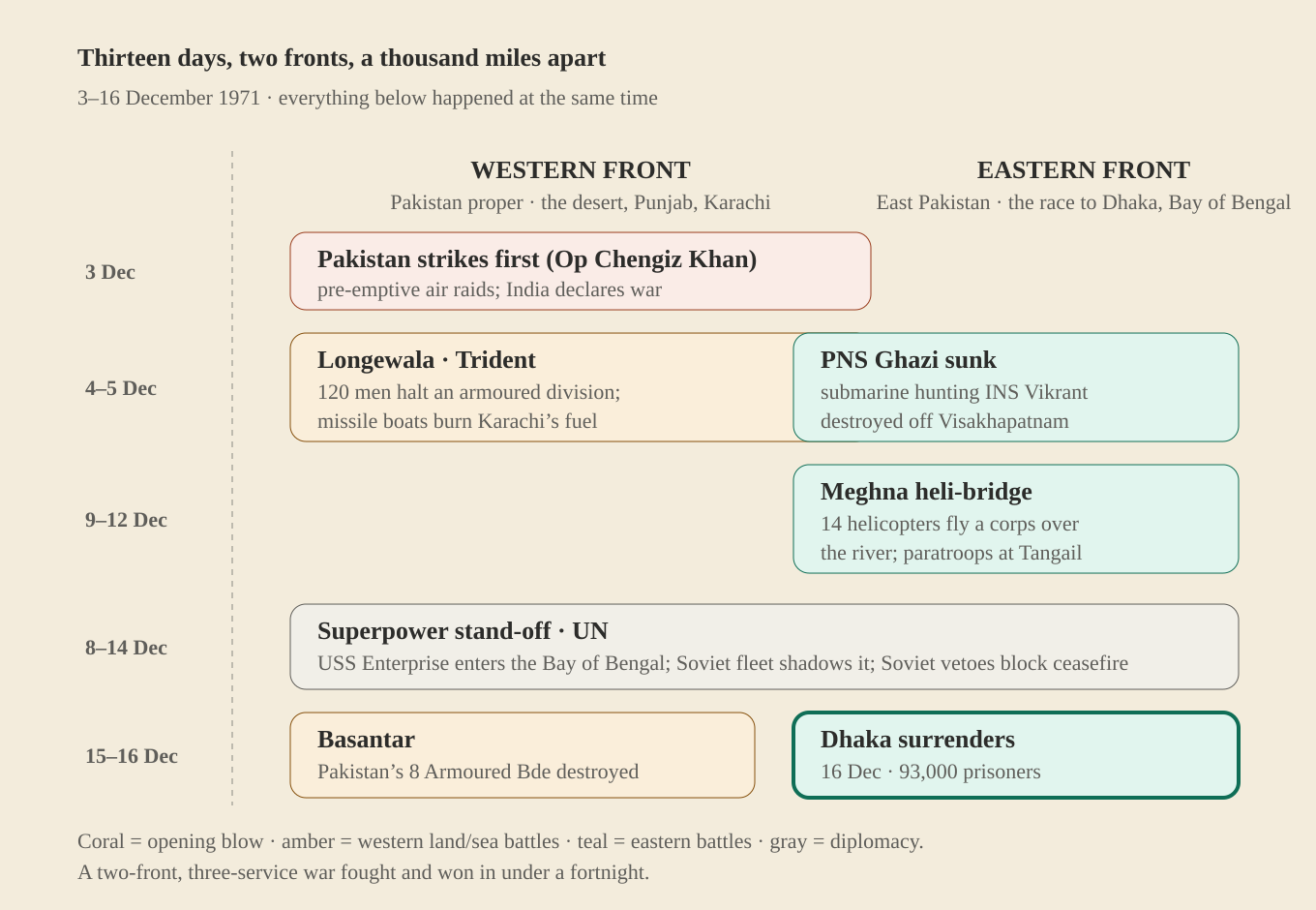
No country had attempted, let alone won, a coordinated two-front, three-service, land-sea-air campaign on this scale since the Second World War. And the contrast that makes it land hardest is India's own: just nine years earlier, in 1962, this same army had been routed in the Himalayas by China - under-equipped, mis-commanded, humiliated. The distance from that wreckage to this is the real measure of 1971.
Honesty requires the other half of the ledger, though, and it makes the achievement more interesting rather than less. The geometry of the war favoured India. It held the strategic initiative and the shorter interior lines; it had a friendly population and the Mukti Bahini fighting alongside it in the East; and its enemy was the one with the impossible map - a single state split into two wings with India's own landmass wedged a thousand miles between them, unable to reinforce one front from the other. The wonder of 1971 is not that India beat impossible odds. It is that India saw the opening its rival's geography had left, and then executed a simultaneous multi-front war with a speed and competence that its own recent history gave nobody any reason to expect.
VII. Longewala: 120 men, a wire fence, and the desert that ate an armoured division
Pakistan's western strategy followed Ayub Khan's old doctrine - that the defence of the East lay in the West - and in the Thar Desert it took the shape of a full-blooded armoured offensive. The attacking force was the Pakistani 18th Infantry Division under Major General B. M. Mustafa, with two armoured regiments under command: 22 Cavalry, riding Chinese-built Type 59 tanks, and 38 Cavalry on Shermans. The plan was to cross the international border, run up the existing desert track along the Ramgarh-Jaisalmer axis, capture the road junction at Longewala overnight, and drive on to take Jaisalmer and its airfield - seizing a slice of Rajasthan as a bargaining chip before the war was decided in the East. Two armoured regiments meant something on the order of ninety tanks, plus a field regiment and mortar and medium batteries in support. Crucially, the Pakistan Air Force had promised air cover and then, at the last hour, withdrew it: the PAF said it first had to activate the Jacobabad strip. Mustafa's columns went forward into the open desert naked of air support.
Holding the junction was a single sub-unit: 'A' Company of the 23rd Battalion, the Punjab Regiment - about 120 men, plus a half-platoon of Border Security Force guards - under Major Kuldip Singh Chandpuri. The rest of 23 Punjab had moved off to Sadhewala to clear a Pakistani post ahead of India's own planned thrust toward Rahimyar Khan; Longewala was a flank-protection picket, not a prepared fortress. The defences were thin: no minefield had been laid, the position had been dug in only roughly, and the company's heaviest punch was a single jeep-mounted 106 mm M40 recoilless rifle, backed by two medium machine guns and a couple of light mortars. Against ninety tanks, this was almost nothing.
Past midnight on 4/5 December, Chandpuri's sentries heard the rumble of massed armour in the dark. He was given the classic picket's choice: pull out on foot across open sand and abandon the junction, or hold and hope to be reinforced at first light. He chose to hold. He sited his single recoilless rifle to engage the lead tanks, ranged his few weapons, called for artillery from the battery at Sadhewala, and - above all - kept his men still and silent. Then the Pakistani attack made the first of its self-destroying mistakes: the armour had outrun its own infantry, a cardinal error, and now milled in front of the post waiting for the foot soldiers to catch up. The lead tanks also ran up against a low strand of barbed wire - strung only to keep the post's camels and stray cattle from wandering - and, in the darkness, mistook it for the leading edge of a minefield. The whole column hesitated, bunched, and began edging sideways looking for a way around, churning in the soft sand.
That hesitation cost them the war's most lopsided battle. Chandpuri's recoilless gun and his artillery picked off the leading tanks; bogged and channelled, the Pakistani armour could neither manoeuvre off the soft sand nor close the post. The company held through the entire night. And at dawn the trap closed from the sky: Hawker Hunters of the Indian Air Force, flying from Jaisalmer under Wing Commander M. S. Bawa, fell on the stalled column. With no PAF cover overhead and no cloud to hide in, the Pakistani tanks stood out black against the pale desert - the IAF pilots called it a turkey shoot. Over the next two days a handful of Hunters worked the column over again and again. By 6-7 December the offensive was a graveyard of armour: by most accounts thirty-odd tanks destroyed - roughly twenty-two by air and a dozen by ground fire - and around a hundred vehicles wrecked or abandoned in the sand. Indian losses were two to three men dead. Chandpuri received the Maha Vir Chakra; 23 Punjab took the battle honour "Longewala."
Longewala is the "Rajasthan debacle" of Pakistan's tanks reduced to its lessons: armour launched without its infantry, across open desert, with no air cover, against a single dug-in company - and destroyed in detail the moment the sun and the IAF came up. It is studied as a near-perfect example of how not to use tanks, and it later became the centrepiece, heavily dramatised, of the film
Border
.
VIII. The Shakargarh bulge: how to take a fortress through a minefield
If Longewala was a battle Pakistan threw away, Basantar was one India had to win the hard way - by walking straight into the most heavily fortified ground on the western front. The Shakargarh salient was a roughly thirty-kilometre dagger of Pakistani territory thrust toward India between Jammu and Punjab, close to the Pakistani base at Sialkot. It mattered to both sides because the road and rail links connecting Jammu and Kashmir to the rest of India ran past its tip; if Pakistan could push out of the bulge, it could cut Kashmir off at the neck. Pakistan's I Corps had accordingly turned the salient into a killing ground - belts of mines, anti-tank ditches, and dug-in Patton tanks sited to bleed any Indian advance white before it reached the Basantar river.
India committed its own I Corps to the sector: the 54th Infantry Division under Major General W. A. G. Pinto, with the 16th Independent Armoured Brigade. The plan was deceptively simple and brutally dangerous - breach the minefield, throw a bridgehead across the Basantar, push the armour over, and then hold the bridgehead against the inevitable armoured counter-attack. Everything depended on the breach. The minefield in front of the river was about 1,600 metres deep - a kilometre and a half of buried mines that had to be lifted by hand, at night, under direct enemy artillery.
The first attempt failed. On the night of 13/14 December, 17 Poona Horse - Centurion tanks, under Lieutenant Colonel Hanut Singh - tried to bounce a crossing south of Jarpal and got stuck north of the minefield in the dark, beaten by bad going, enemy fire and lost direction. So 54 Division switched to a deliberate, set-piece crossing on the night of 15/16 December. An engineer task force - built around the 9 Engineer Regiment, under Major Vijay Rattan Chaudhary - went into the minefield at eight in the evening under heavy shelling to clear safe lanes for the armour. The engineers worked through the night, lifting mines by hand metre by metre; several of them, including Major Chaudhary and Captain Ravindra Nath Gupta, were killed doing it. By about 2100 hours the 47th Infantry Brigade - the "Black Arrow" brigade - had a bridgehead across the river, but the lane through the mines was still only half-cleared.
Then the bridgehead reported Pakistani armour massing to counter-attack, and the whole gamble came to a single decision. The infantry could not hold the bridgehead against tanks without armour of their own, but the safe lane was not yet finished. Rather than wait for the engineers, 17 Poona Horse pushed its Centurions through the partially cleared minefield in the dark - a daylight-into-night charge across mines that, by the book, no one should have ordered. A troop of T-55 tanks fitted with mine-trawls, trained up by Captain J. D. S. Jind of 7 Light Cavalry, had gone ahead to beat a path; the rest followed before the all-clear. It worked. The Centurions got across and dug in to meet the counter-attack head-on.
What hit them on the morning of 16 December was Pakistan's 8 Independent Armoured Brigade - the formation meant to seal the breach and roll the Indians back into the river - with its 13 Lancers and 31 Cavalry riding American M47/M48 Pattons. In the fighting around Jarpal and Barapind, it was destroyed. This is where Second Lieutenant Arun Khetarpal of the Poona Horse - twenty-one years old, barely six months commissioned, commanding a Centurion named Famagusta - took his troop into the path of the Pakistani armour. He overran enemy positions, knocked out Pattons at close range one after another, and when his own tank was hit and set ablaze and he was ordered to pull back, he refused.
My main gun is still working,
and I will get these bastards."
In the same battle, Major Hoshiar Singh of the 3rd Grenadiers had captured the fortified villages of Jarpal and then held them through three days of armoured and infantry counter-attacks, moving from trench to trench under shellfire though gravely wounded, refusing evacuation until the position was secure. He survived, and received the Param Vir Chakra - the only living recipient of the four awarded for the war. By the time the guns fell silent on the 16th, roughly forty-eight Pakistani Pattons lay burning across the Shakargarh countryside, 8 Armoured Brigade was wrecked, and two of its cavalry regiments had effectively ceased to exist. The 47th Brigade took the name "Basantar" in honour of the battle; so did the Poona Horse.
IX. The four Param Vir Chakras of 1971
Four Param Vir Chakras were awarded for the war. Three were won in the western theatre, one in the east:
Lance Naik Albert Ekka, 14 Guards - at the Battle of Gangasagar on the eastern front, on the very first day of the war, he silenced enemy bunkers and machine-gun positions though mortally wounded, clearing the way for his battalion. Posthumous.
Flying Officer Nirmal Jit Singh Sekhon, 18 Squadron - the only Indian Air Force officer ever to receive the PVC. On 14 December, alone over Srinagar, he took off into a wave of attacking Pakistani Sabres and fought them at odds of one against six until he was shot down. Posthumous.
Second Lieutenant Arun Khetarpal, 17 Poona Horse - Battle of Basantar. Posthumous.
Major Hoshiar Singh, 3 Grenadiers - Battle of Basantar. Survived.
Behind these four names stand thousands more: the Vir Chakras and Maha Vir Chakras, and the roughly 3,900 Indian soldiers killed and 9,800 wounded in thirteen days. The fallen of 1971 bought, in less than a fortnight, what the diplomats and the refugees could not.
X. Fire on the water: the Navy burns Karachi
The 1971 war made the Indian Navy, and it did so with a weapon Pakistan did not believe India would dare to use - the Soviet-supplied Styx (P-15 Termit) anti-ship missile, carried by tiny Osa-class missile boats designed for coastal defence, not for offensive strikes hundreds of miles from home. The target was Karachi: Pakistan's only major port, the headquarters of its navy, and the funnel through which its seaborne fuel and war supplies flowed. Shut Karachi and you strangle the West's war.
On the night of 4/5 December came Operation Trident. The strike group built around the 25th Missile Boat Squadron - the "Killer Squadron" - sent three Osa boats, INS Nipat, INS Nirghat and INS Veer, each carrying four Styx missiles, screened by two Petya-class corvettes, INS Kiltan and INS Katchal. Because the little boats had short legs, they had to be brought most of the way toward Karachi before slipping in under cover of dark. The crews, trained on Soviet equipment, passed their signals in Russian to confuse Pakistani interception. Then, from ranges at which the defenders had nothing comparable to reply with, they fired.
It was the first use of anti-ship missiles in combat anywhere in the region, and it was annihilating. INS Nirghat's missiles tore into the destroyer PNS Khaibar, which sank with heavy loss of life. INS Nipat fired on the cargo ship MV Venus Challenger - carrying ammunition for Pakistan - and its escort, the destroyer PNS Shah Jahan; the freighter blew up and the destroyer was crippled beyond repair. INS Veer sank the minesweeper PNS Muhafiz. Then Nipat ran on toward Karachi itself and put its remaining missiles into the Kemari oil-tank farm. The fuel reserves of the Pakistani war machine went up in flames that burned for days and were visible far out to sea. India did not lose a man or a boat. Three nights later, Operation Python sent a single missile boat, INS Vinash, back to finish the work, wrecking more shipping and setting the remaining fuel tanks ablaze. Karachi was effectively closed for the rest of the war, and the Arabian Sea belonged to India. The Navy still marks 4 December as Navy Day in memory of Trident.
The trap at Visakhapatnam: the sinking of PNS Ghazi
On the other coast, the war's most elegant piece of naval deception had already played out - and it turned on India's single most valuable ship, the aircraft carrier INS Vikrant. Pakistan had exactly one submarine with the range and endurance to reach the Bay of Bengal and hunt her: PNS Ghazi, an ageing American-built long-range boat. In mid-November Ghazi sailed from Karachi under Commander Zafar Muhammad Khan, all the way around the subcontinent, with orders to find and sink Vikrant and to mine the approaches to her suspected base.
India knew she was coming. Naval intelligence had intercepted a Pakistani signal to Chittagong asking about a special grade of lubricating oil used only by submarines - a boat with no business being that far east - and, by some accounts, had broken into the relevant Pakistani naval communications. So Vice Admiral N. Krishnan, commanding the Eastern Naval Command, set a trap. The real Vikrant was quietly pulled far away to safe anchorage in the Andaman Islands. In her place, off Visakhapatnam, the Indians staged an elaborate impersonation: the old destroyer INS Rajput, under Lieutenant Commander Inder Singh, broadcast heavy radio traffic and routine signals - even large supply and ration requests - of the kind a carrier and her escorts would generate, so that Pakistani listeners would "confirm" Vikrant was sitting at Vizag.
Ghazi took the bait and closed on Visakhapatnam to lay her mines and wait for the carrier. Around midnight on 3/4 December, INS Rajput, leaving harbour blacked out, detected a disturbance in the water and dropped two depth charges over it. Moments later a heavy underwater explosion shook the area. PNS Ghazi was gone, with all ninety-three men aboard - eleven officers and eighty-two sailors. Whether the fatal blast was Rajput's depth charges or one of Ghazi's own mines, or both, has been argued ever since; Pakistan has long maintained it was an internal accident. Either way the threat to Vikrant died on the seabed off Vizag, and the carrier was freed to pound East Pakistan's ports unmolested for the rest of the war.
XI. The Enterprise sails - and the Soviet bear answers
As Indian columns closed on Dhaka and it became clear the eastern wing would fall within days, Nixon decided to intimidate India. On the pretext of evacuating American citizens, he ordered Task Force 74 - the nuclear-powered aircraft carrier USS Enterprise, then the largest warship in the world, with an amphibious assault ship, guided-missile destroyers and a nuclear attack submarine - out of the Gulf of Tonkin and into the Bay of Bengal. The message to India was unmistakable: stop, or risk a confrontation with the United States Seventh Fleet.
It was gunboat diplomacy of the bluntest kind, and it failed. India invoked the secret consultation provisions of its August treaty with Moscow. From Vladivostok, the Soviet Pacific Fleet dispatched a task force - a cruiser, destroyers and nuclear-armed submarines under Admiral Vladimir Kruglyakov - to shadow and encircle the Enterprise group. Kruglyakov later recounted surfacing his submarines deliberately in front of the Americans, a visible warning. The doctrine was understood on both sides: an attack on India would be treated as an attack on a Soviet partner. Task Force 74 arrived in the Bay of Bengal too late to matter and never fired a shot. Dhaka fell anyway.
The episode burned itself into Indian strategic memory. It is the reason India pressed so hard, in later decades, for blue-water naval power and for strategic autonomy from any single patron - and the reason the Enterprise incident is still invoked whenever a foreign fleet enters the Indian Ocean.
XII. The race to Dhaka
In the east, the campaign was a masterpiece of manoeuvre. Under Lieutenant General Jagjit Singh Aurora's Eastern Command, with Major General J. F. R. Jacob as chief of staff, three corps drove on Dhaka from three directions at once. The doctrine was the opposite of attrition: do not grind through the fortified towns the Pakistanis had garrisoned - bypass them, leave them stranded, and race for the capital, using river crossings, heliborne leaps, paratroops and the Mukti Bahini's local knowledge. The Indian Air Force owned the sky after the first forty-eight hours. Whole Pakistani garrisons would end the war sitting uselessly in bypassed strongpoints, far behind the Indian spearheads.
The decisive stroke was the work of Lieutenant General Sagat Singh and his IV Corps, driving in from Agartala in the east. By 9 December his troops had taken Akhaura and Brahmanbaria and run up against the Meghna - one of the widest rivers on earth, several kilometres across even at its narrowest, with the only bridge, at Ashuganj, blown by the retreating Pakistanis and the far bank held in strength. By the book, this was where the advance should have stopped to mount a deliberate opposed crossing, costing weeks the war did not have. When Aurora signalled him to halt at the east bank, Sagat Singh's reply became legend: "Jaggi, over my dead body."
Instead he improvised the manoeuvre that ended the war - Operation Cactus Lilly, the Meghna heli-bridge. With just fourteen Mi-4 helicopters under Group Captain Chandan Singh, the Indians simply flew the river. Over roughly thirty-six hours from 9 December, in more than four hundred sorties, they lifted some five thousand troops of the 57th Mountain Division - and tonnes of equipment - over the Meghna in relays, landing them behind the Pakistani river line near Raipura, where Mukti Bahini fighters had marked the drop zones with improvised lights in the paddy fields. PT-76 amphibious tanks forded and swam the currents. The strongpoint at Ashuganj was left to wither, un-fought. To the north-west, at Tangail, India dropped the 2nd Parachute Battalion across the last approaches to the capital. Between the airborne drop, the heli-bridge and the columns converging from every side, there was suddenly no organised Pakistani force left between the Indians and Dhaka.
The Meghna crossing is the manoeuvre most worth remembering, and the one most often left out of the popular story. An obstacle Niazi had written off as impassable was simply flown over by fourteen helicopters working in relays. It is the reason Dhaka was encircled in days rather than weeks - and the reason the war was decided before the superpowers could intervene.
Meanwhile the Soviet Union used its Security Council veto, repeatedly between 4 and 14 December, to kill the American- and Chinese-backed ceasefire resolutions that would have frozen the war and stopped India short of Dhaka - buying the precise days the Army needed. By 15 December, with the capital encircled, its airfield cratered and the IAF bombing the Governor's House in the middle of a cabinet meeting, the Pakistani command in the east was broken in spirit.
XIII. "Thirty minutes": how Jacob bluffed an army into surrender
The surrender was, in part, a magnificent bluff. On 16 December, Major General J. F. R. Jacob flew into Dhaka to negotiate with Lieutenant General A. A. K. Niazi, the Pakistani commander in the east, nicknamed "the Tiger." Jacob carried a draft instrument of surrender - and remarkably little to enforce it. The Indian troops actually around Dhaka were heavily outnumbered by Niazi's garrison inside it. Had Niazi chosen to fight on in the city, the cost would have been appalling and the outcome uncertain.
Niazi balked. "Who said I am surrendering?" he demanded when handed the document. Jacob played the only card he had - nerve.
If you do not agree, I will order the resumption
of hostilities and the bombing of Dhaka."
XIV. The Ramna Racecourse, 16 December 1971, 4:31 p.m.
The ceremony was deliberately, pointedly public - the first public military surrender of its kind in modern history. The site chosen was the Ramna Racecourse in Dhaka, the very ground where Sheikh Mujib had launched the freedom movement with his "this time the struggle is for independence" speech in March. The symbolism was total: the place where Bangladesh was declared became the place where its oppressor capitulated.
The choreography, recorded in detail by those present, ran like this. The terms had been vetted and initialled in Niazi's office early in the afternoon. Around 4:30 p.m., Lieutenant General Aurora landed at Dhaka airport in a flight of IAF helicopters, accompanied by the Eastern theatre naval and air commanders - Vice Admiral N. Krishnan and Air Marshal H. C. Dewan - by Lieutenant General Sagat Singh, and by Air Commodore A. K. Khandker, deputy commander of the Bangladesh forces. A single small table and two chairs had been hastily arranged on the open ground by Brigadier Sant Singh - the humble furniture taken from Niazi's own office.
Thousands of Bengalis pressed in around the table, shouting anti-Niazi and anti-Pakistan slogans; officers could barely keep their feet against the crush of the jubilant crowd. Aurora and Niazi sat. At 4:31 p.m. Indian Standard Time, Niazi signed first, then Aurora. Neither man spoke a word. The instrument guaranteed the surrendering soldiers treatment in accordance with the Geneva Conventions - their safety and dignity as prisoners of war. Then, in the act that sealed it, Niazi removed his epaulettes and handed over his service revolver to Aurora. The Tiger of East Pakistan had been disarmed in front of the people he had ruled.
Over ninety thousand men laid down their arms - the largest surrender of armed forces since the Second World War.
More than 90,000 - the figure usually given is about 93,000 - Pakistani soldiers and paramilitaries passed into Indian captivity. They were taken to camps in India, treated under the Conventions, and eventually repatriated after the 1972 Simla Agreement. A new country, Bangladesh, was born. India had its prisoners; Bengal had its freedom.
XV. The military prize
Strip away the sentiment and count what India actually held on the morning of 17 December 1971. A rival state cut in half, its eastern wing gone forever and with it more than half its population. About 93,000 prisoners of war - an entire army, officers and men, in Indian camps. Some 5,000 square kilometres of West Pakistani territory captured in the western sector. And on a separate ledger, 195 Pakistani officers whom the new government of Bangladesh wished to put on trial for war crimes. Add to that a defeated, humiliated Pakistani military, a discredited Yahya Khan swept aside, and a Soviet-friendly diplomatic position that had stared down the United States Seventh Fleet. By any measure in the history of modern war, this was a winning hand of rare completeness.
There was exactly one card India had been playing for since 1947, and now - for the first and only time - it held every chip at the table: Kashmir. A settled, recognised border in Kashmir; an end to the dispute that had already caused two wars and would cause more. The leverage to demand it was sitting in prisoner-of-war camps across northern India, ninety-three thousand men deep.
XVI. Simla, July 1972: how to win a war and lose the peace
From 28 June to 2 July 1972, Indira Gandhi - the Durga of December, the woman who had just dismembered Pakistan - sat down at Barnes Court in Shimla with Zulfikar Ali Bhutto, the leader of the side that had lost. The asymmetry could not have been starker. She was the victor with an army in her pocket. He was, in the phrase of the day, a charismatic man burdened by catastrophe, who had come looking for a face-saving deal and very little else to bargain with.
Here is what the victor walked away with. The ceasefire line in Kashmir was renamed the Line of Control. Both sides agreed, on paper, to resolve their disputes "bilaterally" and by peaceful means, without third-party or United Nations mediation. Both promised to respect the new line and not alter it unilaterally. And there was a soft, unwritten understanding - Bhutto's personal assurance to Gandhi, never committed to the text - that the Line of Control would, in time, quietly harden into the permanent border, once he had survived the political danger of selling such a thing to a furious Pakistani public.
In return, India gave back the 5,000 square kilometres it had captured in the west. It agreed to repatriate all 93,000 prisoners of war. And the 195 men Bangladesh wanted to try for war crimes were, in the end, quietly let go as well. The greatest single bargaining asset India has ever held in its dealings with Pakistan was returned, in full, in exchange for a renamed line and a verbal promise from a man who would be hanged by his own army within six years.
93,000 prisoners - 5,000 sq km - 195 men wanted for war crimes - a broken enemy.
Kept after July 1972:
a renamed ceasefire line, and a promise that was never written down.
The defenders of Simla make a real argument, and it deserves an honest hearing. India's declared war aim, they point out, was the liberation of Bangladesh - and that was achieved in full on 16 December. Pressing a vindictive peace, turning the line into a border by force and parading prisoners through war-crimes tribunals, might have created a permanently revanchist Pakistan and a fresh grievance for the next generation. Gandhi, on this reading, chose magnanimity and long-term stability over a short-term land grab. The Geneva Conventions, in any case, obliged India to repatriate the prisoners once hostilities formally ended; they were never hers to keep indefinitely.
Perhaps. But magnanimity assumes a partner who reciprocates, and a written settlement to anchor it. India got neither. The promise to harden the Line of Control evaporated the moment the prisoners were home and Bhutto was politically safe. Pakistan never accepted the line as a border, never stopped claiming the whole of Kashmir, and - as for the solemn pledge to keep the dispute strictly bilateral - has spent every decade since raising Kashmir at the United Nations, at the Organisation of Islamic Cooperation, and anywhere else that would grant it a microphone. The one clause India most wanted has been the most consistently ignored.
XVII. Kashmir is still burning
The proof of the bargain is written in everything that came after. In 1989 an armed insurgency erupted in the Kashmir Valley, sustained by exactly the cross-border infiltration the "bilateral, peaceful" framework was supposed to render impossible. In 1999, Pakistani troops crossed that same Line of Control in the heights above Kargil, and India had to fight a fourth war to throw them back off ground it thought settled in 1972. The decades since have brought a numbing rhythm of attacks, mobilisations and near-wars. The Line of Control is one of the most militarised borders on earth, and the dispute the victor of 1971 had the leverage to close forever is, half a century on, as open as it has ever been.
That is the uncomfortable coda to the most glorious fortnight in Indian military history. The soldiers did everything asked of them and more: Longewala, Basantar, the burning of Karachi, the race to Dhaka, four Param Vir Chakras and the largest surrender since 1945. They handed the politicians a victory so total it has not been equalled in the subcontinent before or since. What was done with that victory at the negotiating table is a separate question - and on the one issue that has cost India the most blood across the longest span of years, the answer is that the prize was spent for a promise, and the promise was never kept.
XVIII. What the thirteen days meant
None of this diminishes what the war itself was. Pakistan lost its eastern wing and the founding fiction of its existence - that shared religion alone could bind a nation across a thousand miles of difference. Bangladesh joined the family of nations. India established itself as the unchallenged power of South Asia, blooded a navy that would grow into a blue-water force, and exorcised the ghost of 1962 - trading the country of hollow rhetoric and unready armies for one that had, just once, aligned intelligence, diplomacy, political will and military skill toward a single decisive end. Sam Manekshaw was made a Field Marshal, the first in independent India's history. For thirteen days in December, Indira Gandhi was, even to her enemies, Durga.
1962 was the wound. December 1971 was the answer. Simla, July 1972, was the bill - and India is still paying it in Kashmir.
A note on sources and figures. Casualty and prisoner numbers from 1971 vary by source; the prisoner figure is conventionally given as roughly 90,000-93,000, the captured western territory as about 5,000 square kilometres, and atrocity death-toll estimates range very widely. Famous quotations - Manekshaw's "one hundred per cent defeat," Khetarpal's last transmission, Jacob's "thirty minutes" - are drawn from the participants' own later accounts and standard histories; as with all remembered speech, exact wording differs between tellings. The reading of Simla offered here - that India's military gains were under-converted at the negotiating table - is a long-standing and widely held view within India's own strategic community, but it is a judgement, not a settled fact; the case for Gandhi's restraint is given its due in the text. Where this account simplifies a complex operational or diplomatic picture, it does so for narrative clarity, not to distort the record.