Every register is an argument about what counts. This one makes its argument in a single column.
Against each war stands a verdict. Pro-Sanātana where the outcome defended or restored Sanātana sovereignty. Against Sanātana where it damaged it. Indecisive where the field settled nothing. And Internal — Bhāratīya, where both belligerents were of this soil.
That fourth category carries a rule, and here the rule is absolute. Where Bhāratīya fought Bhāratīya — Cōḻa and Cālukya, Pallava and Cālukya, Pratīhāra and Pāla and Rāṣṭrakūṭa — this register takes no side, praises no victor and disparages no loser. The facts are set down in full and the account moves on. The Rāṣṭrakūṭas, Cālukyas, Cōḻas, Pāṇḍyas, Pallavas, Kākatīyas, Hoysalas, Sātavāhanas, Gaṅgas, Senas, the Rajput houses, the Ahoms, the Sikhs, Vijayanagara and the Marathas are all of Bhārata. That they fought one another is a misfortune of history. They were never invaders, and nothing in these pages will treat them as one.
The other rule is its mirror. Where the belligerent came from outside Bhārata, he is named an invader — and it makes no difference how many generations he or his line afterwards sat on a throne here. Duration is not belonging. Tenure is not nativity. The Sultanates of Dillī and the Deccan, the Mughals from Bābur to Aurangzeb, Timūr, Nādir Shāh, Ahmad Shāh Abdālī, the Portuguese, the Dutch, the French and the British are invaders throughout this register, and what they did is set down in the words the sources support and in no softer ones.
Place-names are given as Bhārata's own, with the foreign form in brackets at first mention: the Vitastā and not the Hydaspes, Kānyakubja and not Kanauj, Orugallu and not Warangal, Mūlasthāna and not Multan, Sindhu and not Indus.
The verdict is on the outcome, not on the courage. Cittauḍ (Chittor), Haldīghāṭī, Chamkaur and Rezaṅg La are marked by what the field decided. What they meant is a larger question, and the consequence paragraph under each is where it is answered.
On sources. This register is built from the standard historical literature — the epigraphic corpora, the Persian and Sanskrit chronicles, the Portuguese and Greek accounts, the bakhars and buranjis, and the modern scholarship that works from them. Each entry names the attestation it rests on. What it does not carry is page-level citation verified line by line against the editions themselves. Where a named inscription or chronicle is cited, the artifact is real and its content is as described; where a modern work is named, it is the standard treatment of that campaign. Before any contested entry is quoted in argument, check it against the edition. The apparatus is a map to the sources, not a substitute for opening them.
Figure 1 · The Frontier Line. How far north-west a sovereign Bhāratīya power stood, from the Achaemenid annexation of Gandhāra to the present. Candragupta carries it past the Hindukush in 303 BCE and it is never that far again. It holds around the Sindhu for thirteen centuries — that plateau is the Battle of Rājasthān. It collapses after 1008, rests at zero for five hundred and sixty-five years, and rises almost to the ancient maximum twice within eighty: the Marathas at Aṭaka in 1758, Hari Singh Nalwa at the Khyber in 1837. Then 1849.
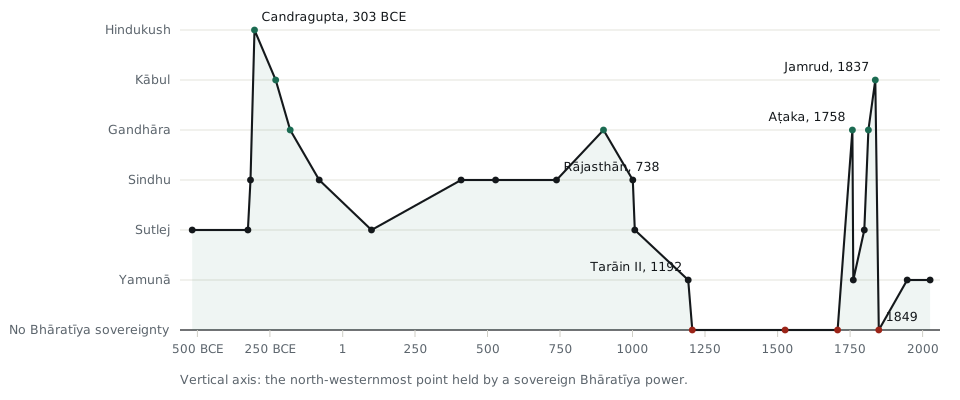
The north-western frontier of Bharatiya sovereignty by date
| Date | Frontier held | Event |
|---|---|---|
| 518 BCE | Sutlej | Achaemenid annexation of Gandhāra and Sindhu |
| 303 BCE | Beyond the Hindukush | Candragupta's settlement with Seleukos |
| 180 BCE | Gandhāra | Yavana pressure |
| 100 CE | Sutlej | Kuṣāṇa rule in the north-west |
| 738 | Sindhu | Battle of Rājasthān — the gate closes |
| 900 | Gandhāra | The Hindu Śāhis at their height |
| 1008 | Sutlej | Gandhāra and Kābul lost permanently |
| 1192 | Yamunā | Tarāin II |
| 1206–1757 | None | No Bhāratīya power in the north-west |
| 1758 | Gandhāra | Marathas at Aṭaka and Puruṣapura |
| 1761 | Yamunā | Panipat III |
| 1813 | Gandhāra | Aṭaka — an Afghan army beaten in the open |
| 1837 | Kābul approaches | Jamrud — the Khyber shut from the Indian side |
| 1849 | None | Annexation of the Pañcanada |
| 1947– | Yamunā–Sutlej | The Radcliffe line |
Figure 2 · The Verdict Ribbon. Every war in this register, in order, one mark each, coloured by verdict. Read left to right and the reversals need no commentary: predominantly green to the tenth century, a wall of red from 1001 to 1707, green again through Svarājya and the Maratha century, red from 1757, green from 1947.

The sixteen strata of the register with verdict counts
| Stratum | Period | Entries | Predominant verdict |
|---|---|---|---|
| I. The Janapadas | c.700–321 BCE | 13 | Mixed |
| II. Maurya, Śuṅga, the Yavana wars | 261 BCE–100 CE | 8 | Pro-Sanātana |
| III. Sātavāhana, Kuṣāṇa, Kṣatrapa | 78–300 CE | 4 | Contested |
| IV. The Gupta age and the Hūṇa wars | 335–550 | 8 | Pro-Sanātana |
| V. The regional empires | 550–1000 | 12 | Internal — Bhāratīya |
| VI. The Arab frontier | 711–1000 | 6 | Pro-Sanātana |
| VII. The Turkic invasions | 1000–1206 | 11 | Against Sanātana |
| VIII. Resistance under the Sultanate | 1206–1400 | 14 | Evenly divided |
| IX. The fifteenth and sixteenth centuries | 1400–1600 | 17 | Against Sanātana |
| X. Hindavī Svarājya | 1645–1707 | 19 | Pro-Sanātana |
| XI. The Khālsā | 1621–1849 | 13 | Pro-Sanātana |
| XII. The Maratha century | 1707–1818 | 17 | Pro-Sanātana |
| XIII. Mahiṣūru and the Company | 1746–1799 | 7 | Against Sanātana |
| XIV. Risings against the Raj | 1763–1900 | 12 | Against Sanātana |
| XV. The world wars and Azad Hind | 1914–1946 | 6 | Mixed |
| XVI. The Republic | 1947– | 13 | Pro-Sanātana |
I. The Janapadas
c. 700–321 BCE. Sixteen mahājanapadas contract into one. The first foreign hands reach the Sindhu — and the first are thrown back out.
Wars of the janapada period with civilizational verdict
| War | Date | Verdict |
|---|---|---|
| Magadha–Aṅga | c. 6th c. BCE | Internal — Bhāratīya |
| Magadha–Kosala wars | c. 500 BCE | Internal — Bhāratīya |
| Ajātaśatru vs the Vajji confederacy | c. 484–468 BCE | Internal — Bhāratīya |
| Achaemenid annexation of Gandhāra and Sindhu | c. 535–518 BCE | Against Sanātana |
| Mahāpadma Nanda's conquests | c. 345 BCE | Pro-Sanātana |
| Massaga — the Assakenoi | 327 BCE | Against Sanātana |
| Aornos — Pīr Sar | 326 BCE | Against Sanātana |
| Hydaspes — Purūṣottama | 326 BCE | Indecisive |
| Sangala — the Kathaioi | 326 BCE | Against Sanātana |
| The Mālava citadel | 325 BCE | Indecisive |
| Candragupta vs the Nandas | c. 322–321 BCE | Pro-Sanātana |
| Expulsion of the Greek satrapies | c. 317–316 BCE | Pro-Sanātana |
| Candragupta vs Seleukos Nikator | c. 305–303 BCE | Pro-Sanātana |
Magadha and Aṅga
c. 6th century BCE · Internal
Bimbisāra's annexation of Aṅga, on the eastern flank, is the first step in the process that ends with a single Bhāratīya empire. Aṅga controlled the Campā river trade and the route to the eastern sea; taking it gave Magadha the revenue base and the iron of the Rājgir hills together. The Buddhist and Jaina canonical literature preserves the outline, and it is worth noting that the earliest sustained account we have of Magadhan politics comes from śramaṇa sources rather than from the court itself.
The consequence is structural rather than dramatic. Magadha begins its climb, and the mahājanapada system begins its consolidation into something an emperor could inherit. Every later imperial project in India — Nanda, Maurya, Gupta — is built on the base Bimbisāra assembled.
Sources: Buddhist canonical literature (Dīgha and Majjhima Nikāyas, Mahāvagga); Jaina Āgamas; D.C. Sircar, Select Inscriptions Bearing on Indian History and Civilization; R.C. Majumdar (gen. ed.), The History and Culture of the Indian People, vol. II, The Age of Imperial Unity.
Magadha and Kosala
c. 500 BCE · Internal
Ajātaśatru against Prasenajit, and then against Prasenajit's son Vidūḍabha — a generational contest between the two strongest powers of the middle Ganga. The sources record reverses on both sides and a settlement sealed by marriage before the fighting resumed. Attached to this sequence is Vidūḍabha's destruction of the Śākyas, remembered in the Buddhist tradition as a massacre carried out in revenge for a slight of lineage.
Both houses were of Bhārata and the register takes no side between them. Settled Kosala was absorbed and Magadha continued its consolidation of the middle Ganga.
Sources: Pāli canonical and commentarial literature; Purāṇic dynastic lists; H.C. Raychaudhuri, Political History of Ancient India; Majumdar (ed.), HCIP vol. II.
Ajātaśatru and the Vajji confederacy
c. 484–468 BCE · Internal
Sixteen years to break the Licchavi republic. The tradition records two siege engines built for the purpose — the mahāśilākaṇṭaka, a stone-throwing catapult, and the rathamusala, a bladed chariot — and, more consequentially, the mission of the minister Vassakāra, who spent three years inside Vaiśālī cultivating suspicion among the Licchavi clans until the confederacy could no longer assemble.
Both parties were of Bhārata and no verdict is entered against either. What the entry records is the constitutional consequence: the gaṇa-saṅgha order — the republican confederacies of the eastern plains, governed by assemblies rather than by a single ruler — ends in the east with Vaiśālī, and Magadhan monarchy becomes the sole form. The Mahāparinibbāna Sutta preserves the conditions of Vajjian strength as they were understood at the time: that they assembled often and in full, and rose and dispersed in concord.
Sources: Mahāparinibbāna Sutta (Dīgha Nikāya); Jaina Bhagavatī Sūtra; Raychaudhuri, Political History of Ancient India; Majumdar (ed.), HCIP vol. II.
The Achaemenid annexation of Gandhāra and Sindhu
c. 535–518 BCE · Against Sanātana
Cyrus reached the eastern marches; Darius I annexed the Sindhu (Indus) lands outright. The Behistun and Persepolis inscriptions list Hinduš and Gandāra among the satrapies, and Herodotos records the Sindhu satrapy as the wealthiest in the empire, paying tribute in gold dust to a value far above any other province.
This is the first loss of the north-western frontier and it should be read as the opening entry in a very long sequence. The corridor through the Hindukush and the Khyber is not a geographical fact alone; it becomes a political fact the moment a power outside Bhārata holds its western mouth. Every invasion in this register from Alexander to Abdālī uses the road that was opened here. Settled It would not be closed from the Indian side until Hari Singh Nalwa at Jamrud, two thousand three hundred and fifty years later.
Sources: Behistun and Persepolis inscriptions of Darius I; Herodotos, Histories III.94–106; Majumdar (ed.), HCIP vol. II; A.K. Narain, The Indo-Greeks (for the frontier's subsequent history).
Mahāpadma Nanda's conquests
c. 345 BCE · Pro-Sanātana
The Purāṇas call him ekarāṭ, sole sovereign, and sarvakṣatrāntaka, ender of all kṣatriyas — a phrase that has been read both as the destruction of the old lineages and as their absorption. What is not disputed is the extent: the Nanda writ ran from the Punjab marches to Kaliṅga, and the Hāthīgumphā inscription of Khāravela records a Nanda canal in Kaliṅga and a Nanda who carried off the Jina image, both of which imply an administration and not merely a raid.
The Nandas are remembered badly, largely because the tradition that survived was written by those who overthrew them. But the empire Candragupta inherited was the empire Mahāpadma built, and the possibility of a single Bhāratīya sovereignty — the thing that made 305 BCE possible — is his achievement.
Sources: Purāṇic dynastic lists (Matsya, Vāyu); Hāthīgumphā inscription of Khāravela; Greek notices of the Gangaridai and Prasii (Curtius Rufus, Diodoros, Plutarch); Raychaudhuri, Political History of Ancient India.
Masakāvatī (Massaga) and the Aśvaka
327 BCE · Against Sanātana
The Aśvaka — the horse-people of the Suvāstu (Swat) valley, whom the Greeks called Assakenoi — held Masakāvatī against Alexander for four days. The garrison — the Greek accounts give seven thousand mercenaries under a commander who had been killed by a bolt from an engine — surrendered on terms. The terms were that they would take service with Alexander. They camped separately that night on a hill, and were surrounded and killed to a man.
Diodoros records that the women of Massaga took up the arms of the dead and fought beside them. This is not an Indian source claiming Indian valour; it is the conqueror's own historiographical tradition recording what it did. Settled It is the earliest written proof in this register of what terms offered by a foreign army were worth, and the lesson would have to be relearned at Tarāin, at Cittauḍ and at Sangameshwar.
Sources: Arrian, Anabasis IV.26–27; Diodoros Siculus XVII.84; Curtius Rufus VIII.10; Plutarch, Alexander; Majumdar (ed.), HCIP vol. II.
Varaṇa (Aornos) — Pīr Sar
326 BCE · Against Sanātana
The rock the tradition held even Indra had not taken. The Greeks called it Aornos, which is generally taken as their rendering of Varaṇa or Āvaraṇa; the identification with Pīr Sar above the Sindhu is Aurel Stein's and is not certain. Contested Alexander's engineers built a mole across the ravine and the position was carried. Strategically it secured his line of communication before the crossing of the Sindhu; symbolically it was the point of the exercise, since he had been told it was impregnable.
The Swat and Buner valleys pass out of Indian control. They will be contested for the next two thousand years and lost permanently in 1008.
Sources: Arrian, Anabasis IV.28–30; Curtius Rufus VIII.11; Aurel Stein, On Alexander's Track to the Sindhu.
The Vitastā (Hydaspes) — the Paurava king (Poros)
326 BCE · Indecisive
Alexander's costliest field battle in Asia, fought across the flooded Vitastā — the river the Greeks called Hydaspes and the British later Jhelum — against the ruler of the Paurava country, whom the Greek writers name Poros after his lineage rather than his person. The Indian order of battle — elephants at intervals in the front line, infantry between them, chariots on the wings — was broken by a night crossing upstream in a storm and by the Companion cavalry taking the Indian horse in the rear. The elephants, wounded and out of control, did as much damage to the Indian line as to the Macedonian.
And the Paurava was left on his throne. That is the honest measure of what was decided. Asked how he wished to be treated, he is recorded as saying: as a king. The Macedonian army refused to cross the Beas within weeks of this victory, and the eastern conquest ended not by treaty but by mutiny. Settled Whatever the Hydaspes was, it was not a conquest of Bhārata.
Sources: Arrian, Anabasis V.8–19; Curtius Rufus VIII.13–14; Plutarch, Alexander 60; Diodoros XVII.87–89; Majumdar (ed.), HCIP vol. II; Narain, The Indo-Greeks.
Sāṅgala and the Kaṭhas (Kathaioi)
326 BCE · Against Sanātana
The Kaṭhas — the Kathaioi of the Greek accounts, a people of the Cenāb country — drew up their wagons in a triple laager before the city and fought from behind them. Arrian gives the Macedonian losses here as higher than at the Hydaspes — a detail that has been consistently underweighted, since Sāṅgala was a city and not a kingdom, and it took the same army longer to reduce than Poros had. The city was razed.
Sources: Arrian, Anabasis V.22–24; Curtius Rufus IX.1; Majumdar (ed.), HCIP vol. II.
The Mālava citadel
325 BCE · Indecisive
The Mālavas and Kṣudrakas of the lower Punjab were, by the Greek account, the most warlike people encountered in the campaign. At an unnamed Mālava town Alexander went over the wall ahead of his men with three companions, was cut off inside, and took an arrow through the lung. He was carried out believed dead. He never recovered his health and was dead within two years.
The campaign of retribution that followed was among the bloodiest of the whole expedition. But the eastern project was already finished — the army had refused at the Beas, and it now had a dying king. Settled The Greek presence in Bhārata would be a garrison problem, not a conquest.
Sources: Arrian, Anabasis VI.6–11; Curtius Rufus IX.4–5; Plutarch, Alexander 63; Majumdar (ed.), HCIP vol. II.
Candragupta and the Nandas
c. 322–321 BCE · Pro-Sanātana
Kauṭilya's political science executed in the field. The tradition — Viśākhadatta's Mudrārākṣasa, the Jaina and Buddhist accounts, the Purāṇic notices — agrees on the essentials: a rejected Brahmin, a young man of obscure descent, a frontier army raised where the writ of Pāṭaliputra was weakest, and a systematic campaign inward from the periphery rather than a strike at the centre. The Arthaśāstra's chapters on the conduct of the vijigīṣu read as the theory of which this was the practice.
Pāṭaliputra taken; the Mauryan state founded. What follows is the first Indian empire with a documented administrative apparatus — revenue, espionage, roads, a standing army — and the political literature to explain itself. Settled
Sources: Viśākhadatta, Mudrārākṣasa; Kauṭilya, Arthaśāstra; Purāṇic lists; Justin's epitome of Trogus XV.4; Plutarch, Alexander 62; R.K. Mookerji, Chandragupta Maurya and His Times.
The expulsion of the Greek satrapies
c. 317–316 BCE · Pro-Sanātana
Within a decade of Alexander's death the Macedonian garrisons were gone from the Sindhu. Eudemos, who had murdered Poros, withdrew west with his elephants to join the wars of the successors. Justin records, in a phrase worth keeping, that India after Alexander's death shook the yoke of servitude from its neck and put his governors to death, and that the author of this liberation was Sandrocottus.
The north-west returns to Indian hands. It is worth marking how quickly: the most celebrated conquest of the ancient world lasted, in Bhārata, under a decade.
Sources: Justin, Epitome of Pompeius Trogus XV.4; Diodoros XIX.14; Mookerji, Chandragupta Maurya and His Times; Majumdar (ed.), HCIP vol. II.
Candragupta and Seleukos Nikator
c. 305–303 BCE · Pro-Sanātana
The war itself is barely documented; the settlement is not. Seleukos ceded Gandhāra, Arachosia, Gedrosia and the Paropamisadae — Kandahar, Herat, Baluchistan, the Kabul valley — and received five hundred war elephants, which he used at Ipsos to win the largest battle of the successor wars. A marriage alliance was concluded and Megasthenes came to Pāṭaliputra as ambassador.
This is the high-water mark of the western frontier for a thousand years and the most favourable settlement any Indian power ever obtained from a great foreign power. Settled It is also the moment from which Megasthenes' account of India derives — the account recording that the Indians were all free, that no Indian army had ever invaded another country, that foreigners were protected, and that he found seven groups among them whose membership was not by birth. That last observation is worth holding on to for what comes two thousand years later.
Megasthenes at the Mauryan court counted seven groups, not four varṇas, and recorded explicitly that membership among them was not determined by birth.
Sources: Megasthenes, Indika (surviving in Arrian, Strabo XV, and Diodoros II); Appian, Syriaca 55; Strabo XV.2.9; Plutarch, Alexander 62; Mookerji, Chandragupta Maurya and His Times; R.C. Majumdar, The Classical Accounts of India.
II. Maurya, Śuṅga and the Yavana Wars
c. 261 BCE – 100 CE. The empire turns inward, then fragments, and the north-west becomes a corridor again.
Wars of the Mauryan and Shunga period with civilizational verdict
| War | Date | Verdict |
|---|---|---|
| Kaliṅga | c. 261 BCE | Indecisive |
| Puṣyamitra Śuṅga vs the Yavanas | c. 185–175 BCE | Pro-Sanātana |
| Menander's advance to Sāketa | c. 155 BCE | Against Sanātana |
| Khāravela's campaigns | c. 1st c. BCE | Pro-Sanātana |
| Śaka invasions — Maues, Azes | c. 90–50 BCE | Against Sanātana |
| Vikramāditya vs the Śakas | c. 57 BCE | Pro-Sanātana |
| Veṇṇi | c. 1st–2nd c. CE | Internal — Bhāratīya |
| Talaiyālaṅkāṇam | c. 2nd c. CE | Internal — Bhāratīya |
Kaliṅga
c. 261 BCE · Indecisive
The only ancient war in this register whose casualty figures come from the victor's own public confession. Aśoka's Thirteenth Rock Edict gives a hundred and fifty thousand deported, a hundred thousand killed, and many times that number dead of other causes — and then states that the king felt remorse, and that the suffering of even a hundredth part of that number now weighed on him.
The verdict is indecisive because the consequence cuts both ways. Kaliṅga was annexed and the Mauryan territorial project completed. But the state's energies were redirected from digvijaya to dhamma-vijaya, and the frontier policy that followed left the north-west to be reoccupied within two generations of Aśoka's death. Contested Whether the redirection weakened the empire militarily is argued in both directions, and the argument is not settled by the edicts, which are the propaganda of the party concerned.
Sources: Aśoka's Thirteenth Major Rock Edict (Girnar, Shahbazgarhi, Kalsi recensions); the Separate Kaliṅga Edicts (Dhauli, Jaugada); D.C. Sircar, Inscriptions of Aśoka; Romila Thapar, Aśoka and the Decline of the Mauryas; Majumdar (ed.), HCIP vol. II.
Puṣyamitra Śuṅga and the Yavanas
c. 185–175 BCE · Pro-Sanātana
Kālidāsa's Mālavikāgnimitram stages the episode: the horse of Puṣyamitra's aśvamedha, loosed and escorted by his grandson Vasumitra, is challenged by a Yavana cavalry force on the right bank of the Sindhu, and the Yavanas are defeated. Patañjali's Mahābhāṣya, contemporary with the reign, uses as a grammatical example the sentence that the Yavana besieged Sāketa and Mādhyamikā — in a past tense denoting recent action.
Taken together these place a Yavana advance deep into Āryāvarta and a Śuṅga counter that turned it. The Śuṅgas have been treated harshly in a certain historiography for their reassertion of Vedic ritual, and the charge of Buddhist persecution levelled at Puṣyamitra rests on late sectarian sources contradicted by the archaeology at Sāñcī and Bhārhut, both of which flourished under Śuṅga patronage. Contested
Sources: Patañjali, Mahābhāṣya III.2.111; Kālidāsa, Mālavikāgnimitram; Gārgī Saṃhitā (Yuga Purāṇa); Narain, The Indo-Greeks; Majumdar (ed.), HCIP vol. II.
Menander's advance to Sāketa
c. 155 BCE · Against Sanātana
The Yuga Purāṇa section of the Gārgī Saṃhitā records the Yavanas reaching Sāketa, Pāñcāla and Mathurā and approaching Kusumadhvaja — Pāṭaliputra — and then withdrawing on account of a war among themselves. Menander's coinage is found across a vast range from the Kabul valley to the Gangetic doab, and his memory survives in the Milindapañha as a king who debated the Buddhist elder Nāgasena.
The consequence is the demonstration that the imperial centre was reachable. After the Mauryas, Āryāvarta is not one thing, and a determined force with a mounted arm can cross it.
Sources: Gārgī Saṃhitā (Yuga Purāṇa); Milindapañha; Strabo XI.11.1 (citing Apollodoros); numismatic corpus in Narain, The Indo-Greeks; Majumdar (ed.), HCIP vol. II.
Khāravela's campaigns
c. 1st century BCE · Pro-Sanātana Contested
The Hāthīgumphā inscription at Udayagiri is one of the great royal records of ancient India: a year-by-year account of a Kaliṅga king who repaired the capital, campaigned west against the Sātavāhanas, marched north against Magadha and made its king do obeisance, drove back a Yavana ruler, and — the line that matters most for this register — brought home the Jina image of Kaliṅga that a Nanda king had carried off three centuries earlier.
The restoration of plundered images enters the vocabulary of Indian kingship here, in the first century BCE, in an inscription cut in the reign of the king who did it. Contested Khāravela's absolute dating is disputed across roughly a century and the reading of several passages, including the Yavana king's name, is uncertain — but the restoration passage is not among the disputed readings.
Sources: Hāthīgumphā inscription (Udayagiri, Odisha); D.C. Sircar, Select Inscriptions vol. I; K.P. Jayaswal and R.D. Banerji, Epigraphia Indica XX; Majumdar (ed.), HCIP vol. II.
The Śaka invasions
c. 90–50 BCE · Against Sanātana
Maues, then Azes, take Taxila and the Punjab. The Indo-Scythian settlement in the west is not a raid but an occupation with a mint, a satrapal structure and a two-century life. From it descend the Kṣaharāta and Kārddamaka lines that will hold Gujarat, Mālava (Malwa) and Saurāṣṭra until Candragupta II.
Sources: Numismatic corpus; Taxila copper-plate of Patika; Mathurā lion capital inscription; Sircar, Select Inscriptions vol. I; Majumdar (ed.), HCIP vol. II, The Age of Imperial Unity.
Vikramāditya and the Śakas
c. 57 BCE · Pro-Sanātana Contested
The tradition holds that a king of Ujjayinī drove the Śakas out and that the era beginning in 57 BCE — the Vikrama Saṃvat, the calendar by which Bhārata still reckons — was begun from that victory. The era's existence and its epoch are beyond dispute; it is the earliest of the great Indian eras in continuous use. What is disputed is the identification of its founder, since the epigraphic record calls it the Kṛta and later the Mālava era before the name Vikrama attaches to it.
Contested The register keeps the entry and marks it. A calendar in unbroken use for two thousand and eighty years is a fact about the civilization whatever the argument over the name attached to its first year.
Sources: Epigraphic occurrences of the Kṛta, Mālava and Vikrama eras (Sircar, Select Inscriptions); the Vikramāditya cycle (Kathāsaritsāgara, Siṃhāsana-dvātriṃśikā); D.C. Sircar, Indian Epigraphy and Indian Epigraphical Glossary.
Veṇṇi
c. 1st–2nd century CE · Internal
Karikāla Cōḻa against the combined Cēra and Pāṇḍya at Veṇṇi. The Puṟanāṉūṟu preserves the aftermath rather than the battle: the Cēra king, wounded in the back, took the wound as a disgrace and starved himself to death facing north. A poet's stanza on his death is among the most quoted in the Sangam corpus.
All three were Tamil houses of Bhārata and no verdict is entered. Cōḻa primacy in the Tamil country dates from here, and with it the Kāverī delta irrigation works — the Kallaṇai among them — that made the later Cōḻa empire economically possible.
Sources: Puṟanāṉūṟu; Paṭṭiṉappālai; K.A. Nilakanta Sastri, A History of South India and The Cōḷas; Majumdar (ed.), HCIP vol. II.
Talaiyālaṅkāṇam
c. 2nd century CE · Internal
Neduñceḻiyan of Madurai, a young king whose accession had been dismissed, against a confederacy of the Cēra, the Cōḻa and five velir chieftains. He won, and the Sangam poets — Nakkīrar and Māṅkuṭi Marutaṉār among them — made the victory the occasion for some of the finest political poetry in Tamil.
A contest among Bhāratīya houses of the Tamil country, entered without verdict. Madurai's ascendancy and the high age of the Sangam academies follow. Contested The chronology of the entire Sangam corpus is uncertain to within a century or more, and this register does not pretend otherwise.
Sources: Puṟanāṉūṟu; Maturaikkāñci of Māṅkuṭi Marutaṉār; Neṭunalvāṭai; Nilakanta Sastri, A History of South India.
III. Sātavāhana, Kuṣāṇa and Kṣatrapa
c. 78–300 CE. Two centuries of contest between indigenous dynasties and settled foreign powers in the west.
Wars of the Satavahana and Kshatrapa period with civilizational verdict
| War | Date | Verdict |
|---|---|---|
| Kuṣāṇa expansion into the Gangetic plain | c. 78–150 CE | Against Sanātana |
| Gautamīputra Sātakarṇi vs Nahapāna | c. 124 CE | Pro-Sanātana |
| Rudradāman I vs the Sātavāhanas | c. 150 CE | Against Sanātana |
| Sātavāhana collapse | c. 225 CE | Internal — Bhāratīya |
Kuṣāṇa expansion into the Gangetic plain
c. 78–150 CE · Against Sanātana
A Central Asian house — the Yuezhi, under Kujula and then Kaniṣka — rules from Puruṣapura across the Punjab to Mathurā and beyond. The Rabatak inscription lists the cities under Kaniṣka's authority and reaches deep into Āryāvarta.
The verdict is against, and it should be entered without the softening the Kuṣāṇas usually receive on account of their patronage of Buddhist art. Patronage by a foreign ruling house is not the same thing as sovereignty exercised by an indigenous one, and the north-west is administered from outside Bhārata for a third time in six centuries. Settled The Gandhāra workshops are magnificent and they are not the point.
Sources: Rabatak inscription; Sārnāth and Mathurā inscriptions of the Kuṣāṇa era; numismatic corpus; B.N. Puri, India under the Kushanas; Majumdar (ed.), HCIP vol. II.
Gautamīputra Sātakarṇi and Nahapāna
c. 124 CE · Pro-Sanātana
The Kṣaharāta line ended. The archaeological confirmation is unusually direct: a hoard at Jogalthembi contained thousands of Nahapāna's silver coins, a large proportion of them restruck with Sātavāhana types — a defeated currency reissued by the victor.
The Nāsik cave inscription of the king's mother, Gautamī Balaśrī, is the record, and it is one of the great statements of restorationist Hindu kingship in the epigraphic corpus: her son is called the destroyer of the Śakas, Yavanas and Pahlavas, the restorer of the glory of the Sātavāhana house, the one who stopped the mixing of the four varṇas, and the ruler whose horses drank of the three oceans.
Destroyer of the Śakas, Yavanas and Pahlavas; restorer of the glory of his house; he whose horses drank of the three oceans. — Nāsik praśasti of Gautamī Balaśrī
Sources: Nāsik cave inscription no. 2 of Gautamī Balaśrī (Epigraphia Indica VIII); Jogalthembi coin hoard; Sircar, Select Inscriptions vol. I; Majumdar (ed.), HCIP vol. II.
Rudradāman I and the Sātavāhanas
c. 150 CE · Against Sanātana
The Junāgaḍh rock inscription of 150 CE — the earliest substantial Sanskrit inscription in the classical style, cut on the same rock that carries Aśoka's edicts — records that Rudradāman twice defeated the lord of Dakṣiṇāpatha and twice spared him on account of the closeness of their connection, meaning a marriage tie.
The same inscription records the repair of the Sudarśana lake dam at Girnar, built under Candragupta Maurya and improved under Aśoka, and states that it was repaired without levying forced labour or a special tax. It is a document of considerable administrative sophistication produced by a dynasty of foreign origin, and the verdict remains against: the western Kṣatrapa recovery prolongs foreign rule in Gujarat and Mālava by two hundred years.
Sources: Junāgaḍh rock inscription of Rudradāman I (Epigraphia Indica VIII); Sircar, Select Inscriptions vol. I; Majumdar (ed.), HCIP vol. II.
The Sātavāhana collapse
c. 225 CE · Internal
The Dakṣiṇāpatha (Deccan) fragments into Ikṣvāku, Ābhīra, Vākāṭaka and Kadamba successors. Nāgārjunakoṇḍa rises under the Ikṣvākus; the Vākāṭakas will matter enormously in the fifth century through the marriage that ties them to the Guptas.
The consequence is a century in which there is no southern counterweight to the north, and no northern power capable of using the opening.
Sources: Purāṇic dynastic lists; Nāgārjunakoṇḍa inscriptions; V.V. Mirashi, Corpus Inscriptionum Indicarum vol. V (Vākāṭaka inscriptions); Majumdar (ed.), HCIP vol. II.
IV. The Gupta Age and the Hūṇa Wars
c. 335–550 CE. The classical order is built, and then very nearly extinguished by the same force that destroyed Rome.
Wars of the Gupta period with civilizational verdict
| War | Date | Verdict |
|---|---|---|
| Samudragupta's Āryāvarta campaign | c. 350 CE | Pro-Sanātana |
| Samudragupta's Dakṣiṇāpatha campaign | c. 355 CE | Pro-Sanātana |
| Candragupta II vs the Western Kṣatrapas | c. 397–409 CE | Pro-Sanātana |
| Kumāragupta I vs the Puṣyamitras | c. 455 CE | Internal — Bhāratīya |
| Skandagupta against the Hūṇas | c. 455–460 CE | Pro-Sanātana |
| Toramāṇa's invasion | c. 500–515 CE | Against Sanātana |
| Bhānugupta at Eran | 510 CE | Indecisive |
| Yaśodharman at Sondani | 528 CE | Pro-Sanātana |
Samudragupta's Āryāvarta campaign
c. 350 CE · Pro-Sanātana
Nine kings of Āryāvarta violently uprooted — the Prayāga praśasti of Hariṣeṇa, incised on the same Aśokan pillar that stands at Allahabad, names them and states the policy plainly. In the north the method was annexation. The forest kingdoms of central India were reduced to servitude; the frontier states of the north-west and the east paid tribute and rendered obeisance.
The praśasti is the fullest surviving account of a digvijaya from the ancient world and it is a document of policy as much as of conquest: it distinguishes explicitly between territories absorbed, rulers subordinated, and powers merely conciliated. What it describes is an imperial architecture, not a raid.
Sources: Allahabad (Prayāga) pillar praśasti of Hariṣeṇa, Corpus Inscriptionum Indicarum vol. III (Fleet); Sircar, Select Inscriptions vol. I; R.C. Majumdar and A.S. Altekar, The Vākāṭaka-Gupta Age; Majumdar (ed.), HCIP vol. III, The Classical Age.
Samudragupta's Dakṣiṇāpatha campaign
c. 355 CE · Pro-Sanātana
Twelve southern kings defeated — the praśasti names them and their capitals, from Kosala and Mahākāntāra down to Kāñcī and Vengī — and then restored to their thrones. The phrase is grahaṇa-mokṣānugraha: capture, release, and favour.
This is the Indian imperial method stated in three words, and it is the deepest structural contrast in this entire register with what conquest would mean after 1192. The southern kings were beaten and left ruling, their capitals not razed, their temples not touched, their lineages not extinguished. Settled An empire was asserted; a civilization was not attacked. The distinction is not sentimental — it is legible in the epigraphic and archaeological record of the campaign route.
Capture, release, and favour. An empire was asserted; a civilization was not attacked.
Sources: Allahabad pillar praśasti of Hariṣeṇa, CII vol. III; Sircar, Select Inscriptions vol. I; Nilakanta Sastri, A History of South India; Majumdar and Altekar, The Vākāṭaka-Gupta Age.
Candragupta II and the Western Kṣatrapas
c. 397–409 CE · Pro-Sanātana
Ujjayinī and Saurāṣṭra taken and the Kārddamaka line extinguished. The last Śaka power in Bhārata ends after three hundred years of occupation of the western seaboard, and the empire reaches the Arabian Sea and its ports. Candragupta's silver coinage for the western provinces is struck on the Kṣatrapa standard — an administrator's decision, not a conqueror's.
The classical golden age follows directly from this. Control of the western ports meant the Roman and Persian Gulf trade; the revenue underwrote the court that Kālidāsa and the Nālandā foundation belong to. Fa-Hien travelled Madhyadeśa in these years and found the people happy and free, the roads safe, capital punishment rare, and travellers unmolested.
Sources: Mehrauli iron pillar inscription; Udayagiri cave inscriptions of Candragupta II; Sāñcī inscription of 412–13 CE; numismatic evidence; Fa-Hien, Fo-kuo-ki (trans. Legge, A Record of Buddhistic Kingdoms); Majumdar and Altekar, The Vākāṭaka-Gupta Age.
Kumāragupta I and the Puṣyamitras
c. 455 CE · Internal
The Bhitarī pillar records that the fortunes of the family had been made to totter, and that the crown prince Skandagupta restored them by defeating the Puṣyamitras. Whether the Puṣyamitras were a tribe of the Narmadā valley or a misreading for another people is argued; that the dynasty came close to falling before the Hūṇas ever arrived is not.
Sources: Bhitarī pillar inscription of Skandagupta, CII vol. III; Bilsad pillar inscription; Majumdar and Altekar, The Vākāṭaka-Gupta Age.
Skandagupta against the Hūṇas
c. 455–460 CE · Pro-Sanātana
The Bhitarī pillar's account of the encounter is one of the most physical lines in the Indian epigraphic corpus: when he joined battle with the Hūṇas, the earth shook. The Junāgaḍh inscription of 457–58 records his appointment of a governor for Saurāṣṭra and the repair, again, of the Sudarśana dam — an empire still functioning under war conditions.
The consequence is the one that matters most and is least stated: India was not Rome because of this battle. The same Hephthalite pressure that broke the western Roman order in the same decades was met on the Indian frontier and held. Settled It was held at ruinous cost — the debasement of Skandagupta's gold coinage is measurable, and the imperial structure never recovers its revenue base — but it was held, and the classical order got two more generations.
Sources: Bhitarī pillar inscription of Skandagupta, CII vol. III; Junāgaḍh rock inscription of Skandagupta (457–58 CE); Gupta gold coinage metrology; Majumdar and Altekar, The Vākāṭaka-Gupta Age; Upendra Thakur, The Hūṇas in India.
Toramāṇa's invasion
c. 500–515 CE · Against Sanātana
The Eran boar inscription records the first regnal year of the great king of kings Toramāṇa ruling the earth — cut in Mālava, in the heart of Gupta country, by a local magnate transferring his allegiance. Punjab and Mālava are lost to the Alchon Hūṇas. The Kaśmīra (Kashmir) tradition preserved by Kalhaṇa remembers Mihirakula, Toramāṇa's son, in terms it uses for no other ruler.
Sources: Eran boar inscription of Toramāṇa, CII vol. III; Kalhaṇa, Rājataraṅgiṇī I.289–307 (trans. Stein); Thakur, The Hūṇas in India; Majumdar (ed.), HCIP vol. III.
Bhānugupta at Eran
510 CE · Indecisive
The Eran pillar of Goparāja records a very great battle and a hero who went to heaven, equal to the best of kings — and that his wife followed him onto the fire. It is the earliest dated inscriptional record of satī in India, and it is a battlefield inscription, which is a fact worth registering about the context in which the practice appears in the epigraphic record.
Militarily the encounter settles nothing. The imperial centre no longer holds the west, and the Gupta writ is contracting toward Magadha.
Sources: Eran pillar inscription of Goparāja (510 CE), CII vol. III; Sircar, Select Inscriptions vol. I; Majumdar and Altekar, The Vākāṭaka-Gupta Age.
Yaśodharman at Sondani
528 CE · Pro-Sanātana
The two victory pillars at Sondani near Mandasor carry the claim in full: that Yaśodharman ruled countries the Guptas had not reached and the Hūṇas had not penetrated, and that Mihirakula, who had bowed his head to no other, did obeisance to him. The Mandasor stone inscription of 532 gives the date frame.
Central Asia's most destructive force of that century is broken on the Mālava plateau, and there is no further Hūṇa power in India. Settled But the effort does not save the Gupta imperium, which does not survive the sixth century, and what follows is the polycentric order — three or four imperial centres at once — that is the great cultural strength and the great strategic vulnerability of medieval Bhārata.
Sources: Sondani pillar inscriptions of Yaśodharman; Mandasor stone inscription of Yaśodharman and Viṣṇuvardhana (532 CE), CII vol. III; Sircar, Select Inscriptions vol. I; Thakur, The Hūṇas in India.
V. The Regional Empires
c. 550–1000 CE. Three or four imperial centres at once, contesting Kānyakubja, Vātāpi and Kāñcī. This is the order the later conquests would find, and exploit.
Wars of the regional imperial period with civilizational verdict
| War | Date | Verdict |
|---|---|---|
| Pulakeśin II vs Harṣa on the Narmadā | c. 618 CE | Internal — Bhāratīya |
| Pallava–Cālukya wars; sack of Vātāpi | c. 620–642 CE | Internal — Bhāratīya |
| Vikramāditya II at Kāñcī | c. 731–745 CE | Internal — Bhāratīya |
| Lalitāditya Muktāpīḍa's digvijaya | c. 725–760 CE | Pro-Sanātana |
| Dantidurga overthrows the Cālukyas | 753 CE | Internal — Bhāratīya |
| The tripartite struggle for Kānyakubja | c. 783–816 CE | Internal — Bhāratīya |
| Nāgabhaṭa II takes Kānyakubja | c. 816 CE | Pro-Sanātana |
| Rājarāja I — Kandalūr and Lanka | c. 993–994 CE | Internal — Bhāratīya |
| Rājendra I's Gaṅgā expedition | 1019–1024 CE | Internal — Bhāratīya |
| Rājendra I vs Śrīvijaya | 1025 CE | Pro-Sanātana |
| Koppam and Kūḍal Saṅgamam | 1054–1063 CE | Internal — Bhāratīya |
| Sena conquest of Bengal | c. 1097–1160 CE | Internal — Bhāratīya |
Pulakeśin II and Harṣavardhana on the Narmadā
c. 618 CE · Internal
Ravikīrti's Aihole praśasti of 634 records that Harṣa, whose lotus feet were arrayed with the rays of the jewels of the diadems of hosts of feudatories, had his harṣa — his joy — melted away by fear when his elephants fell in the battle. Hiuen Tsang, who was at Harṣa's court, independently confirms that the emperor of the north could not subdue the lord of the Dakṣiṇāpatha.
Both were Bhāratīya sovereigns and the register enters no verdict between them. The outcome fixed the Narmadā as the working boundary between northern and southern imperial power for the following centuries, and confirmed the polycentric order — several simultaneous imperial centres rather than one — which is the political shape of Bhārata through the whole classical and early medieval period.
Sources: Aihole inscription of Ravikīrti (634 CE), Epigraphia Indica VI; Hiuen Tsang, Si-yu-ki (trans. Beal); Bāṇa, Harṣacarita; Nilakanta Sastri, A History of South India; Majumdar (ed.), HCIP vol. III.
The Pallava–Cālukya wars and the sack of Vātāpi
c. 620–642 CE · Internal
Pulakeśin II reached the outskirts of Kāñcī at Pullalūr; Narasiṃhavarman I answered by taking Vātāpi itself in 642, killing Pulakeśin, and cutting a victory inscription on a boulder at Bādāmi. He took the title Vātāpikoṇḍa, the taker of Vātāpi.
A century of contest between two Bhāratīya houses, recorded here without verdict. It is also the century in which both produced their finest architecture — the Mahābalipuram rathas and shore temple under the Pallavas, the Bādāmi and Paṭṭadakal complexes under the Cālukyas — much of it endowed from the revenues of these campaigns.
Sources: Bādāmi cliff inscription of Narasiṃhavarman I; Kūram and Kāśākuḍi plates; Aihole inscription; Nilakanta Sastri, A History of South India; K.R. Srinivasan, Temples of South India.
Vikramāditya II at Kāñcī
c. 731–745 CE · Internal
The Cālukya took Kāñcī three times. On each occasion he left the Rājasiṃheśvara — the Kailāsanātha temple — untouched, and endowed it. The record of this is not a Cālukya court claim: it is cut on the temple's own wall, in a Kannada inscription on a pillar of the Kailāsanātha at Kāñcī, in the conqueror's own hand, in the defeated capital.
This is the single most useful document in the register for what war between Bhāratīya powers meant. Settled A victorious king enters the defeated capital, finds its greatest temple, and pays for its upkeep — three times over. Four and a half centuries later a foreign victor entered Somanātha. The contrast is not rhetorical; it is epigraphic, and it can be walked to and read on the wall.
Sources: Kannada inscription of Vikramāditya II on the Kailāsanātha temple, Kāñcīpuram; South Indian Inscriptions vol. I; Nilakanta Sastri, A History of South India; Majumdar (ed.), HCIP vol. III.
Lalitāditya Muktāpīḍa's digvijaya
c. 725–760 CE · Pro-Sanātana
Kalhaṇa's Rājataraṅgiṇī gives Kaśmīra an imperial century under Lalitāditya: campaigns against Yaśovarman of Kānyakubja, against the Tibetans on the eastern passes, and against the Arabs pressing up from Sindh. Chinese sources of the Tang court independently record a Kashmiri king seeking alliance against Tibetan and Arab pressure, which corroborates the strategic picture if not the extent of the conquests.
The Mārtāṇḍa sun temple at Mattan is his monument, and its ruin is the work of a later century that this register reaches in due course. Contested Kalhaṇa wrote four hundred years after the events and the conquest lists are plainly inflated; the frontier achievement is not in doubt.
Sources: Kalhaṇa, Rājataraṅgiṇī IV (trans. M.A. Stein); Tang dynastic annals; Majumdar (ed.), HCIP vol. III; A.L. Basham, The Wonder That Was India.
Dantidurga overthrows the Cālukyas
753 CE · Internal
Rāṣṭrakūṭa power founded on the ruin of the Bādāmi Cālukyas. Out of the proceeds Kṛṣṇa I commissioned the Kailāsa at Ellorā — a temple carved downward out of a single basalt hill, the largest monolithic excavation on earth.
Sources: Sāmāngaḍ copper plates of Dantidurga; Ellorā inscriptions; A.S. Altekar, The Rāṣṭrakūṭas and Their Times; Majumdar (ed.), HCIP vol. IV, The Age of Imperial Kānyakubja.
The tripartite struggle for Kānyakubja
c. 783–816 CE · Internal
The Pratīhāras under Vatsarāja, the Pālas under Dharmapāla and the Rāṣṭrakūṭas under Dhruva and Govinda III, contesting one throne for a generation. Vatsarāja beat Dharmapāla and was then beaten by Dhruva; Dharmapāla installed his own candidate at Kānyakubja and was then beaten by Govinda III, who rode from the Dakṣiṇāpatha to the Ganga and back.
All three were Bhāratīya imperial houses and this register enters no verdict between them and no reproach against any. Settled What is recorded is the outcome: Kānyakubja changed hands repeatedly, no single power established lasting paramountcy over the north through it, and the Pratīhāras emerged holding the city while the Rāṣṭrakūṭas retained the Dakṣiṇāpatha and the Pālas the east. The three-power balance that resulted is the political structure of northern Bhārata until the eleventh century.
Sources: Rādhanpur and Wani plates of Govinda III; Khālimpur plate of Dharmapāla; Gwalior praśasti of Bhoja I; Altekar, The Rāṣṭrakūṭas and Their Times; Majumdar (ed.), HCIP vol. IV.
Nāgabhaṭa II takes Kānyakubja
c. 816 CE · Pro-Sanātana
The Pratīhāras seize the imperial city and hold it. Under Bhoja I and Mahendrapāla the empire runs from the Sutlej to the Narmadā and from Gujarat to Bihar, and the Arab geographers — Al-Masudi and Sulaiman among them — describe the Gurjara ruler as the greatest enemy of the Muslims, maintaining an enormous cavalry, with no road into his country safe for a raider.
That testimony is the point. The western gate held for another two centuries because a single power held it, and the entire cultural efflorescence of the tenth century in the north happens behind that shield.
Sources: Gwalior praśasti of Bhoja I; Sulaiman, Silsilat-al-Tawarikh; Al-Masudi, Muruj-al-Dhahab; Elliot and Dowson, The History of India as Told by Its Own Historians vol. I; Majumdar (ed.), HCIP vol. IV.
Rājarāja I — Kandalūr and Lanka
c. 993–994 CE · Internal
The Cōḻa navy destroyed the Cēra fleet in harbour at Kandalūr Śālai — the opening line of Rājarāja's meykkīrtti, the formulaic eulogy that prefaces his inscriptions and was recited across the empire. Anurādhapura was taken and northern Lanka annexed as a Cōḻa province with its capital at Polonnaruva.
The consequence is the emergence of the first Indian power to think in naval terms as a matter of policy rather than opportunity.
Sources: Rājarāja I meykkīrtti, South Indian Inscriptions vols. II and III; Tanjāvūr Bṛhadīśvara temple inscriptions; Cūḷavaṃsa; Nilakanta Sastri, The Cōḷas.
Rājendra I's Gaṅgā expedition
1019–1024 CE · Internal
A Tamil army marched from the Kāverī to the Ganga, defeated the Pāla Mahīpāla, and returned with Ganga water carried in pots by the defeated kings — with which Rājendra filled a tank at his new capital, Gaṅgaikoṇḍacōḻapuram, the city of the Cōḻa who took the Ganga.
The verdict is internal; the significance is not. This is the clearest pre-modern statement in the register that Bhārata was understood as one country by the people who lived in it. A southern king's claim to legitimacy was completed by touching the northern river. Settled No external theory of Indian unity is required to explain an act whose entire meaning depends on the unity being already assumed.
Sources: Tirumalai rock inscription of Rājendra I; Rājendra I meykkīrtti, SII vols. II–III; Nilakanta Sastri, The Cōḷas; Majumdar (ed.), HCIP vol. V, The Struggle for Empire.
Rājendra I and Śrīvijaya
1025 CE · Pro-Sanātana
The great naval expedition across the Bay of Bengal. The Tanjāvūr inscription names the ports taken — Kadāram, Śrīvijaya, Paṇṇai, Malaiyūr, Talaittakkōlam and others down the Malay peninsula and across Sumatra. The Cōḻa fleet crossed open ocean, fought, and came back.
This is the only sustained overseas force projection in Indian history before the modern navy, and it is the military underwriting of the Southeast Asian Sanātana ecumene — the world of Aṅgkor, Prambanan and Borobudur, of Sanskrit court culture from Champa to Java. Settled The register marks it pro-Sanātana without qualification: the civilization's furthest reach was achieved by an Indian fleet.
Sources: Large Leiden grant; Tanjāvūr inscription of Rājendra I listing the Kadāram conquests, SII vol. II; Chinese Song annals; Nilakanta Sastri, The Cōḷas and Śrī Vijaya; George Coedès, The Indianized States of Southeast Asia.
Koppam and Kūḍal Saṅgamam
1054–1063 CE · Internal
The long Cōḻa–Cālukya attrition on the Tuṅgabhadrā. At Koppam the Cōḻa Rājādhirāja was killed on his elephant and his brother Rājendradeva was crowned on the battlefield itself and continued the action. At Kūḍal Saṅgamam the fighting resumed a decade later with no lasting result.
Both were Bhāratīya powers and neither is judged here. The Tuṅgabhadrā frontier remained where it had been; the Hoysalas, Kākatīyas and Yādavas rose as regional successors over the following century as Cōḻa and Cālukya paramountcy receded.
Sources: Cōḻa and Cālukya inscriptions in SII vols. III–IV; Vikramāṅkadevacarita of Bilhaṇa; Nilakanta Sastri, The Cōḷas; Majumdar (ed.), HCIP vol. V.
The Sena conquest of Bengal
c. 1097–1160 CE · Internal
Vijayasena displaced the Pālas after four centuries of their rule. Lakṣmaṇasena's court produced Jayadeva's Gītagovinda, Dhoyī and Śaraṇa — a brilliant literary moment.
The Sena succession to the Pālas was a transfer between Bhāratīya houses and no verdict is entered on it. The Persian chronicle account of Lakṣmaṇasena's flight from Nadia before Bakhtiyār Khaljī comes from the invaders themselves, has been much repeated and much doubted, Contested and remains the only account there is — an interested one.
Sources: Deopara praśasti of Vijayasena; Sena copper plates; Minhāj-i-Sirāj, Ṭabaqāt-i-Nāṣirī (trans. Raverty); R.C. Majumdar, History of Ancient Bengal.
VI. The Arab Frontier
711–1000 CE. Sindh falls. Everything east of it holds for three centuries. This is the least taught and most consequential defensive achievement in Indian history.
Wars of the Arab frontier with civilizational verdict
| War | Date | Verdict |
|---|---|---|
| First Arab naval raids — Thāna, Bharuch, Debal | 636–643 CE | Pro-Sanātana |
| Muhammad bin Qāsim's conquest of Sindh | 711–713 CE | Against Sanātana |
| Junaid's campaigns into Bhārata | c. 724–738 CE | Indecisive |
| Nāvasārikā (Navsari) | 738 CE | Pro-Sanātana |
| The Battle of Rājasthān | 738 CE | Pro-Sanātana |
| Pratīhāra containment of Sindh | c. 750–950 CE | Pro-Sanātana |
The first Arab naval raids
636–643 CE · Pro-Sanātana
Within four years of the Prophet's death, Arab expeditions probed the Indian coast — Thāna on the Koṅkaṇa (Konkan), Bharuch in Gujarat, Debal at the Sindhu mouth. All were repulsed. The Caliph Umar is recorded in the Arab histories as having forbidden further naval ventures against India, and the effort turned to the land route through Makran, which Arab commanders reported as barren and difficult.
The register opens this era with a victory because that is what the record shows. The first Arab contact with Bhārata was not a conquest; it was six failed landings, and it bought seventy years.
Sources: Al-Balādhurī, Futūḥ al-Buldān; Ṭabarī, Tārīkh al-Rusul wa'l-Mulūk; Elliot and Dowson vol. I; Majumdar (ed.), HCIP vol. III.
Muhammad bin Qāsim's conquest of Sindh
711–713 CE · Against Sanātana
Debal stormed and its temple destroyed; Rājā Dāhir killed on his elephant at Rāwar; Brāhmaṇābād taken; Mūlasthāna (Multan) reduced, its temple stripped of a treasure that gave the city its Arab name, the Frontier of the House of Gold.
The Chachnāma is the source and it is the conquerors' own account. It records the enslavements and the temple-plunder as accomplishments. It records the disposal of the captured women of Dāhir's household. It records the mass executions at Brāhmaṇābād and the debate among the commanders about whether the population might be treated as People of the Book for revenue purposes — a debate about taxation, not about mercy. Settled No benevolent reading survives contact with the primary source, and the register offers none.
Sindh is lost, and it does not return. It becomes the base from which every subsequent probe is launched for three hundred years, and the permanent breach in the western wall.
Sources: ʿAlī Kūfī, Chachnāma (Persian trans. of a lost Arabic original; Kalichbeg Fredunbeg trans.); Al-Balādhurī, Futūḥ al-Buldān; Elliot and Dowson vol. I; Majumdar (ed.), HCIP vol. III.
Junaid's campaigns into Bhārata
c. 724–738 CE · Indecisive
From the Sindh base, Junaid ibn Abd al-Rahman al-Murri sent columns east and south — into Marwar, Mālwā, Gujarat, the Kacch, and toward the Cālukya Dakṣiṇāpatha. Al-Balādhurī names the towns taken. Indian inscriptions of the period name the same campaigns from the other side, using the term Tājika for the invaders.
Towns fell and were not held. The advance was contained, and the containment hardened into a defensive system: the Pratīhāras in the desert, the Cālukyas of Lāṭa on the coast, the Guhilas in Mewar. The verdict is indecisive because the decision came in 738.
Sources: Al-Balādhurī, Futūḥ al-Buldān; Navsari copper plates of Avanijanāśraya Pulakeśin; Elliot and Dowson vol. I; Majumdar (ed.), HCIP vol. III; Baij Nath Puri, The History of the Gurjara-Pratīhāras.
Nāvasārikā — Navsari
738 CE · Pro-Sanātana
The Navsari copper plates of the Cālukya viceroy of Lāṭa record that the Tājika army, having destroyed Saindhava, Kacchella, Saurāṣṭra, Cāvoṭaka, Maurya and Gurjara princes, advanced to take the Dakṣiṇāpatha — and was annihilated. The grant confers on Avanijanāśraya Pulakeśin the titles Dakṣiṇāpatha-sādhāra, the solid pillar of the Dakṣiṇāpatha, and Anivartaka-nivartayitṛ, the repeller of the unrepellable.
The southern flank is sealed. The Arab advance can go no further down the coast, and the Koṅkaṇa and the Dakṣiṇāpatha are closed to it permanently.
Sources: Navsari copper plates of Avanijanāśraya Pulakeśin (Epigraphia Indica IX); Sircar, Select Inscriptions; Majumdar (ed.), HCIP vol. III.
The Battle of Rājasthān
738 CE · Pro-Sanātana
The most under-remembered day in Indian history. A confederacy — Nāgabhaṭa I of the Gurjara-Pratīhāras, the Guhila Bappā Rāwal of Mewar, and the Cālukya forces from the south — destroyed the Umayyad advance out of Sindh in the desert country of western Rājasthān.
Hold the date against the western map. In the same decades the Caliphate had taken Egypt, the Maghreb, and Iberia, and was pressing into Gaul. Tours was 732. Rājasthān was 738. The two battles are six years apart and the second is the larger achievement, because the Arab position in Sindh was already established and supplied, whereas the Andalusian force at Tours was at the end of a long line.
The Gwalior praśasti of Bhoja I records of Nāgabhaṭa that he crushed the great army of the powerful Mleccha king. Al-Balādhurī, from the other side, records the Arab retreat and the loss of the eastern conquests. Settled Everything the Pratīhāras, Rāṣṭrakūṭas, Pālas and Cōḻas built for the next three hundred years — Khajurāho, Ellorā, Tanjāvūr, the Bhakti movement's southern flowering, the entire classical efflorescence of the regional empires — stands on this day. Bhārata is not Egypt, Persia, Syria or North Africa because of it.
Tours was 732. Rājasthān was 738. Only one of them is taught in the country it saved.
Sources: Gwalior praśasti of Bhoja I (Epigraphia Indica XVIII); Navsari plates; Al-Balādhurī, Futūḥ al-Buldān; Elliot and Dowson vol. I; Baij Nath Puri, The History of the Gurjara-Pratīhāras; Majumdar (ed.), HCIP vol. III.
Pratīhāra containment of Sindh
c. 750–950 CE · Pro-Sanātana
Two hundred years of a closed western gate. The Arab geographers are the best witnesses because they are the frustrated party. Sulaiman the merchant, writing in the ninth century, calls the Gurjara king the greatest foe of the Muhammadan faith, notes that he maintains numerous forces and that no other Indian prince has so fine a cavalry, and states plainly that nowhere in India is a robber less feared than in his country. Al-Masudi, who visited in 915, gives the same picture and adds the size of the frontier armies.
This is what a defensive achievement looks like in the sources: not a battle, but two centuries in which a hostile power with a base inside the subcontinent could not use it. Settled It is the single longest sustained defensive success in the register.
Sources: Sulaiman, Silsilat-al-Tawarikh; Al-Masudi, Muruj-al-Dhahab; Al-Iṣṭakhrī and Ibn Ḥawqal on the Sindh frontier; Elliot and Dowson vol. I; Puri, The History of the Gurjara-Pratīhāras.
VII. The Turkic Invasions
1000–1206 CE. The gate gives. Note the pattern that runs through every entry: the invader is beaten and released, returns, and is not merciful in his turn.
Wars of the Turkic invasions with civilizational verdict
| War | Date | Verdict |
|---|---|---|
| Udabhāṇḍapura (Waihind) — Jayapāla | 1001 CE | Against Sanātana |
| Chach / Udabhāṇḍapura — Ānandapāla's confederacy | 1008 CE | Against Sanātana |
| The seventeen expeditions — Mathurā, Kānyakubja, Somanātha | 1009–1026 CE | Against Sanātana |
| Trilochanapāla at the Rāhib | 1021 CE | Against Sanātana |
| Bahraich — Suheldev vs Sālār Masūd | 1034 CE | Pro-Sanātana |
| Kāsahrada — Nāikī Devī vs Ghori | 1178 CE | Pro-Sanātana |
| Tarāin I | 1191 CE | Pro-Sanātana |
| Tarāin II | 1192 CE | Against Sanātana |
| Chandāwar | 1194 CE | Against Sanātana |
| Nālandā, Odantapurī, Vikramaśilā destroyed | c. 1193–1203 CE | Against Sanātana |
| Bakhtiyār Khaljī's Tibet expedition destroyed | 1206 CE | Pro-Sanātana |
Udabhāṇḍapura — Jayapāla
1001 CE · Against Sanātana
The Hindu Śāhi king, whose line had held the Kabul valley and Gandhāra as the outer bastion of Bhārata, was defeated near Puruṣapura (Peshawar) and taken prisoner with fifteen of his relatives and officers. He was ransomed. Utbi records what followed: by the custom of his people a king twice disgraced could not rule, and Jayapāla abdicated in favour of his son, had a pyre built, and burned himself upon it.
The frontier that had held since 738 is breached. It should be marked precisely what was lost — not a province but a bastion: the Śāhi domain was the buffer that had absorbed pressure from the Hindukush for three centuries.
Sources: Al-ʿUtbī, Tārīkh-i-Yamīnī (Kitāb-i-Yamīnī); Firishta, Tārīkh-i-Firishta (Briggs trans.); Elliot and Dowson vol. II; Majumdar (ed.), HCIP vol. V, The Struggle for Empire; Yogendra Mishra, The Hindu Sahis of Afghanistan and the Punjab.
Chach — Ānandapāla's confederacy
1008 CE · Against Sanātana
The last serious attempt to hold the north-west collectively. Firishta records that the rulers of Ujjain, Gwalior, Kānyakubja, Dillī (Delhi) and Ajmer sent contingents, and — the detail that should be in every Indian schoolbook and is in none — that the women of the Punjab sold their jewels and melted their gold ornaments and sent the proceeds to fund the army, and those who had nothing spun and sold cotton to contribute.
The confederacy held the field for days. It broke when Ānandapāla's elephant took fright at naphtha and bolted, and the army, seeing the royal standard leave the field, dissolved.
Gandhāra and Kābul — Sanskritic for two thousand years, the country of Pāṇini's Śalātura, of Takṣaśilā, of the Śāhi temples — are lost permanently. Settled Everything after this is fought on the Indian side of the Sindhu.
Sources: Firishta, Tārīkh-i-Firishta (Briggs trans.); Al-ʿUtbī, Tārīkh-i-Yamīnī; Elliot and Dowson vol. II; Mishra, The Hindu Sahis of Afghanistan and the Punjab; Majumdar (ed.), HCIP vol. V.
The seventeen expeditions
1009–1026 CE · Against Sanātana
Nagarkoṭ (Nagarkot), Thāneśvar, Mathurā, Kānyakubja, Kālañjara, Somanātha. The pattern is consistent and the sources are the raiders' own: the object was portable wealth and the instrument was the temple, because the temple was where accumulated capital sat.
On Mathurā, Utbi and Firishta both preserve Maḥmūd's own reported estimate that the buildings could not be made again under two hundred years and the outlay of a hundred thousand thousand dinars — an aesthetic appreciation and a demolition order in the same breath. On Somanātha the Persian sources record the offer of ransom for the image and its refusal.
The deepest witness is Al-Bīrūnī, who came with the expeditions and had no reason to exaggerate Indian suffering. His Kitāb al-Hind states that Maḥmūd utterly ruined the prosperity of the country and performed wonderful exploits by which the Hindus became like atoms of dust scattered in all directions and like a tale of old in the mouth of the people; that their scattered remains cherish the most inveterate aversion towards all Muslims; and that this is the reason why Hindu sciences have retired far away from the parts of the country conquered. Settled That is the assessment of a scholar in the invader's own service, and no softening survives it.
Their scattered remains cherish the most inveterate aversion towards all Muslims. This is why Hindu sciences have retired far away from the conquered parts. — Al-Bīrūnī, who came with the armies
Sources: Al-Bīrūnī, Kitāb fī Taḥqīq mā li'l-Hind (Sachau trans., Alberuni's India); Al-ʿUtbī, Tārīkh-i-Yamīnī; Firishta; Elliot and Dowson vols. I–II; Mohammad Habib, Sultan Mahmud of Ghaznin; Majumdar (ed.), HCIP vol. V.
Trilochanapāla at the Rāhib
1021 CE · Against Sanātana
The last Śāhi made a final stand on the Ramganga and was defeated; he was assassinated shortly after by his own mutinous troops. The dynasty is extinguished.
Al-Bīrūnī's epitaph is the reason this entry carries weight beyond its military scale. He wrote that the Hindu Śāhi dynasty is now extinct, and that in all their grandeur they never slackened in their ardent desire of doing that which is good and right, that they were men of noble sentiment and noble bearing — and he adds, of Trilochanapāla's murder by his own troops, a note of plain regret. Settled The most careful foreign observer of medieval India recorded that what had been destroyed was worth preserving.
Sources: Al-Bīrūnī, Kitāb al-Hind (Sachau trans.); Kalhaṇa, Rājataraṅgiṇī VII; Mishra, The Hindu Sahis of Afghanistan and the Punjab; Majumdar (ed.), HCIP vol. V.
Bahraich — Suheldev and Sālār Masūd
1034 CE · Pro-Sanātana Contested
A Ghaznavid column under Sālār Masūd was annihilated in the Awadh country and its commander killed. The eastern advance halted for a century and a half — the plain military fact that requires explanation, since between 1034 and the 1190s no Turkic force reached the middle Ganga.
The battle is held firmly in the tradition of Awadh and particularly among the Bhar and Pāsi communities, whose account has Suheldev as a local sovereign leading a confederacy of hill and forest chiefs. The Persian source is late — the Mirʾāt-i-Masʿūdī of Abdur Rahman Chishti, written in the seventeenth century, six hundred years after the event, and hagiographical in purpose. Contested The register keeps the entry and marks the evidentiary position honestly: a contemporary inscription has not been found, the tradition is strong and continuous, and the strategic silence of the following century and a half requires some explanation.
Sources: Abdur Rahman Chishti, Mirʾāt-i-Masʿūdī (17th c.); local Awadh tradition and shrine records at Bahraich; Elliot and Dowson vol. II (notice); discussion in Majumdar (ed.), HCIP vol. V.
Kāsahrada — Nāikī Devī and Ghori
1178 CE · Pro-Sanātana
Muhammad Ghori, moving on Gujarat through the desert, was met at the foot of Mount Abu by the Cāulukya army under the regent queen Nāikī Devī, widow of Ajayapāla, carrying her infant son Mūlarāja II. He was routed and driven back across the desert with heavy loss.
The Jaina chroniclers of Gujarat record it; the Persian historians, characteristically, pass over it briefly. Ghori did not attempt Gujarat again and turned instead to the Punjab, which is the strategic consequence. Dillī bought thirteen more years. Settled It is worth stating plainly that the first Indian ruler to defeat Muhammad Ghori in the field was a woman acting as regent for a child.
Sources: Merutuṅga, Prabandhacintāmaṇi; Someśvara, Kīrtikaumudī; Jaina prabandha literature; Minhāj-i-Sirāj, Ṭabaqāt-i-Nāṣirī (brief notice); A.K. Majumdar, Chaulukyas of Gujarat.
Tarāin I
1191 CE · Pro-Sanātana
Pṛthvīrāja Cauhāna's army broke the Ghurid centre; Ghori himself was wounded by Govind Rai of Dillī and carried from the field by a young Khaljī horseman. The Rajput cavalry did not pursue.
The victory was real and it was not converted. The Ghurid army was allowed to withdraw intact; the Punjab garrisons were not reduced; Ghori was not hunted. Whatever the code that produced this restraint, the register records its price in the next entry. Settled
Sources: Minhāj-i-Sirāj, Ṭabaqāt-i-Nāṣirī (Raverty trans.); Ḥasan Niẓāmī, Tāj-ul-Maʾāsir; Firishta; Elliot and Dowson vol. II; Dasharatha Sharma, Early Chauhan Dynasties.
Tarāin II
1192 CE · Against Sanātana
Ghori returned the following year with a reorganised army and a plan. The Persian accounts describe the method: negotiations to hold the Indian army in position, a dawn attack on a camp not yet formed, four divisions of mounted archers refusing contact and wearing the Rajput line for most of the day, and the reserve committed only when the heavy cavalry was exhausted.
Pṛthvīrāja was taken and killed. Dillī and Ajmer fell within the year.
This is the hinge of the millennium. Settled The Gangetic heartland passes out of Sanātana sovereignty and will not return to it until a Maratha army restores the Mughal emperor as a protected pensioner in 1771 — five hundred and seventy-nine years. Every entry in the next four eras of this register is downstream of one afternoon at Tarāin, and the difference between 1191 and 1192 is that one side released its prisoner and the other did not.
Sources: Minhāj-i-Sirāj, Ṭabaqāt-i-Nāṣirī; Ḥasan Niẓāmī, Tāj-ul-Maʾāsir; Firishta; Elliot and Dowson vol. II; Dasharatha Sharma, Early Chauhan Dynasties; Majumdar (ed.), HCIP vol. V.
Chandāwar
1194 CE · Against Sanātana
Jayacandra Gāhaḍavāla of Kānyakubja, the last great power of the doab, was killed by an arrow in the eye while the battle was still undecided. Kānyakubja and Vārāṇasī were taken. Ḥasan Niẓāmī records the destruction of temples at Vārāṇasī in numbers he gives as approaching a thousand, and the removal of the treasure on fourteen hundred camels.
The doab is finished as an independent power base. With Dillī, Ajmer and Kānyakubja gone in two years, there is no northern state left that can field an imperial army.
Sources: Ḥasan Niẓāmī, Tāj-ul-Maʾāsir; Minhāj-i-Sirāj, Ṭabaqāt-i-Nāṣirī; Firishta; Elliot and Dowson vol. II; Sita Ram Goel, Hindu Temples: What Happened to Them, vol. II (for the temple record).
Nālandā, Odantapurī and Vikramaśilā
c. 1193–1203 CE · Against Sanātana
Bakhtiyār Khaljī's Bihar campaign destroyed the great vihāras. Minhāj-i-Sirāj, writing within decades and from the testimony of men who were there, gives the account that should be read in full and is here paraphrased: the fortified place was taken and found to be a college; the greater number of its inhabitants were shaven-headed Brahmins and they were put to death; there were a great number of books, and when the victors wished to understand them, there was no one left alive who could explain what they said.
The register marks this the deepest wound in its four thousand years. Settled Territory taken can be retaken and was; dynasties destroyed can be replaced and were. A continuous institutional transmission of learning nine hundred years old, with its libraries, its teaching lineages and the men who held the reading tradition, cannot be reconstituted. Tibetan sources record the flight of scholars carrying what manuscripts they could into the Himalaya, which is why parts of the Nālandā corpus survive today only in Tibetan translation.
There was no one left alive who could explain what the books said. — Ṭabaqāt-i-Nāṣirī, on Nālandā
Sources: Minhāj-i-Sirāj, Ṭabaqāt-i-Nāṣirī (Raverty trans.); Tibetan accounts of Dharmasvāmin (Chag lo-tsā-ba, Biography, trans. Roerich); Elliot and Dowson vol. II; R.K. Mookerji, Ancient Indian Education.
Bakhtiyār Khaljī's Tibet expedition destroyed
1206 CE · Pro-Sanātana
The conqueror of Bengal marched north through the Kāmarūpa country with, by the Persian account, ten thousand horse. He was harried in the hills, found the bridge over his line of retreat broken behind him, and lost virtually the entire force. Minhāj-i-Sirāj says he returned with about a hundred men. He died shortly after on his sickbed, killed by one of his own officers.
The north-east is placed beyond the Sultanate's reach permanently. Settled Kāmarūpa (Assam) and the Brahmaputra valley are never annexed by Dillī, and the Ahom state that rises there in 1228 will hold for six hundred years.
Sources: Minhāj-i-Sirāj, Ṭabaqāt-i-Nāṣirī (Raverty trans.); Kāmarūpa Buranjis; Elliot and Dowson vol. II; S.K. Bhuyan, Early British Relations with Kāmarūpa and the Buranji literature.
VIII. Resistance under the Sultanate
1206–1400. Two centuries of raid, siege and jauhar — and the first successful reconquests.
Wars of resistance under the Dillī Sultanate with civilizational verdict
| War | Date | Verdict |
|---|---|---|
| Sukāphā founds the Ahom state | 1228 | Pro-Sanātana |
| Narasiṃhadeva I takes Lakṣmaṇāvatī (Lakhnauti) | 1243–44 | Pro-Sanātana |
| Mongol invasions repelled — Kili, Amroha | 1299–1305 | Indecisive |
| Hammīradeva at Raṇastambhapura | 1301 | Against Sanātana |
| Cittauḍ — first siege | 1303 | Against Sanātana |
| Devagiri, Orugallu (Warangal), Dwārasamudra, Madurai | 1296–1311 | Against Sanātana |
| Fall of Kampili and the jauhar | 1327 | Against Sanātana |
| Orugallu retaken — Musunūri Prolaya and Kāpaya | 1336 | Pro-Sanātana |
| Founding of Vijayanagara | 1336 | Pro-Sanātana |
| Vīra Ballāla III at Madurai | 1342 | Against Sanātana |
| Kumāra Kampaṇa's southern war | c. 1371 | Pro-Sanātana |
| Vijayanagara–Bahmani wars | 1358 onward | Indecisive |
| Rāṇā Hammīra Siṃha recovers Mewar | c. 1326–1364 | Pro-Sanātana |
| Timūr's invasion and the sack of Dillī | 1398–99 | Against Sanātana |
Sukāphā founds the Ahom state
1228 · Pro-Sanātana
A Tai prince crossed the Patkai with a small following and founded, in the upper Brahmaputra, a state that no outside power conquered for six hundred years. The Ahoms adopted the language, the religion and the social order of the country they entered; by the sixteenth century the court was Sanskritic and Vaiṣṇava and the chronicles — the buranjis — were being kept in Assamese as well as Ahom.
The consequence for the register is strategic. The eastern frontier is closed by an indigenous order for the entire medieval period, and every Dillī and Bengal expedition against it fails. That is not a footnote to Indian military history; it is the only frontier that never broke.
Sources: Kāmarūpa Buranjis (Ahom and Assamese chronicles); S.K. Bhuyan (ed.), Deodhai Asam Buranji and Tungkhungia Buranji; Edward Gait, A History of Kāmarūpa.
Narasiṃhadeva I takes Lakṣmaṇāvatī
1243–44 · Pro-Sanātana
The Eastern Gaṅga king of Odisha did not wait to be invaded. He carried the war into Bengal, defeated the Sultanate forces and occupied Lakṣmaṇāvatī, holding the initiative on that frontier for years. The Persian sources record the reverses; the Odishan record is in the temple.
Because Koṇārka — the Sun temple, begun in his reign — was built out of this victory. Settled It is the clearest case in the register of a defensive war financing a monument rather than the reverse, and it is worth setting against the standard picture of thirteenth-century eastern India as a region simply overrun.
Sources: Minhāj-i-Sirāj, Ṭabaqāt-i-Nāṣirī; Eastern Gaṅga copper plates; Kendupatna plates; K.C. Panigrahi, History of Orissa; R.C. Majumdar (ed.), HCIP vol. VI, The Dillī Sultanate.
The Mongol invasions repelled
1299–1305 · Indecisive
At Kili near Dillī in 1299 and at Amroha in 1305, the Chagatai armies that had destroyed Baghdad, Kiev, Samarkand and the Khwarazmian empire were met and turned back on the Indian plain. Zafar Khan's stand at Kili and Malik Kafur's action at Amroha are recorded by Barani and Amir Khusrau.
The verdict is indecisive, and the reason is precise. Both parties were foreign: the Chagatai from the steppe, and the Khaljī state that met them was itself an occupying power holding conquered Bhāratīya territory. One invader defended his conquest against another. Settled The incidental consequence was nevertheless real — Bhārata escaped the Mongol devastation that fell on Iran, Iraq and Central Asia, and its cities, irrigation works and populations survived intact where theirs did not. The register records the benefit without crediting it as a defence of Bhārata, because it was not one. The soldiery who died at Kili and Amroha were largely of this soil; the men who commanded them and kept the country were not.
Sources: Ẓiāʾ al-Dīn Baranī, Tārīkh-i-Fīrūz Shāhī; Amīr Khusrau, Khazāʾin al-Futūḥ; Elliot and Dowson vol. III; Peter Jackson, The Dillī Sultanate: A Political and Military History.
Hammīradeva at Raṇastambhapura
1301 · Against Sanātana
Ranthambore held for a year against Alāuddīn Khaljī's siege works. It fell when the garrison was starved and the defenders came out to die; the women performed jauhar. Amir Khusrau, who was present, describes the fire.
The war began because Hammīra refused to surrender Mongol refugees who had sought his protection. That refusal — the sheltering of men who were not his own people and not his own faith, at the cost of his kingdom — is the origin of the Rajasthani proverb about the word of a Hammīra, that it is given once. Settled The register enters the verdict against and notes that the reason for the war is the reason it is remembered.
Sources: Amīr Khusrau, Khazāʾin al-Futūḥ; Nayacandra Sūri, Hammīra-mahākāvya; Baranī, Tārīkh-i-Fīrūz Shāhī; Dasharatha Sharma, Early Chauhan Dynasties.
Cittauḍ — the first siege
1303 · Against Sanātana
Alāuddīn took Cittauḍ after a siege of several months. Ratnasiṃha fell. The jauhar of the women of the fort, led by Rāṇī Padminī, is held in the Rajasthani and Jaina tradition and entered wider literature through Malik Muhammad Jayasi's Padmāvat two centuries later.
Contested The contemporary Persian sources record the siege and the slaughter but not Padminī; the Rajput tradition is continuous and the Jaina sources are early. The register keeps the account of the tradition, marks the evidentiary position, and declines the colonial-Indological move of treating an indigenous memory as fiction because a foreign chronicler omitted it.
Mewar's independence is broken for the first time. It will be broken twice more and recovered each time — a pattern that begins here and does not end until 1582.
Sources: Amīr Khusrau, Khazāʾin al-Futūḥ; Baranī; Rajasthani bardic tradition; Jaina prabandha literature; Malik Muhammad Jāyasī, Padmāvat (1540); G.H. Ojha, Rājputāne kā Itihās.
Devagiri, Orugallu, Dwārasamudra, Madurai
1296–1311 · Against Sanātana
Malik Kāfūr's campaigns. Rāmacandra Yādava of Devagiri, Pratāparudra Kākatīya of Orugallu, Vīra Ballāla III of the Hoysalas and the Pāṇḍyas of Madurai were reduced in turn. Amir Khusrau's Khazāʾin al-Futūḥ is the triumphal record and gives the plunder in detail, including the treasure of Orugallu — from which the stone later called the Koh-i-Noor is generally held to have come — and the destruction at Śrīraṅgam and Madurai.
The peninsula, untouched by any northern power since 738 and by any foreign one ever, is opened. Settled The four great southern kingdoms are broken separately within fifteen years, which is the price of the polycentric order recorded three eras earlier in this register. Their fall creates the vacuum that Vijayanagara will be founded to fill.
Sources: Amīr Khusrau, Khazāʾin al-Futūḥ and Nuh Sipihr; Baranī, Tārīkh-i-Fīrūz Shāhī; Ibn Baṭṭūṭa, Riḥla; Elliot and Dowson vol. III; Nilakanta Sastri, A History of South India; Majumdar (ed.), HCIP vol. VI.
The fall of Kampili and the jauhar
1327 · Against Sanātana
Kampiladeva, having sheltered a rebel against Muhammad bin Tughlaq, was besieged. When the fort could no longer hold, the women performed jauhar and the men rode out in saffron to die. Ibn Baṭṭūṭa, who was in India within a decade, records the episode.
Two captives taken from that court were sent to Dillī, and returned south as governors, and repudiated their conversion, and founded Vijayanagara nine years later. Settled The defeat produces the reconquest directly, and this is the most consequential causal chain in the medieval register.
Sources: Ibn Baṭṭūṭa, Riḥla; Baranī; Vijayanagara traditional accounts; Nilakanta Sastri, A History of South India; Robert Sewell, A Forgotten Empire.
Orugallu retaken — Musunūri Prolaya and Kāpaya
1336 · Pro-Sanātana
The Vilasa grant of Prolaya Nāyaka is the founding document of Telugu civilizational resistance and one of the most important inscriptions in this entire register. It describes the condition of the Andhra country under the Tughlaq occupation without euphemism: agrahāras seized from Brahmins, temples destroyed and worship stopped, cultivators driven off the land, the produce taken, the country made ownerless and lawless. It then describes the rising: Prolaya Nāyaka gathering a confederacy of seventy-five nāyakas, expelling the garrison, restoring the temple endowments and re-granting the agrahāras.
Kāpaya Nāyaka completed the work and held Orugallu. Settled This is the first successful reconquest in the register after Tarāin, and it happened in Telangana, in Telugu, on the evidence of a Telugu-country copper plate, and it is barely taught anywhere in India.
The country was made ownerless. He gathered seventy-five nāyakas and took it back. — the Vilasa grant, paraphrased
Sources: Vilasa grant of Prolaya Nāyaka (Epigraphia Indica XXXII); Kaluvacheru grant; N. Venkataramanayya, The Early Muslim Expansion in South India; M. Somasekhara Sarma, History of the Reddi Kingdoms.
The founding of Vijayanagara
1336 · Pro-Sanātana
Harihara and Bukka, on the south bank of the Tuṅgabhadrā, under the guidance of Vidyāraṇya of Śṛṅgeri. The state that follows holds the peninsula for two and a quarter centuries.
The consequence is not primarily military. Under Vijayanagara patronage Sāyaṇa produced the commentaries on the Vedic saṃhitās that remain the standard traditional exegesis; Telugu, Kannada and Tamil letters flourished under royal endowment; the temple economy of the south was restored and extended. Settled The register records this as the largest single act of civilizational reconstruction in Indian history, and it was undertaken by a state founded expressly to reverse a conquest.
Sources: Vijayanagara inscriptions, South Indian Inscriptions vols. IV and IX; Robert Sewell, A Forgotten Empire (with the Paes and Nuniz narratives); Nilakanta Sastri, A History of South India; Burton Stein, Vijayanagara.
Vīra Ballāla III at Madurai
1342 · Against Sanātana
The last Hoysala, in his eighties, campaigned against the Madurai Sultanate, was defeated and taken. Ibn Baṭṭūṭa, who was at Madurai, records his end: he was killed, his body flayed and stuffed, and hung from the wall of the city.
Hoysala power ends. Its territory passes to Vijayanagara, which will avenge this within thirty years.
Sources: Ibn Baṭṭūṭa, Riḥla; Hoysala inscriptions; Nilakanta Sastri, A History of South India; Venkataramanayya, The Early Muslim Expansion in South India.
Kumāra Kampaṇa's southern war
c. 1371 · Pro-Sanātana
The destruction of the Madurai Sultanate, and the only major medieval Indian campaign narrated by a queen. Gaṅgādevī, Kampaṇa's wife, wrote the Madhurāvijayam — a Sanskrit mahākāvya in eight cantos describing her husband's march south.
Its most-cited passage is not the battle but the desolation: the ruined maṇḍapas of Śrīraṅgam where spiders now spin, the Kāverī channels running dry because the irrigation works were unmaintained, the coconut groves cut, the Tamil country's temples silent. She has the goddess of Madurai appear to Kampaṇa and hand him a sword to end it.
Worship was restored at Śrīraṅgam; the deity that had been carried into hiding in the hills was brought back. Settled The south is cleared and stays clear for two hundred years.
Sources: Gaṅgādevī, Madhurāvijayam (Vīrakamparāya Caritam); Vijayanagara inscriptions of Kumāra Kampaṇa; Koil Olugu (Śrīraṅgam temple chronicle); Nilakanta Sastri, A History of South India; Sewell, A Forgotten Empire.
The Vijayanagara–Bahmani wars
1358 onward · Indecisive
Two centuries of contest over the Raichur doab between the Krishna and the Tungabhadra, and over the ports of the western coast and the Persian horse trade that supplied both sides' cavalry. Neither power destroyed the other.
The verdict is indecisive and the consequence is double-edged: the line was held for two hundred years, and the strength spent holding it was not available in 1565.
Sources: Firishta, Tārīkh-i-Firishta (Briggs trans.); Vijayanagara and Bahmani inscriptions; Nuniz and Paes in Sewell, A Forgotten Empire; H.K. Sherwani, The Bahmanis of the Dakṣiṇāpatha.
Rāṇā Hammīra Siṃha recovers Mewar
c. 1326–1364 · Pro-Sanātana
A cadet of the Sisodia branch retook Cittauḍ from the Sultanate's governor and restored the Guhila line. The reconquest was gradual, conducted from the hills, and complete.
The consequence is that Mewar exists as an independent power for the next two and a half centuries, and therefore that Sāṅgā is at Khānwā and Pratāp is at Haldīghāṭī. Settled The longest continuous dynastic resistance in Indian history resumes here after a twenty-three-year interruption.
Sources: Mewar inscriptions; Kumbhalgarh praśasti; Rajasthani bardic tradition; G.H. Ojha, Rājputāne kā Itihās; Majumdar (ed.), HCIP vol. VI.
Timūr's invasion and the sack of Dillī
1398–99 · Against Sanātana
He came from Samarqand across the Sindhu in the autumn of 1398, and the register includes him because the earlier framing that excluded him was wrong: it does not matter that the Sultanate he attacked was itself foreign. The country he crossed was Bhārata and the dead were Bhārata's.
The Zafarnāma and Timūr's own memoir record the campaign without shame, because shame was not the point of writing it. Before the battle outside Dillī he had accumulated, on his own account, some hundred thousand Hindu captives taken on the march; judging them a danger at his back, he ordered every one of them killed in a single day, and required each soldier in his army to execute his own share on pain of death. Men who had never taken a life were made to take ten. This is not an inference from a hostile source. It is in the conqueror's own record, given as an act of prudence.
Dillī was then taken and destroyed over some days — the Zafarnāma gives towers built of heads and the citizens killed or carried off in numbers it does not trouble to minimise. Craftsmen and stonemasons were deported to Samarqand to build the Bībī Khānum mosque. On the return march Meerut was stormed, and the country between the Yamunā and the Sindhu was systematically wasted.
Settled The city did not recover for a century. The Tughlaq state collapsed and northern Bhārata fragmented into the Sharqī, Mālava, Gujarat and Jaunpur successor sultanates — which is the political condition Bābur found and exploited a hundred and twenty-eight years later. The register enters no mitigating clause. Nothing in the record admits one.
He counted a hundred thousand captives a danger at his back, and had them killed in a day. It is written in his own memoir, as a measure of good sense.
Sources: Sharaf al-Dīn ʿAlī Yazdī, Ẓafarnāma; the Malfūẓāt-i-Tīmūrī / Tuzk-i-Tīmūrī (attributed memoir); Yaḥyā Sirhindī, Tārīkh-i-Mubārak Shāhī; Elliot and Dowson vol. III; Majumdar (ed.), HCIP vol. VI, The Dillī Sultanate.
IX. The Fifteenth and Sixteenth Centuries
1400–1600. Rajputana rebuilds, Vijayanagara peaks, and the Dakṣiṇāpatha Sultanates combine to end it.
Wars of the fifteenth and sixteenth centuries with civilizational verdict
| War | Date | Verdict |
|---|---|---|
| Rāṇā Kumbha at Sāraṅgpur | 1437 | Pro-Sanātana |
| Kṛṣṇadevarāya at Rāichūr | 1520 | Pro-Sanātana |
| Rāṇā Sāṅgā at Khātolī and Dholpur | 1518–1519 | Pro-Sanātana |
| Zamorin and the Marakkars vs Portugal | 1502–1600 | Indecisive |
| Panipat I | 1526 | Against Sanātana |
| Khānwā | 1527 | Against Sanātana |
| Chanderi | 1528 | Against Sanātana |
| Ahom victory over Turbak | 1533 | Pro-Sanātana |
| Cittauḍ — second siege | 1535 | Against Sanātana |
| Chausā and Kannauj | 1539–1540 | Indecisive |
| Rāṇī Durgāvatī of Gondwana | 1564 | Against Sanātana |
| Panipat II | 1556 | Against Sanātana |
| Rakṣasa-Taṅgaḍi (Talikota) | 1565 | Against Sanātana |
| Cittauḍ — third siege | 1567–68 | Against Sanātana |
| Haldīghāṭī | 1576 | Indecisive |
| Dewair and the recovery of Mewar | 1582 | Pro-Sanātana |
| Ahom–Mughal frontier wars | 1562–1638 | Indecisive |
Rāṇā Kumbha at Sāraṅgpur
1437 · Pro-Sanātana
Mewar against the Sultan of Mālwā, and Mālwā broken. The Vijaya Stambha at Cittauḍ — nine storeys, covered inside and out with sculpture and inscription — was raised from this victory and still stands.
Kumbha held thirty-two forts, of which Kumbhalgarh with its thirty-six-kilometre wall is the greatest. He also wrote a commentary on Jayadeva's Gītagovinda and a treatise on music, and endowed temples across Mewar. Settled The reconstruction after the Sultanate century was cultural as much as military, and this register notes that the same king did both.
Sources: Kīrtistambha (Vijaya Stambha) inscriptions, Cittauḍ; Kumbhalgarh praśasti; Kumbha's Rasikapriyā (commentary on the Gītagovinda) and Saṅgītarāja; G.H. Ojha, Rājputāne kā Itihās.
Kṛṣṇadevarāya at Rāichūr
1520 · Pro-Sanātana
The Bijapur army destroyed and the Raichur doab taken. Nuniz, the Portuguese chronicler, gives the campaign in detail, including the Portuguese arquebusiers present on the Vijayanagara side.
The context is what the entry is for. Domingo Paes, who saw the capital in these years, described a city as large as Rome and much more beautiful, with a population he could not count, streets of jewel merchants trading rubies and diamonds openly, and irrigation works of great scale. Vijayanagara at this moment was, by the testimony of European visitors who had seen Lisbon, Rome and Venice, among the greatest cities in the world. Settled Forty-five years later it was ash, and that interval is the whole argument of the next century.
Sources: Fernão Nuniz and Domingo Paes, chronicles, in Robert Sewell, A Forgotten Empire; Kṛṣṇadevarāya, Āmuktamālyada; Vijayanagara inscriptions, SII vols. IV and IX; Burton Stein, Vijayanagara.
Rāṇā Sāṅgā at Khātolī and Dholpur
1518–1519 · Pro-Sanātana
Ibrāhīm Lodī beaten at Khātolī and Mahmud Khaljī II of Mālwā at Gagron and Dholpur, in successive years. Sāṅgā's confederacy of Rajput houses was, at this moment, the strongest military power in northern India.
He carried, by the traditional account, eighty wounds, had lost one arm and one eye, and was lame from a leg wound. And he was on the point of restoring Hindu paramountcy over the north for the first time since Tarāin — which is the fact that makes 1527 the hinge it is.
Sources: Bābur, Bāburnāma (Beveridge trans.); Firishta; Rajasthani bardic tradition; G.H. Ojha, Rājputāne kā Itihās; R.C. Majumdar (ed.), HCIP vol. VII, The Mughul Empire.
The Zamorin and the Marakkars against Portugal
1502–1600 · Indecisive
A century of naval resistance on the Malabar coast. The Zamorin of Calicut refused the Portuguese demand to exclude Arab traders; the response was the bombardment of Calicut and the cartaz system, under which no Indian ship could sail without a Portuguese licence. Vasco da Gama's burning of the pilgrim vessel Mīrī off Calicut in 1502, with its passengers aboard, is recorded in the Portuguese sources themselves.
The Kunjali Marakkars, admirals to the Zamorin, fought them for four generations with light, fast craft against carracks. The resistance ended in 1600 through betrayal, when the Zamorin was induced to turn on the fourth Kunjali.
The consequence is the loss of Indian maritime independence. Settled From this century, the sea around Bhārata is controlled by someone else, and every subsequent European power arrives by a route that Indian states no longer command.
Sources: Gaspar Correia, Lendas da Índia; João de Barros, Décadas da Ásia; Zainuddin Makhdum, Tuḥfat al-Mujāhidīn; K.M. Panikkar, Malabar and the Portuguese and Asia and Western Dominance; Sanjay Subrahmanyam, The Portuguese Empire in Asia.
Panipat I
1526 · Against Sanātana
Bābur against Ibrāhīm Lodī: a Timurid invader displacing an Afghan one, on Bhāratīya soil, with Bhāratīya dead. Neither party belonged here and the register says so plainly. Three things make the day more than a change of foreign masters.
The first is the technology. Bābur's account describes the method exactly — carts chained together with twisted hide across the front, matchlockmen and field guns under Ustād Alī Qulī behind them, and the tulughma flanking parties wheeling to take the Indian army in both rears. This was the answer to which Bhārata had no answer, and the demand for one came the following year.
The second is that the field was in Bhārata and the dead in the ranks were largely Indian. Bābur's own figures put the Lodī dead at fifteen or sixteen thousand; other estimates in his memoir run higher. Those were Afghan commanders and Indian soldiery.
The third is that the Mughal state is founded here — a foreign house that would hold Dillī for three centuries and remain foreign for every one of them. Settled Everything from Khānwā to Aurangzeb's death in the Dakṣiṇāpatha follows from an afternoon at Panipat, and the verdict is entered against Sanātana without qualification: whichever invader won the field, Bhārata lost the day.
Sources: Bābur, Bāburnāma (Beveridge and Thackston trans.); Firishta; Elliot and Dowson vol. IV; Majumdar (ed.), HCIP vol. VII.
Khānwā
1527 · Against Sanātana
Rāṇā Sāṅgā's confederacy — Mewar, Marwar, Amber, Gwalior, Chanderi, with Afghan contingents — against the same guns and the same wagon-fort. Bābur describes his own position as desperate enough that he broke his wine vessels and swore off drink before the battle, and had his men swear on the Qurʾān.
The Rajput charges could not close with the centre. Sāṅgā was wounded and carried unconscious from the field; the confederacy dissolved; he died within a year, by the tradition poisoned by his own nobles to prevent him renewing the war.
This, and not Panipat, is where Bhārata failed to strangle the Mughal state in its first year. Settled The register enters Khānwā as the costliest single battlefield defeat of the era, because it was the last moment at which the outcome was open.
Sources: Bābur, Bāburnāma; Firishta; Rajasthani bardic tradition; Ojha, Rājputāne kā Itihās; Majumdar (ed.), HCIP vol. VII.
Chanderi
1528 · Against Sanātana
Medini Rai's garrison, having refused terms, fought to the last man; the women performed jauhar. Bābur's own memoir records the fire and the naked men who came out to die when the outer wall was carried.
Sources: Bābur, Bāburnāma; Firishta; Majumdar (ed.), HCIP vol. VII.
The Ahom victory over Turbak
1533 · Pro-Sanātana
The Bengal Sultanate's invasion of Kāmarūpa under Turbak was annihilated on the Bharali; Turbak was killed and the Ahom forces pursued the remnant to the Karatoyā, the traditional western boundary.
The north-eastern frontier stays closed. This is the pattern noted at 1206 and it holds for four more centuries.
Sources: Kāmarūpa Buranjis (Deodhai Asam Buranji); S.K. Bhuyan, Annals of the Dillī Badshahate; Edward Gait, A History of Kāmarūpa.
Cittauḍ — the second siege
1535 · Against Sanātana
Bahādur Shāh of Gujarat besieged Cittauḍ with Ottoman artillery under Rumi Khan. The fort fell. Rāṇī Karṇāvatī, regent for the young Vikramaditya, led the jauhar; the traditional figure is thirteen thousand women.
Mewar bled a second time within two generations, and the third would come thirty-two years later.
Sources: Firishta; Gujarat Sultanate chronicles (Mirʾāt-i-Sikandarī); Rajasthani tradition; Ojha, Rājputāne kā Itihās; James Tod, Annals and Antiquities of Rajasthan (used with caution for the bardic material).
Chausā and Kannauj
1539–1540 · Indecisive
Sher Shāh Sūri destroyed Humāyūn at Chausā and again at Kannauj, and drove the Mughals out of India for fifteen years. It is the only complete expulsion the dynasty ever suffered.
The verdict is indecisive because one foreign house replaced another. But the significance for this register is the demonstration: the Mughal conquest was reversible, and was in fact reversed, by an Indian-based Afghan administrator with a better revenue system and a better road. Settled What Sher Shāh proved possible in 1540, no Indian power attempted again until Śivājī.
Sources: ʿAbbās Khān Sarwānī, Tārīkh-i-Sher Shāhī; Gulbadan Begum, Humāyūn-nāma; Firishta; Elliot and Dowson vol. IV; K.R. Qanungo, Sher Shah.
Rāṇī Durgāvatī of Gondwana
1564 · Against Sanātana
A Candella princess married into the Gond royal house, and regent of Garha-Katanga for sixteen years after her husband's death — a reign the sources agree was prosperous and well-administered. Akbar's general Asaf Khan invaded on the pretext of the kingdom's wealth.
She fought two actions. In the second, at Narrai, she was hit by an arrow in the neck and another in the eye; wounded and about to be taken, she used her own dagger. Her son Vir Narayan died in the fighting that followed and the women of the fort performed jauhar.
Abul Fazl records the plunder: a thousand elephants and a treasury whose value he gives in detail, along with the note that a quantity of gold images were melted down. Settled Central India's independent order ends, and the Akbarnāma is the source for both the campaign and its motive.
Sources: Abul Fazl, Akbarnāma (Beveridge trans.); ʿAbd al-Qādir Badāʾūnī, Muntakhab al-Tawārīkh; Firishta; Majumdar (ed.), HCIP vol. VII.
Panipat II
1556 · Against Sanātana
Hemacandra — Hemu — was born at Rewari, of a family of modest means, and rose through the Sūr administration from a supplier of saltpetre to chief minister and commander-in-chief. The Persian chroniclers, who despise him, record without dispute that he won twenty-two engagements in succession. In October 1556 he took Agra, then Dillī from Tardī Beg, and was consecrated at the Purāṇā Qilā under the title Vikramāditya.
For that month the throne of Dillī was held by an indigenous Hindu sovereign for the first time since Tarāin — three hundred and sixty-four years.
At Panipat on 5 November he had the field. Both wings of the Mughal army were being pushed back when an arrow struck him in the eye and he fell unconscious in the howdah. His army, seeing the elephant without its master, dissolved around a commander who had not been defeated. He was carried before Akbar's camp and beheaded; Bairam Khan's role and the young Akbar's are recorded differently in different sources. The head was sent to Kābul and displayed; a tower of skulls was raised at Panipat, which Peter Mundy saw still standing eighty years later.
Settled The reconquest of Dillī is deferred by two hundred and seventy years, until Mahādjī Śinde in 1771. The register marks this as the great near-restoration of the medieval period, and its omission from the standard national narrative is not an accident of evidence — the evidence is in the Mughal chronicles themselves.
For one month, the throne of Dillī was held by an indigenous Hindu sovereign for the first time in three hundred and sixty-four years. He lost it to a chance arrow, not to an army.
Sources: Abul Fazl, Akbarnāma; Badāʾūnī, Muntakhab al-Tawārīkh; Aḥmad Yādgār, Tārīkh-i-Salāṭīn-i-Afāghina; Firishta; Peter Mundy, Travels in Europe and Asia (for the skull tower); Elliot and Dowson vols. IV–V; K.R. Qanungo and R.P. Tripathi on the Sur–Mughal transition.
Rakṣasa-Taṅgaḍi — Talikota
1565 · Against Sanātana
The four Dakṣiṇāpatha Sultanates — Bijapur, Ahmadnagar, Golconda and Bidar — set aside two centuries of mutual war and combined. Vijayanagara under the aged regent Rāmarāya met them between the villages of Rakṣasa and Taṅgaḍi.
The battle was going Vijayanagara's way when two Muslim commanders in its own service changed sides and Rāmarāya was taken and beheaded on the field. The army broke.
What followed is the entry. The capital was not garrisoned or occupied — it was systematically destroyed. The sacking continued, on the accounts, for five months. Sewell's assessment, working from the Portuguese and Persian material and from the site itself, is that nothing comparable in scale and deliberateness had been seen. The Vitthala temple's stone chariot, the Hazara Rama reliefs, the Krishna and Achyutaraya complexes: what stands at Hampi today is what could not be broken quickly enough.
Settled The last great Hindu imperial state before the Marathas ends. Southern temple patronage, Sanskrit and Telugu court scholarship, the Vijayanagara architectural tradition and the political unity of the peninsula break together. The register enters this as the greatest single act of cultural destruction in the peninsula's history.
Sources: Firishta, Tārīkh-i-Firishta; Rafīʿ al-Dīn Shīrāzī, Taẕkirat al-Mulūk; Cesare Federici (Venetian traveller, at Vijayanagara shortly after); Robert Sewell, A Forgotten Empire; Nilakanta Sastri, A History of South India; Burton Stein, Vijayanagara.
Cittauḍ — the third siege
1567–68 · Against Sanātana
Akbar invested Cittauḍ for four months with mines and sābāts — covered approach trenches. Udai Singh had withdrawn to the hills to preserve the dynasty, leaving the defence to Jaimal of Bednor and Pattā of Kelwa, who were both killed. The jauhar followed.
After the fort was taken Akbar ordered a general massacre of the non-combatant population sheltering inside — the peasantry of the surrounding country who had come in during the siege. Abul Fazl gives the figure as about thirty thousand. Akbar's own fatḥnāma announcing the victory describes the action in terms of religious war. Settled The source for this is the Mughal court historian and the emperor's own proclamation, and the register lets both stand without softening.
The third and last jauhar of Cittauḍ. Udai Singh's preservation of the line is what makes Pratāp possible.
Sources: Abul Fazl, Akbarnāma and Āʾīn-i-Akbarī; Akbar's fatḥnāma of Cittauḍ; Badāʾūnī, Muntakhab al-Tawārīkh; Ojha, Rājputāne kā Itihās; Majumdar (ed.), HCIP vol. VII.
Haldīghāṭī
1576 · Indecisive
Mahārāṇā Pratāp against the Mughal army under Man Singh of Amber. The action in the defile lasted a few hours; Pratāp's horse Cetak carried him out wounded; the Mughals held the field and did not pursue effectively.
Militarily it settled nothing, and the register says so. The battle's fame is disproportionate to its result and has obscured the campaign that actually mattered, which is the next entry.
Sources: Abul Fazl, Akbarnāma; Badāʾūnī, Muntakhab al-Tawārīkh (Badāʾūnī was present); Rajasthani bardic tradition; Ojha, Rājputāne kā Itihās.
Dewair and the recovery of Mewar
1582 · Pro-Sanātana
Six years of guerrilla war in the Aravallis, and then Dewair, where Pratāp's son Amar Singh is recorded in the tradition as having driven his lance through a Mughal commander and his horse together. The Mughal outposts were rolled up and Pratāp recovered Kumbhalgarh, Gogunda, Udaipur and by the traditional count thirty-six forts.
He died in 1597 with the greater part of Mewar free of the empire and never having submitted, never having sent a daughter to Agra, never having attended the court.
Settled The register enters Dewair rather than Haldīghāṭī as the significant action, and notes the larger consequence: the refusal itself became civilizational property. Its function in the following centuries was to establish that submission had never been the only available course — which is precisely the proposition that Śivājī's generation acted on.
Sources: Rajasthani bardic and chronicle tradition; Abul Fazl, Akbarnāma (for the Mughal campaigns in Mewar); Ojha, Rājputāne kā Itihās; Majumdar (ed.), HCIP vol. VII.
The Ahom–Mughal frontier wars
1562–1638 · Indecisive
Repeated Mughal and Koch invasions of the Brahmaputra valley, repeatedly bled out in the hills, the rivers and the monsoon. The frontier held at cost, and the definitive engagement is still a generation away at Saraighat.
Sources: Kāmarūpa Buranjis; Shihābuddīn Ṭālish, Fatḥiyya-i-ʿIbriyya; S.K. Bhuyan, Annals of the Dillī Badshahate; Gait, A History of Kāmarūpa.
X. Hindavī Svarājya
1645–1707. Not a rebellion. The reconstitution of Sanātana sovereignty — with its own coinage, its own calendar, a Sanskrit administrative lexicon and a consecrated throne.
Wars of Hindavi Svarajya with civilizational verdict
| War | Date | Verdict |
|---|---|---|
| Torṇā, Kondāṇā, Purandar taken | 1645–48 | Pro-Sanātana |
| Pratāpgaḍ — Afzal Khān | 1659 | Pro-Sanātana |
| Ghoḍ Khind — Pāvan Khind | 1660 | Pro-Sanātana |
| Umberkhind | 1661 | Pro-Sanātana |
| The night raid on Shāista Khān | 1663 | Pro-Sanātana |
| Surat | 1664, 1670 | Pro-Sanātana |
| Purandar and the Agra escape | 1665–1666 | Indecisive |
| Sinhagaḍ | 1670 | Pro-Sanātana |
| Salher | 1672 | Pro-Sanātana |
| Rājyābhiṣeka at Rāigaḍ | 1674 | Pro-Sanātana |
| The Karnataka campaign | 1677–78 | Pro-Sanātana |
| Saraighat — Lachit Barphukan | 1671 | Pro-Sanātana |
| Burhanpur and the opening of the great war | 1681 | Pro-Sanātana |
| Sambhājī's Portuguese campaign | 1683–84 | Pro-Sanātana |
| Martyrdom of Sambhājī Mahārāj | 1689 | Against Sanātana |
| Fall of Rāigaḍ | 1689 | Against Sanātana |
| The siege of Ceñci (Jinji) | 1690–1698 | Pro-Sanātana |
| Tārābāī's counter-offensive | 1700–1707 | Pro-Sanātana |
| The Twenty-Seven Years' War concludes | 1707 | Pro-Sanātana |
Torṇā, Kondāṇā and Purandar
1645–48 · Pro-Sanātana
The first forts, taken by a boy of seventeen and eighteen, and the oath at Rohireshwar in which the word svarājya appears. What is easily missed is the method: these were not stormed but obtained through the Maval infantry of the hill country, the local deshmukh families, and in some cases the garrison commanders' own sense that the Adilshahi writ was worth less than the alternative offered.
The Jedhe Shakavali, a contemporary chronological record kept by a Maval deshmukh family, is among the most reliable sources for this period precisely because it is a private register of dates rather than a court narrative.
Sources: Jedhe Shakavali; Kṛṣṇājī Anant Sabhāsad, Sabhāsad Bakhar; Jadunath Sarkar, Shivaji and His Times; G.S. Sardesai, New History of the Marathas vol. I.
Pratāpgaḍ — Afzal Khān
1659 · Pro-Sanātana
The Bijapur commander came with a large army and an intention that the Marathi sources and the Persian sources agree on differently. The meeting in the tent below the fort ended with Afzal Khān dead, and the signal gun brought the Maval infantry down on an army strung out in a valley it could not deploy in. Ten thousand were killed or taken; the Bijapur artillery, horses and treasure were captured entire; Śivājī's cavalry was at Panhala within days and in the Koṅkaṇa within weeks.
The register's note: this was not an ambush of opportunity but the anticipation of a treachery, and it converted a defensive position into a strategic offensive within a fortnight. Settled It is the campaign that turned a fort-holder into a state.
Sources: Sabhāsad Bakhar; Jedhe Shakavali; Shivabharata of Paramananda; Khāfī Khān, Muntakhab al-Lubāb; Jadunath Sarkar, Shivaji and His Times; Sardesai, New History of the Marathas vol. I.
Ghoḍ Khind — Pāvan Khind
1660 · Pro-Sanātana
Besieged in Panhala and slipping out at night, Śivājī was pursued. Bājī Prabhu Deśpāṇḍe held the defile at Ghoḍ Khind with a few hundred men against a far larger force, with the instruction to hold until the cannon of Vishalgad were heard. He held, was wounded repeatedly, and by the tradition did not fall until the guns sounded.
The pass was renamed Pāvan Khind, the sacred pass. The state survived its founder's encirclement — the recurring crisis of every one of these decades.
Sources: Sabhāsad Bakhar; Jedhe Shakavali; Marathi bakhar tradition; Sarkar, Shivaji and His Times; Sardesai, New History of the Marathas vol. I.
Umberkhind
1661 · Pro-Sanātana
Kartalab Khān was sent into the Koṅkaṇa with a large force including Rai Bagan, the Deccani commander. The column entered a narrow wooded defile in the ghats and found both ends closed and the heights held. It surrendered wholesale.
The Persian sources record the humiliation; the action is studied as a model of the use of terrain against a superior force. Settled
Sources: Sabhāsad Bakhar; Khāfī Khān, Muntakhab al-Lubāb; Sarkar, Shivaji and His Times; Sardesai, New History of the Marathas vol. I.
The night raid on Shāista Khān
1663 · Pro-Sanātana
The Mughal viceroy of the Dakṣiṇāpatha, the emperor's own maternal uncle, had occupied Pune for nearly three years and was quartered in Śivājī's childhood home, the Lāl Mahal. A small party entered the city and the house at night. Shāista Khān escaped through a window with the loss of three fingers; his son and a number of guards were killed.
Aurangzeb transferred him to Bengal in disgrace. The strategic effect was out of all proportion to the numbers engaged: the Mughal command learned that its writ did not run even in its own quarters in the Dakṣiṇāpatha.
Sources: Sabhāsad Bakhar; Khāfī Khān, Muntakhab al-Lubāb; Bhimsen, Tārīkh-i-Dilkashā; Sarkar, Shivaji and His Times.
Surat
1664, 1670 · Pro-Sanātana
The empire's richest port, and the point of embarkation for the Hajj, taken twice. The mercantile houses that financed the Mughal treasury were emptied.
The register enters this pro-Sanātana and rejects the framing of plunder, which comes from the Mughal chronicles and was adopted uncritically by colonial historiography. Polemical Surat was the revenue centre of an empire that was extracting revenue from Maratha country and denying the Maratha state its own. Taking it was the fiscal arm of a war of independence. The evidence that it was disciplined rather than indiscriminate is that the English and Dutch factories were left alone on both occasions — the English president Sir George Oxenden's own account confirms it — and that religious houses and the poor were not touched, which the European witnesses also record.
Sources: English East India Company factory records at Surat (Oxenden's dispatches); Dutch VOC records; Sabhāsad Bakhar; Khāfī Khān, Muntakhab al-Lubāb; Sarkar, Shivaji and His Times; Sardesai, New History of the Marathas vol. I.
Purandar and the Agra escape
1665–1666 · Indecisive
Mirzā Rājā Jai Singh's campaign was the most competent the empire ever mounted against Śivājī: a systematic reduction of forts combined with diplomacy that isolated him. Twenty-three forts were surrendered under the Treaty of Purandar.
Then Agra. Summoned to court, slighted in the ranking, and placed under detention, Śivājī escaped — by the traditional account concealed in the large baskets of sweets being sent out as offerings — and returned to the Dakṣiṇāpatha by a circuitous route.
Settled The register calls it the single most consequential escape in Indian history. Every entry from Sinhagaḍ to 1707, and by extension the entire Maratha century that follows, depends on a man not being in Mughal custody in 1666.
Sources: Treaty of Purandar text; Jai Singh's dispatches (Haft Anjuman); Sabhāsad Bakhar; Khāfī Khān; Jadunath Sarkar, Shivaji and His Times and House of Shivaji.
Sinhagaḍ
1670 · Pro-Sanātana
Kondāṇā, surrendered under the Purandar treaty, was retaken by escalade up the steepest face at night under Tānājī Mālusare, who was killed in the action. The fort was renamed Sinhagaḍ.
The words attributed to Śivājī — that the fort was won and the lion was lost — are traditional. The campaign of which this was the opening recovered nearly all the surrendered forts within two years.
Sources: Sabhāsad Bakhar; Jedhe Shakavali; Marathi powāḍā (ballad) tradition; Sarkar, Shivaji and His Times; Sardesai, New History of the Marathas vol. I.
Salher
1672 · Pro-Sanātana
A Maratha field army — the sources give figures around sixty thousand horse and foot in two wings — met a Mughal army in the open near Salher in Baglan and destroyed it. The fighting lasted a full day; the Mughal commander Ikhlas Khan was captured.
This is the entry that changes the character of the war. Settled Until Salher the Maratha method was the fort, the defile and the raid, and Mughal doctrine held that the Marathas could not stand in open battle. After Salher that assumption was gone, and the state had a field army as well as a guerrilla capacity.
Sources: Sabhāsad Bakhar; Khāfī Khān, Muntakhab al-Lubāb; Bhimsen, Tārīkh-i-Dilkashā; Sarkar, Shivaji and His Times; Sardesai, New History of the Marathas vol. I.
Saraighat — Lachit Barphukan
1671 · Pro-Sanātana
The eastern theatre of the same decade, and one of the great defensive victories in Indian history. Ram Singh of Amber commanded a large Mughal force sent to recover Kāmarūpa. The Ahom general Lachit Barphukan, gravely ill, fought the decisive action on the Brahmaputra at Saraighat — a river battle in which the Ahom light boats, the prepared earthworks at Agiathuti, and the narrowing of the channel were used against a force that could not deploy.
The Mughal fleet was broken. Lachit died within a year. Kāmarūpa was never again seriously threatened from the west. Settled The register pairs this with Salher deliberately: in a single decade, at opposite ends of Bhārata, the imperial army was defeated in open battle on land and destroyed on water, by two states that had no contact with each other.
Sources: Kāmarūpa Buranjis (Deodhai Asam Buranji, Tungkhungia Buranji); Shihābuddīn Ṭālish, Fatḥiyya-i-ʿIbriyya (the Mughal account); S.K. Bhuyan, Lachit Barphukan and His Times; Gait, A History of Kāmarūpa.
The Rājyābhiṣeka at Rāigaḍ
1674 · Pro-Sanātana
The founding act, and the reason this register treats the Maratha war as a reconstitution rather than a revolt. Consecrated Chatrapati by Gāgā Bhaṭṭa of Vārāṇasī with full Vedic rites, Śivājī issued new coinage in his own name, inaugurated a new era — the Rājyābhiṣeka Śaka — and commissioned the Rājyavyavahārakośa, a lexicon by Raghunāth Paṇḍit replacing the Persian administrative vocabulary with Sanskrit equivalents.
He also built a navy, fortified the coast at Sindhudurg and Vijaydurg, and codified an eight-minister council.
Settled Sovereignty was not merely held; it was formally reconstituted with its own time, its own money, its own language of administration and its own consecrated legitimacy. Everything in the register from 1192 onward had been resistance. This is restoration, and the distinction is the whole point of the entry.
New coin, new calendar, new administrative Sanskrit, a consecrated throne. Not a revolt against an empire — the reconstitution of a sovereignty.
Sources: Sabhāsad Bakhar; Rājyavyavahārakośa of Raghunāth Paṇḍit; Śivarājyābhiṣeka Kalpataru; Jedhe Shakavali; Sarkar, Shivaji and His Times; Sardesai, New History of the Marathas vol. I; V.S. Bendrey, Coronation of Shivaji the Great.
The Karnataka campaign
1677–78 · Pro-Sanātana
Śivājī marched south, took Ceñci and Vellore and a swathe of the Tamil country, and established a second base a thousand kilometres from Rāigaḍ.
The strategic foresight is the entry. Settled When Rāigaḍ fell in 1689 and the Maratha state in the west was overrun, it was Ceñci that kept the war alive for eight years. The Karnataka campaign is the reason the Twenty-Seven Years' War could be fought at all.
Sources: Sabhāsad Bakhar; Khāfī Khān; Sarkar, Shivaji and His Times; Sardesai, New History of the Marathas vol. I.
Burhanpur and the opening of the great war
1681 · Pro-Sanātana
Sambhājī struck Burhanpur, the imperial city of the Dakṣiṇāpatha. Aurangzeb's response was to move the entire apparatus of the Mughal state south — the court, the treasury, the harem, the administration and the army — and it never went back north.
The register enters this pro-Sanātana because it is the strategic decision that destroys the empire, taken by the emperor and provoked by the Marathas. Settled For twenty-six years the Mughal centre of gravity is in the Dakṣiṇāpatha while the north is administered by deputies, and the fiscal and military exhaustion that follows is the direct cause of the collapse after 1707.
Sources: Sāqī Mustaʿid Khān, Maʾāsir-i-ʿĀlamgīrī; Khāfī Khān, Muntakhab al-Lubāb; Bhimsen, Tārīkh-i-Dilkashā; Jadunath Sarkar, History of Aurangzib vols. IV–V.
Sambhājī's Portuguese campaign
1683–84 · Pro-Sanātana
Sambhājī invaded Portuguese Gomāntaka (Goa) in force. The Estado da Índia was reduced to extremity; the Viceroy, Francisco de Távora, took the banner of the Inquisition's patron and prayed at Xavier's tomb — an act the Portuguese records themselves describe as the last resort.
The siege was lifted only because Aurangzeb's army entered the Koṅkaṇa and Sambhājī had to turn. Settled Gomāntaka, with the Inquisition's tribunal still operating, came closer to falling to an Indian power in 1683 than at any other time in two and a half centuries.
Sources: Portuguese records of the Estado da Índia; Assentos do Conselho do Estado; Khāfī Khān; Sarkar, History of Aurangzib vol. IV; Sardesai, New History of the Marathas vol. I.
The martyrdom of Sambhājī Mahārāj
1689 · Against Sanātana
Taken at Sangameshwar through the betrayal of his own brother-in-law Ganoji Shirke, and carried to Aurangzeb's camp at Bahadurgad with his minister Kavi Kalash. He was offered his life on terms including conversion, and refused.
The Mughal sources and the Marathi sources agree on the essentials of what followed: the two men were paraded in mock costume, blinded, their tongues cut out, tortured over some two weeks, and finally dismembered at Tulapur on the Bhima. The bodies were thrown to the river; the tradition holds that the people of the villages downstream gathered what they could and cremated it.
Aurangzeb expected the war to end. Settled What happened instead is the central fact of the era: the Maratha resistance ceased to depend on a single leader and became general, conducted by Rājārām, by Tārābāī, and by sardars and village communities across the Dakṣiṇāpatha simultaneously. The register enters the verdict against, and records that this is the costliest single death in it and the most productive.
Sources: Sāqī Mustaʿid Khān, Maʾāsir-i-ʿĀlamgīrī; Khāfī Khān, Muntakhab al-Lubāb; Bhimsen, Tārīkh-i-Dilkashā; Marathi bakhar tradition; Sarkar, History of Aurangzib vol. IV; Sardesai, New History of the Marathas vol. I.
The fall of Rāigaḍ
1689 · Against Sanātana
The capital was taken by Zulfiqar Khan. Yesubai, Sambhājī's widow, and the child Shāhu went into Mughal captivity for twenty-nine years.
Sources: Maʾāsir-i-ʿĀlamgīrī; Khāfī Khān; Sarkar, History of Aurangzib vol. IV; Sardesai, New History of the Marathas vol. I.
The siege of Ceñci
1690–1698 · Pro-Sanātana
Rājārām reached Ceñci in the Tamil country and held it for eight years against Zulfiqar Khan, while the Dakṣiṇāpatha behind the besieging army was progressively recovered by Maratha commanders operating without a capital.
When the fort finally fell, Rājārām had already left. Settled The siege is the clearest demonstration in the register of a war being won by the side that is being besieged: eight years of the empire's best field army immobilised at the far end of the peninsula.
Sources: Maʾāsir-i-ʿĀlamgīrī; Bhimsen, Tārīkh-i-Dilkashā; Khāfī Khān; Sarkar, History of Aurangzib vol. V; Sardesai, New History of the Marathas vol. I.
Tārābāī's counter-offensive
1700–1707 · Pro-Sanātana
After Rājārām's death she assumed the regency for her infant son and directed the war for seven years. Maratha armies operated in Mālwā, Gujarat, Berar and Khandesh; the Mughal reconquest of the Dakṣiṇāpatha forts was reversed almost as fast as it was accomplished.
Khāfī Khān, who was hostile, is the best witness: he records that she became in fact the ruler, that she was a woman of great understanding who gained a reputation during her husband's lifetime for her knowledge of civil and military matters, and that the Maratha power increased under her direction.
Settled A regent holding a shattered state together with a four-year-old on the throne, against the full weight of the Mughal empire, for seven years, and increasing its territory in the process.
Sources: Khāfī Khān, Muntakhab al-Lubāb; Maʾāsir-i-ʿĀlamgīrī; Bhimsen, Tārīkh-i-Dilkashā; Sarkar, History of Aurangzib vol. V; Sardesai, New History of the Marathas vol. I.
The Twenty-Seven Years' War concludes
1707 · Pro-Sanātana
Aurangzeb died at Ahmadnagar in his eighty-ninth year, in the twenty-sixth year of a campaign he had come south to finish in one season. The Dakṣiṇāpatha was not conquered. The treasury was spent, the army was worn out, the nobility was disaffected, and the northern administration had been run by deputies for a quarter of a century. His own letters at the end, whatever their authenticity in detail, record a man who understood the outcome.
Settled This war, more than any other single cause, ended Mughal power in India. It was not won by a decisive battle; it was won by refusal sustained across three generations — Śivājī, Sambhājī, Rājārām and Tārābāī — and by a countryside that would not stay pacified. Within eleven years of Aurangzeb's death a Maratha army was in Dillī negotiating terms with the empire it had broken.
Sources: Maʾāsir-i-ʿĀlamgīrī; Khāfī Khān, Muntakhab al-Lubāb; Bhimsen, Tārīkh-i-Dilkashā; Manucci, Storia do Mogor (Irvine trans.); Jadunath Sarkar, History of Aurangzib vol. V and Fall of the Mughal Empire vol. I; Sardesai, New History of the Marathas vol. I.
XI. The Khālsā
1621–1849. Punjab from the martyrdom of the Gurus to the closing of the Khyber — the invasion route sealed from the Indian side for the first time in eight centuries.
Wars of the Khalsa with civilizational verdict
| War | Date | Verdict |
|---|---|---|
| Guru Hargobind's battles | 1621–1635 | Pro-Sanātana |
| Martyrdom of Guru Tegh Bahādur | 1675 | Against Sanātana |
| Bhaṅgāṇī and Nadaun | 1688–1691 | Pro-Sanātana |
| Anandpur, Chamkaur, Muktsar | 1700–1705 | Indecisive |
| Samāna and Sirhind — Chappar Chirī | 1709–1710 | Pro-Sanātana |
| Gurdas Nangal and the Dillī executions | 1715–1716 | Against Sanātana |
| The Ghallugharas | 1746, 1762 | Against Sanātana |
| Misls take Lavapura (Lahore); the Dillī raid | 1765, 1783 | Pro-Sanātana |
| Ranjit Singh takes Lavapura | 1799 | Pro-Sanātana |
| Aṭaka (Attock), Mūlasthāna, Kaśmīra | 1813–1819 | Pro-Sanātana |
| Naushahra (Nowshera), Puruṣapura, Jamrud | 1823–1837 | Pro-Sanātana |
| First Anglo-Sikh War | 1845–46 | Against Sanātana |
| Cilianwālā (Chillianwala) and Gujrāt (Gujrat) | 1849 | Against Sanātana |
Guru Hargobind's battles
1621–1635 · Pro-Sanātana
After the execution of Guru Arjan by Jahangir, the sixth Guru took the two swords of mīrī and pīrī — temporal and spiritual authority — and raised the Akal Takht facing the Harimandir. The engagements at Rohilla, Amritsar, Lahira and Kartarpur followed.
The doctrinal foundation of everything in this era is laid here: that spiritual authority may be armed, and that the defence of dharma is not separate from its practice.
Sources: Sikh chronicle tradition (Gurbilās literature); Mughal court records; Hari Ram Gupta, History of the Sikhs vol. I; J.S. Grewal, The Sikhs of the Punjab.
The martyrdom of Guru Tegh Bahādur
1675 · Against Sanātana
A delegation of Kashmiri Pandits under Kirpa Ram came to Anandpur seeking protection against forced conversion. The ninth Guru went to Dillī, was arrested, and was executed at Chandni Chowk with his companions Bhai Mati Das, Bhai Sati Das and Bhai Dyala.
The register enters this among wars because it is a strategic event and not only a religious one. Settled A death accepted on behalf of a community not one's own, of a different tradition and a different province — the title Hind dī Chādar, the shield of Hindustan, states exactly what was done. Twenty-four years later it produced the Khālsā, and the entire military history of the Punjab for the next century and a half descends from it.
Sources: Bachitra Nāṭak (Guru Gobind Singh's own account); Sikh chronicle tradition; Mughal records; Ganda Singh, Guru Tegh Bahadur; Grewal, The Sikhs of the Punjab.
Bhaṅgāṇī and Nadaun
1688–1691 · Pro-Sanātana
Guru Gobind Singh's first field actions, against the hill rajas at Bhaṅgāṇī and alongside them against a Mughal force at Nadaun. He describes Bhaṅgāṇī himself in the Bachitra Nāṭak — an unusual case of an Indian commander's first-person verse account of his own battle.
Sources: Guru Gobind Singh, Bachitra Nāṭak; Gurbilās literature; Hari Ram Gupta, History of the Sikhs vol. I.
Anandpur, Chamkaur and Muktsar
1700–1705 · Indecisive
The long siege of Anandpur by the hill rajas and the Mughal governors; the evacuation under oaths sworn on the Qurʾān and the Gītā; the attack on the column as it crossed the flooded Sarsa, in which the family was scattered and much of the literature of the court was lost.
At Chamkaur, forty men in a mud haveli against a besieging army; the two elder Sahibzadas, Ajit Singh and Jujhar Singh, died in the fighting. At Sirhind the two younger, Zorawar Singh aged nine and Fateh Singh aged six, were bricked up alive by order of Wazīr Khān after refusing conversion. At Muktsar the forty who had earlier deserted returned and died covering the withdrawal.
Militarily this is ruin. Settled Its consequence is that the Khālsā became, in morale, unconquerable — and the specific debt at Sirhind was collected five years later, precisely and by name.
Sources: Guru Gobind Singh, Zafarnāma; Bachitra Nāṭak; Sainapati, Srī Gur Sobhā; Mughal records; Ganda Singh and Teja Singh, A Short History of the Sikhs.
Samāna and Sirhind — Chappar Chirī
1709–1710 · Pro-Sanātana
Banda Singh Bahādur, sent from the Dakṣiṇāpatha by Guru Gobind Singh with a hukamnama, raised the Punjab peasantry. Samāna fell; then at Chappar Chirī outside Sirhind he destroyed the provincial army and killed Wazīr Khān.
What followed is the part usually omitted. Banda abolished the zamīndārī system in the territory he held and granted proprietary rights to the cultivators — a land revolution executed in 1710. He struck coin in the name of the Gurus and issued orders under a state seal from Lohgarh.
Settled The first Khālsā state, with its own coin, seal and land settlement. The register notes that the earliest modern land-to-the-tiller reform in Indian history was carried out by an armed religious order in the Punjab within a year of taking power.
Sources: Sikh chronicle tradition; Mughal newsletters (akhbārāt) of the period; Khāfī Khān, Muntakhab al-Lubāb; Ganda Singh, Life of Banda Singh Bahadur; Grewal, The Sikhs of the Punjab.
Gurdas Nangal and the Dillī executions
1715–1716 · Against Sanātana
Banda was besieged at Gurdas Nangal for eight months and taken when the garrison was starved. He was carried to Dillī with several hundred companions and paraded. The executions ran for days: the prisoners were offered conversion and, on the account of the Mughal record and of the English factory's own dispatch from Dillī, none accepted. Banda was killed last, after his young son.
Settled The state fell. The idea did not, and within thirty years the misls were operating across the Punjab.
Sources: Khāfī Khān, Muntakhab al-Lubāb; Mughal akhbārāt; the East India Company's Dillī factory letter of March 1716; Ganda Singh, Life of Banda Singh Bahadur.
The Ghallugharas
1746, 1762 · Against Sanātana
The Chhoṭā Ghallughārā of 1746, when Lakhpat Rai's forces trapped and killed several thousand Sikhs in the Kahnuwan marshes; and the Vaḍḍā Ghallughārā of 1762, when Ahmad Shāh Abdālī caught the Khālsā moving with its families near Kup and killed, on the usual estimates, in the region of thirty thousand — combatants and non-combatants together. Abdālī went on to blow up the Harimandir and fill the sarovar.
The Khālsā reassembled within months and was raiding Lavapura the same year. Settled The register enters this as the definitive proof that a decentralised confederal order cannot be destroyed by a single massacre, however large — a lesson the eighteenth century learned in the Punjab and the twentieth relearned elsewhere.
Sources: Sikh chronicle tradition; Aḥmad Shāh Durrānī's court chronicles; Ganda Singh, Ahmad Shah Durrani; Hari Ram Gupta, History of the Sikhs vols. II–III.
The misls take Lavapura and raid Dillī
1765, 1783 · Pro-Sanātana
The misls occupied Lavapura and struck coin. In 1783 a Sikh force under Baghel Singh entered Dillī and camped there; the settlement obtained included permission to build gurdwaras at the sites associated with the ninth Guru's martyrdom and the Sahibzadas — Sis Ganj and Rakab Ganj among them.
Punjab returns to Indian hands after seven centuries of foreign or Dillī rule. Settled
Sources: Sikh chronicle tradition; Mughal and Maratha records of the Dillī episode; Hari Ram Gupta, History of the Sikhs vol. IV; Grewal, The Sikhs of the Punjab.
Ranjit Singh takes Lavapura
1799 · Pro-Sanātana
A misl chief of nineteen took Lavapura and within two years was proclaimed Mahārāja. The Sikh Empire is founded, and Punjab is unified under an indigenous sovereign for the first time since the Śāhis held its western marches.
Sources: Sohan Lal Suri, ʿUmdat al-Tawārīkh; Khushwant Singh, Ranjit Singh: Maharajah of the Punjab; Grewal, The Sikhs of the Punjab.
Aṭaka, Mūlasthāna and Kaśmīra
1813–1819 · Pro-Sanātana
At Aṭaka in 1813 the Sikh army under Diwan Mokham Chand defeated an Afghan force under Dost Muhammad Khan and Fateh Khan Barakzai in the open field. Mūlasthāna fell in 1818 after a long siege; Kaśmīra was taken in 1819.
The Aṭaka entry deserves its weight. Settled It is the first defeat of an Afghan army by an Indian army in a set-piece engagement in the open in centuries, and it reverses the direction of a traffic that had run one way since 1001.
Sources: Sohan Lal Suri, ʿUmdat al-Tawārīkh; Afghan chronicles; Khushwant Singh, A History of the Sikhs vol. I; Hari Ram Gupta, History of the Sikhs vol. V.
Naushahra, Puruṣapura and Jamrud
1823–1837 · Pro-Sanātana
Hari Singh Nalwa across the Sindhu: Naushahra in 1823, Puruṣapura occupied and then annexed, and finally the fort at Jamrud built at the mouth of the Khyber itself. At Jamrud in 1837 Nalwa was killed holding the position against a large Afghan force — and the position held, his death concealed until relief arrived.
Settled The Khyber, the road used by every invader from Maḥmūd to Abdālī, was closed from the Indian side and stayed closed. This is the terminal entry of the eight-hundred-year sequence that opened at Udabhāṇḍapura in 1001, and the register marks it as the single most complete strategic reversal in its four thousand years.
The road that had run one way for eight hundred years was shut at its mouth, and the man who shut it died doing it.
Sources: Sohan Lal Suri, ʿUmdat al-Tawārīkh; Afghan and British frontier accounts; Vanit Nalwa, Hari Singh Nalwa: Champion of the Khalsaji; Khushwant Singh, A History of the Sikhs vol. I.
The First Anglo-Sikh War
1845–46 · Against Sanātana
Mudkī (Mudki), Pherūshahr (Ferozeshah), Aliwal and Sabhrāon (Sobraon). The British accounts are unanimous that the Khalsa army fought as well as any they had faced in Asia; Pherūshahr in particular was, by Hardinge's own admission, very nearly a British disaster.
It was lost at the top. The commanders Lal Singh and Tej Singh were in communication with the British throughout, and the army's position at Sabhrāon — a bridgehead on the wrong side of the Sutlej with a boat bridge behind it — was chosen for them. The Jullundur Doab was annexed and an indemnity imposed.
Settled The register records this as a defeat by betrayal rather than by arms, which is not a consolation but a fact about causation.
Sources: British campaign dispatches and the Punjab Blue Books; Sohan Lal Suri, ʿUmdat al-Tawārīkh; Khushwant Singh, A History of the Sikhs vol. II; Amarpal Singh, The First Anglo-Sikh War.
Cilianwālā and Gujrāt
1849 · Against Sanātana
At Cilianwālā the British lost heavily enough — four guns and the colours of three regiments among them — that the action was debated in Parliament and Napier was sent out to replace Gough. At Gujrāt, six weeks later, the Sikh artillery was outmatched and the war ended.
Punjab was annexed. Settled With that, there is no independent Indian state anywhere in the subcontinent. The register's long defensive sequence, which began at the Achaemenid annexation of the Sindhu in 518 BCE, closes here — twenty-three centuries later, at the same river.
Sources: British campaign dispatches; Punjab Blue Books; Khushwant Singh, A History of the Sikhs vol. II; Amarpal Singh, The Second Anglo-Sikh War.
XII. The Maratha Century
1707–1818. The empire the Marathas built across two-thirds of Bhārata, and the sequence by which the Company took it apart.
Wars of the Maratha century with civilizational verdict
| War | Date | Verdict |
|---|---|---|
| Recovery of the throne; Balaji Vishwanath | 1707–1719 | Pro-Sanātana |
| Palkhed | 1728 | Pro-Sanātana |
| Dillī raid | 1737 | Pro-Sanātana |
| Bhopal | 1738 | Pro-Sanātana |
| Vasai (Bassein) | 1739 | Pro-Sanātana |
| Nādir Shāh's invasion and the massacre at Dillī | 1739 | Against Sanātana |
| Ahmad Shāh Abdālī's invasions | 1748–1767 | Against Sanātana |
| Kulaccal (Colachel) | 1741 | Pro-Sanātana |
| Aṭaka and Puruṣapura | 1758 | Pro-Sanātana |
| Panipat III | 1761 | Against Sanātana |
| Rakṣasbhuvan | 1763 | Pro-Sanātana |
| Dillī restored | 1771 | Pro-Sanātana |
| Wadgaon | 1779 | Pro-Sanātana |
| Kharda | 1795 | Pro-Sanātana |
| Assaye and Laswari | 1803 | Against Sanātana |
| Bharatpur | 1805 | Pro-Sanātana |
| Third Anglo-Maratha War | 1817–18 | Against Sanātana |
The recovery of the throne and the Peshwa settlement
1707–1719 · Pro-Sanātana
Shāhu was released from captivity, the succession contested with Tārābāī's line, and the state rebuilt under Balaji Vishwanath. In 1719 a Maratha army marched to Dillī in support of the Sayyid brothers, and returned with imperial sanads conceding the chauth and sardeshmukhi of the six Dakṣiṇāpatha provinces and the swarājya territories in full.
The empire formally acknowledged in writing the state it had spent twenty-six years failing to conquer. Settled
Sources: Marathi state papers (Selections from the Peshwa Daftar); Khāfī Khān; William Irvine, Later Mughals; Sardesai, New History of the Marathas vol. II.
Palkhed
1728 · Pro-Sanātana
Bājīrāo I against the Nizām-ul-Mulk. There was no pitched battle. Bājīrāo manoeuvred around and behind the Nizām's army, cut its communications and forage, and dictated the Convention of Mungi Shevgaon without a general action.
The campaign has been cited in modern military literature — Montgomery among others — as a model of strategic mobility. Settled Its significance in this register is that it establishes the light-cavalry, live-off-the-country method that carried Maratha power to the Sindhu within thirty years.
Sources: Selections from the Peshwa Daftar; Khāfī Khān; G.S. Sardesai, New History of the Marathas vol. II; Jadunath Sarkar, Fall of the Mughal Empire vol. I.
The Dillī raid
1737 · Pro-Sanātana
Bājīrāo appeared before the walls of Dillī with a mobile force, having outrun and outmanoeuvred the imperial armies sent to intercept him. He fought an action on the outskirts and withdrew before a concentration could form.
Mughal prestige did not recover. Settled The demonstration that the capital could be reached at will by a Dakṣiṇāpatha power is what opens the north to Maratha expansion — and, two years later, to Nadir Shah, who had seen the same weakness.
Sources: Selections from the Peshwa Daftar; Mughal akhbārāt; Irvine, Later Mughals; Sarkar, Fall of the Mughal Empire vol. I; Sardesai, New History of the Marathas vol. II.
Bhopal
1738 · Pro-Sanātana
The Nizām's combined army was encircled at Bhopal and forced to terms without a general engagement. Mālava and the whole territory between the Narmadā and the Chambal were ceded.
With this the Marathas are the paramount power in India, and the register marks the transition: from a state defending its own country to an imperial power holding the north.
Sources: Selections from the Peshwa Daftar; Treaty of Doraha Sarai; Sarkar, Fall of the Mughal Empire vol. I; Sardesai, New History of the Marathas vol. II.
Vasai — Bassein
1739 · Pro-Sanātana
Chimājī Appā's two-year campaign against the Portuguese Estado in the northern Koṅkaṇa, ending with the storming of the great fortress of Bassein. Thana, Salsette, Karanja and the whole northern province fell with it.
The consequence is specific and is the reason this entry carries the weight it does. The Portuguese northern province had been the operating theatre of the Gomāntaka Inquisition's northern tribunal and of the forced-conversion regime documented in the Portuguese records themselves — the destruction of temples in Salsette and Bardez, the prohibitions on Hindu rites, the orphan laws. Settled Chimājī's terms provided for the restoration of Hindu worship, and temples were rebuilt on sites where they had been thrown down. Two centuries of that regime end on the Koṅkaṇa coast in 1739.
Sources: Selections from the Peshwa Daftar; Portuguese records of the Estado da Índia; A.K. Priolkar, The Gomāntaka Inquisition; Pandurang Pissurlencar, Portuguese-Maratha Relations; Sardesai, New History of the Marathas vol. II.
Kulaccal
1741 · Pro-Sanātana
Mārtāṇḍa Varma of Tiruvitāṅkūr (Travancore) destroyed a Dutch VOC expeditionary force at Kulaccal on the Malabar coast. The Dutch commander Eustachius De Lannoy was captured, entered Tiruvitāṅkūr service, and reorganised its army on European lines — building the Nedumkotta lines that would matter in 1789.
Settled The first defeat of a European colonial power in Asia by an Asian state in a set-piece land engagement. The register enters it with the note that its lesson — that European forces were beatable and their methods learnable — was available to Indian states sixteen years before Palāśī (Plassey) and was acted on by almost none of them.
Sources: Dutch VOC records; Tiruvitāṅkūr state records and the Mathilakam records; A. Sreedhara Menon, A Survey of Kerala History; K.M. Panikkar, Malabar and the Dutch.
Aṭaka and Puruṣapura
1758 · Pro-Sanātana
Raghunāthrāo's northern campaign took Sirhind, then Lavapura, then Aṭaka, and a Maratha detachment occupied Puruṣapura. The Maratha flag stood on the Sindhu.
Settled This is the furthest extent of Indian sovereignty in the north-west since the Hindu Śāhis — seven hundred and fifty years — and it lasted three years. The register enters it at full weight because the standard narrative of the eighteenth century as unbroken Indian decline cannot accommodate it.
Sources: Selections from the Peshwa Daftar; Marathi correspondence of the northern campaign; Sarkar, Fall of the Mughal Empire vol. II; Sardesai, New History of the Marathas vol. II; T.S. Shejwalkar, Panipat 1761.
Panipat III
1761 · Against Sanātana
Sadāśivrāo Bhau's army marched north to meet Ahmad Shāh Abdālī and was destroyed on 14 January. The engagement was lost after the Maratha centre had broken the Afghan line, when Viśvāsrāo was killed and the news ran through the army. The dead of the day are usually put at around forty thousand combatants; the killing and enslavement of the camp followers afterwards is estimated far higher.
Three things belong in the ledger. First, and against every framing that reduces this to a Maratha–Afghan quarrel: the army was in the north to stop a foreign invader who had already sacked Dillī, butchered the pilgrimage towns of Mathurā and Vṛndāvana, and would destroy the Harimandir the following year. It was there because it had been asked to come. This was the defence of Bhārata, and it was undertaken by the only Bhāratīya power capable of it. Second, the Maratha state recovered its territory within a decade, so the defeat was not structural. Third, what could not be recovered was the generation of commanders and the Peshwa Balaji Bajirao, who died within months.
Settled The register's verdict: a catastrophic loss at exactly the moment the Company was consolidating Bengal after Palāśī. The two events are four years apart and the connection is not coincidence but sequence.
Sources: Kāshirāj Pandit, Bhāʾū Sāhebāncī Bakhar (eyewitness); Marathi letters from the camp; Afghan accounts; T.S. Shejwalkar, Panipat 1761; Sarkar, Fall of the Mughal Empire vol. II; Sardesai, New History of the Marathas vol. II.
Rakṣasbhuvan
1763 · Pro-Sanātana
Mādhavrāo I, aged eighteen, defeated the Nizām decisively on the Godāvarī two years after Panipat and recovered the ceded territory.
Settled The entry exists to make one point: the state that is supposed to have been destroyed in 1761 was dictating terms to its principal southern rival in 1763. Mādhavrāo's eleven-year reign restored Maratha paramountcy across the north and the Dakṣiṇāpatha, and his early death in 1772 did the state more lasting harm than Panipat.
Sources: Selections from the Peshwa Daftar; Sardesai, New History of the Marathas vol. III; Sarkar, Fall of the Mughal Empire vol. II.
Dillī restored
1771 · Pro-Sanātana
Mahādjī Śinde's army took Dillī and reinstated the emperor Shāh Ālam II on the Mughal throne under Maratha protection. The Marathas became the guardians of the imperial person and the effective government of the north.
Settled The register places this as the formal completion of the reconquest opened at Orugallu in 1336. The city taken by Ghori in 1192 is held, five hundred and seventy-nine years later, by an Indian power that installs and protects the descendant of the conquerors as a pensioner. Whatever else the eighteenth century was, it was not the century in which India lost — that is 1803.
Sources: Marathi records of the northern campaigns; Mughal akhbārāt; Sarkar, Fall of the Mughal Empire vols. II–III; Sardesai, New History of the Marathas vol. III; Jadunath Sarkar and Raghubir Sinh (eds.), Shinde correspondence.
Wadgaon
1779 · Pro-Sanātana
A British force marching on Pune was surrounded in the ghats near Talegaon by Mahādjī Śinde and Nānā Phaḍṇavīs, its supplies cut and its retreat blocked. It capitulated. The Convention of Wadgaon required the surrender of all territory acquired since 1773 and the handing over of hostages.
Settled The most humiliating capitulation the East India Company signed in India. The Company repudiated the convention, which is itself the register's point about the value of British engagements at this period.
Sources: East India Company records; Convention of Wadgaon text; Selections from the Peshwa Daftar; Sardesai, New History of the Marathas vol. III; Grant Duff, A History of the Mahrattas.
Kharda
1795 · Pro-Sanātana
The last battle in which all the Maratha houses — Peshwa, Śinde, Holkar, Bhonsle, Gaikwad — fought together, against the Nizām. They won comprehensively.
Within five years they were fighting each other, and the entry is here to make that the explicit hinge. Settled The Company did not defeat a united Maratha confederacy in 1803. It defeated its members separately, having first ensured they would be separate — which is the method noted at Vaiśālī in 484 BCE and at Tarāin and Talikota since.
Sources: Selections from the Peshwa Daftar; Sardesai, New History of the Marathas vol. III; Grant Duff, A History of the Mahrattas.
Assaye and Laswari
1803 · Against Sanātana
At Assaye, Arthur Wellesley attacked the combined Śinde and Bhonsle armies and lost roughly a third of his force; he wrote afterwards that it was the bloodiest action for the numbers he had ever seen, and repeated the judgement after Waterloo. At Laswari, Lake destroyed Śinde's regular brigades, the units trained by de Boigne and Perron.
The Marathas lost because they fought the Company's kind of battle with the Company's kind of army, having abandoned the mobility that had made Palkhed possible. Dillī and the custody of the emperor passed to the British.
Settled The transfer of the fiction of imperial legitimacy is the substantive outcome. From 1803 the Company rules in the emperor's name, and every subsequent annexation is dressed in it.
Sources: Wellesley's dispatches; East India Company records; Sardesai, New History of the Marathas vol. III; Grant Duff, A History of the Mahrattas; Randolf Cooper, The Anglo-Maratha Campaigns and the Contest for India.
Bharatpur
1805 · Pro-Sanātana
Lord Lake assaulted the mud-and-brick fortress of Bharatpur four times and was repulsed four times by the Jāṭ Rājā Ranjit Singh, losing over three thousand men. He raised the siege and settled.
Settled The only major siege the Company abandoned in India, and it was abandoned in the year of its greatest run of victories. The fort's reputation stood for twenty more years.
Sources: East India Company records and Lake's dispatches; Jāṭ chronicle tradition; R.C. Majumdar (ed.), HCIP vol. IX, British Paramountcy and Indian Renaissance.
The Third Anglo-Maratha War
1817–18 · Against Sanātana
Khaḍkī, Sītābaldī, Mahidpur, Koregaon, Āshṭī. The Peshwa Bājīrāo II surrendered and was pensioned to Bithur; the Peśvāī was abolished; Śinde, Holkar and Bhonsle were reduced to subsidiary alliance.
Settled The last great indigenous power in India ends. From 1818 the subcontinent is, in practice, Company territory administered directly or through dependants, and the only military resistance remaining will be regional, tribal or — in 1857 — from within the Company's own army.
Sources: East India Company records; Sardesai, New History of the Marathas vol. III; Grant Duff, A History of the Mahrattas; Majumdar (ed.), HCIP vol. IX.
XIII. Mahiṣūru (Mysore), the South, and the Coming of the Company
1746–1799.
Wars of the Carnatic and Mahiṣūru with civilizational verdict
| War | Date | Verdict |
|---|---|---|
| Carnatic Wars | 1746–1763 | Against Sanātana |
| Palāśī | 1757 | Against Sanātana |
| Baksar (Buxar) | 1764 | Against Sanātana |
| First Anglo-Mahiṣūru War | 1767–69 | Pro-Sanātana |
| Pollilur | 1780 | Pro-Sanātana |
| Nedumkotta — Tiruvitāṅkūr | 1789 | Pro-Sanātana |
| Third and Fourth Anglo-Mahiṣūru Wars | 1790–99 | Against Sanātana |
The Carnatic Wars
1746–1763 · Against Sanātana
Anglo-French proxy wars fought with Indian soldiers, Indian money and Indian thrones as the stakes. Dupleix's innovation — that a small European-officered force of Indian infantry could decide succession disputes, and that the winner would pay for it — is the mechanism by which European power in India was actually built, and it was demonstrated here before it was applied in Bengal.
Vandavāsi (Wandiwash) in 1760 ended French power in India. Settled The register enters the whole sequence as against, because its outcome left the English without a European rival and with a fully developed method for converting Indian factional politics into territory.
Sources: East India Company and Compagnie des Indes records; Robert Orme, A History of the Military Transactions of the British Nation in Indostan; Majumdar (ed.), HCIP vol. VIII, The Maratha Supremacy, and vol. IX.
Palāśī
1757 · Against Sanātana
An afternoon's fighting, largely rained off, decided by the defection of Mir Jafar's division which stood aside, and financed by the banking house of the Jagat Seths. Siraj-ud-Daula's army outnumbered Clive's many times over and mostly did not engage.
The register enters it as a purchase rather than a battle, and notes that the conspiracy involved a forged treaty — the Company's own subsequent enquiries established that Clive substituted a false document to cheat Omichund of his share, which is a useful indication of the standards of the transaction.
Sources: Clive's correspondence; East India Company records; the Parliamentary Select Committee reports of 1772–73; Siyar-ul-Mutakherin of Ghulam Husain Khan; Majumdar (ed.), HCIP vol. VIII.
Baksar
1764 · Against Sanātana
The decisive battle, and not Palāśī. A combined army of Mir Qasim of Bengal, Shuja-ud-Daula of Awadh and the Mughal emperor Shāh Ālam II was beaten by Munro. The Treaty of Allahabad in 1765 granted the Company the dīwānī — the right to collect the revenue of Bengal, Bihar and Odisha.
Settled This is the single most consequential entry in the colonial section, because it is not territorial but fiscal. The dīwānī gave the Company the tax revenue of the richest province in India with which to raise the armies that took the rest of it. India was conquered largely with Indian money, and the mechanism starts here. The Bengal famine of 1770, in which contemporary estimates put the dead at around ten million while the revenue demand was maintained and in some districts increased, is the immediate consequence.
Sources: Treaty of Allahabad; East India Company records; Ghulam Husain Khan, Siyar-ul-Mutakherin; the 1772–73 Parliamentary reports; Majumdar (ed.), HCIP vol. IX; Rajat Kanta Ray on the eighteenth-century Bengal economy.
The First Anglo-Mahiṣūru War
1767–69 · Pro-Sanātana
Haidar Alī outmanoeuvred the Company's armies, appeared before Madras with his cavalry, and dictated the Treaty of Madras at the gates of the presidency — a mutual defence pact and restoration of conquests.
Sources: East India Company records; Mahiṣūru state records; Mark Wilks, Historical Sketches of the South of India; Majumdar (ed.), HCIP vol. VIII.
Pollilur
1780 · Pro-Sanātana
Haidar and Tipu annihilated Colonel Baillie's detachment near Kanchipuram; the survivors were taken prisoner and held for years at Śrīraṅgapaṭṭaṇa (Seringapatam). It was the worst defeat British arms had suffered in India to that date, and the mural of it painted on the wall of the Daria Daulat Bagh is one of the few Indian visual records of a victory over a European army.
Sources: East India Company records; Mahiṣūru records; the Daria Daulat Bagh murals; Wilks, Historical Sketches of the South of India; Majumdar (ed.), HCIP vol. VIII.
Nedumkotta — Tiruvitāṅkūr
1789 · Pro-Sanātana
Tipu Sultan attacked the Nedumkotta lines, the fortified barrier built across the northern approach to Tiruvitāṅkūr by De Lannoy after Kulaccal. The assault failed; the attacking force was thrown into the ditch in a night action and Tipu lost his palanquin, sword, seal and personal effects, which were recovered by the Tiruvitāṅkūr troops.
The invasion of Tiruvitāṅkūr failed, and the register notes that the successful defence rested on a fortification designed by a Dutch officer captured forty-eight years earlier at Kulaccal — an unusually direct line from one entry to another.
Sources: Tiruvitāṅkūr state records and Mathilakam records; East India Company correspondence; Sreedhara Menon, A Survey of Kerala History; Wilks, Historical Sketches.
The Third and Fourth Anglo-Mahiṣūru Wars
1790–99 · Against Sanātana
Cornwallis's campaign took Bangalore and forced the cession of half of Mahiṣūru in 1792; Śrīraṅgapaṭṭaṇa fell in 1799 and Tipu was killed in the breach. Mahiṣūru was partitioned between the Company, the Nizām and the restored Wodeyar house.
Settled The last military obstacle in the peninsula is removed. With Mahiṣūru gone in 1799 and the Marathas broken in 1803 and 1818, there is nothing in the south or west that can field an army.
Sources: East India Company records; Wellesley's dispatches; Mahiṣūru records; Wilks, Historical Sketches of the South of India; Majumdar (ed.), HCIP vol. IX.
XIV. Risings Against the Raj
1763–1900. Suppressed, and none of them wasted. Every one of these fixed the memory that the thing was foreign.
Risings against Company and Crown rule with civilizational verdict
| War | Date | Verdict |
|---|---|---|
| Sannyāsī–Fakīr rebellion | 1763–1800 | Against Sanātana |
| Chuar and Bhūmij risings | 1767–1833 | Against Sanātana |
| Polygar Wars | 1799–1805 | Against Sanātana |
| Vellore mutiny | 1806 | Against Sanātana |
| Anglo-Gorkha War | 1814–16 | Indecisive |
| Paika rebellion, Odisha | 1817 | Against Sanātana |
| Kittūr | 1824 | Against Sanātana |
| Kol rising | 1831–32 | Against Sanātana |
| Santhal Hūl | 1855–56 | Against Sanātana |
| 1857 — the First War of Independence | 1857–58 | Against Sanātana |
| Rāmosī, Bhīl, Khond and Koyā risings | 1818–1880 | Against Sanātana |
| Munda Ulgulān | 1899–1900 | Against Sanātana |
The Sannyāsī–Fakīr rebellion
1763–1800 · Against Sanātana
Nearly four decades of armed resistance across Bengal and Bihar by bands of Daśanāmī sannyāsīs and Madārī faqīrs — groups that had long combined pilgrimage, trade and armed self-protection, and whose movement and revenue-collecting rights the Company's new administration suppressed. The famine of 1770 and the revenue demand behind it turned dispossession into insurgency.
Warren Hastings's own correspondence records the difficulty of suppressing them. The movement entered Indian political consciousness a century later through Bankim Chandra's Ānandamaṭh, and from there, through Vande Mātaram, into the national movement itself.
Sources: East India Company district records and Hastings's correspondence; Jamini Mohan Ghosh, Sannyasi and Fakir Raiders in Bengal; Bankim Chandra Chattopadhyay, Ānandamaṭh (as reception, not source).
The Chuar and Bhūmij risings
1767–1833 · Against Sanātana
Serial revolt across the Jungle Mahals of western Bengal and Chotanagpur, driven by the conversion of customary tenures into a revenue-assessed property system and the auctioning of estates for arrears. The Ganga Narain rising of 1832–33 was the last major phase.
Sources: Bengal district records; Judicial and Revenue proceedings; K.K. Datta, The Santal Insurrection and studies of the Jungle Mahals; Suprakash Ray, Bharater Krishak Bidroha.
The Polygar Wars
1799–1805 · Against Sanātana
The pālaiyakkārar — the chiefly houses of the Tamil country holding revenue and military rights since the Vijayanagara period — refused the Company's tribute demand. Vīrapāṇḍya Kaṭṭabomman of Panchalankurichi was hanged at Kayattar in 1799. The second phase, involving the Marudu brothers of Sivaganga and Umaidurai, ended with their execution in 1801.
Settled The old chiefly and military order of the deep south is eliminated wholesale and replaced by direct revenue administration. The proclamation issued from Tiruchirappalli by the Marudus in 1801, calling on the country to rise against the Company, is one of the earliest documents of organised anti-colonial politics in India.
Sources: Madras Presidency records and the Military Consultations; the Tiruchirappalli Proclamation of 1801; K. Rajayyan, South Indian Rebellion: The First War of Independence 1800–1801; Majumdar (ed.), HCIP vol. IX.
The Vellore mutiny
1806 · Against Sanātana
Fifty-one years before Meerut, and over the same grievance. New regulations prohibited caste marks on the forehead and beards on parade and required a turban of a new pattern with a leather cockade. The sepoys of the Vellore garrison rose, killed some two hundred Europeans, and raised the flag of the Mahiṣūru house from the fort — Tipu's sons were held at Vellore. The rising was put down within a day by Gillespie's cavalry from Arcot and the reprisals were summary.
Settled The Company withdrew the regulations and learned nothing structural, which is the register's point in including it: the causes of 1857 were demonstrated and documented half a century in advance.
Sources: Madras Army records and the Court of Enquiry proceedings; Madras Presidency correspondence; Majumdar (ed.), HCIP vol. IX.
The Anglo-Gorkha War
1814–16 · Indecisive
Amar Singh Thapa and Bhakti Thapa against Ochterlony and Gillespie. At Nalapani, Balbhadra Kunwar held a hastily built stockade with a few hundred men and their families against repeated assaults and artillery, killing Gillespie, and marched out with the survivors when the water was cut. At Deothal the seventy-year-old Bhakti Thapa was killed leading a charge; the British commander returned his body to his own people with honours.
The Treaty of Sugauli ceded Kumaon, Garhwal and Sikkim territory. Settled The war also produced the Gorkha regiments, and thereby a fighting tradition that has served in every subsequent entry of this register.
Sources: East India Company military records; Ochterlony's dispatches; Nepali chronicle sources; John Pemble, The Invasion of Nepal; Majumdar (ed.), HCIP vol. IX.
The Paika rebellion
1817 · Against Sanātana
The Paikas were the hereditary militia of Odisha, holding rent-free service land in return for military obligation to the Khordha raja. The Company's revenue settlement resumed the lands and the new salt monopoly and cowrie currency changes ruined the countryside. Bakshi Jagabandhu Bidyadhar, the hereditary commander, led the rising; Khordha was held and the fighting spread widely before it was put down.
Sources: Bengal and Odisha district records; the Walter Ewer commission report of 1818; K.C. Panigrahi, History of Orissa; Majumdar (ed.), HCIP vol. IX.
Kittūr
1824 · Against Sanātana
On the death of the raja without a natural heir, the Company refused to recognise the adopted son — the doctrine that would be formalised as the Doctrine of Lapse three decades later. Rāṇī Chennamma defeated the first force sent against her, killing its political agent and capturing British officers, whom she released on terms that were not kept. The second and larger force took Kittūr; she was imprisoned at Bailhongal and died there. Her commander Sangolli Rayanna continued a guerrilla resistance until 1831 and was hanged.
Sources: Bombay Presidency and Dharwad district records; Kannada tradition and ballad literature; Majumdar (ed.), HCIP vol. IX.
The Kol rising
1831–32 · Against Sanātana
The Munda, Ho and Oraon communities of Chotanagpur rose against the transfer of their lands to outsiders — dikus — under a revenue system that recognised none of their customary khuntkatti tenures. Buddhu Bhagat was among the leaders and was killed with his family.
Sources: Bengal judicial and revenue proceedings; J.C. Jha, The Kol Insurrection of Chota Nagpur; K.S. Singh, Tribal Movements in India.
The Santhal Hūl
1855–56 · Against Sanātana
Sido and Kanhu Murmu, with their brothers Chand and Bhairav, called an assembly at Bhognadih and declared the Company's authority ended. The grievances were the mahājan credit system with its compounding interest, the resulting bonded labour, and the police who enforced both. Tens of thousands rose; the Santhal Parganas were held for months; the suppression required a large regular force and, on the usual estimates, killed around fifteen thousand.
Settled It is often called the first true people's war against the Company — a rising with no princely leadership, no dynastic claim and no religious sanction from an established order, organised entirely from within a community. The Santhal Parganas Act, creating a protected tenure regime, followed directly.
Sources: Bengal Judicial Proceedings and the Santhal Parganas records; Calcutta Review contemporary accounts; K.K. Datta, The Santal Insurrection of 1855–57; Ranajit Guha, Elementary Aspects of Peasant Insurgency in Colonial India.
1857 — the First War of Independence
1857–58 · Against Sanātana
Meerut, Dillī, Kanpur, Jhansi, Lucknow, Arrah, Chinhat, Gwalior. The proximate cause was the cartridge; the structural causes were annexation under the Doctrine of Lapse, the resumption of rent-free religious and charitable tenures, the dispossession of the taluqdars of Awadh, and the accumulated grievance of an army recruited from communities whose land settlements were being dismantled.
The figures that belong in a register: Kunwar Singh of Jagdishpur, past seventy, crossing the Ganga under fire and cutting off his own shattered arm; Rāṇī Lakṣmībāī, dead in the saddle at Kotah-ki-Serai at twenty-nine; Tātyā Tope, conducting a mobile campaign for a year after the main risings were crushed; Begum Hazrat Mahal, who refused the amnesty and died in exile in Nepal.
The suppression is the other half. Executions by cannon; villages burned along the Grand Trunk Road; Dillī's population expelled and the city's quarter around the Jama Masjid demolished; Awadh systematically pacified over eighteen months.
Settled The consequences shape everything after: the Crown Raj, the reorganisation of the army on the martial-races theory, and — the entry that matters most for this register's editorial position — the census of 1871 onward and Risley's Ethnographic Survey, under which the enumerated, birth-locked, all-India hierarchy that would come to be called caste was constructed as administrative policy. Polemical The manufacture of internal division is the direct institutional legacy of the suppression of 1857, and it was more effective than any army.
The Raj learned from 1857 that India could not be held by force alone. What it built instead was the census.
Sources: Government of India records and the Mutiny Narratives; the Blue Books and the Punjab and NWP records; Ghālib, Dastanbūy; Sayyid Ahmad Khan, Asbāb-i-Baghāwat-i-Hind; V.D. Savarkar, The Indian War of Independence 1857; S.N. Sen, Eighteen Fifty-Seven; R.C. Majumdar, The Sepoy Mutiny and the Revolt of 1857; Nicholas Dirks, Castes of Mind (for the census apparatus).
The Rāmosī, Bhīl, Khond and Koyā risings
1818–1880 · Against Sanātana
Umājī Nāik's Rāmosī rising in the western Dakṣiṇāpatha; the Bhīl risings across Khandesh and Rajputana; the Khond risings in the Odisha hills; the Koyā and Rampa risings in the Godāvarī agency. Continuous, local, and continuously suppressed across six decades.
Settled The register notes that the forest and hill communities absorbed the heaviest sustained military violence of the colonial century, and are the most thinly recorded in the sources — a gap in the archive that this entry names rather than fills.
Sources: Bombay and Madras Presidency records; Agency tract reports; K.S. Singh, Tribal Movements in India (2 vols.); David Hardiman, The Coming of the Devi.
The Munda Ulgulān
1899–1900 · Against Sanātana
Birsa Munda's rising — ulgulān, the great tumult — in Chotanagpur, combining a religious reform movement with an armed campaign against the dikus and the Company's successor administration. He was captured and died in Ranchi jail in June 1900, aged twenty-five.
The Chotanagpur Tenancy Act of 1908 recognised the khuntkatti tenure he had fought for. Settled A defeat that legislated, and the register enters it as such.
Sources: Bengal and Chotanagpur district records; K.S. Singh, Birsa Munda and His Movement; Chotanagpur Tenancy Act 1908.
XV. The World Wars and Azad Hind
1914–1946. A million and a half, then two and a half million, sent to fight other people's wars — and then an army raised to fight their own.
Indian participation in the world wars and the Azad Hind campaign
| War | Date | Verdict |
|---|---|---|
| The First World War | 1914–18 | Indecisive |
| Ghadar and the Komagata Maru | 1913–18 | Against Sanātana |
| Kakori, Lavapura, Chittagong | 1925–1934 | Against Sanātana |
| The Second World War | 1939–45 | Indecisive |
| Imphal and Kohima — Azad Hind | 1944 | Against Sanātana |
| The Red Fort trials and the RIN mutiny | 1945–46 | Pro-Sanātana |
The First World War
1914–18 · Indecisive
Indian divisions held the line at Neuve Chapelle and Ypres in the first winter, when the British Expeditionary Force had been wrecked and there was little else; they fought at Gallipoli, at Kut, in East Africa and in Mesopotamia; the Jodhpur and Mahiṣūru Lancers took Haifa in 1918 in one of the last successful cavalry charges in history. About seventy-four thousand died.
India paid for the war as well as fighting it: a war contribution of a hundred million pounds, and the revenue demand and price inflation that came with it.
The promised political return arrived as the Rowlatt Act and, in April 1919, Jallianwala Bagh. Settled The register enters the verdict indecisive on the war and notes that its political consequence in India was the radicalisation of a generation that had been loyalist in 1914.
Sources: Official History of the War: Military Operations, France and Belgium; India Office records; the Hunter Committee Report (1920); DeWitt Ellinwood and S.D. Pradhan (eds.), India and World War I; Majumdar (ed.), HCIP vol. XI, Struggle for Freedom.
Ghadar and the Komagata Maru
1913–18 · Against Sanātana
The Ghadar Party, formed among Punjabi migrants on the Pacific coast of North America, planned a general rising in India for February 1915 in concert with disaffection in the army. It was penetrated by informers and broken; the Lavapura Conspiracy Case trials sent large numbers to the gallows and to the Andamans. The Komagata Maru, turned away from Vancouver and forced back to Budge Budge, was fired on when it arrived.
Settled The rising failed and seeded the revolutionary current that runs through the 1920s and 1930s.
Sources: Lavapura Conspiracy Case records; the Sedition Committee (Rowlatt) Report 1918; Ganda Singh, The Ghadar Party; Hugh Johnston, The Voyage of the Komagata Maru.
Kakori, Lavapura and Chittagong
1925–1934 · Against Sanātana
The Hindustan Socialist Republican Association: the Kakori train action of 1925 and the executions of Ram Prasad Bismil, Ashfaqullah Khan, Roshan Singh and Rajendra Lahiri; the killing of Saunders and the Assembly bomb; the hanging of Bhagat Singh, Sukhdev and Rajguru in 1931. In Bengal, Surya Sen's capture of the Chittagong armoury in 1930, Pritilata Waddedar's action at the Pahartali club, and Bina Das firing on the Governor at a convocation.
Militarily these actions achieved nothing and the register says so. Settled Politically their effect was very large: they made accommodation harder for every party to the constitutional negotiations, and they established a memory of armed refusal that the events of 1945–46 could draw on.
Sources: Trial records of the Kakori, Lavapura and Chittagong conspiracy cases; Intelligence Bureau records; Bhagat Singh's prison writings and Why I Am an Atheist; Majumdar (ed.), HCIP vol. XI.
The Second World War
1939–45 · Indecisive
Two and a half million Indians volunteered — the largest volunteer army in the history of warfare. They fought at Keren, in the Western Desert, at Monte Cassino, in Iraq and Iran, and through the Burma campaign. About eighty-seven thousand died.
And in 1943, Bengal. The famine killed, on the standard modern estimates, around three million people. Grain continued to be exported from India during it; the Government of India's requests for relief shipping were refused in London; the boat denial policy in the coastal districts had already destroyed the fishing and transport economy of the delta.
Settled The register places these two facts in a single entry deliberately, because they occurred in the same eighteen months and in the same imperial system. Whatever moral case for the Raj survived 1919 did not survive 1943.
Sources: Official History of the Indian Armed Forces in the Second World War; India Office records and the War Cabinet papers; Famine Inquiry Commission Report on Bengal (1945); Amartya Sen, Poverty and Famines; Madhusree Mukerjee, Churchill's Secret War.
Imphal and Kohima — Azad Hind
1944 · Against Sanātana
The Indian National Army, with the Japanese Fifteenth Army, advanced on Manipur. Moirang was taken and the tricolour raised on Indian soil in April 1944. At Imphal and Kohima the offensive was stopped and then destroyed; the supply position collapsed with the monsoon and the retreat cost more than the fighting.
Militarily a defeat, and a heavy one. Settled Its consequence is the next entry, and the two must be read together, because the INA achieved politically what it could not achieve in the field.
Sources: Official History of the Indian Armed Forces in the Second World War: The Reconquest of Burma; Japanese Fifteenth Army records; Peter Fay, The Forgotten Army; Sugata Bose, His Majesty's Opponent.
The Red Fort trials and the RIN mutiny
1945–46 · Pro-Sanātana
The Government chose to try INA officers publicly at the Red Fort, and chose as the first case Shah Nawaz Khan, Prem Sahgal and Gurbaksh Singh Dhillon — a Muslim, a Hindu and a Sikh together. The trial became the largest political mobilisation of the decade; the defence committee spanned every party; there were riots in Calcutta and demonstrations in every major city; the sentences were commuted and the men released.
In February 1946 the ratings of the Royal Indian Navy mutinied at Bombay and Karachi; the strike spread to some seventy-eight ships and twenty shore establishments, and there was sympathetic unrest in the air force and among army units.
Settled The register enters this pro-Sanātana as the decisive military-political event of the independence sequence. The British calculation had always rested on the reliability of the Indian armed forces; after the INA trials and the naval mutiny, the Commander-in-Chief and the Cabinet Mission no longer believed that India could be held. Attlee's government moved to transfer power within eighteen months. This is what set the clock.
The Raj had always rested on one assumption: that the Indian Army would hold India for it. In 1946 that assumption failed, and the empire went home.
Sources: INA trial records (Red Fort, 1945–46); RIN Mutiny Commission of Enquiry report; Cabinet Mission papers and the Transfer of Power volumes (Mansergh, ed.); Peter Fay, The Forgotten Army; Sumit Sarkar, Modern India 1885–1947.
XVI. The Republic
1947 to the present.
Wars of the Indian Republic with civilizational verdict
| War | Date | Verdict |
|---|---|---|
| Junagadh | 1947 | Pro-Sanātana |
| First Kaśmīra War | 1947–48 | Indecisive |
| Hyderabad — Operation Polo | 1948 | Pro-Sanātana |
| Gomāntaka, Daman and Diu — Operation Vijay | 1961 | Pro-Sanātana |
| Sino-Indian War | 1962 | Against Sanātana |
| Indo-Pakistan War | 1965 | Pro-Sanātana |
| Nathu La and Cho La | 1967 | Pro-Sanātana |
| Bangladesh Liberation War | 1971 | Pro-Sanātana |
| Siachen — Operation Meghdoot | 1984 | Pro-Sanātana |
| IPKF, Sri Lanka | 1987–90 | Indecisive |
| Punjab and the insurgency decades | 1984–1995 | Indecisive |
| Kargil | 1999 | Pro-Sanātana |
| Uri response, Balakot, Galwan | 2016–2020 | Indecisive |
Junagadh
1947 · Pro-Sanātana
The Nawab acceded to Pakistan over a state with an overwhelmingly Hindu population and no territorial contiguity with it. Indian forces moved in, the Nawab left, and a plebiscite in February 1948 returned an overwhelming majority for India.
The principle established — that accession could not be signed against the manifest will of the population — is the one India would invoke over Kaśmīra and the one that would be disputed there. Settled
Sources: Ministry of States records; V.P. Menon, The Story of the Integration of the Indian States; Sardar Patel's Correspondence (Durga Das, ed.).
The First Kaśmīra War
1947–48 · Indecisive
The tribal invasion of October 1947 was halted outside Srinagar after the accession and the airlift of 1 Sikh; Shalateng broke the main lashkar; Naushera and Jhangar were held and retaken; Zoji La was forced in November 1948 with light tanks taken to eleven thousand feet, the highest armoured action fought anywhere to that date. Skardu and the Gilgit agency were lost.
The ceasefire of 1 January 1949 froze a line rather than settling a frontier. Settled Every subsequent conflict on that border — 1965, 1971 in the west, Siachen, Kargil and the whole insurgency period — proceeds from the fact that the war was stopped before it was finished.
Sources: Ministry of Defence, Operations in Jammu and Kaśmīra 1947–48 (official history); UN Commission for India and Pakistan records; L.P. Sen, Slender Was the Thread; Sardar Patel's Correspondence.
Hyderabad — Operation Polo
1948 · Pro-Sanātana
The largest princely state, landlocked within India, whose Nizam sought independence while the Razakar irregulars under Qasim Rizvi conducted a campaign of violence in the countryside. The Indian Army's action lasted five days.
Settled The map of the Republic is made contiguous. The register also records what the official Sunderlal Committee, appointed to investigate, found about the communal killings that followed the operation in parts of the state — a report suppressed for decades and released only in 2013, and part of the honest record of the event.
Sources: Ministry of States records; V.P. Menon, The Story of the Integration of the Indian States; the Sunderlal Committee Report (1949, released 2013); Sardar Patel's Correspondence.
Gomāntaka, Daman and Diu — Operation Vijay
1961 · Pro-Sanātana
Four hundred and fifty-one years of Portuguese occupation ended in thirty-six hours by a combined land, sea and air operation. Salazar's instruction to the Governor-General to fight to the last man was not obeyed.
Settled The last European territorial presence in Bhārata is removed. The register notes the length of what was ended: the Portuguese held Gomāntaka longer than the Mughals held Dillī, and the Inquisition's tribunal operated there for two hundred and fifty-two years.
Sources: Ministry of Defence records; Portuguese archival records; A.K. Priolkar, The Gomāntaka Inquisition (for the antecedent history); P.N. Khera, Operation Vijay: The Liberation of Gomāntaka (official account).
The Sino-Indian War
1962 · Against Sanātana
A comprehensive defeat in NEFA and a partial one in Ladakh. The failures were of intelligence, of the forward policy that placed penny-packet posts in indefensible positions, of equipment and clothing at altitude, and of command.
Within the defeat: Rezaṅg La, where C Company of 13 Kumaon under Major Shaitan Singh held a position at sixteen thousand feet against repeated assaults until a hundred and fourteen of a hundred and twenty-three men were dead. The bodies were found in the spring, still at their posts, some with their hands frozen on the weapons. Walong, and Subedar Joginder Singh at Bum La, are of the same order.
Settled The register's verdict is against, without softening. Its consequence is the rebuilding: the expansion of the army from about half a million to over eight hundred thousand, the raising of the mountain divisions, the reorganisation of intelligence, and the acceleration of the strategic programmes. The army that held in 1965 and won in 1971 was built out of this humiliation.
Sources: Ministry of Defence, History of the Conflict with China 1962 (the Henderson Brooks–Bhagat Report, partially public); official regimental histories; Neville Maxwell, India's China War (used with caution as an interested account); Shiv Kunal Verma, 1962: The War That Wasn't.
The Indo-Pakistan War
1965 · Pro-Sanātana
Operation Gibraltar's infiltration into Kaśmīra failed to raise a rising; India responded across the international boundary. At Asal Uttar the Pakistani 1 Armoured Division's Patton regiments were destroyed in the sugarcane and flooded fields — the position is still called Patton Nagar. Haji Pir was taken. At Dograi, 3 Jat fought into Lavapura's outskirts. Chawinda was among the largest tank battles since the Second World War.
Held on every front, and the Haji Pir bulge was the one real territorial gain — returned at Tashkent. Settled The register's entry is pro-Sanātana because the strategic outcome was the restoration of confidence three years after 1962, and because Pakistan's calculation that the Indian Army was broken was disproved.
Sources: Ministry of Defence, Official History of the 1965 India-Pakistan War; regimental and formation histories; Harbaksh Singh, War Despatches.
Nathu La and Cho La
1967 · Pro-Sanātana
Chinese positions overlooking the Nathu La and Cho La passes in Sikkim were cleared in two sharp actions in September and October, with Indian artillery dominating the exchanges. Indian casualties were substantially fewer than Chinese.
Settled Five years after 1962, and the significant fact is the silence that followed: that boundary was not tested again in force for more than half a century, until Doklam and Galwan.
Sources: Ministry of Defence records; formation histories; Probal DasGupta, Watershed 1967.
The Bangladesh Liberation War
1971 · Pro-Sanātana
Thirteen days. In the east, four corps-level thrusts bypassing fortified towns, the heliborne crossing of the Meghna, and the surrender of ninety-three thousand at Dhaka on 16 December — the largest military surrender since the Second World War. In the west, Longewala, where a company and a squadron of Hunters destroyed an armoured advance; and Basantar, where 17 Poona Horse under Arun Khetarpal fought the decisive armour action. At sea, Operation Trident took missile boats into Karachi harbour.
Settled The register enters this as the decisive war of the Republic. It created a nation, it refuted the two-nation theory on the theory's own terms, and it is the only clean and complete subcontinental military settlement of the twentieth century. The register also notes the strategic-political failure that followed at Simla, when ninety-three thousand prisoners and five thousand square miles were exchanged for a form of words.
Sources: Ministry of Defence, Official History of the 1971 India-Pakistan War; the Hamoodur Rahman Commission Report (Pakistan); formation and regimental histories; Jacob, Surrender at Dacca; Srinath Raghavan, 1971: A Global History.
Siachen — Operation Meghdoot
1984 · Pro-Sanātana
Indian troops pre-empted a Pakistani occupation of the Saltoro ridge and the Siachen glacier, moving in April 1984 and taking the dominating heights first. The positions have been held since, at altitudes above twenty thousand feet where the environment kills more men than the enemy.
Settled The Karakoram approach is closed. The register enters it pro-Sanātana on the strategic merit and records the cost without euphemism.
Sources: Ministry of Defence records; formation histories; Nitin Gokhale, Beyond NJ 9842.
The IPKF in Sri Lanka
1987–90 · Indecisive
An intervention that began as the guarantor of an accord and became a counter-insurgency against the force it had come to disarm. The Jaffna operations of October 1987 were costly; over eleven hundred Indian soldiers died in three years; the force withdrew in 1990 without a settlement, and the consequences were paid for at home the following year.
Settled The register's verdict is indecisive and the lesson is stated plainly: the operation was undertaken without a defined political objective that the military instrument could deliver.
Sources: Ministry of Defence records; Depinder Singh, IPKF in Sri Lanka; Harkirat Singh, Intervention in Sri Lanka; Rohan Gunaratna, Indian Intervention in Sri Lanka.
Punjab and the insurgency decades
1984–1995 · Indecisive
A decade of internal conflict, an army operation at the Harimandir Sahib complex whose consequences included the assassination of the Prime Minister and the organised killing of Sikhs in Dillī and elsewhere in November 1984, and a long police-led counter-insurgency that ended the militancy at a heavy cost in the rule of law.
Contested Almost every element of this entry remains politically contested, and the register does not pretend to settle it. It records that the state prevailed, that the methods are still under judicial and historical examination, and that the November 1984 killings remain among the least adequately prosecuted mass crimes in the Republic's history.
Sources: Government of India records and the successive commissions of enquiry (Ranganath Misra, Nanavati); Mark Tully and Satish Jacob, Amritsar: Mrs Gandhi's Last Battle; K.P.S. Gill, Punjab: The Knights of Falsehood; contemporaneous law reports.
Kargil
1999 · Pro-Sanātana
Regular Pakistani troops of the Northern Light Infantry occupied unheld heights across the Dras, Kargil, Batalik and Mushkoh sectors during the winter vacation of posts. The recapture was fought uphill, against prepared positions, at altitudes between fourteen and eighteen thousand feet, in daylight assaults where surprise was impossible: Tololing, Point 4875, Tiger Hill, Khalubar.
Four Param Vir Chakras were awarded, two posthumously — Manoj Kumar Pandey, Vikram Batra, Yogendra Singh Yadav and Sanjay Kumar. The dead numbered around five hundred and twenty-seven.
The political decision not to cross the Line of Control, held throughout, made the recapture far costlier in Indian lives and won the international argument completely — Pakistan was left without a single supporter, including in Washington and Beijing. Settled The register enters this pro-Sanātana and records the trade explicitly: the restraint was paid for in soldiers and cashed in diplomacy.
Sources: Kargil Review Committee Report (1999); Ministry of Defence and formation records; Amarinder Singh, A Ridge Too Far; official regimental accounts.
The Uri response, Balakot and Galwan
2016–2020 · Indecisive
Cross-border ground operations after the Uri attack in September 2016; the Balakot air strike of February 2019 and the aerial engagement the following day; and the Galwan clash of June 2020, in which twenty Indian soldiers and an undisclosed number of Chinese died in hand-to-hand fighting at fourteen thousand feet under a protocol that prohibited firearms.
Contested The register enters these as indecisive because they are recent, the accounts are partial and official on all sides, and the strategic consequences are not yet legible. What is legible is the shift in declared doctrine from strategic restraint to publicly acknowledged response — the first change in that posture since 1971.
Sources: Ministry of Defence and Ministry of External Affairs statements; parliamentary records; contemporaneous reporting, treated with the caution due to a live and contested record.
Figure 3 · What the Victory Bought. Each successful defence measured by the years of security it purchased before the next breach. The Ahom frontier tops the register at close to six centuries unbroken — a fact that emerges from the data rather than from any argument.
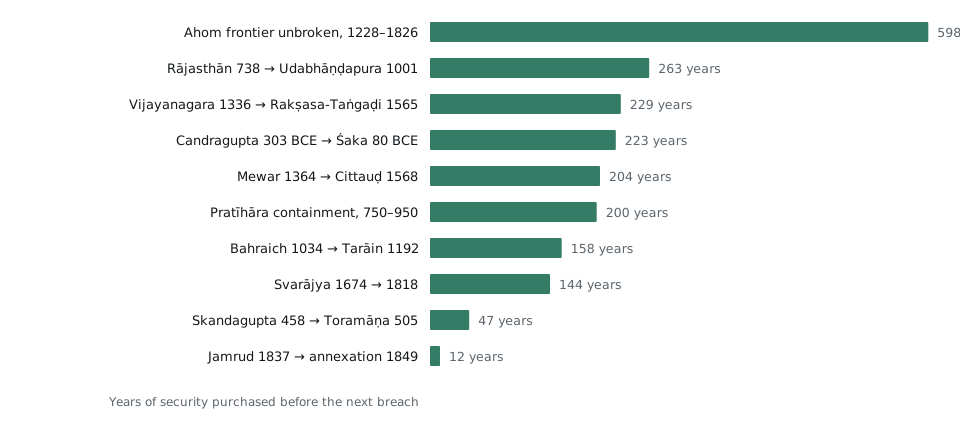
Years of security purchased by each successful defence
| Defence | Held until | Years bought |
|---|---|---|
| Ahom frontier established, 1228 | Burmese and British, 1826 | 598 |
| Battle of Rājasthān, 738 | Udabhāṇḍapura, 1001 | 263 |
| Vijayanagara founded, 1336 | Rakṣasa-Taṅgaḍi, 1565 | 229 |
| Candragupta's settlement, 303 BCE | Śaka invasions, c. 80 BCE | 223 |
| Mewar recovered, 1364 | Cittauḍ, 1568 | 204 |
| Pratīhāra containment of Sindh, 750 | The Ghaznavid breach, 950s | 200 |
| Bahraich, 1034 | Tarāin II, 1192 | 158 |
| Rājyābhiṣeka, 1674 | Third Anglo-Maratha War, 1818 | 144 |
| Skandagupta, 458 | Toramāṇa, 505 | 47 |
| Jamrud, 1837 | Annexation, 1849 | 12 |
Chains of Consequence
Four defeats in this register produced restorations, and the causal links are short enough to be traced. One produced nothing at all.
Defeats that produced restorations, and the one that did not
| The defeat | What followed | The restoration | Interval |
|---|---|---|---|
| Kampili falls, 1327 | Two captives taken to Dillī and sent back south | Vijayanagara founded, 1336 | 9 years |
| Guru Tegh Bahādur executed, 1675 | The Khālsā raised, 1699 | Sirhind taken, 1710 | 35 years |
| Sambhājī Mahārāj martyred, 1689 | The war becomes general across the Dakṣiṇāpatha | Aurangzeb dies with the Deccan unconquered, 1707 | 18 years |
| Imphal and Kohima lost, 1944 | The Red Fort trials and the naval mutiny, 1945–46 | The British leave, 1947 | 3 years |
| Nālandā, Odantapurī and Vikramaśilā burned, 1198 | — | — | — |
The last row is the point of the table. Territory taken can be retaken, and in this register it repeatedly was. Dynasties destroyed are replaced. A continuous institutional transmission of learning nine hundred years old, with its libraries, its teaching lineages and the men who held the reading tradition, has no second link. Settled Parts of the Nālandā corpus survive today only in Tibetan translation, carried into the Himalaya by scholars who ran.
Bibliography and Apparatus
Epigraphic and primary Indian sources
Corpus Inscriptionum Indicarum, vols. I–V (Fleet on the Guptas; Mirashi on the Vākāṭakas). D.C. Sircar, Select Inscriptions Bearing on Indian History and Civilization, 2 vols., and Indian Epigraphy. Epigraphia Indica and South Indian Inscriptions, various volumes. Specific inscriptions cited above include the Prayāga praśasti of Hariṣeṇa, the Bhitarī and Junāgaḍh inscriptions of Skandagupta, the Sondani pillars of Yaśodharman, the Aihole praśasti of Ravikīrti, the Nāsik praśasti of Gautamī Balaśrī, the Junāgaḍh rock inscription of Rudradāman I, the Hāthīgumphā inscription of Khāravela, the Gwalior praśasti of Bhoja I, the Navsari plates of Avanijanāśraya Pulakeśin, the Vilasa grant of Prolaya Nāyaka, and the Kannada inscription of Vikramāditya II on the Kailāsanātha at Kāñcī.
Literary and chronicle sources: Kauṭilya's Arthaśāstra; Viśākhadatta's Mudrārākṣasa; Kālidāsa's Mālavikāgnimitram; Patañjali's Mahābhāṣya; the Gārgī Saṃhitā; Bāṇa's Harṣacarita; Kalhaṇa's Rājataraṅgiṇī (Stein trans.); Bilhaṇa's Vikramāṅkadevacarita; Gaṅgādevī's Madhurāvijayam; Nayacandra Sūri's Hammīra-mahākāvya; Merutuṅga's Prabandhacintāmaṇi; the Puṟanāṉūṟu and Maturaikkāñci; the Koil Olugu of Śrīraṅgam; the Kāmarūpa Buranjis; the Jedhe Shakavali, the Sabhāsad Bakhar and the Bhāʾū Sāhebāncī Bakhar; the Rājyavyavahārakośa; Guru Gobind Singh's Bachitra Nāṭak and Zafarnāma; Sainapati's Srī Gur Sobhā; Sohan Lal Suri's ʿUmdat al-Tawārīkh.
Persian, Arabic and foreign sources
Al-Balādhurī, Futūḥ al-Buldān. Ṭabarī, Tārīkh. The Chachnāma. Al-Bīrūnī, Kitāb fī Taḥqīq mā li'l-Hind (Sachau, Alberuni's India). Al-ʿUtbī, Tārīkh-i-Yamīnī. Sulaiman's Silsilat-al-Tawarikh and Al-Masudi's Muruj-al-Dhahab. Minhāj-i-Sirāj, Ṭabaqāt-i-Nāṣirī (Raverty). Ḥasan Niẓāmī, Tāj-ul-Maʾāsir. Amīr Khusrau, Khazāʾin al-Futūḥ. Ẓiāʾ al-Dīn Baranī, Tārīkh-i-Fīrūz Shāhī. Ibn Baṭṭūṭa, Riḥla. Firishta, Tārīkh-i-Firishta (Briggs). Bābur, Bāburnāma (Beveridge; Thackston). Abul Fazl, Akbarnāma and Āʾīn-i-Akbarī. Badāʾūnī, Muntakhab al-Tawārīkh. Khāfī Khān, Muntakhab al-Lubāb. Sāqī Mustaʿid Khān, Maʾāsir-i-ʿĀlamgīrī. Bhimsen, Tārīkh-i-Dilkashā. Shihābuddīn Ṭālish, Fatḥiyya-i-ʿIbriyya. Ghulam Husain Khan, Siyar-ul-Mutakherin. Elliot and Dowson, The History of India as Told by Its Own Historians, 8 vols. — the standard compendium of these chronicles in translation, to be used with awareness of its editorial framing.
Greek, Chinese and European: Arrian, Anabasis; Curtius Rufus; Diodoros; Plutarch; Strabo; Justin's epitome of Trogus; Megasthenes' Indika in fragments; Herodotos III. Fa-Hien (Legge) and Hiuen Tsang (Beal). Paes and Nuniz in Sewell; Correia and Barros for the Portuguese; the VOC and East India Company records; Manucci's Storia do Mogor (Irvine).
Standard modern scholarship
R.C. Majumdar (gen. ed.), The History and Culture of the Indian People, 11 vols. — the register's principal frame of reference throughout. H.C. Raychaudhuri, Political History of Ancient India. R.K. Mookerji, Chandragupta Maurya and His Times. A.K. Narain, The Indo-Greeks. Upendra Thakur, The Hūṇas in India. K.A. Nilakanta Sastri, A History of South India and The Cōḷas. Baij Nath Puri, The History of the Gurjara-Pratīhāras. A.S. Altekar, The Rāṣṭrakūṭas and Their Times. Robert Sewell, A Forgotten Empire. Burton Stein, Vijayanagara. N. Venkataramanayya, The Early Muslim Expansion in South India. G.H. Ojha, Rājputāne kā Itihās. Jadunath Sarkar, History of Aurangzib (5 vols.), Shivaji and His Times, and Fall of the Mughal Empire (4 vols.). G.S. Sardesai, New History of the Marathas (3 vols.). Grant Duff, A History of the Mahrattas. Ganda Singh, Life of Banda Singh Bahadur and Ahmad Shah Durrani. Hari Ram Gupta, History of the Sikhs. Khushwant Singh, A History of the Sikhs. Edward Gait, A History of Kāmarūpa; S.K. Bhuyan, Lachit Barphukan and His Times. A.K. Priolkar, The Gomāntaka Inquisition. K.M. Panikkar, Asia and Western Dominance. Sita Ram Goel, Hindu Temples: What Happened to Them, 2 vols. Nicholas Dirks, Castes of Mind. Sumit Sarkar, Modern India 1885–1947. Srinath Raghavan, 1971: A Global History. The official histories of the Ministry of Defence for 1947–48, 1962, 1965 and 1971, and the Kargil Review Committee Report.
A closing note on completeness. This register runs to roughly a hundred and ninety entries and it is still not complete, and the omission is in the archive and in the compiler, not in the record of what was given. The Sangam-age wars survive largely in poetry and their sequence is not firm. The Ahom, Kachari, Manipuri and Tripuri wars deserve a register of their own; the Ahoms fought the Mughals many more times than appear here. The Cōḻa naval campaigns could carry a separate study. Above all, the adivasi risings against the Company and the Crown run to hundreds and appear here as a dozen — they are under-recorded in the accessible sources, not under-fought, and naming that gap is the least this register can do about it.
Every register is an argument about what counts. The argument of this one is in the fourth column, and it is this: Bhārata was not conquered because it was weak. It was conquered on the days when it was divided, when it released a beaten enemy, or when it had spent its strength on itself. Rājasthān in 738 and Tarāin in 1192 were fought by comparable civilizations with comparable armies. What differed was that in 738 three houses combined, and in 1191 one house let its prisoner go.
That is not a consoling conclusion and it is not meant to be. It is, however, the one the sources support.