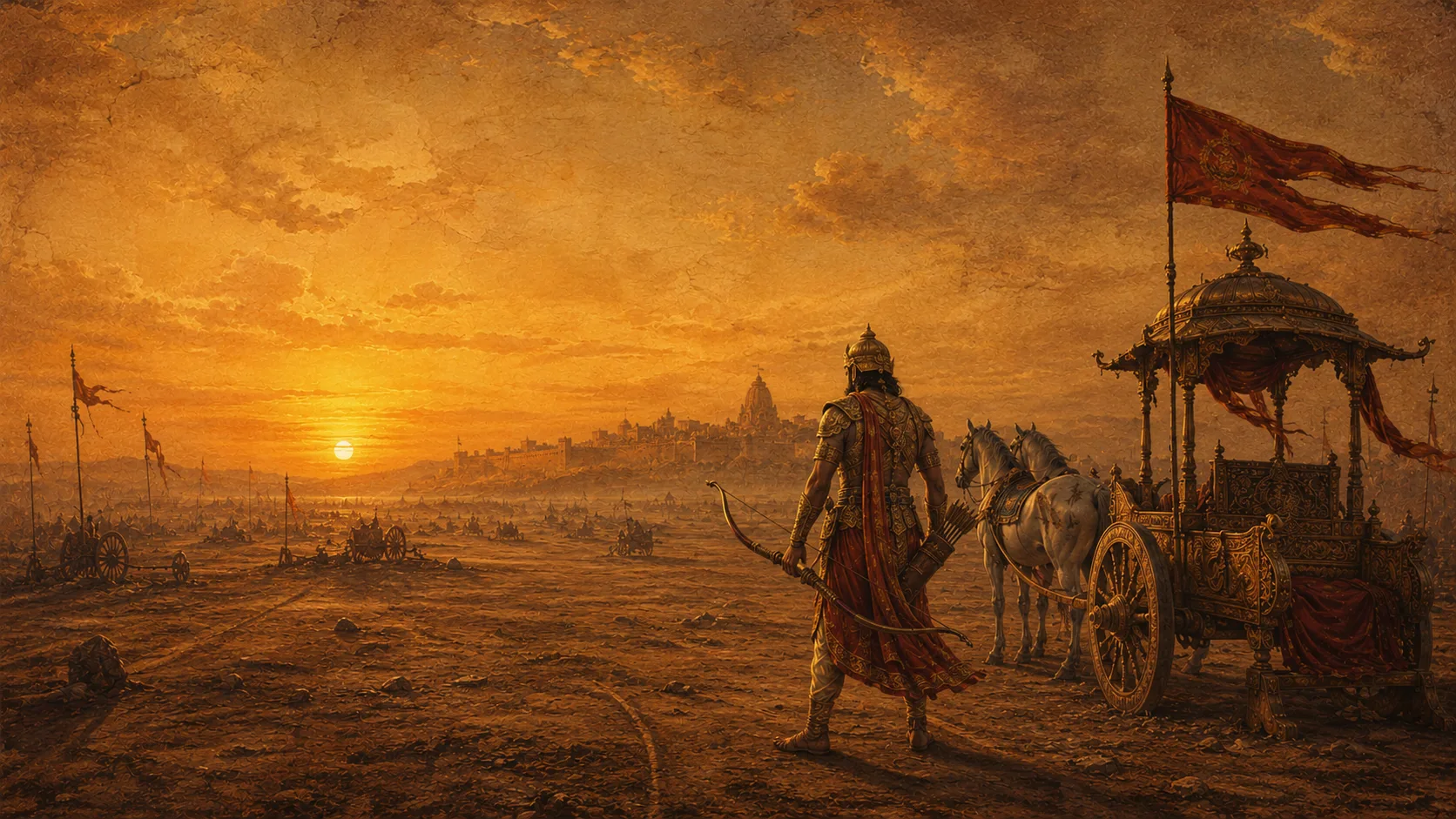
The Question Asked Without Flinching
There is a question that any honest reflection on the long history of Bhārata must be willing to ask, and to ask without comfort: if our tradition of war was as restrained, as disciplined, as governed by dharma as the sources plainly say it was, then why did this land suffer defeat after defeat at the hands of those who honoured none of these restraints?
The triumphal answer — that we were simply nobler — explains nothing, because nobility that loses its temples, its kings, and its people is a strange thing to celebrate alone. The contemptuous answer — that we were weak, divided, otherworldly — is refuted by three thousand years of ferocious resistance: by the Gurjara-Pratihāras who held the western gate for three centuries, by Lalitāditya, by Vijayanagara, by the Marāṭhā confederacy, by the Ahoms of the east who never fell. Neither answer takes the actual structure of yuddhanīti seriously, and so neither answer is true.
This essay sets out that structure in its own words — the verses, the itihāsa, the śāstra — and then confronts the asymmetry that turned a moral achievement of the highest order into a strategic wound. The conclusion is neither despair nor self-congratulation. It is harder than both.
What Dharma-yuddha Was
The tradition draws a sharp line between two kinds of war. There is dharma-yuddha, righteous war fought openly between acknowledged equals under known rules, and there is kūṭa-yuddha, war by stratagem, ambush, deceit. The Manusmṛti, in the seventh adhyāya on rājadharma, opens the subject by forbidding the very class of weapon that strikes from concealment, and makes the king's duty in open battle a matter of explicit prohibition — a list of those he must never strike.
The prohibition of the poisoned and the fire-tipped arrow is striking: the tradition forbids not only dishonourable targets but dishonourable means — the weapon that maims beyond the clean wound, that kills the man who might otherwise have surrendered or been spared. The list of forbidden targets follows directly.
The list continues, and its logic is unmistakable.
The principle behind the whole catalogue is singular: lethal force is licensed only against an active combatant capable of reciprocity. The moment a man steps outside that condition — disarmed, supplicating, fled, seated, surrendered, looking the other way — the licence to strike him ends. This is not gallantry. It is a definition of what a king is permitted to be. To kill outside it is not victory; it is the forfeiture of the very dharma that makes one a king.
And the Manusmṛti completes the picture by promising that the warrior loses nothing by this restraint — that the kṣatriya who falls facing the foe, fighting by the rules, attains the highest reward, while the one who breaks them is degraded.
The reward attaches to the aparāṅmukha — the one who does not turn his face away. To stand and face the enemy is itself the dharma; the prohibition on striking the fled is the mirror of the honour of not fleeing.
The earth is to be enjoyed by the brave — but the brave forfeits the earth the instant he strikes the supplicant.
Every element of the code you can name flows from this one root.
Combat Between Equals — The Rathī and the Rest
The convention that a chariot-warrior fights a chariot-warrior, an elephant-rider his equal, a horseman a horseman, a foot-soldier a foot-soldier, is the institutionalisation of reciprocal risk. The Mahābhārata states the rule of engagement directly in the Bhīṣma-parva, as the armies set their terms on the eve of Kurukṣetra.
The combatants at Kurukṣetra openly agree the samaya, the covenant of battle: one who has withdrawn, one whose weapon has broken, one who is afraid and turns away, one who is unarmoured — none of these is to be struck. A rathī does not ride down a man fallen on the floor. The warrior who strikes downward across the gradient of advantage wins the kill and loses yaśas — glory — which in the heroic economy is worth incomparably more than the corpse. The whole point of the contest was that it be worthy; an unworthy kill subtracted from the killer.
The tradition also fixes the hours of war. Battle is fought between sunrise and sunset; when the conch sounds the day's end, weapons are laid down, and by night the two camps mingle without fear.
The single most consequential breach of this entire code in all of itihāsa is the night that follows the death of Duryodhana — Aśvatthāmā's sauptika, the slaughter of the sleeping in the dark. The Mahābhārata does not present it as a clever victory. It devotes an entire parva, the Sauptika-parva, to marking it as a horror, an act for which Aśvatthāmā is cursed to wander disfigured for three thousand years. The tradition condemns the night-massacre in the strongest terms it possesses. That condemnation is itself the doctrine.
Śaraṇāgati — Refuge, Even for the Enemy
The deepest principle of the code is śaraṇāgati — that one who comes seeking refuge, who surrenders himself and says "I am yours," is to be protected absolutely, even if he comes from the enemy's own camp. This is not a battlefield courtesy. It is a vow that touches the foundation of kingship and of dharma itself.
The supreme exemplar is Rāma's acceptance of Vibhīṣaṇa. Vibhīṣaṇa is Rāvaṇa's own brother, a rākṣasa, arriving across the ocean from the enemy capital at the very threshold of war. Sugrīva and the vānara counsel suspicion — he may be a spy, send him away, even kill him. Rāma overrules them all with one of the most luminous declarations in the whole Rāmāyaṇa.
Rāma goes further, and states the principle as a universal law of the righteous, binding even when the suppliant is a declared foe.
Here is the heart of yuddhanīti: the circle of protection extends across the enemy line. Vibhīṣaṇa is received, crowned king of Laṅkā even before the war is won, and the vow is never broken. The suppliant who surrenders the self is no longer an enemy — he is one placed under the protector's dharma, and to violate that protection is to unmake oneself.
Pardon for the Defeated — Even Rāvaṇa
The code does not merely spare the suppliant; it holds the door of pardon open to the adversary until the very last, on the single condition that he turn from his wrong. The clearest instance is Rāma's message to Rāvaṇa after the first day's defeat, when Rāvaṇa stands disarmed and humiliated on the field, his bow shattered, his chariot broken.
Rāma does not kill him. He sends him home.
This is the same gesture that recurs throughout itihāsa: the defeated is given the night, given his life, given the chance to recover his honour and fight again as an equal — or to accept his wrong and be received. The door to kṣamā, forgiveness, stays open. Rāvaṇa's destruction comes not because the door was shut against him but because he himself refused, again and again, to pass through it — refused to return Sītā, refused to acknowledge adharma, chose annihilation over correction. The tradition is exact about this: the righteous king extends pardon; the destruction of the one who refuses it falls on his own head.
The dharmic conqueror does not seek the death of his enemy. He seeks the end of the enemy's adharma. If the man will part from his wrong, the man is spared.
The Inviolable — Women, the Wounded, the Fallen
No principle is held more absolutely than the inviolability of women, and of the non-combatant population, in victory and defeat alike. The Mahābhārata's Śānti-parva, in Bhīṣma's instruction to Yudhiṣṭhira on rājadharma, is unambiguous about who lies wholly outside the reach of the sword.
The Arthaśāstra of Kauṭilya — the coldest, most clear-eyed text in the whole tradition, a manual of statecraft that contemplates espionage, assassination, and total war — nonetheless lays down with the force of law the conqueror's duty in the captured country: to harm the women of the defeated is among the gravest of crimes.
This is the line that the dharmic theory of conquest draws and never crosses: the queens of the defeated king are not spoils. The women of the conquered city are not spoils. There is no triumph that includes the violation of women — such an act is not a permitted excess of victory but the very mark of the asura, the demon, whose conquest the śāstra names asura-vijaya precisely to place it outside dharma. The wounded man, the man who has thrown down his arms, the man stricken with grief or fear — all are rakṣya, to be protected, not killed.
The Yājñavalkya-smṛti, the other great pillar of the dharma-śāstra beside Manu, repeats the same engagement-law in its own words, confirming that this was not the idiosyncrasy of one text but the settled mind of the tradition.
The Three Conquests — Why the Kingdom Was Not Sacked
The Arthaśāstra classifies victory itself into three kinds, and this classification is the key to the entire civilisational pattern.
The three modes of conquest in Kauṭilya's Arthaśāstra
| Conquest | Sanskrit | What the victor takes |
|---|---|---|
| Righteous conquest | dharma-vijaya | Submission and acknowledgment only; the defeated king keeps throne, realm, gods, and life |
| Greedy conquest | lobha-vijaya | Land and treasure; the defeated is plundered but the order stands |
| Demonic conquest | asura-vijaya | Land, treasure, and the persons, dignity, women, and gods of the conquered — total subjugation |
The dharmic ideal is the dharma-vijaya. The righteous conqueror, having won, is satisfied with submission. The defeated king — or, if he has fallen, his son and heir — is very often reinstated upon his own throne as a sāmanta, a feudatory who keeps his kingdom, his deities, his customs, and his life, owing now only tribute and the acknowledgment of a paramount lord. This is the meaning of the maxim vīra-bhogyā vasundharā — "the earth is to be enjoyed by the brave." The prize of the brave is suzerainty, the apex of the pyramid. Not the annihilation of the loser's world.
Here is the institutional fact that decides everything: the dharma-vijaya was a tournament for the top of a pyramid that otherwise stayed standing. Kingdoms changed their apex; the temple kept its lamp lit, the cultivator kept his field, the agrahāra kept its recitation, the local order persisted unbroken beneath the change of overlord. For the masses and for the defeated dynast alike, war was — in the deepest sense — business as usual. The defeated king was still a king, perhaps now a sāmanta, but a king. The world below him did not end.
The Other Doctrine of War
To set this code beside the one that prevailed against it is not polemic; it is the necessary comparison, and it must be done with the same care for sources that the rest of this essay demands. The point is not to caricature an adversary but to locate, precisely, the structural difference that decided so many fields — and that difference lies in the boundary of the moral community, in who is held to be inside the circle of protection and who is placed outside it.
Settled The juristic tradition that accompanied the conquests divided the world, for the purposes of war, into the dār al-Islām — the domain of submission to the faith — and the dār al-ḥarb — literally the "domain of war," the territory not yet brought under that order. This is a category with no equivalent in yuddhanīti. The dharmic theory knew the rival king, the ari, the śatru — a fellow participant in ṛta even as a foe. It had no concept of an entire land defined as a standing object of religious war by virtue of not yet having submitted. The two doctrines are not two flavours of the same thing; they answer different questions. Yuddhanīti asks: who, on this field, may I righteously strike? The doctrine of jihād in its classical juristic elaboration asks a prior question: against whom is war itself a standing obligation until submission is achieved?
Within that frame, the classical jurists worked out detailed rules for the conquered: the choice, for those outside the protected "peoples of the book," between acceptance of the faith, death, or — where the dispensation of dhimma was extended — survival as a subordinated, tribute-paying community under the jizya, the poll-tax that marked and enforced that subordination. The treatment of temples and idols followed from the same theology: where yuddhanīti commanded the conqueror to uphold the worship of the gods of the conquered land (the Arthaśāstra's explicit instruction, quoted above), the opposing doctrine in its expansionist register treated the idol-temple not as collateral damage but as a primary object — the destruction of which was itself a meritorious act, recorded with pride in the chronicles as a service to the faith.
The asymmetry is exact and worth stating plainly. The Arthaśāstra orders the victor: deva-brāhmaṇa-pūjāṃ ca anuvarteta — "let him maintain the worship of the gods and the honouring of the learned" of the defeated. The opposing doctrine, in its conquest register, recorded the demolition of those same gods' houses as the central achievement of the campaign. One theory protects the loser's sacred order as a matter of the victor's own dharma; the other targets it as a matter of the victor's own dharma. They are mirror images — and a code built entirely around the first cannot, by its own logic, even imagine the second until it has already happened.
This must be said with one essential qualification, or it becomes the very caricature this essay refuses. The juristic tradition was vast, internally contested, and far from uniform in practice. There were rulers within it who extended protection, who patronised temples, who governed plural populations with restraint; there were jurists who narrowed the war-doctrine and emphasised its conditions and limits. Conduct on the ground ranged from coexistence to catastrophe, and varied by ruler, region, and century. The argument here is not that every adversary behaved as the harshest doctrine permitted — manifestly they did not. The argument is narrower and harder to escape: Polemical that the permission existed, that the destruction of the sacred order was doctrinally available and at times doctrinally praised, and that a civilisation whose own theory of war declared such a thing literally unthinkable had built no wall against the adversary who did think it. You cannot defend against a blow your entire moral universe says cannot be struck.
What the Chronicles Record
The strongest evidence is not theological but documentary, and much of it comes from the conquerors' own historians, writing in praise — which is precisely what makes it unanswerable. These men were not hostile witnesses inventing atrocities; they were court chroniclers recording, as glory, what their patrons had done.
Settled Al-Bīrūnī, the great Persian polymath who came to India in the train of Maḥmūd of Ghazni in the early eleventh century, is the most valuable witness because he was no propagandist — he admired much of what he found, learned Sanskrit, and studied the sciences of the land with genuine respect. It is exactly his fairness that gives weight to his testimony about the effect of the campaigns. He records that Maḥmūd utterly ruined the prosperity of the country, that the Hindus became like atoms of dust scattered in all directions, and that they conceived a deep and lasting aversion toward all foreigners as a result — an estrangement, he notes, that made his own scholarly work harder. This is a sympathetic observer describing the social wreckage left by the raids in plain terms, in a scientific treatise, with nothing to gain by exaggeration.
Settled Al-Utbī, Maḥmūd's own secretary and court historian, wrote the Tārīkh-i-Yamīnī (also called the Kitāb-i-Yamīnī) as a celebration of his master's reign. He records the sack of temple-cities and the slaughter and enslavement of their populations not with regret but as triumphs of the faith — the breaking of idols, the conversion of temples, the carrying-off of vast numbers into slavery, all set down as merit. The repeated campaigns against Somnāth and the great temple-towns are narrated in this register: the destruction of the idol as the campaign's crowning purpose and proudest result.
Settled Minhāj-i-Sirāj Jūzjānī, author of the Tabaqāt-i-Nāsirī in the thirteenth century, is the principal chronicle for the Ghurid conquests and the early Delhi Sultanate. He records the conduct of campaigns across northern India — the storming of cities, the treatment of the defeated, the sack of the great seat of learning at the eastern monasteries (the destruction associated with the campaigns of Bakhtiyār Khaljī, in which the libraries and the monastic community of the Magadha region were put to the sword and the books burned). Again the register is one of religious achievement, not lament.
Settled Ferishta (Muḥammad Qāsim Hindū Shāh), writing his great history in the early seventeenth century, compiled and transmitted these earlier accounts and added the campaigns of the later sultanates, including the Deccan wars against Vijayanagara. His narration of the aftermath of Talikoṭā in 1565 — the systematic, months-long destruction of the imperial city of Vijayanagara, one of the largest and richest cities in the world at that hour, reduced to the ruin-field we call Hampi — is the documentary record of an asura-vijaya in the precise technical sense the Arthaśāstra defined: not the replacement of a dynasty but the deliberate annihilation of a civilisational centre, its temples, its markets, its waterworks, its people.
A word on using these sources. They are quoted here for what they celebrate, not for what they were forced to confess — and that is the point. When a court historian records the destruction of temples and the enslavement of populations as the glory of his patron, the historian is the most reliable witness possible, because he has every motive to record it accurately and none to invent it. The modern instinct to soften or explain away these passages does a double disservice: it disbelieves the chroniclers about their own pride, and it erases the dead. The dignified course is to take the chroniclers at their word — about both the conduct and the doctrine that licensed it — while refusing the opposite error of pretending the entire history was nothing but this. It was not. But this was in it, repeatedly, and it was written down by the men who did it.
Set the two records side by side and the asymmetry is no longer an abstraction. On one side, a king's manual that orders the victor to protect the gods and women and customs of the people he has just defeated. On the other, a court chronicle that records the destruction of those gods and the enslavement of those people as the campaign's crowning merit. This is the discontinuity in the rules of the game that the next section anatomises — and the reason a civilisation that fought by the first record kept losing to adversaries operating by the second.
The Asymmetry, Named
Now the tragic question can be put with precision. If this code was so humane and so stable, why did it fail against the invasions that came through the western passes and, later, settled as sultanates? The failure has three layers, and none of them is a failure of courage.
First — the code optimised for an opponent who shared it
When two dharma-bound kings fought, the system was elegant, humane, and stable — stable precisely because the restraints were reciprocal. A king spared the enemy's queens because his own queens would be spared. He reinstated the defeated as sāmanta because the same convention would protect his own line in the hour of his defeat. The whole apparatus was a repeated contest among players who expected to meet again under the same rules. Restraint was not only righteous; it was rational, because it was reciprocated.
Against an adversary who did not share the code and would never reciprocate, every single restraint became a unilateral disadvantage that returned nothing. The rule against the night attack, against pursuing the fled, against striking the unequal, against the ambush — each was now a gift pressed into the hand of an enemy who took it and gave nothing back.
Second — the code never imagined the destruction of the sacred order, and so built no wall around it
This is the deeper wound. A dharma-vijaya system cannot conceive that victory might mean the systematic demolition of temples, the carrying-off of populations, the forced erasure of a people's gods and law and sacred landscape. Why would it raise defences against a thing its own theory of war declared outside dharma and therefore unthinkable? The dharmic theory of conquest protected the king and the combatant; it never developed a doctrine for the adversary whose victory-condition was not the replacement of a rival dynasty but the annihilation of a civilisation's symbolic universe — for whom the temple was not collateral damage but the objective itself. Against an enemy aimed at the gods rather than the throne, a code that guarded only thrones left the gods undefended.
Third — and cruellest — the code could not learn fast enough
Civilisational ethics carry enormous inertia, and that inertia is ordinarily a virtue — it is exactly what keeps a society from throwing away its principles the moment they become inconvenient. But it meant that the lesson — this enemy does not play this game — had to be relearned in blood, dynasty after dynasty, kingdom after kingdom, because each defeated polity was local and each new generation inherited the prestige-economy of restraint without inheriting the memory of the catastrophe. Contested The story the tradition itself tells of the conqueror released after defeat, who returns to destroy the one who released him, is the parable of this exact wound — the tradition diagnosing, in narrative, its own structural injury.
Why Doing Everything Right Was the Trap
Here is the core, stated without consolation. The kingdoms of Bhārata were not overrun despite their ethics. In a specific, limited, but real sense they were overrun through them — not because the ethics were wrong, but because the ethics were non-portable across a discontinuity in the rules of the game.
A code of restraint is a form of cooperation, and cooperation is stable only when defection is punished. The dharmic order had powerful machinery to punish a king who fought without honour — the loss of yaśas, the loss of legitimacy, the censure of the learned, exclusion from the company of the dhārmic. But these were sanctions internal to the civilisation. They had no purchase whatever on an adversary from outside it, who did not seek standing in the Sanskrit cosmopolis and could not be shamed by the judgment of the learned. The enforcement mechanism and the enemy lived in two different worlds.
And so the very thing that made the system humane — that it was self-enforcing through shared values — was the thing that left it defenceless, because shared values were the precondition of the entire structure, and the invader did not share them. This is not a failure of valour. The military record across three millennia refutes that charge utterly. It is a failure of theory — the absence, in the later dominant strand of rājadharma, of a developed doctrine for the non-reciprocating, civilisation-targeting adversary.
It is worth marking that the tradition had the antidote and let it fall into shadow. The Arthaśāstra begins not from chivalry but from mātsya-nyāya — the law of the fishes, where the great devour the small unless restrained by power — and it contemplates without flinching the spy-state, deception, the striking of enemy leadership, the manipulation of the foe who will not fight fair. Kauṭilya's world is colder and clearer precisely because it assumes the worst of the adversary. Part of the tragedy of the later medieval centuries is the eclipse of that cold clarity by a more idealised, more chivalric, and ultimately more brittle synthesis.
The Boundary of the Moral Community
The contrast with the conquest-doctrines that prevailed against Bhārata must be stated exactly, because the romantic version overstates it and the cynical version dissolves it.
No society practises total restraint, and the invaders' codes were not simply formless savagery — they had their own honour, their own law, their own protections. The real difference lay not in restraint versus its absence. It lay in the boundary of the moral community — in who counted as falling inside the circle of protection.
The dharmic conception, for all its hierarchy, drew that circle wide. It extended battlefield protection to the enemy soldier, the enemy king, the enemy's women, the enemy's gods — because the foe, even as foe, was a fellow participant in ṛta, the cosmic and social order. The conquest-theories that prevailed against this land drew the circle tight, around the in-group, and placed the religious and civilisational other outside it — in the zone where the protections lapsed and where the destruction of the other's sacred order became not a crime but a sanctioned act.
When a wide circle meets a narrow circle on the field, and the narrow circle wins, the result is not a mere change of dynasty. It is precisely the thing the wide circle's theory had declared impossible.
The Reckoning — Neither Despair Nor Vindication
It would betray the subject to end in either of the two easy places.
The despairing reading says: ethics is for losers, and the world belongs to those who will do anything. This is false, and the long arc disproves it. The civilisation that produced yuddhanīti was not extinguished. It absorbed, outlasted, resisted, and reconstituted itself — at Vijayanagara, under Śivājī and the Marāṭhā confederacy, in the unbroken Ahom northeast, in the very survival of the textual tradition we are reading at this moment. A code that loses battles can still win the millennium, because the thing it guards — the cultivator's field, the temple's continuity, the unbroken transmission of the Veda — has a resilience that no single conquest can exhaust.
The vindicating reading says: our defeats are the proof of our virtue, and virtue is its own sufficient reward. This is too comfortable, and it dishonours the dead. The temples that fell were real. The catastrophe was real. A tradition that takes itself seriously must be able to say: here our theory of war was incomplete; here we did not develop the rājadharma the hour demanded; here the failure to read the adversary truly was paid for by the innocent. The Arthaśāstra knew this. Part of the work of the present is to recover that clear sight without surrendering the ethical core that made the civilisation worth defending in the first place.
That is the real teaching of yuddhanīti, and it is not a soft one. Restraint must be matched to the adversary one actually faces — not to the adversary one's ethics wish one faced. A doctrine of war that protects the defeated, that grants refuge to the suppliant enemy, that holds the queen and the child and the unarmed wholly inviolable, is a moral achievement of the highest order. And it must be wedded to a doctrine clear-eyed enough to recognise the foe who will never extend the same protection, and resolute enough to deny him the unilateral advantage of one's own honour.
The tragedy was never that Bhārata was too ethical. It was that its ethics of restraint outran its ethics of prudence — that dharma upon the battlefield was not bound tightly enough to the Arthaśāstra's cold knowledge that the law of the fishes waits always at the gate.
The earth is for the brave. But the brave must also be wise — or the earth passes to those who are merely ruthless, and the field, the temple, and the child pay the difference.
Notes & Sources
Manusmṛti 7.90–93. The catalogue of prohibited targets in dharma-yuddha — concealed, barbed, poisoned, and fire-tipped weapons forbidden; the eunuch, the suppliant with folded hands, the man with loosened hair in flight, the seated, the sleeping, the unarmoured, the disarmed, the onlooker, and the one already engaged all placed outside the reach of the sword. Translation here follows the standard reading of the Bühler and Olivelle editions.
Mahābhārata, Bhīṣma-parva. The samaya or covenant of battle agreed before Kurukṣetra, fixing combat between equals, the laying-down of arms at sunset, and the protection of the withdrawn, the broken-weaponed, and the unarmoured. The verse on equals-against-equals and "word against word" for the mismatched reflects the engagement-rules passages of the parva.
Mahābhārata, Sauptika-parva. Aśvatthāmā's night-slaughter of the sleeping Pāñcāla camp, and its framing by the tradition as an atrocity — the curse of three thousand years' wandering — rather than a stratagem to be admired. The parva is the tradition's own most emphatic condemnation of kūṭa-yuddha by night.
Mahābhārata, Śānti-parva. Bhīṣma's instruction to Yudhiṣṭhira on rājadharma, including the inviolability of the messenger, the woman, the child, the aged, the frightened, and the sleeping.
Vālmīki Rāmāyaṇa, Yuddha-kāṇḍa. The Vibhīṣaṇa-śaraṇāgati sequence (sarga 17–18), containing Rāma's vow sakṛd eva prapannāya ("to the one who has sought refuge but once… this is my vow") and mitra-bhāvena samprāptam ("one who comes in friendship I will never abandon"). The dismissal of the disarmed Rāvaṇa from the first day's field — gaccha anujānāmi ("go, I grant you leave… come again with chariot and bow") — appears in the battle sarga of the same kāṇḍa. Verse numbering follows the Baroda critical and Gita Press editions; minor numbering variation exists across recensions.
Kauṭilya, Arthaśāstra. The threefold classification of conquest — dharma-vijaya, lobha-vijaya, asura-vijaya (Book XII) — and the conqueror's duty in the pacified territory: to refrain from violating the women and seizing the property of the defeated, and to uphold the customs, law, gods, and learned men of the conquered land (Book XIII, on the settlement of the won country). The mātsya-nyāya, the law of the fishes, is the foundational premise of Book I. Passages are paraphrased to their sense; the Sanskrit lines given are representative of the doctrine rather than single fixed pādas, as the Arthaśāstra is prose sūtra.
On vīra-bhogyā vasundharā. A widely transmitted nīti-maxim (śūrāś ca kṛta-vidyāś ca vīra-bhogyā vasundharā), expressing that sovereignty — not annihilation — is the prize of the brave and the learned.
Manusmṛti 7.89–90. The reward of the kṣatriya who fights facing the foe and never turns away (aparāṅmukha), and the opening prohibition of treacherous, barbed, poisoned, and fire-tipped weapons. The numbering of the war-section verses (roughly 7.87–95) varies slightly across editions; the readings here follow the standard Bühler/Olivelle sequence and are given to their settled sense.
Yājñavalkya-smṛti. The engagement-rules verse (a chariot-warrior not to fight a foot-soldier, nor the eunuch, suppliant, loose-haired, seated, or surrendered) appears in the vyavahāra portion and closely parallels Manu 7.91–93, confirming the rule as the shared mind of the dharma-śāstra rather than the position of a single text. Wording given to sense; consult a critical edition for exact pāda numbering before citing the number.
On the juristic categories. Dār al-Islām / dār al-ḥarb, the conditions of dhimma, the jizya, and the classical doctrine of jihād as elaborated by the medieval jurists are presented here in their broad, well-attested outline as found in standard accounts of Islamic legal history (the siyar literature, the law of war and nations). The essay deliberately does not proof-text individual scriptural verses or single juristic rulings — both because the juristic tradition is internally varied and contested, and because the argument rests on the structural availability of the conquest-doctrine, not on any one citation. Readers seeking the primary material should consult the classical fiqh literature on siyar directly and in full context.
Al-Bīrūnī, *Taḥqīq mā li-l-Hind* (Kitāb al-Hind), c. 1030 CE. The observations on the devastation of Maḥmūd of Ghazni's campaigns, the scattering of the population, and the resulting Hindu aversion to foreigners are among the most-cited passages of the work; the standard English reference is Edward Sachau's translation (Alberuni's India, 1888/1910). Paraphrased to sense here, not quoted verbatim. Al-Bīrūnī's value lies precisely in his evident sympathy and scientific detachment.
Al-Utbī, *Tārīkh-i-Yamīnī* (Kitāb-i-Yamīnī), early 11th c. Court history of Maḥmūd of Ghazni by his own secretary, narrating the temple-city campaigns, idol-breaking, slaughter, and enslavement in the register of religious triumph. Transmitted in al-Jurbādhqānī's Persian version and digested in Elliot & Dowson, The History of India as Told by Its Own Historians, Vol. II — a colonial-era compilation to be used with awareness of its editorial framing, but a route to the chroniclers' own words.
Minhāj-i-Sirāj Jūzjānī, *Tabaqāt-i-Nāsirī*, 13th c. Principal chronicle for the Ghurid conquests and early Delhi Sultanate, including the eastern campaigns of Bakhtiyār Khaljī and the destruction of the Magadha monastic centres of learning. Standard English translation by H. G. Raverty (1881).
Ferishta (Muḥammad Qāsim Hindū Shāh), *Tārīkh-i-Ferishta* (Gulshan-i-Ibrāhīmī), early 17th c. Compiles the earlier chroniclers and carries the narrative through the Deccan sultanates, including the destruction of Vijayanagara after Talikoṭā (1565). Standard English translation by John Briggs (1829). The reduction of Vijayanagara is independently attested by archaeology at Hampi and by the Portuguese eyewitness accounts of Domingo Paes and Fernão Nuniz, who saw the city in its prime.
A note on the chronicle sources. These works are cited for what their authors record with approval — the destruction of temples, the enslavement of populations, the breaking of idols as meritorious acts. A court historian celebrating his patron's deeds is, on those deeds, the most credible witness available: every motive to record accurately, none to fabricate. The essay neither extends these particular records to the whole of the period nor softens them; both moves would falsify the evidence — the first by overreach, the second by erasure.
A note on method. Where verse numbering or exact wording varies across recensions and editions, the reading given is the one most widely transmitted and most faithful to the doctrine under discussion. The argument of this essay does not rest on any single contested pāda but on the consistent shape of the whole corpus — smṛti, itihāsa, and nīti-śāstra speaking with one voice on the dharma of the battlefield.